
Market Overview
| Study Period | 2021 - 2031 |
|---|---|
| Market Size (2026) | USD 23.75 Billion |
| Market Size (2031) | USD 41.87 Billion |
| Growth Rate (2026 - 2031) | 12.01 % |
| Fastest Growing Market | Europe |
| Largest Market | North America |
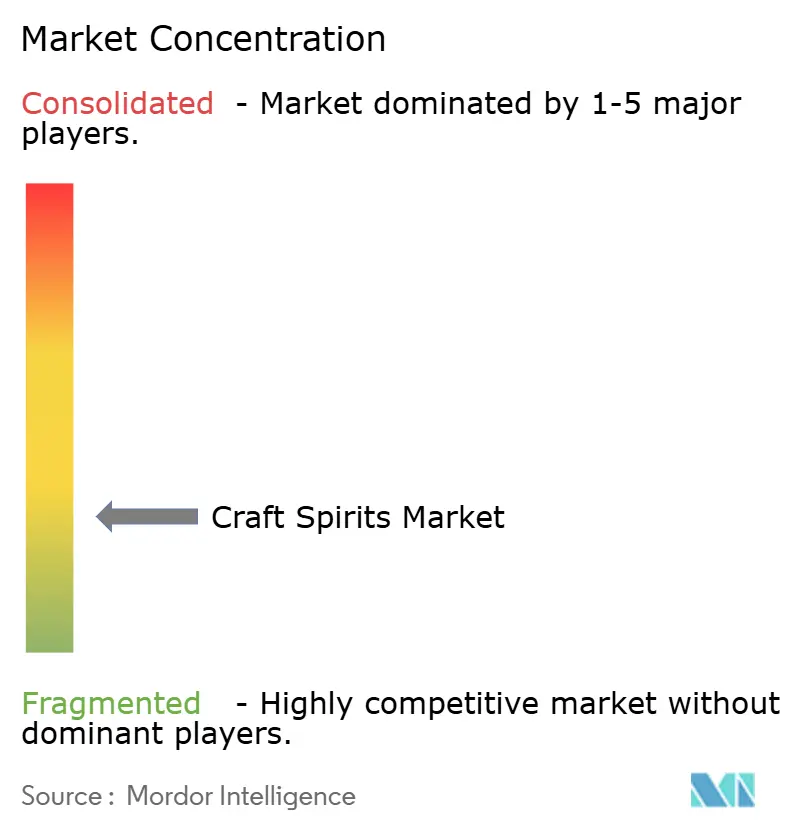
| Market Concentration | Low |
Major Players
*Disclaimer: Major Players sorted in no particular order Image © Mordor Intelligence. Reuse requires attribution under CC BY 4.0. |
|
Craft Spirits Market Analysis by Mordor Intelligence
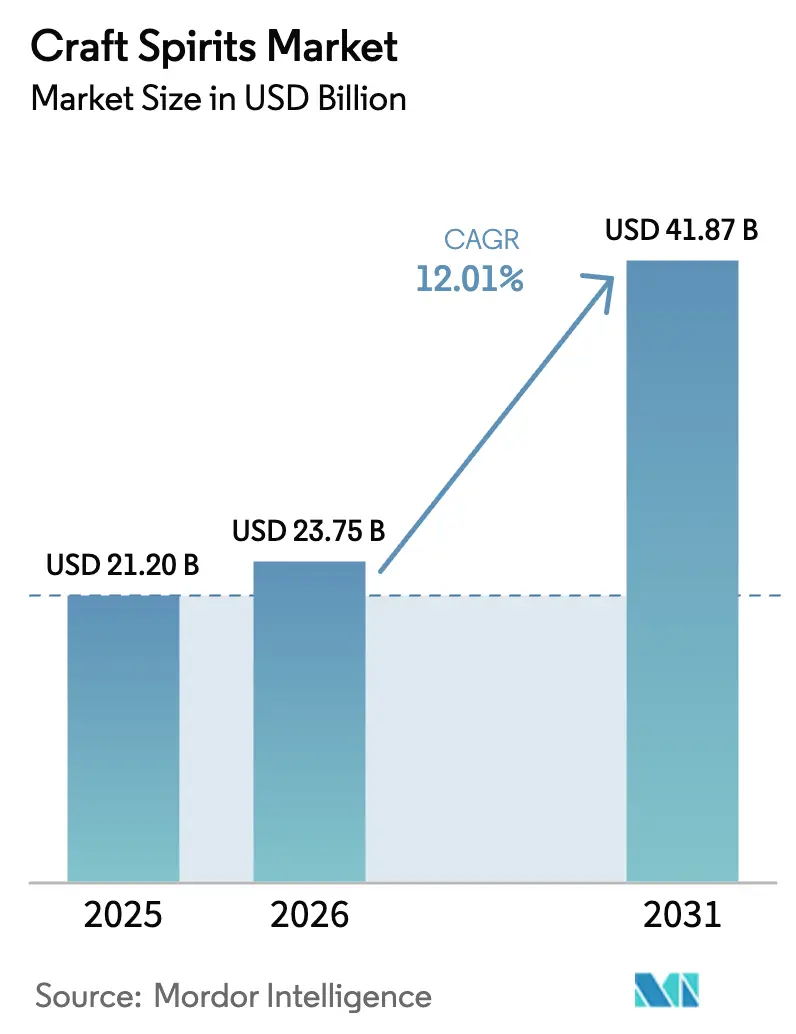
The Craft Spirits Market size is projected to expand from USD 21.20 billion in 2025 and USD 23.75 billion in 2026 to USD 41.87 billion by 2031, registering a CAGR of 12.01% between 2026 to 2031. This growth is driven by changing consumer tastes, new distribution methods, and a growing interest in artisanal products. Whiskey remains the top segment in the market, supported by its global popularity and the trend of premiumization. Craft producers are focusing on creating aged and small-batch whiskey offerings. Gin is growing quickly, especially with its botanical-infused and locally inspired varieties that appeal to younger consumers. Grain-based spirits dominate the market due to their flexibility and traditional uses, while fruit-based spirits are gaining popularity for their regional flavors and sustainable production methods. In terms of distribution, on-trade channels like bars and restaurants generate significant revenue through tasting events and craft cocktails. At the same time, off-trade sales are increasing through convenience stores and direct-to-consumer platforms. North America leads the market, thanks to its established craft ecosystem and supportive regulations for small producers. Europe is also showing strong growth potential, driven by renewed interest in artisanal distilling, government support, and rising demand for local premium spirits.
Key Report Takeaways
- By product type, whiskey led with 26.77% of craft spirits market share in 2025, whereas gin is projected to grow at a 12.25% CAGR to 2031.
- By ingredient, grain-based formulations held 62.88% share of the craft spirits market size in 2025; fruit-based spirits are forecast to expand at a 12.43% CAGR to 2031.
- By distribution channel, the on-trade segment accounted for 58.34% revenue in 2025; off-trade is poised for an 11.95% CAGR through 2031.
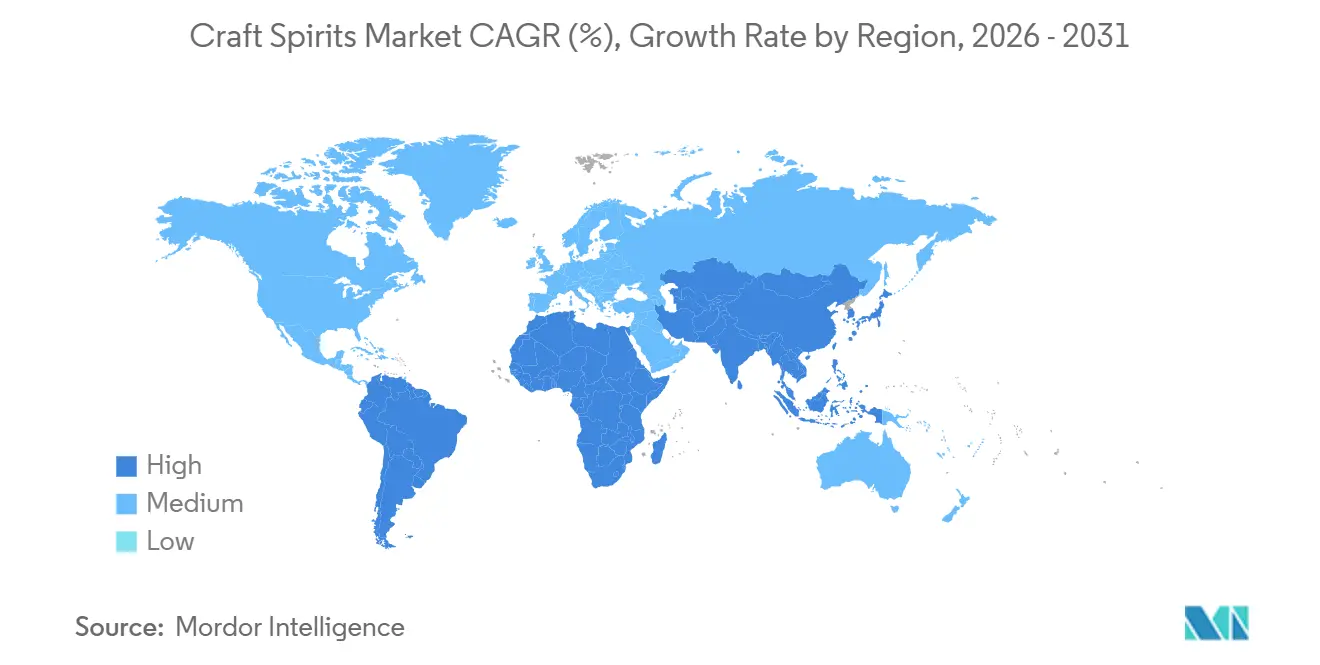
- By geography, North America commanded 38.75% of the craft spirits market size in 2025, while Europe is projected to post the fastest 12.96% CAGR to 2031.
Note: Market size and forecast figures in this report are generated using Mordor Intelligence’s proprietary estimation framework, updated with the latest available data and insights as of January 2026.
Market Trends and Insights
Drivers Impact Analysis of Craft Spirits Market*
| Driver | (~) % Impact on CAGR Forecast | Geographic Relevance | Impact Timeline |
|---|---|---|---|
| Rising number of microbreweries propelling the demand for craft spirits | +3.2% | Global, with concentration in North America and Europe | Medium term (2-4 years) |
| Product differentiation in terms of ingredients and alcohol content | +2.5% | Global, with early adoption in premium markets | Medium term (2-4 years) |
| Surge in demand for premium alcoholic beverages | +3.8% | Global, particularly strong in North America, Europe, and emerging Asian markets | Long term (≥ 4 years) |
| Increasing preference for innovative flavors | +2.1% | Global, with strongest impact in urban centers | Short term (≤ 2 years) |
| Growth of cocktail culture and mixology | +1.9% | Global, with highest concentration in urban markets and hospitality hubs | Medium term (2-4 years) |
| Tourism and experiential marketing | +1.4% | Global, particularly strong in tourism-dependent regions | Long term (≥ 4 years) |
| Source: Mordor Intelligence | |||


Rising Number of Microbreweries Propelling the Demand for Craft Spirits
The growth of microbreweries has established a strong foundation for craft spirits development, as many beer producers have expanded into distillation operations. According to the American Craft Spirits Association, the number of active craft distillers in the United States reached 3,069 by 2024, showing an 11.5% increase despite challenging market conditions. States such as California, New York, Pennsylvania, Texas, and Washington have emerged as major centers for craft production [1]Source: American Craft Spirits Association (ACSA), "Craft Spirits Data Project", americancraftspirits.org. Micro-distilleries are now using fruit fermentation to create unique vodka bases, combining skills from craft brewing and distilling. Improved production capabilities have enabled these producers to offer small-batch and limited-edition products, increasing consumer interest and expanding the market. This trend is expected to continue until 2031.
Product Diffrentiation in Terms of Ingredients And Alcohol Content
Craft distillers are using product differentiation as a key strategy by incorporating unique ingredients and offering varied alcohol content levels. This approach helps them create distinct market positions and attract specific consumer groups. The market is expanding its alcohol content options, as seen in April 2024 when Barrell Craft Spirits launched its first Full Proof Bourbon at 123 proof (61.5% ABV) to meet the demand for stronger flavor profiles. Additionally, the low and no-alcohol spirits segment is growing rapidly. Leading companies like Heineken are planning to achieve a 90% market share in zero-alcohol options by 2025. This strategy addresses the rising demand from health-conscious consumers and changing drinking habits. These trends highlight the industry's focus on meeting diverse consumer preferences.
Surge in Demand for Premium Alcoholic Beverages
The spirits market is growing rapidly due to rising demand for premium alcoholic drinks that highlight quality, authenticity, and brand heritage. Higher disposable incomes and urbanization have encouraged consumers to spend more on luxury spirits, with whiskey, especially Scotch, leading the way. Companies like Diageo and Pernod Ricard have expanded their premium Scotch offerings to meet this demand. The revival of international travel and social events has boosted Scotch exports through duty-free and gifting channels. Scotch whisky holds a strong market share in Asia, North America, and Europe, supported by effective marketing, unique brand experiences, and increasing e-commerce sales. According to the Scotch Whisky Association, the Asia Pacific region held the largest share of Scotch whiskey exports worldwide in 2024, accounting for 29.1% of the export market [2]Source: The Scotch Whisky Association, "Scotch Whisky industry records £5.4bn global exports in 2024, amid 'Turbulent' Global Trading Conditions", scotch-whisky.org.uk.
Increasing Preference For Innovative Flavors
As consumers increasingly seek out innovative flavor experiences, the craft spirits industry is undergoing a significant transformation. In response to this shift, manufacturers are rolling out sophisticated product developments. A prime example is Diageo's introduction of the Smirnoff Spicy Tamarind. Meanwhile, craft distillers are setting themselves apart in a crowded market by infusing botanicals like tahini and white pepper. A growing trend in the industry sees players harnessing local botanicals and fruits, crafting regional variations that resonate with both local and global audiences. A case in point: in August 2024, Johnnie Walker Blue Label unveiled its Elusive Umami variant in India, seamlessly blending umami notes from Japanese cuisine into its Scotch whisky.
Restraints Impact Analysis of Craft Spirits Market*
| Restraint | (~) % Impact on CAGR Forecast | Geographic Relevance | Impact Timeline |
|---|---|---|---|
| Stringent government regulations | -1.8% | Global, with highest impact in highly regulated markets like India and Nordic countries | Long term (≥ 4 years) |
| Consumers' inclination toward low/no-alcohol spirits | -0.9% | Global, particularly strong in North America and Western Europe | Medium term (2-4 years) |
| Supply chain disruptions affecting equipment and packaging | -1.2% | Global, with highest impact in import-dependent regions | Short term (≤ 2 years) |
| Premium pricing of craft spirits faces resistance from price-sensitive consumers | -1.5% | Global, particularly pronounced in emerging markets and during economic downturns | Medium term (2-4 years) |
| Source: Mordor Intelligence | |||
Stringent Government Regulations
The craft spirits industry faces complex regulatory challenges that affect market entry and growth. In the U.S., the three-tier distribution system remains a major hurdle for small producers, though recent changes in regulations have created new opportunities. Despite 85% of craft spirits consumers wanting easier access, only nine states and D.C. currently allow direct-to-consumer (D2C) spirits shipping (Crafted ERP). Trade disputes add further complications, with the U.S. reintroducing steel and aluminum tariffs in Q1 2025, which may lead to a 50% EU tariff on American whiskey, impacting exports (The Whiskey Lab). Additionally, the Tobacco Tax and Trade Bureau (TTB) plans to introduce mandatory "Alcohol Facts" labels. While this will improve transparency for consumers, it will also increase compliance costs for craft producers.
Consumers Inclination Towards low/no Alcohol Spirits
The demand for low-alcohol and alcohol-free beverages is growing, reshaping the craft spirits market with both challenges and opportunities. Diageo's "Distilled 2025" report highlights "zebra striping," where consumers alternate between alcoholic and non-alcoholic drinks at social events. This trend shows a shift as more traditional spirits consumers explore alcohol-free options. Generation Z is at the forefront, focusing on mindful drinking and healthier lifestyles. Changes like the U.S. Surgeon General's warning on alcohol-cancer risks and Ireland's new labeling laws have influenced choices, leading to a 1% drop in traditional alcohol sales in 2024. While this shift challenges traditional craft spirits makers, it also sparks innovation. Craft distillers are responding by creating high-quality non-alcoholic alternatives that retain the elegance and traditions of classic spirits.
*Our forecasts treat driver/restraint impacts as directional, not additive. The impact forecasts reflect baseline growth, mix effects, and variable interactions.
Craft Spirits Market Segment Analysis
By Product Type:
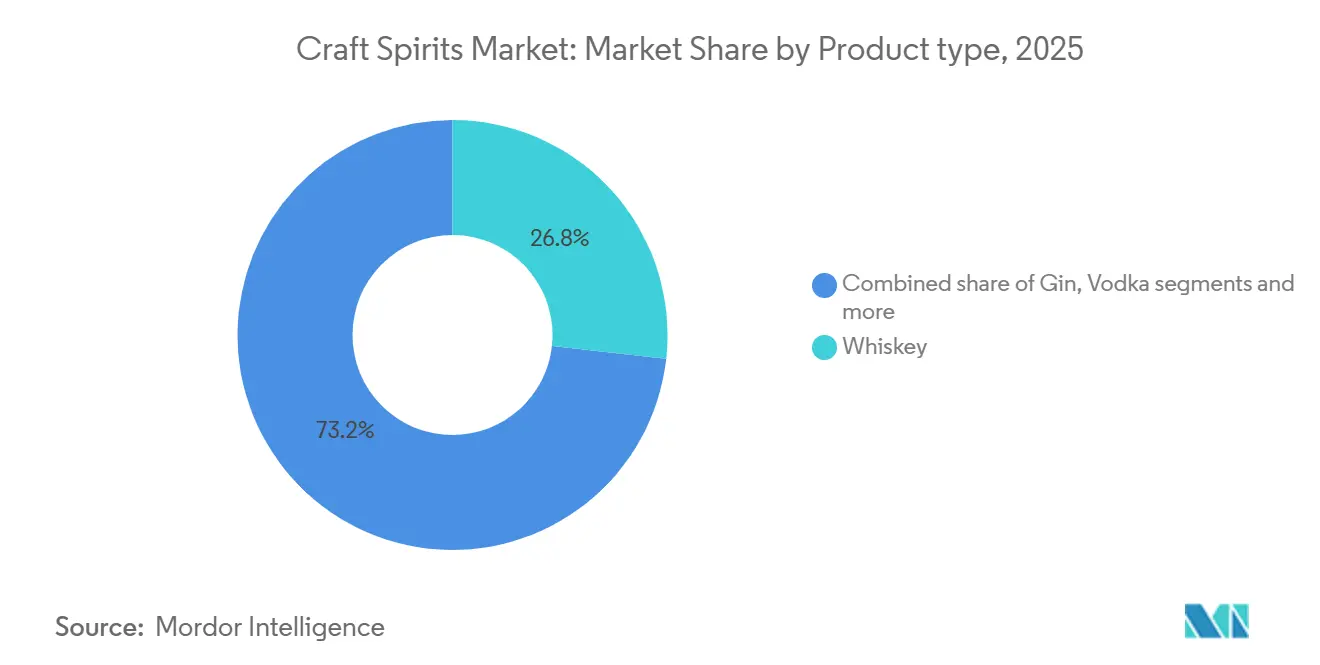
Whiskey Dominates While Gin AcceleratesIn 2025, whiskey commands a dominant 26.77% share of the craft spirits market, buoyed by a consumer shift towards premium offerings and a nod to traditional production methods. However, this category grapples with challenges stemming from oversupply, leading to pricing pressures and inventory management dilemmas. In May 2025, Radico made a strategic move, unveiling TRIKAL Indian Single Malt and Morpheus Super Premium Whisky, aiming squarely at the luxury and super-premium segments.
Gin is poised for the most significant growth, projected to achieve a CAGR of 12.25% from 2026 to 2031. This surge is largely attributed to innovative flavor developments and regional adaptations. Distillers in numerous countries are harnessing local botanicals, crafting unique products tailored for both domestic and global markets. Vodka remains a staple segment, with craft producers innovating through fruit fermentation to craft distinctive base spirits. While brandy holds a smaller slice of the market, it's witnessing a surge in popularity, especially in regions like South Korea, where there's a notable uptick in premium spirit imports.


By Ingredient:
Grain-Based Dominance with Fruit-Based InnovationGrain-based spirits hold a dominant 62.88% share of the craft spirits market in 2025, highlighting the fundamental role of traditional ingredients such as corn, rye, barley, and wheat in whiskey and vodka production. The United States spirits industry consumed 2.8 billion pounds of grain in 2023, representing a 121% increase over the past decade [3]Source: Distilled Spirits Council of the United States, "Distilled Spirits Council of the United States October 2024", distilledspirits.org. In the premium whiskey segment, craft producers differentiate their products through mash bill composition and grain origin to support premium pricing strategies.
Fruit-based spirits are expected to be the fastest-growing ingredient segment, with a projected CAGR of 12.43% from 2026 to 2031. This growth is fueled by advancements in traditional brandy production and the popularity of fruit-infused vodkas and gins. Micro-distilleries are using fruit fermentation techniques to produce vodka, supporting sustainability goals and creating unique flavors. Agave-based spirits continue to grow steadily, while craft producers are exploring alternative bases like honey and maple. These producers aim to use local agricultural resources and adopt sustainable practices. The focus on innovation and sustainability is driving the demand for these spirits. This trend highlights the evolving preferences of consumers in the spirits market.
By Distribution Channel:
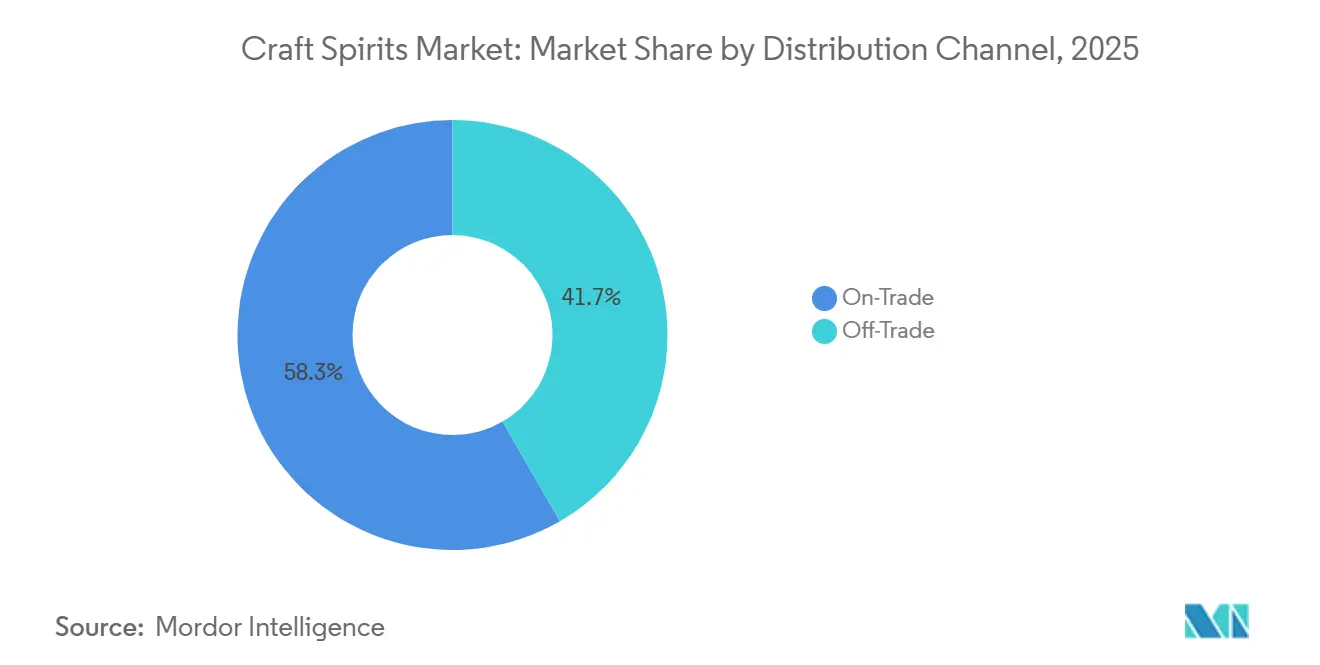
On-Trade Leadership with Off-Trade GrowthIn 2025, the on-trade channel holds a 58.34% share of the craft spirits distribution market. Bars, restaurants, and hospitality venues play a key role in increasing brand awareness and encouraging customers to try premium craft products. After recovering from the pandemic, this channel has grown significantly, driven by the global popularity of cocktail culture. In Singapore, the strong cocktail scene supports the demand for premium spirits, while Thailand's tourism recovery provides craft brands with more visibility in hospitality venues. The on-trade channel remains important for craft spirits, as bartenders act as brand ambassadors and give customers the chance to sample products before buying full bottles.
The off-trade channel is expected to grow at a CAGR of 11.95% from 2026 to 2031, supported by improved retail strategies and the expansion of direct-to-consumer sales. Specialty and liquor stores continue to be important for craft spirits distribution, offering carefully selected products and expert staff to help customers choose premium options. Although e-commerce is growing, its progress has been slowed by regulatory restrictions in many markets. However, recent changes in regulations show promise. For example, New York now allows direct-to-consumer spirits shipping, and Mississippi will permit direct-to-consumer wine shipments starting February 2025. These developments suggest that this distribution model could expand further in the future.
Geography Analysis
North America Craft Spirits Market
In 2025, North America held the largest market share at 38.75%. The United States has a strong craft distilling industry, with 3,069 active craft distillers, according to the American Craft Spirits Association. However, the sector faced its first decline in 2023, with a 3.6% drop in production volumes and a 1.1% decrease in value, based on the same source. Regulations are changing, with nine states and Washington, D.C., now allowing direct-to-consumer spirits shipping. Trade tensions remain a challenge, as the U.S. planned to introduce a 25% tariff on Canadian and Mexican imports in March 2025. This could lead to retaliatory actions and disrupt supply chains.
Europe and APAC Craft Spirits Market
Europe is expected to grow the fastest, with a projected CAGR of 12.96% from 2026 to 2031. This growth is driven by strong craft traditions, a well-established cocktail culture, and rising demand for premium products. In Asia, the market is expanding, especially in South Korea, where whisky imports reached a record 30,586 tons in 2023, a 13.1% increase from the previous year, according to the Korea Customs Service.
South America and MEA Craft Spirits Market
South America and the Middle East and Africa are emerging markets. Brazil and the UAE are seeing higher consumption of premium spirits. Distillers in these regions are using local botanicals to create unique gin products for both domestic and international markets. These regions offer growth opportunities for craft spirits manufacturers who can adapt to local regulations and meet consumer preferences.

Regulatory Landscape
Regulation for craft spirits is shaped by a mix of national excise and labeling rules, plus fragmented sub-national controls that affect route-to-market. In the United States, the Alcohol and Tobacco Tax and Trade Bureau (TTB) rulemaking continues to affect packaging and compliance, including the January 2025 final rule (T.D. TTB-200) that added 15 new standards of fill for distilled spirits and removed the can-versus-other-container distinction, and a September 2025 Federal Register final rule implementing refund procedures for Craft Beverage Modernization Act excise tax benefits.
In Europe, spirit-drink labeling and GI-related compliance requirements continue to evolve, with Regulation (EU) 2026/471 (adopted in February 2026) reducing operational burden by removing the requirement to indicate the producer name in the same field of vision as the geographical indication for spirit drinks. Across markets, trade-policy uncertainty and state-by-state permissions for direct-to-consumer shipping keep commercialization pathways uneven for small distillers, even as demand for easier access grows.
Value Chain Analysis
The craft spirits value chain begins with agricultural inputs (grains and fruits) and specialty processing aids, then moves through distillation, maturation (especially for whiskey), blending, bottling, labeling, and compliance documentation before reaching route-to-market via wholesalers, retailers, and on-trade accounts. For many craft producers, packaging (glass and closures) and energy-intensive operations function as meaningful cost centers, and working capital tightens when aging inventory ties up cash for multi-year periods.
Distribution is a major chokepoint in several markets, since wholesalers have consolidated and often prioritize higher-volume brands, which raises the bar for chain authorization. Recent U.S. association tracking pointed to stress on the producer base, including a reported decline in active craft distillers between August 2024 and August 2025, while legislative and permitting initiatives such as California Assembly Bill 1246 (signed October 3, 2025) created a one-year pilot starting January 1, 2026 for licensed craft distilleries to ship spirits directly to consumers via a Type 94 Direct Shipper permit. Tasting rooms, hyper-local placements, and selective D2C programs are increasingly used alongside traditional wholesale to stabilize unit economics.
Competitive Landscape
The craft spirits market features a competitive landscape where global spirits companies and independent craft distillers coexist. Small-batch producers focus on flexibility and innovation, while multinational companies use their strong distribution networks and financial resources to gain an edge. Leading companies like Diageo, Pernod Ricard, and Constellation Brands strengthen their market presence through strategic acquisitions and investments in the craft spirits segment.
Large corporations are actively shaping the market by creating dedicated craft divisions and innovation centers. They acquire craft distilleries, launch brand development programs, and implement targeted strategies to meet the growing demand for premium and super-premium spirits. This approach helps them stay efficient while maintaining the unique appeal of craft production.
In May 2025, Heaven Hill Distillery introduced the "Family Farms First" program in partnership with Farm Rescue to support family-owned farms. This initiative is part of the Heaven Hill "Grain to Glass" program, which helps farming families that supply ingredients for food and whiskey production. Constellation Brands is also focusing on sustainability, aiming to achieve "TRUE Zero Waste to Landfill" certification for key facilities by fiscal year 2025 and adopting circular packaging across its beverage alcohol products.
Craft Spirits Industry Leaders
-
Pernod Ricard SA
-
Diageo PLC
-
Bacardi Limited
-
Constellation Brands Inc.
-
Remy Cointreau SA
- *Disclaimer: Major Players sorted in no particular order
Craft Spirits Market Companies Covered in this Report
- Pernod Ricard SA
- Diageo PLC
- Bacardi Limited
- Constellation Brands Inc.
- Remy Cointreau SA
- Davide Campari-Milano NV
- William Grant & Sons Ltd
- Suntory Holdings Ltd
- Brown-Forman Corporation
- Heaven Hill Distilleries, Inc.
- Rogue Ales & Spirits
- Hotaling & Co.
- Kings County Distillery
- St. George Spirits Inc.
- Ian Macleod Distillers Ltd
- Copperworks Distilling Company
- Cotswolds Distillery Ltd
- Kweichow Moutai Co. Ltd.
- Allied Blenders And Distillers Limited (ABDL)
- Sazerac Company, Inc.

Market Opportunities and Future Outlook
Regulatory and channel openings create whitespace for small producers that can pair compliant operations with local sourcing and controlled distribution. In the United States, the SPIRIT Act (H.R. 9407) surfaced in June 2026 as a policy lever tied to federal excise tax credits for qualifying small distillers and domestic agricultural sourcing thresholds, aligning commercial incentives with ingredient provenance and supporting farm-to-bottle narratives in premium craft positioning.
Operational modernization and targeted capacity investments are also shaping opportunity areas, particularly for whiskey-led portfolios where inventory accuracy and maturation accountability are central. Industry coverage in May 2026 pointed to increased use of digital tools to track proof gallons, bulk gallons, and yield losses, along with experimentation with A.I. in sales operations via platforms such as Big Thirst and Pour Now, plus larger-brand adoption examples including Four Roses Bourbon and The Macallan. On the supply side, capacity and capability expansions signal room for contract and white-label work and tourism-led experiences, including Hinterhaus Distilling installing a new 2,000-liter copper pot still in May 2026 to expand output and Dunnet Bay Distillers commencing production in July 2026 at the new Stannergill Distillery in Caithness, Scotland (240,000 liters annual capacity) with sustainability features such as electric steam boilers.
Recent Industry Developments in Craft Spirits Market
- July 2026: Dunnet Bay Distillers commenced production at the new Stannergill Distillery in Caithness, Scotland, with stated annual capacity of 240,000 liters and a sustainability focus that includes electric steam boilers. The new site adds craft production capability in the United Kingdom while reinforcing sustainability-led positioning that can support on-trade storytelling and distillery-visit economics.
- June 2026: Inspired Spirits (makers of Quro) announced a seed funding round led by The Chennai Angels to expand the team, support market entry, and advance product research. The raise highlights continued capital formation around craft spirits brands seeking scaled distribution and faster product development cycles.
- April 2026: Copperworks Distilling Co. signed a lease for a new Kenmore, Washington facility designed to add consumer-facing concepts such as a tavern, whiskey garden, and restaurant, with a planned summer 2026 opening. The move strengthens experiential retail and tasting-led sales in a period when wholesale access can be constrained by distributor prioritization.


Craft Spirits Market Report Scope and Research Methodology
Market Definition and Coverage
For this report, the craft spirits market includes sales value of spirits produced by craft-style distilleries and sold through on-trade and off-trade routes, where the product is positioned as craft and is typically made in smaller batches with distinct sourcing or production choices.
Scope exclusions: We do not count beer, wine, hard seltzers, RTD cocktails, mixers, bar equipment, or tourism-led revenues such as tasting-room tickets and tours.
Segments Covered in This Report
-
By Product Type
- Whiskey
- Gin
- Vodka
- Brandy
- Other Types
-
By Ingredient
- Grain-based
- Fruit-based
- Agave-based
- Others
-
By Distribution Channel
- On-Trade
-
Off-Trade
- Specialty/Liquor Stores
- Other Off Trade Channels
-
By Geography
-
North America
- United States
- Canada
- Mexico
- Rest of North America
-
Europe
- Germany
- United Kingdom
- Italy
- France
- Spain
- Netherlands
- Poland
- Belgium
- Sweden
- Rest of Europe
-
Asia-Pacific
- China
- India
- Japan
- Australia
- Indonesia
- South Korea
- Thailand
- Singapore
- Rest of Asia-Pacific
-
South America
- Brazil
- Argentina
- Colombia
- Chile
- Peru
- Rest of South America
-
Middle East and Africa
- South Africa
- Saudi Arabia
- United Arab Emirates
- Nigeria
- Egypt
- Morocco
- Turkey
- Rest of Middle East and Africa
-
North America
Data Sources, Market Sizing, and Validation
Desk Research
Desk work starts by mapping the legal and measurement language used in spirits, because terms like craft, small batch, and independent are not applied the same way in every country. We rely on public references such as the US Alcohol and Tobacco Tax and Trade Bureau releases, national customs and trade statistics, and agriculture or commodity bulletins that help explain movements in inputs like grains and agave.
We then align category and channel splits using sources such as the American Craft Spirits Association publications, public statistics from national alcohol regulators (where available), peer-reviewed papers on beverage alcohol trends, and trade association updates. Company filings, investor decks, reputable press, and product recall or labeling notices are also used to sense-check volume and pricing direction. For specific company financials, shipment signals, and patent activity, paid database subscriptions are used only as supporting inputs. This list is illustrative, and many other public sources were also used for data collection, clarification, and cross-checking.
Primary Interviews and Surveys
Fieldwork is used to confirm what gets treated as craft in practice and how pricing moves across channels, since these details are rarely consistent in public sources. We spoke with a mix of producers, importers, distributors, and on-trade and off-trade decision makers across APAC, EMEA, and the Americas, and then we rechecked key assumptions when large variances appeared during modeling.
Distribution of primary research fieldwork respondents
| Company type | Respondent position | Region |
|---|---|---|
| Top tier: 34% | CXOs: 13% | APAC: 46% |
| Mid tier: 49% | Functional/Unit leaders: 31% | EMEA: 34% |
| Smaller Players: 17% | Managers: 56% | Americas: 20% |
Market-Sizing & Forecasting
The core sizing starts from a top-down build where spirits consumption, category mix, and channel splits are reconstructed by geography and then narrowed to the craft-eligible demand pool. To keep the totals grounded, selective bottom-up checks are run using sampled producer revenue ranges, channel checks on case volumes, and a simple price times volume sanity test for key spirit types.
A few inputs that matter more than general alcohol trends are used in the model, such as the pace of new distillery openings, shifts in on-trade versus off-trade share, premiumization signals that move average selling price, import intensity for certain craft subcategories, and excise or labeling rule changes that can alter what is marketed as craft. When public data is missing for smaller markets, gaps are handled by using proxy indicators like spirits trade flows and income-led premium share patterns, followed by expert review so the implied craft share does not jump unrealistically.
For forecasting, scenario analysis is used around pricing and on-trade recovery, and the final trajectory is then smoothed with an exponential trend where expert inputs suggest short-term volatility. Growth rates are not pushed mechanically, because distribution expansion and shelf space limits often constrain craft penetration even when consumer interest is high.
Data Validation & Update Cycle
Outputs are checked against independent signals such as craft distillery counts, case-volume direction, and observed shelf pricing to confirm that value growth is not being created only by assumptions. If a country shows an outlier change, we revisit the craft definition applied, the channel weighting, and currency conversion timing, and we may re-contact participants to confirm what changed.
A multi-step review is followed before sign-off, where calculations, assumptions, and year-to-year movements are inspected by another analyst. The report is refreshed annually, and interim updates are made when material events occur, such as major tax changes or sharp demand swings. Before delivery, a final update pass is completed so clients receive the latest view.
Mordor Intelligence's Craft Spirits Market Size Versus Other Published Estimates
Published craft spirits market values often differ because the word craft is not a fixed category, and because companies choose different years, currencies, and pricing logic when they convert volume into value. Differences also come from whether the estimate is built from retail sales dollars, producer revenues, or a blended view that mixes both.
Some published figures fold in a wider set of alcohol products and treat craft as a brand style across many labels. In Mordor Intelligence, a stricter craft spirits-only scope is kept, and the sizing is tied to spirit-type and channel splits with checks on distillery activity and realistic ASP progression by region.
Benchmark comparison
| Source | Market Size | Gaps in Research Methodology |
|---|---|---|
| Mordor Intelligence | USD 21.20 B (2025) | |
| Global Consultancy A | USD 25.76 B (2024) | Uses a higher recent-year value and applies a fast growth curve, which can inflate totals when craft labeling is treated broadly across premium spirits and when ASP uplift is assumed uniformly across regions. |
| Industry Association B | USD 7.58 B (2024) | Represents a US-only retail sales view tied to a specific craft distiller definition and local market structure, so it does not capture global demand or cross-border trade effects. |
Taken together, the spread is mainly explained by geography coverage and how craft eligibility and pricing are applied in the calculation. By keeping the steps traceable to channel splits, spirit-type mix, and observable market signals, the model stays easier to reproduce and to update when definitions or demand patterns shift.


Key Questions Answered in the Report
What is the current craft spirits market size?
The craft spirits market size reached USD 23.75 billion in 2026 and is projected to grow to USD 41.87 billion by 2031.
Which product category leads the craft spirits market?
Whiskey leads, accounting for 26.77% of craft spirits market share in 2025, buoyed by premium single-malt and small-batch demand.
Why is Europe the fastest-growing region for craft spirits?
Europe blends heritage distilling with modern cocktail culture and shows a projected 12.96% CAGR from 2026 to 2031, aided by premium demand and sustainability priorities.
How are craft distillers addressing the surge in low/no alcohol interest?
Many producers introduce botanical non-alcoholic spirits and lower-ABV variants to capture health-conscious consumers while maintaining brand engagement.
Page last updated on:


 Your data is secure and never sold or shared.


