
HR Knowledge Base and Self-Service Platform Market Size and Share
Market Overview
| Study Period | 2020 - 2031 |
|---|---|
| Market Size (2026) | USD 4.67 Billion |
| Market Size (2031) | USD 7.98 Billion |
| Growth Rate (2026 - 2031) | 11.31 % |
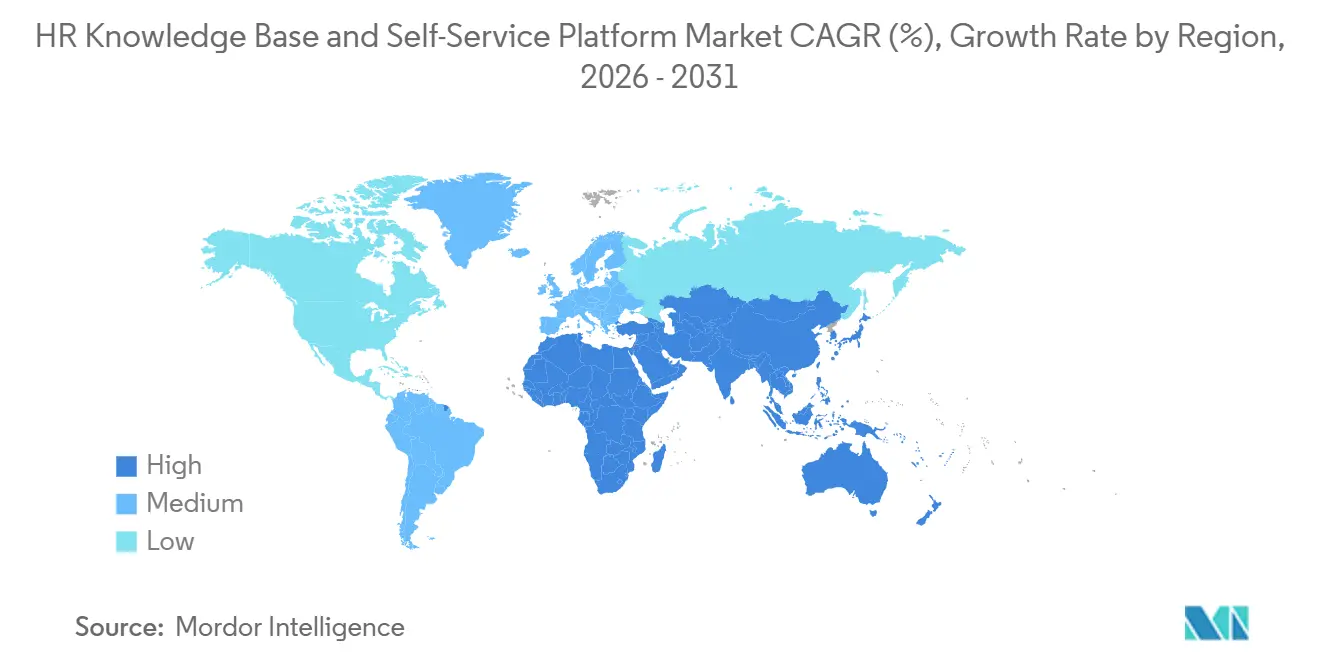
| Fastest Growing Market | Asia-Pacific |
| Largest Market | North America |
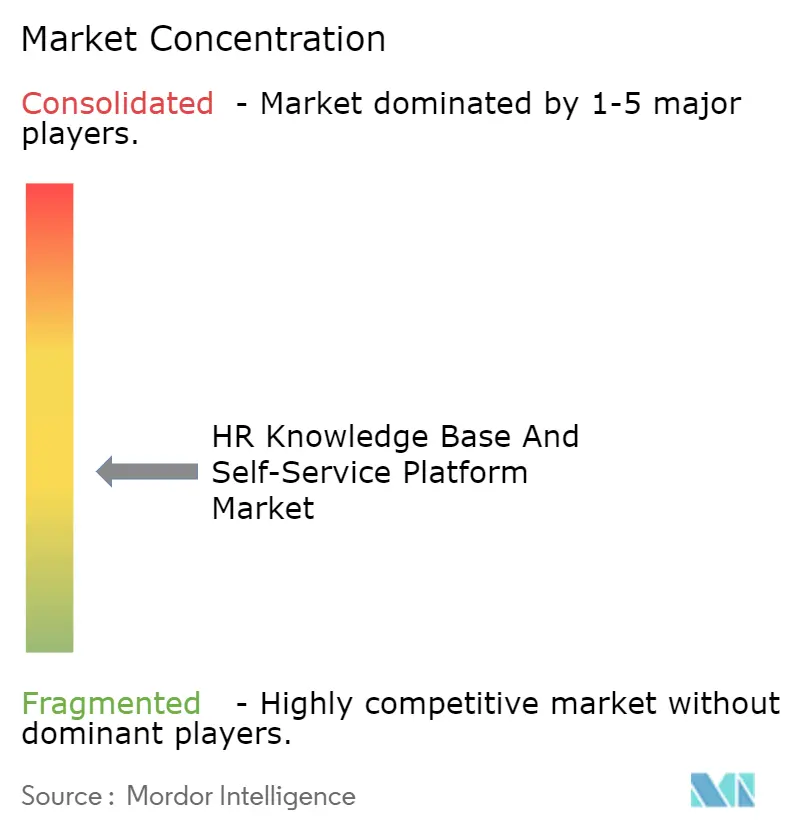
| Market Concentration | Medium |
Major Players *Disclaimer: Major Players sorted in no particular order Image © Mordor Intelligence. Reuse requires attribution under CC BY 4.0. | |
HR Knowledge Base and Self-Service Platform Market Analysis by Mordor Intelligence
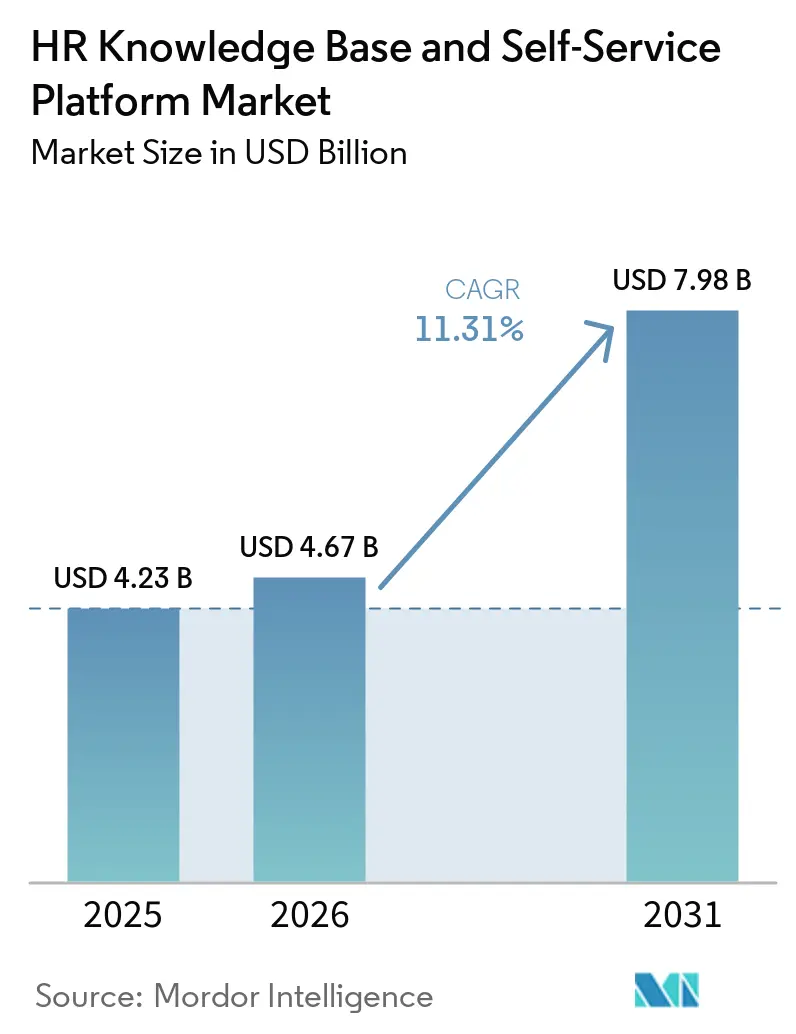
The HR Knowledge Base And Self-Service Platform Market size is projected to expand from USD 4.23 billion in 2025 and USD 4.67 billion in 2026 to USD 7.98 billion by 2031, registering a CAGR of 11.31% between 2026 and 2031. The market is moving beyond basic policy storage and ticket routing, and buyers now expect platforms to answer multi-step HR questions, apply compliance guardrails, and tailor responses at scale. The average enterprise HR-AI budget reached USD 1.6 million in 2026, showing that spending has shifted from pilot programs to live deployments. Cloud-based platforms held 68.41% of revenue in 2025 because SaaS pricing tracks employee counts more easily and because buyers want continuous model and content updates that on-premises systems struggle to support. Shadow AI use inside HR teams is also shortening buying cycles for controlled knowledge deployments, especially where policy mistakes can create payroll, legal, or employee relations issues. The HR knowledge base and self-service platform market remains moderately fragmented, with large-suite vendors benefiting from installed bases, while specialist vendors continue to win spend through stronger governance and employee experience features.
Key Report Takeaways
- By deployment model, cloud-based platforms held 68.41% share of the HR knowledge base and self-service platform market revenue in 2025, while hybrid is projected to be the fastest-growing configuration through 2031.
- By functionality, knowledge management accounted for 26.71% of revenue in 2025, while conversational AI and virtual agents are expected to be the fastest-growing functional segment through 2031.
- By end-user industry, information technology and telecom held the largest revenue share in 2025, while healthcare and life sciences are projected to expand at a 16.40% CAGR through 2031.
- By end-user enterprise size, large enterprises accounted for the largest share in 2025, while small and medium-sized enterprises are projected to expand at a 15.82% CAGR through 2031.
- By geography, North America held 41.23% of revenue in 2025 in the HR knowledge base and self-service platform market, while Asia-Pacific is projected to grow at a 15.63% CAGR through 2031.
Note: Market size and forecast figures in this report are generated using Mordor Intelligence’s proprietary estimation framework, updated with the latest available data and insights as of January 2026.
Market Trends and Insights
Drivers Impact Analysis of HR Knowledge Base and Self-Service Platform Market*
| Driver | (~) % Impact on CAGR Forecast | Geographic Relevance | Impact Timeline |
|---|---|---|---|
| AI-Enabled HR Service Delivery Modernization | +3.2% | Global | Medium term (2-4 years) |
| Need for 24-7 Employee Self-Service Across Hybrid Workforces | +2.1% | Global | Short term (≤ 2 years) |
| Cloud HR Suite Consolidation and Lower Total Cost of Ownership | +1.8% | North America and Europe | Medium term (2-4 years) |
| Rising Compliance Complexity Across Multi-Country HR Policies | +1.4% | Global, concentrated in Europe and APAC | Long term (≥ 4 years) |
| Shadow AI Governance Driving Demand for Controlled HR Knowledge Layers | +0.9% | North America and EU | Medium term (2-4 years) |
| Deskless and Multilingual Workforce Support Expanding Addressable Use Cases | +0.7% | APAC, MEA, South America | Medium term (2-4 years) |
| Source: Mordor Intelligence | |||
AI-Enabled HR Service Delivery Modernization
AI has shifted from being an optional feature to a core requirement in HR knowledge bases and self-service platforms. Enterprises now expect these systems to resolve complex HR queries while staying anchored to approved policy content. Workday’s March 2026 rollout of Sana introduced a self-service agent with over 300 HR and finance skills, and one customer reported 90% user adoption within 40 days while retiring 400 unsanctioned AI licenses.[1] This illustrates why governed platforms are replacing unapproved tools in HR service environments. Buyers are no longer focused only on ticket deflection; they are also testing whether a system can preserve a single source of policy truth across thousands of employee interactions. Vendors that ground retrieval in company-specific HR content are gaining an edge, since generic models without organizational context are harder to trust in regulated workflows.
Need For 24-7 Employee Self-Service Across Hybrid Workforces
Hybrid work has permanently changed when and how employees seek HR support in the HR knowledge base and self-service platform market. Questions now come from different time zones, devices, and worker types, and that pattern does not fit the design of older HR help desks. Microsoft’s Employee Self-Service Agent has already demonstrated enterprise-scale viability, serving hundreds of thousands of employees and vendors across more than 100 countries through a single conversational interface.[2] Mature deployments handle a large share of routine HR questions without human support, but adoption often stalls when knowledge content is incomplete or outdated. This shifts attention from portal access alone to content quality, freshness, and guided action completion. Platforms that combine proactive notifications, contextual retrieval, and step-by-step workflow support are performing better than passive portals built around static search.
Cloud HR Suite Consolidation and Lower Total Cost of Ownership
Stack consolidation supports growth in the HR knowledge base and self-service platform markets, as enterprises seek fewer moving parts across HR operations. Buyers are not consolidating only to add new features; many are doing so to reduce integration upkeep, content duplication, and permission management across disconnected systems. When policy content, self-service workflows, and identity controls are on one platform, version control and access enforcement become native features rather than custom projects. This matters more as organizations expand AI-enabled self-service because every extra connector can slow updates and create governance gaps. Cloud architecture also supports faster release cycles for model changes, compliance content updates, and interface improvements across large user bases. As a result, unified cloud deployments are becoming easier to justify than maintaining several point tools that must be stitched together and governed separately.
Rising Compliance Complexity Across Multi-Country HR Policies
Compliance is becoming a stronger buying factor in the HR knowledge base and self-service platform market as labor rules and AI obligations diverge across countries. The EU AI Act classifies many employment-related AI systems as high-risk, imposing additional documentation, oversight, and transparency requirements on employers and vendors.[3] At the same time, multinational employers must maintain country-specific HR content for local payroll, benefits, employee data, and notification rules. Static policy intranets struggle when updates must be surfaced correctly by role, location, and employment status in real time. That is increasing demand for platforms that can tag content by jurisdiction, flag policy conflicts, and map employee interactions to governance requirements. The regulatory environment is moving in different directions across countries, so this demand is likely to remain durable rather than cyclical.
Restraints Impact Analysis of HR Knowledge Base and Self-Service Platform Market*
| Restraint | (~) % Impact on CAGR Forecast | Geographic Relevance | Impact Timeline |
|---|---|---|---|
| Sensitive Employee Data Privacy and Explainability Requirements | -1.8% | Global, concentrated in EU | Medium term (2-4 years) |
| Legacy HRIS, Payroll, and Identity Integration Complexity | -1.2% | Global | Medium term (2-4 years) |
| Works Council and AI Employment Law Review Slowing Production Rollouts | -0.8% | Germany, France, Netherlands, and broader EU | Medium term (2-4 years) |
| Low Content Governance Maturity and Over-Permissioned Repositories | -0.5% | Global | Short term (≤ 2 years) |
| Source: Mordor Intelligence | |||
Sensitive Employee Data Privacy And Explainability Requirements
Privacy and explainability rules are slowing parts of the HR knowledge base and self-service platform market, especially for employers handling sensitive employee records. These platforms process compensation data, leave information, performance history, disciplinary records, and immigration status, which raises the compliance bar. Explanation duties for automated decision-making remain a live issue in employment use cases, and the EU AI Act imposes documentation requirements on providers and deployers of high-risk systems, which can delay procurement when the documentation chain is incomplete.[4] This burden is harder for mid-market buyers to absorb because they often lack dedicated privacy and legal teams. Vendors that ship explainability dashboards, audit logs, and compliant consent workflows as standard features are better positioned in regulated buying cycles.
Legacy HRIS, Payroll, And Identity Integration Complexity
Integration complexity remains a practical restraint on the HR knowledge base and self-service platform market because personalized self-service depends on live data flows. Knowledge platforms must connect reliably with HRIS, payroll, and identity systems to return current, permission-based answers. That work becomes more difficult when employers run several HR platforms with different APIs, field structures, authentication models, and update cycles. The problem is not only technical; it also affects governance, as inaccurate joins, movers, leavers, or payroll triggers can yield the wrong response for the wrong employee. This creates a structural advantage for vendors already in the core HR stack, as they can reduce connector maintenance and speed up deployment. Mid-market buyers are especially affected because a small internal IT team may not be able to sustain a multi-system integration model over time.
*Our forecasts treat driver/restraint impacts as directional, not additive. The impact forecasts reflect baseline growth, mix effects, and variable interactions.
HR Knowledge Base and Self-Service Platform Market Segment Analysis
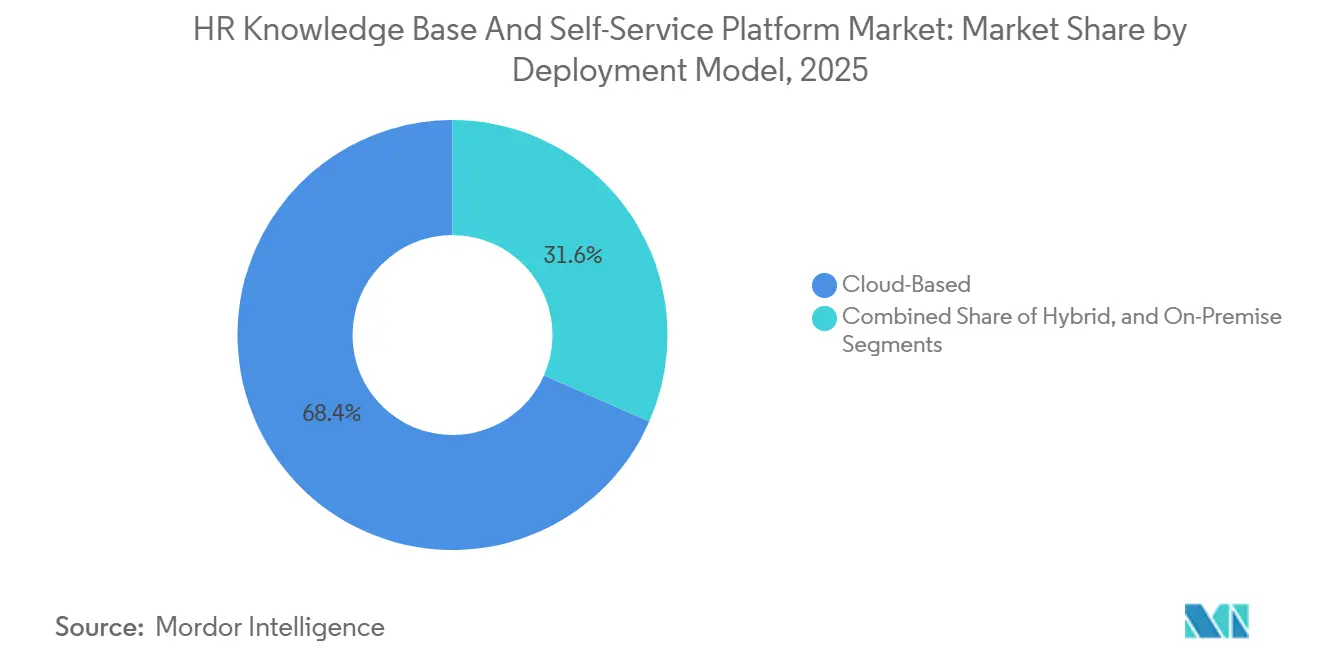
Cloud-based platforms accounted for 68.41% of the HR knowledge base and self-service platform market size in 2025, making cloud the clear mainstream deployment choice. The segment benefited from SaaS pricing that can rise or fall with headcount, which is important for employers managing seasonal, global, or project-based workforces. It also benefited from the need for continuous model tuning and content updates, since cloud-native environments can push those changes more easily than on-premises systems. In the HR knowledge base and self-service platform market, this has made cloud the default option for buyers who want faster releases and lower day-to-day infrastructure effort. Large organizations in information technology and telecom, retail, and financial services accelerated cloud moves in 2024 and 2025 because AI-enabled search, natural language query resolution, and contextual policy retrieval are difficult to support in older deployments without major custom work.
Hybrid is the fastest-growing deployment option through 2031 because some employers still need tighter control over where sensitive employee data sits. This is especially relevant in regulated settings where data residency rules or internal security policies make full SaaS migration harder to approve. Vendors are responding with federated models that keep sensitive records in private or on-premises environments while letting retrieval and user interaction run through managed cloud layers. That approach helps preserve modern user experience without forcing a full infrastructure replacement at the start of the project. On-premises remains present in high-security public sector and defense settings, but its role is narrowing as the HR knowledge base and self-service platform market places more value on update speed, audit readiness, and lower maintenance effort.

By End User Enterprise Size:
Large Enterprises Lead Spending While SMEs Set The Growth PaceLarge enterprises held the largest share of revenue in 2025 because they had the scale to justify replacing or augmenting HR shared services with self-service platforms. In many of these organizations, HR teams manage thousands of monthly employee questions, so even modest automation can create meaningful savings in staff time and response quality. The HR knowledge base and self-service platform market has therefore seen large buyers favor broader platform contracts that combine knowledge management, virtual agents, service workflows, and analytics. Those deals often favor vendors that can deliver integrated capabilities on top of existing HCM systems. Large employers also tend to have stronger governance, change management, and compliance resources, which makes it easier to move from pilot programs to enterprise production use.
Small and medium-sized enterprises are projected to grow at a 15.82% CAGR from 2026 to 2031, which makes them the fastest-growing customer tier. This shift reflects lower implementation burdens, as cloud-native tools reduce the cost and effort that once kept advanced deployments out of reach for firms with fewer than 5,000 employees. Tiered packaging is also helping because buyers can start with knowledge management or employee self-service without replacing an entire HCM stack. In the HR knowledge base and self-service platform industry, that modular model is widening adoption among firms with 200 to 2,000 employees and among smaller regulated employers that need controlled HR content without enterprise-scale complexity.
By Functionality:
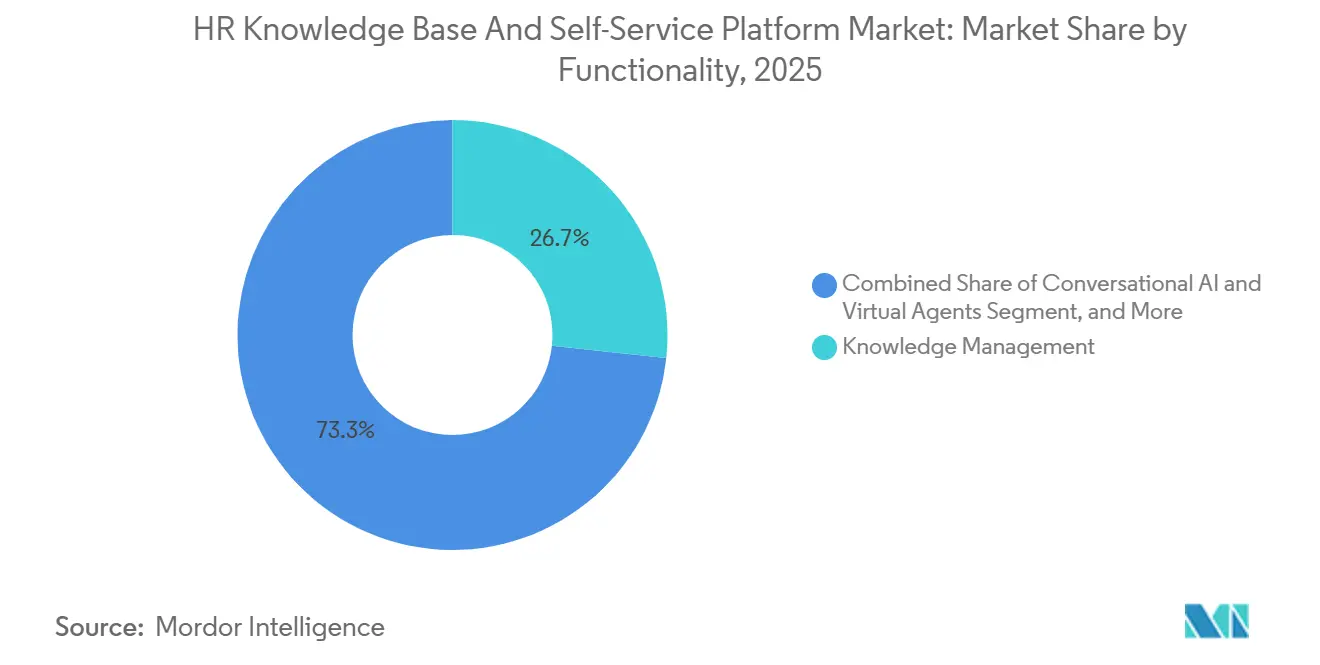
Knowledge Management Provides The Base While Conversational AI Scales FastestKnowledge management held 26.71% of revenue in 2025, making it the largest functional block in the HR knowledge base and self-service platform market. Its role as the content foundation for search, employee self-service, virtual agents, and governance modules explains that position. When the knowledge layer is inconsistent, outdated, or duplicated, other features become less reliable because they are pulling from weak source material. This is why buyers continue to invest in governed policy repositories even as AI interfaces receive most of the attention. Knowledge discovery and search are also gaining importance because employees usually phrase questions in natural language rather than the exact terms used in HR documents.
Conversational AI and virtual agents are the fastest-growing functional segment as enterprises move from menu-based support to multi-turn interaction. New platforms allow enterprises to build and deploy customized HR, IT, and finance agents in weeks, while Workday’s Sana agent added more than 300 HR and finance skills in 2026. Service automation is gaining traction alongside these agents because buyers want users to complete tasks inside the same interaction rather than being redirected to back-office teams. Analytics and governance remain smaller today, but they are attracting more investment as the HR knowledge base and self-service platform markets need stronger logging, audit trails, and control layers for regulated AI use.
By End-User Industry:
Information Technology And Telecom Leads Adoption While Healthcare And Life Sciences Grows FastestInformation technology and telecom held the largest end-user revenue share in 2025, supported by early adoption of self-service tools and higher knowledge complexity per employee. These organizations often manage distributed teams, frequent policy updates, and a high volume of digital workflows, which makes employee self-service easier to justify. BFSI also maintained strong penetration because regulated firms already depend on documented processes, access controls, and auditable employee interactions. Retail and e-commerce continued to adopt mobile-first self-service because large frontline workforces frequently ask repeat questions about schedules, onboarding, pay, and benefits. Industrial manufacturing and government deployments also expanded as multi-site workforces and language diversity increased the strain on centralized HR teams.
Healthcare and life sciences are projected to grow at a 16.40% CAGR through 2031, making it the fastest-growing vertical in this market. Multi-facility health networks need role-specific and jurisdiction-specific HR content that staff can access quickly between shifts and across locations. Employment-related AI tools used for monitoring or assessment can fall into high-risk categories under the EU AI Act, underscoring the value of documented and governed HR knowledge delivery. Other industries, including logistics, hospitality, and education, are also adding to demand as platform pricing becomes more accessible and as mobile interfaces improve for workers with limited desktop access. The HR knowledge base and self-service platform industry is therefore widening beyond its traditional concentration in knowledge-heavy office environments
Geography Analysis
North America HR Knowledge Base and Self-Service Platform Market
North America held 41.23% of the HR knowledge base and self-service platform market share in 2025, giving the region the largest global position. The region benefited from high enterprise SaaS penetration, larger HR shared services budgets, and faster early adoption of AI-assisted employee experience tools. The United States remained the anchor market because large employers there have been quicker to connect self-service with broader HCM and workflow modernization programs. The scale and maturity of enterprise workforce software demand, closely tied to North American vendor ecosystems, mean competition centers less on basic portal functions and more on AI quality, governance depth, and integration breadth.
Europe HR Knowledge Base and Self-Service Platform Market
Europe remains a major region in the HR knowledge base and self-service platform market, but regulatory and consultation rules more heavily shape it. GDPR, the EU AI Act, and national labor frameworks all influence how quickly employers can move from testing to scaled production use. Germany and France are especially important because works council consultation and employee oversight rules can add months to deployment timelines for HR AI systems. That has increased the appeal of vendors that can show stronger documentation, explainability, and local policy controls from the start.
The Americas, APAC and MEA HR Knowledge Base and Self-Service Platform Market
Asia-Pacific is projected to grow at a 15.63% CAGR through 2031, the fastest regional pace in the HR knowledge base and self-service platform market. Demand is strong for mobile-first, multilingual support where deskless manufacturing, logistics, and retail workforces need it. Multilingual mobile-first HR systems in India have shown adoption improvements of more than 70% compared with English-only systems, highlighting the importance of language coverage in high-growth settings. South America, the Middle East, and Africa are at earlier adoption stages, but vendor expansion into hubs such as Mexico City shows that providers are preparing for broader enterprise demand across Mexico, Central America, and South America.
Competitive Landscape
The HR knowledge base and self-service platform market remains moderately fragmented, split between large HCM suite vendors and specialist platforms. Workday, UKG, and Dayforce benefit from deep installed bases and closer links to core employee data, which simplifies personalization and permissions. At the same time, specialists such as Leena AI, Simpplr, and Staffbase continue to win incremental demand by focusing on governance, employee experience design, and flexible orchestration across existing HR stacks. This balance means the market does not operate like a winner-take-all category, even though the largest suite vendors enjoy clear distribution advantages.
Large vendors are reinforcing their position through product expansion. Workday’s release of Sana and the Sana Self-Service Agent in March 2026 added a broader self-service layer with more than 300 workflow skills, while UKG expanded AI-led payroll and employee assistance capabilities in 2025 and 2026. These moves matter because buyers often prefer to extend trusted platforms before introducing new specialist tools into sensitive HR environments. The installed-base advantage is strongest where buyers want fewer integrations, fewer vendor reviews, and tighter governance of employee content. Still, large vendors face pressure to deliver faster innovation in multilingual support, AI controls, and frontline worker use cases.
Specialists are responding by pushing deeper into control and experience features rather than trying to match the breadth of the suite. Simpplr launched its AI Control Center in May 2026, giving IT administrators centralized oversight of AI features, provider choice, and configuration. Staffbase expanded its regional presence with a Mexico City hub in February 2026, while Leena AI introduced its studio for custom AI colleagues in October 2025. These moves highlight where white space remains, particularly in multilingual deployments, frontline communication, and governed orchestration across mixed HR stacks. The market, therefore, remains open to both platform extension and specialist substitution, depending on buyer priorities and regulatory exposure.
HR Knowledge Base and Self-Service Platform Industry Leaders
-
UKG Inc.
-
Dayforce Corporation
-
Rippling, Inc.
-
Darwinbox Digital Solutions Pte. Ltd.
-
Workday, Inc.
- *Disclaimer: Major Players sorted in no particular order
HR Knowledge Base and Self-Service Platform Market Companies Covered in this Report
- Workday, Inc.
- UKG Inc.
- Dayforce Corporation
- Rippling, Inc.
- Bamboo HR LLC
- Personio SE and Co. KG
- Hi Bob Ltd.
- Darwinbox Digital Solutions Pte. Ltd.
- Everyday Software, S.L.
- Connecteam Ltd.
- Leena AI, Inc.
- Simpplr, Inc.
- Staffbase GmbH
- iTacit Inc.
- Trainual, Inc.
- Tettra, Inc.
- Axero Solutions, LLC
- Korra AI LTD.
- Public Sector Analytics Limited
- Humaans Software UK LTD
Recent Industry Developments in HR Knowledge Base and Self-Service Platform Market
- May 2026: UKG introduced UKG Pro Pay with Workforce AI at Payroll Congress 2026, embedding agentic, assistive, and generative AI across the payroll processing lifecycle to enable real-time anomaly detection and natural language payroll auditing. Research by UKG and KPMG underpins the product, identifying 2-4% total labor spend lost to payroll leakage at large enterprises, making accurate knowledge-driven payroll a quantified ROI opportunity.
- May 2026: Simpplr launched the AI Control Center, a centralized IT administrator console governing every AI feature, LLM provider, and configuration across its AI-powered employee experience platform, directly addressing enterprise demand for auditable AI deployment in HR knowledge environments.
- March 2026: Workday made Sana for Workday and the Sana Self-Service Agent globally available to all Workday customers, with the self-service agent offering over 300 skills for HR and finance task automation and early deployments reporting significant reductions in HR support tickets.
- February 2026: Staffbase established a Mexico City regional hub to serve enterprise customers across Mexico, Central and South America, following double-digit Americas growth and 2025 expansions into Japan, France, Italy, and Spain.
Global HR Knowledge Base and Self-Service Platform Market Report Scope
The HR Knowledge Base and Self-Service Platform market refers to software solutions that enable organizations to centralize HR information, automate employee support, and provide self-service capabilities for workforce management. These platforms integrate functionalities such as knowledge management, search and discovery, employee self-service portals, conversational AI, service automation, and analytics-driven governance. Delivered through cloud-based, on-premises, and hybrid deployment models, they cater to both large enterprises and SMEs across industries, including BFSI, healthcare, IT and telecom, retail, manufacturing, government, and others. The core purpose of this market is to enhance HR efficiency, reduce administrative overhead, improve employee experience, and provide scalable, data-driven solutions for workforce engagement and compliance.
The HR Knowledge Base and Self-Service Platform market report is segmented by Deployment Model (Cloud-Based, On-Premises, and Hybrid), Enterprise Size (Large Enterprises and Small and Medium-Sized Enterprises), Functionality (Knowledge Management, Knowledge Discovery and Search, Employee Self-Service, Conversational AI and Virtual Agents, Service Automation, Analytics and Governance), End-user Industry (BFSI, Healthcare and Life Sciences, Information Technology and Telecom, Retail and E-commerce, Industrial Manufacturing, Government and Public Sector, and Other End-user Industries), and Geography (North America, South America, Europe, Asia-Pacific, Middle East, and Africa). The Market Forecasts are Provided in Terms of Value (USD)
Segmentation Overview
| Cloud-Based |
| On-Premises |
| Hybrid |
| Large Enterprises |
| Small and Medium-Sized Enterprises |
| Knowledge Management |
| Knowledge Discovery and Search |
| Employee Self-Service |
| Conversational AI and Virtual Agents |
| Service Automation |
| Analytics and Governance |
| BFSI |
| Healthcare and Life Sciences |
| Information Technology and Telecom |
| Retail and E-commerce |
| Industrial Manufacturing |
| Government and Public Sector |
| Other End-user Industries |
| North America | United States |
| Canada | |
| Mexico | |
| South America | Brazil |
| Argentina | |
| Rest of South America | |
| Europe | Germany |
| United Kingdom | |
| France | |
| Italy | |
| Spain | |
| Russia | |
| Netherlands | |
| Rest of Europe | |
| Asia-Pacific | China |
| Japan | |
| India | |
| South Korea | |
| Australia and New Zealand | |
| Rest of Asia-Pacific | |
| Middle East | Saudi Arabia |
| United Arab Emirates | |
| Rest of Middle East | |
| Africa | South Africa |
| Nigeria | |
| Rest of Africa |
| By Deployment Model | Cloud-Based | |
| On-Premises | ||
| Hybrid | ||
| By End User Enterprise Size | Large Enterprises | |
| Small and Medium-Sized Enterprises | ||
| By Functionality | Knowledge Management | |
| Knowledge Discovery and Search | ||
| Employee Self-Service | ||
| Conversational AI and Virtual Agents | ||
| Service Automation | ||
| Analytics and Governance | ||
| By End-user Industry | BFSI | |
| Healthcare and Life Sciences | ||
| Information Technology and Telecom | ||
| Retail and E-commerce | ||
| Industrial Manufacturing | ||
| Government and Public Sector | ||
| Other End-user Industries | ||
| By Geography | North America | United States |
| Canada | ||
| Mexico | ||
| South America | Brazil | |
| Argentina | ||
| Rest of South America | ||
| Europe | Germany | |
| United Kingdom | ||
| France | ||
| Italy | ||
| Spain | ||
| Russia | ||
| Netherlands | ||
| Rest of Europe | ||
| Asia-Pacific | China | |
| Japan | ||
| India | ||
| South Korea | ||
| Australia and New Zealand | ||
| Rest of Asia-Pacific | ||
| Middle East | Saudi Arabia | |
| United Arab Emirates | ||
| Rest of Middle East | ||
| Africa | South Africa | |
| Nigeria | ||
| Rest of Africa | ||
Key Questions Answered in the Report
What is the current size of the HR knowledge base and self-service platform space?
It was valued at USD 4.23 billion in 2025 and is forecast to reach USD 7.98 billion by 2031 at an 11.31% CAGR over 2026-2031.
Why are enterprises investing more in HR self-service platforms now?
Buyers want platforms that can answer multi-step HR questions, apply compliance rules, and reduce dependence on manual HR support teams.
Which deployment model is leading adoption?
Cloud-based platforms led with 68.41% of revenue in 2025 because buyers prefer scalable pricing and continuous updates.
Which business segment is growing the fastest?
Small and medium-sized enterprises are growing the fastest, with a projected 15.82% CAGR through 2031 as cloud-native tools lower deployment barriers.
Which end-user industry is expanding fastest?
Healthcare and life sciences is projected to grow at a 16.40% CAGR through 2031 because multi-facility employers need governed, role-specific HR policy access.
Which region shows the strongest growth outlook?
Asia-Pacific has the highest regional growth rate, with a projected 15.63% CAGR through 2031, supported by multilingual and mobile-first workforce needs.