
North America Corrugated And Folding Carton Packaging Market Size and Share
Market Overview
| Study Period | 2020 - 2031 |
|---|---|
| Forecast Data Period | 2026 - 2031 |
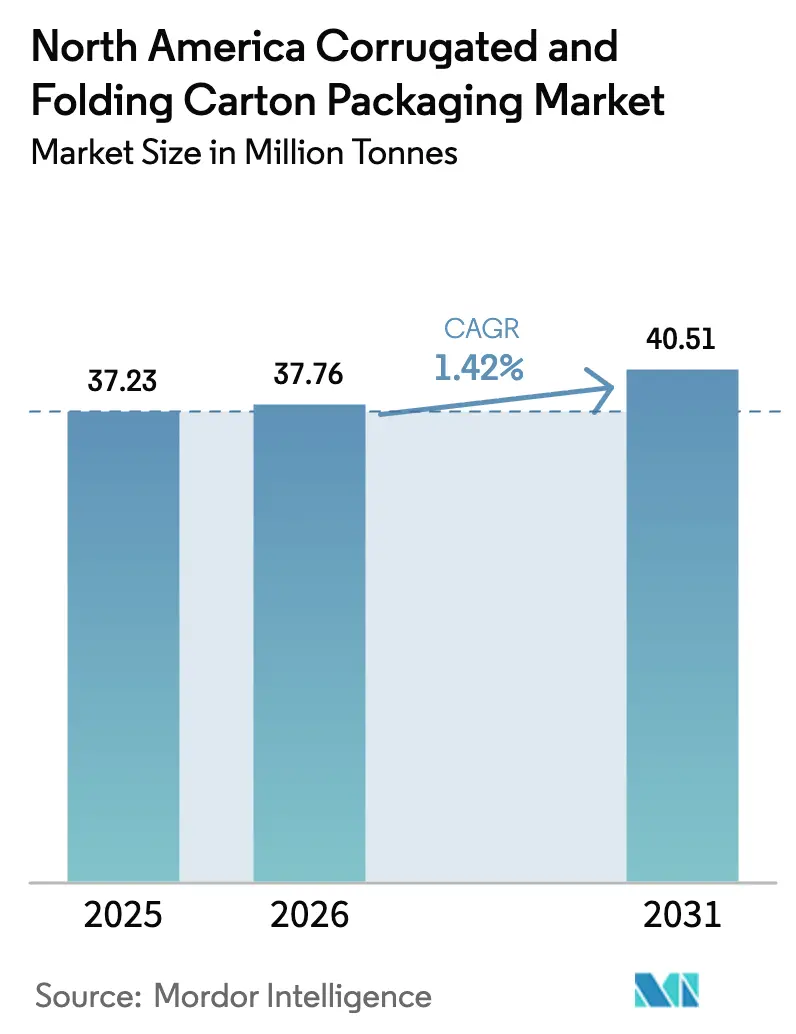
| Base Year Market Size (2025) | 37.23 Million tonnes |
| Market Volume (2026) | 37.76 Million tonnes |
| Market Volume (2031) | 40.51 Million tonnes |
| Growth Rate (2026 - 2031) | 1.42 % |
| Market Concentration | Medium |
Major Players *Disclaimer: Major Players sorted in no particular order Image © Mordor Intelligence. Reuse requires attribution under CC BY 4.0. | |
North America Corrugated And Folding Carton Packaging Market Analysis by Mordor Intelligence
The North America corrugated and folding carton packaging market size in 2026 is estimated at 37.76 million tonnes, growing from 2025 value of 37.23 million tonnes with 2031 projections showing 40.51 million tonnes, growing at 1.42% CAGR over 2026-2031. Regulatory compliance, near-shoring of manufacturing, and e-commerce fulfillment standards are now the prime drivers of volume rather than pure consumption gains, positioning the North America corrugated and folding carton packaging market for steady yet subdued expansion. Recycled fiber remains the dominant input as brands seek Forest Stewardship Council (FSC) certification, while bamboo and agro-residue blends garner patent attention as credible substitutes for the volatile wood-based supply.[1]Forest Stewardship Council US, “FSC Certification in North America,” us.fsc.org Tight FDA guidance on pharmaceutical cartons and retailers’ shelf-ready mandates propel folding-carton upgrades that carry higher graphics and barrier requirements. Incremental, AI-enabled right-sizing is reshaping board engineering, and capital spending above USD 2.5 billion through 2025 underscores a shift toward automation and digital print that shortens run lengths and personalizes appearance.
Key Report Takeaways
- By material, recycled fiber held 48.05% of the North America corrugated and folding carton packaging market share in 2025, whereas bamboo and agro-residue blends are projected to expand at a 3.16% CAGR through 2031.
- By packaging type, corrugated boxes accounted for 54.55% of the North America corrugated and folding carton packaging market size in 2025, while folding cartons are advancing at a 2.15% CAGR on the back of healthcare demand.
- By board type, single-wall designs led with 38.05% of the North America corrugated and folding carton packaging market share in 2025; triple-wall applications are forecast to grow at a 2.78% CAGR owing to automotive logistics.
- By printing technology, offset retained 46.05% share of the North America corrugated and folding carton packaging market size in 2025, yet digital printing is climbing at a 3.72% CAGR as converters chase personalization.
- By end-user industry, food and beverage captured 32.10% share of the North America corrugated and folding carton packaging market size in 2025, whereas personal care and cosmetics are predicted to rise at a 2.58% CAGR until 2031.
- By geography, the United States commanded 73.00% of the North America corrugated and folding carton packaging market share in 2025; Mexico is the fastest-growing territory at 3.54% CAGR through 2031.
Note: Market size and forecast figures in this report are generated using Mordor Intelligence’s proprietary estimation framework, updated with the latest available data and insights as of 2026.
North America Corrugated And Folding Carton Packaging Market Trends and Insights
Drivers Impact Analysis*
| Driver | (~) % Impact on CAGR Forecast | Geographic Relevance | Impact Timeline |
|---|---|---|---|
| E-commerce packaging volume surge | +0.4% | US hubs extending into Canada and Mexico | Short term (≤2 years) |
| Lightweighting and material efficiency | +0.2% | EPA regions in the US, federal zones in Canada, emerging Mexico | Medium term (2-4 years) |
| Corporate sustainability procurement targets | +0.3% | US retail chains, Canadian operations, Mexican manufacturing | Medium term (2-4 years) |
| Retail shelf-ready packaging adoption | +0.2% | Grocery chains in the US and Canada, expanding Mexican retail | Short term (≤2 years) |
| AI-driven box-size optimization platforms | +0.1% | Fulfillment centers in the US and Canada | Short term (≤2 years) |
| Rise of micro-fulfillment centers | +0.1% | Urban US markets and Canadian cities | Medium term (2-4 years) |
| Source: Mordor Intelligence | |||
E-commerce packaging volume surge
Automation in fulfillment drives stricter tolerances for cartons, prompting performance upgrades in single-wall boards that must withstand direct-to-consumer shipping stresses. FDA guidance released in 2024 now treats prescription deliveries as e-commerce shipments, compelling folding cartons to integrate tamper-evidence and child-resistant features that align with parcel sortation systems.[2]U.S. Food and Drug Administration, “Packaging-Human Drugs,” FDA.gov AI algorithms embedded in converting lines enable plants to output more than 1,200 discrete box sizes per hour, slashing void-fill usage by 35% and saving corrugating medium. This capability boosts demand for both structural corrugated formats and premium-printed folding cartons that travel as their own shipper. Consequently, the North America corrugated and folding carton packaging market gains diversified volume with higher average revenue per tonne, tempering the mature demand curve.
Lightweighting and material efficiency mandates
EPA waste-reduction targets published in 2024 catalyze investment in lower basis-weight containerboard that maintains compression strength through advanced flute designs, trimming board weight by 18-22% yet meeting automated handling specs. FSC audit data confirms that 89% of corrugated output in North America now carries chain-of-custody certifications, a leap from 76% a year earlier. Such momentum encourages converters to adopt precision corrugators and closed-loop quality control that keep tight tolerances as the paper caliper shrinks. As material weight inches down, unit price edges up because clients pay for documented sustainability progress, contributing incremental value growth in the North America corrugated and folding carton packaging market.
Corporate sustainability procurement targets
Retail and consumer-goods firms embed recyclability thresholds and lifecycle metrics in sourcing contracts, forcing box makers to prove recycled content or carbon scores during tenders. Cascades reported that deals governed by explicit environmental requirements already make up 67% of its folding-carton revenue, commanding 8-12% price premiums when certification is verified. FSC, life-cycle analytics, and carbon disclosure now operate as deal qualifiers across big-box chains and fast-moving consumer goods brands. Smaller converters without auditing capabilities face shrinking addressable demand, sharpening competitive bifurcation, yet enlarging the total certified tonnage flowing through the North America corrugated and folding carton packaging market.
Retail shelf-ready packaging adoption
Grocery and club-store formats want cartons that shift from pallet to shelf with no unpacking, slicing labor minutes, and ensuring planogram consistency. Graphic Packaging’s USD 75 million fine-line die-cut installs target this need, integrating tear-strips and high-fidelity flexo that endure the supply chain’s scuffs while still merchandising on the shelf. Shelf-ready solutions often blend corrugated rigidity with folding-carton graphics, driving cross-vertical synergies inside converter networks. Adoption moves fastest in packaged foods, cosmetics, and small electronics, spurring incremental tonnage of high-spec board grades and widening the functional reach of the North America corrugated and folding carton packaging market.
Restraints Impact Analysis*
| Restraint | (~) % Impact on CAGR Forecast | Geographic Relevance | Impact Timeline |
|---|---|---|---|
| Volatility in OCC prices | −0.3% | Recycling-dependent regions across North America | Short term (≤2 years) |
| Converters’ capital-expenditure inflation | −0.2% | US manufacturing centers and Mexican expansion zones | Medium term (2-4 years) |
| Labor shortages in box plants | −0.2% | US and Canadian industrial corridors | Short term (≤2 years) |
| Deforestation concerns and NGO pressure | −0.1% | US and Canadian timber basins | Long term (≥4 years) |
| Source: Mordor Intelligence | |||
Volatility in OCC prices
BLS producer-price data show containerboard swings of 28-35% through 2024, eroding margins for mills dependent on traded recycled fiber. Georgia-Pacific spent USD 550 million on vertical integration to steady inbound OCC, an option out of reach for smaller independents. During price spikes, converters accelerate tests of tomato-stem and wheat-straw fiber, but the commercial scale remains embryonic and premium priced. State recycling mandates elevate recovered-content quotas, increasing purchasing stress exactly when OCC supplies tighten. The resulting squeeze subtracts volume growth potential from the North America corrugated and folding carton packaging market until fiber alternatives mature.
Converters’ capital-expenditure inflation
Equipment vendors raised list prices amid steel and electronics shortages, inflating turnkey corrugator installs by 15-20% between 2023 and 2025. Borrowing costs climbed, lengthening payback periods on digital printers and servo-driven die-cutters essential for short runs. Firms defer or phase out investments, slowing the replenishment of aging assets that limit productivity. Mexican green-field projects encounter elevated civil works pricing, stretching timelines just as near-shoring demand peaks. Capex inflation, therefore, tempers the modernization pace inside the North America corrugated and folding carton packaging market.
*Our forecasts treat driver/restraint impacts as directional, not additive. The impact forecasts reflect baseline growth, mix effects, and variable interactions.
Segment Analysis
By Material: Recycled Fiber Retains Scale amid Alternative Fiber Momentum
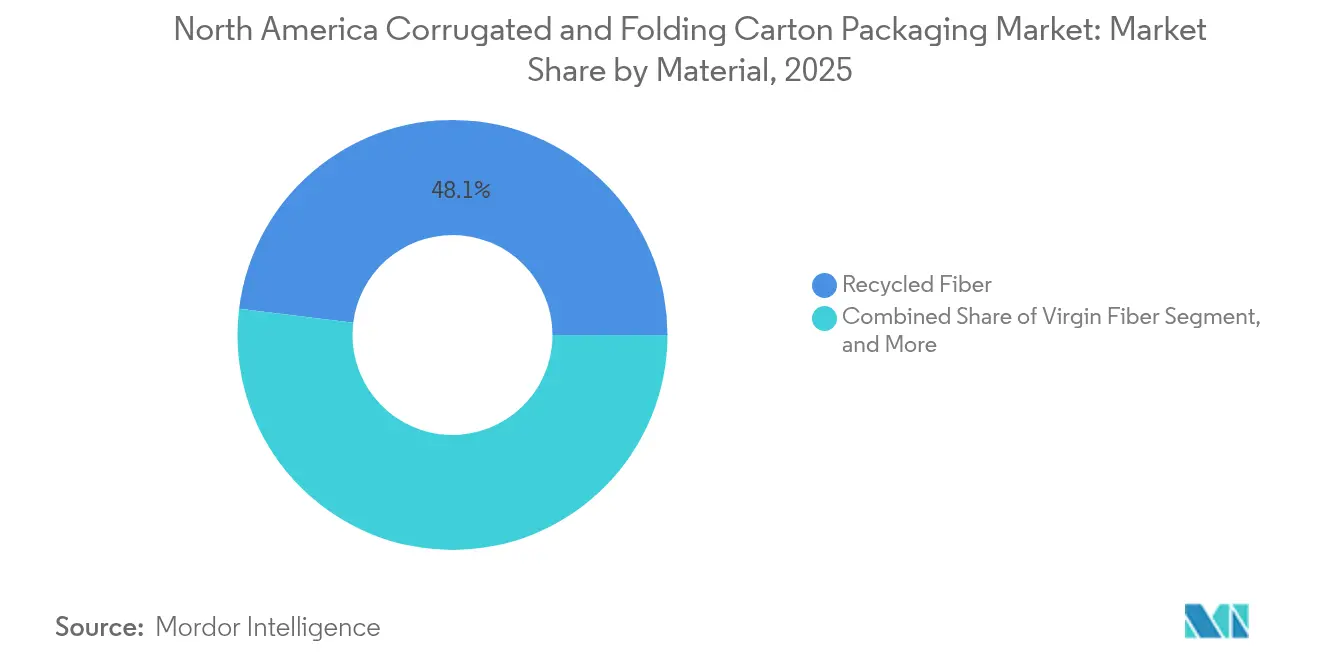
Recycled fiber accounted for 48.05% of the North America corrugated and folding carton packaging market share in 2025, validating municipal collection systems and retailer procurement mandates that favor post-consumer content. Market participants exploit its scale economies, yet volatile OCC pricing drove Cascades to incur an extra EUR 45 million (USD 48.6 million) in raw-material spend during early 2024. Consequently, strategic investment flows into agro-residue like tomato stems and wheat straw, a cohort expanding at 3.16% CAGR and supported by 23 patent filings in 2024 alone.
Alternative fiber pilots now move from lab to line as converters search for cost stability and marketing differentiation. While mechanical properties approach those of wood pulp, supply consistency and food-contact compliance still gate large-scale switch-overs. The North America corrugated and folding carton packaging market thus balances two trajectories: recycled fiber’s cost-risk yet comprehensive network, and fast-growing niche fibers still ramping into commercial breadth.



By Packaging Type: Corrugated Volume Dominance Meets Folding-Carton Value Uplift
Corrugated boxes held 54.55% of the North America corrugated and folding carton packaging market share in 2025, thanks to e-commerce logistics that demand durable shippers. Volumes rise in line with parcel counts, yet margin uplift stems from smart-box algorithms and linerboard weight reductions that preserve strength. Folding cartons, though smaller, grow at a 2.15% CAGR because FDA compliance pushes pharma brands into multi-layer barriers and tamper-evident locks that command higher unit pricing.
Converters straddle both forms through hybrid designs that marry corrugated rigidity with carton graphics, satisfying shelf-ready tasks while trimming layers. Investments in digital print blur the line further, allowing corrugators to deliver offset-like imagery on micro-flute and enabling cartons to assume secondary-pack roles. This convergence elevates the total addressable opportunity for the North America corrugated and folding carton packaging market.
By Board Type: Single-Wall Efficiency vs Triple-Wall Strength
Single-wall substrates represented 38.05% of the North America corrugated and folding carton packaging market size in 2025, leveraged for lightweight e-commerce parcels taxed by dimensional-weight tariffs. High-precision corrugators add next-gen flutes that lift edge-crush while shaving basis weight, preserving cost leadership. Triple-wall boards rise at a 2.78% CAGR as Mexico’s automotive exports require dense, vibration-resistant crates, reinforcing Mexico’s outsized influence on heavy-duty demand.
Suppliers develop hybrid flutes that chase single-wall economics yet near double-wall strength, guided by 15 patents filed in 2024. As end users refine SKU-specific cushioning, board selection hinges on predictive analytics rather than rule-of-thumb, expanding consultative service revenue across the North America corrugated and folding carton packaging market.
By Printing Technology: Offset Scale Maintains Share while Digital Rockets Upward
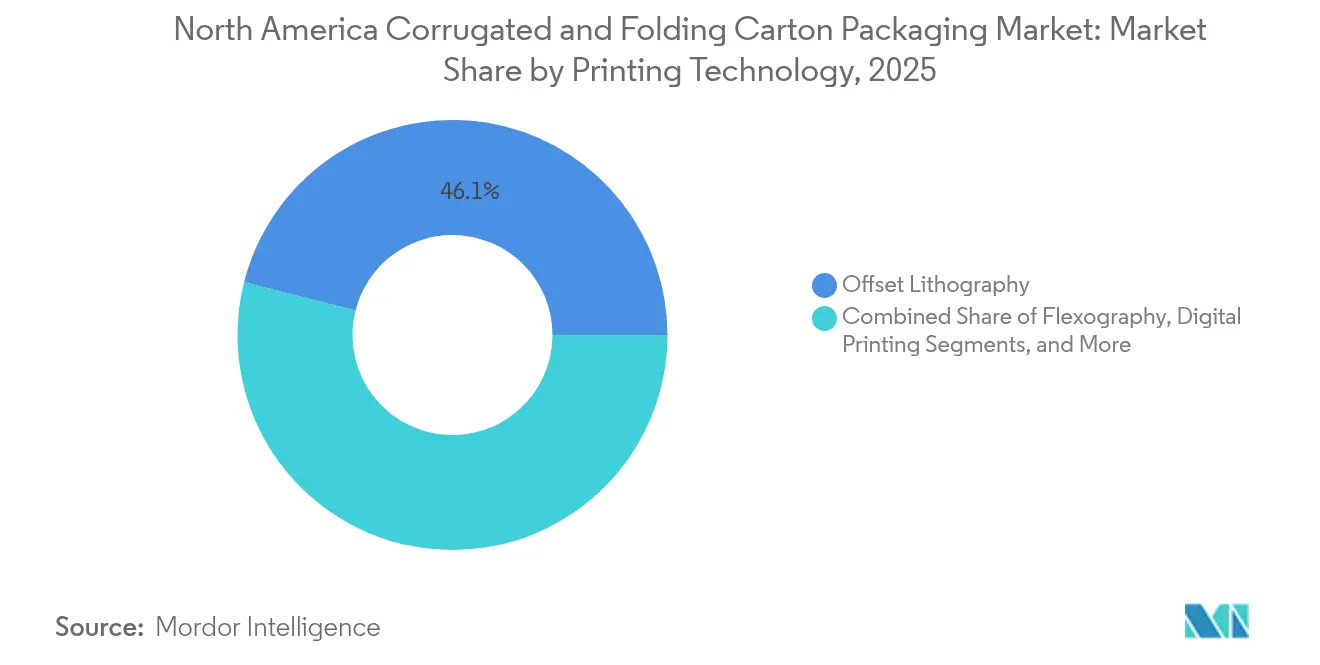
Offset lithography secured 46.05% of the North America corrugated and folding carton packaging market share in 2025, serving long-run food and beverage cartons that require precise brand-color fidelity. Digital print powers a 3.72% CAGR by enabling serialized pharmaceutical packs and personalized cosmetic sleeves, shortening the minimum economic run length to dozens instead of thousands.
Capital migration toward inkjet corrugators and toner-based sheet-fed presses accelerates as converters chase SKU proliferation. Setup-free changeovers cut waste and support micro-fulfillment demands for graphics variation. This technology mix evolves the revenue model from price-per-tonne toward price-per-impression, adding elasticity to the North America corrugated and folding carton packaging market.
By End-User Industry: Food Scale Counter-balances Healthcare Innovation
Food and beverage held 32.10% share of the North America corrugated and folding carton packaging market size in 2025, underpinned by everyday consumption and substitution away from plastic toward recyclable fiber. Personal care and cosmetics climb at 2.58% CAGR, leveraging premium folding cartons with holographic inks and soft-touch varnishes that amplify shelf impact.
Healthcare’s stringent serialization rules make tamper-evident and child-resistant cartons a steady margin driver, while electronics brands adopt anti-static liner stocks to secure microchips amid near-shoring. Industrial segments ride Mexico’s assembly growth, pulling heavier flutes and triple-wall wraps. The heterogeneous end-user base cushions cyclical shocks and sustains multi-segment depth within the North America corrugated and folding carton packaging market.
Geography Analysis
United States volume dominance stems from nationwide e-commerce fulfillment centers that specify lighter single-wall boards yet higher graphics fidelity, sustaining a high-margin mix for converters. Capital outlays in Iowa, Georgia, and Illinois add automated corrugators with AI integration, signaling a commitment to domestic capacity even amid near-shoring flows.
Canada’s packaging demand aligns with grocery and resource exports, but sustainability policy intensifies FSC adoption faster than the continental average. Urban micro-fulfillment growth around Toronto and Vancouver stimulates smaller ship-ready cartons that demand digital print agility. The North America corrugated and folding carton packaging market consequently sees technology migration northward as converters replicate US workflows.
Mexico evolves from import-reliant consumption to self-supplied capacity, anchored by automotive, electronics, and appliance clusters in Bajío and northern states. Rising labor competence, combined with duty advantages under USMCA, attracts both local entrepreneurs and multinationals setting up corrugators and folding-carton lines. Triple-wall board gains traction for cross-border parts shipments, balancing Mexico’s youthful consumer demand for shelf-ready cosmetics and personal-care packs. Local fiber sourcing remains underdeveloped, pushing investments in recycled medium and agro-residue pulping that could diversify the supply mix across the North America corrugated and folding carton packaging market.
Regulatory Landscape
Regulation in North America is increasingly shaped by state-level extended producer responsibility (EPR) requirements for packaging and paper products, which translate sustainability targets into formal registration, reporting, and fee obligations. In the United States, California SB 54 and other state programs have raised compliance needs for corrugated and folding carton producers and brand owners, with Circular Action Alliance (CAA) operating as a multi-state Producer Responsibility Organization (PRO) that coordinates producer participation. Parallel labeling enforcement, including California SB 343 restrictions on recyclability claims, is also influencing how fiber-based packaging is marketed and how converters substantiate recycled content and recyclability.
In 2026, the regulatory calendar tightened further as Maryland adopted its first packaging and paper products EPR regulations (COMAR 26.04.14) on May 5, 2026, effective May 25, 2026, adding new producer registration and reporting workflows alongside existing state programs. For converters serving healthcare and pharmaceutical end users, FDA packaging guidance continues to influence folding carton specifications (for example, requirements tied to prescription distribution and traceability), which drives compliance-oriented demand for higher-integrity cartons, tamper evidence, and track-and-trace compatible features in secondary packaging.
Value Chain Analysis
The value chain begins with fiber sourcing (virgin pulp and recycled OCC), moves through containerboard and paperboard production, and then into converting operations that manufacture corrugated boxes and folding cartons, including printing, die-cutting, coating, and finishing. Large integrated players such as International Paper, Smurfit WestRock, Georgia-Pacific, Packaging Corporation of America, and Cascades control key upstream inputs and downstream converting capacity, which helps stabilize supply as OCC pricing fluctuates and as e-commerce specifications tighten. Certification and compliance services (for example, FSC chain-of-custody, recyclability substantiation, and EPR reporting support) have also become embedded in procurement, shifting the value chain from a primarily material flow to a documentation-heavy, audit-ready system.
Downstream, brand owners, retailers, and e-commerce fulfillment networks increasingly require right-sized packaging, shelf-ready functionality, and higher graphic fidelity, which pushes more value toward digital and automated converting, short-run capability, and faster design-to-production cycles. Channel dynamics are also moving away from merchant distribution for standard boxes toward more direct, contract-based procurement with large buyers, where converters bundle structural design, compliance documentation, and service-level commitments. Consolidation and portfolio reshaping, including Smurfit WestRock formed in July 2024 and International Paper completing the DS Smith acquisition on January 31, 2025, further concentrates scale across mills, plants, and logistics networks, influencing lead times and regional service footprints across the United States, Canada, and Mexico.
Competitive Landscape
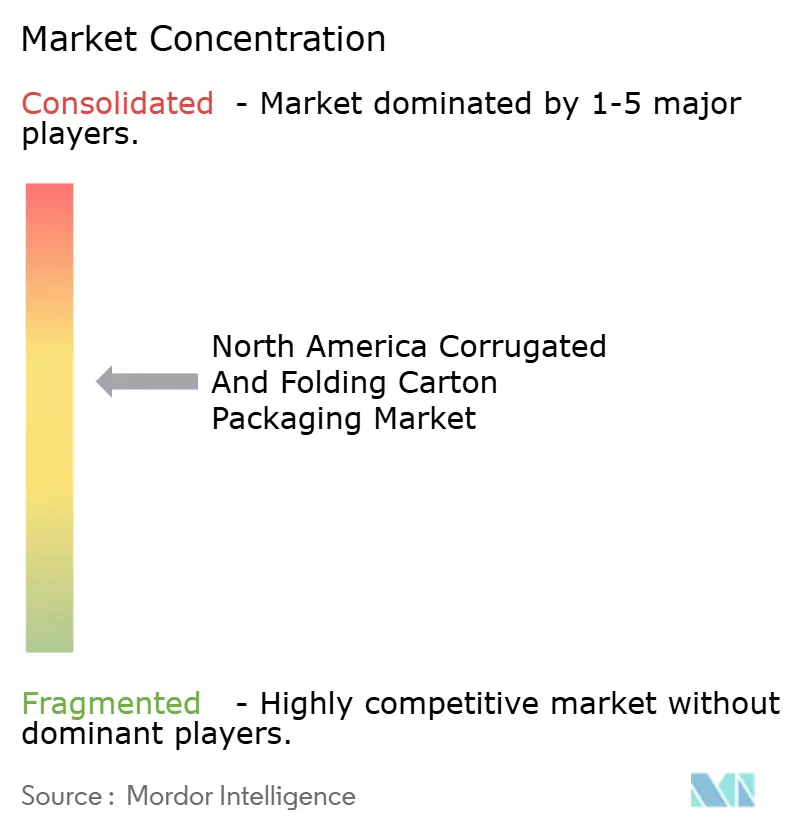
The market shows moderate consolidation as the top five converters account for about 65% of regional output, yet dozens of mid-tier independents thrive on niche agility. International Paper allocated USD 260 million to expand digital converting and AI-driven box lines in 2024, targeting e-commerce SKU complexity. Packaging Corporation of America spent USD 45 million on digital cutters that serve pharmaceutical serialization demands, reflecting a pivot toward short runs with track-and-trace features.
Georgia-Pacific’s USD 550 million Green Bay expansion and concurrent Alabama mill projects advance vertical integration amid OCC volatility, locking in linerboard feedstock and throughput. Graphic Packaging’s USD 75 million deployment of precision die-cutting amplifies shelf-ready offering for grocers and club stores, illustrating convergence between carton graphics and ship-ready rigidity. Sonoco’s partnerships with pharma majors embed serialization technology into folding cartons, a sign that regulatory compliance can become a revenue moat.
Smaller independents compete through regional service and custom job speed, yet rising capex costs and labor gaps tighten margins. Alliances form around shared digital print assets and joint FSC accreditation to meet bidding criteria. M&A interest stays active as private-equity investors seek bolt-ons that bring specialty coatings or automation IP. Overall, technology adoption, fiber security, and sustainability credentials set the competitive tempo inside the North America corrugated and folding carton packaging market.
North America Corrugated And Folding Carton Packaging Industry Leaders
International Paper Company
Smurfit WestRock
Packaging Corporation of America
Georgia-Pacific LLC
Cascades Inc.
- *Disclaimer: Major Players sorted in no particular order

Market Opportunities and Future Outlook
EPR implementation is creating a tangible opportunity for converters and mills that can supply compliant, auditable fiber-based packaging at scale while helping customers manage registration, reporting, and eco-modulated fee structures. In California, SB 54 requirements linked to Circular Action Alliance (CAA) include mid-2026 milestones (such as producer registration and baseline reporting timeframes), while Maryland added an additional compliance layer when COMAR 26.04.14 became effective on May 25, 2026. These programs support demand for packaging formats with documented recycled content, verified sourcing (including FSC chain-of-custody where required by buyers), and substantiated recyclability claims, particularly as California SB 343 restricts misleading recyclability labeling and the use of chasing-arrows symbols.
Operationally, the market also shows whitespace in converting upgrades that better match tighter fulfillment tolerances and retail shelf-ready requirements, while lowering material per shipment through lightweighting and right-sizing. The investment cycle visible in major operators (for example, International Paper adding capability and network flexibility through acquisitions and new-builds, and producers executing multiple containerboard price moves in 2026) points to scale, fiber security, and automation being treated as competitive differentiators rather than incremental add-ons. For smaller and mid-tier converters, the opportunity is more concentrated in specialized services such as rapid structural design for micro-fulfillment, compliance-ready documentation, and short-run digital print for SKU proliferation, where buyers pay for performance, traceability compatibility, and proof of sustainability attributes rather than commodity tonnage alone.
Recent Industry Developments
- June 2026: International Paper completed the $360 million acquisition of North Pacific Paper Company (NORPAC) to enhance system flexibility and West Coast service capabilities. The consolidation expands coast-to-coast capacity and strengthens IP's footprint in West Coast logistics for NA corrugated markets.
- May 2026: International Paper began construction on a $225 million, 468,000-square-foot corrugated packaging facility in Rankin County, Mississippi. The new facility adds capacity in the primary NA market, improving regional service and supporting e-commerce packaging growth.
- May 2026: International Paper, Georgia-Pacific, Packaging Corporation of America announced containerboard price increases effective June 1, 2026. The move signals ongoing input cost discipline and could exert price pressure on packaging converters.


Research Methodology Framework and Report Scope
Market Definition and Coverage
For this methodology, the market covers corrugated boxes and folding cartons used to pack, protect, and ship products across North America, counted in physical volume shipped (tonnes) across major end use supply chains.
Scope exclusions: It excludes non-paper packaging formats (such as rigid plastic, flexible packs, and metal) and any double counting between primary packs and transport packs.
Segmentation Overview
- By Material
- Virgin Fiber
- Recycled Fiber
- Bamboo and Agro-residue Fiber Blends
- By Packaging Type
- Folding Cartons
- Corrugated Boxes
- By Board Type
- Single Wall
- Double Wall
- Triple Wall
- Folding Boxboard (FBB)
- Other Board Types
- By Printing Technology
- Offset Lithography
- Flexography
- Digital Printing
- Other Printing Technologies
- By End-User Industry
- Food and Beverage
- Healthcare and Pharmaceutical
- Personal Care and Cosmetics
- Electronics and Appliances
- Other End-user Industries
- BY Geography
- United States
- Canada
- Mexico
Data Sources, Market Sizing, and Validation
Desk Research
Desk research was used to establish the market structure and pull stable time series that can be cross-checked year over year. We relied on public North America packaging and paper statistics, including government trade and manufacturing datasets, customs import and export records, and industrial production indicators, which helped map where volumes were moving.
We also reviewed industry association publications and technical resources, including fiber and paperboard shipment data, packaging recycling metrics, and standards that influence box and carton specifications. Company filings, investor presentations, and reputable press were used to confirm capacity additions, mill conversions, and major demand shifts by end users. To support cross-checks, we used paid subscriptions for company financials and intelligence, plus shipment-level import and export databases where relevant. The sources listed here are illustrative only, since many other public and paid references were also used for collection, validation, and clarification.
Primary Interviews and Surveys
Primary work focused on interviews and surveys with packaging converters, paperboard and containerboard participants, distributors, and large end user procurement and packaging teams. We used these discussions to validate shipped volume ranges, mix shifts between corrugated and folding cartons, and typical weight per unit outcomes, so the revenue narratives would not distort the volume model. The assumptions were then re-tested for consistency across the United States, Canada, and Mexico.
Distribution of primary research fieldwork respondents
| Company type | Respondent position |
|---|---|
| Top tier: 32% | CXOs: 16% |
| Mid tier: 49% | Functional/Unit leaders: 40% |
| Smaller Players: 19% | Managers: 44% |
Market-Sizing & Forecasting
Sizing starts from a top-down build where paper and paperboard production and trade data are used to reconstruct a realistic demand pool, which is then filtered to corrugated and folding carton uses in North America. After that, the totals are corroborated with selective bottom-up approximations, including converter capacity and utilization checks, sampled carton and box weight assumptions, and channel conversations that indicate where volumes were won or lost.
Key inputs used in the model include containerboard and paperboard shipment indicators, corrugated box and folding carton output trends, manufacturing activity for major carton consuming industries, e-commerce shipping intensity signals, and recovered fiber and virgin fiber availability that can constrain tonnage. Where direct data is thin, gaps were handled through ratio-based allocations tied to end use production indicators, then adjusted only when interviews confirmed a sustained shift.
Forecasting was primarily done using scenario analysis, supported by simple regression checks on industrial output and trade flows, so the forward view remains explainable and can be reproduced. Assumptions were kept practical, and they were updated when multiple independent signals pointed in the same direction.
Data Validation & Update Cycle
Validation is done in steps so unusual jumps are questioned before any final numbers are published. We compare model outputs against independent signals such as shipment trends, capacity announcements, and trade movements, then investigate variances that sit outside normal ranges.
Before sign-off, the work goes through internal analyst review, followed by re-contact triggers when a key assumption moves materially, such as major mill conversions or sustained changes in end use demand. Reports are refreshed annually, with interim updates when large events affect volumes, and a final pre-delivery pass is performed so clients receive the latest updated view.
Mordor Intelligence's North America Corrugated and Folding Carton Packaging Market Sizing Compared With Other Published Estimates
Published estimates for this market can look far apart because some sources measure value while others track physical shipments, and the pricing layer can change quickly when paper inputs move. Differences also come from how corrugated and folding cartons are separated versus grouped, and whether Mexico and Canada are fully captured or treated as extensions of US demand.
In a refresh-led approach, the biggest splits usually appear when the currency timing, average selling price progression, and the timing of demand normalization are not updated in line with recent quarters, which then shifts the implied tonnage. Our checks prioritize shipment and production signals first, then pressure test them with interview feedback and trade movements, and that cadence is kept current in Mordor Intelligence.
Benchmark comparison
| Source | Market Size | Gaps in Research Methodology |
|---|---|---|
| Mordor Intelligence | USD 37.23 M (2025) | |
| Industry Publisher A | USD 36.73 B (2024) | Reported in value terms and appears to apply an average price layer across mixed packaging types, which can inflate or compress results when paper input costs shift and the mix changes. |
| Industry Publisher B | USD 37.27 B (2025) | Uses a longer horizon with a low growth narrative, but the method description is light on how North America coverage is handled and how volume to value conversions are refreshed after pricing resets. |
The table mainly shows that unit choice and price updating rules drive most of the spread, not just demand direction. When shipment tonnage is the anchor and assumptions are re-checked on a repeat schedule, the outcome is easier to trace back to visible market signals and to explain in a planning discussion.


Key Questions Answered in the Report
What is the 2026 volume of North American corrugated and folding cartons?
The region shipped 37.76 million tonnes in 2026.
How fast will volume grow by 2031?
It is forecast to rise at a 1.42% CAGR, reaching 40.51 million tonnes.
Which material leads the mix today?
Recycled fiber commands 48.05% share, underpinned by mature collection systems and FSC mandates.
Where is growth strongest geographically?
Mexico is forecast to post a 3.54% CAGR through 2031 as near-shoring accelerates packaging demand.
Which printing technology is gaining the most traction?
Digital printing is expanding at 3.72% CAGR, driven by personalization and short-run economics.
What restrains faster expansion?
OCC price volatility, labor shortages, and rising capex inflate costs and temper overall market growth.
Page last updated on:


 Your data is secure and never sold or shared.


