
Market Overview
| Study Period | 2020 - 2031 |
|---|---|
| Forecast Data Period | 2026 - 2031 |
| Base Year Market Size (2025) | USD 9.02 Billion |
| Market Size (2026) | USD 9.23 Billion |
| Market Size (2031) | USD 10.32 Billion |
| Growth Rate (2026 - 2031) | 2.26 % |
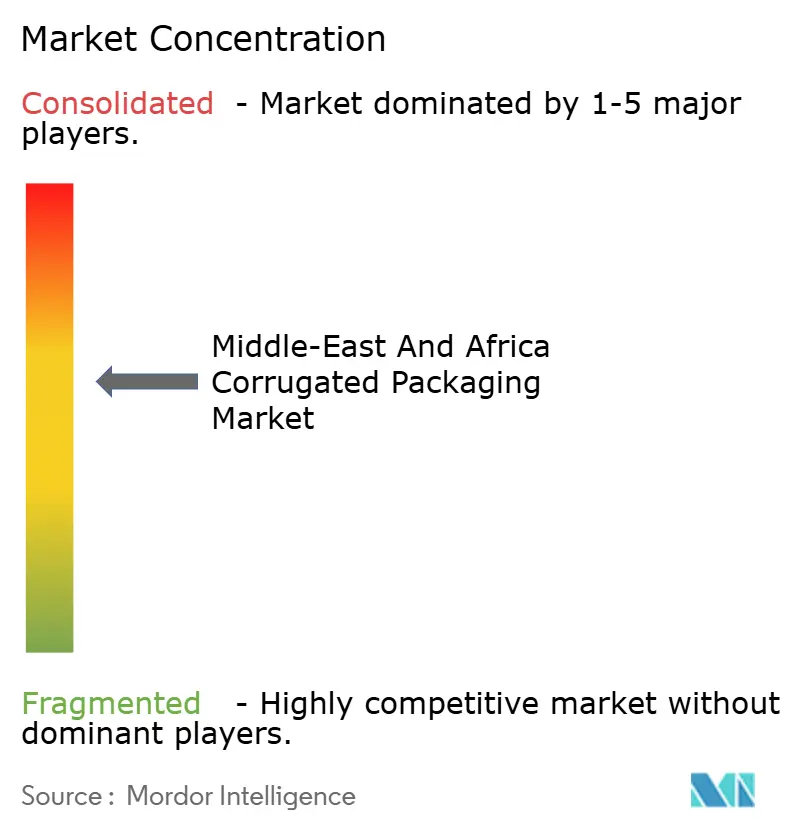
| Market Concentration | Medium |
Major Players *Disclaimer: Major Players sorted in no particular order Image © Mordor Intelligence. Reuse requires attribution under CC BY 4.0. | |
Middle-East And Africa Corrugated Packaging Market Analysis by Mordor Intelligence
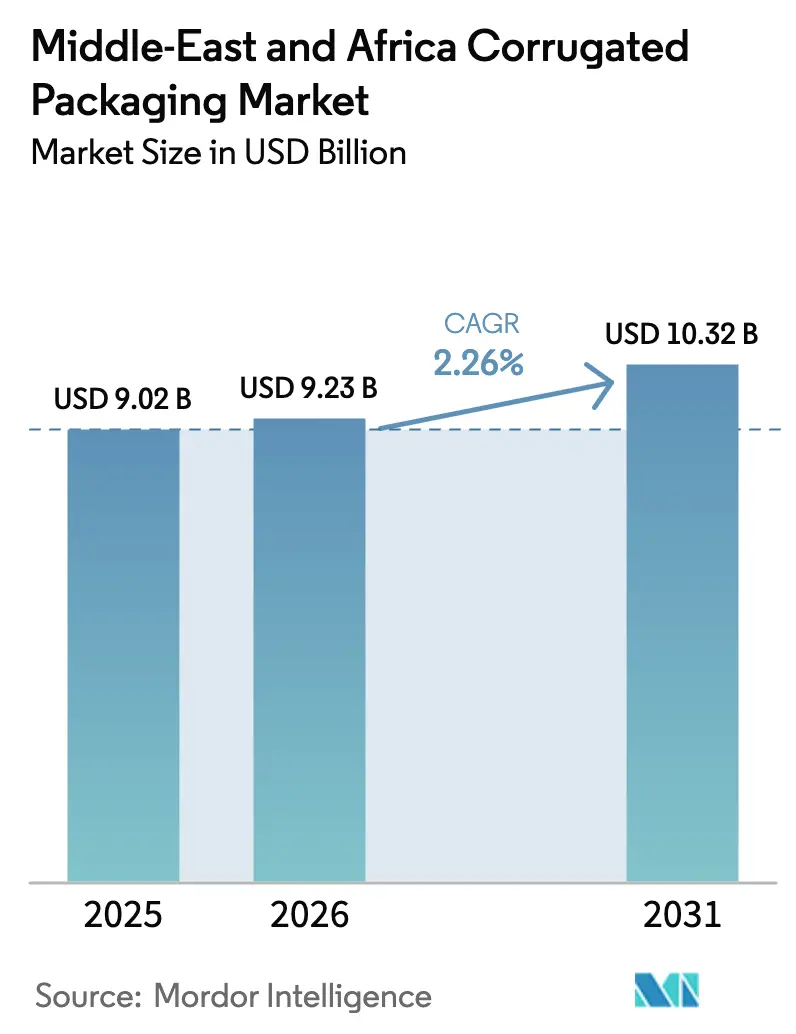
The Middle East and Africa corrugated packaging market size is projected to expand from USD 9.02 billion in 2025 and USD 9.23 billion in 2026 to USD 10.32 billion by 2031, registering a CAGR of 2.26% between 2026 and 2031. The measured trajectory conceals a strategic shift as converters pivot toward digitally enabled e-commerce logistics, extended-producer-responsibility frameworks, and AfCFTA-linked trade lanes. Local brand owners are demanding board grades that balance water efficiency with recyclability, while fast-growing online retailers in Saudi Arabia, the United Arab Emirates, Egypt, and South Africa push converters to invest in die-cut designs and micro-flute substrates. Heavy industry, fresh-produce exporters, and Government incentives for closed-loop recycling further shape procurement decisions. Competitive strategies hinge on backward integration into kraft-liner capacity, adoption of digital printing for micro-runs, and alliances with waste-management firms that secure recycled fiber.
Key Report Takeaways
- By box type, slotted containers led with 43.0 % revenue share in 2025; die-cut containers are forecast to rise at a 3.11 % CAGR through 2031.
- By board grade, single-wall board accounted for 48.2 % of the Middle East and Africa corrugated packaging market share in 2025, while triple-wall board is advancing at a 3.89 % CAGR through 2031.
- By flute size, C-Flute captured 31.4 % share in 2025, and F-Flute is projected to grow at a 2.85 % CAGR to 2031.
- By end-user, the food segment commanded 24.6 % share of the Middle East and Africa corrugated packaging market size in 2025; e-commerce and retail is expanding at a 2.78 % CAGR through 2031.
Note: Market size and forecast figures in this report are generated using Mordor Intelligence’s proprietary estimation framework, updated with the latest available data and insights as of 2026.
Market Trends and Insights
Drivers Impact Analysis of Middle-East And Africa Corrugated Packaging Market*
| Driver | (~) % Impact on CAGR Forecast | Geographic Relevance | Impact Timeline |
|---|---|---|---|
| E-commerce Boom Driving Last-Mile-Friendly Packaging | +0.80% | GCC core (Saudi Arabia, UAE), Egypt, South Africa | Short term (≤ 2 years) |
| Rapid Expansion of FMCG and Organised Retail | +0.60% | Saudi Arabia, UAE, Egypt, Nigeria, South Africa | Medium term (2-4 years) |
| Government Incentives for Local Manufacturing and Recycling | +0.50% | Saudi Arabia, UAE, Egypt, South Africa | Medium term (2-4 years) |
| Export-Oriented Fresh-Produce Logistics Growth | +0.40% | Morocco, Egypt, South Africa, Kenya | Long term (≥ 4 years) |
| Inter-African Trade Surge Under AfCFTA | +0.30% | Pan-African, early gains in East Africa and Southern Africa | Long term (≥ 4 years) |
| Digital Printing Adoption for Micro-Brands | +0.20% | GCC, Egypt, South Africa | Medium term (2-4 years) |
| Source: Mordor Intelligence | |||


E-commerce Boom Driving Last-Mile-Friendly Packaging
Online retail in the region expanded by 30% in 2024, boosting demand for die-cut cartons that slash dimensional-weight fees and withstand reverse-logistics handling.[1]World Bank Group, “Middle East and North Africa Overview,” worldbank.org Saudi Arabia’s digital-payment adoption lifted e-commerce penetration in tier-2 cities, prompting converters to specify F-Flute and micro-flute profiles for 20-30% material savings.[2]Saudi Arabian Monetary Authority, “Retail Sector Data,” sama.gov.sa In the United Arab Emirates, cross-border marketplaces require tamper-evident, multilingual graphics, intensifying interest in variable-data digital printing.[3]UAE Ministry of Economy, “Economic Performance Reports,” moec.gov.ae Inline hybrid presses shown at drupa 2024 allow runs of 500 units, letting micro-brands personalize graphics without plate lead times. Collectively, these shifts lead converters to retool for shorter order cycles, narrower flutes, and interactive QR-codes that double as returns portals.
Rapid Expansion of FMCG and Organised Retail
Hypermarket chains in Saudi Arabia, the United Arab Emirates, and Egypt are scaling into secondary cities where summer temperatures top 45 °C. Corrugated shippers must comply with Saudi Food and Drug Authority labelling, carry Arabic text, and survive high-humidity distribution. Egypt’s grocery modernisation brings ISO 22000 food-grade board to the forefront. Nigeria, while promising, contends with port congestion and currency swings that suppress cold-chain investment. Still, Gulf Cooperation Council paper-packaging output is forecast to hit USD 12.8 billion by 2032, signalling sustained retail-led demand.[4]GSO Secretariat, “GCC Paper Packaging Market Outlook,” gso.org.sa
Government Incentives for Local Manufacturing and Recycling
Egypt’s EPR levy of EGP 37.5 per kilogram on non-recycled packaging raises landed costs on virgin-fiber imports, favouring local mills with recycled-content lines. Kenya’s May 2025 EPR rules compel brand owners to underwrite collection schemes, lifting demand for baled, easily repulped corrugated. Dubai’s pilot pushes for 75 % landfill diversion by 2030, rewarding converters that secure recycled fiber and closed-loop logistics. Saudi Arabia’s Vision 2030 ties water allocation to closed-loop recycling; WASCO collected 500,000 tonnes of paper in 2024, lowering virgin-fiber dependence.
Export-Oriented Fresh-Produce Logistics Growth
South Africa shipped 31.75 million citrus cartons to Middle East buyers in the 2023-2024 season, necessitating moisture-resistant, ventilated corrugated that preserves cold-chain integrity. Morocco and Egypt export berries and dates to the European Union in wax-coated cartons fitted with modified-atmosphere liners. Kenya’s limited cold storage delays adoption of advanced boxes, yet AfCFTA tariff preferences encourage investment in durable triple-wall shippers for cross-border trucks. Converters targeting produce logistics often bundle RFID tags for traceability, feature EU importers increasingly require.
Restraints Impact Analysis of Middle-East And Africa Corrugated Packaging Market*
| Restraint | (~) % Impact on CAGR Forecast | Geographic Relevance | Impact Timeline |
|---|---|---|---|
| Volatility in Kraft Paper Supply and Prices | -0.40% | Egypt, Nigeria, Kenya, smaller Gulf markets | Short term (≤ 2 years) |
| Competition from Flexible Plastic Packaging | -0.30% | Nigeria, Kenya, smaller North African markets | Medium term (2-4 years) |
| Import-Dependent Raw-Material Logistics Risk | -0.20% | Egypt, Nigeria, Kenya | Short term (≤ 2 years) |
| Water-Scarcity-Driven Mill Regulations | -0.10% | Saudi Arabia, UAE, Egypt | Long term (≥ 4 years) |
| Source: Mordor Intelligence | |||
Volatility in Kraft Paper Supply and Prices
Egypt imports 60 % of its kraft liner, so a 10 % pound-euro slide in 2024 pushed up landed costs equivalently. Nigerian converters faced 15-20 % surcharges tied to naira depreciation and Lagos port congestion. Red Sea diversions extended Kenyan lead times from 30 to 50 days, forcing recycled-fiber substitution that compromised burst strength. Investments like Middle East Paper Company’s SAR 1.78 billion mill expansion aim to offset such volatility via regional capacity.
Competition from Flexible Plastic Packaging
Flexible pouches weigh 40-50 % less than comparable corrugated cartons, a decisive advantage in logistics-cost-heavy markets such as Nigeria and Kenya. Single-use plastic bans in Nigeria, Ethiopia, and Ghana are spurring substitution, yet inconsistent enforcement keeps plastics in play. Gulf producers lobby for transition extensions while digital-print-ready pouch lines court FMCG marketers with high-gloss graphics. Corrugated converters must match visual appeal and invest in barrier coatings to defend share.
*Our forecasts treat driver/restraint impacts as directional, not additive. The impact forecasts reflect baseline growth, mix effects, and variable interactions.
Middle-East And Africa Corrugated Packaging Market Segment Analysis
By Box Type:
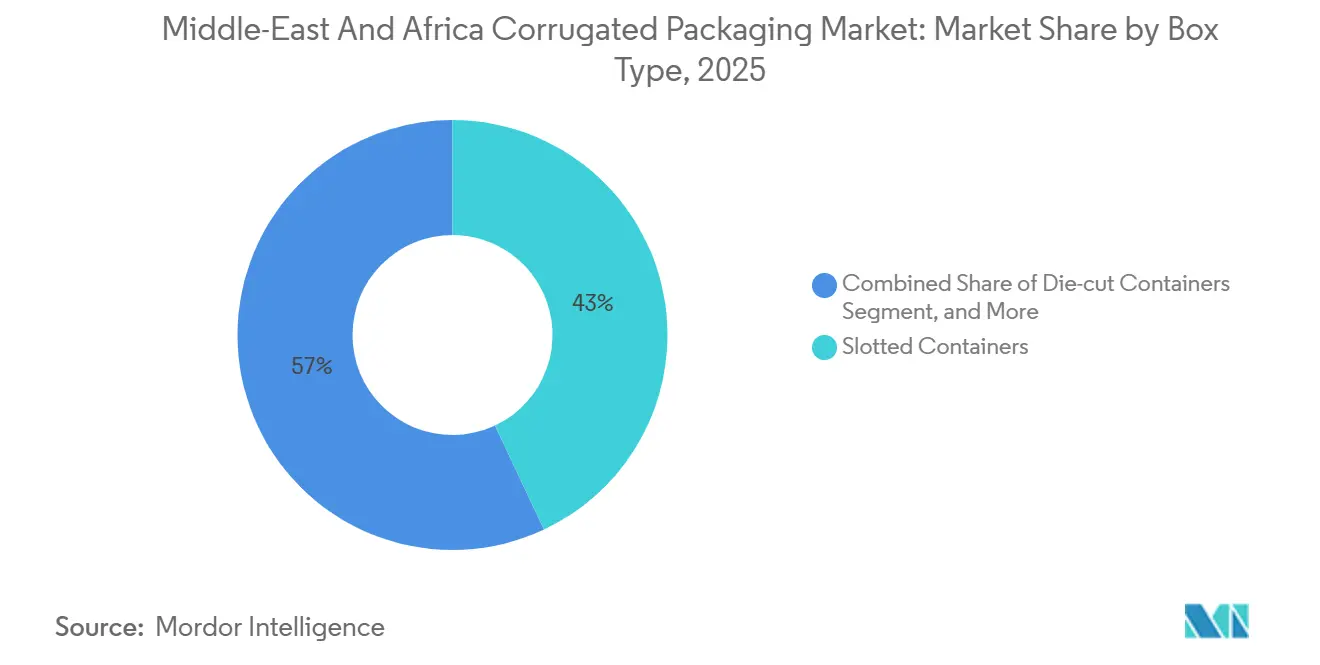
Die-Cut Containers Unlock Custom Fit for E-CommerceSlotted containers retained a 43.0 % share of the Middle East and Africa corrugated packaging market in 2025, testament to their cost efficiency and compatibility with case erectors. They remain the default for high-volume food and beverage shipments across Saudi Arabia, the United Arab Emirates, Egypt, and South Africa. Die-cut containers, however, chart a 3.11 % CAGR to 2031, outpacing the overall Middle East and Africa corrugated packaging market. E-commerce platforms mandate custom-fit packaging that trims void space and lowers dimensional-weight charges, while enhancing the unboxing moment. Inline digital-printing systems unveiled at drupa 2024 enable converters to add QR-coded graphics in runs as low as 500 units, meeting micro-brand aesthetics without tooling delays. Five-panel folders aid flat-packed apparel exports, whereas telescopic boxes serve automotive and heavy-machinery spares where two-piece construction ensures crush resistance. Bliss boxes and self-erecting containers sit in niche pharmaceutical and electronics channels that prize tamper evidence, cushioning, and rapid fulfilment.
The Middle East and Africa corrugated packaging market size for die-cut designs is projected to expand steadily as last-mile networks deepen. Converters in Gulf Cooperation Council cities are adding laser-die lines that sharpen crease tolerance, enabling self-locking flaps which reduce tape usage. This engineering shift also aligns with extended-producer-responsibility rules that penalize non-recyclable void-fill. As a result, die-cut adoption will rise fastest in markets where digital payments, reverse logistics, and smartphone penetration intersect.


By Board Grade:
Triple-Wall Board Rises on Heavy-Duty ExportsSingle-wall board accounted for 48.2 % of Middle East and Africa corrugated packaging market share in 2025. Its 200-300 psi burst strength, ample for ambient grocery distribution, and its smooth printable surface make it the workhorse across food, beverage, and FMCG lines. Double-wall board supports mid-weight consumer electronics and appliances, offering 400-500 psi while still cutting weight relative to wood crates. Triple-wall board, boasting over 1,000 psi, shows the sharpest growth at 3.89 % CAGR, propelled by AfCFTA cross-border machinery and chemicals trade. The Middle East and Africa corrugated packaging market size for triple-wall applications will accelerate as exporters seek fumigation-free, lighter alternatives to wooden crates. Middle East Paper Company’s fifth machine is tailored for heavy-duty liner grades, a signal that regional mills expect sustained demand for triple-wall capacity. Solid fiber board, despite ultimate rigidity, stays relegated to high-value electronics due to its weight premium.
Price-sensitive African corridors may initially resist triple-wall’s 30-40 % cost premium, yet total landed-cost analysis shows freight savings and damage reduction offsetting upfront spend. Trans- Sahel Road upgrades and rail links within the Horn of Africa will further underscore triple-wall’s durability advantage in rough-handling environments.
By Flute Size:
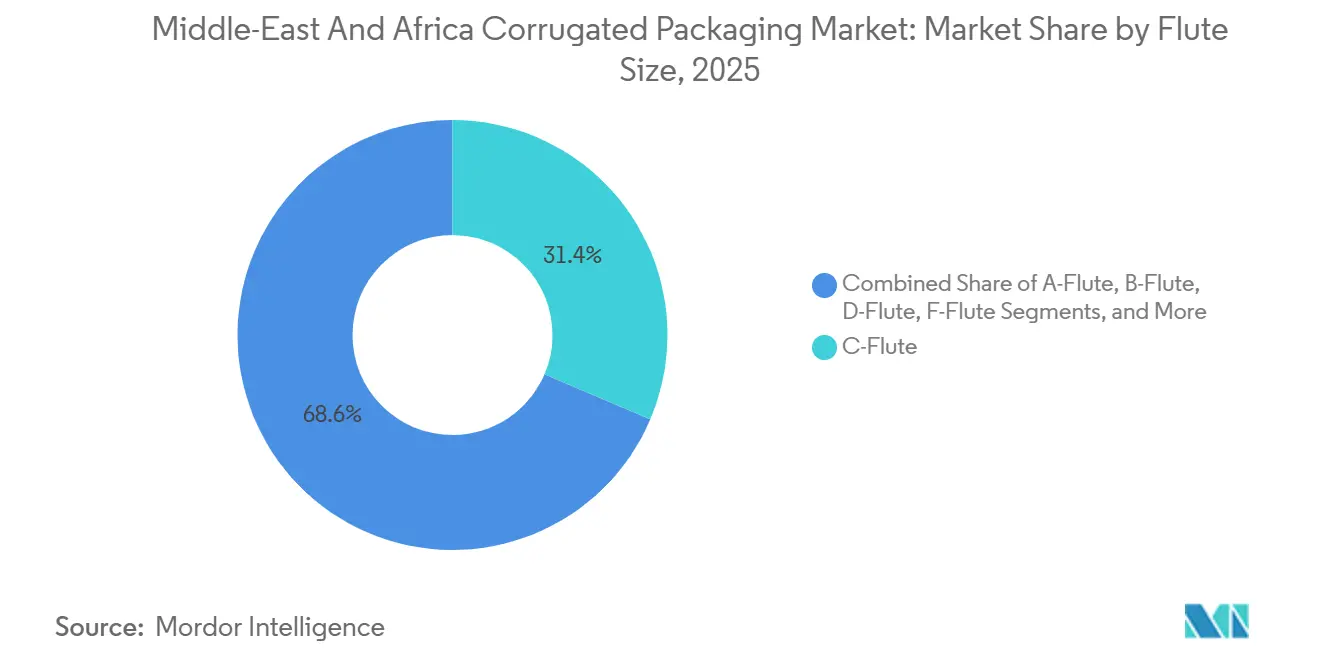
F-Flute Captures Freight-Sensitive CategoriesC-Flute, at 31.4 % share in 2025, balances cushioning and printability, anchoring the grocery and beverage verticals. B-Flute optimizes canned goods and bottled beverages where carton count per sheet drives economics. E-Flute and the ultrathin F-Flute target electronics, cosmetics, and rapid-turn textiles. F-Flute’s 2.85 % CAGR surpasses the overall Middle East and Africa corrugated packaging market, driven by consumer electronics importers in Dubai and personal-care exporters in Egypt who prize reduced dimensional weight. Metsä Board’s 2024 micro-flute launch demonstrates technical feasibility for moisture-resistant thin walls. A-Flute lingers in fragile ceramics and glass, while emerging N- and K-Flutes service specialized cushioning profiles.
Fine-screen digital print pairs well with micro-flute surfaces, allowing 150-line-per-inch resolution that rivals folding cartons. That capability gives brand owners marketing latitude without migrating to costlier solid-bleached-sulfate cartons. Consequently, micro-flutes will see the fastest uptake where unit economics and brand aesthetics converge.
By End-User Industry:
Online Retail Surges Past Mature Food BaseThe food category maintained a 24.6 % share in 2025, anchored by population growth, urban grocery formats, and ISO 22000 compliance. Beverage shippers rely on reinforced partitions to prevent bottle breakage in the Gulf’s high-heat logistics chain. Yet e-commerce and retail, advancing at 2.78 % CAGR, will emerge as the pivotal growth engine for the Middle East and Africa corrugated packaging market. As digital platforms scale, converters must integrate return-ready tear strips and smart-label numbering to accommodate reverse flows. Consumer electronics brands adopt E- and F-Flutes, pairing electrostatic-discharge coatings with narrow caliper to trim airfreight costs. Personal-care marketers leverage digitally printed corrugated for influencer-friendly unboxing; variable graphics embed sustainability messages that resonate with Gen-Z buyers.
Industrial and chemicals exporters shift from wooden crates to triple-wall to meet fumigation-free rules and slash freight weight. Agriculture and fresh produce rely on ventilated boxes lined with wax or polymer coatings to keep citrus and berries market fresh. Other verticals pharma, textiles, building supplies maintain stable but smaller demand tied to infrastructure and healthcare spending across the continent.
Geography Analysis
Middle East Corrugated Packaging Market
Saudi Arabia and the United Arab Emirates collectively anchor the Middle East quadrant of the Middle East and Africa corrugated packaging market, fuelled by retail modernization, e-commerce adoption, and Vision 2030 manufacturing incentives. Saudi retail sales hit USD 85 billion in 2024, necessitating standardized slotted cartons that endure 45 °C summer warehousing. The United Arab Emirates, a re-export nexus, ships corrugated-boxed goods onward to East Africa and South Asia, so cartons must satisfy multi-jurisdictional customs codes. Middle East Paper Company’s capacity doubling to 900,000 tpa by 2027 underlines Riyadh’s import-substitution drive. Turkey bridges European and Gulf demand but faces currency gyrations that ralent investment. Oman, Kuwait, Bahrain, and Jordan represent smaller yet steady pockets, buoyed by demographic expansion and logistics-free-zone incentives.
Africa Corrugated Packaging Market
Africa’s crown markets are Egypt and South Africa. Mondi’s EGP 5.5 billion expansion in Sadat City capitalizes on Egypt’s proximity to Mediterranean lanes and North African FMCG clusters. Egypt’s EPR surcharge nudges converters toward domestic linerboard, reducing 60 % kraft-liner import exposure. South Africa’s citrus chain shipped 31.75 million cartons to GCC buyers in the 2023-2024 season, validating demand for cold-chain-grade cartons. Nigeria’s potential is partially constrained by port delays and naira volatility, yet January 2025 plastic bans provide corrugated tailwinds. Kenya, Ethiopia, and Ghana follow with EPR rules and plastic prohibitions that accelerate paper substitution, though enforcement varies by county. Morocco leverages EU produce demand, packaging berries in RFID-tagged, wax-coated cartons to satisfy phytosanitary checkpoints. Investments by Middle East Paper Company in Zimbabwe, Malawi, and Mozambique reveal confidence that AfCFTA lanes will elevate localized carton demand in landlocked Southern African states.
Regulatory Landscape
Regulation across the Middle East and Africa is tightening around packaging waste, recycled-content traceability, and food-contact compliance, which is raising the practical obligations for corrugated packaging users and converters. Kenya implemented the Sustainable Waste Management Act (Legal Notice No. 176 of 2024) effective 5 May 2025, shifting responsibility for collection and recycling onto producers and importers. Egypt also introduced EPR-linked measures (including schemes affecting shopping bags) in March 2025, increasing the cost of non-recycled packaging formats and encouraging locally sourced, recyclable fiber-based solutions.
Standards bodies and sector regulators add another layer of compliance. In the GCC, GSO standards are applied with varying mandatory status across Saudi Arabia, UAE, Kuwait, and Qatar, with enforcement and labeling oversight running through agencies such as the Saudi Food and Drug Authority (SFDA) and UAE standardization bodies (including ESMA-related frameworks). In East Africa, the EAC notified the WTO in April and May 2025 of adopted food-contact packaging standards, while national institutions such as the Egyptian Organization for Standardization and Quality (EOS) and the Institute of Ethiopian Standards (IES) remain central for testing, labeling, and technical committee alignment (ISO/ARSO/AIDMO participation).
Value Chain Analysis
The regional corrugated value chain starts with recovered paper collection and virgin fiber or imported kraft liner, then moves through containerboard mills, corrugators (sheet plants), and converting (printing, die-cutting, folder-gluing), followed by distribution to end users such as food, FMCG retail, e-commerce, and export-oriented produce logistics. Supply risk is concentrated upstream, since several markets remain import-dependent for kraft liner and are exposed to freight disruptions and FX volatility. This makes local linerboard capacity and stable recovered-fiber flows more important, including Saudi Arabia’s scale-up of recovered paper collection through WASCO.
Downstream, converters differentiate through short lead times, micro-flute capability, and higher-graphics printing. They also increasingly pair these with compliance documentation for food-contact applications and recycled-content reporting demanded by brand-owner ESG scorecards. The operational footprint of key players illustrates how end-market requirements shape execution, with Arabian Packaging running corrugated production in Dubai alongside a broader MEA and South Asia footprint, and Queenex Corrugated Carton Factory operating a 10,000 sq m facility in Mussafah, Abu Dhabi to produce RSC, trays, and telescopic boxes. As procurement teams optimize freight weight and reduce non-recyclable components, converting capabilities like multi-color print, die-cutting, and fit-to-product design have become more central to retaining customers across retail and cross-border distribution.
Competitive Landscape
The Middle East and Africa corrugated packaging market features moderate concentration. Multinationals Mondi, Smurfit Kappa, and International Paper pair scale economics with integrated kraft capacity. Regional champions Middle East Paper Company, INDEVCO, Obeikan, Arabian Packaging, and Napco capitalize on agility, local languages, and regulatory familiarity. Mondi’s USD 180 million Sadat City phase-up focuses on food-grade linerboard for North African and EU outlets. Middle East Paper Company’s SAR 1.78-billion-line targets 30 % Saudi share and eastern-Africa exports, supplied in part by WASCO’s 500,000-tonne recovered fiber harvest. Extended-producer-responsibility levies in Egypt, Kenya, and Dubai penalize single-use plastics, positioning corrugated integrators with recycling muscle for share gains.
White-space opportunities include digital print for micro-brands, die-cut boxes tuned to e-commerce, and triple-wall board substituting wooden crates in AfCFTA corridors. Gulf plants roll out inline inkjet units showcased at drupa 2024, allowing 48-hour turnarounds on QR-coded cartons. Smaller African mills still rely on two-colour flexography, limiting their bids for premium jobs. Waste-management joint ventures like WASCO are vertically integrating into corrugation, threatening incumbents reliant on imported kraft. In the Gulf, only 10 % of 9 million tonnes of annual packaging waste is recycled, prompting likely consolidation of under-invested mills as EPR fees bite.
Middle-East And Africa Corrugated Packaging Industry Leaders
Arabian Packaging Co. LLC
Queenex Corrugated Carton Factory LLC
United Carton Industries Company (JSC)
Napco National CJSC
Cepack Group SARL
- *Disclaimer: Major Players sorted in no particular order
Middle-East And Africa Corrugated Packaging Market Companies Covered in this Report
- Arabian Packaging Co. LLC
- Queenex Corrugated Carton Factory LLC
- United Carton Industries Company
- Napco National CJSC
- Cepack Group SARL
- Falcon Pack IND LLC
- World Pack Industries LLC
- Universal Carton Industries Group LLC
- Express Pack Print LLC
- Green Packaging Boxes Industries LLC
- Tarboosh Packaging Co. LLC
- Unipack Containers & Carton Products LLC
- Al Rumanah Packaging LLC
- NBM Pack LLC
- Mondi plc
- Smurfit Kappa Group plc
- International Paper Company
- Middle East Paper Company
- INDEVCO Paper Containers SAL
- Obeikan Paper Industries Co.
- National Paper Company SAE
- RAK Packaging LLC
- Al Bayader International LLC
- Hadera Paper Ltd. (Amnir Corrugated)

Market Opportunities and Future Outlook
White space is emerging around EPR-compliant, high-recyclability corrugated solutions that reduce plastic and mixed-material components while still meeting food-contact and labeling requirements across multiple jurisdictions. Practical opportunities cluster in compliance-ready designs for exporters operating under harmonization efforts, including East African Community standards that formalize composition, testing, and food-contact requirements for intra-regional trade. In the GCC, GSO-aligned labeling and SFDA-led enforcement are also pulling demand for consistent pack specifications across retail chains.
Logistics-linked partnerships and network upgrades further support differentiated offerings in transport-efficient corrugated formats. These include right-sized die-cut boxes and lightweight micro-flute structures that can cut dimensional weight in last-mile delivery. Arabian Packaging has highlighted logistics integration initiatives with Etihad Rail and DHL, targeting a 37% CO2 reduction through sustainable freight solutions, which indicates customer pull for packaging suppliers that link box performance with measurable distribution emissions improvements. For converters, the opportunity set includes closed-loop fiber sourcing arrangements with waste-management partners, higher-spec moisture and compression performance for produce exports, and faster-turn, variable-graphics capability for micro-brands and cross-border marketplace requirements without long plate lead times.
Recent Industry Developments in Middle-East And Africa Corrugated Packaging Market
- February 2026: United Carton Industries Company (UCIC) announced an expansion project for the Ras Al Khaimah plant in the UAE, undertaken by Ras Al Khaimah Packaging LTD Co., with an estimated cost of USD 20.2 million. The expansion broadens local capacity to meet growing demand for corrugated packaging in the MEA region. The project strengthens UCIC's integrated packaging capabilities and supports regional supply resilience.
- September 2025: Mondi completed phase one of Sadat City expansion in Egypt, adding 30,000 tpa of containerboard. The expansion increases supply capacity for MEA corrugated packaging. The move strengthens integrated kraft capacity to support regional demand.
- August 2025: Napco National CJSC completed acquisition of Arabian Flexible Packaging to strengthen regional footprint. The consolidation expands Napco's regional packaging portfolio. The deal supports integrated packaging offerings and local content initiatives in UAE.


Middle-East And Africa Corrugated Packaging Market Report Scope and Research Methodology
Market Definition and Coverage
For this report, the market is defined as revenue generated from corrugated packaging used across Middle East and Africa, covering the sale of finished corrugated boxes and related corrugated formats supplied to end users.
Scope exclusions: This sizing excludes non-corrugated paper packaging like folding cartons, molded fiber, and paper bags, and it also excludes plastic or metal transport packaging.
Segments Covered in This Report
- By Box Type
- Slotted Containers
- Die-cut Containers
- Five-panel Folder Boxes
- Telescopic Boxes
- Other Box Types
- By Board Grade
- Single-wall Board
- Double-wall Board
- Triple-wall Board
- Solid Fiber Board
- By Flute Size
- A-Flute
- B-Flute
- C-Flute
- E-Flute
- F-Flute
- Other Flutes
- By End-User Industry
- Food
- Beverage
- Consumer Electronics and Electrical Appliances
- Personal Care and Household Care
- Industrial and Chemicals
- Agriculture and Fresh Produce
- E-commerce and Retail
- Other End-Users
- By Geography
- Middle East
- Saudi Arabia
- United Arab Emirates
- Turkey
- Rest of Middle East
- Africa
- Egypt
- South Africa
- Nigeria
- Rest of Africa
- Middle East
Data Sources, Market Sizing, and Validation
Desk Research
Desk research was used to map the supply chain and set realistic guardrails for demand by country and by key end use. We mainly pulled public statistics and technical references that describe containerboard and corrugated board flows, recycling rates, and trade movements that impact local box consumption.
Sources included public and official references such as UN Comtrade for paper and paperboard trade, national statistics offices and customs authorities in the region, central bank FX and inflation series, and environmental agencies that publish recycling and waste indicators. We also reviewed materials and packaging standards references such as ISO documentation, along with peer reviewed papers on corrugated performance and fiber recovery, and we complemented this with company filings, investor presentations, association websites, and reputable press. For a few narrow checks, subscription datasets were used for company financials and intelligence, patent lookups, and shipment-level trade views, and the desk sources listed here are illustrative only since many other references were used for validation and clarification.
Primary Interviews and Surveys
Primary work focused on validating the split between local production and imported packaging materials, typical pricing behavior, and the pace of change in end-user demand (especially export produce, processed foods, and e-commerce fulfillment). We spoke with converters, containerboard and paper suppliers, distributors, and large packaging buyers across major markets in the Gulf, North Africa, and Southern Africa, and the feedback was used to close gaps in utilization, product mix, and margin assumptions before finalizing the model.
Distribution of primary research fieldwork respondents
| Company type | Respondent position |
|---|---|
| Top tier: 28% | CXOs: 13% |
| Mid tier: 55% | Functional/Unit leaders: 36% |
| Smaller Players: 17% | Managers: 51% |
Market-Sizing & Forecasting
Sizing started with a top-down build where containerboard availability, trade balances for relevant paper grades, and converting intensity were used to reconstruct the addressable corrugated packaging demand pool by sub-region. After the first pass totals were formed, they were stress-tested using selective bottom-up approximations, such as sampled converter revenue checks, channel pricing discussions, and box consumption patterns reported by large buyers, which then helped adjust outliers.
Inputs that mattered in this market included corrugated board pricing trends linked to kraftliner and recycled medium movements, export-oriented fresh produce volumes that pull higher box demand seasonally, retail and e-commerce shipment intensity that shifts box mix, and country-level currency and inflation effects that move reported USD values. Where direct local data was thin, gaps were handled by using proxy indicators, such as trade flows for paper inputs and known manufacturing hubs, and then narrowing the estimate through interview-based ranges.
Forecasts were built using scenario analysis supported by a short multivariate regression layer for the variables that showed stable relationships over time, such as output growth in food processing and export activity, trade-led industrial demand, and packaging price pass-through. Assumptions were kept simple and repeatable, and each forecast step was checked for realism against constraints like capacity additions, recycling feedstock availability, and import dependence.
Data Validation & Update Cycle
Outputs were validated through multiple checks that compare the model results with independent signals, including trade trends, price movements for key paper inputs, and country-level manufacturing and retail activity. When a variance looked too wide, the drivers were re-opened, and experts were re-contacted to confirm whether the gap came from product mix, pricing, or timing effects.
Before sign-off, the model goes through step-by-step analyst review so arithmetic, units, and currency conversions stay consistent, and so country totals reconcile to the regional number. The report is refreshed annually, and interim updates are made when material events occur, such as sharp paper price swings, major capacity changes, or policy shifts affecting recycling and packaging rules. Before delivery, a final pass is done so clients receive the most current view available.
Mordor Intelligence's Middle East and Africa Corrugated Packaging Market Size Compared Against Other Published Estimates
Published values for MEA corrugated packaging often differ because each publisher draws the scope line differently and then applies different price and conversion assumptions across a region with uneven data coverage. Even if the geography label looks the same, the inputs behind volumes, average selling prices, and FX timing can vary a lot.
Some estimates fold in broader paper-based packaging revenue, and they may also blend corrugated board, folding cartons, and other adjacent formats into one number. For Mordor Intelligence, the market total is limited to corrugated packaging revenue only, and the USD series is kept consistent using base-year pricing logic and country checks that are re-validated through interviews, which reduces over-counting when paper price inflation spikes.
Benchmark comparison
| Source | Market Size | Gaps in Research Methodology |
|---|---|---|
| Mordor Intelligence | USD 9.02 B (2025) | |
| Trade Publisher A | USD 26.80 B (2024) | The figure appears to use a wider basket that blends corrugated packaging with other paper packaging formats, and it likely applies a different base year with a higher assumed price level, which inflates the total when compared on a like-for-like corrugated-only basis. |
| Packaging Portal B | USD 38.37 B (2024) | This value looks consistent with an expanded scope and aggressive inclusion of adjacent materials and services, and the methodology is not transparent on how box volumes are converted to revenue across countries with different import dependence and currency conditions. |
The spread across sources is mostly explained by scope expansion beyond corrugated packaging and by differences in how pricing and currency timing are handled across MEA. By keeping the count tied to clear corrugated-only revenue drivers and then cross-checking assumptions with grounded channel feedback, the resulting number stays traceable to repeatable steps rather than broad category roll-ups.


Key Questions Answered in the Report
What is the projected value of the Middle-East and Africa corrugated packaging market in 2031?
The market is forecast to reach USD 10.32 billion by 2031, reflecting a 2.26 % CAGR between 2026 and 2031.
Which board grade is growing fastest in regional demand?
Triple-wall board leads, registering a 3.89 % CAGR on the back of heavy-duty industrial and AfCFTA export shipments.
How are extended-producer-responsibility rules influencing packaging choices?
EPR fees in Egypt, Kenya, and Dubai raise costs on non-recycled or plastic formats, steering brand owners toward locally sourced, recyclable corrugated boxes.
Why are die-cut containers gaining share over slotted containers?
E-commerce platforms need custom-fit cartons that reduce void space, cut dimensional-weight charges, and deliver branded unboxing experiences.
Which countries are key growth hubs for corrugated packaging in Africa?
Egypt and South Africa lead in consumption and capacity, while Nigeria, Kenya, and Ghana show rising demand fueled by plastic bans and organized retail expansion.
How does digital printing impact the corrugated sector in the region?
Inline inkjet hybrids enable short-run, variable graphics, allowing converters to serve micro-brands and e-commerce sellers without expensive plates or long lead times.
Page last updated on:





