
Middle East Corrugated Packaging Market Size and Share
Market Overview
| Study Period | 2020 - 2031 |
|---|---|
| Forecast Data Period | 2026 - 2031 |
| Historical Data Period | 2020 - 2024 |
| Market Size (2026) | USD 7.27 Billion |
| Market Size (2031) | USD 8.77 Billion |
| Growth Rate (2026 - 2031) | 3.82 % |
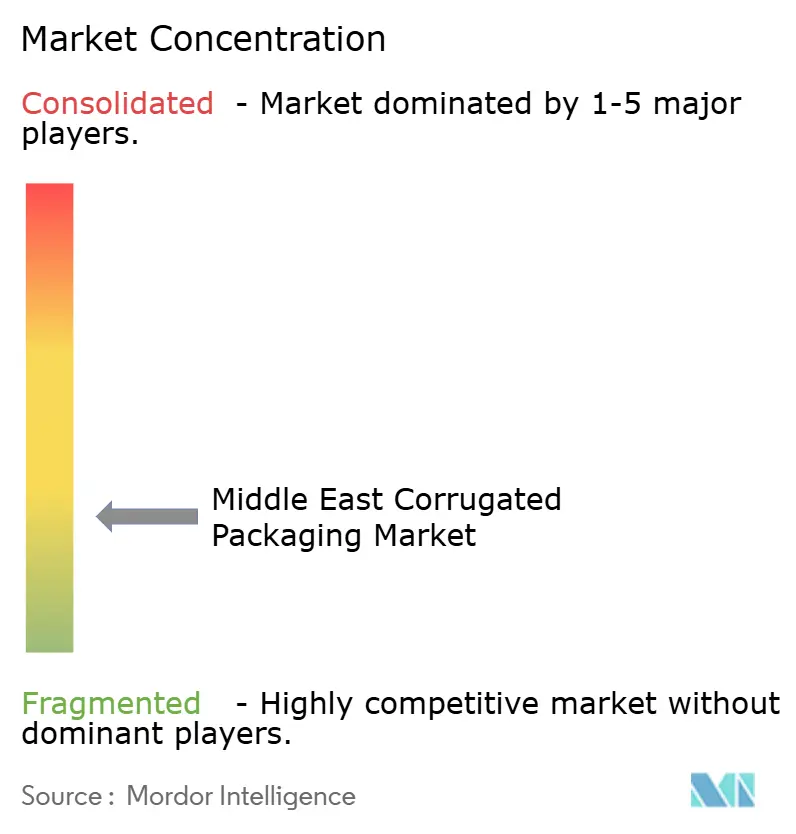
| Market Concentration | Low |
Major Players *Disclaimer: Major Players sorted in no particular order Image © Mordor Intelligence. Reuse requires attribution under CC BY 4.0. | |
Middle East Corrugated Packaging Market Analysis by Mordor Intelligence
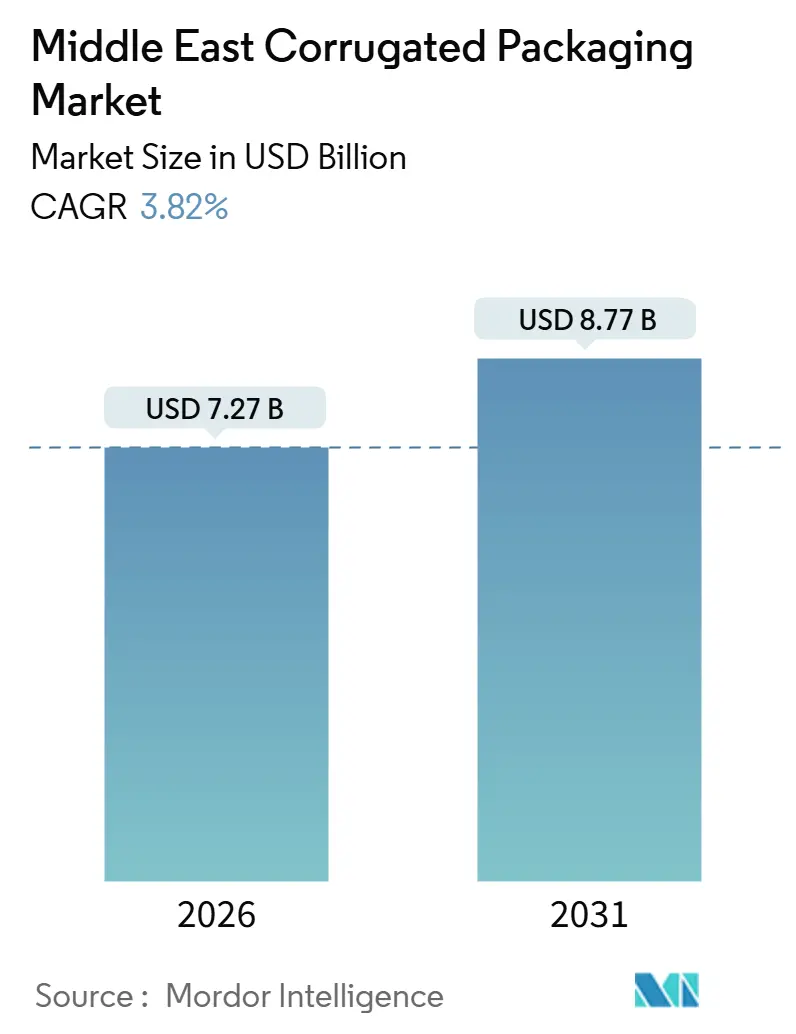
The Middle East corrugated packaging market size stands at USD 7.27 billion in 2026 and is projected to reach USD 8.77 billion by 2031, expanding at a 3.82% CAGR, according to Mordor Intelligence data. Rising e-commerce penetration, government-backed industrial diversification, and investments in regional cold-chain infrastructure continue to reshape demand, moving the market beyond its traditional food and beverage core. Online retailers demand lightweight, digitally printed boxes that can be produced in variable runs, while manufacturers in Saudi Arabia and the United Arab Emirates (UAE) are specifying heavy-duty, triple-wall formats for export shipments. Micro-flute profiles that save shelf space and improve graphics are gaining share in premium consumer goods, and converters investing in hybrid digital-flexographic presses are securing short-run orders at premium margins. Currency shifts and pulp volatility have raised operating risk, yet backward-integrated mills enjoy cost protection and are building capacity in lightweight liner grades to serve the next wave of e-commerce growth.
Key Report Takeaways
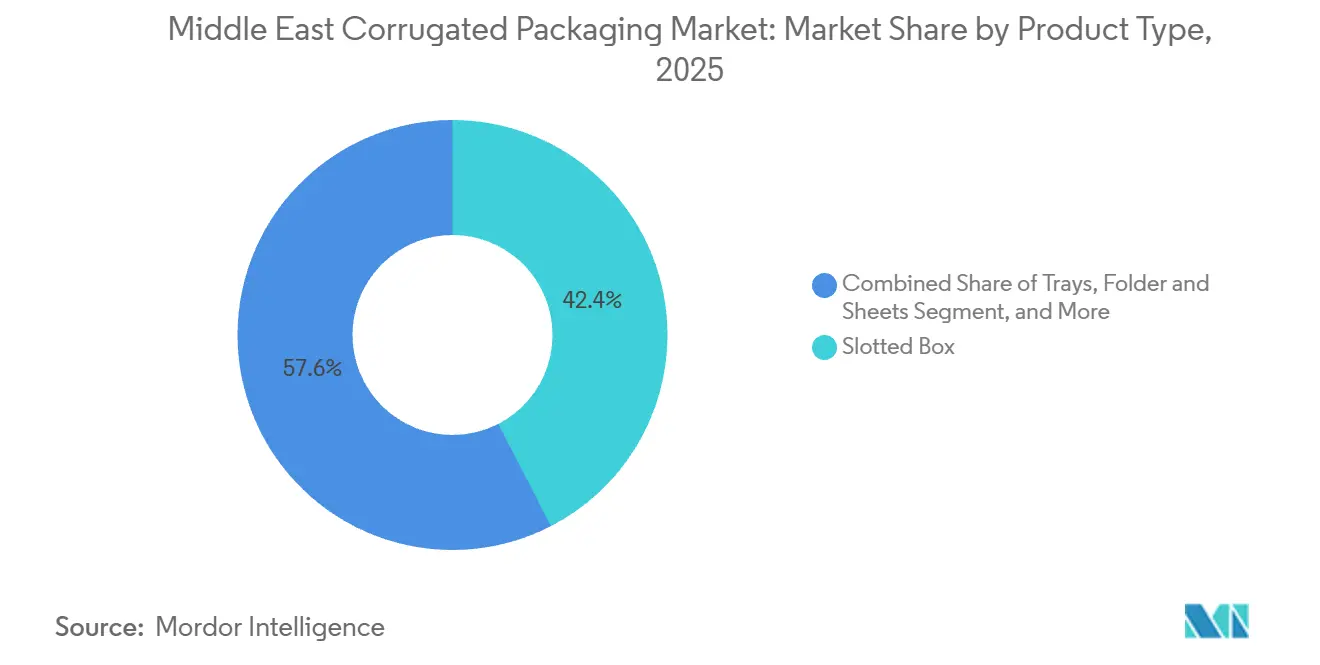
- By product type, slotted boxes led with 42.43% of the Middle East corrugated packaging market share in 2025, while trays and folders recorded the highest projected CAGR at 5.66% through 2031.
- By board type, single-wall held 38.32% of the Middle East corrugated packaging market share in 2025 and triple-wall is forecast to expand at 4.32% CAGR to 2031.
- By flute profile, C-flute captured 32.54% share of the Middle East corrugated packaging market size in 2025 and F-flute is advancing at a 4.65% CAGR through 2031.
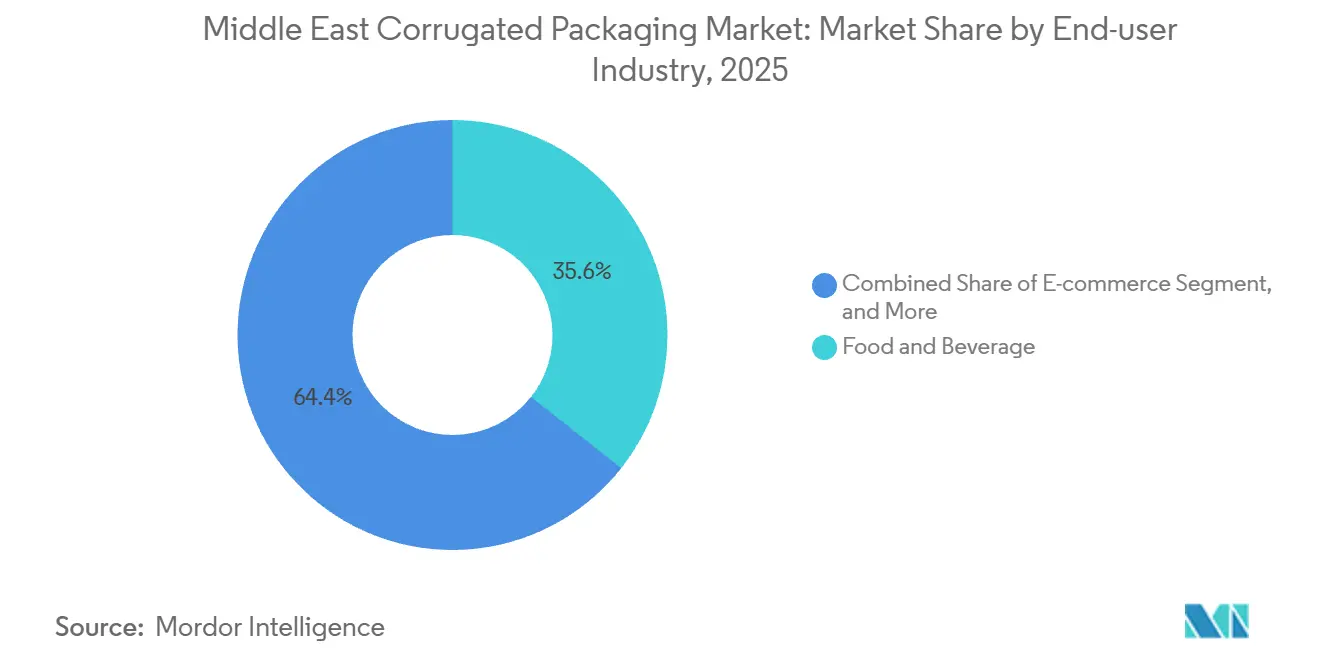
- By end user, food and beverage commanded 35.63% share in 2025, whereas e-commerce posts the fastest 4.73% CAGR through 2031.
- By print technology, flexography accounted for 28.54% of the Middle East corrugated packaging market share in 2025 and digital printing shows a 4.54% CAGR outlook to 2031.
- By geography, Saudi Arabia dominated with 32.34% share in 2025 and Jordan is the fastest growing country at 5.01% CAGR through 2031.
Note: Market size and forecast figures in this report are generated using Mordor Intelligence’s proprietary estimation framework, updated with the latest available data and insights as of January 2026.
Market Trends and Insights
Drivers Impact Analysis of Middle East Corrugated Packaging Market*
| Driver | (~) % Impact on CAGR Forecast | Geographic Relevance | Impact Timeline |
|---|---|---|---|
| E-commerce boom accelerating corrugated demand | +1.2% | Saudi Arabia, UAE, Qatar | Short term (≤ 2 years) |
| Food delivery growth in GCC nations | +0.8% | Saudi Arabia, UAE, Kuwait | Medium term (2-4 years) |
| Government-led industrial diversification projects | +0.9% | Saudi Arabia, UAE, Jordan | Long term (≥ 4 years) |
| Shift toward lightweight high-strength boards | +0.5% | Regional, strongest in UAE and Saudi Arabia | Medium term (2-4 years) |
| Digital printing adoption for short-run packaging | +0.4% | UAE, Saudi Arabia, Qatar | Short term (≤ 2 years) |
| Temperature-controlled date export packaging | +0.3% | Saudi Arabia, UAE | Medium term (2-4 years) |
| Source: Mordor Intelligence | |||
E-Commerce Boom Accelerating Corrugated Demand
Gulf Cooperation Council (GCC) online sales reached USD 50 billion in 2025, up 30% year-over-year, and every additional parcel shipped translates into at least one corrugated unit consumed. Brand owners demand custom graphics, return-ready tear strips, and pack-to-fit algorithms that reduce freight costs, pushing converters toward digital presses capable of printing lots as small as 500 units. Saudi Arabia’s National Industrial Development and Logistics Program earmarked USD 427 billion for delivery hubs and automated sortation centers, each standardized around dimensional-weight optimized box footprints.[1] Local converters that still rely on long-run flexographic lines risk losing share to agile plants that offer 48-hour turnaround and variable-data printing. Cross-border sellers from China and India have already set the benchmark for lightweight, high-graphic packaging, raising regional customer expectations.
Food Delivery Growth in GCC Nations
The GCC food-delivery channel is projected to generate USD 30 billion by 2028, with Saudi Arabia and the UAE accounting for 70% of orders and driving corrugated demand toward moisture-resistant single-wall boxes.[2] Cloud kitchens and dark stores, which numbered over 1,200 in the region by end-2025, insist on packaging that maintains temperature for at least 45 minutes while surviving condensation. Converters coat boards with polyethylene or wax emulsions, raising material cost 8-12% but enabling restaurant chains to charge premium delivery fees. Subscription meal-kit providers use vented trays that extend the shelf life of fresh produce by up to 3 days, thereby reducing food waste. So far, GCC regulators have issued few binding rules on food-delivery packaging, leaving performance standards to competitive differentiation rather than compliance.
Government-Led Industrial Diversification Projects
Saudi Arabia’s Public Investment Fund invests USD 40 billion per year in industrial cities such as Jazan and Ras Al-Khair, attracting export-oriented factories that will consume an extra 1.2 million tons of corrugated annually by 2031. The UAE’s Operation 300bn strives to lift industrial gross domestic product (GDP) to AED 300 billion (USD 81.7 billion) by 2031, which requires clean-room-compatible corrugated dunnage for aerospace parts and medical devices. Jordan’s free-trade zones extend duty-free access to U.S. and European markets, inviting multinational brands to source competitively priced boxes that meet ISO 9001 and ISO 14001 standards. Over time, the region moves from import-dependent retail consumption toward export-oriented manufacturing, rewarding converters that certify quality systems and offer heavyweight triple-wall formats.
Shift Toward Lightweight High-Strength Boards
Hybrid fiber formulations, including nano-cellulose coatings, enable a 15-20% basis-weight reduction while holding edge-crush values above 32 pounds per square foot, cutting both material and freight cost. International Paper and WestRock license these formulations to regional mills, and Saudi plants are adding refining lines that make lightweight liner grades locally, displacing imports that carry 5-7% tariffs. For e-commerce shippers, lighter boxes avoid higher dimensional-weight charges and lower Scope 3 carbon emissions by up to 18% for every ton-mile transported. Retailers increasingly choose suppliers able to document such carbon savings, giving technical innovators a clear margin edge.
Restraints Impact Analysis of Middle East Corrugated Packaging Market*
| Restraint | (~) % Impact on CAGR Forecast | Geographic Relevance | Impact Timeline |
|---|---|---|---|
| Kraft paper price volatility | -0.6% | Regional, strongest impact in Saudi Arabia and UAE | Short term (≤ 2 years) |
| Water scarcity impact on paper mills | -0.4% | Saudi Arabia, UAE, Jordan | Long term (≥ 4 years) |
| Import tariffs on recovered paper | -0.3% | Saudi Arabia, UAE, Qatar | Medium term (2-4 years) |
| Rise of reusable plastic crates in produce sector | -0.2% | UAE, Oman, Saudi Arabia | Medium term (2-4 years) |
| Source: Mordor Intelligence | |||
Kraft Paper Price Volatility
Northern Bleached Softwood Kraft (NBSK) pulp prices fell from USD 1,400 per ton in 2022 to USD 800-900 in 2024, yet containerboard prices slipped only 15-20%, compressing converter margins by up to 300 basis points. The Middle East imports 60% of its kraft liner, leaving converters exposed to freight surcharges during Red Sea disruptions and dollar strength cycles. Domestic mills tie prices to global benchmarks, so tariffs give limited shelter. Backward-integrated players, such as Obeikan Industrial Investment Group, enjoy a 150-200 basis-point cushion, and they continue to invest in capacity while smaller firms defer automation.
Water Scarcity Impact on Paper Mills
Paper production requires 15-20 gallons of water per pound of output, a challenge in Saudi Arabia, where non-renewable aquifers are declining by 2-3% per year.[3] Desalinated water costs USD 1.50-2.00 per cubic meter, adding USD 30-40 to the cost of every ton of containerboard made in coastal mills. The UAE recovers up to 90% of process water through closed-loop systems, but at upfront costs of USD 5-8 million per mill, beyond the reach of many family-owned converters. Jordan’s per-capita renewable-water availability slipped below 100 cubic meters in 2024, ensuring that future containerboard capacity will cluster near seawater-fed locations, while inland converters will rely on imported parent rolls.
*Our forecasts treat driver/restraint impacts as directional, not additive. The impact forecasts reflect baseline growth, mix effects, and variable interactions.
Middle East Corrugated Packaging Market Segment Analysis
By Product Type:
Trays and Folders Gain Share in Retail-Ready FormatsSlotted boxes maintained 42.43% of 2025 revenue, anchoring shipments in bulk logistics and general merchandise. Trays, folders, and sheets, however, show a 5.66% CAGR through 2031, propelled by club-store merchandising and direct-to-consumer (DTC) models that prefer open-top or self-display formats. The Middle East corrugated packaging market benefits when supermarket operators demand shelf-ready designs that avoid secondary handling, reducing labor cost up to 30%. Digital print capability allows rapid artwork changes for seasonal promotions, and converters report margin uplifts of 15% on specialty trays versus commodity regular slotted containers. Telescope and multi-piece boxes occupy heavy-duty niches, such as industrial machinery, where two-piece designs reduce corner-crush failures. Corrugated pallets and die-cut shapes serve pharmaceuticals and electronics, delivering high protective performance in compact footprints.
Trays and folders also align with cold-chain expansion, carrying vented produce that reaches retail coolers faster, cutting spoilage by 2-3 days. Meal-kit providers prefer folded mailers that fit standard courier lockers, a format boosted by food-delivery growth. As a result, the Middle East corrugated packaging market size allocated to trays and folders will rise steadily. Converters that master quick-change die-cutting and high-resolution graphics look set to capture this incremental volume, especially in the UAE, where e-grocery shipments already exceed 1 million orders per week.

By Board Type:
Triple-Wall Demand Rises with Industrial ExportsSingle-wall accounted for 38.32% share in 2025, dominating e-commerce, fast food, and light industrial uses where unit cost drives specification. Double-wall satisfies mid-weight appliances and consumer electronics, offering improved stacking without high material expense. Triple-wall grows 4.32% CAGR through 2031 on the back of Saudi and UAE heavy machinery exports, which require crush resistances above 1,000 pounds. Industrial estates such as King Salman Energy Park ship gas turbines in triple-wall cartons fitted with polyethylene vapor barriers, preventing corrosion during sea voyages.
Regional converters expand heavy-duty corrugator lines capable of laminating three mediums in a single pass, cutting production time by 30-40%. Triple-wall producers that certify ISO 9001 quality systems command price premiums, because multinational buyers stipulate global standards. Over time, the Middle East corrugated packaging market share for triple-wall aligns closely with capital-goods export growth. Although raw material costs are higher, unit economics are protected by specialized design fees and value-added cushioning inserts.
By Flute Profile:
F-Flute Advances in Premium Consumer GoodsC-flute held 32.54% share in 2025 owing to its general-purpose balance of cushioning and stacking strength. E-flute continued to gain in cosmetics and ready-to-display snacks, offering lithographic print quality and 10-15% volume savings. F-flute, at only 0.03 inch flute height, leads growth at 4.65% CAGR, locked into premium chocolates, perfumes, and smartphones sold in the UAE luxury retail channel. Its fine profile bridges the gap between folding carton appearance and corrugated durability, a key selling point in brand-conscious segments.
Converters adopting F-flute must invest in precision rotary scoring and laser die-cutting to avoid flute-tip crush, adding USD 200,000-300,000 to each line. Despite the capex, payback generally occurs within 24 months, given the 20-25% margin uplift that micro-flute formats fetch. The Middle East corrugated packaging market size in F-flute remains small relative to mainstream C- and B-flute, yet its faster growth signals a structural shift toward premiumization, especially in channels influenced by tourism and duty-free retail.
By End-User Industry:
E-Commerce Outpaces Traditional SegmentsFood and beverage dominated with 35.63% of revenue in 2025, spanning fresh produce, dairy, and processed foods that ship daily across the region. E-commerce, however, posts a 4.73% CAGR outlook and represents the single largest incremental opportunity, because every online order needs a branded shipper that also serves as a return package. Saudi pharmaceutical production is targeted to reach USD 8 billion by 2030, requiring tamper-evident boxes, while personal-care brands demand grease-proof liners and high-graphic lids to support in-store visibility.
Industrial manufacturers exporting auto parts and construction modules specify double- and triple-wall boxes with reinforced corners. Electronics assemblers insist on anti-static coatings and custom foam inserts, creating niche value pools. As online retail and localized manufacturing advance in parallel, converters able to toggle between short-run customized jobs and regular commodity orders will outperform the market. Consequently, the Middle East corrugated packaging market benefits from a diversified demand base that mitigates cyclical risk in any single sector.
By Print Technology:
Digital Gains Ground in Short-Run ApplicationsFlexography retained 28.54% share in 2025 due to its high speed and low cost per thousand at run lengths above 10,000 units. Lithography remains the gold standard for photographic graphics but incurs a 20-30% cost premium because sheets must be laminated to board. Digital printing, growing 4.54% CAGR, eliminates plates and enables same-shift artwork changes, a capability prized by e-commerce merchants and small and medium enterprises (SMEs) marketing limited-edition products. The UAE alone processed 1.2 million e-commerce parcels per day in 2025, each of which was a candidate for personalized messaging.
Converters installing HP Indigo, EFI Nozomi, or Durst platforms secure orders that flexo operators decline, boosting average selling prices by 15-20%. Hybrid workflows that gang digital and flexo on the same line maximize asset utilization and keep per-unit cost competitive. Ultimately, the Middle East corrugated packaging market will reflect a dual-print landscape, flexo for bulk, digital for agility. Plants that master both technologies are best positioned to meet volatile customer lead-time needs.
Geography Analysis
Saudi Arabia Corrugated Packaging Market
Saudi Arabia led the Middle East corrugated packaging market with 32.34% share in 2025, lifted by USD 1 trillion in Public Investment Fund allocations across manufacturing zones, logistics corridors, and export-oriented industries. Containerboard capacity reached 1.2 million tons, and domestic mills are shifting to lightweight liner grades that align with parcel-delivery growth. Date exporters shipped 133,000 tons in 2024, generating box demand for moisture-barrier cartons fitted with ventilation features, extending shelf life by up to 15 days during voyages to Europe and Asia.
United Arab Emirates Corrugated Packaging Market
The UAE functions as the region’s cold-chain and digital-commerce hub, leveraging Jebel Ali port and free-zone incentives to re-export boxes to Africa and South Asia. Operation 300bn aims to lift industrial GDP to AED 300 billion (USD 81.7 billion) by 2031, growing demand for clean-room-compatible corrugated dunnage. Dubai processed 450 million parcels in 2025, and leading online platforms prefer digital print formats with batch sizes under 5,000. Abu Dhabi’s Khalifa Industrial Zone is attracting food processors that insist on halal-certified packaging, driving converters toward traceability software investments.
Jordan and Middle East Corrugated Packaging Market
Jordan, while smaller, is the fastest-growing market at 5.01% CAGR through 2031, benefiting from free-trade agreements that permit duty-free exports to the United States and the European Union. Food processors require grease-resistant cartons for olive oil and confectionery, and the kingdom’s pharmaceutical sector demands child-resistant structures. The Rest of Middle East bloc, covering Oman, Bahrain, Kuwait, and Iraq, registers steady volume as each government pivots from oil reliance toward localized food processing and light manufacturing, creating incremental box demand that favors converters willing to establish satellite plants.
Regulatory Landscape
Regulation in the Middle East corrugated packaging market is shaped by national standards and conformity programs that govern paper and cardboard performance, labeling, and test methods. In Saudi Arabia, the Saudi Standards, Metrology and Quality Organization (SASO) maintains a technical regulation for paper and cardboard products (including corrugated paperboard), which increases the importance of documented sampling, dimensional tolerances, and laboratory verification for converters supplying large FMCG, industrial, and e-commerce accounts.
Across the wider region, compliance readiness is reinforced by industry bodies and buyer-driven requirements. The Chamber of Printing and Packaging Industries (CPPI) in Egypt represents packaging stakeholders before governmental institutions and supports alignment on sector standards, while multinational procurement commonly references management-system certifications (for example, ISO 9001 and ISO 14001) and standardized performance testing such as ISO 12048 edge-crush testing. This raises expectations for in-house QA and traceability among regional converters.
Value Chain Analysis
The value chain starts with fiber and recovered paper procurement, followed by pulp and containerboard production (liner and medium), conversion into corrugated board, and printing and converting (die-cutting, folding, gluing). Downstream, products are distributed to end users across food and beverage, e-commerce, and industrial exporters. Because the region imports a meaningful share of kraft liner, freight and pulp benchmark swings transmit quickly into paper costs, making supply contracts, inventory planning, and grade optimization (lightweight, high-strength liners) central to converter margins.
Scale and integration also shape cost and service levels. Backward-integrated producers and groups with multi-site footprints can balance parent-roll sourcing, reduce exposure to spot paper markets, and support shorter lead times. For example, Napco National operates an integrated platform across 20 facilities in Saudi Arabia and the UAE, spanning packaging and logistics-linked capabilities, while UCIC uses related-party supply chain agreements, including technology service contracts with groups such as Zamil Group, Hail Saeed Anam Group, and Al-Essaei Group, to maintain production continuity and customer service.
Competitive Landscape
The Middle East corrugated packaging market remains fragmented, with more than 20 regional converters and no firm exceeding 10% share. Obeikan Industrial Investment Group and Saudi Paper Manufacturing Company benefit from backward-integrated pulp capacity, preserving margins when kraft prices swing. They also extend 30-45-day payment terms, a hurdle for smaller operators. Yet niche converters armed with digital presses capture high-margin, short-run orders in the e-commerce and premium food sectors, where branded unboxing and 48-hour lead times command price premiums.
Technology adoption marks the competitive fault line. Plants adding automated die-cutters and real-time tracking systems secure pharmaceutical and electronics contracts that mandate lot-level traceability. International Paper’s hybrid-board licensing accelerates the shift to lightweight, high-strength grades, handing early adopters a 10-15% material-cost edge. Quality benchmarks also rise after the Gulf Standards Organization adopted ISO 12048 edge-crush testing in 2024, a move that favors mills with in-house laboratories.
White-space opportunities exist in temperature-controlled corrugated for cold-chain produce, triple-wall formats for heavy industrial exports, and micro-flute boxes for premium consumer goods. Converters that build specialized lines and secure sustainability certifications, such as ISO 14001, are poised to differentiate as multinational brands raise environmental requirements.
Middle East Corrugated Packaging Industry Leaders
-
Arabian Packaging Co. LLC
-
Queenex Corrugated Carton Factory
-
United Carton Industries Company (UCIC)
-
Napco National
-
Falcon Pack Industries LLC
- *Disclaimer: Major Players sorted in no particular order
Middle East Corrugated Packaging Market Companies Covered in this Report
- Arabian Packaging Co. LLC
- Queenex Corrugated Carton Factory LLC
- United Carton Industries Company JSC
- Napco National
- Falcon Pack Industries LLC
- Cepack Group DMCC
- World Pack Industries LLC
- Universal Carton Industries Group LLC
- Green Packaging Boxes Ind LLC
- Tarboosh Packaging Co. LLC
- Unipack Containers and Carton Products LLC
- Al Rumanah Packaging LLC
- Arabian Paper Products Co. Ltd
- Saudi Paper Manufacturing Co.
- Middle East Packaging LLC
- Obeikan Industrial Investment Group
- Al-Jazira Printing Inks LLC
- United Printing and Publishing LLC
- Majan Printing and Packaging SAOG
- Delta Printing Press LLC
Market Opportunities and Future Outlook
White-space opportunities center on higher-specification corrugated formats that align with measurable shifts in regional demand, including short-run, high-graphic e-commerce shippers; heavyweight triple-wall packs for export-oriented industrial loads; and performance-enhanced boards for cold-chain and moisture exposure. GCC online sales reached USD 50 billion in 2025, and converters with hybrid digital-flexographic capacity can monetize smaller lot sizes and frequent artwork changes. At the same time, quality-controlled heavy-duty formats fit industrial diversification programs and export packaging needs.
Recent corporate actions also indicate continuing capacity and capability build-out that widens the range of addressable applications. In February 2026, United Carton Industries Company (UCIC) approved an AED 74 million expansion for its Ras Al Khaimah plant (via Ras Al Khaimah Packaging LTD Co.), increasing regional conversion capacity and strengthening service coverage for UAE and nearby GCC demand centers. In parallel, supplier qualification and food-safety governance create room for converters that can document consistent packaging-material performance, supported by renewed BRCGS certifications across multiple Napco National business units in May 2026 and by compliance with SASO technical regulation requirements for paper and cardboard in Saudi Arabia.
Recent Industry Developments in Middle East Corrugated Packaging Market
- February 2026: United Carton Industries Company (UCIC) board approved AED 74 million expansion project for Ras Al Khaimah plant (Ras Al Khaimah Packaging LTD Co.), with completion expected in Q3 2027. The expansion strengthens the regional footprint and increases capacity, supporting faster lead times and potential wins of GCC packaging contracts. This aligns with rising demand for lightweight packaging in the Gulf.
- December 2025: Saudi Paper Manufacturing Company announced SAR 800 million expansion at its Dammam mill adding 150,000-ton lightweight containerboard capacity. The project expands local supply and reduces import reliance, aligning with growing lightweight containerboard demand in the MEA packaging. It positions the company to capture share in MEA packaging growth.
- October 2025: Obeikan Industrial Investment Group partnered with HP Inc. to install a USD 12 million digital corrugated press in Riyadh, enabling 48-hour turnaround on 500-unit orders. The upgrade advances digital and short-run capability for regional packaging, unlocking premium quick-turn orders and supporting e-commerce growth. This strengthens competitiveness in high-margin segments.
Middle East Corrugated Packaging Market Report Scope and Research Methodology
Market Definition and Coverage
This methodology covers corrugated packaging used across the Middle East. Market revenue is counted as corrugated boxes and related corrugated formats sold by suppliers to end users through direct and distribution channels.
Scope exclusions: this sizing excludes non-corrugated paper packaging (such as folding cartons), flexible packaging, and returnable plastic transit packaging.
Segments Covered in This Report
- By Product Type
- Slotted Box
- Telescope/Multi-Piece Boxes
- Trays, Folder and Sheets
- Other Product Types
- By Board Type
- Single Wall
- Double Wall
- Triple Wall
- By Flute Profile
- A Flute
- B Flute
- C Flute
- E Flute
- F Flute
- Other Flute Profiles
- By End-user Industry
- Food
- Beverages
- Pharmaceuticals
- Personal Care and Household
- Industrial
- Electrical and Electronics
- Other End-user Industries
- By Print Technology
- Flexography
- Digital
- Lithography
- Other Print Technology
- By Country
- Saudi Arabia
- United Arab Emirates
- Qatar
- Jordan
- Rest of Middle East
Data Sources, Market Sizing, and Validation
Desk Research
Desk research was used to build the core model, with focus on the supply base, trade flows, and end use demand signals that drive corrugated box consumption across the GCC and wider Middle East. We relied on public and official sources such as national statistics portals in the GCC, customs and trade releases, UN Comtrade, World Bank macro indicators, and central bank currency series to keep conversions and deflators consistent over time.
To translate demand into packaging needs, we also reviewed non-paywalled references such as FAO food production and trade indicators, public port and logistics statistics in major hubs, and packaging and recycling association publications where available. Company annual reports, investor presentations, and press coverage were used to map capacity additions, mill integration, and pricing commentary. A paid subscription for company financials, patent search, and shipment level trade checks was then used selectively to close gaps. The sources listed here are illustrative only, and we used many additional public documents for data collection, validation, and clarification.
Primary Interviews and Surveys
Primary interviews and surveys were used to confirm what the desk signals could not fully explain, mainly the split between export-grade and domestic grades, pricing movements, and how quickly customers shifted to lighter grammages. We spoke with converters, containerboard participants, distributors, and large end users across the Middle East, so assumptions on utilization, yield losses, and typical order sizes could be checked and adjusted.
Distribution of primary research fieldwork respondents
| Company type | Respondent position |
|---|---|
| Top tier: 29% | CXOs: 12% |
| Mid tier: 55% | Functional/Unit leaders: 32% |
| Smaller Players: 16% | Managers: 56% |
Market-Sizing & Forecasting
Sizing starts with a top down build that reconstructs corrugated packaging demand from end use output and trade, then allocates it to countries using manufacturing activity and logistics intensity. The model uses practical inputs such as food and beverage production trends, e-commerce parcel growth direction, industrial output and export mix, containerboard and OCC availability signals, and average selling price movement by grade and print requirement.
After forming regional totals, we corroborate them with selective bottom up approximations, such as rolling up a sample of converter revenue ranges, applying typical utilization bands to installed corrugation capacity, and running channel checks on common box specifications and price ranges. Where data is missing for smaller markets, we apply proxy ratios using close peers (for example, similar import dependence and end use mix), and then correct these after primary feedback.
For forecasting, we run scenario analysis around the variables that most often swing demand in the Middle East, including trade corridor strength, consumer staples volumes, and pulp and recovered fiber pricing, which affects realized box prices. The scenarios are then converted into a base case path after expert validation on expected pricing pass-through and realistic capacity ramp-ups.
Data Validation & Update Cycle
Validation is done through multiple checks that ensure logical consistency across the model and also by looking for mismatches with independent signals such as trade statistics, board output direction, and shipment patterns reported by large end users. If a country result shifts faster than its demand drivers, we re-open assumptions and re-contact the primary set to confirm whether a new capacity addition, regulation change, or pricing event explains the deviation.
Before sign-off, the work is reviewed in steps, starting with an internal sense check, then cross-country comparisons, and a final review pass to confirm all conversions and growth rates. Reports are refreshed annually, with interim updates when material events occur, such as major mill start-ups, trade disruptions, or sharp currency moves. Right before delivery, the full dataset is rechecked so clients receive the latest updated view.
Mordor Intelligence's Middle East Corrugated Packaging Market Size Compared Against Other Published Estimates
Published market sizes for Middle East corrugated packaging can vary widely because boundaries are not always aligned, and underlying price and volume assumptions can start from different baselines. In practice, the biggest swings typically come from what geographies are included, whether containerboard is mixed with converting revenue, and how currency timing is handled.
We use import and export statistics, containerboard capacity signals, and converter utilization checks as evidence to keep Mordor Intelligence's estimate tied to the Middle East-only corrugated packaging revenue pool, which is refreshed using the latest available datapoints rather than older base-year pricing. When other estimates also include Africa, fold in wider paper packaging formats, or project price escalation without matching demand drivers, the reported totals tend to rise relative to a Middle East-only corrugated packaging model.
Benchmark comparison
| Source | Market Size | Gaps in Research Methodology |
|---|---|---|
| Mordor Intelligence | USD 7.27 B (2026) | |
| Industry Publisher A | USD 6.00 B (2024) | Uses a looser definition centered on corrugated boxes only, and the value is anchored to an older base year with limited adjustment for grade mix and price pass-through in 2025-2026. |
| Market Portal B | USD 38.37 B (2024) | Applies a wider geography and scope that reads like Middle East plus Africa, and the figure likely blends multiple packaging categories, which inflates the total versus a Middle East-only corrugated packaging revenue model. |
The spread is mainly explained by differences in scope and timing, not by a single growth assumption. By keeping geography, product boundaries, and price logic clearly stated, the resulting market size can be traced back to observable demand and supply indicators and repeated in future refreshes.
Key Questions Answered in the Report
What is the current value of the Middle East corrugated packaging market?
The market stands at USD 7.27 billion in 2026 and is forecast to reach USD 8.77 billion by 2031.
Which segment is growing fastest in regional corrugated demand?
E-commerce boxes post the highest 4.73% CAGR, overtaking traditional food and beverage applications.
Why are triple-wall boxes gaining popularity?
Heavy-machinery exports from Saudi Arabia and the UAE require crush resistance above 1,000 pounds, driving 4.32% CAGR growth in triple-wall formats.
How are converters coping with kraft paper price swings?
Backward-integrated mills offset pulp volatility, while smaller firms invest in lightweight boards and digital presses to protect margins.
Which country leads consumption, and which grows fastest?
Saudi Arabia held 32.34% market share in 2025, whereas Jordan leads growth at a 5.01% CAGR outlook.
What technology is transforming short-run packaging orders?
Digital printing enables economical runs as small as 500 units with 48-hour turnaround, capturing premium e-commerce and promotional work.