
North America Cheese Powder Market Size and Share
Market Overview
| Study Period | 2021 - 2031 |
|---|---|
| Forecast Data Period | 2026 - 2031 |
| Base Year Market Size (2025) | USD 547.22 Million |
| Market Size (2026) | USD 580.12 Million |
| Market Size (2031) | USD 818.5 Million |
| Growth Rate (2026 - 2031) | 7.13 % |
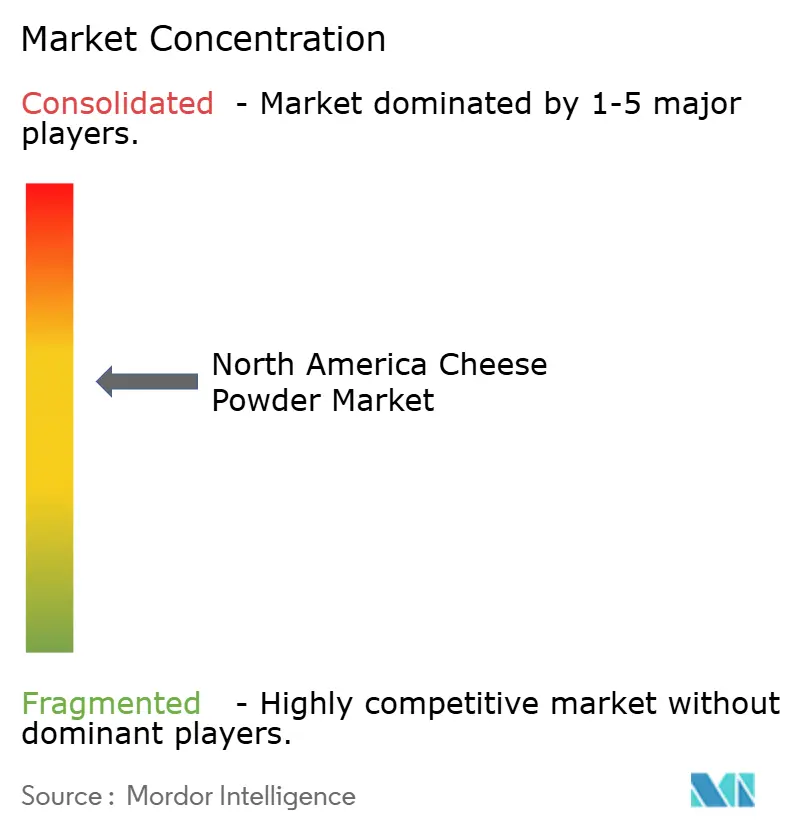
| Market Concentration | Medium |
Major Players
*Disclaimer: Major Players sorted in no particular order Image © Mordor Intelligence. Reuse requires attribution under CC BY 4.0. |
|
North America Cheese Powder Market Analysis by Mordor Intelligence
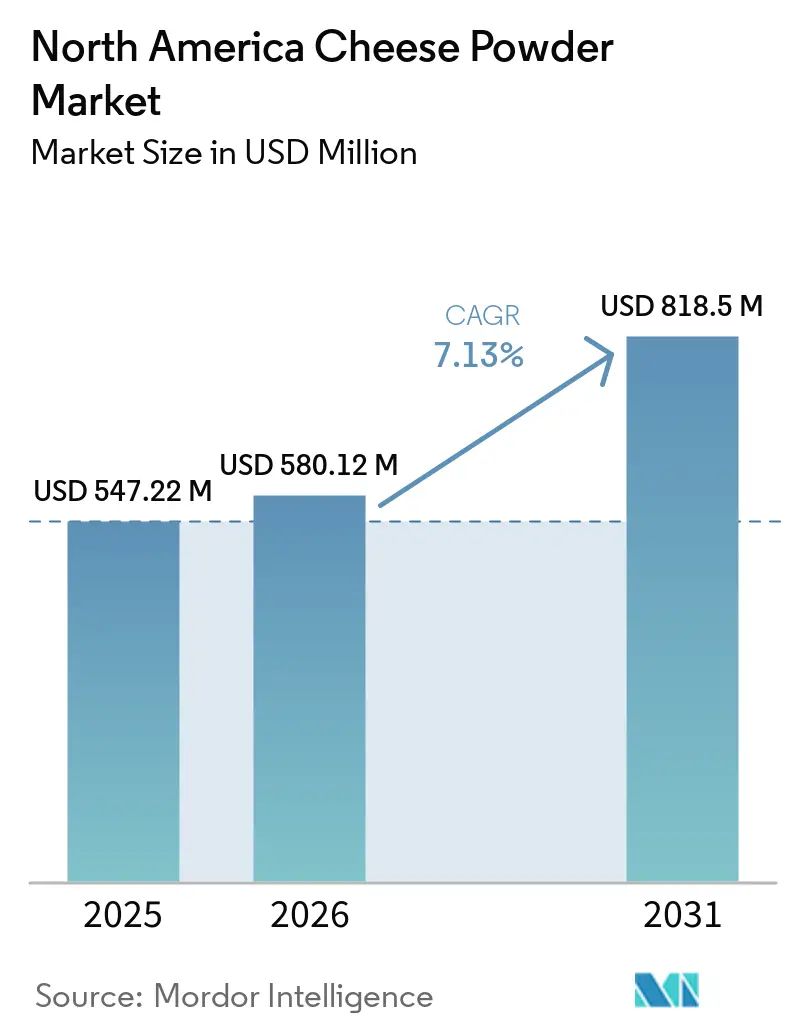
The North America cheese powder market size is expected to grow from USD 547.22 million in 2025 to USD 580.12 million in 2026 and is forecast to reach USD 818.50 million by 2031 at a 7.13% CAGR over 2026-2031. The North America cheese powder market is primarily driven by the increasing demand for convenient and shelf-stable dairy ingredients within the food processing industry. The rise in busy consumer lifestyles has led to higher consumption of ready-to-eat meals, snacks, instant foods, and quick-service restaurant products, where cheese powder is extensively used for its consistent flavor and extended shelf life. The growth of the savory snacks segment, including popcorn, chips, crackers, and extruded snacks, has further boosted the demand for cheese powder as a cost-effective seasoning option. Consumer preference for bold, indulgent, and cheese-flavored products, along with ongoing innovations in processed foods, is prompting manufacturers to incorporate premium cheese powder formulations into their offerings. Furthermore, the region benefits from advanced dairy processing infrastructure, abundant milk production, and established ingredient manufacturers, ensuring a steady supply of high-quality cheese powder. Expanding applications in bakery, sauces, dressings, seasonings, and convenience foods, combined with rising demand for clean-label, natural, and specialty cheese powders, continue to drive market growth in North America.
Key Report Takeaways
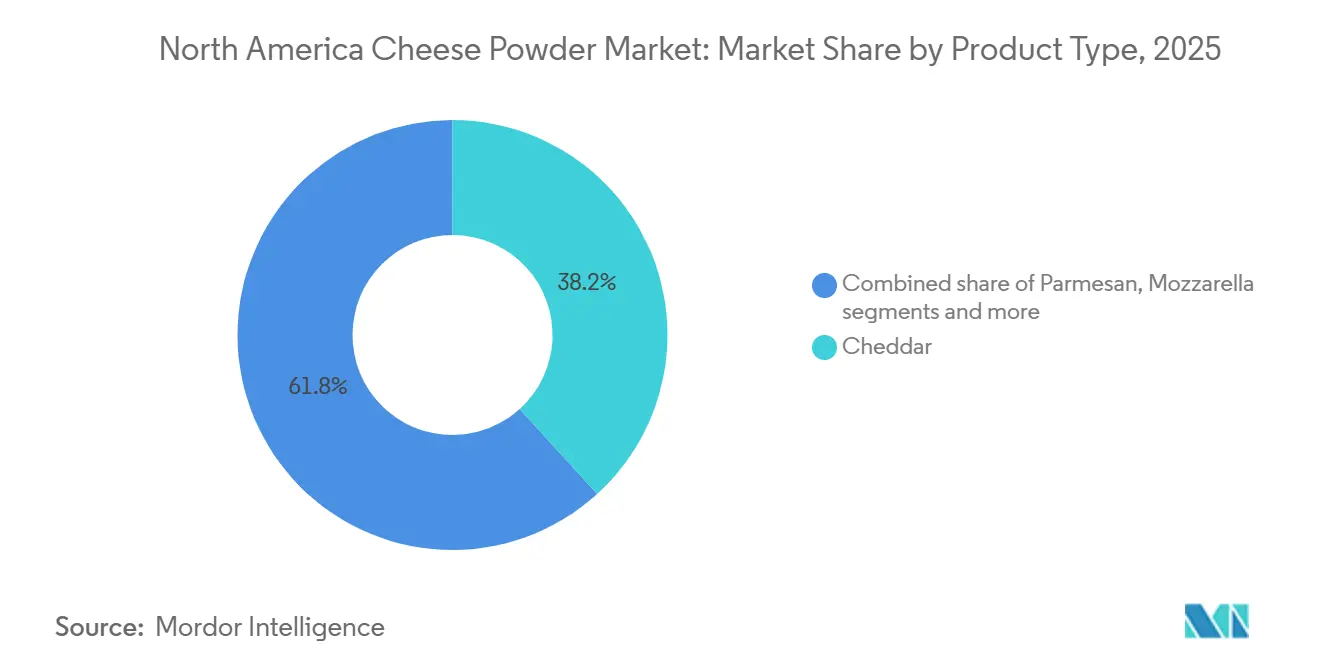
- By product type, cheddar held 38.24% of the North America cheese powder market in 2025, while mozzarella is projected to record the fastest CAGR of 8.26% during 2026 to 2031 across the region.
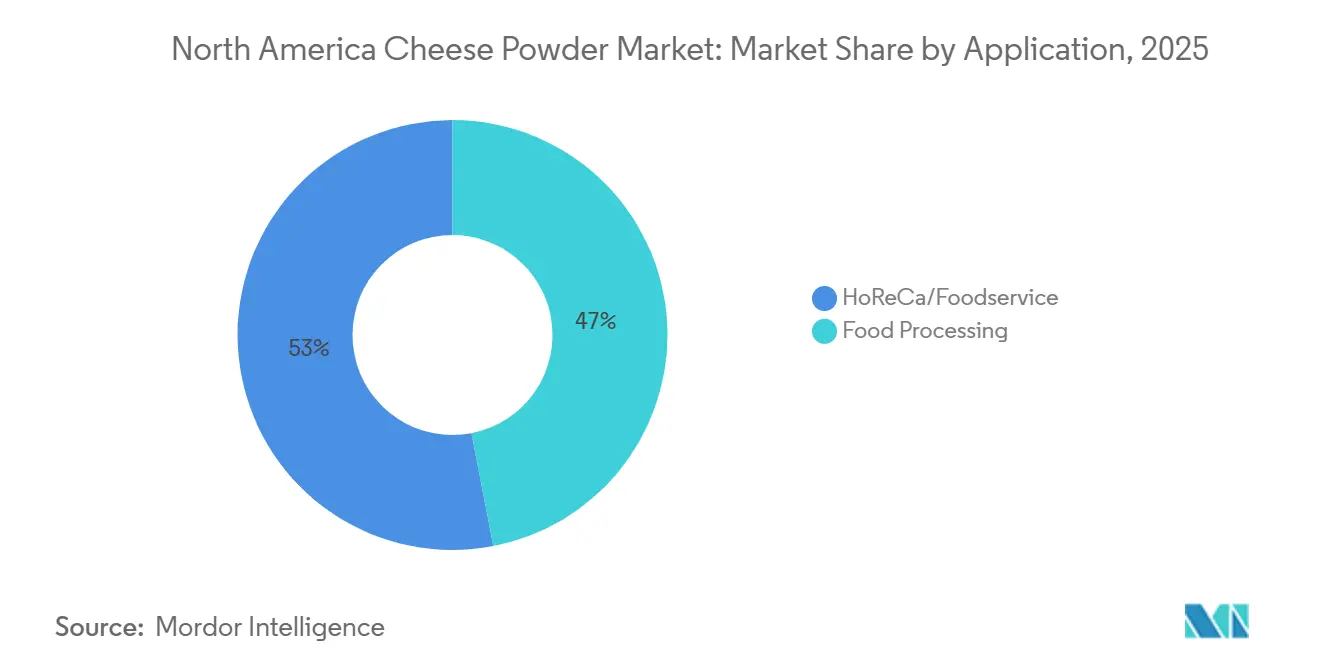
- By application, HoReCa/foodservice accounted for 53.03% share of the North America cheese powder market in 2025, while food processing is forecast to grow at the highest CAGR of 7.91% during 2026 to 2031 in North America.
- By geography, the United States held 80.73% share of the North America cheese powder market in 2025, while Mexico is expected to post the fastest CAGR of 7.98% during 2026 to 2031 within the region,
Note: Market size and forecast figures in this report are generated using Mordor Intelligence’s proprietary estimation framework, updated with the latest available data and insights as of January 2026.
North America Cheese Powder Market Trends and Insights
Drivers Impact Analysis*
| Driver | (~) % Impact on CAGR Forecast | Geographic Relevance | Impact Timeline |
|---|---|---|---|
| Expanding snack food industry | +1.8% | United States primarily, growing contribution from Canada and Mexico | Short term (≤ 2 years) |
| Growing preference for clean-label and natural cheese ingredients | +1.3% | United States and Canada, early-stage in Mexico | Medium term (2–4 years) |
| Strong demand from the foodservice industry | +1.5% | United States and Mexico core, spill-over to Canada | Short term (≤ 2 years) |
| Technological advancements in spray drying and dairy processing | +0.8% | United States and Canada, gradual transfer to emerging markets | Long term (≥ 4 years) |
| Rising demand for convenience and shelf-stable food ingredients | +0.7% | North America-wide | Medium term (2–4 years) |
| Increasing product innovation in cheese flavors | +0.5% | United States -led, rapid adoption in Mexico's processed food sector | Medium term (2–4 years) |
| Source: Mordor Intelligence | |||
Expanding snack food industry
The growth of the snack food industry is a key driver of the North America cheese powder market. Manufacturers increasingly utilize cheese powder to enhance the flavor, texture, and shelf stability of various savory snacks. Products such as potato chips, popcorn, crackers, tortilla chips, extruded snacks, and baked snack mixes benefit from cheese powder due to its concentrated flavor, ease of use, and consistent performance during processing. The rising consumer preference for convenient, ready-to-eat snacks with bold cheese flavors continues to drive demand for cheese-based seasonings across the region. According to the 2026 State of Snacking Report by Mondelez International, 66% of U.S. adults snack at least once daily, underscoring the ongoing significance of snacking in daily eating habits[1]Source: Mondelez International, "2026 State of Snacking Report," mondelezinternational.com. As snack manufacturers expand their product portfolios with new cheese-flavored and premium offerings, the demand for cheese powder is projected to grow steadily, contributing to the expansion of the North American market.
Growing preference for clean-label and natural cheese ingredients
The rising demand for clean-label and natural cheese ingredients is a key factor driving the North America cheese powder market. Consumers are increasingly favoring food products made with recognizable, minimally processed ingredients that are free from artificial additives. In response, food manufacturers are incorporating natural cheese powders into snacks, sauces, seasonings, bakery products, and ready meals to align with evolving consumer preferences while ensuring authentic flavor and functionality. This trend is prompting ingredient suppliers to expand their offerings of clean-label cheese powders, produced using simplified processing methods and without synthetic preservatives or artificial flavors. Additionally, consumer willingness to pay a premium for natural products supports this shift. According to Ingredion's 2024 Consumer Food Preference Trends Report, 78% of consumers indicated they would pay more for products labeled as "natural" or "all-natural," highlighting the strong market demand for clean-label formulations[2]Source: Ingredion, "2024 Consumer Food Preference Trends Report," ingredion.com. As food brands increasingly emphasize transparency and natural ingredient declarations, the adoption of clean-label cheese powders is expected to grow across North America.
Strong demand from the foodservice industry
The foodservice industry is a significant driver of the North America cheese powder market, as restaurants, quick-service chains, cafeterias, and institutional kitchens increasingly utilize cheese powder for its consistent flavor, extended shelf life, and operational efficiency. Cheese powder is commonly used in seasoning blends, sauces, dips, soups, pasta dishes, and snack toppings due to its advantages, including easy storage, reduced waste, and uniform product quality compared to fresh cheese. The growth of the foodservice sector, driven by rising away-from-home dining and menu innovation, is boosting the consumption of cheese-based ingredients across North America. According to the "Restaurants Canada Revises 2025/26 Sales Forecast" report, commercial foodservice sales in Canada grew by 6.9% during the first seven months of 2025[3]Source: Restaurants Canada, "Restaurants Canada Revises 2025/26 Sales Forecast," restaurantscanada.org. As foodservice operators expand their offerings and prioritize efficient, high-quality ingredients, the demand for cheese powder is expected to increase, supporting the continued growth of the North American cheese powder market.
Technological advancements in spray drying and dairy processing
Technological advancements in spray drying and dairy processing are contributing to the growth of the North America cheese powder market by enabling manufacturers to produce higher-quality products with enhanced flavor retention, solubility, texture, and shelf stability. Modern spray-drying systems offer improved control over temperature, moisture levels, and particle size, helping preserve the functional and sensory characteristics of cheese while extending its shelf life. Developments in dairy processing, such as advanced emulsification, enzyme technology, and precision blending, have broadened the range of cheese powder formulations for use in snacks, bakery products, sauces, ready meals, and seasonings. Additionally, automation and energy-efficient processing technologies are enhancing production efficiency, minimizing waste, and ensuring consistent product quality at scale. These advancements help manufacturers meet the changing needs of food processors and foodservice operators, support premium, clean-label, and specialty cheese powders, and drive growth in the North American cheese powder market.
Restraints Impact Analysis*
| Restraint | (~) % Impact on CAGR Forecast | Geographic Relevance | Impact Timeline |
|---|---|---|---|
| Volatility in dairy raw material supply | −1.3% | North America-wide, most acute in United States /Canada supply surges | Short term (≤ 2 years) |
| Increasing demand for plant-based food products | −0.8% | United States and Canada where plant-based maintains retail shelf presence | Medium term (2–4 years) |
| Allergen concerns associated with dairy ingredients | −0.4% | United States -wide, affecting food processing/foodservice reformulation timelines | Medium term (2–4 years) |
| Regulatory and labeling compliance requirements | −0.3% | United States and Canada under FDA/CFIA frameworks | Long term (≥ 4 years) |
| Source: Mordor Intelligence | |||
Volatility in dairy raw material supply
Volatility in dairy raw material supply poses a significant challenge to the North America cheese powder market. Fluctuations in milk availability and cheese production directly impact manufacturing costs and supply chain stability. Factors such as changing weather conditions, feed price inflation, livestock diseases, labor shortages, and evolving environmental regulations affect milk production volumes and pricing, creating uncertainty for cheese powder manufacturers. As cheese powder production relies on a steady supply of high-quality cheese, disruptions in the dairy value chain can result in higher raw material costs, reduced production efficiency, and narrower profit margins. Price instability further complicates the ability of manufacturers to secure long-term supply contracts and maintain consistent pricing for food processors and foodservice customers. Additionally, unpredictable raw material costs may hinder product innovation and reduce the competitiveness of smaller manufacturers with limited procurement resources, ultimately restricting the growth potential of the North American cheese powder market.
Increasing demand for plant-based food products
The rising demand for plant-based food products is limiting the growth of the North America cheese powder market. Consumers are increasingly adopting vegan, flexitarian, and dairy-free diets due to health, environmental, and ethical considerations. This trend is prompting food manufacturers to replace traditional dairy-based cheese powders with plant-based alternatives made from ingredients such as nuts, oats, soy, peas, and starches, used in snacks, sauces, seasonings, and ready meals. As retailers and foodservice operators expand their offerings of dairy-free products to align with shifting consumer preferences, conventional cheese powder faces heightened competitive pressure. Furthermore, advancements in the taste, texture, and functionality of plant-based cheese ingredients are enhancing their acceptance in mainstream food applications. This shift in consumer preferences is reducing the demand growth for dairy-derived cheese powder, particularly in product categories where plant-based formulations are gaining traction, thereby constraining the expansion of the North American cheese powder market.
*Our forecasts treat driver/restraint impacts as directional, not additive. The impact forecasts reflect baseline growth, mix effects, and variable interactions.
Segment Analysis
Cheddar's Scale Anchors the Base; Mozzarella Gains Ground Fast
Cheddar powder accounted for 38.24% of North America's cheese powder revenue in 2025, driven by its widespread consumer acceptance, distinctive flavor profile, and versatile applications across various food products. It is a key ingredient in savory snacks such as potato chips, popcorn, crackers, and extruded snacks, where its rich and tangy taste enhances product appeal. The rising demand for convenience foods, ready-to-eat meals, sauces, dips, macaroni and cheese, and seasoning blends has further boosted the adoption of cheddar cheese powder due to its consistent flavor, long shelf life, and ease of use in dry formulations. Additionally, the well-established cheddar cheese manufacturing industry in the United States and Canada ensures a steady supply of raw materials, enabling large-scale production of cheese powder. Innovations in premium, aged, reduced-fat, and clean-label cheddar cheese powders have expanded their applications across retail and foodservice sectors, supporting sustained demand in the region.
Mozzarella cheese powder is projected to grow at a forecast CAGR of 8.26% from 2026 to 2031, outpacing other product types. This growth is attributed to the increasing popularity of Italian-inspired foods, convenience meals, and foodservice applications. Its mild, creamy flavor makes it a preferred ingredient for pizzas, pasta dishes, garlic bread, bakery products, sauces, seasoning blends, and frozen ready meals, offering an authentic cheese taste without the handling challenges of fresh mozzarella. The rapid expansion of quick-service restaurants, rising frozen food consumption, and increased home meal preparation have further driven the use of mozzarella cheese powder in processed food formulations. Food manufacturers favor mozzarella cheese powder for its consistent flavor, improved shelf stability, and ease of storage, which also reduces transportation and refrigeration costs. Advances in dairy processing technologies have enabled the production of high-quality mozzarella cheese powders with enhanced flavor retention and functionality, promoting broader adoption across industrial food manufacturing and foodservice channels in North America.



Foodservice Commands Volume Today; Food Processing is the Growth Engine Tomorrow
In 2025, the HoReCa/Foodservice segment accounted for 53.03% of North America's cheese powder revenue, driven by the rapid growth of quick-service restaurants, casual dining chains, institutional catering, and convenience-focused food outlets. Foodservice operators increasingly utilize cheese powder in sauces, dips, soups, pasta dishes, baked goods, seasoning blends, and snack toppings due to its consistent flavor, extended shelf life, and simplified storage compared to fresh cheese. Its ease of handling eliminates the need for refrigeration, reduces food waste, and enhances operational efficiency in high-volume kitchens. The growing consumer preference for cheese-flavored menu items, such as loaded fries, burgers, pizzas, nachos, and specialty snacks, has further boosted their adoption in restaurants and catering services. Additionally, cheese powder supports standardized taste across multiple locations, making it a preferred ingredient for franchise operations and large foodservice chains aiming for product consistency and cost efficiency.
The food processing segment is projected to grow at a 7.91% CAGR through 2031, driven by the increasing production of packaged foods, ready-to-eat meals, savory snacks, bakery products, frozen foods, and seasoning blends. Manufacturers favor cheese powder for its concentrated cheese flavor, long shelf life, uniform quality, and compatibility with dry and processed food formulations. It enables consistent taste while reducing transportation, storage, and refrigeration costs associated with natural cheese. Rising consumer demand for convenient, indulgent, and value-added food products has encouraged manufacturers to incorporate cheese powder into snack coatings, macaroni and cheese, instant noodles, soups, sauces, dressings, and processed meat products. Moreover, advancements in spray-drying technology and customized cheese powder formulations have enhanced functionality, solubility, and flavor stability, allowing food processors to develop innovative products while maintaining manufacturing efficiency and scalability across North America.
Geography Analysis
The United States is the leading contributor to the North America cheese powder market, accounting for 80.73% of regional revenue in 2025. This dominance is supported by its extensive dairy industry, high cheese production, and strong demand from the processed food and foodservice sectors. The well-developed snack food industry, increasing consumption of ready-to-eat meals, and the popularity of cheese-flavored products have driven the use of cheese powder in applications such as seasonings, sauces, soups, bakery products, and frozen foods. Quick-service restaurants and major food manufacturers prefer cheese powder for its consistent flavor, long shelf life, and lower storage and transportation costs compared to natural cheese. Additionally, continuous product innovation, including premium, clean-label, reduced-fat, and specialty cheese powders, contributes to market growth. Advanced dairy processing infrastructure, significant investments in spray-drying technologies, and the presence of leading dairy ingredient manufacturers further enable efficient large-scale production, solidifying the United States' dominant position in the regional market.
Mexico is projected to achieve a 7.98% CAGR from 2026 to 2031, making it the fastest-growing market in the region. This growth is driven by the rapid expansion of the processed food industry, rising urbanization, and increasing demand for convenient and affordable packaged foods. The growing consumption of savory snacks, instant noodles, bakery products, and ready-to-cook meals has encouraged food manufacturers to use cheese powder as a flavor-enhancing ingredient with extended shelf stability. The expanding quick-service restaurant sector and a growing preference for Western-style fast foods, such as pizzas, burgers, nachos, and flavored snacks, have further boosted demand for cheese powder in foodservice applications. Additionally, rising investments by multinational food manufacturers, improved retail distribution networks, and increasing consumer interest in value-added food products are supporting the adoption of cheese powder in industrial food production. Its cost efficiency, ease of storage, and compatibility with diverse processed food formulations make cheese powder an attractive ingredient for manufacturers catering to Mexico's growing convenience food market.
Canada and the Rest of North America are experiencing steady growth in the cheese powder market, driven by increasing consumption of processed foods, premium snacks, and convenience meals, along with a well-established dairy processing industry. In Canada, strong demand from the foodservice sector, expanding production of packaged foods, and consumer preference for natural and clean-label dairy ingredients are encouraging the use of cheese powder in sauces, seasonings, bakery products, and ready meals. Advanced dairy processing capabilities and a stable supply of high-quality milk further support domestic cheese powder production. In the Rest of North America, market growth is fueled by rising urbanization, the gradual expansion of modern retail and foodservice channels, and increasing adoption of packaged and frozen food products. As international food brands continue to expand across the region and consumers seek convenient, flavorful, and shelf-stable food options, demand for cheese powder is expected to grow steadily in both industrial food processing and foodservice applications.
Competitive Landscape
The North America cheese powder market features a moderately concentrated competitive landscape, with competition divided between large integrated dairy processors and specialized ingredient manufacturers. Large-scale producers leverage extensive milk procurement networks, vertically integrated processing facilities, and established relationships with food manufacturers and foodservice operators. These advantages enable them to compete effectively on production capacity, supply reliability, and cost efficiency. On the other hand, specialized ingredient suppliers focus on differentiation through customized formulations, application-specific solutions, and clean-label product development to meet evolving customer demands. The competitive focus is increasingly shifting toward product quality, flavor consistency, functionality, and application expertise rather than price alone.
Competition in the market is increasingly shaped by strategic investments in value-added dairy ingredient production, expansion of processing infrastructure, and supply chain optimization. Manufacturers are enhancing production capabilities to improve operational efficiency while expanding their portfolios of specialty dairy ingredients for processed food, snack, and foodservice applications. Additionally, companies are investing in advanced manufacturing technologies, enhanced spray-drying capabilities, and integrated ingredient platforms to offer greater flexibility to industrial food processors. The growing emphasis on premium formulations, clean-label ingredients, and customized flavor systems is driving suppliers to develop differentiated products that align with changing consumer preferences and food manufacturers' reformulation requirements.
Growth opportunities in the market are concentrated in functional cheese powders, clean-label specialty varieties, and application-specific seasoning systems designed for convenience foods and foodservice operators. Increasing demand for formulations with health-oriented ingredients, natural colors, and simplified ingredient declarations is fostering innovation. Advances in precision dairy processing, modular spray-drying equipment, and flexible manufacturing technologies are reducing development timelines and lowering entry barriers for smaller ingredient manufacturers to introduce innovative products. As retailers and food manufacturers reformulate products to eliminate artificial additives and enhance label transparency, agile specialty producers are gaining a competitive edge by delivering customized, application-ready cheese powder solutions more quickly than traditional large-scale manufacturers.
North America Cheese Powder Industry Leaders
-
Fonterra Co-operative Group Limited
-
Archer Daniels Midland Company
-
Cargill, Incorporated
-
Kerry Group plc.
-
Land O'Lakes, Inc.
- *Disclaimer: Major Players sorted in no particular order

Recent Industry Developments
- January 2026: Royal FrieslandCampina completed the acquisition of Wisconsin Whey Protein, enhancing its North American processing capacity and incorporating it into FrieslandCampina Ingredients' premium global supply chain.
- April 2024: Butter Buds Inc., a producer of dairy and non-dairy ingredient solutions, has launched Cheese Buds® Simple Cheddar Cheese Concentrate. This clean-label ingredient is designed to help food manufacturers enhance the authentic flavor of cheddar cheese while simplifying ingredient declarations. The concentrate delivers a rich cheddar taste at low usage levels, allowing manufacturers to avoid labeling the product as "flavor" or "natural flavor," thereby supporting cleaner product labels. Additionally, it offers a cost-effective solution and can be used in various applications, including sauces, soups, seasonings, and baked goods, while ensuring premium taste and formulation efficiency.


North America Cheese Powder Market Report Scope
| Cheddar |
| Parmesan |
| Mozzarella |
| Blue Cheese |
| Other Types |
| Food Processing | Bakery and Confectionery |
| Dairy | |
| Soups, Sauces and Condiments | |
| Ready Meals | |
| Other Applications | |
| HoReCa/Foodservice |
| United States |
| Canada |
| Mexico |
| Rest of North America |
| By Product Type | Cheddar | |
| Parmesan | ||
| Mozzarella | ||
| Blue Cheese | ||
| Other Types | ||
| By Application | Food Processing | Bakery and Confectionery |
| Dairy | ||
| Soups, Sauces and Condiments | ||
| Ready Meals | ||
| Other Applications | ||
| HoReCa/Foodservice | ||
| By Country | United States | |
| Canada | ||
| Mexico | ||
| Rest of North America | ||


Key Questions Answered in the Report
What is the 2031 outlook for North America cheese powder demand?
The North America cheese powder market is forecast to reach USD 818.50 million by 2031 from USD 580.12 million in 2026, rising at a 7.13% CAGR over 2026 to 2031.
Which country leads regional revenue today?
The United States led the region with 80.73% share in 2025, supported by its large snack, restaurant, and food processing base .
Which product type is growing fastest in cheese powder across North America?
Mozzarella is the fastest-growing product type with an expected CAGR of 8.26% through 2031, helped by pizza, frozen meals, and Italian-style appetizer demand .
Which application area contributes the most revenue?
HoReCa/foodservice held the largest share at 53.03% in 2025 because restaurant and institutional kitchens rely on shelf-stable cheese ingredients for sauces, coatings, and dry blends.
Page last updated on:


 Your data is secure and never sold or shared.


