
Market Overview
| Study Period | 2020 - 2031 |
|---|---|
| Forecast Data Period | 2026 - 2031 |
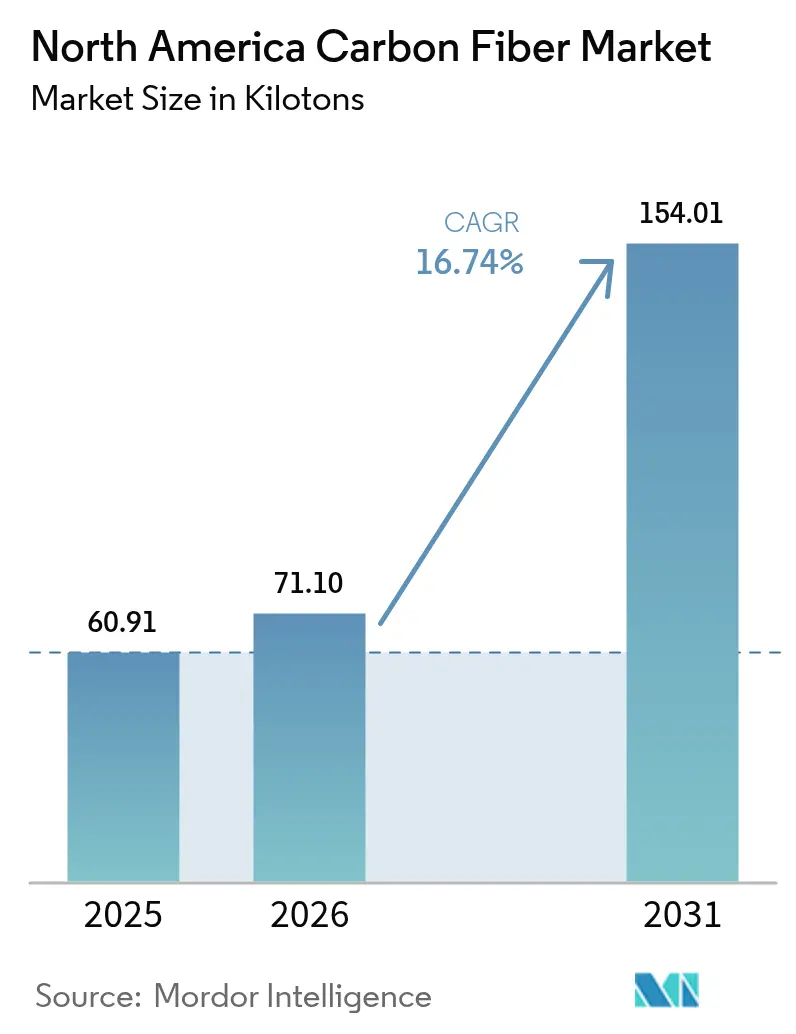
| Base Year Market Size (2025) | 60.91 kilotons |
| Market Volume (2026) | 71.1 kilotons |
| Market Volume (2031) | 154.01 kilotons |
| Growth Rate (2026 - 2031) | 16.74 % |
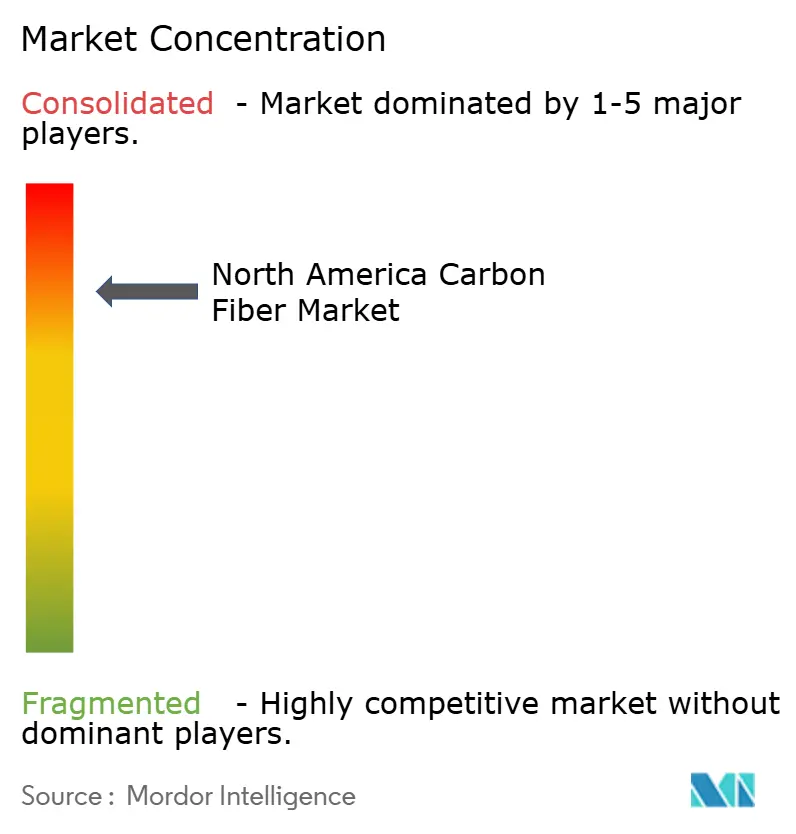
| Market Concentration | High |
Major Players *Disclaimer: Major Players sorted in no particular order Image © Mordor Intelligence. Reuse requires attribution under CC BY 4.0. | |
North America Carbon Fiber Market Analysis by Mordor Intelligence
The North America Carbon Fiber Market size is expected to grow from 60.91 kilotons in 2025 to 71.1 kilotons in 2026 and is forecast to reach 154.01 kilotons by 2031 at 16.74% CAGR over 2026-2031. Demand rises as aerospace production recovers, electric-vehicle makers cut curb weight and renewable-energy firms build longer wind blades. Polyacrylonitrile (PAN) continues to lead raw-material supply, yet fast-growing petroleum-pitch alternatives signal price-driven substitution. Recycled fibers gain traction because automakers and wind-turbine OEMs seek lower life-cycle emissions. United States output expansions by Hexcel and Toray improve local availability, but precursor sourcing and capital intensity still pose risk. Competitive success now depends on diversified end-use portfolios, agile production lines and close customer integration, rather than reliance on legacy aerospace volumes.
Key Report Takeaways
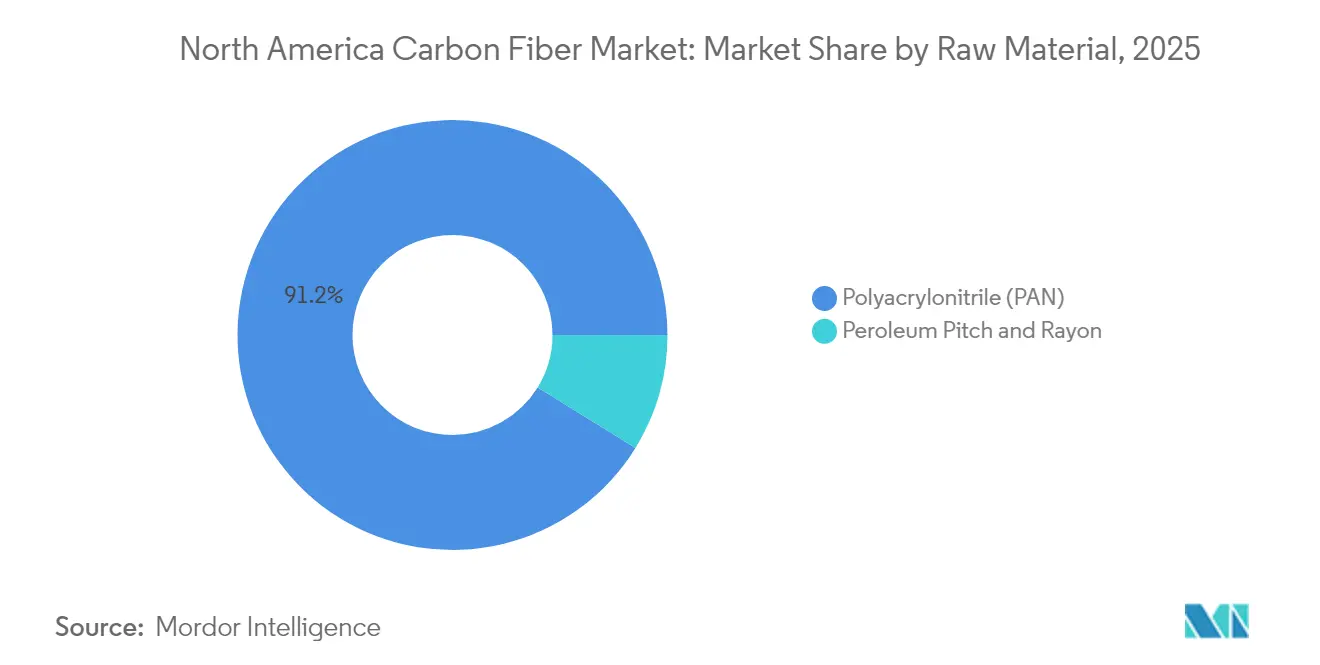
- By raw material, Polyacrylonitrile (PAN) retained 91.20% share of the North America carbon fiber market in 2025; petroleum pitch and rayon are projected to grow at an 18.25% CAGR to 2031.
- By type, virgin fiber commanded 75.40% share of the North America carbon fiber market size in 2025, while recycled fiber is advancing at a 18.48% CAGR through 2031.
- By application, composite materials accounted for 66.70% share of the North America carbon fiber market size in 2025 and are expected to rise at an 18.10% CAGR during the outlook period.
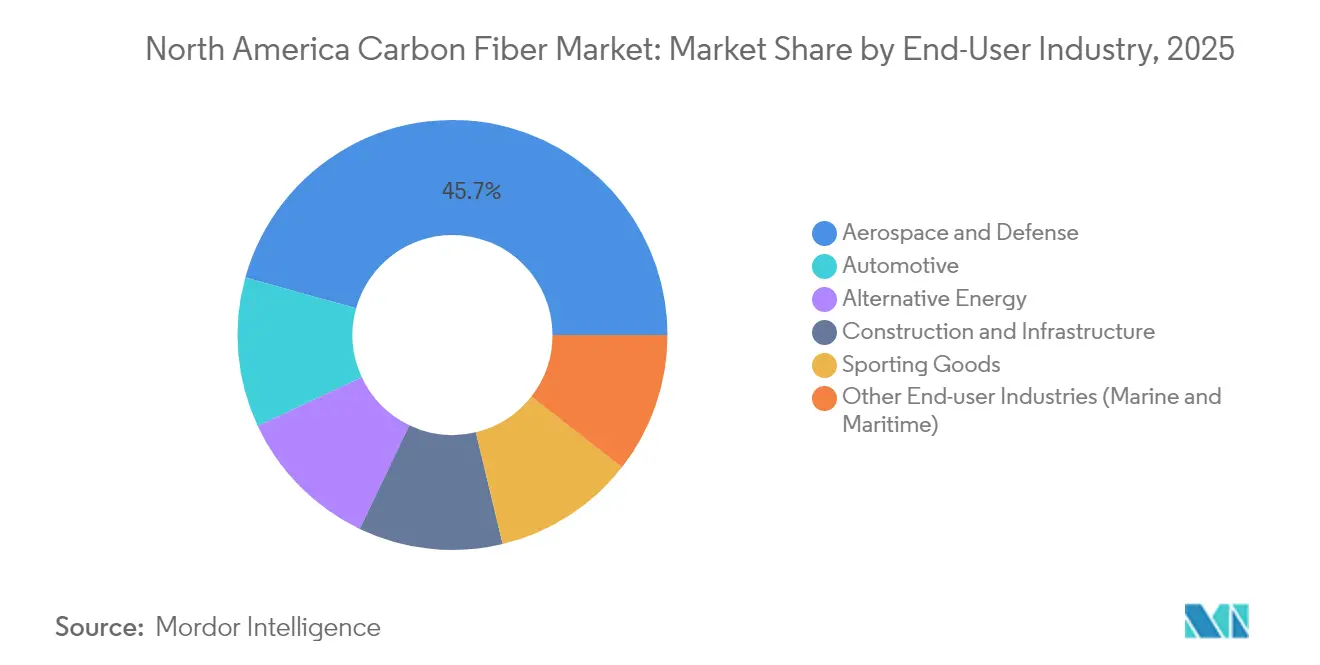
- By end-user industry, aerospace and defense held 45.70% of the North America carbon fiber market share in 2025, whereas automotive is forecast to expand at an 18.05% CAGR through 2031.
- By geography, the United States led with 62.90% share and is also set to post the fastest 17.60% CAGR to 2031.
Note: Market size and forecast figures in this report are generated using Mordor Intelligence’s proprietary estimation framework, updated with the latest available data and insights as of 2026.
Market Trends and Insights
Drivers Impact Analysis of North America Carbon Fiber Market*
| Driver | (~) % Impact on CAGR Forecast | Geographic Relevance | Impact Timeline |
|---|---|---|---|
| Rising Demand from Lightweight Vehicles | +4.20% | United States & Canada, with spillover to Mexico | Medium term (2-4 years) |
| Accelerating Usage in Aerospace and Defense | +3.80% | United States primarily, with Canada defense applications | Long term (≥ 4 years) |
| Growing Utilization from Wind Energy Sector | +3.10% | United States & Canada, concentrated in wind corridor states | Medium term (2-4 years) |
| Expansion of High-Performance Sporting Goods | +1.70% | North America-wide, with premium market concentration | Short term (≤ 2 years) |
| Adoption in Hydrogen Storage Tanks for Heavy-Duty Mobility | +2.90% | United States & Canada, focused on transportation hubs | Long term (≥ 4 years) |
| Source: Mordor Intelligence | |||
Rising Demand from Lightweight Vehicles
Automotive electrification positions the North America carbon fiber market at the center of new lightweight strategies. Automakers use automated-fiber-placement lines to integrate structural parts in mainstream models, as shown by General Motors’ pilot trials. Federal R&D funding from the U.S. Department of Energy accelerates ductile carbon-fiber composite development for battery-pack housings[1]. Regulations on fuel economy and consumer range expectations underpin sustained multi-year demand across volume platforms.
Accelerating Usage in Aerospace and Defense
Aerospace keeps its lead within the North America carbon fiber market because next-generation aircraft and hypersonic defense systems require high-modulus fiber. Toray supplies thermoset and thermoplastic prepregs for NASA’s HiCAM program to improve fast-build composite wings. Collins Aerospace invested USD 200 million to enlarge Spokane carbon-carbon brake capacity, while GE Aerospace earmarked almost USD 1 billion for U.S. composite part production, reinforcing long-cycle demand visibility.
Growing Utilization from Wind Energy Sector
Blade lengths now exceed 100 meters for land-based turbines, and only carbon fiber delivers stiffness without penalty weight. Although SGL Carbon logged a 35.2% sales dip in 2023 due to inventory corrections, its long-term supply pacts with turbine OEMs keep the growth route intact. Fiberline’s profile deal with Nordex for Delta4000 models illustrates how specialized suppliers piece together multi-year volume programs.
Expansion of High-Performance Sporting Goods
Athletic footwear brands mainstreamed carbon-plate running shoes. Carbitex secured expansion funding to quintuple 2025 sales, driven by demand from global shoe makers. Brooks Running and other brands embed thin carbon inserts for energy return gains. Recreational-vehicle and consumer-equipment firms echo this trend, broadening the North America carbon fiber market scope beyond heavy industries.
Restraints Impact Analysis of North America Carbon Fiber Market*
| Restraint | (~) % Impact on CAGR Forecast | Geographic Relevance | Impact Timeline |
|---|---|---|---|
| High Research and Development, and Capital Expenditure | -2.80% | North America-wide, concentrated in manufacturing centers | Long term (≥ 4 years) |
| Regulatory-Driven Supply Risk for Raw Materials | -1.90% | United States & Canada, with trade policy implications | Medium term (2-4 years) |
| Limited Recycling Infrastructure and quality variance | -1.40% | United States primarily, with emerging Canada initiatives | Medium term (2-4 years) |
| Source: Mordor Intelligence | |||
Regulatory-Driven Supply Risk for Raw Materials
Critical-material reviews by the White House and the Canadian government signal heightened scrutiny of PAN precursor imports. Policy shifts, such as export-control lists or stricter environmental permits, could pinch supply and raise compliance costs for the North America carbon fiber market.
Limited Recycling Infrastructure and Quality Variance
Recycled fiber often shows inconsistent sizing and shorter fiber lengths, limiting aerospace uptake. Investment flows into regional recycling hubs, but uniform standards and scaled logistics remain under development[2].
*Our forecasts treat driver/restraint impacts as directional, not additive. The impact forecasts reflect baseline growth, mix effects, and variable interactions.
North America Carbon Fiber Market Segment Analysis
By Raw Material:
PAN Dominance Faces Cost PressuresPAN commanded 91.20% of the North America carbon fiber market in 2025. The segment benefits from proven strength-to-weight ratios and well-understood supply chains. Petroleum-pitch and rayon, in contrast, are set to grow at an 18.25% CAGR because auto and construction buyers prioritize lower cost over ultimate tensile strength. Advanced Carbon Products LLC has developed a mesophase pitch carbon fiber precursor, offering a significant cost-saving opportunity compared to the conventional PAN-based production method.
Demand shifts favor suppliers that diversify precursor choice. Higher yield rates that exceed 70% for pitch versus 55% for PAN can cut per-kilogram costs when furnace energy remains constant. For mass-market uses such as pressure vessels or civil infrastructure, these economics make alternative precursors increasingly credible options.

By Type:
Virgin Fiber Leadership Challenged by Recycling InnovationVirgin fiber retained 75.40% share of the North America carbon fiber market size in 2025 because aerospace and defense require full traceability. Recycled fiber, however, is projected to post a 18.48% CAGR. Vartega reached mechanical properties comparable to virgin fiber but at half the cost and 96-99% lower CO₂ footprint.
OEM acceptance of recycled intermediates is rising. Boeing’s use of KyronTEX sidewall panels shows that strict cabin-interior requirements can be met with reclaimed content. Automotive injection-molding compounds with recycled strands now cut finished-part cost by up to 30%, spurring volume adoption.
By Application:
Composites Maintain Dual LeadershipComposite materials captured a 66.70% share and are also growing at an 18.10% CAGR, delivering both scale and momentum. Their leadership illustrates carbon fiber’s core value: enabling structures, not products. Automated fiber placement, rapid-cure resins, and closed-mold techniques shrink cycle times, broadening use in EV chassis, wind blades, and architectural retrofits.
Textile-grade fibers address 3-D woven preforms and braid sleeves for complex shapes, supplying segments such as marine and motorsports. Micro-electrode demand remains niche but validates fiber versatility. Catalysis fibers are used for high-surface-area reactors, yet volumes stay modest relative to structural composites.
By End-User Industry:
Aerospace Leadership Faces Automotive DisruptionAerospace and defense supplied 45.70% volume in 2025 thanks to long program cycles and stringent certification. Automotive, however, registers the fastest 18.05% CAGR as battery-electric platforms deploy carbon fiber to cut mass. Alternative-energy industries, including wind and hydrogen storage, further diversify outlets.
Construction agencies adopt carbon-fiber-reinforced polymer rebar to eliminate corrosion, lowering bridge life-cycle costs. Sporting-goods brands continue premium pricing for performance, offering attractive margins for specialty fiber runs and quick-turn fabrication.
Geography Analysis
United States Carbon Fiber Market
The United States leads the North America carbon fiber market with a 62.90% share in 2025 and is projected to grow at an 17.60% CAGR to 2031. Federal designation of carbon fiber as a critical material spurs domestic furnace builds, while Hexcel and Toray expansions add 19,000 t of fresh yearly capacity. Defense and commercial aviation initiatives ensure baseline demand, whereas new mobility and wind-blade programs pull additional tonnage.
Canada Carbon Fiber Market
Canada follows with rising uptake in aerospace, hydrogen buses, and wind-turbine components. Research labs at the University of British Columbia advance bitumen-based fibers targeting a USD 12 kg cost to localize supply. Clean-tech investment credits and abundant hydroelectric power give Canadian producers a low-carbon advantage.
Mexico and North America Carbon Fiber Market
Mexico rounds out regional dynamics, leveraging USMCA access and competitive labor to host capacity such as Zoltek’s 13,000 t Guadalajara line. Aerospace clusters in Chihuahua now assemble complex aerostructures with imported and locally converted fiber. Smaller North American economies contribute niche volumes in marine and industrial equipment, helping solidify integrated supply chains across the continent.
Regulatory Landscape
North American demand for carbon fiber is increasingly shaped by performance-based material standards and government procurement rules, particularly for infrastructure and aerospace applications. In April 2026, ASTM International published implementation guidance tied to ASTM F3628-26 for CFRP wraps used in bridge applications, adding temperature-extreme cycling requirements (-40 C to +85 C) that affect material qualification and supplier test programs for civil-works projects.
Policy and compliance requirements also affect upstream sourcing and sustainability documentation. Canada’s Treasury Board of Canada Secretariat maintains a federal Standard on Embodied Carbon in Construction (amended March 2025), which increases disclosure and embodied-carbon reduction requirements for federally funded projects and can include composite reinforcement solutions. On trade, the 2026 USITC Harmonized Tariff Schedule lists MFN duty treatment for carbon fiber classifications (for example, HTS 6815.13.00.00 shown as Free), while additional duties can still apply by origin and classification, creating variability in import landed cost for precursors and fiber products.
Value Chain Analysis
The North America carbon fiber value chain runs from precursor production (predominantly PAN) through stabilization and carbonization, surface treatment and sizing, and conversion into intermediate forms such as fabrics and prepregs, then into molded composite parts. Regional conversion capacity and know-how concentrate around aerospace and industrial composite hubs, with the United States hosting major carbon fiber and prepreg operations including Toray facilities in Decatur, Alabama (carbon fiber) and Tacoma, Washington (prepreg), and additional prepreg activity clustered across states such as South Carolina, Washington, and California.
Key constraints remain at the precursor and fiber-making stages where capital intensity, furnace lead times, and qualification cycles limit rapid capacity response, while downstream converters manage scrap, resin compatibility, and tight customer specifications. Government-supported scale-up infrastructure also affects process de-risking: the U.S. Department of Energy operates the Carbon Fiber Technology Facility (CFTF) at Oak Ridge National Laboratory as a pilot-scale platform to validate manufacturing processes and alternative precursor pathways. Distribution and integration typically move through direct supply agreements and long-term programs, with aerospace-grade materials requiring traceability and certification, and automotive, wind, and infrastructure channels pushing higher-tow formats, cost-down routes, and improvements in recycled-fiber consistency.
Competitive Landscape
The North America carbon fiber market shows highly consolidated concentration because multimillion-dollar furnaces and proprietary know-how restrict new capacity. Hexcel, Toray, and SGL Carbon hold dominant positions, backed by long-term aerospace contracts and in-house precursor streams. Smaller innovators such as Vartega focus on recycling and low-cost pitch, targeting automotive and industrial clients.
Strategic moves emphasize vertical integration. Toray is adding 3,000 t capacity in South Carolina to supply hydrogen-tank filament-winding and pressure vessels. Collins Aerospace invests USD 200 million in carbon-carbon brakes, widening its aftermarket revenue base. Players deploy automated fiber placement and digital twins to raise throughput and cut scrap. Those that blend virgin, recycled and alternative-precursor lines position best for price volatility and sustainability reporting.
Supply-chain resilience measures include sourcing backup PAN strands, renewable electricity contracts and lifecycle certification. Firms that pair value-added processing with regionally proximate customers reduce logistics risk. Overall, the strategic landscape favors incumbents that continuously refresh technology and extend beyond a single sector reliance.
North America Carbon Fiber Industry Leaders
-
Hexcel Corporation
-
Mitsubishi Chemical Carbon Fiber and Composites Inc.
-
SGL Carbon
-
Syensqo
-
Toray Industries Inc.
- *Disclaimer: Major Players sorted in no particular order
North America Carbon Fiber Market Companies Covered in this Report
- A&P Technology, Inc.
- ACP Composites Inc.
- DowAksa
- Gurit Services AG
- Hexcel Corporation
- HS HYOSUNG USA
- Jiangsu Hengshen Co., Ltd.
- Mitsubishi Chemical Carbon Fiber and Composites Inc.
- Present Advanced Composites Inc.
- SGL Carbon
- Syensqo
- TEIJIN LIMITED
- Toray Industries Inc.
- Vartega Inc.
Market Opportunities and Future Outlook
Opportunities concentrate where North American buyers are actively funding capacity, qualification, and domestic supply chain reinforcement. A visible whitespace sits upstream in PAN and acrylonitrile resilience: Trillium Renewable Chemicals scheduled commissioning work in Q2 2026 for its Project Falcon demonstration plant at INEOS Nitriles Green Lake to produce bio-based acrylonitrile, aligning with end-user pressure to reduce life-cycle emissions and with procurement requirements that increasingly track embodied carbon. In parallel, DOE-backed scale-up infrastructure at ORNL (CFTF) and partnerships such as ACP Technologies continuous pilot capability (opened in February 2026) support translation of alternative precursors and process improvements into industrial practice, tightening the pipeline for lower-cost fibers and differentiated grades.
Downstream, the strongest openings connect to high-throughput composite manufacturing and program pull from aerospace and new mobility. Hexcel broke ground in May 2026 on the Hexcel Applications Center at Wichita State University NIAR, creating a dedicated access point for automated composite process development that can shorten iteration cycles between fiber and prepreg suppliers and component manufacturers. On the demand side, aerospace utilization remains anchored by high-composite platforms, with Boeing reaching a 14-per-month 787 production rate in April 2026 as cited in the evidence pack. EV programs publicly incorporating carbon fiber prepreg inserts, such as Tesla confirming use in Cybertruck structures in May 2026 per the evidence pack, expand the addressable space for consistent, higher-volume tows, recycled intermediates, and faster-cure or thermoplastic conversion routes.
Recent Industry Developments in North America Carbon Fiber Market
- June 2026: Hexcel and Deutsche Aircraft announced a long-term industrial partnership and supply agreement covering advanced composite solutions for the D328eco regional aircraft program. The agreement reinforces multi-year pull-through for aerospace-grade carbon fiber and prepreg systems and strengthens supplier positioning around new aircraft qualification cycles.
- May 2026: Hexcel and Wichita State University NIAR broke ground on the Hexcel Applications Center in Wichita, Kansas. The site expands customer access to automated composite manufacturing and process development capabilities, supporting faster industrialization of carbon-fiber composite parts across aerospace and adjacent end uses.
- February 2025: SGL Carbon decided to restructure its Carbon Fibers business unit and discontinue loss-making activities, signaling a shift toward margin protection and a tighter portfolio. The move affects competitive dynamics by reallocating capacity and management focus toward higher-value applications and away from commoditized fiber volumes.
North America Carbon Fiber Market Report Scope and Research Methodology
Market Definition and Coverage
For this methodology, the North America carbon fibers market covers carbon fiber supply and demand within the region, tracked as fiber volume used across major end-use manufacturing and composite conversion activities.
Scope exclusions: Carbon fiber reinforced polymer parts and composite finished components are not counted unless the measurement is explicitly at the carbon fiber material level.
Segments Covered in This Report
- By Raw Material
- Polyacrylonitrile (PAN)
- Petroleum Pitch and Rayon
- By Type
- Virgin Carbon Fiber (VCF)
- Recycled Carbon Fiber (RCF)
- By Application
- Composite Materials
- Textiles
- Micro-electrodes
- Catalysis
- By End-user Industry
- Aerospace and Defense
- Alternative Energy
- Automotive
- Construction and Infrastructure
- Sporting Goods
- Other End-user Industries (Marine and Maritime)
- By Geography
- United States
- Canada
- Mexico
- Rest of North America
Data Sources, Market Sizing, and Validation
Desk Research
Desk work started with a clean view of regional demand signals and manufacturing activity that typically pull carbon fiber volumes, and then inputs were normalized to a common unit basis. We relied on public and official sources such as US International Trade Commission trade statistics, US Census Bureau manufacturing data, Energy Information Administration industrial indicators, and USGS materials publications to frame production and trade context.
Next, we reviewed aerospace and transportation build indicators and published materials performance references to keep assumptions realistic, alongside company filings, investor presentations, and reputable press coverage for capacity changes and plant updates. We also used a paid subscription for company financials and intelligence, plus a separate patent database, mainly to cross-check expansion timing and technology direction. The desk sources listed here are illustrative, and we used additional public references for data collection, cross-checks, and clarification.
Primary Interviews and Surveys
Primary interviews focused on speaking with carbon fiber value chain participants and downstream users, so we could validate the regional demand split and the practical conversion losses that desk sources do not show clearly. We captured perspectives from producers, distributors, and composite processors, then pressure-tested assumptions with procurement and engineering roles across key end-use industries in the US, Canada, and Mexico.
Distribution of primary research fieldwork respondents
| Company type | Respondent position |
|---|---|
| Top tier: 32% | CXOs: 12% |
| Mid tier: 53% | Functional/Unit leaders: 38% |
| Smaller Players: 15% | Managers: 50% |
Market-Sizing & Forecasting
Sizing was built using top-down and bottom-up logic, starting from a demand-pool reconstruction that ties carbon fiber needs to the region's manufacturing output and composite consumption signals. The top-down pass used indicators such as aerospace production and delivery cycles, wind blade build activity, light-weighting adoption in transportation platforms, regional import and export movements for carbon fiber, and announced capacity utilization direction, which are then converted into fiber volume requirements.
To corroborate totals, we ran selective bottom-up checks such as sampled volume by key end-use pools, channel checks on shipment patterns, and sanity checks on implied volume per application. We then adjusted for gaps where a single application lacked clean public visibility. Forecasting leaned on scenario analysis supported by expert consensus on ramp-up timing, utilization recovery, and application mix shifts, and then the year-by-year curve was smoothed to align with practical commissioning and qualification timelines. When input data ranges were wide, we first used conservative midpoints, then revalidated in interviews until a repeatable set of assumptions held together across countries in the region.
Data Validation & Update Cycle
Validation was done through triangulation across independent signals, and each major driver was checked for directional consistency before totals were finalized. We compared model outputs against trade movements, published capacity announcements, and implied end-use build rates, then flagged sharp jumps that did not fit known commissioning or qualification constraints.
Anomalies were reviewed stepwise, starting with unit conversions and timing alignment, followed by a second analyst review, then re-contact of sources if the variance stayed unexplained. Reports are refreshed annually, with interim updates triggered by material events such as large capacity additions, policy shifts, or sudden demand shocks. Before delivery, a final pass is completed so clients receive the most current view available at the time of publication.
Mordor Intelligence's North America Carbon Fibers Market Size Compared Against Other Published Estimates
Published market sizes for this topic often differ because some sources report value in USD and others report physical volume, and the scope around what is counted as carbon fiber can also shift. Timing also matters, since capacity ramps and qualification cycles can change the near-term picture without altering the long-term direction.
A common gap driver is that some estimates fold carbon fiber reinforced plastic parts and finished composite components into the total, which inflates the number when compared with a fiber-only lens. Some figures also assume faster price progression or use a single average selling price for all end uses, then apply currency conversion using a different reference period. Some external totals also align to US and Canada only. In Mordor Intelligence, only carbon fiber material volumes consumed in North America are counted and converted into USD using application-mix pricing checks, so composite parts and finished components sit outside scope.
Benchmark comparison
| Source | Market Size | Gaps in Research Methodology |
|---|---|---|
| Mordor Intelligence | USD 0.06 B (2025) | |
| Global Consultancy A | USD 1.38 B (2025) | Reported as revenue, not volume, and it relies on blended pricing across PAN and pitch that can shift totals when the end-use mix changes. |
| Regional Consultancy B | USD 4.50 B (2024) | Uses a broader basket that can include carbon fiber plus composite materials or finished components, and it also applies a different base-year timing and geography cut. |
The table mostly shows a unit and scope mismatch rather than a true disagreement on demand direction. When fiber volumes are kept separate from composite part revenues, and when pricing is applied only after the end-use mix is validated, the result stays traceable to clear signals and can be repeated year after year.
Key Questions Answered in the Report
What is the projected CAGR for the North America carbon fiber market between 2026 and 2031?
The market is expected to expand at a 16.74% CAGR, rising from 71.1 kilotons in 2026 to 154.01 kilotons by 2031.
Which end-user industry currently consumes the most carbon fiber in North America?
Aerospace and defense leads with a 45.70% share of 2025 demand, thanks to ongoing aircraft production and defense modernization.
Why are recycled carbon fibers gaining momentum?
Recycled fibers offer up to 50% cost savings and a 96-99% cut in CO₂ emissions compared with virgin material, meeting automaker and wind-energy sustainability targets.
How significant is the United States within regional demand?
The United States accounts for 62.90% of 2025 volume and is also the fastest-growing geography at an 17.60% CAGR through 2031.
Which raw-material precursor is growing fastest, and why?
Petroleum-pitch and rayon precursors are forecast to grow at an 18.25% CAGR, as lower costs attract automotive and construction applications where ultra-high strength is not mandatory.