
Non-PVC IV Bags Market Size and Share
Market Overview
| Study Period | 2020 - 2031 |
|---|---|
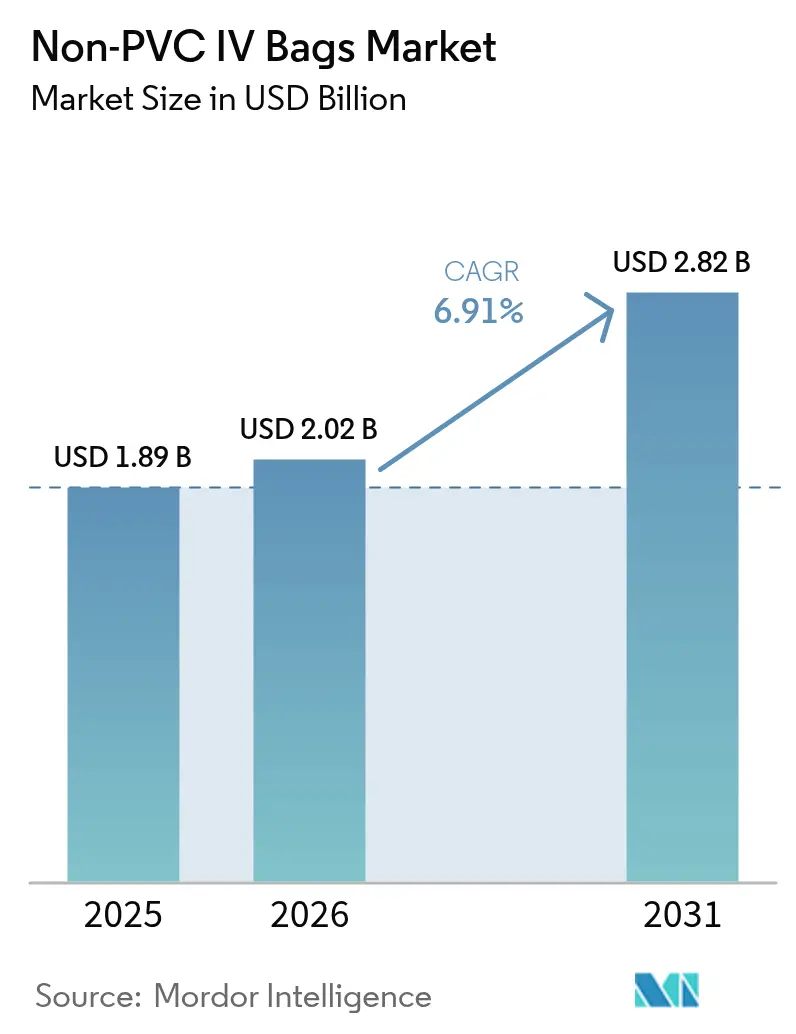
| Market Size (2026) | USD 2.02 Billion |
| Market Size (2031) | USD 2.82 Billion |
| Growth Rate (2026 - 2031) | 6.91 % |
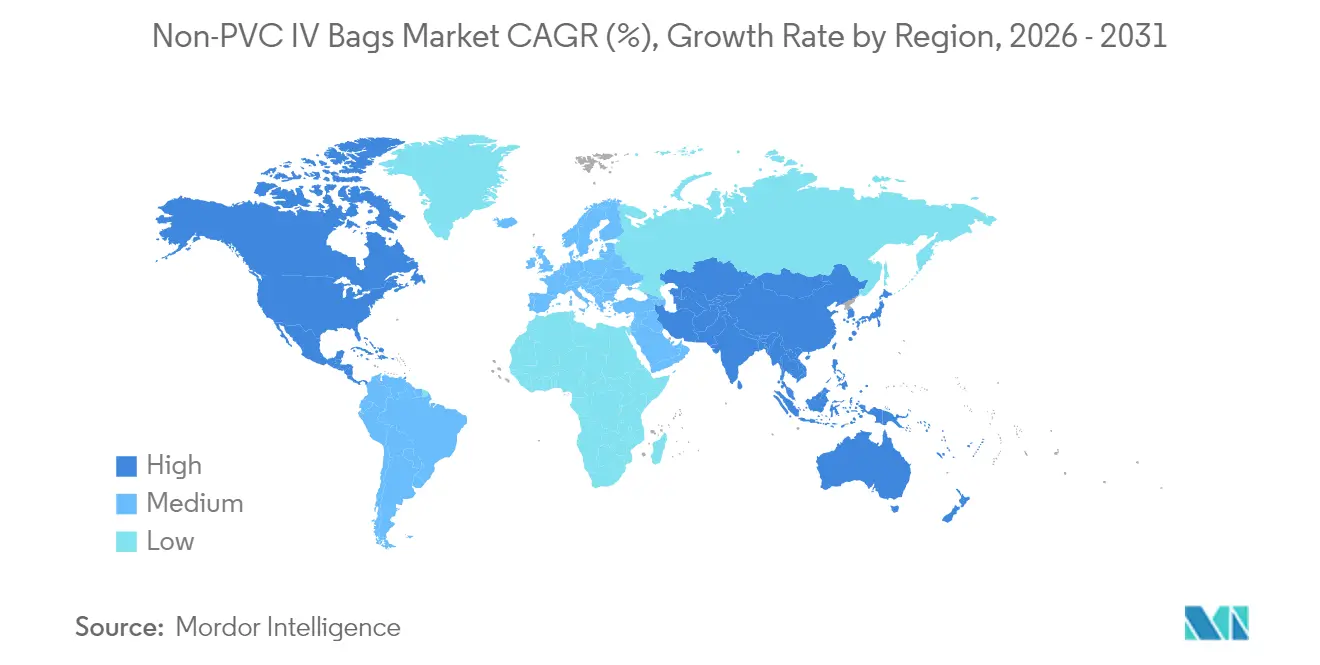
| Fastest Growing Market | Asia Pacific |
| Largest Market | North America |
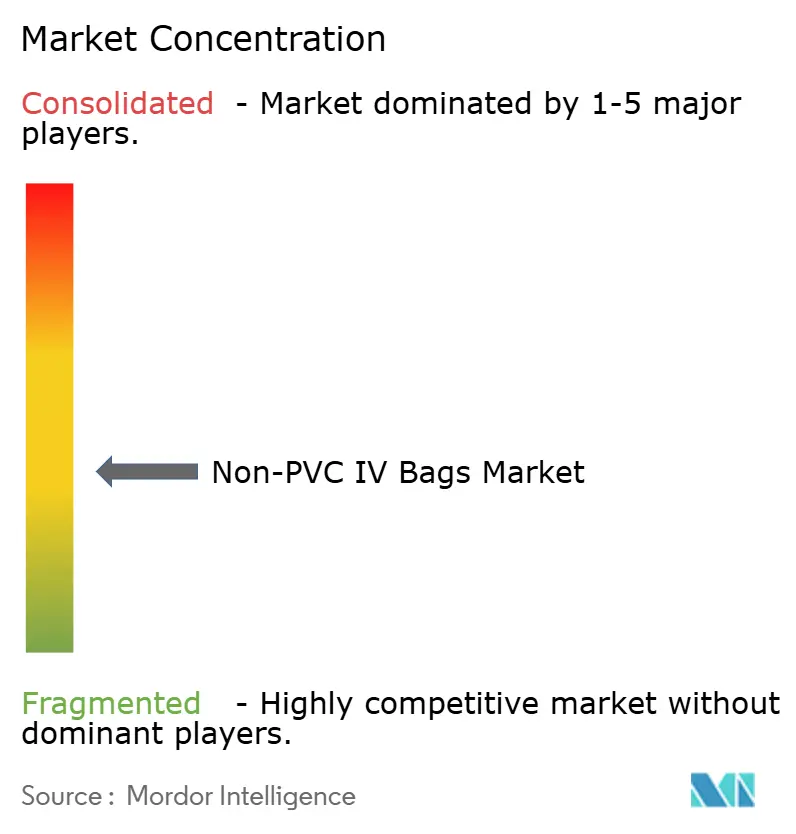
| Market Concentration | Medium |
Major Players *Disclaimer: Major Players sorted in no particular order Image © Mordor Intelligence. Reuse requires attribution under CC BY 4.0. | |
Non-PVC IV Bags Market Analysis by Mordor Intelligence
The non-PVC IV bags market size is expected to grow from USD 1.89 billion in 2025 to USD 2.02 billion in 2026 and is forecast to reach USD 2.82 billion by 2031 at 6.91% CAGR over 2026-2031. Regulatory pressure to remove di-ethyl-hexyl phthalate (DEHP) from clinical environments, hospital decarbonisation targets and a steady pipeline of complex biologic infusions are reshaping procurement strategies in North America, Europe and select Asia–Pacific economies. Ethylene Vinyl Acetate (EVA) maintains a volume lead, yet polypropylene’s rapid uptake signals cost-focused buyers are pivoting to lower-priced, recyclable resins. Growth is also supported by smarter drug-delivery formats, with RFID-enabled labels increasingly paired with smart pumps to curb medication errors. Finally, supply-chain shocks in petrochemicals are nudging manufacturers toward biomass-derived EVA that promises lower lifecycle emissions while safeguarding performance.
Key Report Takeaways
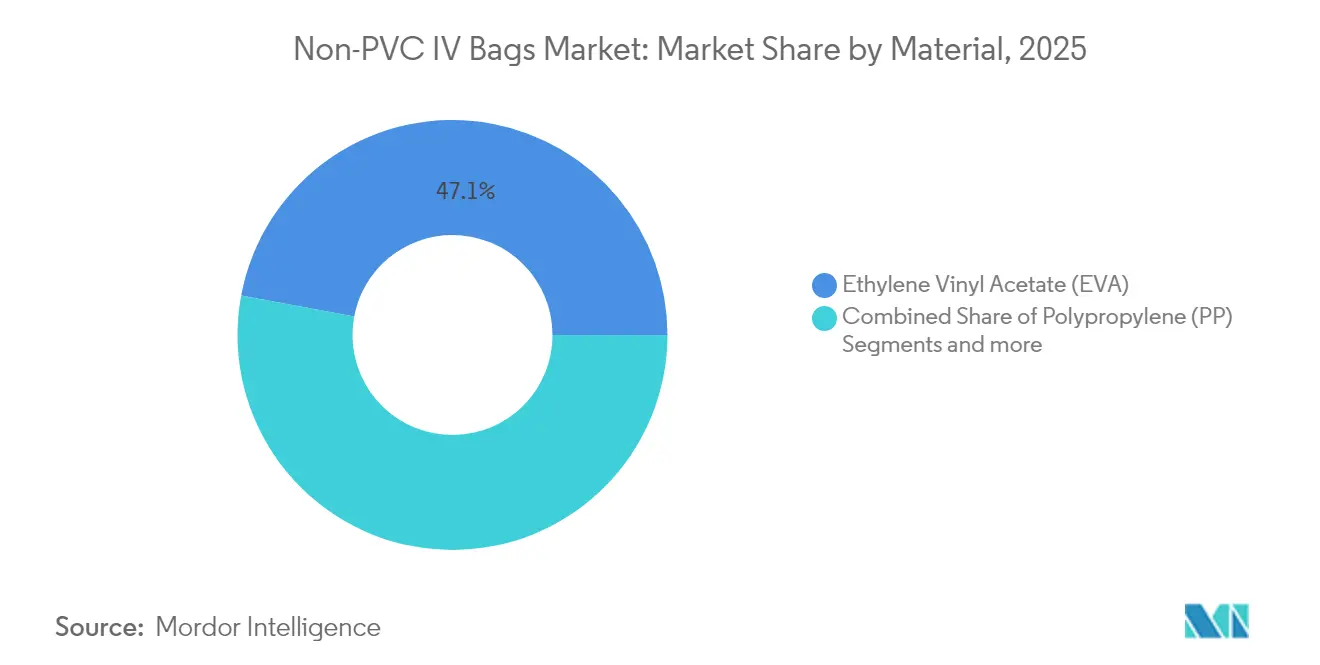
- - By material, EVA captured 47.05% of the non-PVC IV bags market share in 2025.
- - By product type, single-chamber formats held 65.10% of the non-PVC IV bags market size in 2025, while multi-chamber solutions are advancing at a 7.45% CAGR through 2031.
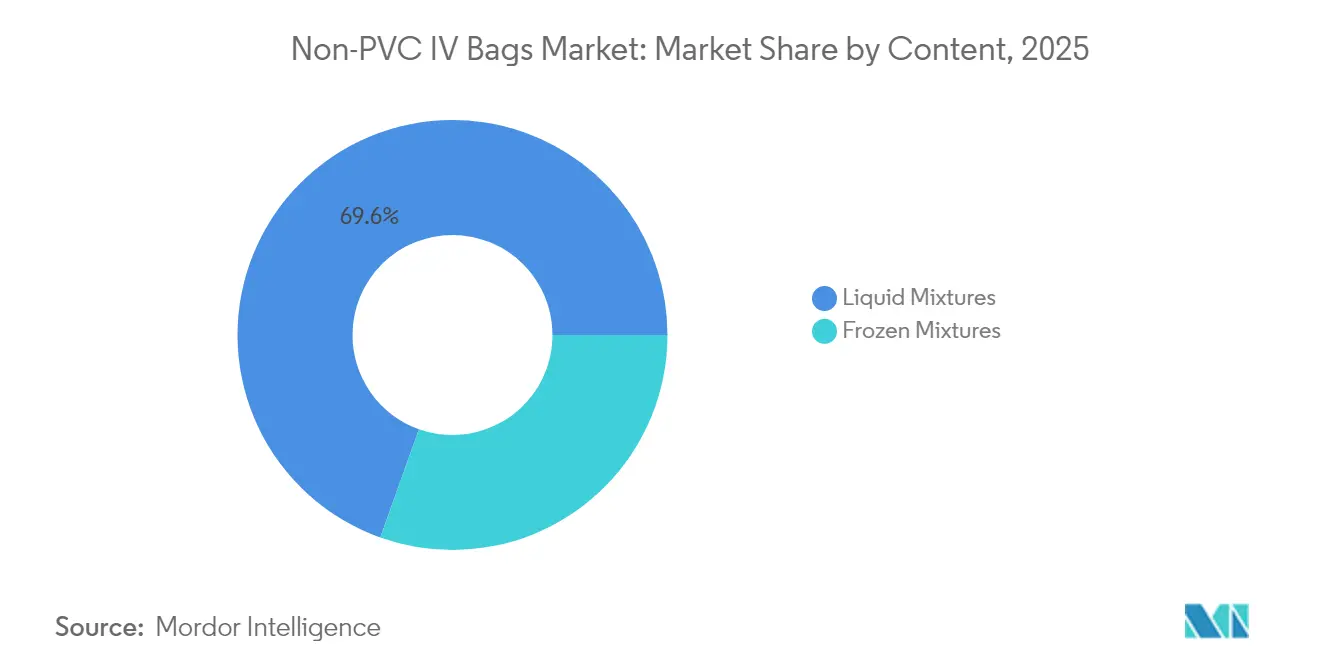
- - By content, liquid mixtures commanded 69.55% share of the non-PVC IV bags market size in 2025.
- - By end-user, hospitals represented 70.85% revenue in 2025 and ambulatory surgical centres are expanding at 7.54% CAGR to 2031.
- - By geography, North America represented 40.85% revenue in 2025 and Asia-Pacific are expanding at 7.60% CAGR to 2031.
Note: Market size and forecast figures in this report are generated using Mordor Intelligence’s proprietary estimation framework, updated with the latest available data and insights as of 2026.
Global Non-PVC IV Bags Market Trends and Insights
Drivers Impact Analysis*
| Driver | (~) % Impact on CAGR Forecast | Geographic Relevance | Impact Timeline |
|---|---|---|---|
| Declining PVC acceptance in mature markets | +1.8% | North America & Europe | Medium term (2-4 years) |
| Rapid biologics & oncology infusion growth | +1.5% | Global, concentrated in developed markets | Long term (≥ 4 years) |
| Rise of home- & ambulatory-care infusion | +1.2% | North America & Europe, expanding to APAC | Medium term (2-4 years) |
| Stringent EU REACH / U.S. Prop-65 DEHP bans | +1.0% | North America & Europe | Short term (≤ 2 years) |
| Embedded RFID & e-label innovations | +0.8% | Global, led by developed markets | Long term (≥ 4 years) |
| Hospital decarbonisation procurement targets | +0.6% | Global, strongest in Europe & North America | Medium term (2-4 years) |
| Source: Mordor Intelligence | |||
Declining PVC Acceptance in Mature Markets
Procurement teams in large academic hospitals are actively retiring PVC devices as evidence of phthalate toxicity spreads across clinical networks. Cleveland Clinic’s pledge to remove PVC and DEHP from two high-volume supply categories by 2025 has become a bellwether for sustainability benchmarking among US health systems [1]Cleveland Clinic, “PVC and DEHP Elimination Initiative,” clevelandclinic.org. The US FDA’s advisory to minimise DEHP exposure in neonatal and paediatric settings elevated non-PVC alternatives from optional to essential in critical care. Purchasing consortia now evaluate bids against lifecycle risk metrics rather than unit price alone, pushing vendors to deliver compliant solutions at scale [2]Practice Greenhealth, “Safer Materials in Neonatal Care,” practicegreenhealth.org.In the European Union, the REACH Restrictions Roadmap targeting PVC additives gives manufacturers regulatory certainty to retool production lines. As peer institutions publicise progress reports, a network effect is rapidly normalising DEHP-free IV procurement across North America and Western Europe.
Rapid Biologics & Oncology Infusion Growth
The oncology pipeline is driving demand for bags that will not leach plasticisers or compromise biologic potency. Sources projects more than 100 new cancer therapies to debut over the next five years, many requiring non-PVC containers to preserve drug stability. Antibody–drug conjugates alone generated USD 14.9 billion sales in 2024 at a 40% compound growth rate. These high-value therapeutics make price a secondary concern to safety and compatibility, favouring non-PVC formats even in cost-sensitive institutions. Radioligand and personalised therapies need containers with superior chemical inertness; EVA and emerging copolyesters fit this requirement. Investments in dedicated oncology infusion suites ensure hospitals continue to stock premium DEHP-free bags, while home-based chemotherapy services use the same specifications to extend treatment beyond inpatient wards.
Rise of Home- & Ambulatory-Care Infusion
Ambulatory surgical centres (ASCs) treated 3.3 million Medicare beneficiaries in 2022, absorbing USD 6.1 billion in federal spending and validating the shift toward lower-cost outpatient care [3]Medicare Payment Advisory Commission, “Ambulatory Surgical Center Services Payment System,” medpac.gov. Longer storage intervals and patient self-administration elevate sterility and barrier requirements, prompting purchasing teams to standardise on non-PVC containers. Interoperability with dose-error-reduction pumps has accelerated adoption of RFID-tagged bags that feed preparation data directly to electronic medical records, mitigating wrong-drug and wrong-dose events. Home infusion providers increasingly embed DEHP-free specifications in tender documents to protect vulnerable, long-term patients. The projected USD 142 billion outlay for global infusion therapy by 2027 will channel a large share toward alternate-site settings, sustaining above-average growth for the non-PVC IV bags market.
Stringent EU REACH / US Prop-65 DEHP Bans
Converging regulations are eliminating the feasibility of region-specific PVC product lines. The European Commission’s Regulation (EU) 2023/2482 forbids DEHP in medical devices from July 2030 unless companies secure authorisation by January 2029. In California, AB 2300 requires manufacturers to brief customers on DEHP-free solutions by July 2025 and update compliance status by January 2028, effectively accelerating R&D timelines. The European Chemicals Agency proposal to expand the Authorisation List may capture 11 additional substitute phthalates, pushing manufacturers toward phthalate-free resins. With major markets now aligned, global suppliers face a single path: scale up non-PVC production or exit high-value regions.
Restraints Impact Analysis*
| Restraint | (~) % Impact on CAGR Forecast | Geographic Relevance | Impact Timeline |
|---|---|---|---|
| 15-20% price premium vs. PVC equivalents | -1.4% | Global, most pronounced in price-sensitive markets | Short term (≤ 2 years) |
| Supply-chain reliance on EVA resin imports | -0.9% | Global, concentrated in regions without petrochemical capacity | Medium term (2-4 years) |
| Qualification inertia in low-income countries | -0.7% | Low- and middle-income countries | Long term (≥ 4 years) |
| End-of-life recycling bottlenecks | -0.5% | Global, most acute in regions with advanced waste management | Medium term (2-4 years) |
| Source: Mordor Intelligence | |||
15-20% Price Premium vs PVC Equivalents
Even where legislation mandates DEHP removal, procurement managers must reconcile higher unit prices with flat operating budgets. PVC enjoys decades of process optimisation that deliver scale efficiencies; by contrast non-PVC bag lines still carry smaller batch sizes and higher resin costs. Large-volume commodities such as 0.9% saline amplify the absolute cost delta when hospitals purchase millions of units. Some systems postpone conversion until final rule-making deadlines remove low-cost PVC options entirely. Promisingly, Dow-Mitsui Polychemicals introduced biomass-derived EVA in 2024, signalling a route to eventual cost parity as bio-feedstock volumes rise. As environmental, health and disposal costs become line-item charges in value-based tenders, the apparent premium narrows, yet price remains a near-term hurdle in low-resource settings.
Supply-Chain Reliance on EVA Resin Imports
Producers operating outside North America and Northeast Asia depend on imported EVA, exposing them to exchange-rate risk and shipping disruptions. The sector’s experience during recent hurricane-related ethylene outages underscored the fragility of single-source supply for critical care products. Volatile crude oil prices translate almost directly into EVA contracts, undermining multi-year price agreements with hospitals. Governments are beginning to bundle localisation incentives with healthcare tenders, yet a full resin plant requires multi-billion-dollar investment and multi-year permitting. Alternative feedstocks—bio-ethylene or chemically recycled polyethylene—could broaden the supplier base once regulatory approvals are secured, but these remain medium-term prospects.
*Our forecasts treat driver/restraint impacts as directional, not additive. The impact forecasts reflect baseline growth, mix effects, and variable interactions.
Segment Analysis
By Material: Cost-Driven Polypropylene Challenge to EVA Leadership
EVA retained 47.05% non-PVC IV bags market share in 2025, benefiting from its flexibility and optical clarity that echo legacy PVC performance while eliminating DEHP. Nonetheless, the polypropylene subsegment is advancing at a 7.32% CAGR to 2031, powered by lower resin prices, better recyclability and simpler sterilisation protocols. The non-PVC IV bags market is witnessing innovation in bio-based EVA grades that match mechanical properties yet cut cradle-to-gate emissions by up to 75%. In cost-constrained public hospitals of emerging Asia, polypropylene’s price advantage is winning tenders even where EVA dominates in premium oncology centres. Regulatory dossiers show both resins meet USP <661.1> extractables limits, leaving procurement teams to trade off flexibility versus cost. Over the forecast horizon, the segment may converge toward a two-horse race unless copolyester ether (COPE) makers unlock mass-production pricing.
EVA suppliers are countering polypropylene’s momentum by highlighting cold-temperature crack resistance and longer sterilisation window. Multi-national resin producers are also investing in closed-loop take-back programs to collect and re-process used bags, creating a circularity narrative attractive to hospital sustainability officers. Where governments assign extended-producer-responsibility fees, these programs could offset EVA’s price premium, extending the resin’s dominance in the non-PVC IV bags market.



By Product: Multi-Chamber Systems Gain Clinical Favour
Single-chamber bags generated 65.10% of the non-PVC IV bags market size in 2025 on the back of broad application in hydration, antibiotics and analgesics. That said, multi-chamber variants are projected to post a 7.45% CAGR through 2031 as parenteral nutrition protocols become more sophisticated. Clinical studies link pre-filled triple-chamber nutrition bags to fewer compounding errors and improved calorie accuracy. Hospitals without 24-hour pharmacy services appreciate room-temperature shelf lives of up to 24 months, reducing wastage. B. Braun’s DUPLEX drug-delivery system, cleared by the US FDA in April 2025, demonstrated a 54% reduction in medication errors, illustrating the safety premium driving adoption.
Nevertheless, a practitioner survey reported in ECRI found that one-third of clinicians had encountered at least one error using multi-chamber parenteral nutrition, spotlighting the need for robust in-service training. Manufacturers are embedding colour-coded activation ports and audible snap indicators to address usability challenges. As hospital pharmacy budgets tighten, cost calculators showing labour savings from ready-to-use bags strengthen the commercial case, supporting double-digit penetration gains within the non-PVC IV bags market.
By Content: Frozen Mixtures Move Beyond Niche Uses
Liquid formulations accounted for 69.55% revenue in 2025 thanks to entrenched practice, ambient distribution chains and rapid turn-round compounding. Frozen mixtures, once limited to isolated oncology preparations, are expanding at a 7.58% CAGR as cold-chain logistics mature. These products safeguard potency of monoclonal antibodies and high-value chemotherapy agents during six-month storage cycles, attractive for tertiary hospitals operating regional drug repositories. Temperature-tracking labels embedded in non-PVC laminate films feed data to cloud dashboards, helping pharmacists maintain Good Distribution Practices and avoid costly discard.
Refrigerated shipping containers equipped with passive phase-change panels now permit cross-continent transfer without dry ice, lowering freight emissions. Although buying managers must amortise freezer capital costs, reduced drug obsolescence and emergency stockpiling benefits often offset the investment. In lower-latitude geographies where ambient heat challenges drug stability, adoption of frozen bags is expected to outpace the global average, lifting share within the non-PVC IV bags market.
By End-User: ASC Expansion Broadens Addressable Volume
Hospitals retained 70.85% consumption in 2025, driven by round-the-clock critical-care demand and high inventory turns. Yet ambulatory surgical centres are forecast to show a 7.54% CAGR into 2031, reflecting payer incentives to migrate day surgeries to lower-cost venues. ASCs value lightweight, puncture-resistant non-PVC bags that integrate seamlessly with compact smart pumps for post-operative analgesia. Medicare’s expanded bundled payments for outpatient joint replacements place a premium on error-free infusion therapy, giving DEHP-free devices a competitive edge.
Specialty clinics dedicated to rheumatology, gastroenterology and immunology represent an emergent user base, deploying infusion suites to administer biologics outside hospital walls. Home-health agencies form the smallest but fastest elongating slice, enabled by courier networks delivering RFID-tagged, stability-certified bags directly to patients. Vendors offering end-to-end cold-chain fulfilment and on-site waste pickup are differentiating themselves as reimbursement models increasingly reward total-cost-of-care savings rather than initial purchase price.
Geography Analysis
North America led with 40.85% of global revenue in 2025 as early DEHP bans and hospital sustainability charters created assured demand for compliant products. Widespread adoption in high-acuity neonatal intensive-care units underpins baseline volume, while state-level legislation such as California’s Toxic-Free Medical Devices Act removes residual PVC products from formularies. Growth now hinges on penetrating smaller community hospitals and Veteran Affairs facilities where budget sensitivity remains significant.
Europe follows as a mature but steadily expanding arena. The delayed EU cut-off date of July 2030 grants institutions ample transition time, enabling orderly retirement of PVC inventories. Procurement frameworks increasingly evaluate carbon-footprint disclosures alongside clinical performance, giving a boost to closed-loop recycling pilots led by Baxter in the United Kingdom. Variations in national reimbursement constrain rapid uptake in Southern Europe, but Nordic and German hospitals continue to set aggressive plastic-reduction benchmarks that ripple across continental group purchasing organisations.
Asia-Pacific is the fastest-growing territory, registering a 7.60% CAGR through 2031. Population-weighted healthcare capacity additions, particularly in China, India and Southeast Asia, are enlarging baseline demand for infusion disposables. Regional governments have announced incentives for domestic clean-room manufacturing plants, attracting joint ventures between global resin suppliers and local contract manufacturers. Meanwhile, fragmented regulatory oversight necessitates country-specific registrations, elongating approval timelines for foreign brands. Companies adept at technology transfer and local-content sourcing stand to capture above-market gains, accelerating broader adoption of the non-PVC IV bags market across the region.

Regulatory Landscape
Regulatory Landscape: Oversight on phthalate-related risk and infusion container performance is tightening, which is pushing procurement teams and manufacturers to accelerate conversion away from DEHP-plasticized PVC in high-value markets. In the European Union, the REACH authorisation regime for DEHP (Annex XIV) and the Medical Device Regulation (EU) 2017/745 (MDR) together increase compliance and documentation demands, while MDR also raises expectations for real-world performance data and post-market safety reporting for infusion containers.
Several dated policy anchors shape manufacturers' transition roadmaps. California's Toxic-Free Medical Devices Act (AB 2300, signed September 2024) sets a DEHP prohibition timeline for IV solution containers (January 1, 2030) and tubing (January 1, 2035), with a potential extension to January 1, 2032 for certain manufacturers awaiting FDA approval or lacking equipment. On the standards side, EN ISO 15747:2026 updates physical, chemical, and biological testing requirements for plastic containers for intravenous injections, reinforcing the need for validated extractables, sterility assurance, and material compatibility across EVA, polypropylene, and other non-PVC constructions.
Value Chain Analysis
Value Chain Analysis: The value chain covers polymer and additive suppliers (EVA, polypropylene, multilayer structures, and port materials), medical-grade film extrusion and lamination, bag converting (forming, welding, port insertion), sterilisation, and then filling and secondary packaging within IV-solution and premix drug operations. Manufacturing is capital-intensive, as non-PVC constructions often require different joining technologies and process validation than legacy PVC systems. Quality systems such as ISO 13485 and routine biocompatibility and extractables/leachables testing also remain central, including alignment to applicable standards such as EN ISO 15747:2026.
Downstream, distribution is led by hospital purchasing organizations and large health systems, with procurement increasingly embedding DEHP-free requirements tied to deadlines such as California's 2030 restriction for IV solution containers. Bottlenecks concentrate in qualified medical film capacity, validated welding and converting lines, and continuity of resin supply for EVA-dependent producers. This strengthens the value of supplier qualification, dual sourcing, and vendor partnerships. Industry leaders including Baxter, B. Braun Melsungen AG, and Fresenius Kabi operate across multiple chain nodes, with differentiation increasingly tied to manufacturing scale, ready-to-administer formats (including multi-chamber systems), and programs that reduce end-of-life handling friction for providers.
Competitive Landscape
The non-PVC IV bags market features medium concentration, with fewer than 15 global players capable of high-volume medical-grade film extrusion, gamma sterilisation and multi-chamber welding. Barriers include ISO 13485 certification, biocompatibility validation and capital-intensive clean-room facilities. Leading firms emphasise incremental material innovation—such as peroxide-free cross-linking to cut extractables—alongside cost-down programmes to chip away at the enduring EVA premium.
Sustainability credentials are fast emerging as a differentiator. Baxter piloted a take-back scheme at Northwestern Memorial Hospital that diverted 6 tons of IV-bag waste from landfill, illustrating how circularity initiatives can fortify customer loyalty. Patent filings are trending toward smart-label integration and modular port systems; one recent US grant covers a plunger-sealed additive port that extends shelf life without compromising sterility. These innovations speak directly to usability and safety, aligning with hospital metrics tied to reimbursement.
M&A continues to reshape the field. Nordson’s USD 460 million purchase of Atrion in May 2024 secured three FDA-registered plants and a specialised fluid-delivery portfolio, plugging capability gaps in non-PVC bag production. Regional contestants are also gaining ground: several Southeast Asian firms now supply EVA film to domestic assemblers, reducing dependence on imports and creating price competition in mid-tier segments. Overall, supply chain resilience, regulatory agility and ESG performance are likely to dictate share shifts rather than disruptive technology alone.
Non-PVC IV Bags Industry Leaders
B. Braun Medical Inc
Baxter
JW Life Science
RENOLIT SE
Fresenius Kabi
- *Disclaimer: Major Players sorted in no particular order

Market Opportunities and Future Outlook
Market Opportunities and Future Outlook: A near-term whitespace exists where capacity resilience and mandated DEHP transition timelines intersect, as providers seek assured supply alongside verified non-DEHP, non-PVC material platforms. In North America, Otsuka ICU Medical LLC announced an over USD 500 million expansion (July 2026) of US IV solutions manufacturing, including a new 500,000-square-foot facility and upgrades to an existing 700,000-square-foot site in Austin, Texas, explicitly tying the program to non-DEHP product innovation and supply resilience.
Another opportunity area is the shift toward ready-to-use and error-reducing delivery formats that reward higher-function bags and ports rather than commodity containers. Multi-chamber systems are already being commercialized in pediatric and parenteral nutrition use cases, including Fresenius' Pedismof three-chamber bag launch in Europe in June 2026, which supports demand for higher-barrier non-PVC films, robust seal integrity, and usability features. In addition, equipment changeover required to move from PVC to non-PVC joining methods creates service and aftermarket demand for validated tooling, process development, and compliance documentation packages that help manufacturers and fillers maintain supply continuity while meeting EU MDR and state-level DEHP restrictions.
Recent Industry Developments
- July 2026: In a major capacity expansion, Otsuka ICU Medical LLC announced over USD 500 million investment to expand US IV solutions manufacturing, including a new 500,000-square-foot facility and upgrades to a 700,000-square-foot site in Austin, Texas. The initiative strengthens supply resiliency and enables non-DEHP product innovation across the IV container ecosystem.
- July 2025: In a move to broaden ready-to-administer options, B. Braun expanded its Heparin Sodium Injection portfolio with additional premixed products packaged in EXCEL IV Containers that are not made with DEHP, PVC, or natural rubber latex. This action reinforces supplier differentiation around safety-focused materials and portfolio breadth in non-PVC formats.
- May 2024: Nordson Corporation completed its USD 460 million acquisition of Atrion Corporation, adding a specialized fluid-delivery portfolio and three US FDA-registered manufacturing facilities. The deal strengthens Nordson's footprint in medical fluid management components that support IV delivery systems and tightens integration options across upstream components and downstream container and administration platforms.


Research Methodology Framework and Report Scope
Market Definition and Coverage
For this study, the market covers revenue earned from non-PVC intravenous (IV) bags used to store and deliver infusion fluids, including standard bags and specialty configurations made using non-PVC polymers.
Scope exclusions: Excludes PVC IV bags and IV administration sets, connectors, and other infusion accessories that are sold separately from the bag.
Segmentation Overview
- By Material
- Ethylene Vinyl Acetate (EVA)
- Polypropylene (PP)
- Copolyester Ether (COPE)
- Others
- By Product
- Single-Chamber Bags
- Multi-Chamber Bags
- By Content
- Liquid Mixtures
- Frozen Mixtures
- By End-User
- Hospitals
- Specialty Clinics
- Ambulatory Surgical Centers
- Others
- By Geography
- North America
- United States
- Canada
- Mexico
- Europe
- Germany
- United Kingdom
- France
- Italy
- Spain
- Rest of Europe
- Asia-Pacific
- China
- Japan
- India
- Australia
- South Korea
- Rest of Asia-Pacific
- Middle East and Africa
- GCC
- South Africa
- Rest of Middle East and Africa
- South America
- Brazil
- Argentina
- Rest of South America
- North America
Data Sources, Market Sizing, and Validation
Desk Research
Desk work starts with mapping the demand pool and the supply footprint, so later assumptions are not made in isolation. We used public healthcare usage signals and medical device context sources such as FDA device and safety communications, CDC healthcare statistics, WHO health data, OECD health indicators, and UN Comtrade trade statistics for medical plastics and related product categories.
To connect demand with pricing logic, we also reviewed manufacturer annual reports and investor decks, import and export summaries, hospital and group purchasing tender notices where available, and peer reviewed articles on DEHP risk and non-PVC material adoption. A paid subscription for company financials and intelligence was used selectively to sanity check revenue exposure where disclosures were limited, and a patent database was checked to understand material innovation activity. These desk sources are illustrative, and many other public and paid references were also used during data collection, validation, and clarification.
Primary Interviews and Surveys
Primary calls and surveys were used to confirm how non-PVC bags are specified and purchased, and to pressure test desk assumptions around price premiums, mix shifts, and tender behavior. We spoke with a mix of bag manufacturers, polymer and film suppliers, distributors, and hospital procurement and clinical users across APAC, EMEA, and the Americas, then used follow ups when inputs did not reconcile cleanly with observed demand patterns.
Distribution of primary research fieldwork respondents
| Company type | Respondent position | Region |
|---|---|---|
| Top tier: 39% | CXOs: 14% | APAC: 40% |
| Mid tier: 42% | Functional/Unit leaders: 28% | EMEA: 37% |
| Smaller Players: 19% | Managers: 58% | Americas: 23% |
Market-Sizing & Forecasting
Sizing is built using a top-down approach where infusion usage and hospital procedure intensity are translated into annual bag consumption, which is then filtered by non-PVC penetration in purchasing and clinical protocols. Results are corroborated with selective bottom-up approximations, including sampled supplier revenue by region, channel checks on tendered volumes, and a volume times average selling price build for common bag types before totals are adjusted.
Key inputs in the model include hospital admissions and inpatient days, chemotherapy and parenteral nutrition usage trends, tender cycle timing and contract lengths, product mix between single-chamber and multi-chamber bags, and material mix shifts across EVA, polypropylene, and copolyester ether. Average selling prices are handled using a simple ladder by region and end user, then stress tested against interview feedback on resin cost pass-through and pricing discipline. For forecasting, scenario analysis is used around non-PVC adoption pace, regulatory pressure on DEHP, and capacity additions, and the final path is selected after expert consensus checks. Where bottom-up pieces are missing for smaller countries, we fill gaps using proxy ratios linked to hospital bed counts and import reliance, and then re-check the totals against regional demand signals.
Data Validation & Update Cycle
Outputs are checked against independent signals so the number does not only reflect one dataset or one viewpoint. We run variance checks across regions, reconcile implied per-capita consumption against hospital activity indicators, and review any sharp year-on-year moves before sign-off.
A multi-step analyst review is used, where assumptions, units, and conversions are rechecked and the model is rebuilt for sample countries to confirm reproducibility. When primary feedback shows a material mismatch, such as an unexpected price drop or a tender delay, respondents are re-contacted and the affected driver is updated. The report is refreshed annually, with interim updates triggered by material events, and a final pre-delivery pass is completed so clients receive the latest view.
Mordor Intelligence's Non Pvc Iv Bags Market Size Versus Other Published Estimates
Published market values for non-PVC IV bags can vary because the scope and the counted revenue lines are not always consistent, and pricing and adoption assumptions are handled differently across studies. Differences also come from the base year chosen, the regions emphasized, and how quickly the model is refreshed after tender shifts or supply changes.
The main gap comes from whether PVC bags are quietly mixed into the total and whether related infusion items are bundled, where Mordor Intelligence counts only non-PVC IV bags and keeps administration sets and accessories outside the market value even when they are procured together.
Benchmark comparison
| Source | Market Size | Gaps in Research Methodology |
|---|---|---|
| Mordor Intelligence | USD 2.02 B (2026) | |
| Global Consultancy A | USD 1.89 B (2026) | Uses a narrower demand pool by leaning heavily on announced adoption intentions, and it applies conservative price progression that can understate multi-chamber and specialty bag mixes in hospital tenders. |
| Industry Publisher B | USD 2.99 B (2026) | Appears to include adjacent items or broader definitions of non-PVC solution bags, and it assumes faster penetration and higher average selling prices without showing checks against hospital usage and tender cadence. |
The table shows that the spread is largely explained by what is included in the market basket and how quickly adoption and pricing are assumed to move. By anchoring the model to observable infusion demand signals, validating key adoption and ASP steps through interviews, and keeping inclusions consistent, the estimate stays easier to track, explain, and update year after year.


Key Questions Answered in the Report
What is the 2026 value of the non-PVC IV bags market?
The market is valued at USD 2.02 billion in 2026.
How fast is the non-PVC IV bags market expected to grow?
It is projected to expand at a 6.91% CAGR, reaching USD 2.82 billion by 2031.
Which material currently leads sales of DEHP-free IV containers?
EVA holds 47.05% share, though polypropylene is the fastest-growing alternative.
Why are multi-chamber bags gaining traction?
They simplify parenteral nutrition delivery and demonstrated a 54% error reduction in FDA-cleared systems.
Which region shows the highest growth potential?
Asia-Pacific is forecast to post a 7.60% CAGR through 2031 amid rapid healthcare infrastructure expansion.
What is the main restraint to wider adoption in emerging markets?
A 15-20% price premium over PVC remains a barrier where reimbursement budgets are tight.
Page last updated on:





