
Nigeria Management Consulting Services Market Size and Share
Market Overview
| Study Period | 2020 - 2031 |
|---|---|
| Forecast Data Period | 2026 - 2031 |
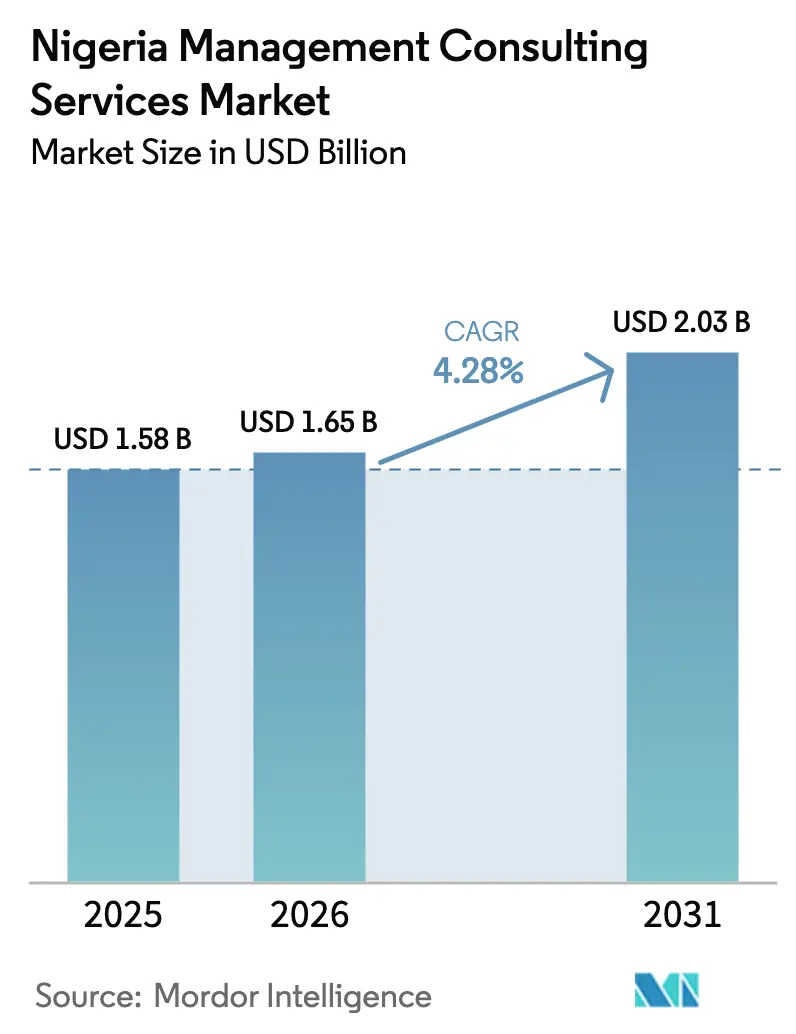
| Base Year Market Size (2025) | USD 1.58 Billion |
| Market Size (2026) | USD 1.65 Billion |
| Market Size (2031) | USD 2.03 Billion |
| Growth Rate (2026 - 2031) | 4.28 % |
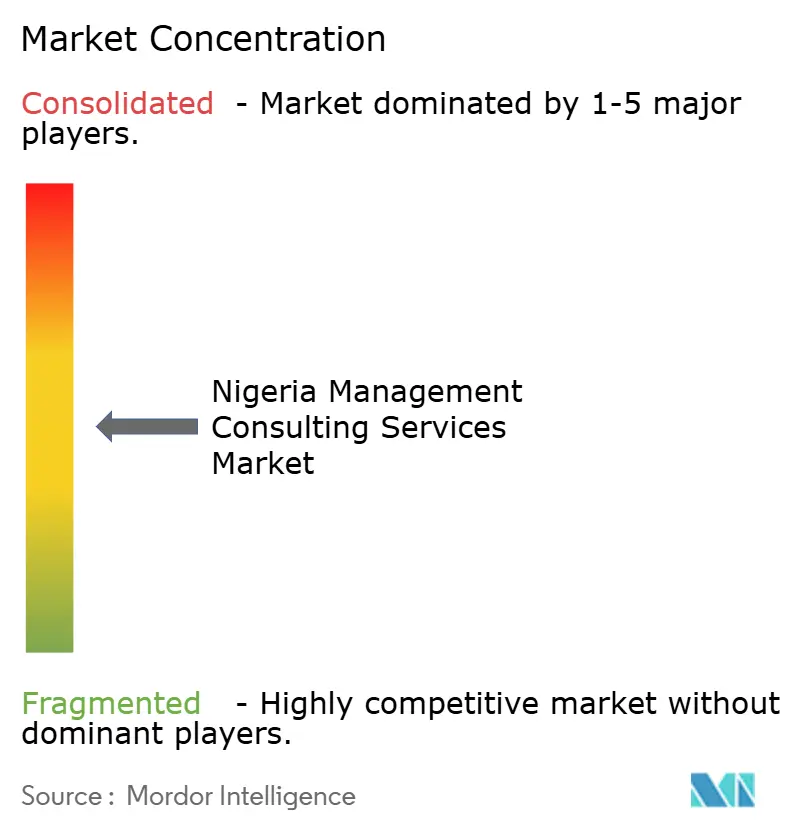
| Market Concentration | Medium |
Major Players *Disclaimer: Major Players sorted in no particular order Image © Mordor Intelligence. Reuse requires attribution under CC BY 4.0. | |
Nigeria Management Consulting Services Market Analysis by Mordor Intelligence
Nigeria management consulting services market size in 2026 is estimated at USD 1.65 billion, growing from 2025 value of USD 1.58 billion with 2031 projections showing USD 2.03 billion, growing at 4.28% CAGR over 2026-2031. Growth is sustained by the country’s accelerating economic diversification, with services already accounting for 56% of GDP and expanding 5% in 2024, and by President Bola Tinubu’s reform agenda that targets a USD 1 trillion economy within the decade.[1]Semafor, “Nigeria’s economy could be turning a corner,” semafor.com Rising foreign investment, rapid digital transformation, and tax reforms that cut withholding tax on local professional services to 5% jointly strengthen demand for high-value advisory support. At the same time, the naira’s depreciation, inflation above 30%, and an acute skills gap intensify the need for operational efficiencies that professional consultancies provide. Competitive dynamics remain fluid as the Big Four confront cost-efficient indigenous firms that leverage local knowledge, technology platforms, and the “Outsource to Nigeria Initiative” to win mid-market mandates.
Key Report Takeaways
- By organization size, large enterprises controlled 72.98% of Nigeria management consulting services market share in 2025; small and medium-sized enterprises are expanding at a 5.05% CAGR to 2031.
- By service type, operations consulting captured 33.18% revenue share in 2025, while technology consulting advances at a 6.15% CAGR through 2031.
- By delivery model, on-site consulting accounted for 64.58% of Nigeria management consulting services market size in 2025, yet remote engagements are rising at 7.12% CAGR to 2031.
- By end-user industry, financial services led with 26.47% share in 2025; healthcare and life sciences posts the highest projected CAGR at 7.36% through 2031.
Note: Market size and forecast figures in this report are generated using Mordor Intelligence’s proprietary estimation framework, updated with the latest available data and insights as of 2026.
Nigeria Management Consulting Services Market Trends and Insights
Drivers Impact Analysis*
| Driver | (~) % Impact on CAGR Forecast | Geographic Relevance | Impact Timeline |
|---|---|---|---|
| Government diversification reforms fueling advisory demand | +1.2% | National, with concentration in Lagos, Abuja, Port Harcourt | Medium term (2-4 years) |
| Surge in FDI and MNC expansion requiring local expertise | +0.8% | National, with spillover to regional hubs | Short term (≤ 2 years) |
| Enterprise-wide digital-transformation programmes | +1.0% | National, with early adoption in financial services and telecommunications | Medium term (2-4 years) |
| Rise of indigenous tech-enabled consultancies | +0.6% | National, with concentration in Lagos and Abuja tech corridors | Long term (≥ 4 years) |
| AfCFTA-driven regional expansion mandates | +0.4% | National, with focus on trade corridors and border states | Long term (≥ 4 years) |
| ESG and sustainability compliance advisory uptick | +0.3% | National, with emphasis on extractive industries and financial services | Medium term (2-4 years) |
| Source: Mordor Intelligence | |||
Government Diversification Reforms Fueling Advisory Demand
The government’s Economic Transformation Roadmap moves the economy from oil dependency toward a balanced structure built on natural, built, human, and social capital. This multi-phase program forces ministries and corporates to seek structured guidance on funding models, implementation sequencing, and performance metrics.[2]NESG Group, “EPR Journal H1 2024,” nesgroup.org The 2025 Tax Reform Acts consolidate more than 20 statutes, create the Nigeria Revenue Service, and impose a 15% minimum effective tax rate for large corporates, which pushes firms to secure compliance toolkits, tax optimization playbooks, and change-management expertise. Removal of fuel subsidies and unification of foreign-exchange windows alter cost structures across industries, raising short-run volatility that elevates the value of scenario planning and risk-mitigation advisory. As execution complexity rises, the Nigeria management consulting services market finds itself embedded in every phase of reform delivery.
Surge in FDI and MNC Expansion Requiring Local Expertise
Foreign investment inflows jumped to USD 3.4 billion in Q1 2024, a four-year high, yet composition skews to banking at 61.2%, underscoring the need for consultants to redirect capital to under-funded real-sector activities. Infrastructure mega-projects such as the USD 20 billion Ogidigben Gas Revolution Industrial Park demand regulatory mapping, partner alignment, and development-finance structuring. Portfolio investors hold a shorter time horizon, creating openings for advisers to craft long-term project pipelines that reduce volatility and advance industrialization. The Nigeria management consulting services market therefore acts as the critical interface between foreign capital and local opportunity.
Enterprise-wide Digital Transformation Programmes
Digital economy value added climbed to 19.78% of GDP in Q2 2024 as policy pushes—from AI-powered company registration to open banking—expanded the national technology stack. The EU’s EUR 820 million (USD 899 million) commitment to Nigeria’s digital capacity underscores external confidence in the roadmap. Sector examples abound: banks modernize core systems to meet open-banking rules, while healthcare providers align with the Nigeria Digital Health Initiative despite an interoperability readiness score of 2.0/5 that signals heavy advisory input still required. These multipronged programmes secure a durable growth runway for the Nigeria management consulting services market in technology engagements.
Rise of Indigenous Tech-enabled Consultancies
Local firms such as Verraki Partners and Phillips Consulting employ cloud-native toolkits and analytics engines to compress delivery cycles and reduce fee levels relative to international houses. Government-led outsourcing nodes, for example the Gombe State BPO Centre targeting 2,000 new roles, demonstrate an ecosystem approach that positions indigenous consultancies for scale.[3]State House Abuja, “Outsource to Nigeria Initiative,” statehouse.gov.ng Regulatory sandboxes in banking and capital markets allow these firms to refine proofs of concept before commercial rollout, building credibility that draws mid-market clients. Their cultural fluency and naira-denominated cost base strengthen price-value alignment, a deciding factor for cost-conscious SMEs.
Restraints Impact Analysis*
| Restraint | (~) % Impact on CAGR Forecast | Geographic Relevance | Impact Timeline |
|---|---|---|---|
| Talent shortage and high consultant turnover | -0.9% | National, with acute impact in Lagos, Abuja, Port Harcourt | Short term (≤ 2 years) |
| Macroeconomic volatility and Naira depreciation | -0.7% | National, with spillover effects on international engagements | Medium term (2-4 years) |
| Freelance platforms under-cutting traditional fees | -0.4% | National, with concentration in urban centers | Long term (≥ 4 years) |
| Conflict-of-interest scrutiny in public projects | -0.3% | National, with focus on federal and state government contracts | Medium term (2-4 years) |
| Source: Mordor Intelligence | |||
Talent Shortage and High Consultant Turnover
Nigeria produces 1.5 million graduates per year yet employers flag critical-thinking and digital-skills deficits, a mismatch that elevates onboarding costs and stretches project timelines. Brain drain removes experienced mentors from universities, weakening the talent pipeline. Wage increases mandated by the 2024 Minimum Wage Amendment Act raise entry costs without solving the capability gap. International firms struggle to keep local hires against offers from fintechs paying in hard currency, making retention packages more expensive. This talent bottleneck crimps the Nigeria management consulting services market at the very moment demand accelerates.
Macroeconomic Volatility and Naira Depreciation
The naira’s 70% fall amplifies the cost of imported knowledge assets and software platforms that many consultancies rely on. Inflation near 34% reduces client discretionary budgets, prompting project delays. Government debt-service ratios above 60% of revenue constrain public-sector consulting spend. Policy-rate hikes to 27.5% lift financing costs for local firms seeking working capital. Although reforms improve long-run fundamentals, short-run volatility reduces deal flow and forces inventive pricing, such as outcome-based fees or phased delivery.
*Our forecasts treat driver/restraint impacts as directional, not additive. The impact forecasts reflect baseline growth, mix effects, and variable interactions.
Segment Analysis
By Organization Size – SMEs Drive Growth Despite Enterprise Dominance
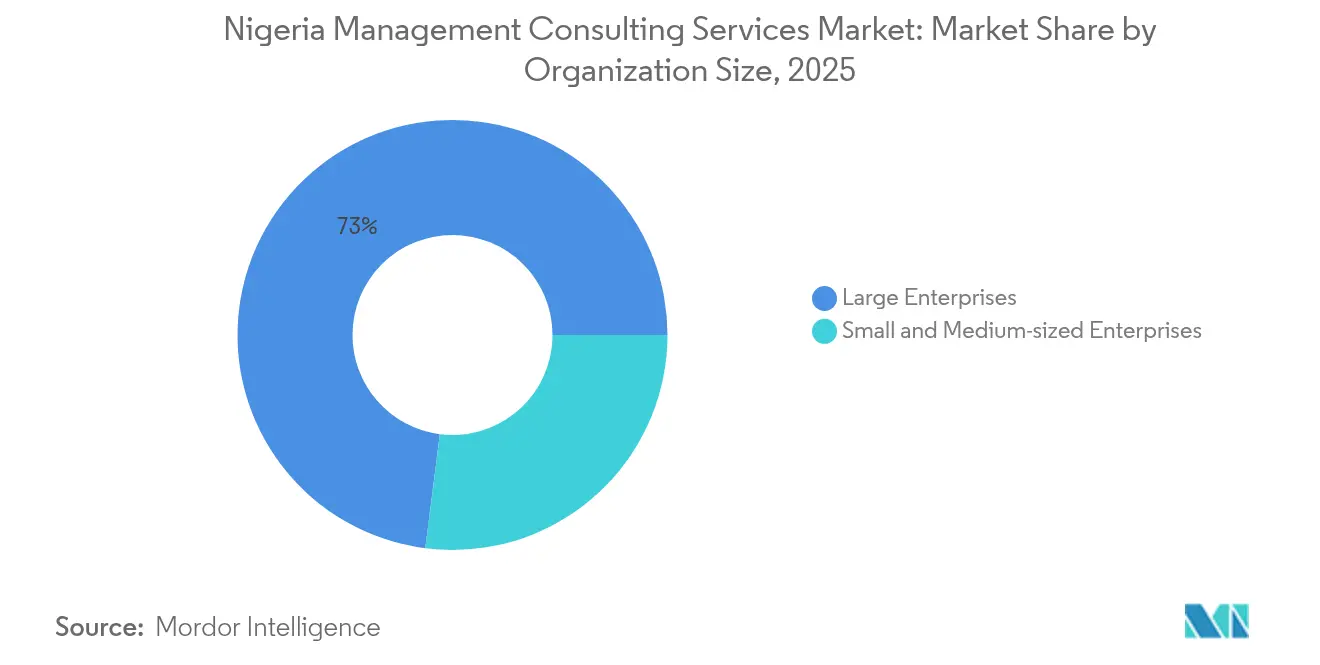
Large enterprises generated 72.98% of Nigeria management consulting services market size in 2025 as digital transformation, compliance programs, and AfCFTA strategies demanded broad engagements. SMEs, however, expand at a 5.05% CAGR to 2031 thanks to credit-access programs and a reduced 5% withholding-tax rate that makes professional advice more affordable.
Large corporates procure multi-module projects that span strategy, technology, and ESG frameworks, often awarding work through global procurement units that favor firms with international footprints. SMEs instead lean on agile indigenous consultancies that package advisory outputs into modular sprints delivered remotely, meeting budget constraints while closing knowledge gaps. This two-tiered demand profile helps the Nigeria management consulting services market book revenue diversity.



By Service Type – Technology Consulting Accelerates
Operations consulting held 33.18% Nigeria management consulting services market share in 2025, confirming client emphasis on cost control in a volatile macro environment. Technology consulting, however, is projected to deliver a 6.15% CAGR through 2031 as sectors digitize processes to raise productivity.
Banks integrate open-API architectures, hospitals migrate to electronic medical records, and public agencies deploy AI chatbots for citizen services. Each initiative needs system integrators, data-governance blueprints, and change-management playbooks, roles that technology consultants fill. These engagements often bundle strategy consulting elements to align digital investments with enterprise value creation.
By Delivery Model – Remote Services Gain Traction
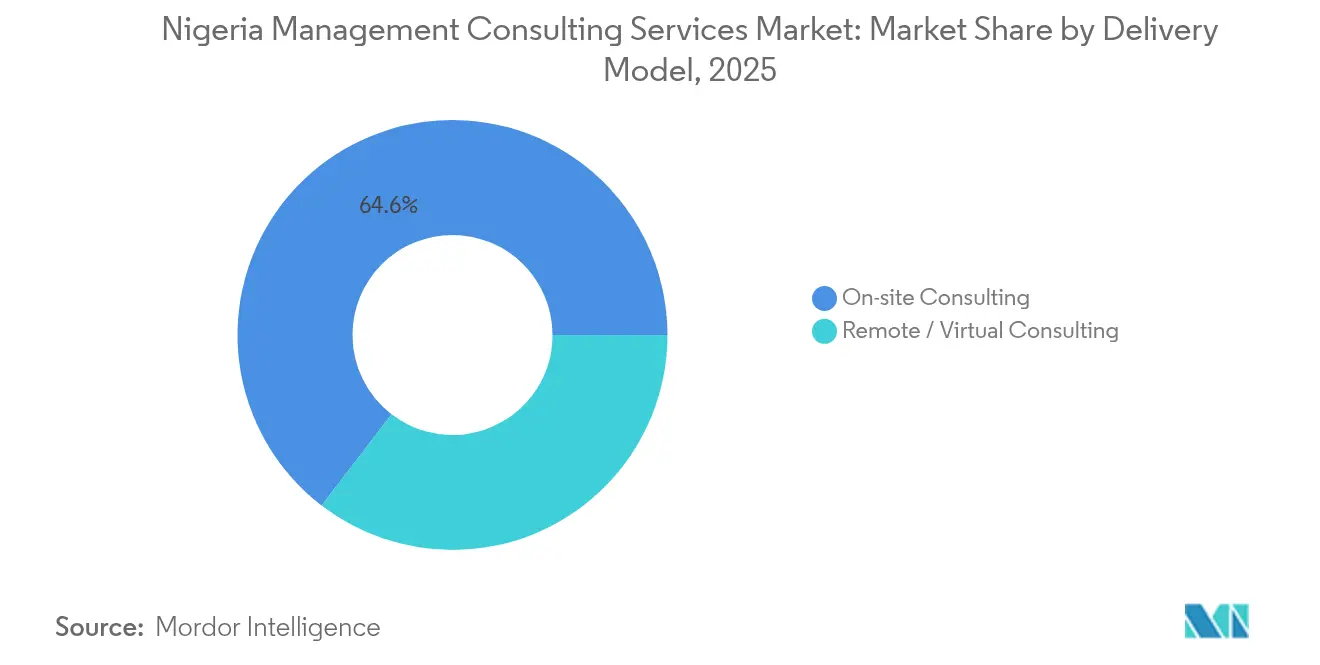
On-site engagements still comprised 64.58% of Nigeria management consulting services market size in 2025 owing to relationship-centric buyer preferences, yet remote delivery records a 7.12% CAGR through 2031.
Virtual court pilots, tele-rehabilitation programs, and BPO center growth validate digital channels for high-skill services. Hybrid models combine kick-off workshops in person with analytics sprints online, lowering travel costs that have risen with currency devaluation. As broadband penetration and cloud adoption improve, remote work earns cultural legitimacy and unlocks new client segments in secondary cities.
By End-user Industry – Healthcare Leads Growth
Financial services commanded 26.47% revenue in 2025 due to recapitalization-driven advisory mandates and fintech compliance needs. Healthcare and life sciences is on track for 7.36% CAGR, powered by USD 3 billion National Health Sector Renewal Investment commitments that require digital health integration, supply-chain redesign, and ESG alignment.
Manufacturing clients demand consulting on lean operations, energy efficiency, and AfCFTA supply-chain relocation strategies. Energy firms facing low-carbon transition scenarios seek project roadmaps that maintain cash flows while meeting ESG thresholds. Government agencies contract capacity-building programs to implement tax, trade, and local-governance reforms, further diversifying demand.
Geography Analysis
Lagos, Abuja, and Port Harcourt anchor more than half of Nigeria management consulting services market revenue because they host financial headquarters, federal ministries, and energy majors respectively. Lagos serves as the base for African regional operations of global banks and consumer conglomerates, driving cross-border advisory deals. Abuja channels public-sector engagements ranging from tax reform rollouts to national digital-identity systems. Port Harcourt generates energy-sector consulting demand covering production efficiencies, gas commercialization, and renewable integration.
Provincial hubs are emerging as the federal government decentralizes economic activity. Gombe State’s BPO center validates northern potential for knowledge-services parks. Plateau, Nasarawa, and Kogi states attract mining advisory work for lithium and cobalt projects that feed global battery supply chains. Border states invest in trade-facilitation upgrades to harness AfCFTA traffic, generating logistics-optimization mandates.
Local government autonomy, affirmed by the Supreme Court in July 2024, will shift budgetary authority to 774 councils. These entities require project-management offices, budgeting systems, and governance frameworks, enlarging the Nigeria management consulting services market footprint beyond traditional metros.
Competitive Landscape
The competitive arena is moderately fragmented. The Big Four plus McKinsey, BCG, and Bain leverage global frameworks and international client relationships, yet face fee pressure in mid-market deals where Phillips Consulting, Verraki Partners, and Agusto Consulting win share by offering culturally attuned teams at naira-based rates.
Strategic differentiation is moving toward AI-enabled diagnostics, cloud-native delivery platforms, and proprietary data sets that sharpen insights while reducing project timelines. Indigenous firms build vertical specializations—such as healthcare digitalization or public-sector tax systems—where regulatory nuance trumps global templates.
The “Outsource to Nigeria Initiative” fosters joint ventures between international consultancies and local BPO vendors, blending process know-how with cost advantages. Freelance marketplaces add competitive noise by offering senior consultants on project-basis pricing, pushing incumbent firms to adopt flexible staffing pools and outcome-linked fee models.
Nigeria Management Consulting Services Industry Leaders
PwC Nigeria
KPMG Professional Services
Deloitte Nigeria
EY Nigeria
McKinsey and Company
- *Disclaimer: Major Players sorted in no particular order

Recent Industry Developments
- January 2025: Transgrid Enerco acquired 60% of Eko Electricity Distribution Company for USD 200 million, and immediately retained consulting support for revenue-cycle redesign, loss-reduction analytics, and tariff benchmarking. The deal strengthens the privatisation narrative and elevates utility-sector advisory spend.
- January 2025: British International Investment and Johnvents Group closed a USD 40.5 million cocoa-sector investment that triples processing capacity. Consultants are designing ESG-compliant traceability systems aimed at 100% transparency by 2027, positioning Nigerian cocoa for premium export channels.
- January 2025: Alpha GRIP Management secured multibillion financing for the USD 20 billion Ogidigben Gas Industrial Park. Advisory firms lead project-finance structuring, stakeholder alignment, and regulatory navigation across energy, infrastructure, and environmental domains.
- March 2024: Nigeria launched the “Outsource to Nigeria Initiative” with the Gombe BPO Center, signaling government intent to capture global outsourcing flows. Strategy advisers craft positioning roadmaps and workforce-skills curricula that align with international service-level standards


Nigeria Management Consulting Services Market Report Scope
| Large Enterprises |
| Small and Medium-sized Enterprises |
| Strategy Consulting |
| Operations Consulting |
| HR Consulting |
| Technology Consulting |
| Other Service Types (Implementation, Function-specific, Industry-specific) |
| On-site Consulting |
| Remote / Virtual Consulting |
| IT and Telecommunications |
| Healthcare and Life Sciences |
| Financial Services (BFSI) |
| Manufacturing and Industrial |
| Energy and Utilities |
| Government and Public Sector |
| Real Estate and Construction |
| Retail and Consumer Goods |
| Media, Entertainment and Sports |
| Hospitality and Travel |
| Other End-user Industries (Education, Transportation and Logistics, Agriculture and Agribusiness, among others) |
| By Organization Size | Large Enterprises |
| Small and Medium-sized Enterprises | |
| By Service Type | Strategy Consulting |
| Operations Consulting | |
| HR Consulting | |
| Technology Consulting | |
| Other Service Types (Implementation, Function-specific, Industry-specific) | |
| By Delivery Model | On-site Consulting |
| Remote / Virtual Consulting | |
| By End-user Industry | IT and Telecommunications |
| Healthcare and Life Sciences | |
| Financial Services (BFSI) | |
| Manufacturing and Industrial | |
| Energy and Utilities | |
| Government and Public Sector | |
| Real Estate and Construction | |
| Retail and Consumer Goods | |
| Media, Entertainment and Sports | |
| Hospitality and Travel | |
| Other End-user Industries (Education, Transportation and Logistics, Agriculture and Agribusiness, among others) |


Key Questions Answered in the Report
What is the forecast size of Nigeria’s consulting market by 2031?
The Nigeria management consulting services market is projected to reach USD 2.03 billion in 2031.
Which client segment is expanding the fastest?
Small and medium-sized enterprises are growing at a 5.05% CAGR as tax reforms and digital platforms make advisory services more accessible.
Which service line shows the highest growth rate?
Technology consulting is advancing at a 6.15% CAGR on the back of nationwide digital-transformation agendas.
How will AfCFTA shape consulting demand?
Tariff waivers on 90% of African goods drive demand for cross-border supply-chain design, regulatory alignment, and market-entry strategies.
What tax change affects local consultancy fees?
The 2025 Tax Reform Acts lowered withholding tax on Nigerian professional services from 10% to 5%, improving cost competitiveness.
How fragmented is the competitive landscape?
The market scores 5 on a 10-point concentration scale, meaning the top five firms control under 50% of revenue, leaving significant room for specialized players.
Page last updated on:


 Your data is secure and never sold or shared.


