
India Management Consulting Services Market Size and Share
India Management Consulting Services Market Analysis by Mordor Intelligence
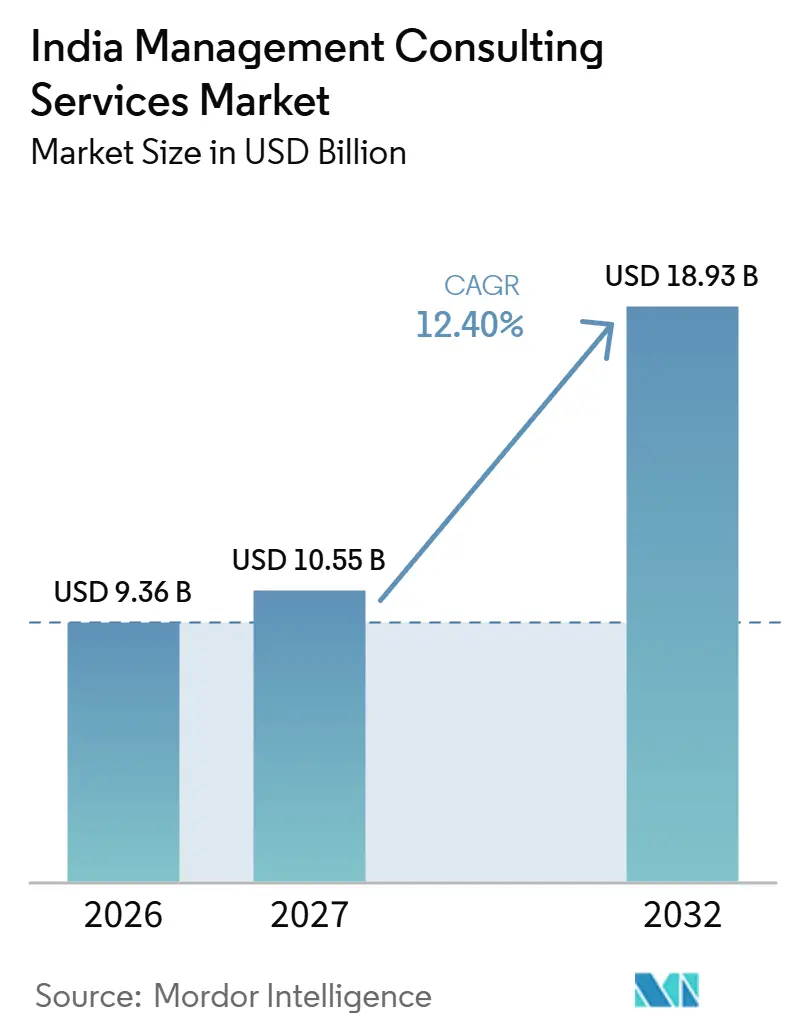
The India management consulting services market size is expected to increase from USD 9.36 billion in 2026 to USD 10.55 billion in 2027 and reach USD 18.93 billion by 2032, growing at a CAGR of 12.4% over 2027-2032.
Enterprise AI plans and recurring sustainability disclosures in India create advisory demand by leaving buyers to resolve who owns the data and who answers for results. Partnerships and proposed integrated platforms give advisers routes to bring business design closer to implementation. For financial-services capability centers in Mumbai, those questions span operating functions, favoring advisers able to carry recommendations into implementation. Advisers that sell bounded decisions within a wider transformation path fit that demand, while outcome-focused fee discussions raise the bar for stating what an assignment will deliver.
Key Report Takeaways
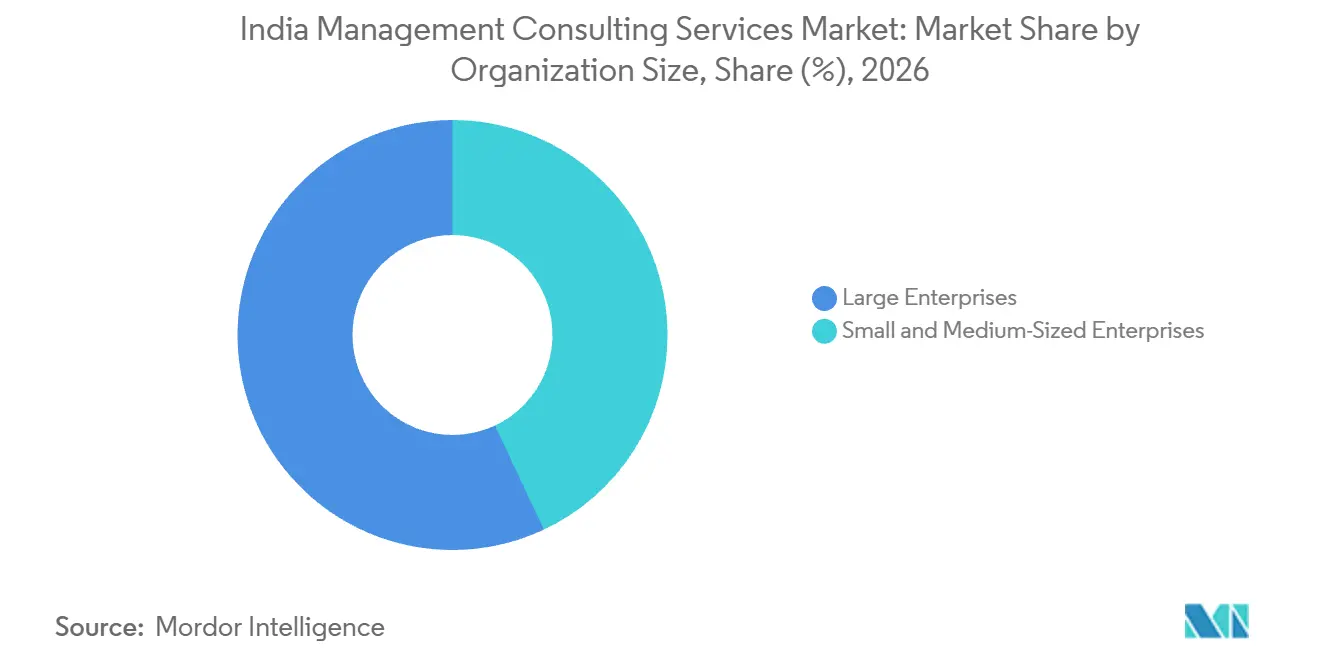
- By organization size, large enterprises held a 56.99% India management consulting services market share in 2026, while small and medium-sized enterprises are the fastest-growing segment with a forecast CAGR of 13.05% over 2027-2032.
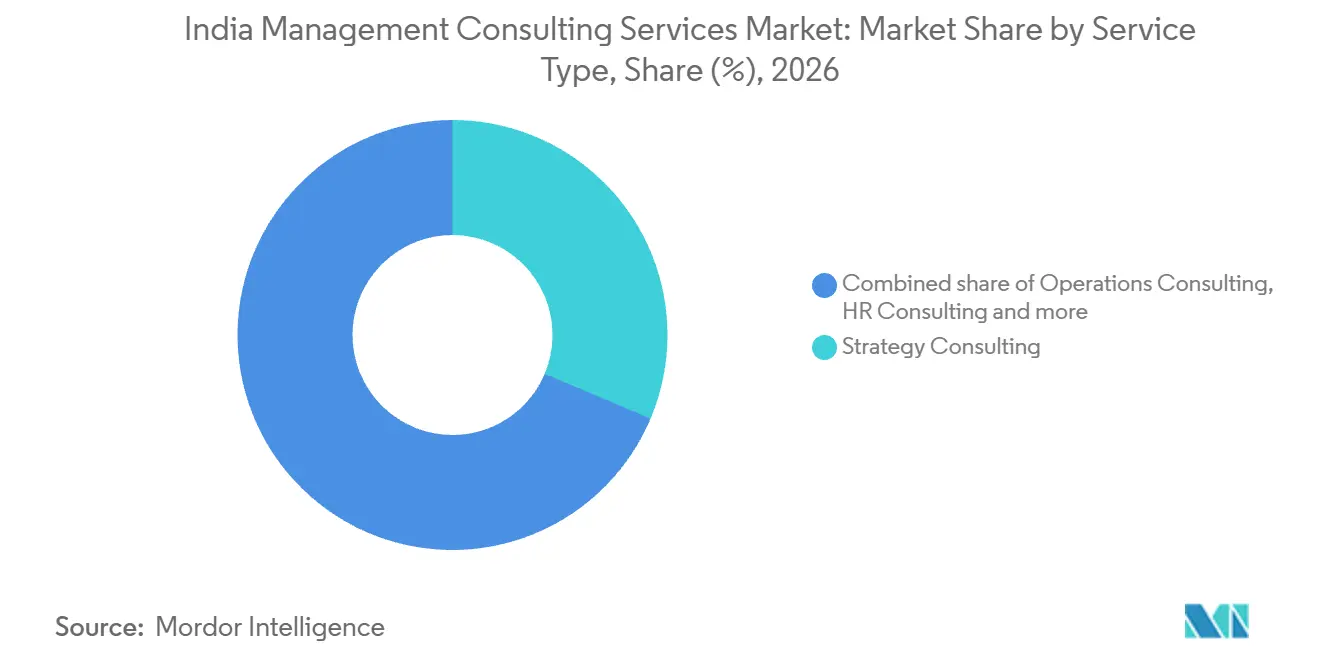
- Strategy consulting led service types with a 31.35% share of the India management consulting services market size in 2026, while technology consulting is the fastest-growing segment with a forecast CAGR of 12.75% over 2027-2032.
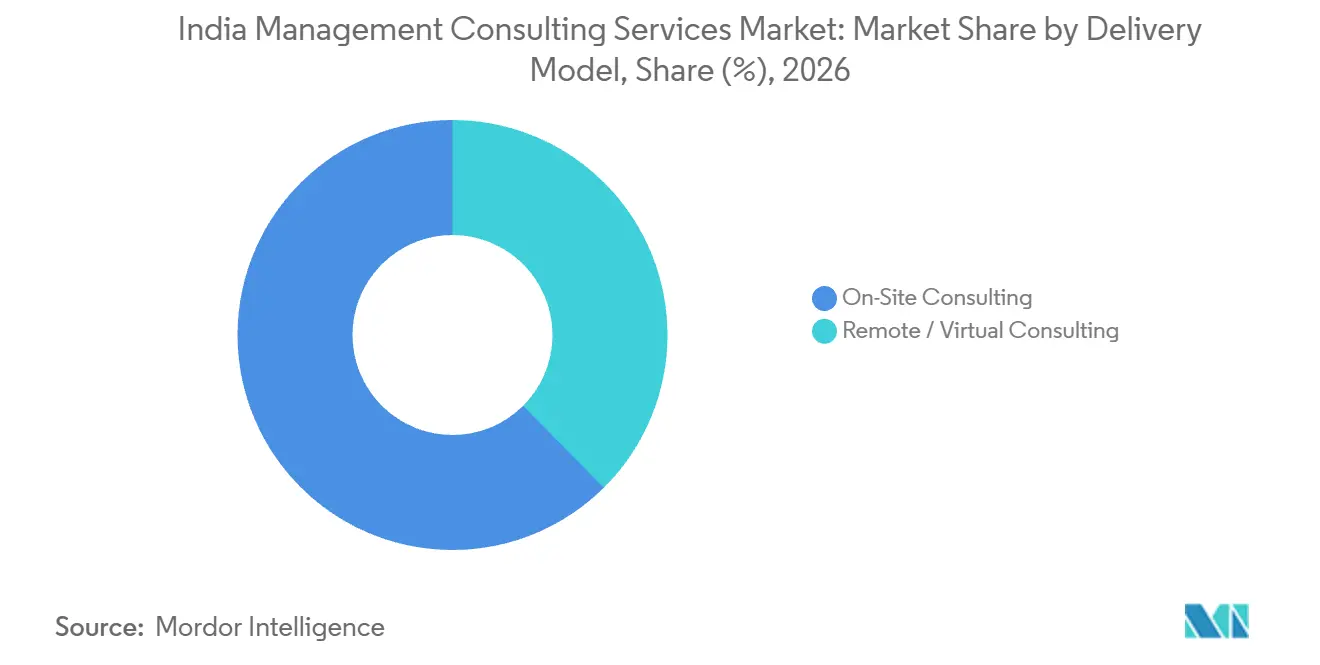
- For delivery models, on-site consulting held 62.44% of India's management consulting revenue in 2026, while remote / virtual consulting is the fastest-growing segment with a forecast CAGR of 13.15% over 2027-2032.
- Among end-user industries, IT and telecommunications held 18.07% of India's management consulting revenue in 2026, while the fastest-growing segment, healthcare and life sciences, has a forecast CAGR of 13.6% over 2027-2032.
Note: Market numbers in this report are based on Mordor Intelligence's proprietary estimation framework, which combines nine months of actuals with Q4 projections for base year 2026.
Market Trends and Insights
Drivers Impact Analysis of India Management Consulting Services Market*
| Driver | (~) % Impact on CAGR Forecast | Geographic Relevance | Impact Timeline |
|---|---|---|---|
| Accelerated Digital-Transformation Spend by Large Indian Corporates | +5% | Nationwide | Medium term (2-4 years) |
| Mandatory ESG-Reporting Advisory Needs Post-SEBI BRSR Rollout | +2.6% | Nationwide | Short term (≤ 2 years) |
| Rise of GCCs Demanding Hybrid Consulting Engagements | +3.4% | City of Bengaluru | Medium term (2-4 years) |
| Rapid VC-Backed SME Scaling Requiring Growth-Strategy Consulting | +2.5% | City of Bengaluru | Short term (≤ 2 years) |
| Corporate Succession Planning Amidst Generational Transitions | +1.1% | Nationwide | Long term (≥ 4 years) |
| Demand for Deal-Ready Operational Turnaround Playbooks | +1.5% | Nationwide | Short term (≤ 2 years) |
| Source: Mordor Intelligence | |||
Accelerated Digital-Transformation Spend by Large Indian Corporates
AI and analytics investment creates advisory demand where enterprise technology choices must be translated into business priorities and operating responsibilities. In a survey conducted from May through July 2025, 93% of respondents from Indian enterprises expected to increase spending on AI and analytics.[1] For large corporate buyers, the consulting opportunity is to determine which proposed applications justify organizational change before technical delivery absorbs the investment. Advisory work can connect use-case selection with decision rights, implementation sequencing and measures that distinguish a deployed tool from an effective business process. Phasing the assignment puts a funding decision between the AI diagnosis and wider implementation, making expansion contingent on a business case rather than the spending intention alone.
Mandatory ESG-Reporting Advisory Needs Post-SEBI BRSR Rollout
Recurring sustainability disclosure creates an advisory task that extends beyond drafting a narrative for the annual reporting cycle. SEBI requires the top 1,000 listed entities by market capitalization to include the updated BRSR format in annual reports from FY 2023-24.[2] For covered Indian companies, consulting can translate that reporting duty into clear data ownership, consistent definitions and an organized route from operating records to disclosures. Annual repetition makes consistency across reporting cycles valuable, since redefining the same data for each narrative would recreate the preparation work. Once that foundation is established, advisers can concentrate on changed operations and reporting exceptions rather than reconstructing the disclosure process each year.
Rise of GCCs Demanding Hybrid Consulting Engagements
Global capability center (GCC) expansion creates an advisory opening at the boundary between a local operating center and its parent company's organization. India had 2,117 global capability centers as of March 2026, 32% more than in FY2021. For an operator, establishing responsibilities between the center and the parent business can be as important as defining the work assigned to the center. Hybrid consulting engagements can combine on-site work on local operating responsibilities with remote specialist analysis of questions shared across the wider organization. Hybrid delivery gives the parent access to specialist analysis after setup, when allocating decision rights across a growing center becomes the continuing advisory question.
Rapid VC-Backed SME Scaling Requiring Growth-Strategy Consulting
New capital creates choices for a funded startup about which services to expand and which operating commitments it can sustain. Bengaluru-based voice AI startup Bolna raised USD 6.3 million in a seed round led by General Catalyst in January 2026. In September 2026, Bolna reported handling around 15 million call minutes per day across its platform company-wide. An advisory mandate can distinguish the service level promised to customers from the organizational and cost commitments needed to deliver it. At that call volume, growth advice can test the cost of each proposed service commitment before expansion turns it into a recurring obligation.
Restraints Impact Analysis of India Management Consulting Services Market*
| Restraint | (~) % Impact on CAGR Forecast | Geographic Relevance | Impact Timeline |
|---|---|---|---|
| Persistent Pricing Pressure from IT Services Majors | -1.5% | Nationwide | Short term (≤ 2 years) |
| Talent Attrition to Product-Management and VC Ecosystem | -1% | Nationwide | Medium term (2-4 years) |
| Growing Client Preference for Outcome-Based Fee Structures | -0.7% | Nationwide | Medium term (2-4 years) |
| AI-Led Self-Service Diagnostics Reducing Basic Consulting Demand | -0.5% | Nationwide | Long term (≥ 4 years) |
| Source: Mordor Intelligence | |||
Persistent Pricing Pressure from IT Services Majors
Standalone advisory fees face pressure when a buyer compares a consulting assignment with advice included in a larger technology-services offer. The supplier of the wider engagement can assess the economics of the whole mandate, while a specialist adviser must recover its costs from the advisory scope. This makes a bounded diagnostic or process-redesign assignment vulnerable to a comparison that assigns little separate value to its analytical work. A specialist can respond by defining the decision and responsibility covered by its fee. Even a tightly scoped mandate can demand senior expertise while supporting only a modest standalone fee, which limits the work a specialist can economically accept.
Talent Attrition to Product-Management and VC Ecosystem
The talent constraint in a senior consulting exit is the loss of sector context as well as available delivery time. In 2025, former McKinsey associate partner Manish Jain joined Atomic Capital as a partner, moving into venture capital focused on India's startup landscape. His consulting career included advising conglomerates and high-growth businesses in logistics, e-commerce, industrials and technology. For a consulting team, losing that combination of sector familiarity and assignment experience can increase the effort needed to transfer responsibilities. Rebuilding that sector context competes with billable senior work, so a firm may need time to restore the delivery capacity the departing partner provided.
*Our forecasts treat driver/restraint impacts as directional, not additive. The impact forecasts reflect baseline growth, mix effects, and variable interactions.
India Management Consulting Services Market Segment Analysis
By Organization Size:
Broad Corporate Programs Support Large Enterprise DemandLarge enterprises accounted for a 56.99% share of the India management consulting services market size in 2026. On March 24, 2025, Steel Authority of India Limited, a state-owned steel producer, signed a strategic consulting agreement with McKinsey & Company India LLP. The agreement covered a digital transformation program focused on key process-value-chain areas from mines to marketing. An assignment spanning production and commercial processes can require shared priorities across functions before technical work is sequenced. A single program can expose trade-offs between production priorities and marketing requirements before separate projects lock them in.
Small and medium-sized enterprises are forecast to grow at a CAGR of 13.05% over 2027-2032, making them the fastest-growing segment. In March 2026, the Rajya Sabha's Department-Related Parliamentary Standing Committee on Industry reported about 488,000 small enterprises and about 36,816 medium enterprises registered on Udyam. For a smaller firm considering how to divide sales and operating responsibilities, a narrowly defined engagement could address that decision without redesigning the whole organization. Limiting the assignment to that transition would reduce the advisory work needed from a single buyer. The opportunity is to reach more of this enterprise base through smaller engagements, rather than require each prospective client to fund a broad transformation.

By Service Type:
Strategy Leads While Technology Links Advice With DeliveryStrategy consulting represented a 31.35% India management consulting services market share in 2026. Small Industries Development Bank of India appointed McKinsey & Company India LLP in October 2025 for a 24-month assignment to validate, formulate and implement its medium-term corporate strategy. The combined scope makes the transition from a strategic recommendation to implementation part of the advisory mandate. The scheduled October 2025-October 2027 term allows the buyer to assess the strategy against implementation decisions within the same engagement.
Technology consulting is forecast to grow at a CAGR of 12.75% over 2027-2032, making it the fastest-growing segment. On September 3, 2025, Telecommunications Consultants India Limited (TCIL) and Punjab National Bank signed an MoU. Under the MoU, TCIL will provide IT consultancy, project management and turnkey technology execution, serving as Project Management Consultant or Project Implementing Agency depending on requirements. In April 2025, Accenture announced a collaboration with Indian retailer Malabar Gold & Diamonds to develop and deliver an AI-powered, cloud-enabled platform for its global operations. For the buyer, defining whether the adviser oversees delivery or implements it determines the accountability required from a technology consulting mandate.
By Delivery Model:
Implementation Oversight Supports On-Site WorkOn-site consulting was the largest segment by delivery model, accounting for 62.44% of the market in 2026. In January 2026, the Life Insurance Corporation of India (LIC) issued a request for proposal for a 5-year Digital Personal Data Protection (DPDP) implementation assignment. It required qualified resources at LIC premises and, after contract signing, an on-site project manager at its Mumbai Central Office, and LIC's March 24, 2026 result notice named Ernst & Young LLP as selected bidder. The assignment combined advisory assessments and policy design with implementation, technology and tool-support activities. Requiring a project manager at the Mumbai office makes implementation accountability a resident role, rather than an occasional handoff between advisory reviews.
Remote / virtual consulting is forecast to grow at a CAGR of 13.15% over 2027-2032, making it the fastest-growing segment. For a buyer whose advisory problem can be described through shared documents and structured data, physical proximity is less central to the diagnostic task. Its constraint is that the engagement must make responsibilities and information requirements explicit when the adviser cannot observe day-to-day work directly. A buyer could therefore commission a discrete diagnostic question without funding a resident team, widening the range of assignments suited to external advice.
By End-User Industry:
Telecom Scale and Healthcare Development Shape DemandIT and telecommunications accounted for 18.07% of the market in 2026, making it the largest segment by end-user industry. India had 1.33 billion wireless and wireline telephone subscribers at the end of March 2026. At that service scale, advisory work can focus on how network, customer-service and corporate responsibilities are coordinated. An operator considering changes across those functions would need a mandate distinguishing organizational decisions from the technical work required to execute them. Defining who resolves a network issue that becomes a customer-service problem gives the advisory assignment a concrete management decision, distinct from the network investment itself.
The fastest-growing segment, healthcare and life sciences, is forecast to grow at a CAGR of 13.6% over 2027-2032. On February 10, 2025, Adani Group said it had engaged Mayo Clinic for strategic and clinical-practice advice at its planned Health City campuses in Ahmedabad and Mumbai. The announced advisory scope included organizational objectives, clinical practices, technology integration and healthcare quality. A healthcare developer can use such a mandate to connect organizational design with the clinical and technology decisions involved in planning a facility. This creates an advisory role in aligning those decisions before the operating model is established, making sector-specific judgment central to the proposed development.
Geography Analysis
Mumbai offers a financial-services entry point for advisory firms, with JLL's 2026 profile describing its capability-center setups as driven by banks, financial institutions and multinational corporations. Bengaluru's GCC activity spanned information technology and IT-enabled services, engineering and manufacturing R&D, analytics innovation centers and retail operations. Delhi NCR's corporate-services mix included IT, financial services, e-commerce and retail, healthcare, consulting and education. For advisory firms, these contrasting enterprise bases favor different combinations of financial-process expertise, technology operating-model design and coordination across business functions, making sector knowledge more useful than a uniform metropolitan sales approach.
The opportunity in Hyderabad, Pune and Chennai is to connect specialized enterprise functions with the operating decisions of their parent businesses. JLL's 2026 profile described Hyderabad as a healthcare and biotechnology hub, with life sciences, pharmaceuticals, IT services and semiconductors among its growth sectors. Pune's GCC activity covered financial services, automotive, IT services, manufacturing and engineering. Chennai's GCC profile centered on manufacturing and automotive, complemented by IT services, financial services and engineering R&D. Those sector combinations support an advisory proposition built around engineering, service delivery and corporate oversight, with healthcare expertise particularly relevant to Hyderabad and production-related knowledge relevant to Pune and Chennai.
Ahmedabad and Jaipur suggest different routes for advisory firms seeking work beyond the technology and financial-services centers. A 2025 Technology Development Board booklet identified Ahmedabad's industrial clusters in pharmaceuticals, pharma machinery, foundry, fabrication and textiles. Hawa Mahal in Jaipur recorded 1.82 million domestic visits in 2025. Ahmedabad's industrial mix supports process and organizational advice, while Hawa Mahal's visitor volume points to tourism and hospitality operators as a possible buyer group in Jaipur. A smaller advisory practice could use those distinct applications to build a focused regional specialty, with engagement scope determined by industrial processes in Ahmedabad or tourism and hospitality operations in Jaipur.
Regulatory Framework and Outlook
This comparison of selected jurisdictions examines India's personal-data regime and Maharashtra's establishment rules from the perspective of consulting firms operating offices and processing covered personal data. The DPDP Rules schedule security safeguards for data held or controlled by Data Fiduciaries, including processing on their behalf, with the relevant duty commencing 18 months after the November 2025 Gazette publication. Maharashtra's October 2025 amendment raised the establishment registration threshold from 10 to 20 or more employees, with establishments below 20 workers providing an intimation while statutory worker protections remain unchanged.
Regulatory Table of India Management Consulting Services Market
| Decision factor | India | Maharashtra |
|---|---|---|
| Primary authority | Data Protection Board of India | State-appointed Chief Facilitator and Facilitators |
| Key instruments or direction | Digital Personal Data Protection Rules, 2025, with staged commencement | Shops and Establishments Act with the October 2025 threshold amendment |
| Commercial effect | Role-specific preparation for personal-data safeguards | Registration or intimation according to the amended workforce threshold |
| Current policy attractiveness | Medium | High |
| Future direction of policy attractiveness | Hardening | No change |
| Source: Mordor Intelligence | ||
India's medium rating reflects the preparation required where advisory work involves covered personal-data processing. Its direction hardens as the scheduled security-safeguard duty commences, making the provider's fiduciary or processor role commercially important. Maharashtra's high rating reflects lighter establishment administration for smaller offices under the amended threshold. The state's retained worker protections and Facilitator structure support continuity in the operating framework after that threshold change, underpinning the no-change direction.
Value Chain Stages
The value chain compares business diagnosis, organizational design and implementation by the work performed and the fees consulting suppliers can earn. The Department of Expenditure's 2025 consultancy procurement manual describes fixed-price contracts linked to defined outputs or milestones and retainers paid at agreed staff rates, with contract choice depending on the assignment. These alternatives make the definition of deliverables commercially important, because a supplier must connect its diagnostic work to a usable decision or an agreed delivery responsibility.
Value Chain Analysis Table of India Management Consulting Services Market
| Primary activity | Key participants | Value capture | Bottleneck | Resilience response |
|---|---|---|---|---|
| Diagnose the business and operating model | Business advisers such as Grant Thornton Bharat LLP | Diagnostic assignment fees | Unclear boundaries between the business problem and symptoms | Agree the baseline, scope and decision to be supported |
| Design business processes and organizational responsibilities | Business and people advisers such as Ernst & Young LLP and Grant Thornton Bharat LLP | Business-design consulting fees | Conflicting responsibilities across functions | Assign decision owners and define cross-functional handoffs |
| Integrate processes with implementation | Consulting and implementation providers such as Deloitte Touche Tohmatsu India LLP | Implementation consulting fees | Handoffs between process design and technical work | Link implementation milestones to agreed process responsibilities |
| Source: Mordor Intelligence | ||||
The commercial distinction between these stages is the responsibility a supplier accepts when moving from diagnosis to execution. A business adviser can earn fees for a defined assessment, while an implementation provider must connect process choices with the work required to put them into operation. As assignments cross that boundary, explicit handoffs protect the value of the original diagnosis by keeping the implementation tied to the business decision it was meant to support.
Competitive Landscape
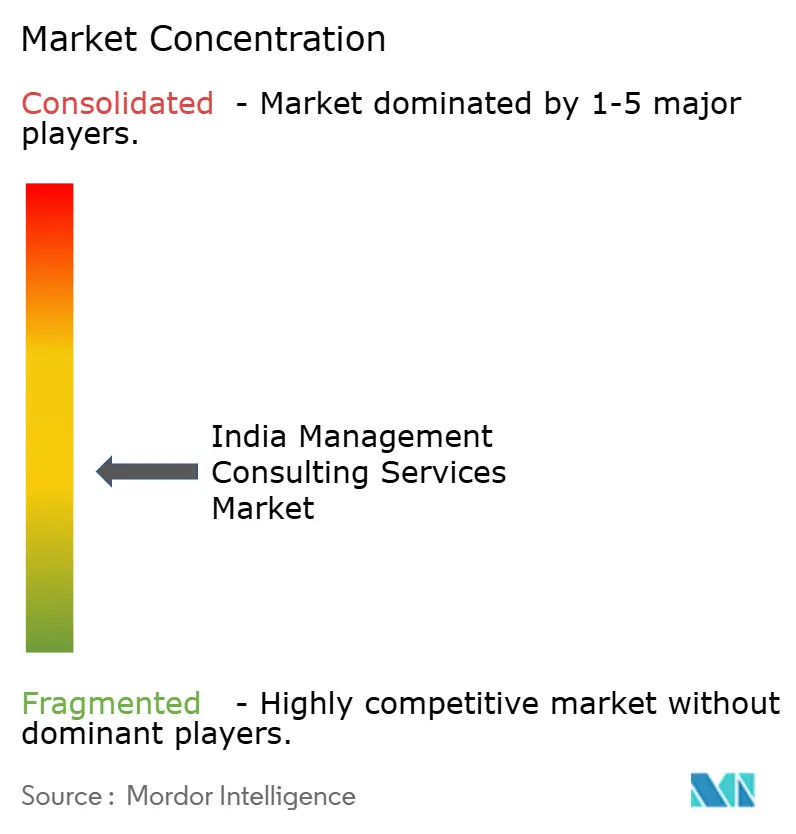
The competitive field is moderately fragmented, with strategy specialists competing alongside firms combining advice with operating or technology capabilities. McKinsey & Company Inc., Boston Consulting Group Inc., Deloitte Touche Tohmatsu India LLP, PricewaterhouseCoopers Services LLP and Accenture Solutions Pvt. Ltd. are among the major competitors. McKinsey provides strategy advice, Deloitte offers GCC strategy and operations support, PwC has an India consulting business, and Accenture provides strategy and consulting services in India. In February 2026, OpenAI announced global multi-year Frontier Alliance partnerships with Boston Consulting Group, McKinsey and Accenture to help implement its enterprise products in customer technology stacks. Shared technology partnerships put more weight on the business changes surrounding deployment, leaving firms to differentiate through industry expertise and delivery responsibilities.
Partnerships also allow advisers to extend their offer into the practical requirements of establishing Indian capability centers. In August 2025, Deloitte India formed an alliance with Embark to support global firms building and scaling GCCs in India across strategy, operations, infrastructure and governance.[3] For a prospective GCC operator, connecting those workstreams can reduce the number of interfaces that must be designed between the advisory assignment and the center's establishment. The competitive implication is a broader engagement boundary, where a rival offering only initial strategy advice must explain how its work connects to the operational and governance decisions that follow.
Structural integration could strengthen competition for assignments requiring coordinated resources across countries. In September 2026, PwC US and PwC India announced a proposed joint venture combining PwC India's Consulting business with PwC US Advisory's India-based capabilities to serve Indian, US and global clients. They expected closing in the first half of 2027, subject to closing conditions and regulatory approvals, with existing structures serving clients until then. For buyers, the proposed platform offers a basis for evaluating how cross-border delivery responsibilities could be organized within a combined advisory business. Regulatory approval and integration timing therefore matter to when that proposition can become an operating alternative, giving established delivery arrangements continued commercial relevance during the transition.
India Management Consulting Services Industry Leaders
-
McKinsey & Company Inc.
-
Boston Consulting Group Inc.
-
Deloitte Touche Tohmatsu India LLP
-
PricewaterhouseCoopers Services LLP
-
Accenture Solutions Pvt. Ltd.
- *Disclaimer: Major Players sorted in no particular order
India Management Consulting Services Market Companies Covered in this Report
- McKinsey & Company Inc.
- Boston Consulting Group Inc.
- Bain & Company Inc.
- Deloitte Touche Tohmatsu India LLP
- PricewaterhouseCoopers Services LLP
- Ernst & Young LLP
- KPMG Assurance and Consulting LLP
- Accenture Solutions Pvt. Ltd.
- IBM India Pvt. Ltd.
- Infosys Ltd.
- Tata Consultancy Services Ltd.
- Cognizant Technology Solutions India Pvt. Ltd.
- Wipro Ltd.
- LTM Ltd.
- Grant Thornton Bharat LLP
- BDO India LLP
- Alvarez & Marsal India Pvt. Ltd.
- Protiviti India Member Pvt. Ltd.
- Roland Berger Pvt. Ltd.
- Kearney India Pvt. Ltd.
- Frost & Sullivan India Pvt. Ltd.
- Zinnov Management Consulting Pvt. Ltd.
- RedSeer Management Consulting Pvt. Ltd.
- Technopak Advisors Pvt. Ltd.
- Praxis Global Alliance Pvt. Ltd.
Key Opportunities for Market Participants
The opportunities compare advisory assignments that turn regulatory requirements into operational preparation for covered organizations. Rule 3 of India's Digital Personal Data Protection Rules, 2025 is scheduled to commence 18 months after the November 2025 Gazette publication. It requires standalone, plain-language notices itemizing personal data and explaining processing purposes and related goods, services or uses. The BRSR Core glide path also covers the top 1,000 listed entities by market capitalization for assessment or assurance in FY 2026-27, creating a separate preparation need.
Market Opportunities Table of India Management Consulting Services Market
| Opportunity | Why now | Buyer / lead segment | Recommended play | Main barrier | Likely beneficiaries |
|---|---|---|---|---|---|
| Consent-notice and purpose-process design | Scheduled Rule 3 notice and purpose requirements | Covered consumer-facing Data Fiduciaries | Connect itemized data purposes with clear notices and customer processes | Preserving clarity across different data uses | Privacy advisers such as Deloitte Touche Tohmatsu India LLP |
| Phased privacy implementation governance | Specified DPDP Act duties scheduled for the 18-month phase | Covered multi-business Data Fiduciaries | Sequence readiness deliverables and assign process owners | Coordinating responsibilities across business functions | Privacy-governance advisers such as Deloitte Touche Tohmatsu India LLP |
| BRSR Core preparation | FY 2026-27 assessment or assurance glide path | Top 1,000 listed entities by market capitalization | Prepare reporting evidence with an independent verification arrangement | Provider and associate conflicts within the client group | Preparation and review advisers such as Ernst & Young LLP |
| Source: Mordor Intelligence | |||||
BRSR Core preparation is the clearest opening as the FY 2026-27 assessment or assurance requirement reaches the top 1,000 listed entities by market capitalization. SEBI requires listed entities to ensure that their assessment or assurance provider and its associates provide no consulting services to the entity or its group. A preparation adviser therefore needs an independent verification arrangement, making partner selection part of engagement design.
Recent Industry Developments in India Management Consulting Services Market
- Sep 2026: PwC US and PwC India announced a proposed joint venture combining PwC India's Consulting business with PwC US Advisory's India-based capabilities for Indian, US and global clients. Closing was expected in the first half of 2027, subject to closing conditions and regulatory approvals, with existing structures serving clients until then.
- Feb 2026: Deloitte Touche Tohmatsu India LLP announced an alliance with Confluent Inc. to support Indian enterprises' legacy modernization, real-time data access and readiness for AI, pairing Deloitte's advisory capabilities with Confluent's data-streaming platform.
- Dec 2025: Deloitte Touche Tohmatsu India LLP announced an expanded Google Cloud partnership to provide security advisory, resale and managed security services for Indian enterprises and public-sector organizations.
India Management Consulting Services Market Report Scope and Research Methodology
Market Definition and Coverage
The India management consulting services market measures annual spending on professional management consulting services purchased by organizations and public-sector bodies in India. The fees are classified by client organization size, consulting service type, delivery model, and end-user industry.
Scope exclusions: Standalone software licenses and IT implementation services, staffing and recruitment services, outsourced business-process operations, and clients' in-house advisory spending are excluded.
Segments Covered in This Report
- By Organization Size
- Large Enterprises
- Small and Medium-Sized Enterprises
- By Service Type
- Strategy Consulting
- Operations Consulting
- HR Consulting
- Technology Consulting
- Other Service Types
- By Delivery Model
- On-Site Consulting
- Remote / Virtual Consulting
- By End-User Industry
- IT and Telecommunications
- Healthcare and Life Sciences
- Financial Services (BFSI)
- Manufacturing and Industrial
- Energy and Utilities
- Government and Public Sector
- Real Estate and Construction
- Retail and Consumer Goods
- Media, Entertainment and Sports
- Hospitality and Travel
- Other End-User Industries
Data Sources, Market Sizing, and Validation
Desk Research
Public research uses sources such as the Securities and Exchange Board of India's BRSR circular to identify compliance-related advisory needs, the Reserve Bank of India's Annual Report and Economic Review for Indian economic and credit conditions, and the Ministry of Finance's Economic Survey for sector and business activity context. NITI Aayog's India Services Sector report adds a policy and trade view of professional and management consulting services in India.
Company annual reports, stock exchange filings, procurement notices and contracts, investor materials, and reputable business press can clarify consulting revenue, assignment activity, client sectors and service boundaries. Analysts check these materials against public indicators before they inform assumptions. These sources are not exhaustive, and further sources inform collection, validation and clarification.
Primary Interviews and Surveys
Interviews and structured surveys would include Indian consulting providers across firm sizes, client procurement and transformation leaders, and specialists in finance, people, operations and technology who buy or evaluate external advice. Respondents would test the interpretation of public indicators, engagement pricing, buyer mix and the separation of consulting fees from implementation or managed services. Where evidence is incomplete, analysts would record the range and reason for uncertainty, then triangulate responses with filings, contracts, public datasets and independent market signals.
Distribution of primary research fieldwork respondents
| Company type | Respondent position | Region |
|---|---|---|
| Top tier: 34% | CXOs: 20% | |
| Mid tier: 42% | Functional/Unit leaders: 35% | |
| Smaller Players: 24% | Managers: 45% |
Market-Sizing & Forecasting
The estimate starts with Indian organizational demand for paid external advisory work, then checks selected portions of that top-down total against provider revenue roll-ups and sampled engagement value by average fee and project volume. Key indicators include business investment and credit conditions from the RBI and Economic Survey, BRSR-related advisory obligations described by SEBI, professional-services activity and trade in NITI Aayog's report, and demand signals from provider filings and public procurement awards. Each indicator helps explain the level or direction of consulting purchases. A multivariate forecast relates these demand indicators to market revenue, with scenario analysis for changes in investment, compliance demand, and technology-led transformation, while segment shares are built from reported service, buyer, delivery and industry assignments and checked so the categories reconcile to the total. When evidence about a driver changes, analysts ask Indian provider and buyer experts to assess its likely direction and segment effect, then document disagreements for review. If public data or selective roll-ups are missing, adjacent-year evidence and comparable public indicators can bound the estimate, while unsupported values remain ranges for analyst review rather than precise observations.
Data Validation & Update Cycle
Analysts triangulate provider disclosures, procurement records, regulatory and macroeconomic indicators, and interview evidence, then investigate any material variance in size, growth or segment share against the underlying source and definition. Before any trend is accepted as market movement, analysts compare the source's definition, reporting period and revenue basis with the working estimate. When a source changes its classification, analysts map the prior and new categories before adjusting the series. A second analyst reviews formulas, units, source dates and category reconciliation, and unresolved anomalies return to the source owner or respondent for clarification when the evidence can be checked directly. The model is refreshed annually, revisited between annual cycles after material regulatory, economic or industry events, and given a fresh source and anomaly review before delivery.
Mordor Intelligence's India Management Consulting Services Market Sizing Compared With Other Published Estimates
Published estimates can differ in the transactions and products they count and the inputs used to model demand. The India management consulting services market measures annual spending on professional management consulting services purchased by organizations and public-sector bodies in India.
Key Gap Drivers include the study's defined coverage and market-specific modeling choices. A multivariate forecast relates these demand indicators to market revenue, with scenario analysis for changes in investment, compliance demand, and technology-led transformation, while segment shares are built from reported service, buyer, delivery and industry assignments and checked so the categories reconcile to the total.
Benchmark comparison
| Source | Market Size | Gaps in Research Methodology |
|---|---|---|
| Mordor Intelligence | USD 10.55 B (2027) | |
| Regional Consultancy A | USD 13 B (2025) | At its 2025 base, this estimate is 23.2% above this report's 2027 value of USD 10.55 B, 2 years later. The total includes IT, sustainability, healthcare and cybersecurity advisory in addition to management consulting. |
| Industry Association C | USD 9.13 B (2024) | At its 2024 base, this estimate is 13.5% below this report's 2027 value of USD 10.55 B, 3 years later. The source reports national management consulting sector revenue for an earlier measurement year. |
Mordor Intelligence's analysts triangulate provider disclosures, procurement records, regulatory and macroeconomic indicators, and interview evidence, then investigate any material variance in size, growth or segment share against the underlying source and definition.
Key Questions Answered in the Report
How is the India management consulting services market size expected to change?
It is expected to reach USD 10.55 billion in 2027 and USD 18.93 billion by 2032, growing at a CAGR of 12.4% over 2027-2032.
Which forces support management-consulting demand in India?
In a 2025 survey, 93% of Indian enterprise respondents expected higher AI and analytics spending. SEBI also requires annual BRSR disclosures from the top 1,000 listed entities by market capitalization.
Which management-consulting service type leads in India?
Strategy consulting held the largest share by service type at 31.35% in 2026.
Which firms are major management-consulting competitors in India?
McKinsey & Company Inc., Boston Consulting Group Inc., Deloitte Touche Tohmatsu India LLP, PricewaterhouseCoopers Services LLP and Accenture Solutions Pvt. Ltd. are major competitors.
What constrains the outlook for management consulting in India?
The loss of experienced advisers can constrain specialist delivery. The market is nevertheless forecast to grow at a CAGR of 12.4% over 2027-2032.
How do management-consulting opportunities differ across Indian cities?
JLL's 2026 profile associated Mumbai's capability centers primarily with financial services and Bengaluru's with technology, engineering, analytics and retail operations.