
New York Data Center Market Size and Share
Market Overview
| Study Period | 2019 - 2031 |
|---|---|
| Forecast Data Period | 2025 - 2031 |
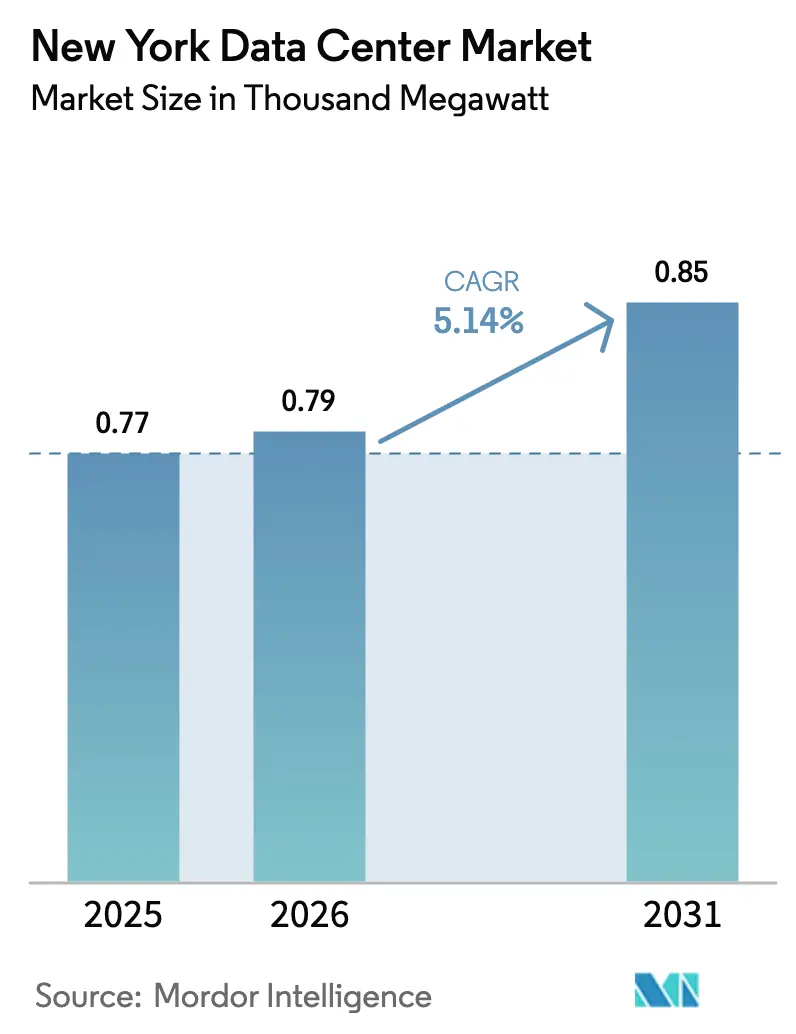
| Base Year Market Size (2025) | 0.77 Thousand megawatt |
| Market Volume (2026) | 0.79 Thousand megawatt |
| Market Volume (2031) | 0.85 Thousand megawatt |
| Growth Rate (2025 - 2031) | 5.14 % |
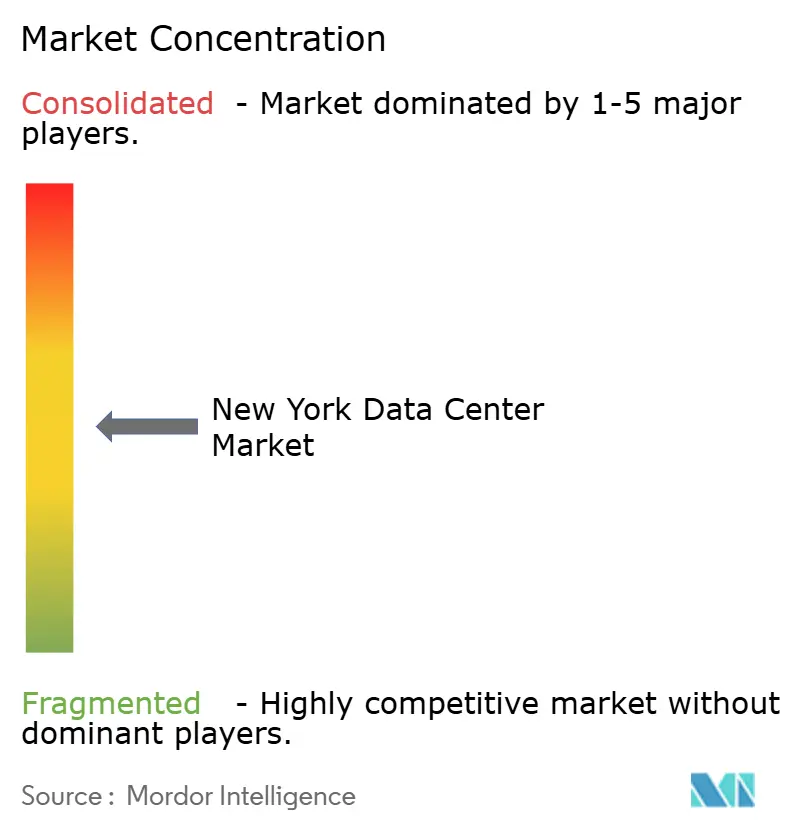
| Market Concentration | Medium |
Major Players *Disclaimer: Major Players sorted in no particular order Image © Mordor Intelligence. Reuse requires attribution under CC BY 4.0. | |
New York Data Center Market Analysis by Mordor Intelligence
The New York data center market size stands at 854.5 MW in 2025 and is projected to reach 1,154.2 MW by 2031, representing a 5.14% CAGR over the forecast period. Wall Street’s need for sub-millisecond order executions, the proliferation of hyperscale cloud campuses, and a wave of office-to-data-center conversions in Midtown are anchoring demand growth. Power-dense AI training clusters are pushing rack requirements from 5–10 kW toward 50 kW and beyond, accelerating adoption of liquid cooling and renewable-powered designs. Competitive intensity is rising as incumbents fight for the limited parcels with both dual-feed utility access and ample fiber routes. At the same time, Local Law 97 and statewide carbon-neutrality targets are forcing operators to sign long-term green-energy contracts or add on-site generation, tilting the playing field toward firms with balance-sheet strength. Capacity shortfalls flagged by the grid operator, combined with multi-billion-dollar equity inflows, set the stage for continued price premiums in prime locations.
Key Report Takeaways
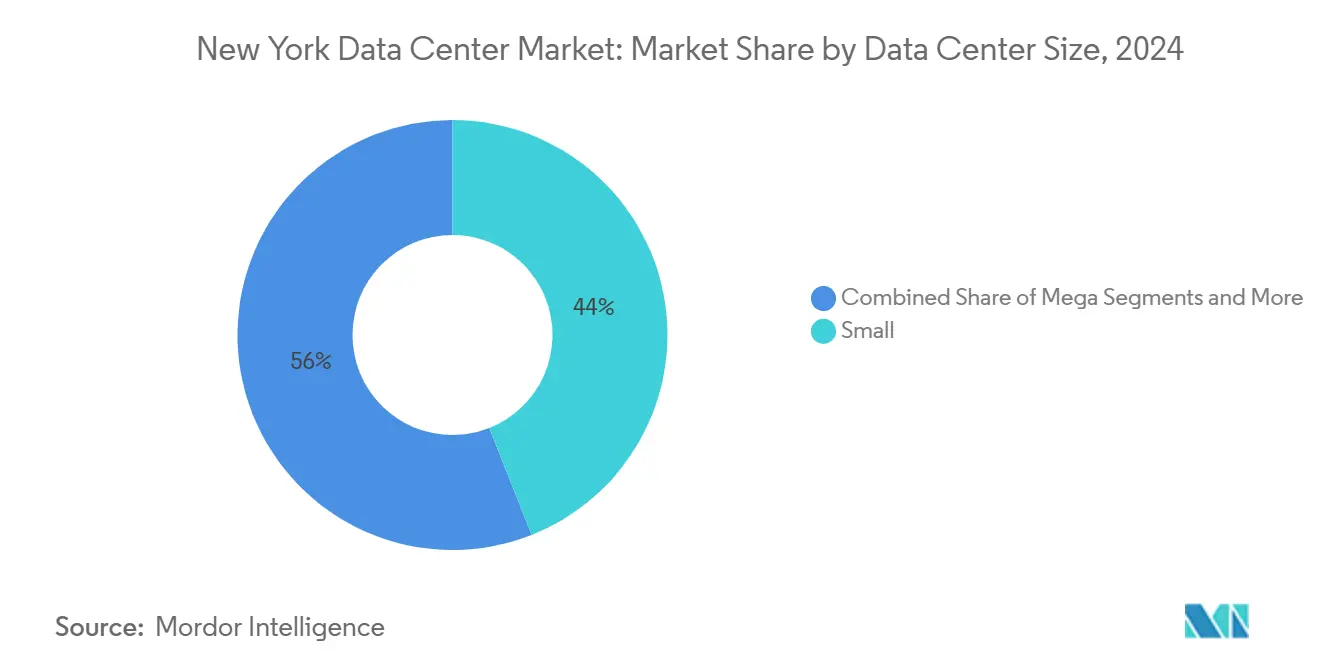
- By data center size, the Small category captured 44% of the New York data center market share in 2024, while Large sites are forecast to record the fastest 6.1% CAGR through 2031.
- By tier standard, Tier III facilities accounted for 60% of the New York data center market size in 2024, while Tier IV builds are advancing at a 6.60% CAGR through 2031.
- By end-user industry, IT and Telecom represented a 43% share of the New York data center market size in 2024, and cloud/telecom hybrid use cases are expanding at a 4.86% CAGR to 2031.
Note: Market size and forecast figures in this report are generated using Mordor Intelligence’s proprietary estimation framework, updated with the latest available data and insights as of January 2026.
New York Data Center Market Trends and Insights
Drivers Impact Analysis*
| DRIVER | (~) % IMPACT ON CAGR FORECAST | GEOGRAPHIC RELEVANCE | IMPACT TIMELINE |
|---|---|---|---|
| Hyperscale cloud footprint expansion | +1.2% | Manhattan, Brooklyn, Queens | Medium term (2–4 years) |
| Capital-markets latency advantage | +0.8% | Manhattan Financial District, Northern NJ | Short term (≤ 2 years) |
| NY CLCPA renewable-energy credits and green tariffs | +0.6% | Statewide, NYC metro | Long term (≥ 4 years) |
| Fiber densification via subsea cable landings | +0.5% | Long Island, Manhattan | Medium term (2–4 years) |
| Vacant Midtown office conversions | +0.4% | Manhattan below 59th St | Medium term (2–4 years) |
| Municipal micro-grids and on-site fuel cells | +0.3% | Outer boroughs | Long term (≥ 4 years) |
| Source: Mordor Intelligence | |||
Hyperscale Cloud Footprint Expansion
AWS, Microsoft, and Google have each committed multi-hundred-megawatt campuses in the metro, often pairing them with dedicated 400 G interconnect nodes for edge workloads. Digital Realty alone booked USD 521 million of new leases in Q3 2024, with an average yield of 12%, underscoring customer willingness to pay premiums for proximate capacity.[1]Digital Realty, 3Q 2024 Earnings Presentation, digitalrealty.com Power density per rack is moving toward 50 kW, and immersion-ready white space is now a standard requirement in hyperscale RFPs. Operators are locking in long-term renewable power purchase agreements and battery energy storage to guarantee capacity at fixed pricing. The scale and speed of these projects are widening the gap between well-capitalized global landlords and smaller regional providers.
Capital-Markets Latency Advantage
High-frequency trading desks measure distance in microseconds, driving demand for facilities within a 50-mile ring of the major exchanges. NASDAQ’s co-location suite reports order-acknowledge loops below 50 μs, while racks at Equinix NY4 in Secaucus command monthly rents near USD 3,500.[2]NASDAQ, Stock Exchange Co-Location, nasdaq.com Bare-metal deployments rather than virtualized instances dominate these footprints, eliminating hypervisor overhead. Proximity-driven pricing shields landlords from broader colocation commoditization, sustaining premium EBITDA margins. Exchange-operated facilities such as the NYSE campus in Mahwah further segment the market into latency-tiered clusters.
NY CLCPA Renewable-Energy Credits and Green Tariffs
New York’s mandate for 70% renewable electricity by 2030 is spurring adoption of long-term hydropower contracts and on-site fuel cells. Operators achieving power-usage-effectiveness below 1.3 qualify for tradable credits that directly lower operating costs. Microsoft’s two-phase immersion tanks have cut server-level power draw by up to 15% while freeing capacity for AI accelerators.[3]Microsoft, To Cool Datacenter Servers, Microsoft Turns to Boiling Liquid, microsoft.com Early movers secure favorable credit multipliers that will sunset as carbon caps tighten, creating a first-mover advantage and new barriers to entry.
Fiber Densification via Subsea Cable Landings
The AEC-1 and AEC-2 transatlantic systems land on Long Island, delivering 800 G wavelengths straight into Manhattan bypass routes and trimming round-trip latency to London by multiple milliseconds. A privately built Hudson River dark-fiber conduit was activated in 2024, the first in two decades, adding needed diversity into the city’s West Side carrier hotels. Dense fiber paths underpin the region’s role as an intercontinental switching node and support emerging edge use cases such as AR/VR streaming and real-time fraud analytics.
Restraints Impact Analysis*
| RESTRAINTS | (~) % IMPACT ON CAGR FORECAST | GEOGRAPHIC RELEVANCE | IMPACT TIMELINE |
|---|---|---|---|
| Manhattan real-estate and construction costs | −0.9% | Manhattan high-density zones | Short term (≤ 2 years) |
| Local Law 97 carbon-emission caps | −0.6% | NYC buildings > 25,000 sq ft | Medium term (2–4 years) |
| Utility power-availability constraints | −0.5% | NYC metro, especially outer boroughs | Medium term (2–4 years) |
| Grid interconnection-queue delays | −0.4% | Statewide NYISO territory | Long term (≥ 4 years) |
| Source: Mordor Intelligence | |||
Manhattan Real-Estate and Construction Costs
Core Manhattan retrofit projects often exceed USD 400 per square foot, double the outer-borough average, shrinking pro-forma returns. Competing residential conversions—such as the 1,320-unit SoMA redevelopment—tighten the supply of suitable buildings. Tax abatements under the Industrial and Commercial Abatement Program rarely apply south of 96th Street, tilting new developments toward Brooklyn and Queens. Landlords able to deliver powered shell space in the outer boroughs are winning hyperscale pre-leases that bypass Midtown sticker shock.
Local Law 97 Carbon-Emission Caps
Starting in 2025, data centers above 25,000 sq ft face stiff fines if carbon intensity thresholds are breached. Operators must either electrify mechanical loads or procure zero-carbon power certificates to remain compliant. Retrofitting legacy diesel backup systems with fuel cells or advanced UPS flywheels raises capex and extends project timelines. Firms that locked in long-duration renewable contracts prior to 2024 enjoy a structural cost edge over late entrants, intensifying the competitive gulf.
*Our forecasts treat driver/restraint impacts as directional, not additive. The impact forecasts reflect baseline growth, mix effects, and variable interactions.
Segment Analysis
By Data Center Size: Large Facilities Drive Market Evolution
Small data centers command 44% market share in 2024, reflecting the predominance of enterprise colocation deployments and multi-tenant facilities that serve New York's diverse business ecosystem. Large/hyperscale facilities represent the fastest-growing segment at 6.1% CAGR through 2030, driven by cloud service providers and AI workload requirements that demand massive power densities and specialized cooling infrastructure. The size distribution reflects the market's evolution from traditional enterprise hosting toward hyperscale architectures that support modern digital applications.
Medium-sized facilities (15-50 MW) serve as the backbone for many financial services deployments, offering the capacity needed for high-frequency trading systems while maintaining the flexibility for custom configurations. Micro data centers (<5 MW) fill specialized niches including edge computing applications and backup facilities, though their market share continues to decline as organizations consolidate operations into larger, more efficient facilities. Related Companies' USD 45 billion development pipeline focuses primarily on large-scale facilities, with individual projects exceeding 100 MW to serve hyperscale requirements Data Center Dynamics. The trend toward larger facilities is driven by economies of scale in power procurement, cooling efficiency, and operational management, with hyperscale deployments achieving Power Usage Effectiveness ratios below 1.2 compared to 1.5-1.8 for smaller facilities.



By Tier Standard: Tier IV Growth Accelerates
Tier III halls dominated with 60% of the New York data center market size in 2024, balancing cost and uptime. Financial traders and cloud platforms, however, are upgrading to Tier IV shells that promise 99.995% availability and concurrently maintainable subsystems. These deployments are projected to log a 6.60% CAGR through 2030. The Intercontinental Exchange liquidity center in Mahwah exemplifies this push, featuring fully isolated power paths and N+2 chilled water loops. Higher-tier adoption is further reinforced by cyber-resilience mandates under federal banking guidance, pushing enterprise RFPs to specify Tier IV design signatures.
In the outer boroughs, new-build Tier IV campuses capitalize on larger footprints, allowing ring-bus medium-voltage distribution and redundant on-site generation. Manhattan retrofits, constrained by elevator cores and existing risers, often cap upgrades at Tier III. As uptime premiums rise, Tier IV capacity is expected to capture incremental share, while lower tiers remain confined to dev-test workloads and archival nodes.
By Absorption: Hyperscale Momentum Builds
Colocation retained 48% of 2024 revenue, but single-tenant build-to-suit halls are pacing growth with a 5.20% CAGR. Cloud majors contract entire 20–40 MW pods, stipulating custom PUE targets and immersion-ready bays, a model that sidesteps multi-tenant fit-out lag times. Retail colocation continues to serve latency-sensitive trading racks and compliance-bound workloads that favor granular power billing. Managed cloud-on-ramp services follow hyperscalers into new suburbs, providing direct connects and packet-optical fabrics into the nearest transatlantic landing station. The shift in mix will raise average hall size, deepen capital intensity, and keep leasing tenors above 10 years, locking in predictable cash yields.
Wholesale landlords able to straddle both models—leasing powered shells to hyperscalers while carving out carrier-dense suites—enjoy diversified revenue streams. Smaller operators lacking scale may gravitate toward edge nodes or interconnection-only meet-me rooms to remain relevant in the evolving New York data center market.

Geography Analysis
Manhattan contains the densest cluster of carrier hotels, anchored by 60 Hudson Street and 111 8th Avenue. Limited utility capacity and real-estate costs exceeding USD 400 per square foot, however, restrain further greenfield growth. Many landlords now favor white-box conversions of prewar office towers, but Local Law 97 compliance often requires costly façade and mechanical retrofits. As a result, Manhattan’s share of the New York data center market size has plateaued even as overall capacity expands.
Brooklyn and Queens are capturing spillover demand by pairing lower land costs with diverse fiber entrances, supported by new dark-fiber builds across the East River. Tax incentives under the Industrial and Commercial Abatement Program can shave operating expenses by double-digit percentages, tipping total-cost-of-ownership models in favor of the boroughs. DataVerge’s carrier-neutral hub in Industry City now hosts one of the largest internet exchanges in the state, evidence that interconnection density is migrating outward.
Beyond the five boroughs, Long Island leverages its submarine cable stations to serve as the metro’s gateway to Europe, while Northern New Jersey’s ample substation capacity and lower property taxes attract hyperscale campuses. DataBank’s Orangeburg complex, 30 miles north of Midtown, illustrates the trend toward exurban “clean-sheet” developments with 45 MW expansion headroom. The grid operator warns of a potential 446 MW shortfall in 2025, a deficit that could accelerate geographic diversification to sites with pre-committed renewable generation.
Regulatory Landscape
New York Citys Local Law 97 sets building carbon-emission caps for buildings over 25,000 sq ft, with enforcement starting in 2025, pushing data center operators toward electrified mechanical systems and procurement of zero-carbon power or credits to avoid fines. At the state level, New Yorks Climate Leadership and Community Protection Act (CLCPA) requirement for 70% renewable electricity by 2030 reinforces long-term renewable procurement strategies (including hydropower contracting) alongside efficiency measures such as PUE targets below 1.3.
In July 2026, Governor Kathy Hochul issued Executive Order No. 62, establishing a temporary (up to one-year) moratorium on certain environmental permits for new hyperscale data centers at or above 50 MW while the state develops a Generic Environmental Impact Statement (GEIS). The order becomes an immediate gating item for large greenfield projects that have not yet secured required permits. Parallel state actions include New York State Department of Public Service activity on large-load interconnection reforms (DPS Case 26-E-0045) and policy debate around the Responsible Data Center Development Act (S10642/A11560), alongside permitting requirements such as 6 NYCRR Parts 601 and 602 for water withdrawals that can materially affect cooling-water strategies and project schedules.
Value Chain Analysis
The New York data center value chain starts with site acquisition and zoning approvals in constrained, high-cost submarkets, where carrier hotels anchored by 60 Hudson Street and 111 8th Avenue shape early location decisions. From there, the chain moves into powered-shell development, fit-out, and ongoing operations.
Key upstream dependencies include utility power reservations and interconnection through NYISO processes, major electrical equipment (transformers, switchgear, and UPS systems), and cooling systems that are increasingly liquid-ready for AI racks, plus backup power solutions. Downstream, operators complete commissioning, certification aligned to Tier III and Tier IV design and operational processes, and maintenance services. On the go-to-market side, capacity is monetized through retail colocation and higher-volume wholesale or hyperscale leases, layered with interconnection ecosystems tied to dense fiber routes and subsea cable connectivity via Long Island landings. Recent facility launches show how the technical stack and supplier mix are shifting, including DataBanks LGA3 campus build in Orangeburg, which emphasizes high-density configurations that extend to liquid-cooled racks, and CoreSites NY3 in Secaucus, which expands metro capacity closer to large-load power and fiber corridors. These projects also show how capital access, equipment lead times, and utility coordination drive timelines, while Executive Order No. 62 adds a permitting constraint for new >=50 MW projects that can ripple into procurement sequencing for large orders of PDUs, chillers, and generators.
Competitive Landscape
Digital Realty, Equinix, and CoreSite together control the majority of carrier-dense square footage in the metro. Digital Realty’s 2024 bookings of USD 521 million and Equinix’s USD 15 billion hyperscale joint venture underscore balance-sheet advantages that let these firms pre-commit transformers and switchgear before lead times stretch past two years. Power reservations have become the new moat, and incumbents with decades-long utility relationships command premium valuations.
Private-equity-backed challengers are scaling rapidly. Related Companies has earmarked USD 45 billion for metro projects, and Vantage Data Centers secured USD 13 billion globally to chase AI capacity. DataBank raised USD 2 billion to lift aggregate power from 330 MW to 850 MW, including a 45 MW campus in Orangeburg. Technology differentiation focuses on immersion cooling, Nvidia DGX-Ready certifications, and on-site fuel cells that satisfy both uptime and carbon scoring metrics.
Market entry barriers remain high: zoning hurdles, Local Law 97 overlays, and 36-month utility interconnection queues deter all but the most capitalized investors. Nonetheless, the outer-borough land rush and equity inflows point to sustained building activity, ensuring that price discovery will hinge on renewable power access rather than on raw square footage alone.
New York Data Center Industry Leaders
Digital Realty Trust, Inc.
DataBank
CoreSite
CyrusOne
Equinix Inc.
- *Disclaimer: Major Players sorted in no particular order

Market Opportunities and Future Outlook
A key whitespace sits at the intersection of grid readiness and large-load demand management. As of May 2026, NYISO had 12,000 MW of data center load requests in its interconnection queue, and New York State Department of Public Service activity on interconnection reforms (DPS Case 26-E-0045) points to an active pathway for solutions that combine phased buildouts, demand-response, on-site generation, and storage to improve financeability and permitting outcomes. Operators with proven approaches to power procurement and delivery have a tighter fit with customers seeking high-density, AI-ready capacity without waiting for multi-year grid upgrades.
There is also a near-term opportunity in metro-adjacent capacity that supports New York City workloads while navigating real-estate and permitting constraints. This is reinforced by completed builds such as DataBanks 20 MW LGA3 launch in Orangeburg and CoreSites 15 MW NY3 completion in Secaucus. Executive Order No. 62 (July 2026) increases the premium on projects below the 50 MW threshold, expansions on permitted sites, and conversions that can move forward without new hyperscale environmental permitting. At the same time, Local Law 97 compliance requirements raise demand for low-carbon designs, renewable power contracting, and high-efficiency cooling retrofits that reduce carbon exposure for both operators and tenants.
Recent Industry Developments
- March 2026: Digital Realty closes a $3.25 billion U.S. hyperscale data center fund, targeting New York and other major metros. The financing expands its capacity to pre-commit capacity in high-demand markets, supporting AI workloads and longer lead times in NY metro.
- September 2025: CoreSite completes NY3 data center in Secaucus, New Jersey. The capacity addition provides a new 15MW, 138,000 sq ft facility, reinforcing NY market position.
- May 2025: DataBank opens LGA3 data center at Orangeburg, New York campus. Adds 20MW critical IT load for AI/digi-growth, strengthening NY availability and density.


Research Methodology Framework and Report Scope
Market Definition and Coverage
For this report, the market captures data center supply and demand in New York, measured mainly through operational and planned IT load capacity, which reflects how much critical compute power can be supported across facilities.
Scope exclusions: The sizing excludes on-device or room-level IT closets that are not run as purpose-built data center sites.
Segmentation Overview
- By Data Center Size
- Small
- Medium
- Large
- Mega
- Massive
- By Tier Type
- Tier I and II
- Tier III
- Tier IV
- By Absorption
- Non-Utilized
- Utilized
- Colocation Type
- Retail
- Wholesale
- Hyperscale
- End-User
- BFSI
- IT and Telecom
- Media and Entertainment
- Government and Education
- Healthcare and Life Sciences
- Other End Users
- Colocation Type
Data Sources, Market Sizing, and Validation
Desk Research
Desk research was used to set the factual base for supply, demand signals, and operating constraints in the New York data center ecosystem. In this market, power availability and interconnection timing often set the pace of capacity additions, so we focused on public energy and grid information.
Sources consulted include non-paywalled references such as the U.S. Energy Information Administration, the New York Independent System Operator, the New York State Energy Research and Development Authority, the Federal Energy Regulatory Commission, and the U.S. Census Bureau, along with select peer-reviewed papers on data center energy efficiency. We also reviewed public filings, investor presentations, credible press coverage, and selective paid subscriptions for company financials and intelligence, news and financials, and patent databases where technology claims needed quick verification. These examples are not exhaustive, and additional sources were used to collect, validate, and clarify inputs as the model was finalized.
Primary Interviews and Surveys
We conduct expert interviews and surveys with data center operators, developers, utilities, brokers, and enterprise users active in New York State and its metro demand pool. Their feedback checks utilization, rack density, lease timing, power availability, pricing, and project delays, while filling gaps in public records. We use the findings to triangulate assumptions and adjust the final New York analysis.
Distribution of primary research fieldwork respondents
| Company type | Respondent position |
|---|---|
| Top tier: 28% | CXOs: 15% |
| Mid tier: 47% | Functional/Unit leaders: 30% |
| Smaller Players: 25% | Managers: 55% |
Market-Sizing & Forecasting
Sizing starts with a top-down build that reconstructs the addressable IT load from New York capacity announcements, energization timelines, and grid and utility readiness indicators, which are then mapped to expected utilization patterns. Once that backbone is set, the totals are cross-checked with selective bottom-up approximations, such as a sampled roll-up of facility level MW, channel checks on pre-lease intensity, and ASP-per-kW style reasonableness checks where pricing is disclosed.
A few market-specific inputs drive the model, including commissioned and under-construction MW, expected rack density moves (especially for AI-ready halls), power availability and interconnection lead times, vacancy and absorption direction, and the share of demand that prioritizes low latency connectivity. When the public pipeline is incomplete, gaps are handled through conservative ranges and then narrowed using interview feedback on actual build cadence and typical phase sizing.
Forecasting leans on scenario analysis supported by a simple time-series overlay. Power constraints, permitting outcomes, and large pre-leases can move the near-term path even when long-run demand remains healthy. The final forecast is adjusted only after the scenario outcomes align with what operators and buyers described as feasible in the next few years.
Data Validation & Update Cycle
Validation is done by triangulating outputs across independent checks, so MW totals, implied utilization, and build timing do not move in opposite directions without a clear reason. Outliers are flagged through variance checks versus prior year estimates, public project timelines, and grid level signals, then reviewed in a second analyst pass before sign-off.
If a major project is delayed, a large lease is announced, or power allocation rules change, we re-contact sources and re-run the sensitive parts of the model. Reports are refreshed annually, with interim updates for material events, and a final pre-delivery review is completed so clients receive the most current view available at the time of publication.
Mordor Intelligence's New York Data Center Market Sizing Compared With Other Published Estimates
Published market sizes for New York data centers often differ because the market can be expressed in different units, and because the geography boundary is not always treated the same way. Some estimates focus on revenue pools, while others size physical capacity. This can make the numbers look far apart even when the two sources are describing similar activity on the ground.
Key gap drivers usually come from what is counted as New York, how planned capacity is treated before it is energized, and what assumptions are used for utilization and density over time. By tracking interconnection readiness and energization timing, Mordor Intelligence keeps the estimate tied to deployed IT load capacity, which reduces the risk of mixing in speculative pipeline MW that may slip due to power and permitting constraints.
Benchmark comparison
| Source | Market Size | Gaps in Research Methodology |
|---|---|---|
| Mordor Intelligence | USD 0.77 T (2025) | |
| Real Estate Advisory A | USD 0.70 T (2024) | Often uses a tri-state inventory cut and reports point-in-time operational capacity only, which can exclude near-term expansions that are permitted but not yet commissioned. |
| Industry Media B | USD 0.85 T (2025) | Commonly folds in broader announced pipeline MW and applies higher density assumptions earlier, which can overstate effective IT load if power delivery timelines are delayed. |
The comparison shows that the spread is mainly created by boundary choices and how future capacity is counted before it is actually energized. Our approach stays transparent by linking each step back to observable MW additions, commissioning status, and practical utilization, which makes the final total easier to replicate and update as conditions change.


Key Questions Answered in the Report
What is the current capacity of the New York data center market?
The metro supports 854.5 MW of installed IT load in 2025 and is forecast to climb to 1,154.2 MW by 2031.
Which boroughs are attracting the most new data center builds?
Brooklyn, Queens, and Long Island are drawing hyperscale and colocation projects because of lower land costs and better power availability compared with Midtown.
How does Local Law 97 affect new data center projects?
Facilities larger than 25,000 sq ft must cut carbon intensity or face fines beginning in 2025, leading operators to lock in renewable power and electrify mechanical systems.
What cooling technology is gaining momentum in New York facilities?
Liquid immersion and direct-to-chip loops are the fastest-growing options due to rising rack densities and stricter energy-efficiency targets.
Why are financial firms paying premium rents for colocation space?
Sub-millisecond latency to exchanges translates directly into trading revenue, so banks lease cabinets in facilities within 50 miles of Manhattans markets.
How significant are renewable energy credits for data center economics?
Operators achieving PUE below 1.3 can monetize state renewable credits, shaving operating costs and improving long-term competitiveness.
Page last updated on:
- Data Center Security Market Security worldwide, split by security type, offering and facility type.
- Artificial Intelligence (AI) Data Center Market Global AI facilities demand, split by facility type, component and tier.
- Data Center Cooling Market Cooling worldwide, split by cooling technology, cooling component and facility type.
- Belgium Data Center Networking Market Belgium networking, split by component, end-user and data-center type.
- Global Data Center Physical Security Market Physical security across all regions, split by solution type and service type.
- New Zealand Data Center Cooling Market New Zealand cooling, split by facility type, tier and cooling technology.
- Nigeria Data Center Networking Market Nigeria networking, split by component, end-user and data-center type.
- United Arab Emirates Data Center Networking Market Networking in United Arab, split by component, end-user and data-center type.
- Canada Data Center GPU Market GPUs in Canada, split by deployment type, gpu type and interconnect.
- Vietnam Hyperscale Data Center Market Vietnam's hyperscale sites, split by facility type, component and tier.
- AI Data Center GPU Market AI accelerators across the global market, covering deployment mode, gpu type and interconnect.


 Your data is secure and never sold or shared.


