
MRNA Synthesis Raw Materials Market Size and Share
Market Overview
| Study Period | 2019 - 2030 |
|---|---|
| Market Size (2025) | USD 1.78 Billion |
| Market Size (2030) | USD 2.32 Billion |
| Growth Rate (2025 - 2030) | 5.42 % |
| Fastest Growing Market | Asia Pacific |
| Largest Market | North America |
| Market Concentration | Medium |
Major Players *Disclaimer: Major Players sorted in no particular order Image © Mordor Intelligence. Reuse requires attribution under CC BY 4.0. | |

MRNA Synthesis Raw Materials Market Analysis by Mordor Intelligence
The mRNA synthesis raw materials market was valued at USD 1.78 billion in 2025 and is forecast to reach USD 2.32 billion by 2030, advancing at a 5.42% CAGR. The market’s current size, solid commitment to pandemic preparedness budgets, and expansion into oncology and rare-disease pipelines signal a shift from crisis-driven procurement toward a steady demand cycle. Government stockpiles, regional manufacturing incentives, and rapid technological gains in capping and delivery reagents underpin medium-term growth, while delivery-system optimization and decentralized production architectures create long-term opportunities. Supply-chain diversification—especially into Asia-Pacific—tempers North America’s dominance, and quality-driven purchasing favors suppliers with GMP track records. Competitive strategies increasingly revolve around vertical integration and specialty acquisitions that secure control over high-value nodes of the mRNA synthesis raw materials market.[1]U.S. Department of Health and Human Services, “HHS Provides USD 176 Million to Develop Pandemic Influenza mRNA-Based Vaccine,” hhs.gov
Key Report Takeaways
- By raw material type, cap analogs captured 41.34% of mRNA synthesis raw materials market share in 2024; lipid nanoparticle components are projected to expand at a 9.74% CAGR to 2030.
- By purity grade, research-grade products held 56.38% share of the mRNA synthesis raw materials market size in 2024 and GMP-grade materials are advancing at an 8.57% CAGR through 2030.
- By application, vaccines accounted for 81.33% share of the mRNA synthesis raw materials market size in 2024, while therapeutics record the highest projected growth at 9.44% CAGR to 2030.
- By end user, biopharmaceutical and biotech companies led with 48.71% revenue share in 2024; CDMOs and CROs are growing at 8.47% CAGR through 2030.
- By geography, North America commanded 44.51% of mRNA synthesis raw materials market share in 2024, whereas Asia-Pacific is set to register a 7.81% CAGR between 2025-2030.
Note: Market size and forecast figures in this report are generated using Mordor Intelligence’s proprietary estimation framework, updated with the latest available data and insights as of January 2026.
Market Trends and Insights
Drivers Impact Analysis of MRNA Synthesis Raw Materials Market*
| Driver | (~) % Impact on CAGR Forecast | Geographic Relevance | Impact Timeline |
|---|---|---|---|
| Surge in post-COVID mRNA vaccine pipeline | +1.2% | Global, led by North America & Europe | Medium term (2-4 years) |
| Capital inflow for dedicated mRNA GMP plants | +0.9% | North America, Europe, Asia-Pacific core markets | Long term (≥ 4 years) |
| High-yield enzymatic capping chemistries | +0.7% | Global, centered in U.S. innovation hubs | Medium term (2-4 years) |
| Government pandemic-preparedness stockpiles | +0.8% | North America, Europe, select Asia-Pacific nations | Long term (≥ 4 years) |
| Synthetic/animal-free feedstocks adoption | +0.5% | Global, regulation-driven | Medium term (2-4 years) |
| Decentralized micro-factories for mRNA | +0.4% | North America, Europe early adopters | Long term (≥ 4 years) |
| Source: Mordor Intelligence | |||
Surge In Post-COVID mRNA Vaccine Pipeline
More than 740 active clinical trials now explore mRNA technologies across infectious-disease, oncology, and rare-disease indications, stabilizing demand beyond pandemic cycles. BioNTech’s 10-year UK expansion, backed by a GBP 129 million grant, illustrates long-range R&D commitments that require uninterrupted supplies of modified nucleotides and cap analogs.[2]Ugur Sahin, “BioNTech Expands Partnership With UK Government to Broaden Regional Research and Development Activities,” investors.biontech.deModerna’s 45-program portfolio adds breadth, and melanoma data from mRNA-4157 with pembrolizumab—showing a 44% recurrence-risk reduction—validates therapeutic potential that feeds raw-material consumption. Suppliers can therefore invest in dedicated capacity without fearing sudden drop-offs typical of the early COVID-19 period.
Capital Inflow For Dedicated mRNA GMP Facilities
Wacker’s EUR 100 million competence center in Germany, along with Moderna’s UK, Australian, and Canadian plants, establishes long-term procurement baselines for GMP-grade enzymes, nucleotides, and LNP lipids.[3]WACKER, “WACKER Opens mRNA Competence Center in Halle an der Saale, Germany,” wacker.com Each greenfield site—costing hundreds of millions—prioritizes secure supply chains, which favors premium providers able to document regulatory compliance. Aurora Biosynthetics’ AUD 200 million launch in Australia shows public-private financing accelerating local capacity that further localizes demand. These investments reduce lead times and mitigate logistic risk, embedding geographically distributed hubs into the mRNA synthesis raw materials market.
Advances In High-Yield Enzymatic Capping Chemistries
TriLink’s CleanCap platform now delivers >95% capping efficiency and lowers production cost by up to 40% compared with legacy enzymatic methods. The new CleanCap M6 variant lifts protein expression by more than 30%, directly boosting drug potency and encouraging rapid adoption across vaccine and therapeutic developers. Stabilized analogs such as Medronate-FlashCap allow optochemical control of translation, opening precision-protein applications. Regulatory comfort with these chemistries reduces qualification hurdles, letting suppliers capitalize on price premiums tied to performance gains.
Government Pandemic-Preparedness Stockpiles
The U.S. PHEMCE program earmarks USD 29.5 billion through 2027 for medical countermeasures, turning episodic purchases into predictable multi-year contracts. The HRPAS rule grants federal priority ratings to essential health resources, funneling consistent orders toward nucleotide and enzyme suppliers. Germany’s standby-capacity deal with Wacker ensures half of the new plant remains on reserve for government deployment, guaranteeing baseline revenue irrespective of commercial ebb-and-flow. Standardized specifications that accompany stockpiles simplify production runs and reduce SKU complexity.
Restraints Impact Analysis of MRNA Synthesis Raw Materials Market*
| Restraint | (~) % Impact on CAGR Forecast | Geographic Relevance | Impact Timeline |
|---|---|---|---|
| Cost & supply bottlenecks for modified nucleotides | -0.8% | Global; sharpest in emerging markets | Short term (≤ 2 years) |
| Lengthy GMP qualification of suppliers | -0.6% | Global; regulation-driven | Medium term (2-4 years) |
| Ambient-temperature instability of capping enzymes | -0.4% | Global; logistics-dependent regions | Short term (≤ 2 years) |
| IP cliffs on CleanCap-like technologies | -0.3% | North America & Europe patent jurisdictions | Medium term (2-4 years) |
| Source: Mordor Intelligence | |||
Cost & Supply Bottlenecks For Modified Nucleotides
Pseudouridine and N1-methylpseudouridine remain scarce because synthesis requires intricate, multi-step chemistry mastered by only a handful of vendors. Price spikes during the pandemic exposed an oligopolistic landscape, forcing manufacturers to keep high safety stocks or accept production delays. The situation hampers uptake in cost-sensitive markets where payers already question mRNA price points, shaving near-term growth from the mRNA synthesis raw materials market.
Lengthy GMP Qualification Of Raw-Material Suppliers
FDA documentation demands can stretch to 24 months, anchoring customers to incumbent vendors that already meet regulatory expectations. Smaller innovators face high administrative costs and extended timelines, discouraging new entrants and curbing competition. Pharmaceutical companies value supply security above marginal cost savings, reinforcing oligopoly, limiting sourcing flexibility, and restraining the mRNA synthesis raw materials market’s speed of innovation.
*Our forecasts treat driver/restraint impacts as directional, not additive. The impact forecasts reflect baseline growth, mix effects, and variable interactions.
MRNA Synthesis Raw Materials Market Segment Analysis
By Raw Material Type:
Cap Analogs Lead Despite LNP InnovationCap analogs held 41.34% of mRNA synthesis raw materials market size in 2024, mirroring their central role in translation efficiency. Their dominance persists even as lipid nanoparticle components accelerate at 9.74% CAGR, fueled by the pivot toward delivery optimization in oncology and rare-disease projects. Modified nucleotides command premium pricing because they curb immunogenicity and stabilize therapeutic constructs. Unmodified nucleotides continue to serve high-volume applications, while RNA polymerase variants extend run times and yield. Plasmid DNA templates are regaining traction through synthetic linearization methods that ease regulatory burden. Emerging capless hairpin structures could eventually disrupt traditional capping workflows, but commercial impact will remain modest through 2030. Buffers and reagents benefit from the rise of single-use bioprocessing, with pre-sterile formulations simplifying GMP compliance and lowering contamination risk inside the mRNA synthesis raw materials market.
Second-generation LNPs featuring plant-derived cholesterol dovetail with synthetic lipids to reduce batch variability. Suppliers able to couple high-purity lipids with proprietary ionizable head groups hedge against commoditization. Simultaneously, combinatorial screening accelerates selection of tissue-targeted LNPs that require novel helper-lipid blends, increasing SKU complexity and creating room for specialty vendors. These dynamics ensure that delivery-focused categories outpace traditional inputs, yet high-volume cap analogs will continue to anchor revenues.




By Purity Grade:
Research Applications Dominate Despite GMP GrowthResearch-grade inputs accounted for 56.38% of mRNA synthesis raw materials market share in 2024, reflecting vibrant discovery activity in academic labs and biotech startups. Nonetheless, GMP-grade materials are forecast to grow 8.57% annually as late-phase programs mature. The gap between research and GMP quality has narrowed because suppliers like New England Biolabs scaled enzyme production under GMP conditions, enabling one-stop sourcing. Hybrid “enhanced research” grades now satisfy early clinical needs without the full cost of GMP, blurring traditional demarcations in the mRNA synthesis raw materials market.
Regulators increasingly expect higher documentation standards even in Phase I trials, pushing startups to upgrade sooner. Established GMP vendors respond by offering volume-based discounts, while research suppliers climb the quality ladder. The resulting competitive overlap fosters innovation in documentation systems, electronic batch records, and real-time release testing that shorten lot-release cycles.
By Application:
Vaccines Mature As Therapeutics AccelerateVaccines delivered 81.33% of mRNA synthesis raw materials market size in 2024, building on pandemic-era infrastructure. Growth here moderates as COVID-19 volumes plateau but remains stable through booster updates for influenza and RSV. Therapeutics, however, are set to expand at 9.44% CAGR as oncology, rare genetic, and autoimmune programs progress. Aldevron’s role in the first personalized CRISPR mRNA therapy underscores the shift toward bespoke formulations. Research and diagnostics retain healthy demand, acting as feeder pipelines that will mature into commercial programs later in the decade.
Therapeutic expansion creates new requirements—tissue-specific delivery, repeated dosing tolerance, and immune-evasion chemistry—turning modified nucleotides and custom LNP cocktails into growth engines. Suppliers offering modular kits that integrate GMP-grade templates, enzymes, and lipids gain share as they simplify tech-transfer into clinical manufacturing.

By End User:
Biotech Leadership Amid CDMO ExpansionBiotech and biopharma firms held 48.71% of revenue in 2024 thanks to their innovation leadership. Many, however, outsource high-volume production to CDMOs, and that segment is projected to grow 8.47% CAGR. Samsung Biologics’ USD 1.2 billion multi-year contract exemplifies the shift toward strategic outsourcing partnerships. CDMOs leverage economies of scale and established regulatory credentials to become anchor customers, creating long-term raw-material purchase agreements that stabilize supplier cash flows within the mRNA synthesis raw materials market.
Academic institutes remain vital early-stage users, often trialing emerging chemistries before industry uptake. Their geographical concentration in North America and Western Europe supports local specialty suppliers. Meanwhile, Asian CDMOs serve multinational demand, reinforcing Asia-Pacific’s rise as a supply-chain hub.
Geography Analysis
North America, Europe and APAC MRNA Synthesis Raw Materials Market
North America commanded 44.51% of mRNA synthesis raw materials market share in 2024, buoyed by mature biotech clusters and federal funding frameworks. Yet Asia-Pacific is on track for a 7.81% CAGR owing to China’s USD 4.17 billion biomanufacturing stimulus and South Korea’s USD 1.92 billion mRNA production program. Europe follows with robust regulatory structures and high-value infrastructure, such as Merck KGaA’s EUR 300 million advanced research center.
The Americas and EMEA MRNA Synthesis Raw Materials Market
Governments now view mRNA inputs as strategic assets, drafting policies to ensure local availability. The U.S. HRPAS mechanism prioritizes domestic resources during emergencies, while Germany’s standby-capacity contracts secure half of Wacker’s new output for national needs. Emerging regions, notably the Middle East, Africa, and South America, are beginning to incentivize local fill-finish facilities; however, they still rely on imported high-purity nucleotides and enzymes. Global suppliers must therefore navigate a patchwork of sovereignty initiatives that shape the mRNA synthesis raw materials market’s geographic demand curve.


Competitive Landscape
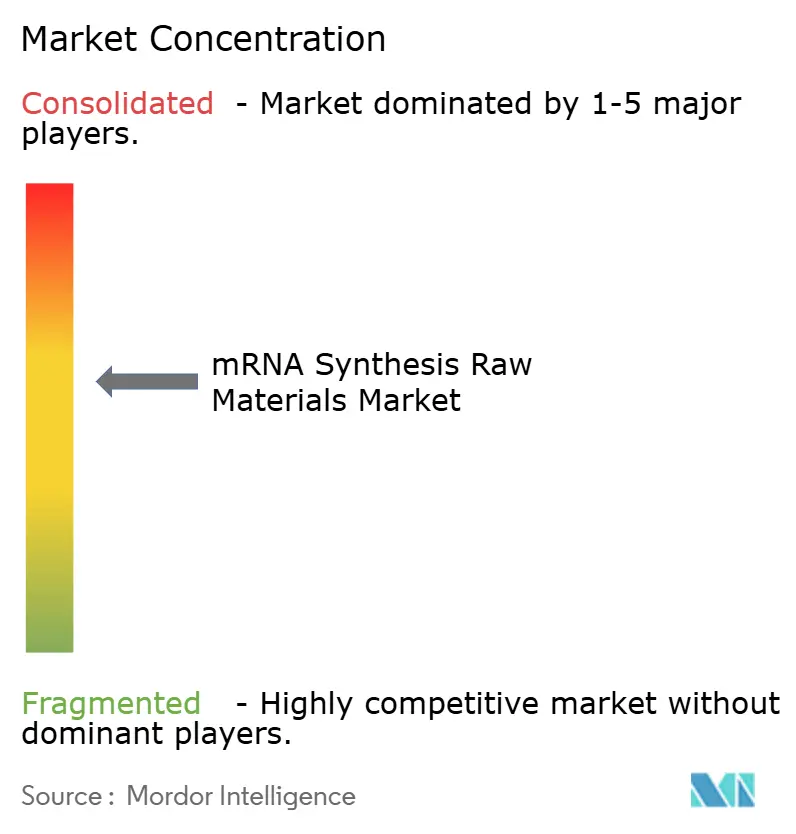
The mRNA synthesis raw materials market remains moderately fragmented. Large life-science conglomerates leverage compliance records and scale, while specialist firms thrive on proprietary chemistries. Thermo Fisher’s USD 4.1 billion acquisition of Solventum’s filtration unit and Agilent’s USD 925 million BIOVECTRA purchase highlight a push toward vertical control of high-margin steps. Cap analogs and modified nucleotides exhibit higher concentration because complex synthesis and IP barriers deter new entrants, whereas unmodified nucleotides and buffers face fierce price competition.
Technology remains the principal differentiator. CleanCap licensing, novel ionizable lipids, and thermostable RNA polymerases grant suppliers durable pricing power despite the commodity-like appearance of raw materials. Single-use manufacturing trends create openings for suppliers providing pre-sterilized kits that meet closed-system requirements. Intellectual-property shifts, particularly forthcoming patent expirations, inject uncertainty that could shuffle market shares if generic producers satisfy quality expectations.
Regulatory compliance is the moat: vendors with established FDA drug-master files retain clients even when cheaper alternatives emerge. Suppliers unable to fund cGMP expansions risk marginalization as programs advance into late-phase trials. Overall, the interplay of IP, compliance, and technology drives a competitive equilibrium where neither full commoditization nor extreme concentration prevails, keeping strategic M&A activity elevated through the forecast horizon.
MRNA Synthesis Raw Materials Industry Leaders
Thermo Fisher Scientific Inc.
TriLink BioTechnologies
Merck KGaA
Danaher Corporation
Aldevron LLC
- *Disclaimer: Major Players sorted in no particular order
MRNA Synthesis Raw Materials Market Companies Covered in this Report
- Thermo Fisher Scientific
- TriLink BioTechnologies
- Merck
- Danaher
- Aldevron LLC
- New England Biolabs
- Bachem Holding
- Charles River
- Evonik Industries
- GenScript Biotech Corp.
- LGC Biosearch Technologies
- Cayman Chemical Company
- Precision NanoSystems (PNI Therapeutics)
- Acuitas Therapeutics
- eTheRNA Manufacturing
- Catalent Pharma Solutions
- Samsung Group

Recent Industry Developments in MRNA Synthesis Raw Materials Market
- July 2025: BioSpring commits several hundred million euros to build a ton-scale RNA plant in Germany, elevating European raw-material capacity.
- May 2025: The U.S. administration cancels USD 766 million in mRNA vaccine contracts, spotlighting political risk tied to stockpile funding.
- May 2025: TriLink BioTechnologies and the International Vaccine Institute sign an MoU to co-develop mRNA vaccines for equitable global access.
- February 2025: The MHRA opens consultation on individualized mRNA cancer immunotherapies, clarifying future regulatory pathways.


Global MRNA Synthesis Raw Materials Market Report Scope
| Modified Nucleotides |
| Unmodified Nucleotides |
| Cap Analogs & Capping Reagents |
| RNA Polymerase & Auxiliary Enzymes |
| Plasmid DNA Templates |
| Buffers & Reagents |
| Lipid Nanoparticle Components |
| Research Grade |
| GMP Grade |
| Vaccines |
| Therapeutics |
| Research & Diagnostics |
| Biopharmaceutical & Biotech Companies |
| CDMOs & CROs |
| Academic & Research Institutes |
| North America | United States |
| Canada | |
| Mexico | |
| Europe | Germany |
| United Kingdom | |
| France | |
| Italy | |
| Spain | |
| Rest of Europe | |
| Asia-Pacific | China |
| Japan | |
| India | |
| Australia | |
| South Korea | |
| Rest of Asia-Pacific | |
| Middle East and Africa | GCC |
| South Africa | |
| Rest of Middle East and Africa | |
| South America | Brazil |
| Argentina | |
| Rest of South America |
| By Raw Material Type | Modified Nucleotides | |
| Unmodified Nucleotides | ||
| Cap Analogs & Capping Reagents | ||
| RNA Polymerase & Auxiliary Enzymes | ||
| Plasmid DNA Templates | ||
| Buffers & Reagents | ||
| Lipid Nanoparticle Components | ||
| By Purity Grade | Research Grade | |
| GMP Grade | ||
| By Application | Vaccines | |
| Therapeutics | ||
| Research & Diagnostics | ||
| By End User | Biopharmaceutical & Biotech Companies | |
| CDMOs & CROs | ||
| Academic & Research Institutes | ||
| By Geography | North America | United States |
| Canada | ||
| Mexico | ||
| Europe | Germany | |
| United Kingdom | ||
| France | ||
| Italy | ||
| Spain | ||
| Rest of Europe | ||
| Asia-Pacific | China | |
| Japan | ||
| India | ||
| Australia | ||
| South Korea | ||
| Rest of Asia-Pacific | ||
| Middle East and Africa | GCC | |
| South Africa | ||
| Rest of Middle East and Africa | ||
| South America | Brazil | |
| Argentina | ||
| Rest of South America | ||


Key Questions Answered in the Report
How large is the mRNA synthesis raw materials market in 2025?
The market stands at USD 1.78 billion in 2025 and is projected to reach USD 2.32 billion by 2030.
What CAGR is expected for mRNA raw materials through 2030?
A steady 5.42% CAGR is forecast, reflecting stable vaccine demand and accelerating therapeutic pipelines.
Which raw material segment is growing fastest?
Lipid nanoparticle components are expected to grow at 9.74% CAGR thanks to delivery-system innovation.
Why is Asia-Pacific the fastest-growing region?
Government investments exceeding USD 6 billion in China and South Korea are building local GMP capacity and lifting regional demand.
What challenges threaten near-term growth?
Supply bottlenecks for modified nucleotides and lengthy GMP supplier qualification can slow expansion, especially in emerging markets.
How are suppliers responding to quality requirements?
Many vendors expand GMP-grade production and acquire specialty units to control critical purification and synthesis steps.
Page last updated on:


 Your data is secure and never sold or shared.


