
Mortuary Equipment Market Size and Share
Market Overview
| Study Period | 2020 - 2031 |
|---|---|
| Market Size (2026) | USD 1.83 Billion |
| Market Size (2031) | USD 2.35 Billion |
| Growth Rate (2026 - 2031) | 5.13 % |
| Fastest Growing Market | Asia Pacific |
| Largest Market | North America |
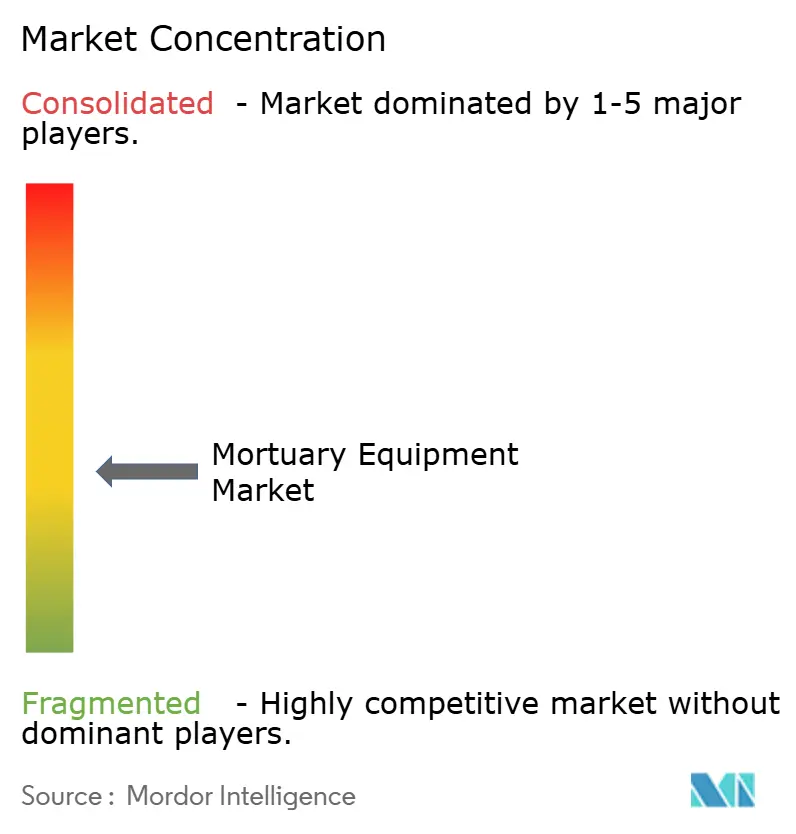
| Market Concentration | Medium |
Major Players *Disclaimer: Major Players sorted in no particular order Image © Mordor Intelligence. Reuse requires attribution under CC BY 4.0. | |
Mortuary Equipment Market Analysis by Mordor Intelligence
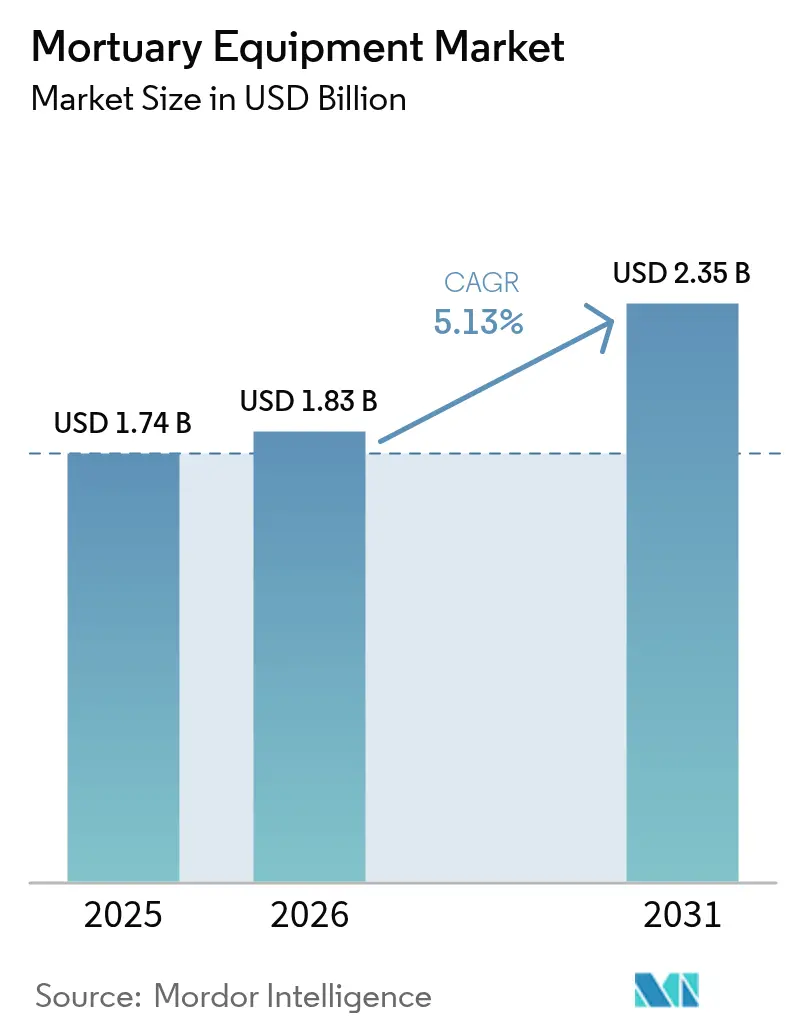
The Mortuary Equipment Market size was valued at USD 1.74 billion in 2025 and estimated to grow from USD 1.83 billion in 2026 to reach USD 2.35 billion by 2031, at a CAGR of 5.13% during the forecast period (2026-2031).
Demand is strongest for refrigeration units because every facility requires reliable cold storage that complies with updated refrigerant rules. Automation momentum is visible as hospitals, medical examiners, and pathology labs replace manual handling with IoT-linked lifts and conveyor systems that raise throughput and improve staff safety. Capital spending is also encouraged by government grants that modernize autopsy infrastructure and by private-equity investment targeting niche medical devices. Supply chain volatility in stainless steel and refrigerants is pushing manufacturers to redesign products for cost efficiency while meeting stricter environmental mandates. Collectively these forces keep the mortuary equipment market on a predictable upward path, albeit one punctuated by regional cultural sensitivities that shape adoption speed.
Key Report Takeaways
- By product type, refrigeration units led with 38.95% of mortuary equipment market share in 2025 and cadaver lifts and transport systems are projected to post the fastest 6.78% CAGR through 2031.
- By technology, semi-automatic systems held 33.77% share of the mortuary equipment market size in 2025, while fully automated and IoT-enabled equipment is set to advance at a 6.12% CAGR to 2031.
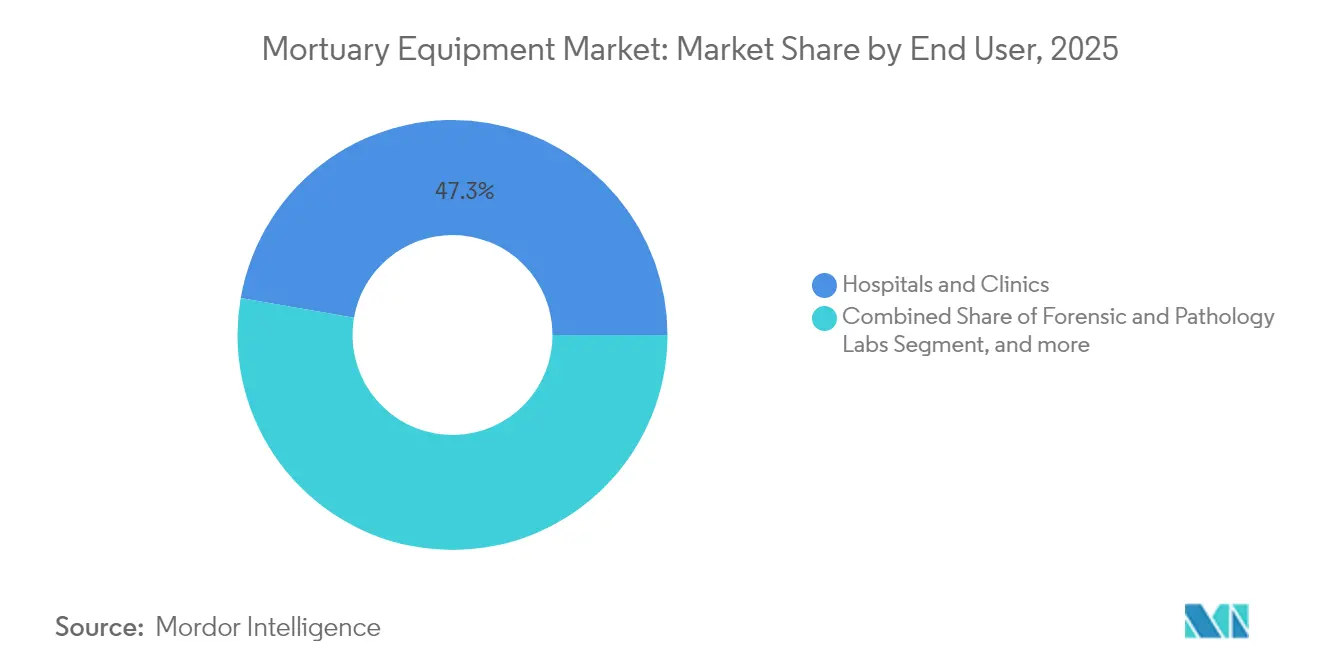
- By end user, hospitals and clinics accounted for 47.25% of the mortuary equipment market size in 2025; forensic and pathology laboratories are expanding at an 8.18% CAGR through 2031.
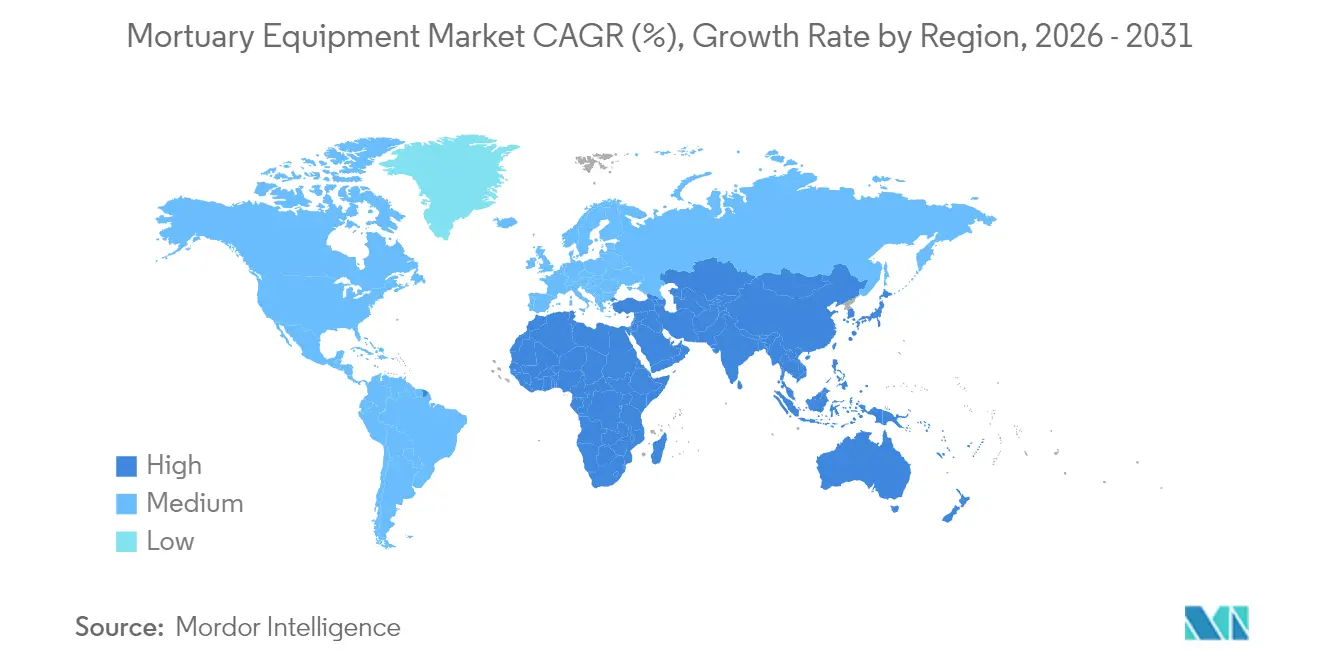
- By geography, North America commanded 36.88% revenue in 2025; Asia Pacific is on course for the highest 7.16% CAGR by 2031.
Note: Market size and forecast figures in this report are generated using Mordor Intelligence’s proprietary estimation framework, updated with the latest available data and insights as of 2026.
Market Trends and Insights
Drivers Impact Analysis of Mortuary Equipment Market*
| Driver | (~) % Impact on CAGR Forecast | Geographic Relevance | Impact Timeline |
|---|---|---|---|
| Aging Population & Rising Mortality Rates | +1.2% | Global, concentrated in North America & Europe | Long term (≥ 4 years) |
| Expansion of Morgue Facilities & Automation Needs | +0.9% | Global, strongest in Asia Pacific | Medium term (2-4 years) |
| Growth in Forensic & Pathology Research Funding | +0.7% | North America & Europe, emerging in Asia Pacific | Medium term (2-4 years) |
| Adoption of Digital Autopsy Workflows | +0.6% | North America & Europe, pilot programs in Asia Pacific | Long term (≥ 4 years) |
| Increase in Bariatric Cadavers Necessitating High-Capacity Lifts | +0.4% | North America, expanding to Europe & Asia Pacific | Short term (≤ 2 years) |
| Disaster-Response Demand for Portable Modular Coolers | +0.3% | Global, episodic regional spikes | Short term (≤ 2 years) |
| Source: Mordor Intelligence | |||
Aging Population and Rising Mortality Rates
Longer life expectancy coupled with larger cohorts of seniors, is straining existing morgue infrastructure. Facilities such as the Iowa Office of the State Medical Examiner—originally built for 800 cases but processing 2,000 have secured USD 36.3 million for new autopsy stations, illustrating how caseload pressure turns directly into equipment orders. Wider demographic data show a similar imbalance across U.S. and European countries, prompting administrators to seek high-capacity refrigeration, heavier-duty lifts, and compact racking that fits into retrofitted basements. The mortuary equipment market, therefore, benefits from predictable replacement and expansion cycles that track aging trends rather than discretionary capital budgets.
Expansion of Morgue Facilities and Need for Automation
Hospital upgrades and green-field forensic centers increasingly specify semi-automatic or fully automated workflows with IoT monitoring. Digital twin pilots in pathology labs cut labeling errors by 90% and improve slide quality by up to 30%, proving the operational value of sensors and analytics. New installations combine temperature probes, RFID-tagged cadaver trays, and cloud dashboards so supervisors can monitor conditions remotely. Automation also mitigates labor constraints as experienced mortuary technicians retire faster than replacements arrive, a mismatch that hospital administrators cite when approving cap-ex for innovative lifts and conveyors. Consequently, the mortuary equipment market is witnessing premium pricing for network-ready devices.
Forensic and Pathology Research Funding Growth
Federal programs such as the Bureau of Justice Assistance Strengthening the Medical Examiner-Coroner System grant provide portable X-ray units and fellowship salaries, directly boosting procurement volumes for imaging suites, cutting tables, and biosafety cabinets.[1] Separately, the National Institute of Justice has funded CT-scan–driven virtual autopsy pilots that save three full-time pathologist positions each year, creating a persuasive ROI case.[2] Grants often stipulate modern data-capture equipment, nudging buyers toward IoT-enabled workstations and digital evidence storage hardware. These funding flows keep the mortuary equipment market resilient even when general hospital budgets tighten.
Adoption of Digital Autopsy Workflows
Post-mortem CT and MR imaging have migrated from research to routine, particularly for complex trauma and culturally sensitive cases where minimal invasion is preferred. Mixed-reality headsets now allow pathologists to inspect 3-D reconstructions while standing over the body, reducing repeat incisions and shortening report times. The shift forces facilities to add dedicated scanner bays, advanced workstations, and secure servers, widening the product basket purchased under the mortuary equipment market. Vendors that integrate imaging hardware with autopsy tables and case-management software gain an edge, fostering deeper hardware–software partnerships across the supply chain.
Restraints Impact Analysis of Mortuary Equipment Market*
| Restraint | (~) % Impact on CAGR Forecast | Geographic Relevance | Impact Timeline |
|---|---|---|---|
| High Capital & Maintenance Costs of Advanced Systems | -0.8% | Global, acute in emerging markets | Medium term (2-4 years) |
| Cultural and Religious Sensitivities Around Post-Mortem Practices | -0.5% | Global, concentrated in Asia Pacific & Middle East | Long term (≥ 4 years) |
| Volatile Supply Chain for Medical-Grade Stainless Steel | -0.4% | Global, severe in Europe & North America | Short term (≤ 2 years) |
| Regulatory Pressure from New Refrigerant Standards (F-Gas Phase-Down) | -0.3% | Europe primary, expanding to other regions | Medium term (2-4 years) |
| Source: Mordor Intelligence | |||
High Capital and Maintenance Costs of Advanced Systems
Medical-grade stainless steel prices spiked when molybdenum reached USD 90 per kg in 2023, lifting chassis and racking costs by double-digit percentages. Manufacturers also face the U.S. FDA Quality Management System Regulation deadline that harmonizes with ISO 13485:2016 from February 2026, adding audit and documentation expenses.[3] These inputs push list prices upward, putting automated mortuary carts beyond the reach of many municipal coroners whose annual equipment budgets rarely exceed USD 200,000. Maintenance contracts for sensor-laden systems also cost more than manual tables, prolonging payback periods. As a result, some facilities stagger upgrades, tempering near-term growth in the mortuary equipment market.
Cultural and Religious Sensitivities Around Post-Mortem Practices
In regions where faith traditions emphasize rapid burial or restrict autopsy incisions, standard embalming pumps and dissection suites see limited uptake. Studies of Muslim, Jewish, and Indigenous families show higher refusal rates for full autopsy, prompting coroners to rely on imaging or external examination. East-Asian practices often involve family washing rituals and specialized coffin dimensions that clash with Western-sized racks, forcing local distributors to offer custom trays. Vendors incur extra design costs and longer certification timelines, which slow expansion into high-population markets. Consequently cultural factors remain a structural restraint on the mortuary equipment market despite rising mortality.
*Our forecasts treat driver/restraint impacts as directional, not additive. The impact forecasts reflect baseline growth, mix effects, and variable interactions.
Mortuary Equipment Market Segment Analysis
By Product Type:
Refrigeration Leadership and Lift InnovationRefrigeration systems retained 38.95% of mortuary equipment market share in 2025, a reflection of universal preservation needs and tighter F-Gas regulations that push buyers toward HFC-free models. Refrigerators and modular coolers anchor every capital project, making this segment the largest contributor to mortuary equipment market size. Growth continues as facilities retrofit to meet phase-down schedules and to add extra chambers for surge capacity during disasters. Vendors differentiate through tighter temperature uniformity, hydrocarbon refrigerants, and embedded data loggers that feed compliance dashboards.
Cadaver lifts and transport trolleys exhibit the fastest 6.78% CAGR because bariatric decedents are more common and worker-injury rules demand mechanical assistance. OEMs now market bariatric lifts rated to 1,000 lb, often with dual-column scissor designs that maintain stability in crowded corridors. Integration with ceiling-mounted track systems further reduces manual handling, a feature valued by unionized hospital staff. Although these lifts occupy a smaller slice of mortuary equipment market size today, their rapid adoption will trim refrigeration dominance over the forecast period. Shelving racks, autopsy tables, embalming pumps, and specialty consumables round out the product mix, each benefitting from incremental upgrades tied to broader facility overhauls.


By Technology:
Semi-Automatic Prevalence and IoT MomentumSemi-automatic equipment held 33.77% revenue in 2025 because it balances affordability with partial labor savings. Programmable height-adjust lifts and push-button tray loaders fall into this tier and remain popular in municipal morgues with budget ceilings. Yet the shift toward network-ready devices is unmistakable. Fully automated carts that move decedents from cooler to table without human push force are growing at 6.12% CAGR, making them one of the brightest niches within the mortuary equipment market.
IoT-enabled modules present the biggest upside. Digital sensors embedded in refrigeration doors transmit humidity and temperature data to dashboards, helping maintain chain-of-custody records acceptable in court proceedings. Predictive maintenance analytics flag compressor wear before failure, preventing evidence spoilage and reducing energy bills. Clinics adopting such systems report 15% lower downtime and 8% lower utility costs within a year, validating the business case for management teams. While manual equipment still sees uptake in low-income settings, procurement preference is clearly shifting toward cloud-connected portfolios, reinforcing the market’s long-run digitization narrative.
By End User:
Hospital Dominance and Forensic Laboratory UpswingHospitals and clinics controlled 47.25% of mortuary equipment market size in 2025 because they bundle decedent care into broader acute-care services. Large academic centers also use mortuary suites for teaching, thereby justifying investments in ergonomic tables, multi-view camera systems, and RFID-tagged body pouches that integrate with electronic medical records. Regulations mandating temperature logging and infectious-disease controls further elevate hospital spending, locking in their leadership.
Forensic and pathology laboratories represent the fastest-expanding buyers at 8.18% CAGR. National grants earmarked for toxicology, DNA backlogs, and drug overdose investigations pay for CT scanners, robotic saws, and ventilated necropsy hoods—items that command premium margins in the mortuary equipment market. Research institutes additionally require 3-D visualization workstations for teaching and case reconstruction, enhancing demand for GPU-powered servers and specialized software. Funeral homes, disaster-response agencies, and medical schools contribute smaller but steady volumes, often purchasing modular coolers and portable embalming gear that travel with mass-fatality response teams.
Geography Analysis
North America Mortuary Equipment Market
North America generated 36.88% of 2025 sales, making it the clear leader in the mortuary equipment market. Stronger public funding, mature private autopsy service providers, and rigorous OSHA standards underpin high baseline demand for refrigeration suites, powered lifts, and stainless workstations. The recently approved USD 36.3 million Iowa expansion illustrates how state budgets fund significant capacity additions that immediately translate into equipment orders. Federal grants through the Bureau of Justice Assistance further accelerate procurement of imaging and handling systems. As a result the region expects continued 5%-plus growth even against a high installed base.
APAC Mortuary Equipment Market
Asia Pacific is forecast to expand at 7.16% CAGR, the fastest worldwide. Healthcare modernization programs in China, India, and Southeast Asian economies include morgue upgrades within hospital masterplans. Japan’s concerted push to professionalize death-care services, emphasizing ethical practices and compliance, encourages digital autopsy and IoT-ready coolers, directly lifting segment revenues. Rapid urbanization drives cremation over burial, widening the addressable product scope to include ash-processing equipment. Although cultural resistance influences certain subsegments, the sheer scale of hospital construction and demographic aging allows the mortuary equipment market to flourish across Asia Pacific.
EMEA and LATAM Mortuary Equipment Market
Europe shows mid-single-digit gains anchored by standardized regulations. The 2024/573 F-Gas rule forces the replacement of older HFC-based refrigeration by 2030, creating a regulatory pull for advanced coolers. National health services also invest in bariatric lifts as obesity prevalence rises. Supply chain challenges, especially stainless coil shortages, add cost pressures yet have not derailed expansion plans. Latin America, the Middle East, and Africa present early-stage opportunities where donor-funded hospital projects introduce modern mortuary suites; however, economic volatility and cultural factors limit the conversion of potential into immediate sales.
Regulatory Landscape
Mortuary equipment compliance is driven more by facility design and occupational-health rules than by traditional medical-device pathways. In the United States, Defense Health Agency (DHA) performance criteria for mortuary equipment influence specifications and procurement, particularly for refrigeration units and handling systems, and they shape supplier qualification.
Globally, procurement practices also track regulator guidance and codes such as the Australian Building Codes Board National Construction Code (NCC) 2025 provisions for mortuaries and NHS England HBN 16-01 for mortuary facilities. Together, these frameworks reinforce 24/7 readiness, secure chain-of-custody, and hygiene features, which feed through to refrigeration and handling specifications.
Value Chain Analysis
The value chain begins with raw materials and critical components, including medical-grade stainless steel, copper tubing, insulation panels, electronic controls, and refrigeration subassemblies such as compressors and refrigerants. Manufacturers typically combine design and engineering with sheet-metal fabrication, welding, surface finishing, refrigeration assembly, and integration of sensors and monitoring software. They then deliver installation, validation, and ongoing service contracts, since uptime, temperature compliance, and documentation requirements drive buyer decisions.
Dubai Health Authority (DHA) procurement standards for continuous temperature monitoring and IT-integrated chain-of-custody workflows influence supplier selection and deployment in Middle East markets. Downstream, hospital buyers often use centralized procurement channels through government frameworks, while funeral operators and many non-hospital customers rely on direct sales and regional distributors for customization, installation logistics, and maintenance responsiveness. Lead times and costs remain sensitive to stainless-steel price volatility and refrigeration component availability, which encourages modular, standardized platforms and bundled service offerings to reduce lifecycle risk for hospitals, medical examiners, and pathology laboratories.
Competitive Landscape
The mortuary equipment market remains moderately fragmented even as consolidation accelerates. Waud Capital Partners’ 2025 takeover of Mopec Group, one of the largest U.S. autopsy-table makers, signals growing private-equity appetite for specialized medical devices. Regional brands still hold a considerable share, particularly in Europe, where family-owned workshops supply customized stainless units to local hospitals. Yet global healthcare suppliers such as Thermo Fisher Scientific leverage broad distribution networks to cross-sell pathology workstations alongside general lab equipment.
Technology capability is the new battleground. Manufacturers that embed IoT sensors, develop cloud dashboards, and partner with software firms to deliver digital twin solutions differentiate sharply from legacy metal-fabrication shops. Disaster-response modules, such as trailer-mounted coolers and inflatable mortuaries, constitute another white-space arena with heightened interest after recent pandemic and weather-related mass-fatality events. Meanwhile, compliance expertise covering F-Gas, ISO 13485, and local cremation regulations acts as a non-price lever that large vendors use to win multiyear service contracts. In sum, the mortuary equipment market rewards firms that combine material engineering, regulatory advisory, and data analytics skill sets.
Mortuary Equipment Industry Leaders
-
Roftek Ltd
-
SM Scientific Instruments Pvt. Ltd
-
KUGEL medical GmbH & Co. KG
-
LEEC Ltd
-
Thermo Fisher Scientific Inc.
- *Disclaimer: Major Players sorted in no particular order
Mortuary Equipment Market Companies Covered in this Report
- Thermo Fisher Scientific
- Mopec
- LEEC Ltd
- Ferno-Washington
- KUGEL medical
- Mortech Manufacturing Company
- SM Scientific Instruments Pvt Ltd
- Roftek
- HYGECO
- Mortuary Lift Company
- Flexmort
- WJ Kenyon Ltd
- Frima Funéraire
- UFSK International GmbH
- Fiocchetti Scientific
- Mobi Medical Supply
- Intarcon
- Naugra Export
- Tekequipment (Aus)
- Mixta Medical
- Desco Medical
Market Opportunities and Future Outlook
A clear whitespace remains in deployable, modular capability that reduces reliance on fixed facilities during surge events, renovations, or remote operations. In January 2026, EZtransfer entered a distribution partnership with Flexmort to supply AirCool refrigeration systems and CadSeal hermetic containment technology in North America, pointing to a channel-led approach for scaling specialized refrigeration and containment solutions.
Facility standards such as NHS England HBN 16-01 and Dubai Health Authority requirements also continue to pull buyers toward continuous temperature monitoring, infection-control design, and IT-integrated chain-of-custody workflows. This supports demand for IoT-ready refrigeration units, data loggers, and connected handling systems rather than standalone metalwork.
Recent Industry Developments in Mortuary Equipment Market
- January 2026: EZtransfer entered a distribution partnership with Flexmort to supply AirCool refrigeration systems and CadSeal hermetic containment technology in North America. The alliance broadens access to turnkey containment and climate-control offerings for mortuary facilities, enhancing cross-border distribution and service reach.
- June 2025: YSENMED launched ysenmedmortuary.com to display its mortuary portfolio, including autopsy tables, body freezers, and embalming systems. The move broadened international discovery and quotation flow for buyers seeking OEM/ODM options, strengthening cross-border sourcing dynamics for standardized equipment categories.
- July 2024: GPG Granit acquired Isofroid, expanding into mortuary refrigeration and preservative fluids. The deal widened GPG Granit's conservation-focused offering and increased its ability to bundle refrigeration hardware with consumables and service, influencing purchasing decisions where turnkey supply and maintenance coverage matter.
Mortuary Equipment Market Report Scope and Research Methodology
Market Definition and Coverage
This market covers equipment used to receive, preserve, move, prepare, and store deceased bodies across mortuaries and related facilities, with value measured as the revenue from equipment sales and replacements across major regions.
Scope exclusions: services (funeral services, embalming as a service), consumables, and facility construction or general-purpose hospital furniture are excluded when they are not sold as mortuary-specific equipment.
Segments Covered in This Report
- By Product Type
- Refrigeration Units
- Autopsy Tables & Workstations
- Cadaver Lifts & Transport Systems
- Embalming & Preservation Equipment
- Shelving & Storage Racks
- Body Bags & Consumables
- Cremation & Tissue-Disposal Equipment
- Other Accessories
- By Technology
- Manual
- Semi-automatic
- Fully-Automated / IoT-enabled
- By End User
- Hospitals & Clinics
- Forensic & Pathology Labs
- Academic & Research Institutes
- Other End Users
- By Geography
- North America
- United States
- Canada
- Mexico
- Europe
- Germany
- United Kingdom
- France
- Italy
- Spain
- Rest of Europe
- Asia-Pacific
- China
- Japan
- India
- Australia
- South Korea
- Rest of Asia-Pacific
- Middle East & Africa
- GCC
- South Africa
- Rest of Middle East & Africa
- South America
- Brazil
- Argentina
- Rest of South America
- North America
Data Sources, Market Sizing, and Validation
Desk Research
Desk research starts with building the demand context and tightening the equipment boundary, then mapping how mortuary equipment is typically purchased and replaced. We anchored long-run demand signals using public health and mortality time series and related definitions from the World Health Organization, the United Nations population database, and the World Bank.
To make the model practical, we checked import and export patterns and category notes from UN Comtrade and national customs statistics, and we reviewed technical and usage references from peer reviewed forensic medicine journals and government health department publications. We also used company filings, product catalogs, investor materials, and credible press coverage to understand price ranges, replacement cycles, and channel structures. In a few places, paid subscriptions for company financials and patent databases were used to fill gaps on product focus and innovation activity. These examples are not exhaustive, and many other public sources were also used to collect, validate, and clarify data points.
Primary Interviews and Surveys
Primary work was used to test what the desk data could not confirm cleanly, especially average selling price movement, typical equipment bundles in mortuaries, and how purchase decisions shift across hospitals, funeral homes, and forensic facilities. We spoke with a mix of manufacturers, distributors, facility operators, and subject experts across Americas, EMEA, and APAC to check assumptions against real procurement and replacement behavior.
Distribution of primary research fieldwork respondents
| Company type | Respondent position | Region |
|---|---|---|
| Top tier: 32% | CXOs: 13% | APAC: 50% |
| Mid tier: 52% | Functional/Unit leaders: 41% | EMEA: 30% |
| Smaller Players: 16% | Managers: 46% | Americas: 20% |
Market-Sizing & Forecasting
Sizing is built using a top-down approach where mortality and population trends, facility counts, and equipment penetration assumptions are used to reconstruct the addressable demand pool for preservation and handling equipment. Those totals are then corroborated with selective bottom-up approximations, such as sampled price x volume checks for core items (for example refrigeration units, body handling trolleys, and autopsy tables) and channel feedback on typical order sizes, and then adjusted where the two views do not reconcile.
Key inputs used in the model include annual deaths and aging mix, the count and throughput of facilities that handle cadavers, replacement and maintenance driven purchase cycles, average selling prices by equipment class, and trade flow signals that indicate availability and sourcing patterns. When direct country data is thin, we bridge gaps using proxy indicators like health infrastructure levels and procurement practices confirmed through interviews, then keep the uplift or discount logic consistent across the series.
For forecasting, scenario analysis is applied around mortality trajectory, budget tightness in healthcare and municipal bodies, and the pace of upgrades toward better hygiene and cold storage standards. Assumptions are kept traceable so a reader can see how each variable moves the final number, and we recheck the trend shape against expert consensus before locking the forecast.
Data Validation & Update Cycle
Validation is done by cross-checking modeled totals against independent signals such as trade direction changes, visible installation activity patterns, and plausible replacement timing for long life equipment. If a country or product line shows an unexpected jump, we recheck the input series, revisit the conversion assumptions, and reconnect with industry respondents when the variance cannot be explained by public events.
A multi-step review is followed before sign-off, including internal consistency checks across regions and a final analyst review that focuses on outliers and unit economics. The report is refreshed annually, and interim updates are triggered when material events occur (for example major regulatory changes or unusually large demand shocks). Before delivery, a fresh pass is completed so clients receive the latest updated view.
Mordor Intelligence's Mortuary Equipment Market Size Compared With Other Published Estimates
Published market values for mortuary equipment often do not match because each publisher sets its own boundary on what counts as equipment, and because the time window, pricing logic, and currency timing can be handled differently. Even when the same terms are used, the included products and end users can shift the total.
Trade flow direction, mortality trend stability, and replacement cycle checks are the evidence points that keep Mordor Intelligence aligned to equipment-only demand (not funeral services), which is why its 2026 value can land above or below other figures depending on how adjacent categories are treated. In addition, some estimates rely on a single base year and then apply a smooth growth curve, which can understate short-term price changes for refrigeration and preparation equipment. Others broaden scope by counting body bags and other supplies more fully, which increases the total even if the underlying facility base is similar.
Benchmark comparison
| Source | Market Size | Gaps in Research Methodology |
|---|---|---|
| Mordor Intelligence | USD 1.83 B (2026) | |
| Global Consultancy A | USD 1.11 B (2024) | Uses a 2024 base and a narrower essential-equipment framing on the published page, which can undercount broader mortuary facility purchases and later-year price effects when compared on a 2026 basis. |
| Industry Publisher B | USD 1.19 B (2025) | Reports a 2025 figure with limited public detail on included product boundary and valuation build, and the longer forecast horizon can also dilute near-term pricing and replacement-cycle shifts into a smoother curve. |
The spread across the three numbers is mainly explained by year alignment and what gets counted as equipment versus adjacent supplies, and then by how pricing is carried forward. By keeping the inputs tied to observable signals and interview-tested purchase behavior, we keep the total reproducible and easier to audit when assumptions need to be updated.
Key Questions Answered in the Report
What is the size of the global mortuary equipment market in 2026?
The mortuary equipment market size is USD 1.83 billion in 2026.
How fast is demand for cadaver lifts growing?
Cadaver lifts and transport systems are projected to grow at 6.78% CAGR through 2031.
Which region leads in revenue for mortuary equipment?
North America accounts for 36.88% of global sales thanks to robust forensic funding and private infrastructure.
Why are IoT-enabled mortuary devices becoming popular?
Connected sensors cut equipment downtime, improve compliance, and align with hospital digitization strategies, driving accelerated adoption.
What regulatory change is influencing refrigeration purchases in Europe?
The EU F-Gas Regulation 2024/573 mandates phasedown of high-GWP refrigerants, prompting replacement of legacy mortuary coolers.
How does cultural sensitivity affect equipment sales?
Religious or cultural objections to invasive autopsies reduce demand for embalming pumps and dissection tools in certain regions, slowing market penetration.