Market Overview
| Study Period | 2020 - 2031 |
|---|---|
| Market Size (2026) | USD 62.93 Billion |
| Market Size (2031) | USD 78.72 Billion |
| Growth Rate (2026 - 2031) | 4.59 % |
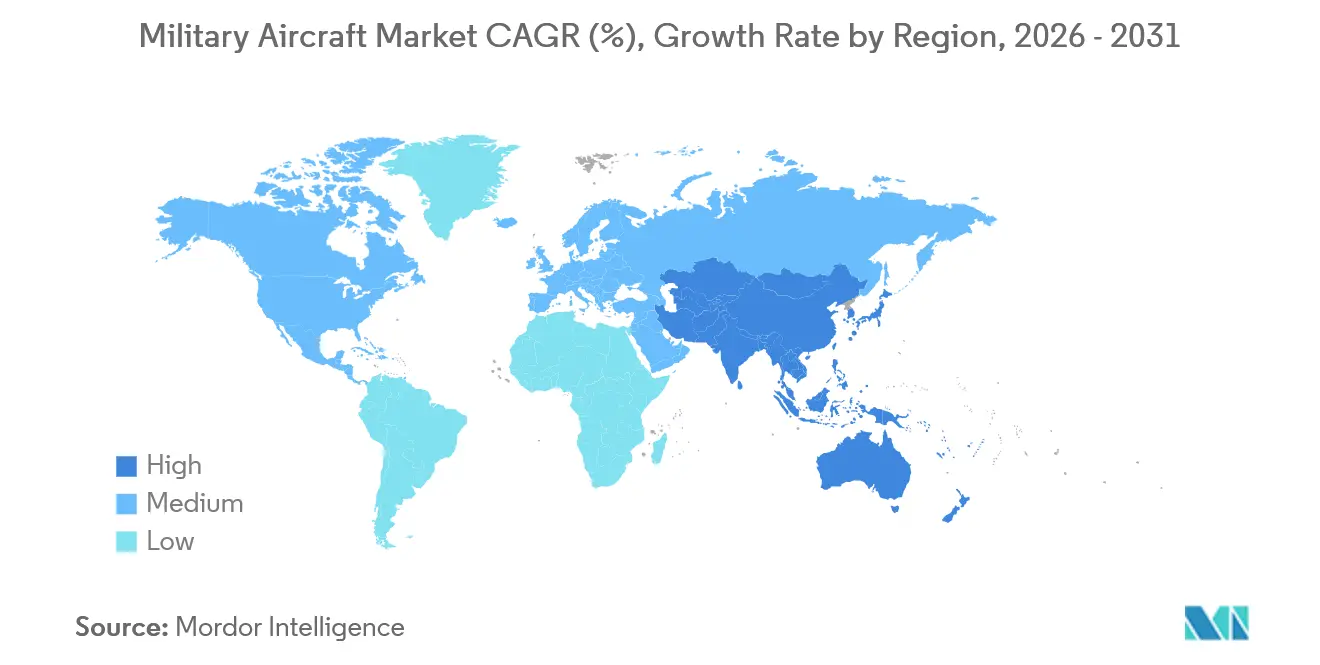
| Fastest Growing Market | Asia Pacific |
| Largest Market | North America |
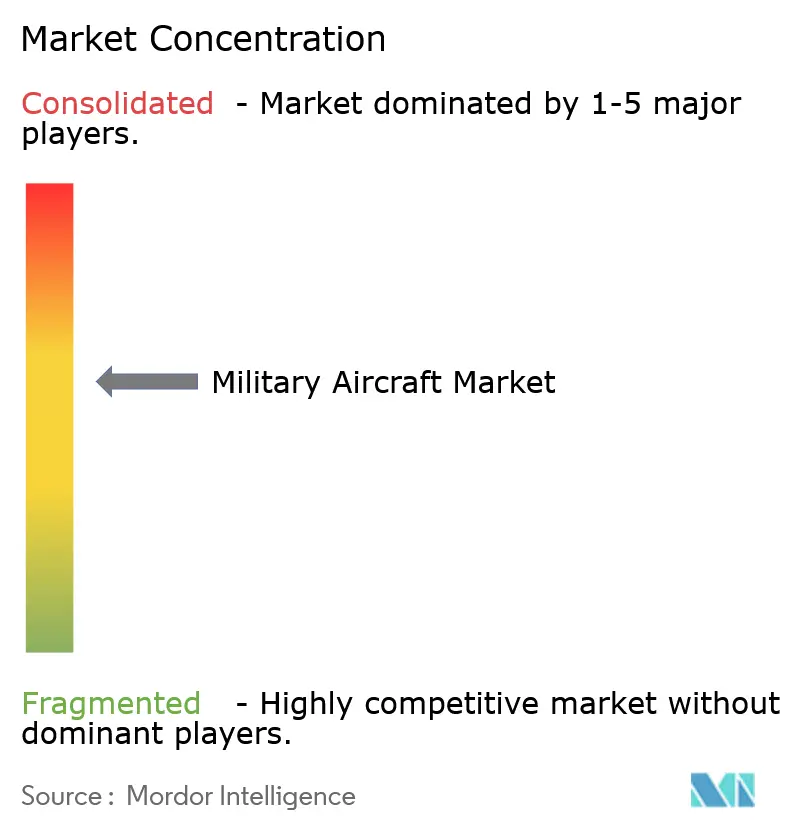
| Market Concentration | Medium |
Major Players *Disclaimer: Major Players sorted in no particular order Image © Mordor Intelligence. Reuse requires attribution under CC BY 4.0. | |
Military Aircraft Market Analysis by Mordor Intelligence
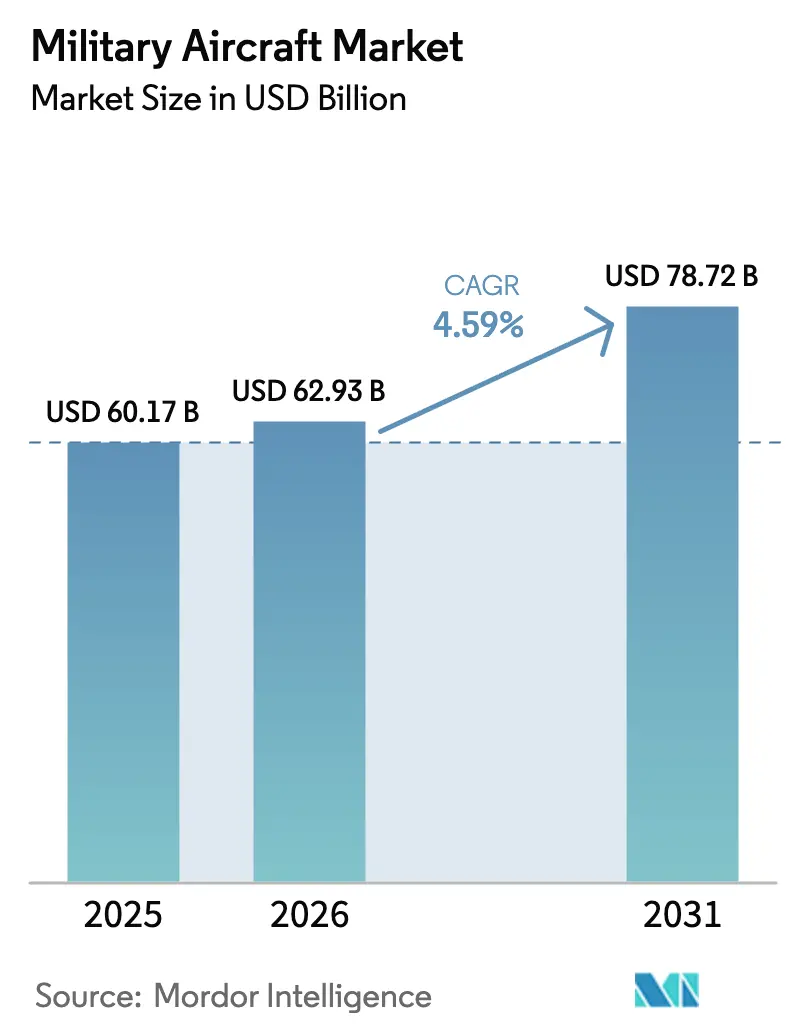
The military aircraft market size is expected to grow from USD 60.17 billion in 2025 to USD 62.93 billion in 2026 and is forecast to reach USD 78.72 billion by 2031 at 4.59% CAGR over 2026-2031. Continued fleet-modernization programs, record defense budgets, and rapid technology refresh cycles reinforce steady multi-year procurement pipelines across major economies. Heightened regional tensions accelerate near-term orders as planners seek airpower parity, while open-systems architecture makes incremental upgrades less costly and more attractive. At the same time, sustainability goals spur early investments in hybrid-electric propulsion that promise lighter logistical footprints. Competitive intensity remains high, yet supply-chain resilience and sovereign production capability now carry as much weight as raw performance features when contracts are awarded.
Key Report Takeaways
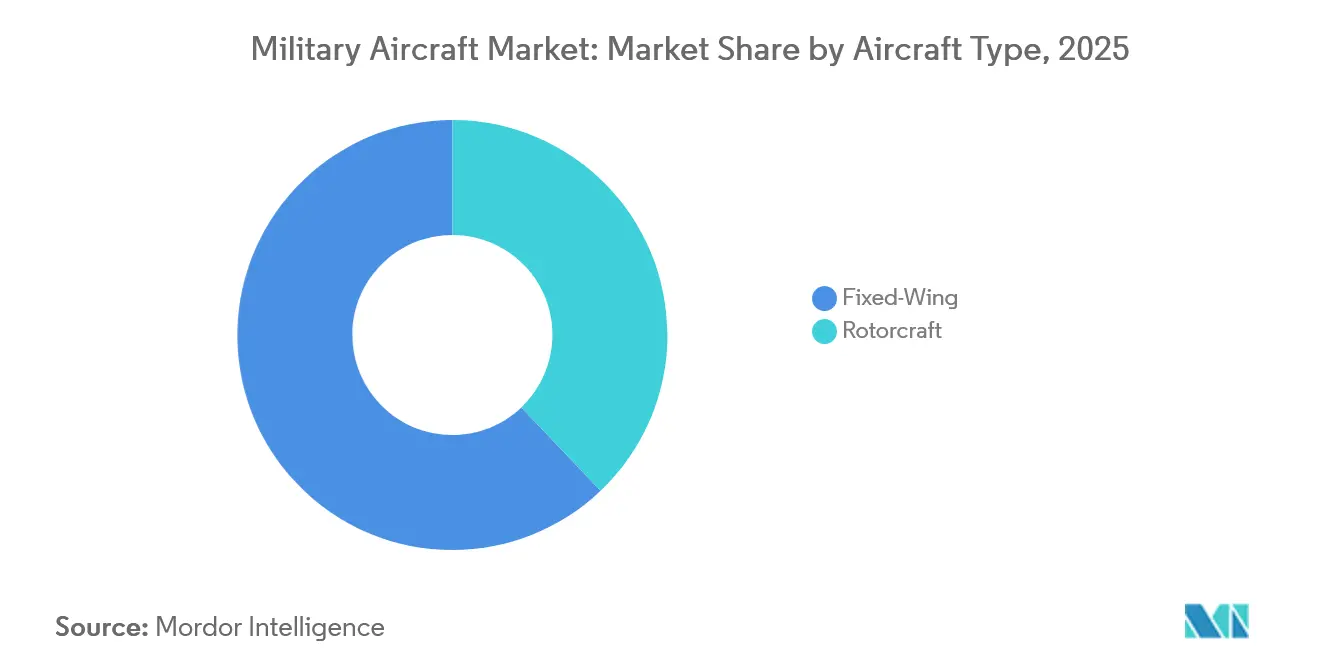
- By aircraft type, fixed-wing platforms captured 62.10% revenue share in 2025, whereas rotorcraft are expanding at a 5.68% CAGR through 2031.
- By end-user service, the Air Force segment held 50.70% of the military aircraft market share in 2025, while joint/special operations is advancing at a 4.48% CAGR through 2031.
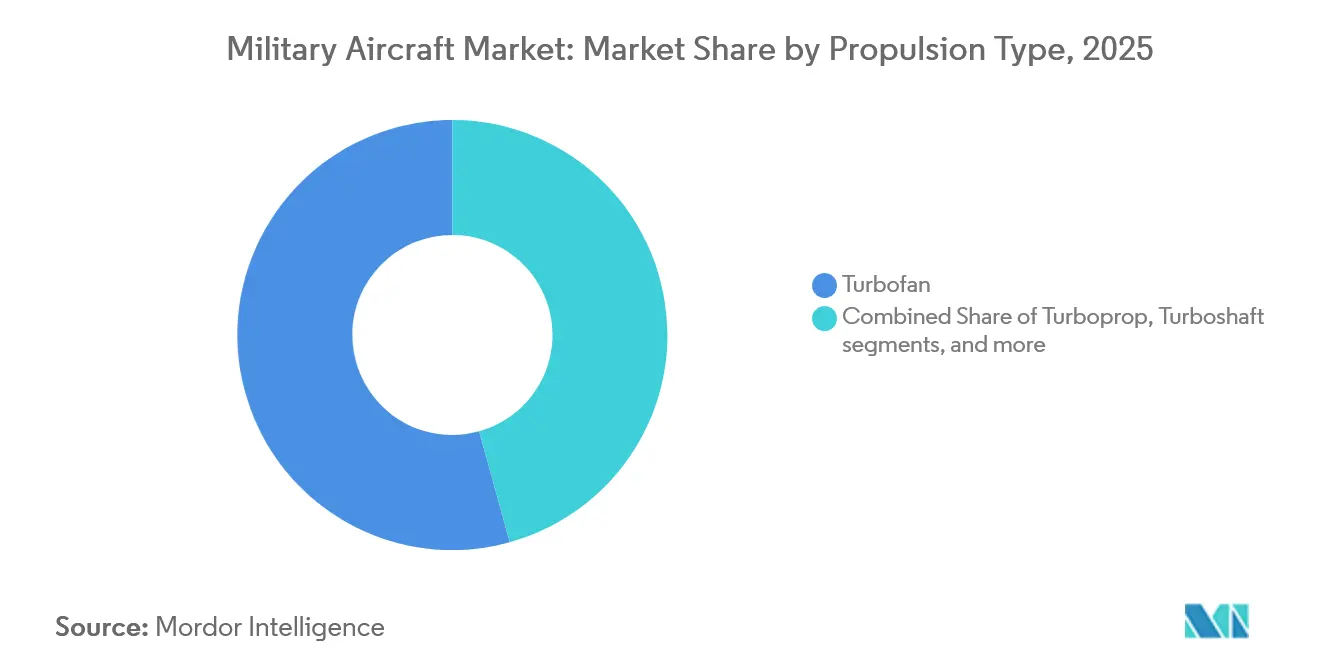
- By propulsion type, turbofan engines accounted for 54.30% of the military aircraft market size in 2025, yet fully electric or hybrid-electric systems are registering 5.58% growth through 2031.
- By geography, North America led the military aircraft market with 31.60% of the market share in 2025; Asia-Pacific is expected to post the fastest CAGR of 6.36% to 2031.
Note: Market size and forecast figures in this report are generated using Mordor Intelligence’s proprietary estimation framework, updated with the latest available data and insights as of 2026.
Market Trends and Insights
Drivers Impact Analysis of Military Aircraft Market*
| Driver | (~) % Impact on CAGR Forecast | Geographic Relevance | Impact Timeline |
|---|---|---|---|
| Growing defense budgets | +0.7% | Global (North America, Europe, Asia-Pacific) | Medium term (2-4 years) |
| Obsolescent Cold War fleets | +0.6% | North America, Europe, allied nations | Long term (≥4 years) |
| High-tempo regional flashpoints | +0.5% | Asia-Pacific, Middle East, Eastern Europe | Short term (≤2 years) |
| Huge 5th-generation export backlog | +0.4% | Global production bases in North America and Europe | Medium term (2-4 years) |
| Open-systems retrofit economics | +0.3% | North America, Europe, expanding to Asia-Pacific | Long term (≥4 years) |
| Hybrid-electric tactical lifters | +0.2% | North America, Europe, global adoption | Long term (≥4 years) |
| Source: Mordor Intelligence | |||
Record-high Defense Budgets
Global military expenditure reached USD 2.4 trillion in 2024, a 6.8% jump from the previous year, and roughly 15% of that total is earmarked for aviation programs.[1] The US alone dedicated USD 886 billion to defense, sustaining F-35 production, B-21 bomber roll-outs, and next-generation air-dominance prototypes.[2] European NATO members boosted spending by 11%, honoring the 2% of GDP pledge and responding to the Ukraine conflict.[3] China’s USD 296 billion allocation and similar budget growth in India, Japan, and Australia underpin rising orders across the military aircraft market. Higher top-line budgets secure multi-year funding streams and shorten acquisition cycles, ensuring OEM backlogs remain healthy through 2030.
Obsolescent Cold-War Fleets
About 1,200 US Air Force aircraft now exceed planned service life, driving maintenance costs above replacement thresholds.[4] Similar stresses affect Europe, where Tornado and early Typhoon variants approach retirement without firm successors. Escalating sustainment expense makes recapitalization cheaper than life-extension, funneling fresh demand into fighters, air-lifters, trainers, and EW platforms.
High-tempo Regional Flashpoints
The Ukraine conflict demonstrated that air superiority still shapes ground outcomes, prompting European states to accelerate fighter acquisitions and enhance integrated air defenses. Tensions around Taiwan, the South China Sea, and the Korean Peninsula have similar effects in the Asia-Pacific. Japan, South Korea, and Australia are expanding F-35 fleets or developing indigenous alternatives. Precision-strike and ISR platforms remain essential for deterrence and counter-threat operations in the Middle East. Elevated operational tempo depletes airframe hours faster, triggering earlier replacements and higher spare-parts demand.
Huge 5th-generation Export Backlog
The F-35 program has over 3,000 aircraft on firm orders worth roughly USD 400 billion, locking in the workload for the next decade. Deliveries of Eurofighter Typhoon and Rafale exports also extend beyond 2030. A limited supplier pool and high switching costs give prime contractors pricing power and production stability. New buyers are willing to wait to secure 5th-generation capability, sustaining a robust pipeline for the military aircraft market even if defense budgets flatten later in the decade.
Restraints Impact Analysis of Military Aircraft Market*
| Restraint | (~) % Impact on CAGR Forecast | Geographic Relevance | Impact Timeline |
|---|---|---|---|
| Supply chain and labor bottlenecks | -0.4% | Global, acute in North America and Europe | Short term (≤2 years) |
| Program cost overruns | -0.3% | Global, complex development programs | Medium term (2-4 years) |
| Chip-export controls on avionics | -0.2% | China, Russia, global spillover | Medium term (2-4 years) |
| Expanding cyberattack surface | -0.1% | Global, advanced systems | Long term (≥4 years) |
| Source: Mordor Intelligence | |||
Supply Chain and Labor Bottlenecks
Military-grade semiconductor lead times exceeded 52 weeks in 2024, resulting in delayed deliveries of mission computers across multiple aircraft lines. Titanium shortages, caused by geopolitical sanctions, force OEMs to source alternative alloys or pay premiums, while aerospace manufacturers report a 25% rise in unfilled skilled labor positions, further slowing throughput. Because a missing component can halt entire assembly lines, production forecasts slide to the right, tempering near-term output across the military aircraft market.
Program cost overruns
GAO reviews show an average cost growth of 27% for major US aviation programs, reducing the number of aircraft that can be bought within fixed budgets. The F-35’s lifetime price tag swelled to USD 1.7 trillion, inviting political scrutiny and export-customer pushback. When overruns hit non-US programs, smaller domestic budgets have little room to absorb them, often leading to scope reductions or cancellations that trim military aircraft market demand.
*Our forecasts treat driver/restraint impacts as directional, not additive. The impact forecasts reflect baseline growth, mix effects, and variable interactions.
Military Aircraft Market Segment Analysis
By Aircraft Type:
Fixed-wing Dominance Faces Rotorcraft MomentumFixed-wing platforms generated 62.10% of 2025 revenues, anchored by high-value fighter and transport contracts that account for much of the military aircraft market. Multi-role jets such as the F-35, Rafale, and Typhoon dominate because they replace multiple legacy models with a single airframe, streamlining maintenance and training. Airlift aircraft such as the C-130J and A400M strategically support distributed operations and humanitarian missions, ensuring ongoing procurement. Training fleets are aging fast, prompting the US T-7A, India HTT-40, and other programs that will add to fixed-wing orders through 2030.
Rotorcraft capture a smaller base, yet post a 5.68% CAGR that outpaces the broader military aircraft market. Operational experience in Afghanistan, Iraq, and humanitarian crises proved the value of vertical-lift agility for insertion, medevac, and heavy-lift roles unreachable by runways. UH-60 and AH-64 refresh cycles continue, while CH-47 modernization ensures heavy-lift relevance. Emerging designs, such as tilt-rotor and compound helicopters, promise extended range and speed, attracting joint forces seeking multi-domain flexibility.

By End-User Service:
Air Force Leadership Challenged by Joint Operations GrowthAir Force budgets still account for 50.70% of 2025 spending, reflecting doctrinal primacy and the cost of high-performance jets. Large programs like the B-21 bomber and KC-46 tanker keep the segment central to the military aircraft market. Yet joint/special operations aircraft log the fastest 4.48% CAGR as hybrid conflict scenarios require rapid, discreet insertion and C3I assets. Specialized transports with redundant comms and defensive aids receive priority, while low-signature surveillance platforms support contested-area awareness.
Army Aviation maintains a steady rotorcraft focus, funding the Future Long-Range Assault Aircraft (FLRAA) to extend reach for ground forces. Naval and Marine Corps Aviation invests in carrier-capable fighters, tilt-rotors, and maritime patrol aircraft, ensuring force projection at sea. Though smaller, the paramilitary and Coast Guard fleets upgrade patrol and SAR aircraft to secure borders and exclusive economic zones, adding incremental demand to the military aircraft market.
By Propulsion Type:
Turbofan Maturity Meets Electric InnovationTurbofan engines accounted for 54.30% of 2025 deliveries, sustaining the military aircraft market in the high-thrust fighter and transport categories. The F135, delivering 43,000 lbs of thrust, exemplifies state-of-the-art metallurgy and additive manufacturing that improve durability. Turboprops remain essential for basic trainers, light transports, and intelligence, surveillance, and reconnaissance (ISR) missions where fuel burn matters more than speed. Turboshaft upgrades under the Improved Turbine Engine Program (ITEP) lift helicopter hot-and-high performance.
While still niche, fully electric or hybrid-electric propulsion logs 5.58% growth as battery energy density improves. Hybrid systems on unmanned aircraft already extend endurance and cut acoustic signatures for ISR sorties. Electric architectures promise lower maintenance and easier field sustainment, aligning with the broader military aircraft market pursuit of agile basing and reduced logistical tails.
Geography Analysis
North America Military Aircraft Market
North America retained 31.60% of the military aircraft market in 2025, underpinned by the US’s USD 886 billion defense budget, which funds F-35 lots, the B-21 bomber acquisition, and Next Generation Air Dominance (NGAD) prototypes. Canada is buying 88 F-35As, while Mexico emphasizes transports and surveillance for counter-narcotics and disaster relief. Long-established industrial ecosystems, robust supply chains, and advanced R&D labs keep North America at the technological forefront and attract foreign sales through Foreign Military Sales channels.
APAC Military Aircraft Market
Asia-Pacific posts a 6.36% CAGR as China fields J-20 stealth fighters and accelerates H-20 bomber development. India’s Tejas and future AMCA programs support indigenous capability and reduce reliance on imports. Japan, South Korea, and Australia invest in F-35s and local co-development, strengthening alliance interoperability. Rising tensions around Taiwan and the South China Sea are compelling regional air forces to modernize sooner, thereby expanding the military aircraft market faster than in any other geography.
Europe Military Aircraft Market
Europe is mature yet dynamic, coordinating sixth-generation initiatives such as FCAS and Tempest worth more than USD 100 billion. The Ukraine war galvanized spending, prompting Germany to order 38 additional Eurofighter combat aircraft and other states to refresh squadrons under NATO’s 2% guidance. Collaborative programs share cost and technology risk, preserving strategic autonomy even as suppliers consolidate.
MEA Military Aircraft Market
The Middle East and Africa contribute selectively: Gulf Cooperation Council members buy advanced fighters and reconnaissance assets to deter regional threats, while African nations favor cargo and patrol aircraft that suit peacekeeping and humanitarian roles. Limited budgets slow uptake, yet targeted procurements still provide growth pockets within the global military aircraft market.
Competitive Landscape
The market is moderately consolidated, with five prime contractors—Lockheed Martin, Boeing, Airbus, Northrop Grumman, and Leonardo—accounting for most of the global market share in 2024 revenues. This highlights a concentrated structure that newcomers find hard to penetrate. Scale, certified production lines, and export-license experience help incumbents secure follow-on contracts and long-term support deals. As seen in the F-35 program, multinational co-production frameworks tether jobs and technology transfer to partner nations, building political support that further insulates prime positions.
Mid-tier firms exploit white-space niches. General Atomics and Kratos Defense dominate in medium-altitude unmanned systems and target drones, respectively, proving that focused innovation can yield strong positions without matching the capital intensity of manned aircraft programs. Start-ups leverage advances in the civil sector in composites, AI, and battery technology to prototype lighter, cheaper assets, such as eVTOL scouts. Governments encourage such diversity to improve supply-chain resilience, yet certification hurdles and security regulations slow market entry.
Supply disruptions and geopolitical sanctions push OEMs to localize key inputs, making sovereign industrial capability a competitive differentiator. Companies demonstrating titanium substitution, redundant chip sourcing, and robust cyber-defense stand out in bid evaluations. As open-systems standards spread, airlines and air forces can mix-and-match mission software, lending smaller vendors an entry point through apps rather than airframes, subtly reshaping value capture in the military aircraft market.
Military Aircraft Industry Leaders
-
Airbus SE
-
Lockheed Martin Corporation
-
The Boeing Company
-
Northrop Grumman Corporation
-
Leonardo S.p.A.
- *Disclaimer: Major Players sorted in no particular order
Military Aircraft Market Companies Covered in this Report
- Airbus SE
- The Boeing Company
- Lockheed Martin Corporation
- Northrop Grumman Corporation
- BAE Systems plc
- Leonardo S.p.A.
- Textron Inc.
- Dassault Aviation SA
- Saab AB
- Embraer S.A.
- Korea Aerospace Industries Ltd.
- United Aircraft Corporation
- Rostec
- Aviation Industry Corporation of China
- Hindustan Aeronautics Limited
- Kawasaki Heavy Industries, Ltd.
- Mitsubishi Heavy Industries, Ltd.
- Turkish Aerospace Industries, Inc.
- Israel Aerospace Industries Ltd.
- Tata Advanced Systems Limited
Recent Industry Developments in Military Aircraft Market
- October 2025: The Swedish Defence Materiel Administration granted Saab AB a procurement contract to conduct conceptual studies on future fighter systems. The agreement, worth SEK 2.6 billion (USD 274 million), covers research initiatives from 2025 to 2027.
- September 2025: The Indian Ministry of Defence (MoD) finalized a procurement contract with Hindustan Aeronautics Limited for 97 Light Combat Aircraft (LCA) Mk1A. The agreement encompasses the delivery of 68 fighter aircraft and 29 twin-seater variants, including associated equipment, to strengthen the Indian Air Force (IAF) fleet.
- March 2025: The US Pentagon awarded Boeing the contract to develop the NGAD fighter aircraft. This sixth-generation fighter, the F-47, will replace the existing F-22 Raptor in the US Air Force's advanced combat aircraft fleet.
Global Military Aircraft Market Report Scope
Segmentation Overview
By Aircraft Type
| Fixed-Wing Aircraft | Combat Aircraft |
| Multi-role Aircraft | |
| Training Aircraft | |
| Transport Aircraft | |
| Other Aircraft | |
| Rotorcraft | Multi-Mission Helicopter |
| Transport Helicopter | |
| Other Helicopter |
By End-User Service
| Air Force |
| Army Aviation |
| Naval/Marine Corps Aviation |
| Joint/Special Operations |
| Paramilitary and Coast Guard |
By Propulsion Type
| Turbofan |
| Turbojet |
| Turboprop |
| Turboshaft |
| Fully Electric/Hybrid-Electric |
By Geography
| North America | United States | |
| Canada | ||
| Mexico | ||
| Europe | United Kingdom | |
| France | ||
| Germany | ||
| Spain | ||
| Italy | ||
| Russia | ||
| Rest of Europe | ||
| Asia-Pacific | China | |
| India | ||
| Japan | ||
| South Korea | ||
| Indonesia | ||
| Australia | ||
| Rest of Asia-Pacific | ||
| South America | Brazil | |
| Rest of South America | ||
| Middle East and Africa | Middle East | Saudi Arabia |
| United Arab Emirates | ||
| Qatar | ||
| Rest of Middle East | ||
| Africa | South Africa | |
| Nigeria | ||
| Rest of Africa | ||
| By Aircraft Type | Fixed-Wing Aircraft | Combat Aircraft | |
| Multi-role Aircraft | |||
| Training Aircraft | |||
| Transport Aircraft | |||
| Other Aircraft | |||
| Rotorcraft | Multi-Mission Helicopter | ||
| Transport Helicopter | |||
| Other Helicopter | |||
| By End-User Service | Air Force | ||
| Army Aviation | |||
| Naval/Marine Corps Aviation | |||
| Joint/Special Operations | |||
| Paramilitary and Coast Guard | |||
| By Propulsion Type | Turbofan | ||
| Turbojet | |||
| Turboprop | |||
| Turboshaft | |||
| Fully Electric/Hybrid-Electric | |||
| By Geography | North America | United States | |
| Canada | |||
| Mexico | |||
| Europe | United Kingdom | ||
| France | |||
| Germany | |||
| Spain | |||
| Italy | |||
| Russia | |||
| Rest of Europe | |||
| Asia-Pacific | China | ||
| India | |||
| Japan | |||
| South Korea | |||
| Indonesia | |||
| Australia | |||
| Rest of Asia-Pacific | |||
| South America | Brazil | ||
| Rest of South America | |||
| Middle East and Africa | Middle East | Saudi Arabia | |
| United Arab Emirates | |||
| Qatar | |||
| Rest of Middle East | |||
| Africa | South Africa | ||
| Nigeria | |||
| Rest of Africa | |||
Market Definition
- Aircraft Type - All the military aircraft and rotorcraft which are used for various applications are included in this study.
- Sub-Aircraft Type - For this study, sub-aircraft types such as fixed-wing aircraft and rotorcraft based on their application are considered.
- Body Type - Multi-Role Aircraft, Transport, Training Aircraft, Bombers, Reconnaissance Aircraft, Multi-Mission Helicopters, Transport Helicopters and various other aircraft and rotorcraft are considered in this study.
| Keyword | Definition |
|---|---|
| IATA | IATA stands for the International Air Transport Association, a trade organization composed of airlines around the world that has an influence over the commercial aspects of flight. |
| ICAO | ICAO stands for International Civil Aviation Organization, a specialized agency of the United Nations that supports aviation and navigation around the globe. |
| Air Operator Certificate (AOC) | A certificate granted by a National Aviation Authority permitting the conduct of commercial flying activities. |
| Certificate Of Airworthiness (CoA) | A Certificate Of Airworthiness (CoA) is issued for an aircraft by the civil aviation authority in the state in which the aircraft is registered. |
| Gross Domestic Product (GDP) | Gross domestic product (GDP) is a monetary measure of the market value of all the final goods and services produced in a specific time period by countries. |
| RPK (Revenue Passenger Kilometres) | The RPK of an airline is the sum of the products obtained by multiplying the number of revenue passengers carried on each flight stage by the stage distance - it is the total number of kilometers traveled by all revenue passengers. |
| Load Factor | The load factor is a metric used in the airline industry that measures the percentage of available seating capacity that has been filled with passengers. |
| Original Equipment Manufacturer (OEM) | An original equipment manufacturer (OEM) traditionally is defined as a company whose goods are used as components in the products of another company, which then sells the finished item to users. |
| International Transportation Safety Association (ITSA) | International Transportation Safety Association (ITSA) is an international network of heads of independent safety investigation authorities (SIA). |
| Available Seats Kilometre (ASK) | This metric is calculated by multiplying Available Seats (AS) in one flight, defined above, multiplied by the distance flown. |
| Gross Weight | The fully-loaded weight of an aircraft, also known as “takeoff weight,” which includes the combined weight of passengers, cargo, and fuel. |
| Airworthiness | The ability of an aircraft, or other airborne equipment or system, to operate in flight and on the ground without significant hazard to aircrew, ground crew, passengers or to other third parties. |
| Airworthiness Standards | Detailed and comprehensive design and safety criteria applicable to the category of aeronautical product (aircraft, engine or propeller). |
| Fixed Base Operator (FBO) | A business or organization that operates at an airport. An FBO provides aircraft operating services like maintenance, fueling, flight training, charter services, hangaring, and parking. |
| High Net worth Individuals (HNWIs) | High Net worth Individuals (HNWIs) are individuals with over USD 1 million in liquid financial assets. |
| Ultra High Net worth Individuals (UHNWIs) | Ultra High Net worth Individuals (UHNWIs) are individuals with over USD 30 million in liquid financial assets. |
| Federal Aviation Administration (FAA) | The division of the Department of Transportation is concerned with aviation. It operates Air Traffic Control and regulates everything from aircraft manufacturing to pilot training to airport operations in the United States. |
| EASA (European Aviation Safety Agency) | The European Aviation Safety Agency is a European Union agency established in 2002 with the task of overseeing civil aviation safety and regulation. |
| Airborne Warning and Control System (AW&C) aircraft | Airborne Warning and Control System (AEW&C) aircraft is equipped with a powerful radar and on-board command and control center to direct the armed forces. |
| The North Atlantic Treaty Organization (NATO) | The North Atlantic Treaty Organization (NATO), also called the North Atlantic Alliance, is an intergovernmental military alliance between 30 member states – 28 European and two North American. |
| Joint Strike Fighter (JSF) | Joint Strike Fighter (JSF) is a development and acquisition program intended to replace a wide range of existing fighter, strike, and ground attack aircraft for the United States, the United Kingdom, Italy, Canada, Australia, the Netherlands, Denmark, Norway, and formerly Turkey. |
| Light Combat Aircraft (LCA) | A light combat aircraft (LCA) is a light, multirole jet/turboprop military aircraft, commonly derived from advanced trainer designs, designed for engaging in light combat. |
| Stockholm International Peace Research Institute (SIPRI) | Stockholm International Peace Research Institute (SIPRI) is an international institute that provides data, analysis, and recommendations for armed conflict, military expenditure, and arms trade as well as disarmament and arms control. |
| Maritime Patrol Aircraft (MPA) | A maritime patrol aircraft (MPA), also known as maritime reconnaissance aircraft is a fixed-wing aircraft designed to operate for long durations over water in maritime patrol roles, in particular, anti-submarine warfare (ASW), anti-ship warfare (AShW), and search and rescue (SAR). |
| Mach Number | The Mach number is defined as the ratio of true airspeed to the speed of sound at the altitude of a given aircraft. |
| Stealth Aircraft | Stealth is a Common term applied to low observable (LO) technology and doctrine, that makes an aircraft near invisible to radar, infrared or visual detection. |
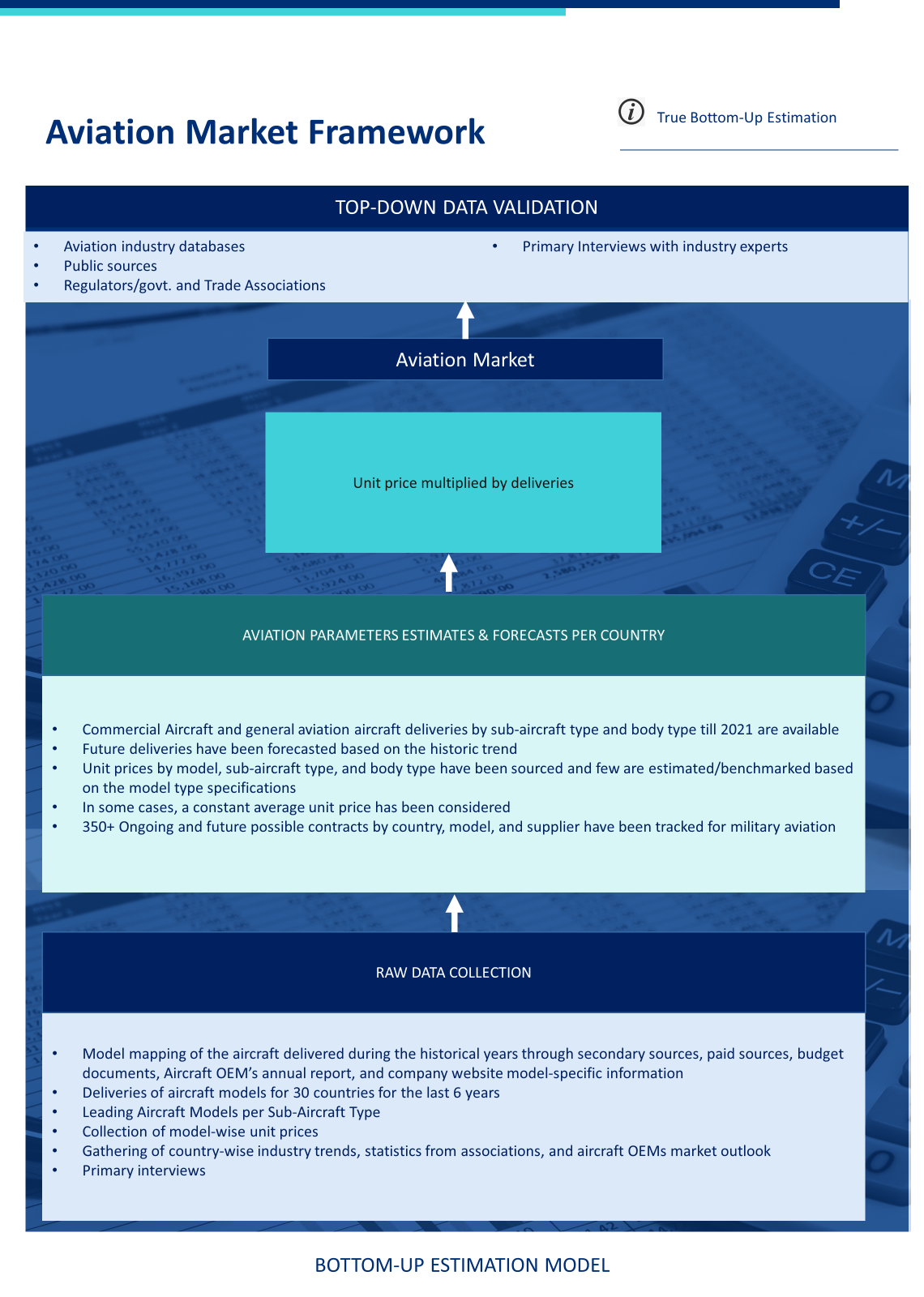
Research Methodology
Mordor Intelligence follows a four-step methodology in all our reports.
- Step-1: Identify Key Variables: In order to build a robust forecasting methodology, the variables and factors identified in Step-1 are tested against available historical market numbers. Through an iterative process, the variables required for market forecast are set and the model is built on the basis of these variables.
- Step-2: Build a Market Model: Market-size estimations for the historical and forecast years have been provided in revenue and volume terms. For sales conversion to volume, the average selling price (ASP) is kept constant throughout the forecast period for each country, and inflation is not a part of the pricing.
- Step-3: Validate and Finalize: In this important step, all market numbers, variables and analyst calls are validated through an extensive network of primary research experts from the market studied. The respondents are selected across levels and functions to generate a holistic picture of the market studied.
- Step-4: Research Outputs: Syndicated Reports, Custom Consulting Assignments, Databases & Subscription Platforms