Global Microtomes Market Size and Share
Market Overview
| Study Period | 2020 - 2031 |
|---|---|
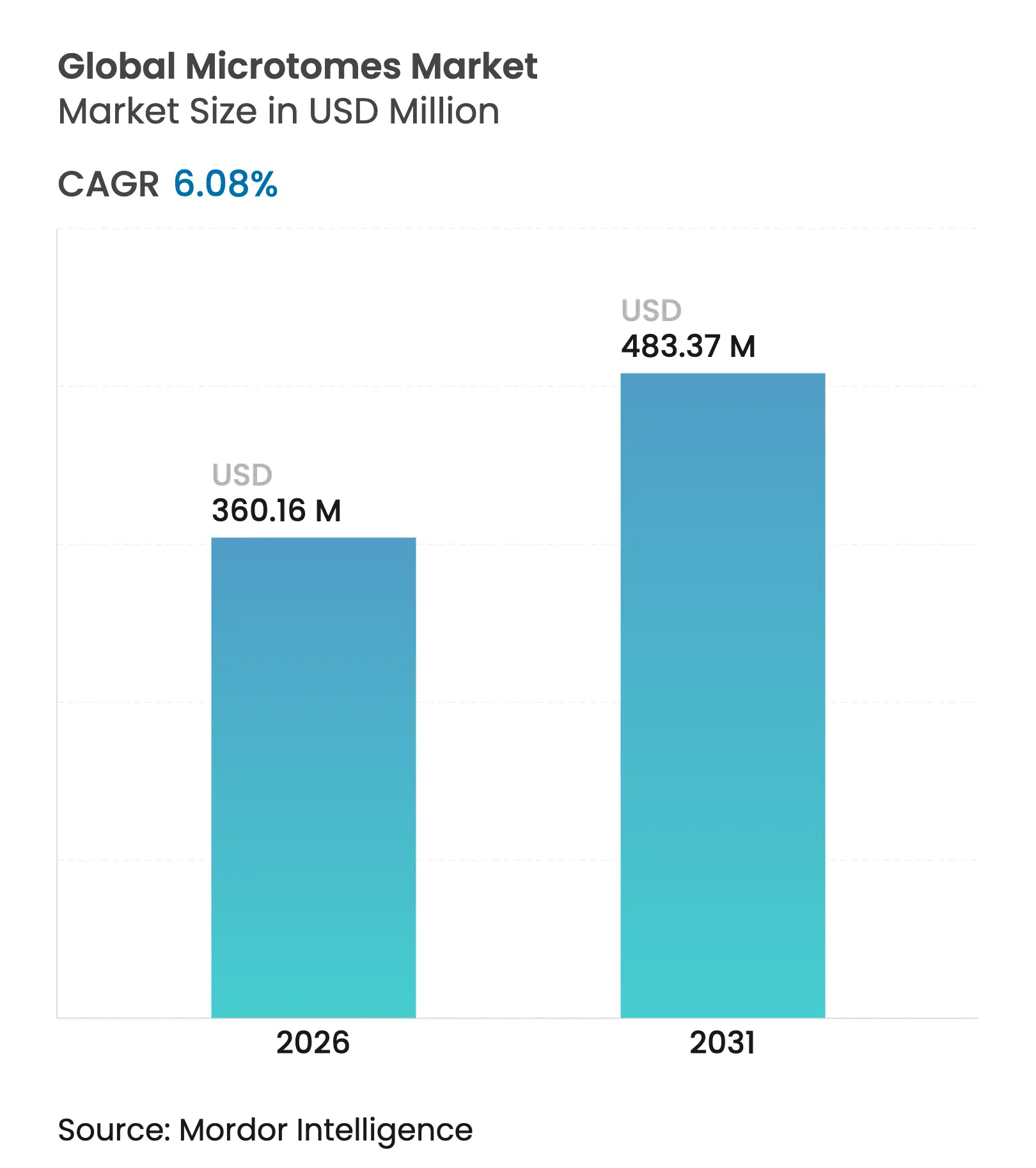
| Market Size (2026) | USD 360.16 Million |
| Market Size (2031) | USD 483.37 Million |
| Growth Rate (2026 - 2031) | 6.08 % CAGR |
| Fastest Growing Market | Asia Pacific |
| Largest Market | North America |
| Market Concentration | Medium |
Major Players *Disclaimer: Major Players sorted in no particular order. Image © Mordor Intelligence. Reuse requires attribution under CC BY 4.0. |

Global Microtomes Market Analysis by Mordor Intelligence
The microtomes market size is expected to grow from USD 339.52 million in 2025 to USD 360.16 million in 2026 and is forecast to reach USD 483.37 million by 2031 at 6.08% CAGR over 2026-2031. Rising global cancer incidence, accelerating digital pathology projects, and ongoing laboratory infrastructure investments in emerging economies are the chief growth engines. Automated sectioning systems are gaining traction as health systems confront staffing shortages and the need for throughput gains. Regional dynamics remain uneven: North America retains scale advantages, yet Asia-Pacific laboratories are adopting new instruments fastest as governments prioritize self-reliance in medical technology. On the competitive front, suppliers are bundling precision sectioners with whole-slide imaging software, while also investing in local blade production to shield customers from geopolitical supply risks.
Key Report Takeaways
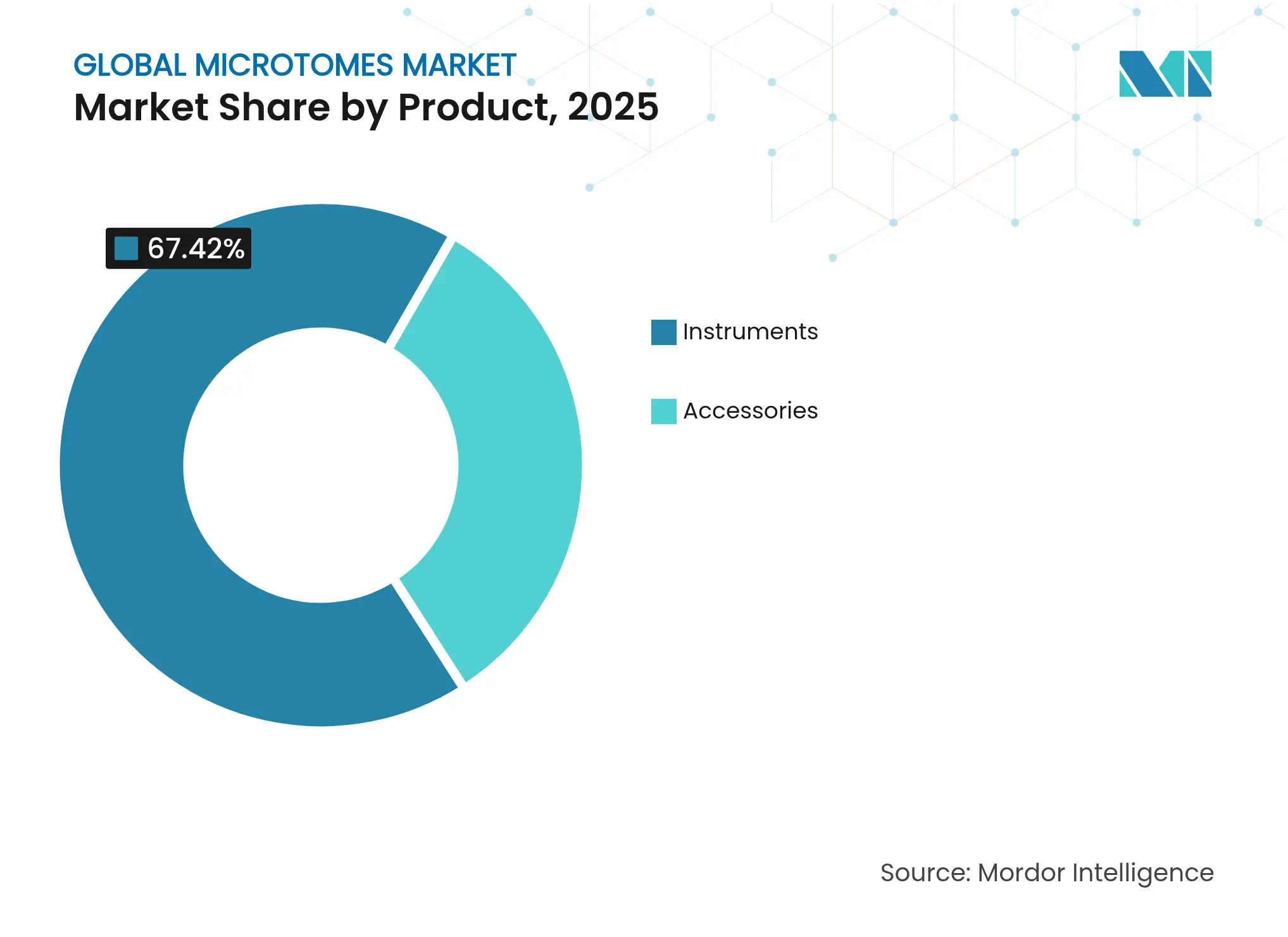
- By product, instruments led with 67.42% revenue share in 2025; accessories are projected to expand at a 6.73% CAGR to 2031.
- By technology, manual systems accounted for 52.56% of microtomes market share in 2025, whereas fully automated platforms are advancing at a 7.22% CAGR through 2031.
- By application, disease diagnostics held 64.22% of the microtomes market size in 2025; digital pathology is the fastest-growing use case at 7.3% CAGR to 2031.
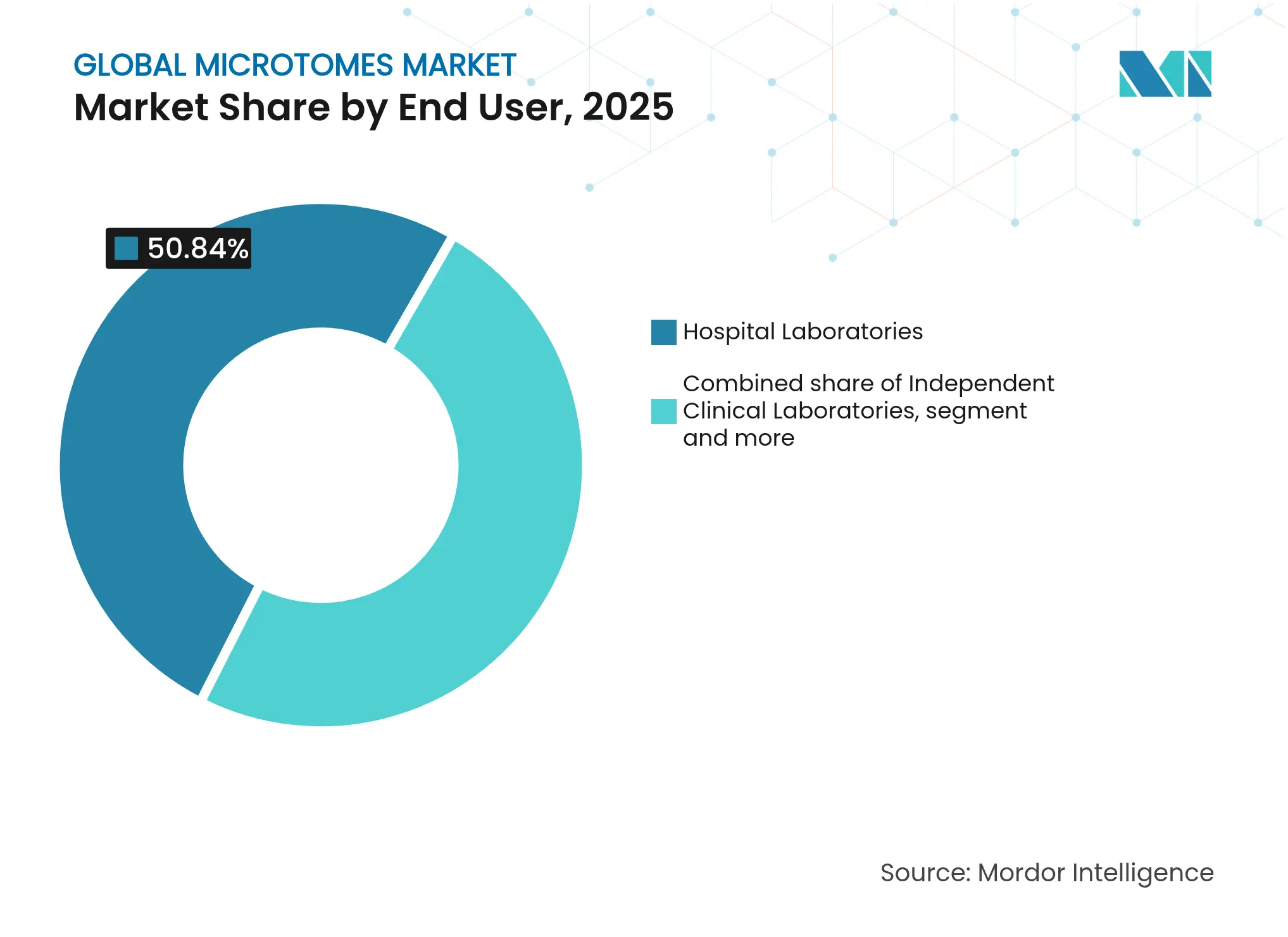
- By end user, hospital laboratories commanded 50.84% share of the microtomes market size in 2025, while pharmaceutical and biotechnology companies are increasing spending at a 7.03% CAGR.
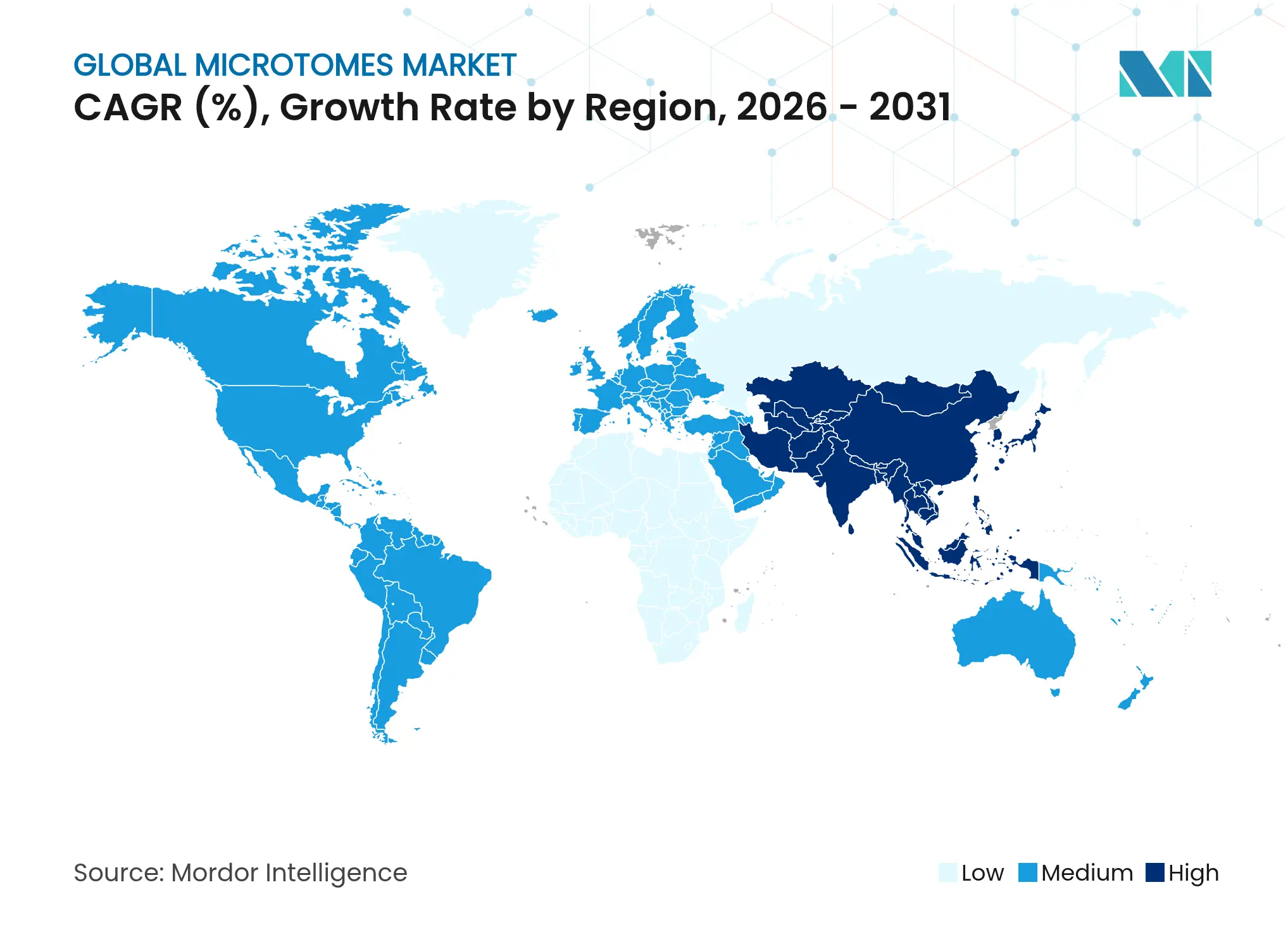
- By geography, North America dominated with 42.18% share in 2025; Asia-Pacific is set to register a 7.7% CAGR to 2031.
Note: Market size and forecast figures in this report are generated using Mordor Intelligence's proprietary estimation framework, updated with the latest available data and insights as of 2026.
Global Microtomes Market Trends and Insights
Drivers Impact Analysis
| Driver | (~) % Impact on CAGR Forecast | Geographic Relevance | Impact Timeline |
|---|---|---|---|
Rising global cancer burden | +1.8% | Global, with highest impact in aging populations of North America and Europe | Long term (≥ 4 years) |
Digital pathology adoption | +1.2% | North America & EU leading, APAC rapid adoption | Medium term (2-4 years) |
Advances in automated microtomy | +0.9% | Global, concentrated in developed markets initially | Medium term (2-4 years) |
Histopathology lab expansion in APAC | +1.1% | APAC core, spill-over to MEA | Long term (≥ 4 years) |
Demand for 3-D tissue & spatial-omics sectioning | +0.7% | North America & EU research institutions | Short term (≤ 2 years) |
Microtome use in material-science & battery R&D | +0.3% | Global, concentrated in technology hubs | Medium term (2-4 years) |
| Source: Mordor Intelligence | |||
Rising Global Cancer Burden
New oncologic cases are projected to climb 75% by 2050 versus 2022, intensifying demand for precise sectioning equipment that supports advanced biomarker testing. Prostate cancer studies that employ multiplex immunohistochemistry have reported sensitivities above 99%, a performance that hinges on uniform tissue slices. Whole-mount techniques are also expanding because they improve tumor volume estimation and link imaging to pathology, further raising microtome utilization.
Digital Pathology Adoption
The United States Food and Drug Administration has cleared several whole-slide imaging systems for primary diagnosis, signaling regulatory confidence in digital workflows. Vendors such as Leica Biosystems and Indica Labs are integrating slide scanners with AI software, which in turn demands thin, scratch-free sections from modern automated microtomes. Laboratories pursuing full digital conversion report that image-based decisions now influence nearly 70% of therapeutic choices, placing sectioning quality at the center of diagnostic integrity.
Advances in Automated Microtomy
Systems like the Leica UC Enuity bring automated knife and sample alignment that produces repeatable sub-micron cuts while reducing operator skill requirements. Nanopolished blade edges have been shown to lower tissue trauma and support faster downstream staining. Automation directly counters staffing gaps; the American Society for Clinical Pathology registered an 18% vacancy rate in core labs in 2024.
Histopathology Lab Expansion in APAC
China’s medical-equipment sector has grown 15% per year, a rate well above global averages, buoyed by policies that foster domestic production and larger oncology screening programs.[1] Pandemic-era supply shocks pushed regional labs to adopt automated microtomes that preserve quality despite limited staffing. India, Indonesia, and Vietnam show similar trajectories as they fast-track cancer screening and digital records, positioning the microtomes market for sustained demand across the region.
Restraints Impact Analysis
| Restraint | (~) % Impact on CAGR Forecast | Geographic Relevance | Impact Timeline |
|---|---|---|---|
Shortage of skilled histotechnologists | -1.4% | Global, particularly acute in developed markets | Long term (≥ 4 years) |
High cost of advanced systems | -0.8% | Emerging markets primarily, budget-constrained institutions | Medium term (2-4 years) |
Supply-chain risk for precision blades | -0.6% | Global, concentrated in regions dependent on single suppliers | Short term (≤ 2 years) |
Substitution by laser micro-dissection systems | -0.4% | North America & EU research institutions primarily | Medium term (2-4 years) |
| Source: Mordor Intelligence | |||
Shortage of Skilled Histotechnologists
Worldwide there are only 14 pathologists per million population, with Africa averaging fewer than 3, limiting throughput in many laboratories.[2] In the United Kingdom, just 3% of pathology departments report full staffing, forcing facilities to lower certification standards and accept longer turnaround times. While automation eases daily workloads, complex cases still need expert oversight, constraining the microtomes market when professionals are unavailable.
High Cost of Advanced Systems
Premium automated microtomes can require capital outlays that smaller clinics cannot absorb, especially as supply-chain expenses have risen to as much as 20% of device revenue for manufacturers.[3] Leasing models and pay-per-use agreements are emerging but remain uncommon in lower-income regions. Consequently, some institutions delay upgrades, slowing penetration even as total-cost-of-ownership studies show labor savings often recoup initial spend within three years.
Segment Analysis
By Product: Instruments Lead Despite Accessories Growth Acceleration
Instruments held 67.42% of microtomes market share in 2025, underlining their prevalence in clinical histology. Rotary systems dominate routine cases, while laser and vibrating variants meet specialist demands for thicker neuroscience slices or ultra-thin research cuts. Accessories, notably disposable blades and specimen holders, are growing at a 6.73% CAGR as laboratories look for consistent performance and lower injury risk. Innovations in nanopolished steel and diamond coatings explain much of this accessories acceleration. Many regional suppliers are localizing blade manufacturing to counter shipping bottlenecks and steady the microtomes market.
Early adoption of accessories with RFID-enabled tracking also supports traceability mandates in regulated settings. Although accessories account for a smaller revenue base today, their high replacement frequency means recurring sales that buttress supplier margins. As automation rises, consumable-smart microtomes that alert technicians to blade-life parameters are being piloted, a development expected to lock in accessory demand through proprietary ecosystems.
Note: Segment shares of all individual segments available upon report purchase
By Technology: Manual Systems Dominate While Automation Accelerates
Manual platforms captured 52.56% of microtomes market share in 2025 because they cost less and give experienced technicians tactile feedback that remains useful for atypical specimens. However, fully automated models are expanding at 7.22% CAGR as hospitals adopt lean staffing models. Automated devices, integrating stepper-motor drives and onboard diagnostics, consistently yield slices under 4 µm, a quality threshold recommended for digital scanning.
Semi-automated units provide a bridge solution, offering motorized trimming yet retaining manual advance for delicate tissues, thereby accommodating budget-sensitive buyers. As cloud-based laboratory information systems mature, vendors are bundling predictive-maintenance dashboards, enabling labs to schedule servicing around workload peaks. This connectivity is forecast to keep the microtomes market on its automation trajectory without fully displacing legacy equipment in low-volume settings.
By End User: Hospitals Lead While Pharma Companies Accelerate
Hospital laboratories represented 50.84% of the microtomes market size in 2025 due to their direct role in patient care. Nonetheless, pharmaceutical and biotechnology firms are the fastest-expanding customers, with 7.03% CAGR linked to surging biomarker and companion-diagnostic pipelines. Contract research organizations that service these firms increasingly specify automated microtomes to guarantee reproducible GLP-compliant sections across multicenter trials.
Independent clinical labs also hold a sizable share as they absorb overflow testing from community hospitals. Their growth prospects hinge on adopting automation to offset wage inflation and to meet same-day reporting contracts. Academic centers and government institutes continue to push the boundaries of microtome functionality by sectioning composite materials and battery electrodes, widening the scope of the microtomes market beyond life sciences.
Note: Segment shares of all individual segments available upon report purchase
By Application: Disease Diagnostics Dominates While Digital Pathology Surges
Disease diagnostics accounted for 64.22% of the microtomes market size in 2025, reflecting the indispensable role of sectioning in cancer workflows. Oncology specimens, particularly breast and prostate tissues, depend on high-integrity slices for multiplex staining that guides therapy selection. Elsewhere, 3-D omics technologies are emerging, prompting demand for instruments capable of controlled serial sectioning at micron-level intervals.
Digital pathology, rising at 7.3% CAGR, relies on consistent section flatness and uniform thickness to avoid scan artifacts. Laboratories moving to remote sign-out models stipulate automated sectioners that cut, track, and transmit QC data directly into slide scanners, creating a virtuous cycle that reinforces purchasing of high-end systems. Pre-clinical drug safety teams also leverage automated microtomes to process large animal cohorts, underscoring the equipment’s relevance beyond core pathology.
Geography Analysis
North America led with 42.18% revenue in 2025, propelled by large cancer-screening volumes, high per-capita health spending, and early uptake of digital pathology. Federal reimbursement schemes support capital investment, and domestic blade manufacturing mitigates shipping delays. Europe exhibits steady but slower growth; its aging population and universal coverage sustain demand, yet shortages of histotechnologists limit daily throughput in several countries.
Asia-Pacific is advancing at a 7.7% CAGR as China, India, and Southeast Asia expand pathology networks to detect non-communicable diseases earlier. Government incentives for local medical-device production are fostering regional players, particularly in precision blades, thereby lowering total cost of ownership and broadening the buyer base. Japan and South Korea contribute incremental gains through high-end research applications such as spatial-omics, while Australia functions as a regional referral hub for complex oncologic diagnostics.
Latin America and the Middle East–Africa are still nascent but present upside as private hospital chains invest in modern laboratories. Political instability and currency volatility can slow procurement, yet multilateral cancer-control programs are gradually improving funding visibility. Suppliers who offer modular upgrades and financing plans are well-positioned to capture early adopters in these frontier markets, further diversifying the global microtomes market.

Competitive Landscape
Market Concentration
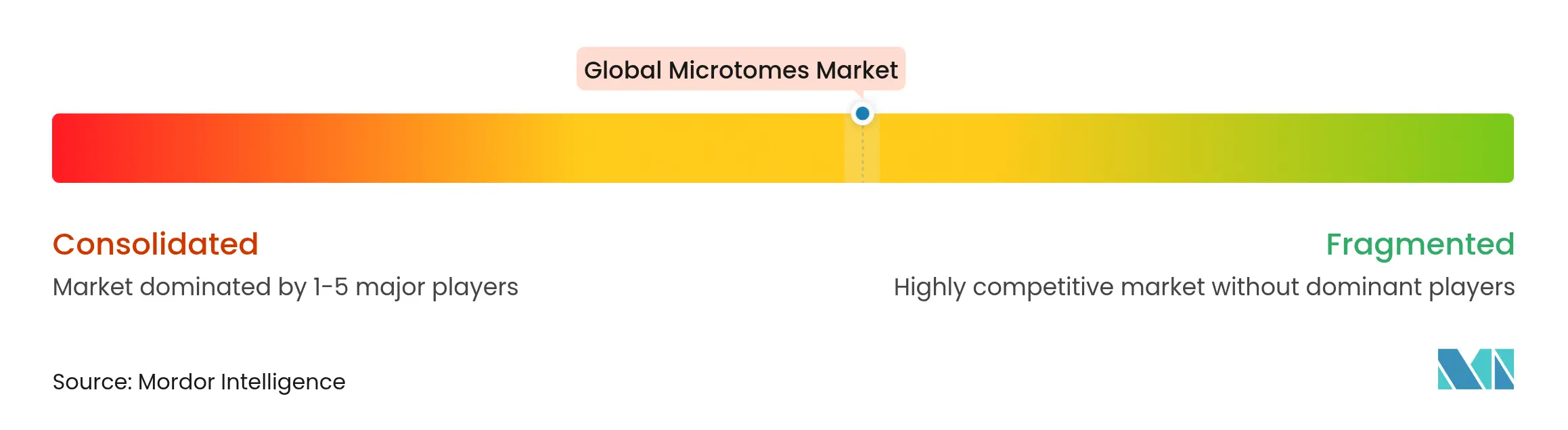
Competition is moderate, with major players prompting a steady pace of incremental innovation rather than price wars. Leica Biosystems has extended its suite through an AI partnership that marries Aperio scanners to HALO AP analytics, creating an end-to-end pathway from sectioning to diagnosis. Thermo Fisher Scientific is investing USD 2 billion in U.S. production to strengthen domestic supply for blades and consumables. Sakura Finetek continues to refine its Tissue-Tek line with ergonomic designs that reduce repetitive-strain injuries.
Emerging manufacturers are exploiting niches such as cryogenic sectioning for regenerative medicine, while start-ups pursue smart microtomes that adjust cutting force in real time via machine-vision feedback. Supply-chain resilience has become a differentiator; firms are dual-sourcing tungsten and diamond raw materials to reduce lead times. Meanwhile, service models are shifting toward multi-year uptime guarantees bolstered by IoT sensors that forecast part failures weeks in advance.
White-space opportunities include non-biological applications in semiconductor cross-sectioning and lithium-ion battery research, fields that demand ultra-clean slicing within inert environments. Vendors able to transfer histology know-how to these segments can open new revenue pools without cannibalizing core medical demand, strengthening the long-term outlook for the microtomes market.
Global Microtomes Industry Leaders

*Disclaimer: Major Players sorted in no particular order
Recent Industry Developments
- January 2025: The European Society of Pathology issued digital-workflow guidelines emphasizing microtome calibration as critical for producing homogeneous sections ready for whole-slide imaging.
- March 2024: Leica Microsystems unveiled the UC Enuity ultramicrotome featuring automated knife alignment and modular upgrades to aid both novice and expert users.
- October 2023: Leica Microsystems opened a USD 60 million manufacturing complex in Singapore, expanding capacity for advanced microtome production.
- January 2023: A Journal of Biological Engineering study documented increased adoption of vibrating microtomes for tissue-slice assays, citing superior preservation of cellular architecture.
Table of Contents for Global Microtomes Industry Report
1. Introduction
- 1.1 Study Assumptions & Market Definition
- 1.2 Scope of the Study
2. Research Methodology
3. Executive Summary
4. Market Landscape
- 4.1 Market Overview
- 4.2 Market Drivers
- 4.2.1 Rising global cancer burden
- 4.2.2 Digital pathology adoption
- 4.2.3 Advances in automated microtomy
- 4.2.4 Histopathology lab expansion in APAC
- 4.2.5 Demand for 3-D tissue & spatial-omics sectioning
- 4.2.6 Microtome use in material-science & battery R&D
- 4.3 Market Restraints
- 4.3.1 Shortage of skilled histotechnologists
- 4.3.2 High cost of advanced systems
- 4.3.3 Supply-chain risk for precision blades
- 4.3.4 Substitution by laser micro-dissection systems
- 4.4 Value / Supply-Chain Analysis
- 4.5 Regulatory Landscape
- 4.6 Technological Outlook
- 4.7 Porter’s Five Forces Analysis
- 4.7.1 Threat of New Entrants
- 4.7.2 Bargaining Power of Buyers
- 4.7.3 Bargaining Power of Suppliers
- 4.7.4 Threat of Substitutes
- 4.7.5 Intensity of Competitive Rivalry
5. Market Size & Growth Forecasts (Value)
- 5.1 By Product
- 5.1.1 Instruments
- 5.1.1.1 Rotary Microtomes
- 5.1.1.2 Vibrating Microtomes
- 5.1.1.3 Laser Microtomes
- 5.1.1.4 Sliding/Sledge Microtomes
- 5.1.1.5 Other Instruments
- 5.1.2 Accessories
- 5.2 By Technology
- 5.2.1 Manual Microtomes
- 5.2.2 Semi-automated Microtomes
- 5.2.3 Fully Automated Microtomes
- 5.3 By Application
- 5.3.1 Disease Diagnostics – Histopathology
- 5.3.2 Digital Pathology & Whole-Slide Imaging
- 5.3.3 Drug Discovery & Pre-clinical Testing
- 5.3.4 Others
- 5.4 By End User
- 5.4.1 Hospital Laboratories
- 5.4.2 Independent Clinical Laboratories
- 5.4.3 Pharmaceutical & Biotechnology Companies
- 5.4.4 Contract Research Organisations (CROs)
- 5.4.5 Others
- 5.5 By Geography
- 5.5.1 North America
- 5.5.1.1 United States
- 5.5.1.2 Canada
- 5.5.1.3 Mexico
- 5.5.2 Europe
- 5.5.2.1 Germany
- 5.5.2.2 United Kingdom
- 5.5.2.3 France
- 5.5.2.4 Italy
- 5.5.2.5 Spain
- 5.5.2.6 Rest of Europe
- 5.5.3 Asia-Pacific
- 5.5.3.1 China
- 5.5.3.2 Japan
- 5.5.3.3 India
- 5.5.3.4 Australia
- 5.5.3.5 South Korea
- 5.5.3.6 Rest of Asia-Pacific
- 5.5.4 Middle East and Africa
- 5.5.4.1 GCC
- 5.5.4.2 South Africa
- 5.5.4.3 Rest of Middle East and Africa
- 5.5.5 South America
- 5.5.5.1 Brazil
- 5.5.5.2 Argentina
- 5.5.5.3 Rest of South America
6. Competitive Landscape
- 6.1 Market Concentration
- 6.2 Market Share Analysis
- 6.3 Company Profiles (includes Global level Overview, Market level overview, Core Segments, Financials as available, Strategic Information, Market Rank/Share for key companies, Products & Services, and Recent Developments)
- 6.3.1 Thermo Fisher Scientific Inc.
- 6.3.2 Leica Biosystems Nussloch GmbH (Danaher Corporation)
- 6.3.3 Sakura Finetek
- 6.3.4 SLEE medical GmbH
- 6.3.5 MEDITE Medical GmbH
- 6.3.6 Histo-Line Laboratories
- 6.3.7 Amos Scientific Pty Ltd
- 6.3.8 Boeckeler Instruments Inc.
- 6.3.9 Diapath SpA
- 6.3.10 Cardinal Health
- 6.3.11 Epredia (PHC Holdings)
- 6.3.12 Bright Instrument Co. Ltd
- 6.3.13 Erma Inc.
- 6.3.14 microTec Laborgeräte GmbH
- 6.3.15 Especialidades Médicas MYR, S.L.
- 6.3.16 Jinhua Yidi Medical Appliance Co.,Ltd.
- 6.3.17 Zhejiang Jinhua kedi Instrumental Equipment Co. Ltd (JINHUA KEDI)
7. Market Opportunities & Future Outlook
- 7.1 White-space & Unmet-Need Assessment
Global Microtomes Market Report Scope
As per the scope of the report, a microtome is a device used to cut thin sections of tissues for microscopic examination, and the process is known as microtomy. The cut tissue, usually of 2 to 10-micrometer thickness, is further processed for observation under a microscope. The microtomes market is segmented by product, technology, end user, and geography. The product segment is divided into instruments and accessories. The technology segment is further segmented into manual microtomes and automated microtomes. The end-user segment includes hospital laboratories, clinical laboratories, pharmaceutical and biotechnology companies, and other end-users. The geography segment is divided into North America, Europe, Asia-Pacific, Middle East and Africa, and South America. The report offers the value (USD) for the above segments.
| By Product | Instruments | Rotary Microtomes |
| Vibrating Microtomes | ||
| Laser Microtomes | ||
| Sliding/Sledge Microtomes | ||
| Other Instruments | ||
| Accessories | ||
| By Technology | Manual Microtomes | |
| Semi-automated Microtomes | ||
| Fully Automated Microtomes | ||
| By Application | Disease Diagnostics – Histopathology | |
| Digital Pathology & Whole-Slide Imaging | ||
| Drug Discovery & Pre-clinical Testing | ||
| Others | ||
| By End User | Hospital Laboratories | |
| Independent Clinical Laboratories | ||
| Pharmaceutical & Biotechnology Companies | ||
| Contract Research Organisations (CROs) | ||
| Others | ||
| By Geography | North America | United States |
| Canada | ||
| Mexico | ||
| Europe | Germany | |
| United Kingdom | ||
| France | ||
| Italy | ||
| Spain | ||
| Rest of Europe | ||
| Asia-Pacific | China | |
| Japan | ||
| India | ||
| Australia | ||
| South Korea | ||
| Rest of Asia-Pacific | ||
| Middle East and Africa | GCC | |
| South Africa | ||
| Rest of Middle East and Africa | ||
| South America | Brazil | |
| Argentina | ||
| Rest of South America | ||

