
Microbiome Sample Preparation Technology Market Size and Share
Market Overview
| Study Period | 2019 - 2030 |
|---|---|
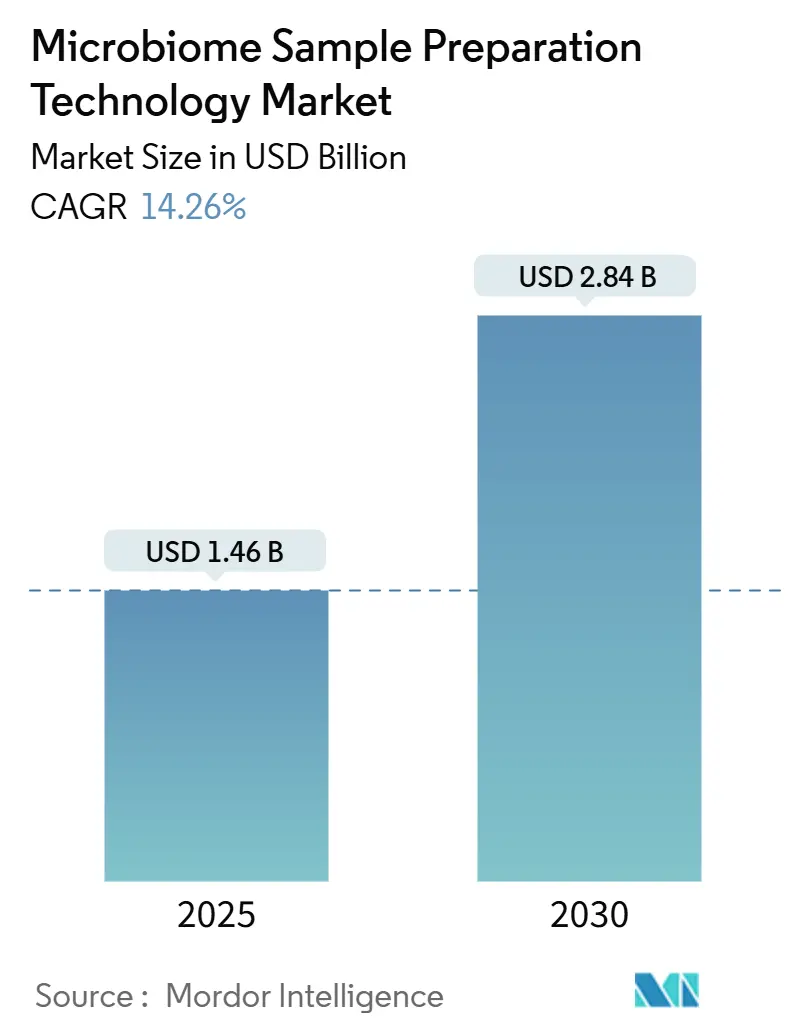
| Market Size (2025) | USD 1.46 Billion |
| Market Size (2030) | USD 2.84 Billion |
| Growth Rate (2025 - 2030) | 14.26 % |
| Fastest Growing Market | Asia Pacific |
| Largest Market | North America |
| Market Concentration | Medium |
Major Players *Disclaimer: Major Players sorted in no particular order Image © Mordor Intelligence. Reuse requires attribution under CC BY 4.0. | |
Microbiome Sample Preparation Technology Market Analysis by Mordor Intelligence
The microbiome sample preparation technology market size stood at USD 1.46 billion in 2025 and is projected to reach USD 2.84 billion by 2030, reflecting a 14.26% CAGR across the forecast period. Rapid uptake of metagenomic next-generation sequencing in hospital laboratories, mounting pharmaceutical investment in live biotherapeutic pipelines, and regulatory emphasis on standardized laboratory protocols underpin the growth trajectory of the microbiome sample preparation technology market. Leading suppliers are prioritizing host-DNA depletion chemistries, room-temperature stabilization reagents, and fully automated extraction workstations that can process 96–192 samples in a single run, thereby shrinking turnaround times and minimizing contamination risks. Regional dynamics mirror technology adoption curves: North America maintains a demand advantage on the back of FDA-cleared therapeutics, whereas Asia-Pacific laboratories are scaling capacity fastest as governments earmark precision-medicine budgets. At the application level, clinical diagnostics is moving from bench to bedside, while drug-discovery groups boost consumables demand as they standardize strain-preservation workflows for live biotherapeutic products. Competitive intensity remains moderate, but consolidation momentum is visible in acquisitions such as Nestlé Health Science’s purchase of VOWST and Mapmygenome’s takeover of Microbiome Insights, moves that integrate proprietary reagents with expanded geographic reach.
Key Report Takeaways
- By product type, kits and reagents led with 61.22% revenue share in 2024, while instruments and automation platforms are projected to expand at a 17.35% CAGR through 2030.
- By technology, magnetic-bead extraction captured 37.46% of microbiome sample preparation technology market share in 2024; host-DNA depletion technologies are forecast to grow at an 18.82% CAGR to 2030.
- By sample type, stool specimens accounted for 53.87% of the 2024 market, whereas urine samples are poised to advance at an 18.33% CAGR between 2025 and 2030.
- By workflow step, nucleic-acid extraction held 39.58% share in 2024, while collection and stabilization is projected to register a 17.44% CAGR through 2030.
- By application, clinical diagnostics commanded 37.34% of market share in 2024; drug discovery and development is expected to climb at an 18.39% CAGR to 2030.
- By end-user, pharmaceutical and biotechnology companies held 32.77% of 2024 revenue, whereas hospitals and diagnostic laboratories are anticipated to post a 16.48% CAGR through 2030.
- By geography, North America led with 34.68% regional share in 2024, while Asia-Pacific is forecast to record a 16.37% CAGR through 2030.
Note: Market size and forecast figures in this report are generated using Mordor Intelligence’s proprietary estimation framework, updated with the latest available data and insights as of January 2026.
Market Trends and Insights
Drivers Impact Analysis of Microbiome Sample Preparation Technology Market*
| Driver | (~) % Impact on CAGR Forecast | Geographic Relevance | Impact Timeline |
|---|---|---|---|
| Rising Adoption Of NGS & Metagenomics In Clinical Diagnostics | +3.2% | Global, with North America & Europe leading | Medium term (2-4 years) |
| Growing Investment In Microbiome Therapeutics Pipeline | +2.8% | North America & EU core, expansion to APAC | Long term (≥ 4 years) |
| Demand For High-Throughput & Automated Sample-Prep Workflows | +2.1% | Global, concentrated in developed markets | Short term (≤ 2 years) |
| Emergence Of Room-Temperature Stabilization Chemistries | +1.9% | Global, particularly beneficial for remote regions | Medium term (2-4 years) |
| Rapid Uptake Of Host-DNA Depletion Kits For Low-Biomass Samples | +1.7% | Global, with emphasis on clinical applications | Short term (≤ 2 years) |
| Regulatory Push For Standardized Microbiome Lab Protocols | +1.4% | North America & EU, expanding globally | Long term (≥ 4 years) |
| Source: Mordor Intelligence | |||
Rising Adoption of NGS & Metagenomics in Clinical Diagnostics
Hospital systems now rely on metagenomic next-generation sequencing to identify pathogens within 24 hours, a leap that raised detection rates for pulmonary infections to 86% versus 67% for legacy culture-based tests.[1] Prospective sepsis trials further underscore value: pathogen identification improved to 74%, prompting antibiotic-regimen changes in 29.2% of cases and trimming 7-day mortality.[2]The FDA has extended breakthrough-device status to multiple mNGS panels, easing reimbursement discussions and accelerating adoption. As a result, laboratories are upgrading extraction workstations to handle daily sample volumes exceeding 1,000 while enforcing ISO-15189 quality standards. Artificial-intelligence plugins that triage sequencing reads and flag antimicrobial-resistance genes shrink interpretation time from hours to minutes, cementing NGS as a frontline diagnostic modality that drives recurring demand for premium extraction kits, magnetic-bead consumables, and host-DNA depletion reagents.
Growing Investment in Microbiome Therapeutics Pipelines
After the approvals of VOWST and REBYOTA, more than 200 companies now channel venture and strategic capital into live biotherapeutic research, expanding indication coverage across oncology, metabolic, and neuroimmune disorders. Funding milestones include Seventure Partners’ placement in Nimble Science’s SIMBA capsule for intestinal biopsies and Boehringer Ingelheim’s multistage collaborations with early-stage microbiome firms. High-stakes clinical trials need standardized collection, stabilization, and extraction regimes that safeguard strain viability, prompting sponsors to standardize on room-temperature stabilization tubes and closed-cartridge extraction systems. Contract development organizations consequently lock in multiyear reagent agreements, expanding the installed base of automated platforms and cementing the microbiome sample preparation technology market as a foundational component of biotherapeutic manufacturing.
Demand for High-Throughput & Automated Sample-Prep Workflows
Large clinical laboratories process thousands of specimens daily, rendering manual spin-column steps impractical. QIAGEN’s forthcoming QIAsprint can run 192 samples in under 30 minutes, trimming labor hours by 70% and plastic usage by 50%.[3]Beckman Coulter’s Echo One deploys acoustic dispensing to eliminate pipette tips and slash library-prep times to 15 minutes. Return-on-investment models confirm payback within 18–24 months once daily volumes exceed 300 samples, fueling adoption among regional reference labs. Automated loggers integrate with LIMS, providing chain-of-custody transparency crucial for regulatory compliance and for pharma CAPA audits.
Emergence of Room-Temperature Stabilization Chemistries
DNA Genotek’s OMNIgeneGUT tube holds microbial profiles intact for 60 days at 15–25 °C, an asset that unlocks longitudinal studies and home-collection kits without dry-ice shipments. QIAGEN’s PowerProtect reagent preserves both DNA and RNA, enabling parallel metatranscriptomic and metagenomic workflows. Sponsors of global cohorts cite 25–30% logistics-cost reduction after switching from cold-chain to ambient transport. For regions lacking reliable freezers, ambient stabilization is prerequisite to enter multiregional trials, boosting addressable volumes for extraction consumables designed to handle preservative matrices.
Restraints Impact Analysis of Microbiome Sample Preparation Technology Market*
| Restraint | (~) % Impact on CAGR Forecast | Geographic Relevance | Impact Timeline |
|---|---|---|---|
| High Capital Cost Of Automated Instruments | -2.4% | Global, particularly impacting smaller laboratories | Medium term (2-4 years) |
| Shortage Of Skilled Molecular-Biology Technicians | -1.8% | Global, more acute in developing regions | Long term (≥ 4 years) |
| Regulatory Ambiguity Around Microbiome Diagnostics | -1.3% | Global, with regional variations | Medium term (2-4 years) |
| Pre-Analytical Variability From Collection & Shipping Methods | -1.1% | Global, affecting study reproducibility | Short term (≤ 2 years) |
| Source: Mordor Intelligence | |||
High Capital Cost of Automated Instruments
Top-tier extraction workstations exceed USD 350,000 and carry annual service contracts of 8–10% of list price. Such upfront outlays eclipse budget cycles for mid-size labs, delaying adoption. Leasing options exist, but residual-value uncertainty and rapid obsolescence deter long commitments. Consequently, the microbiome sample preparation technology market grows more slowly among community hospitals and academic cores that still rely on manual spin columns.
Shortage of Skilled Molecular-Biology Technicians
Global demand for technicians versed in nucleic-acid extraction and library prep outstrips supply. In the United States, advertised salaries for senior microbiome technologists rose 18% year-over-year, eroding lab margins. Developing economies face deeper deficits due to limited training pipelines. Automation mitigates routine tasks but fails to replace human troubleshooting, keeping skilled labor a gating factor for throughput expansion.
*Our forecasts treat driver/restraint impacts as directional, not additive. The impact forecasts reflect baseline growth, mix effects, and variable interactions.
Microbiome Sample Preparation Technology Market Segment Analysis
By Product Type:
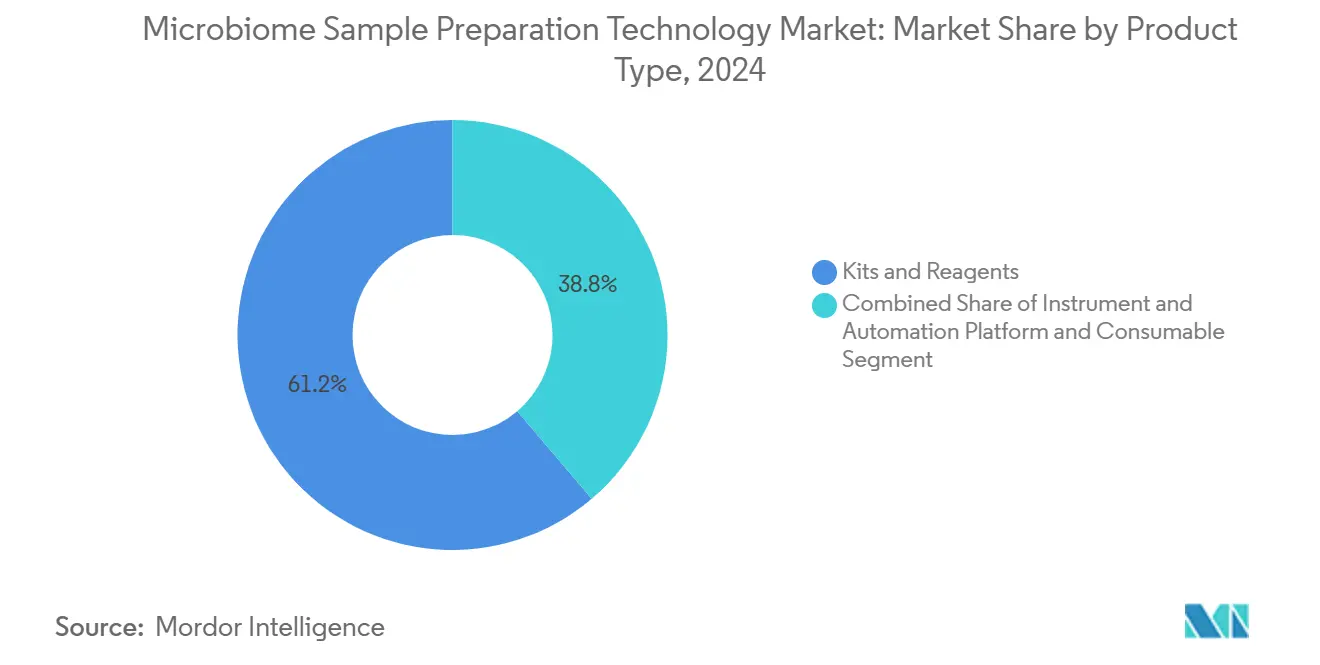
Kits Anchor Revenue as Automation ScalesKits and reagents generated 61.22% of the microbiome sample preparation technology market share in 2024, underscoring their centrality to every extraction workflow. Consumables post predictable repeat orders, so this portion of the microbiome sample preparation technology market size expands in lockstep with rising test volumes. Instruments and automation platforms, although smaller today, are projected to advance at a 17.35% CAGR through 2030 as laboratories trade manual spin columns for robotic lines that process up to 192 samples per run.
Recurring kit demand stabilizes supplier revenues, while closed-cartridge designs elevate switching costs by binding reagents to proprietary hardware. Automation systems are gaining adoption in reference laboratories where daily volumes exceed 300 samples, trimming labor by 70% and reducing plastic waste by 50%. Synergistic bundling of reagents with hardware increases lifetime value per customer and locks in long-term consumables demand.

By Technology/Method:
Magnetic-Bead Dominates, Host-DNA Depletion SurgesMagnetic-bead extraction accounted for 37.46% of the microbiome sample preparation technology market share in 2024, reflecting its compatibility with high-throughput automation and consistent nucleic-acid yields. Host-DNA depletion technologies, although a niche in 2024, are forecast to climb at an 18.82% CAGR to 2030 as clinical labs seek to overcome human-DNA contamination that can exceed 90% of total reads.
Magnetic beads remain the method of choice for 96-well and 384-well formats, supporting both short-read and long-read sequencing platforms. Depletion kits now accompany every low-biomass respiratory or blood specimen, raising microbial read proportions by 10- to 15-fold. Hybrid systems that marry bead-based extraction with methyl-capture depletion are on the roadmap and promise further gains in sensitivity.
By Sample Type:
Stool Leads, Urine Gains GroundStool specimens represented 53.87% of the microbiome sample preparation technology market size in 2024, long favored for their high microbial density and established protocols. Urine samples, however, are expected to advance at an 18.33% CAGR between 2025 and 2030 as non-invasive diagnostics find broader clinical acceptance and home-collection kits improve compliance.
Stool kits remain indispensable for gut-health panels and FMT donor screening, while urine-optimized extraction buffers tackle low-biomass hurdles and salt inhibition. Oral, skin, and vaginal specimens together form a growing secondary market, driven by oral-health, dermatology, and women’s-health applications. Environmental samples continue to expand in agriculture and ecology, requiring more aggressive lysis chemistries.
By Workflow Step:
Extraction Commands Spend, Collection StandardizesNucleic-acid extraction captured 39.58% of the microbiome sample preparation technology market share in 2024, reflecting its status as the most labor-intensive and error-prone stage. Collection and stabilization is projected to grow at 17.44% CAGR through 2030 as ambient-temperature preservatives displace cold-chain logistics and enable remote sampling.
Automated magnetic-rack stations now combine extraction, bead cleanup, and on-deck quantification, cutting hands-on time by 75%. Ambient stabilizers deliver 60-day room-temperature integrity, lowering shipping costs by 30–40% and expanding trial access in rural geographies. Library-prep automation and QC reagents follow extraction in the spend hierarchy but benefit from the same throughput pressures.
By Application:
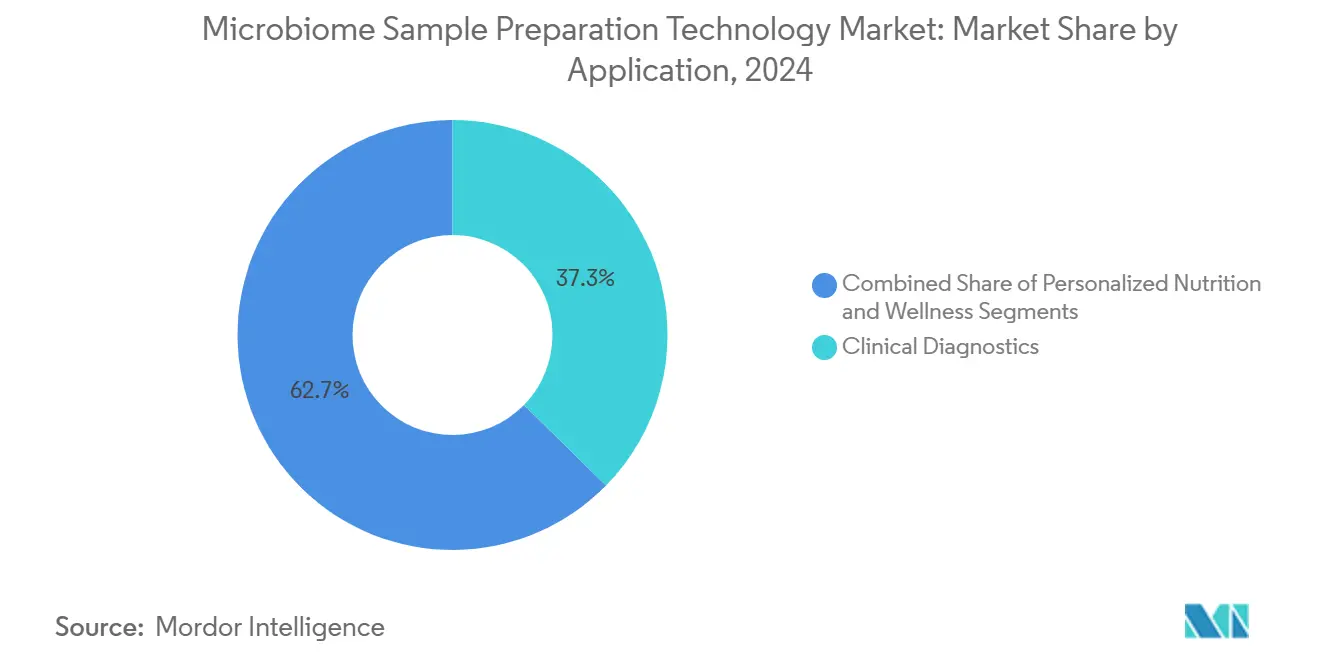
Diagnostics Dominates, Drug Discovery AcceleratesClinical diagnostics accounted for 37.34% of microbiome sample preparation technology market share in 2024, buoyed by hospitals adopting metagenomic panels for pulmonary and bloodstream infections. Drug discovery and development will post an 18.39% CAGR to 2030 as pharmaceutical sponsors funnel capital into live-biotherapeutic pipelines that demand GMP-grade extraction and strain-preservation workflows.
Diagnostics revenue rises with each reimbursement expansion, while drug-discovery demand spikes during preclinical screening and Phase II manufacturing scale-ups. Personalized nutrition, agriculture, and academic research together add diversification and insulate the category from single-sector shocks. Multi-omics initiatives further enlarge sample-prep spend by requiring DNA, RNA, and metabolite preservation in unified protocols.
By End-User:
Pharma Leads, Hospitals Ramp UpPharmaceutical and biotechnology companies held 32.77% of the microbiome sample preparation technology market size in 2024, reflecting heavy investment in therapeutic pipelines. Hospitals and diagnostic laboratories represent the fastest-growing customer group, advancing at a 16.48% CAGR through 2030 as sepsis and respiratory workflows standardize mNGS panels.
Pharma demand centers on GMP compliance and large-batch reproducibility, leading to long-term reagent contracts with bundled validation services. Hospitals emphasize rapid turnaround and cost-per-test economics, driving purchases of mid-throughput extraction robots paired with AI-driven bioinformatics. Academic cores and contract research organizations supply overflow sequencing capacity, while food-and-agriculture labs add incremental volumes tied to soil-health and food-safety mandates.
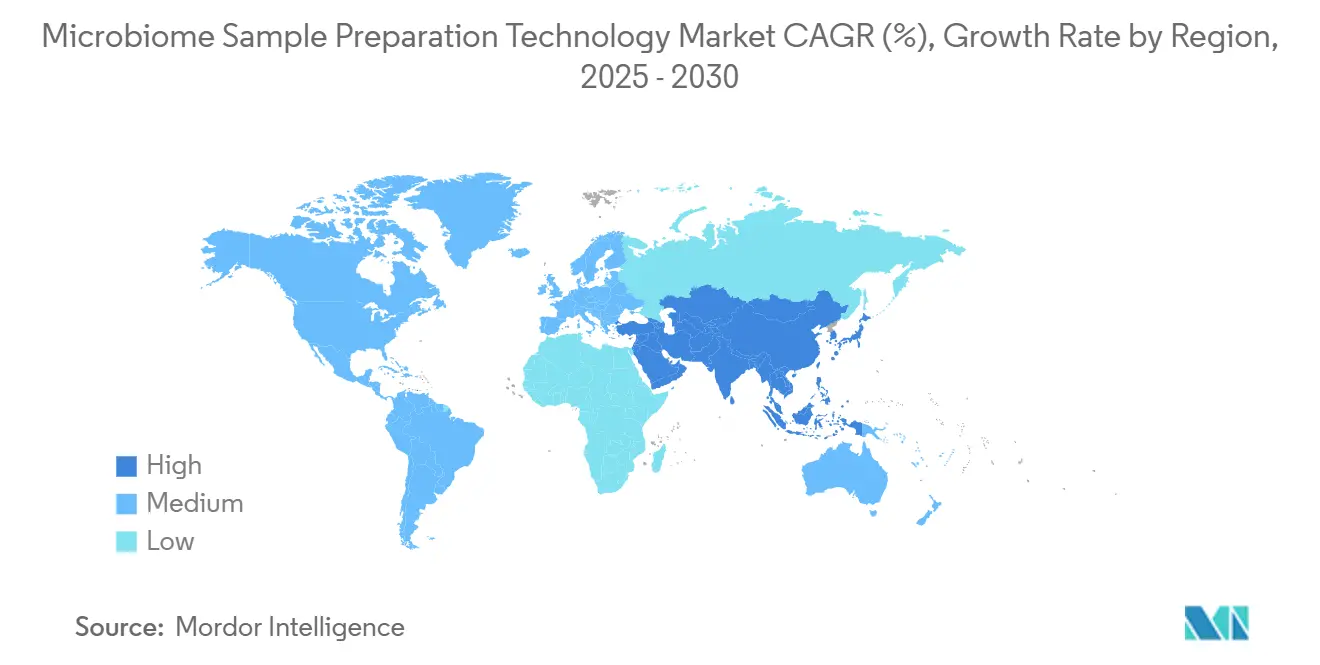
Geography Analysis
North America Microbiome Sample Preparation Technology Market
North America held 34.68% revenue in 2024, anchored by FDA approvals of the first microbiota-based drugs and an expansive clinical-trial ecosystem. The United States alone houses >150 CLIA-certified labs offering mNGS, while BARDA grants and NIH funding bolster translational programs. Canada leverages government grants to scale sequencing hubs, and Mexico positions maquiladora zones for reagent component manufacturing, securing regional supply chains.
APAC Microbiome Sample Preparation Technology Market
Asia-Pacific is the fastest-growing territory at a 16.37% CAGR through 2030. China’s precision-medicine blueprint fuels bulk purchasing of automated workstations, while MGI Tech’s metagenomic package aligns with domestic standards. Japan pairs robotics expertise with pharma alliances to trial live biotherapeutics, and South Korea’s HEM Pharma taps a 95,000-sample gut database for functional foods partnerships. India’s large patient cohorts and cost advantages beckon CROs, while Australia spearheads soil-microbiome R&D for drought resilience.
EMEA and South America Microbiome Sample Preparation Technology Market
Europe preserves second-largest share via harmonized quality frameworks and pharma heavyweights. Germany leads instrument deployment; the U.K. concentrates on bioinformatics startups; France supports public-private consortia trialing vaginal microbiome therapeutics. Middle East & Africa and South America remain early-stage but gain traction as agricultural microbiome adoption widens and infectious-disease burdens find metagenomic solutions, each adding incremental volume to the microbiome sample preparation technology market.
Competitive Landscape
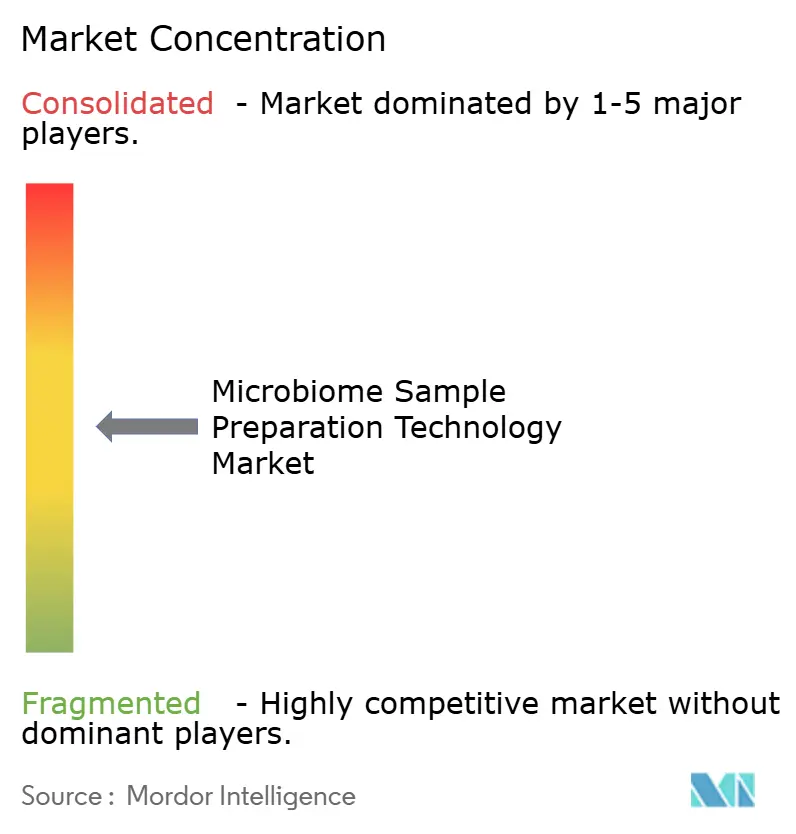
Industry leaders QIAGEN, Thermo Fisher Scientific, and Illumina together account for a significant share of global revenue and focus on turnkey workflows that bundle extraction chemistry, hardware, and informatics. QIAGEN's pipeline of three automation instruments targets entry-level to high-throughput settings, reinforcing reagent loyalty. Thermo Fisher's new mass spectrometers integrate downstream proteomics, positioning the firm to cross-sell multi-omic sample-prep kits. Illumina maintains an advantage in library-prep eco-systems, enabling seamless handoff into its sequencers.
Mid-tier specialists—Atrandi Biosciences, Nimble Science, and Fluxergy—differentiate via niche capabilities such as single-cell isolation or intestinal-capsule sampling. Consolidation highlights include Nestlé Health Science's USD 175 million purchase of VOWST rights and Mapmygenome's acquisition of Microbiome Insights. Patent landscapes show a tilt toward methylation-based depletion and ambient-temperature preservatives, signaling next-wave competition. The microbiome sample preparation technology market rewards integration prowess; thus, alliances between software vendors and hardware OEMs proliferate, bundling AI-driven analytics with automated benches to deliver clinic-ready results within 48 hours.
Microbiome Sample Preparation Technology Industry Leaders
-
Zymo Research
-
Qiagen
-
Thermo Fisher Scientific
-
Illumina
-
Danaher
- *Disclaimer: Major Players sorted in no particular order
Microbiome Sample Preparation Technology Market Companies Covered in this Report
- QIAGEN
- Thermo Fisher Scientific
- Illumina
- Zymo Research
- Danaher
- Agilent Technologies
- Promega
- Revvity
- Roche
- New England Biolabs
- Takara Bio
- MGI Tech
- CleanNA
- DNA Genotek (Orasure)
- Norgen Biotek
- Celemics
- Tecan Group
- Eppendorf
- Hamilton Company
- Opentrons
- Favorgen Biotech
- Macherey-Nagel
- Omega Bio-tek
Recent Industry Developments in Microbiome Sample Preparation Technology Market
- May 2025: Mapmygenome acquired Microbiome Insights, adding 1,000+ global client projects to its microbial-sequencing roster
- April 2025: QIAGEN unveiled the QIAsymphony Connect, QIAsprint, and QIAmini extraction systems scheduled for commercial launch by 2026.
- August 2024: Nestlé Health Science signed a USD 175 million agreement with Seres Therapeutics for global rights to VOWST, the first FDA-approved oral microbiota therapy.
Global Microbiome Sample Preparation Technology Market Report Scope
| Kits & Reagents | DNA Extraction Kits |
| RNA Extraction Kits | |
| Host-DNA Depletion Kits | |
| Library Preparation Kits | |
| Sample Collection & Stabilization Reagents | |
| Instruments & Automation Platforms | Automated Magnetic-Bead Extraction Systems |
| Automated Liquid-Handling Robots | |
| Microfluidic Cartridge-Based Prep Systems | |
| Bead-Beating & Homogenization Instruments | |
| Others | |
| Consumables | Magnetic Beads |
| Spin Columns & Filter Tubes | |
| Deep-Well & Microplates | |
| Others |
| Mechanical & Bead-beating Lysis |
| Enzymatic & Chemical Lysis |
| Magnetic-Bead Nucleic-Acid Extraction |
| Spin-Column & Filter-Based Extraction |
| Host-DNA Depletion Technologies |
| Microfluidic & Cartridge-Based Prep |
| Stool / Fecal |
| Oral / Saliva |
| Skin |
| Vaginal |
| Urine |
| Environmental (Soil & Water) |
| Collection & Stabilization |
| Homogenization & Lysis |
| Nucleic-Acid Extraction & Purification |
| Library Preparation |
| QC & Quantification |
| Automation & Robotics |
| Clinical Diagnostics |
| Drug Discovery & Development |
| Personalized Nutrition & Wellness |
| Agricultural & Environmental Microbiome |
| Academic & Translational Research |
| Pharmaceutical & Biotechnology Companies |
| Academic & Research Institutes |
| Hospitals & Diagnostic Laboratories |
| Contract Research & Sequencing Service Providers |
| Food & Agriculture Testing Labs |
| North America | United States |
| Canada | |
| Mexico | |
| Europe | Germany |
| United Kingdom | |
| France | |
| Italy | |
| Spain | |
| Rest of Europe | |
| Asia-Pacific | China |
| Japan | |
| India | |
| Australia | |
| South Korea | |
| Rest of Asia-Pacific | |
| Middle East and Africa | GCC |
| South Africa | |
| Rest of Middle East and Africa | |
| South America | Brazil |
| Argentina | |
| Rest of South America |
| By Product Type | Kits & Reagents | DNA Extraction Kits |
| RNA Extraction Kits | ||
| Host-DNA Depletion Kits | ||
| Library Preparation Kits | ||
| Sample Collection & Stabilization Reagents | ||
| Instruments & Automation Platforms | Automated Magnetic-Bead Extraction Systems | |
| Automated Liquid-Handling Robots | ||
| Microfluidic Cartridge-Based Prep Systems | ||
| Bead-Beating & Homogenization Instruments | ||
| Others | ||
| Consumables | Magnetic Beads | |
| Spin Columns & Filter Tubes | ||
| Deep-Well & Microplates | ||
| Others | ||
| By Technology / Method | Mechanical & Bead-beating Lysis | |
| Enzymatic & Chemical Lysis | ||
| Magnetic-Bead Nucleic-Acid Extraction | ||
| Spin-Column & Filter-Based Extraction | ||
| Host-DNA Depletion Technologies | ||
| Microfluidic & Cartridge-Based Prep | ||
| By Sample Type | Stool / Fecal | |
| Oral / Saliva | ||
| Skin | ||
| Vaginal | ||
| Urine | ||
| Environmental (Soil & Water) | ||
| By Workflow Step | Collection & Stabilization | |
| Homogenization & Lysis | ||
| Nucleic-Acid Extraction & Purification | ||
| Library Preparation | ||
| QC & Quantification | ||
| Automation & Robotics | ||
| By Application | Clinical Diagnostics | |
| Drug Discovery & Development | ||
| Personalized Nutrition & Wellness | ||
| Agricultural & Environmental Microbiome | ||
| Academic & Translational Research | ||
| By End-User | Pharmaceutical & Biotechnology Companies | |
| Academic & Research Institutes | ||
| Hospitals & Diagnostic Laboratories | ||
| Contract Research & Sequencing Service Providers | ||
| Food & Agriculture Testing Labs | ||
| By Geography | North America | United States |
| Canada | ||
| Mexico | ||
| Europe | Germany | |
| United Kingdom | ||
| France | ||
| Italy | ||
| Spain | ||
| Rest of Europe | ||
| Asia-Pacific | China | |
| Japan | ||
| India | ||
| Australia | ||
| South Korea | ||
| Rest of Asia-Pacific | ||
| Middle East and Africa | GCC | |
| South Africa | ||
| Rest of Middle East and Africa | ||
| South America | Brazil | |
| Argentina | ||
| Rest of South America | ||
Key Questions Answered in the Report
What is the projected revenue for microbiome sample preparation technologies by 2030?
The segment is forecast to reach USD 2.84 billion by 2030, expanding at a 14.26% CAGR.
Which product category generates the most revenue?
Kits and reagents lead at 61.22% of 2024 revenue thanks to their recurring-consumable model.
Why are host-DNA depletion kits gaining traction?
They elevate microbial read percentages in low-biomass clinical samples, improving diagnostic sensitivity and supporting faster therapeutic decisions.
Which region will grow fastest over the next five years?
Asia-Pacific will post a 16.37% CAGR through 2030, propelled by Chinese, Japanese, and Indian investments in precision medicine.
How are room-temperature preservatives impacting logistics?
Ambient-stable chemistries cut cold-chain costs by up to 40% and enable broader geographic sampling, especially in remote settings.
What competitive moves are shaping the landscape?
High-profile deals such as Nestlé’s acquisition of VOWST and Mapmygenome’s purchase of Microbiome Insights demonstrate ongoing consolidation that blends therapeutics pipelines with sample-prep competencies.