
Micro PC and Stick PC Market Size and Share
Market Overview
| Study Period | 2020 - 2031 |
|---|---|
| Market Size (2026) | USD 1.58 Billion |
| Market Size (2031) | USD 2.70 Billion |
| Growth Rate (2026 - 2031) | 11.30 % |
| Fastest Growing Market | Asia Pacific |
| Largest Market | Asia Pacific |
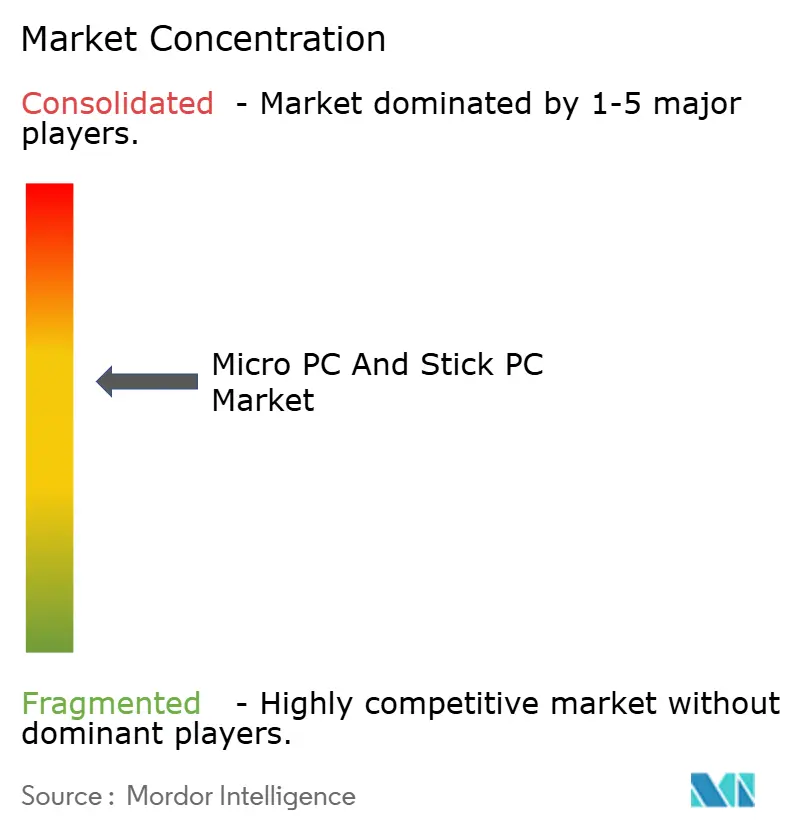
| Market Concentration | Medium |
Major Players *Disclaimer: Major Players sorted in no particular order Image © Mordor Intelligence. Reuse requires attribution under CC BY 4.0. | |
Micro PC and Stick PC Market Analysis by Mordor Intelligence
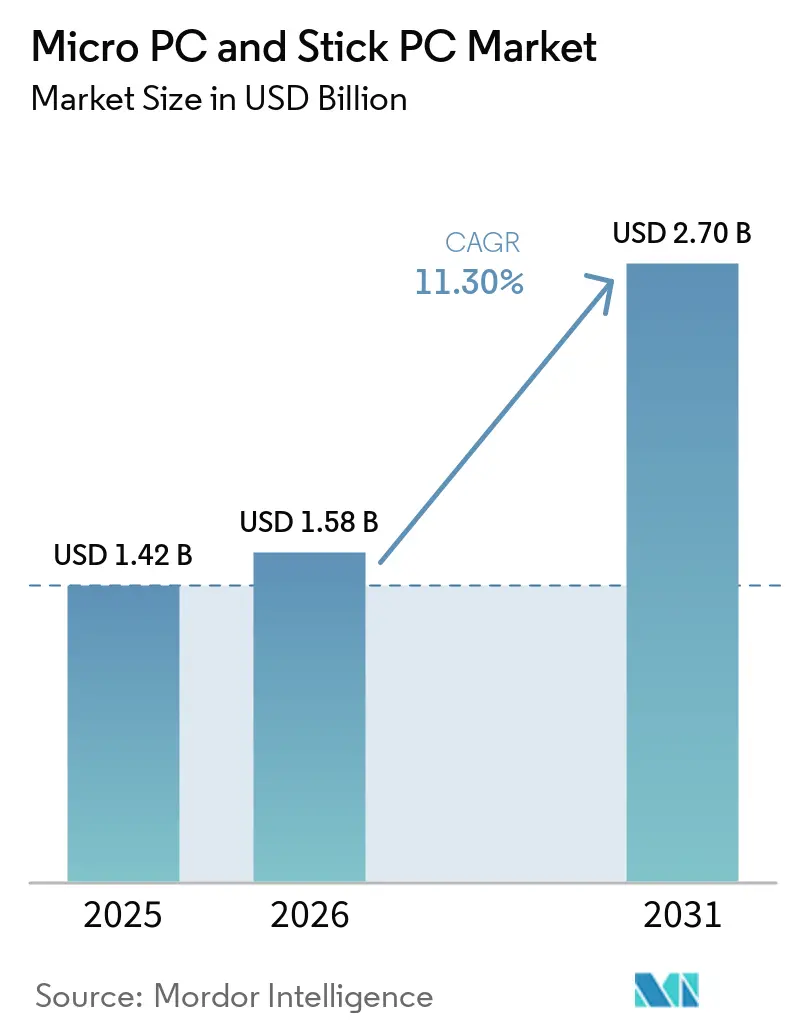
The Micro PC and Stick PC market size is projected to expand from USD 1.42 billion in 2025 and USD 1.58 billion in 2026 to USD 2.70 billion by 2031, registering a CAGR of 11.3% between 2026 to 2031. Demand accelerates as enterprises replace Windows 10 desktops, comply with sovereign-AI rules that favor on-device inference, and roll out factory-floor nodes that fit inside control cabinets. Organizations also prize the form factor’s 15-25 watt power draw, which curbs electricity bills and supports emissions targets, while freeing desk and rack space in high-rent urban offices. Chipmakers have responded by introducing sub-15-watt processors with integrated neural engines that let small boxes run large language models without cloud latency. Competitive intensity is rising because agile Chinese assemblers now deliver parity on performance, thermals, and certifications, forcing global incumbents to differentiate through firmware security, advanced heat spreading, and enterprise service bundles that sustain margins within the Micro PC and Stick PC market.
Key Report Takeaways
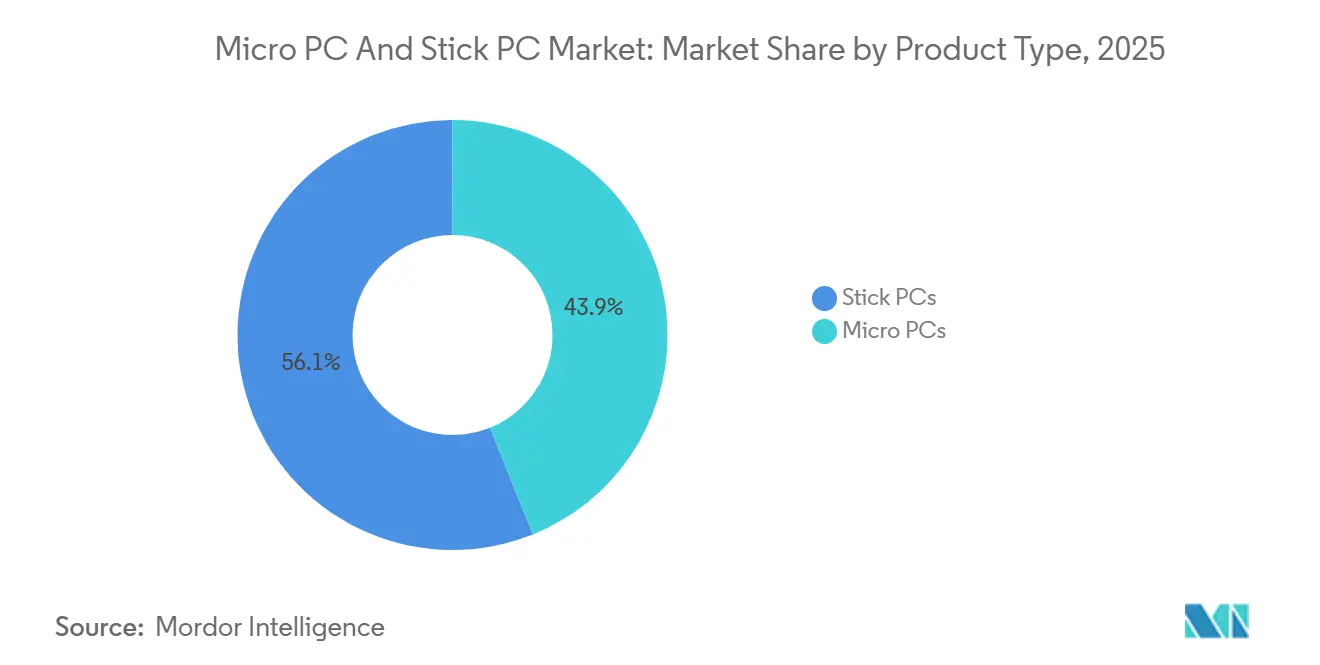
- By product type, stick PCs held 56.10% of the Micro PC and Stick PC market share in 2025, while performance-focused micro PCs are forecast to grow at a 14.60% CAGR through 2031.
- By processor architecture, x86 systems commanded 63.20% of the Micro PC and Stick PC market size in 2025, whereas ARM platforms are projected to expand at a 14.10% CAGR from 2026 to 2031.
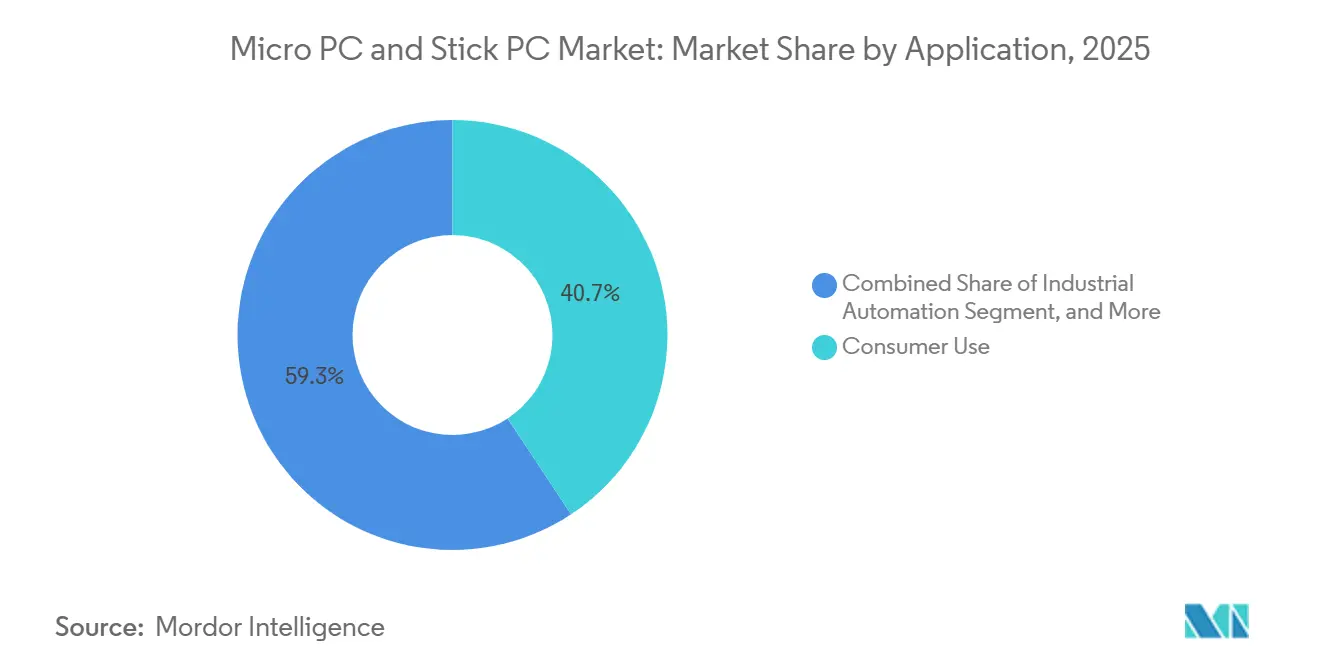
- By application, consumer use accounted for 40.70% of the Micro PC and Stick PC market size in 2025, and industrial automation is advancing at a 14.90% CAGR to 2031.
- By distribution channel, online sales captured 66.90% of the Micro PC and Stick PC market share in 2025 and are forecast to rise at a 12.80% CAGR during 2026-2031.
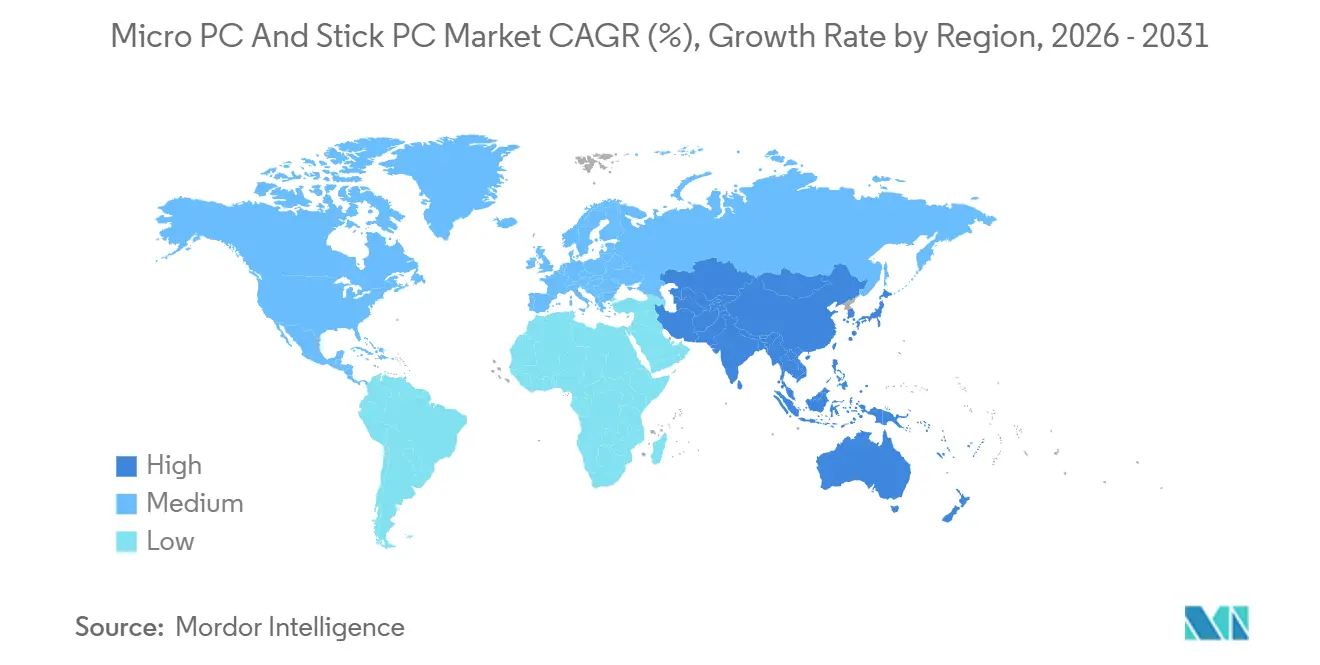
- By geography, Asia-Pacific led with 32.20% of the Micro PC and Stick PC market size in 2025 and is expected to register a 14.50% CAGR through 2031.
Note: Market size and forecast figures in this report are generated using Mordor Intelligence’s proprietary estimation framework, updated with the latest available data and insights as of January 2026.
Market Trends and Insights
Drivers Impact Analysis of Micro PC and Stick PC Market*
| Driver | (~) % Impact on CAGR Forecast | Geographic Relevance | Impact Timeline |
|---|---|---|---|
| Rising Demand for Compact and Portable Computing Solutions Among Remote Workers | 2.80% | Global, concentration in North America and Europe | Medium term (2-4 years) |
| Growth of Digital Signage Deployments in Retail and Hospitality | 2.40% | Asia-Pacific core, spillover to Middle East and Africa | Medium term (2-4 years) |
| Advancements in Low-Power High-Performance Processors Enabling Fanless Designs | 2.10% | Global | Long term (≥ 4 years) |
| Enterprise Shift Toward Space-Saving IT Infrastructure in Smart Offices | 1.90% | North America and Europe, emerging in Asia-Pacific cities | Short term (≤ 2 years) |
| Increasing Adoption of Micro PCs in Industrial Automation and Edge Computing | 1.70% | Asia-Pacific factories, North America and Europe industrial corridors | Long term (≥ 4 years) |
| Emergence of Plug-and-Play Stick PCs for Affordable Smart TV Upgrade in Emerging Markets | 1.30% | South America, Africa, Southeast Asia | Medium term (2-4 years) |
| Source: Mordor Intelligence | |||
Rising Demand For Compact And Portable Computing Solutions Among Remote Workers
Hybrid staff want desktop-class power that migrates easily between home and headquarters. Dell’s Pro 5 Micro nests Panther Lake silicon inside a 0.7-liter box and drives two 4K monitors without a dock.[1] Lenovo’s Yoga Mini i Gen 11 adds a 45-TOPS neural engine so analysts can run local language models without cloud costs.[2] Procurement teams are increasingly standardizing on micro units to reduce service calls, while utility managers report a 20% reduction in endpoint energy consumption after retiring traditional towers. These developments are driving the growth of the Micro PC and Stick PC market, as organizations shift towards workspace layouts centered around lighter, quieter, and more energy-efficient clients. Additionally, the compact size and versatility of micro PCs make them ideal for modern office environments, where space optimization and operational efficiency are key priorities.
Growth Of Digital Signage Deployments In Retail And Hospitality
Quick-service restaurants, malls, and hotels now rely on screens that auto-refresh menus, loyalty prices, and carbon scores, enhancing customer engagement and operational efficiency. Giada’s DN76 and DK310 micro PCs power 24-hour menu boards across Asia-Pacific, ensuring seamless performance and reliability. AOPEN’s bundled solutions streamline kiosk rollouts in clinics, simplifying patient check-in processes while significantly reducing maintenance costs. Additionally, Japanese convenience store chains are deploying thousands of micro PCs to comply with the 2025 energy-label laws, driving regional demand and highlighting the growing adoption of these devices in the Micro PC and Stick PC market. These advancements underscore the increasing reliance on micro PCs across various industries, further solidifying their role in meeting evolving business and regulatory requirements.
Advancements In Low-Power High-Performance Processors Enabling Fanless Designs
Intel’s 18A node brings quad-core chips down to 12-15 watts TDP, enabling noiseless passively cooled enclosures. Qualcomm’s Snapdragon X Elite attains similar benchmarks at 8-10 watts, empowering battery-powered micro PCs for field work.[3] Phoenix Contact’s VL3 UPC 2440 EDGE operates efficiently at an ambient temperature of 60 °C, even in dusty cabinet environments, without experiencing failure. This robust performance highlights the device's reliability and durability, making it suitable for a wide range of industrial and commercial applications. Such advancements not only expand the potential use cases for these devices but also strengthen the growth prospects for the Micro PC and Stick PC market. The ability to function seamlessly in challenging conditions positions these devices as a preferred choice for industries requiring compact and resilient computing solutions.
Enterprise Shift Toward Space-Saving IT Infrastructure In Smart Offices
Real estate costs urge firms to shrink desk footprints. ASUS’s NUC 16 Pro snaps behind monitors, cutting clutter at hot-desking hubs.[4] Shared-workspace providers are increasingly pre-installing micro PCs to optimize rentable desk density. According to HP’s FY 2026 data, 35% of micro PC shipments now feature neural engines integrated into compact cases. This development highlights the growing demand for smart-office solutions, which is emerging as a significant driver for the Micro PC and Stick PC market. The integration of advanced technologies like neural engines further positions these devices as essential components in modern office environments, catering to the evolving needs of businesses and shared workspaces.
Restraints Impact Analysis of Micro PC and Stick PC Market*
| Restraint | (~) % Impact on CAGR Forecast | Geographic Relevance | Impact Timeline |
|---|---|---|---|
| Thermal Management Challenges Limiting Sustained Performance | -1.60% | Global | Short term (≤ 2 years) |
| Competition from Smartphones and Tablets for Casual Computing Use | -1.30% | Global, stronger in emerging markets | Medium term (2-4 years) |
| Limited Upgradability and Customization Hindering Enterprise Adoption | -0.90% | North America and Europe | Long term (≥ 4 years) |
| Security Vulnerabilities Due to Limited Hardware TPM in Ultra-Small Form Factors | -0.70% | Global, high in regulated industries | Short term (≤ 2 years) |
| Source: Mordor Intelligence | |||
Thermal Management Challenges Limiting Sustained Performance
Passive boxes can freely dissipate only 10-15 watts; workloads above that force frequency throttling that halves throughput. Emerson’s PACSystems IPC adds heat pipes that vent energy to an external fin stack, yet this increases the bill of materials by double-digit percentages. Reliability data show every extra 10 °C slashes capacitor life by nearly 20%. Vendors now split catalogs into silent 15-watt units and fan-assisted 35-watt models, a necessary compromise that slows the Micro PC and Stick PC market in high-compute niches.
Competition From Smartphones And Tablets For Casual Computing Use
In 2025, tablets shipped 162 million units, offering features such as touch displays, batteries, and 5G radios at prices comparable to entry-level stick PCs. These advancements have positioned tablets as a competitive alternative in the market. Leading manufacturers like Apple and Samsung have further enhanced their devices by introducing desk modes that seamlessly integrate with external monitors. This innovation has significantly reduced the advantages that stick PCs once held for activities like browsing and streaming. In regions such as Africa and South America, consumer preferences are shifting toward all-in-one tablets, which eliminate the need for additional components like separate screens required by compute sticks. This preference highlights the convenience and cost-effectiveness of tablets in these markets.
*Our forecasts treat driver/restraint impacts as directional, not additive. The impact forecasts reflect baseline growth, mix effects, and variable interactions.
Micro PC and Stick PC Market Segment Analysis
By Product Type:
Performance Needs Drive Micro PC MomentumStick PCs controlled 56.10% of 2025 volume, buoyed by USD 200 price tags and plug-and-play HDMI insertion. Yet thermal ceilings of 6-10 watts curb AI inference and multi-display output, motivating enterprises to pivot. Micro PCs, forecast to grow at 14.60% CAGR, integrate dual-channel DDR5, NVMe slots, and 2.5-GbE networking, enabling edge analytics at shop-floor speeds. Winmate’s IRDRW500 delivers IP65 ingress protection and MIL-STD-810H shock resistance, proving rugged micro enclosures can thrive in bus depots and outdoor kiosks. Second-generation stick designs add vapor chambers, but engineering labs still reserve complex workloads for micro chassis, cementing a long-run share shift inside the Micro PC and Stick PC market.
In the consumer realm, Lenovo’s sub-USD 250 Chromebox Micro streams 4K content for living rooms, offering an affordable yet high-performance solution for home entertainment. Similarly, Dell’s VESA-mounted micro PCs provide efficient computing by running Windows 365 thin clients, which offload heavy rendering tasks to Azure, ensuring seamless performance for users. In the education sector, ministries in countries like Brazil and India initially deploy stick PCs in first-wave labs due to their cost-effectiveness and compact design. As budgets increase and software requirements become more complex, these institutions transition to micro units, which offer enhanced capabilities and scalability. This progression strengthens both segments of the Micro PC and Stick PC market, although the trend increasingly favors higher-margin micro boxes, which are better suited for advanced applications and long-term use cases.
By Processor Architecture:
ARM Efficiency Advances Edge Adoptionx86 devices held 63.20% share in 2025, fueled by entrenched Windows compatibility and Intel vPro manageability. Nonetheless, ARM shipments are set to climb 14.10% annually as power-sipping silicon undercuts cooling costs. Qualcomm’s 8-10 watt Snapdragon X Elite matches 28-watt x86 scores, letting railway operators install fanless micro PCs in driver cabs without risking dust ingress QUALCOMM.COM. Raspberry Pi CM5 modules anchor USD 150 edge nodes used in Chinese textile plants, demonstrating low-license ARM cores fit ultra-budget niches RASPBERRYPI.COM.
RISC-V variants appeal to government programs seeking royalty-free chips, though limited toolchains slow uptake. Intel’s 18A and AMD’s Zen 5 slim the efficiency divide yet still trail ARM in watt-per-performance, meaning ARM will keep absorbing sensor gateway and signage endpoints within the Micro PC and Stick PC market. The Micro PC and Stick PC industry sees software stacks grow more multi-architecture each quarter, ensuring healthy coexistence rather than outright displacement.
By Application:
Industrial Automation Generates The Fastest UpsideConsumer use represented 40.70% in 2025 but now grows below the headline pace as tablets and streaming sticks cover casual tasks. Factory automation logs a 14.90% CAGR, replacing proprietary PLCs with IEC 62443-4-1 certified micro PCs that run open SCADA suites. Robustel’s EG5120 provides DIN-rail mounting, dual Ethernet, and RS-485 to speak Modbus lineside, cutting retrofit costs. Digital signage retains momentum, installing three-screen menu boards managed by edge analytics that tune promotions by foot-traffic heat maps.
Healthcare follows, thanks to antimicrobial, fanless micro PCs that comply with IEC 60601-1 for patient-room safety. HIMSS 2026 showcased models that log audit trails for medical device recordkeeping. Education programs use stick PCs for basic labs, then graduate to micro PCs with bigger SSDs for coding curricula. Transportation, building automation, and point-of-sale round out demand, collectively diversifying revenue streams across the Micro PC and Stick PC market.

By Distribution Channel:
Online Direct Sales Capture MarginOnline portals controlled 66.90% of the 2025 value and will expand 12.80% annually as Dell, HP, and Lenovo offer web configurators that ship factory-image devices within days. Chinese newcomers leverage Alibaba storefronts to reach global hobbyists with overclockable micro boards, broadening exposure without retail rent. Refurbishment brokers collect off-lease devices, cleanse drives, and resell to schools, adding a fast-growing secondary loop to the Micro PC and Stick PC market.
Offline retail, still 33.10%, survives on impulse purchases of HDMI stick PCs stocked near streaming boxes. Electronics chains showcase micro PCs alongside gaming monitors, but low unit margins make big-box buyers cautious. System integrators serving small businesses continue to source through distribution, bundling install labor and warranty handling. Yet as firmware provisioning, BIOS updates, and compliance reporting move into cloud dashboards, enterprises increasingly prefer direct relationships, cementing the long-term channel tilt found in the Micro PC and Stick PC market.
Geography Analysis
APAC Micro PC and Stick PC Market
Asia-Pacific captured 32.20% of the 2025 value and should grow 14.50% annually on factory automation grants in China, signage mandates in Japan, and Digital India classroom rollouts. Regional OEMs pair ARM gateways with 4G modems so rural plants bypass fiber, raising volumes. Singapore’s green-building code rates micro PCs as low-energy edge controllers, further widening adoption. The Micro PC and Stick PC market thereby leans heavily on Asian manufacturing and policy.
North America Micro PC and Stick PC Market
North America builds premium demand around AI-ready corporate desktops as firms rush Windows 10 replacements before the 2025 end-of-life (EOL). The transition is driven by the need for enhanced security, improved performance, and compatibility with modern applications. Micro PCs mounted behind monitors help landlords downsize server closets, reducing HVAC loads and operational costs. These compact devices also support energy efficiency goals, aligning with sustainability initiatives. Municipalities deploy fanless units for traffic-signal analytics, enabling real-time data processing and improved traffic management. This deployment anchors a civic vertical that insulates the Micro PC and Stick PC market from consumer volatility, ensuring steady demand.
EMEA and LATAM Micro PC and Stick PC Market
Europe mirrors this but layers strict energy directives and GDPR security audits that require discrete TPM sockets, an upgrade that favors mid-tier micro PCs with hardware attestation. Latin America’s school grants and Africa’s community hubs buy entry sticks first, then step up to micro formats as curriculums add coding and AI lessons. Middle East smart-city blueprints specify micro PCs for room automation in new hotels, lifting per-room device counts. Collectively, these localized vectors reinforce global equilibrium across the Micro PC and Stick PC market.
Competitive Landscape
The Micro PC and Stick PC market is moderately concentrated, with the top five vendors holding slightly over 60% of the market share. This concentration provides opportunities for emerging players to scale and capture market share. Intel, which previously dominated the Next-Unit-of-Compute (NUC) segment, now faces competition from Minisforum’s AI X1 Pro-470, which integrates Ryzen AI silicon at a 20% lower price point. Established players like Lenovo, Dell, and HP leverage their global logistics networks, BIOS manageability features, and extensive warranty services to maintain their market positions. Meanwhile, ASUS has adopted a strategy of bundling Windows 365 credentials to attract hybrid-cloud buyers, further intensifying competition in the market.
Niche players have carved out specific segments where certifications and specialized requirements deter larger vendors. For instance, Cybernet and Advantech dominate the medical cart segment by offering products with antimicrobial plastics, catering to healthcare environments. Similarly, ASRock Industrial has recently achieved IEC 62443-4-1 firmware certification, positioning itself to meet stringent factory safety audit requirements. Canonical’s certified Ubuntu operating system has also reduced software compatibility barriers for OEMs, thereby expanding the supplier base. Key technological advancements, such as chiplet packaging for improved heat dispersion, 40-TOPS neural engines for AI workloads, and discrete TPM bays to address 2026 firmware vulnerabilities, are becoming critical differentiators in the market.
While aggressive pricing strategies remain prevalent in the entry-level stick PC segment, premium market success is increasingly determined by advanced thermal management solutions and compliance capabilities. Vendors are focusing on integrating sophisticated features to meet the demands of enterprise and industrial applications. For example, advancements in thermal design ensure reliable performance in compact form factors, while compliance with industry standards enhances product appeal in regulated sectors. As a result, the Micro PC and Stick PC market is evolving, with a clear emphasis on innovation and specialization to address diverse customer needs and maintain competitive advantage.
Micro PC and Stick PC Industry Leaders
-
Intel Corporation
-
Lenovo Group Limited
-
Dell Technologies Inc.
-
HP Inc.
-
ASUSTeK Computer Inc.
- *Disclaimer: Major Players sorted in no particular order
Micro PC and Stick PC Market Companies Covered in this Report
- Intel Corporation
- Lenovo Group Limited
- Dell Technologies Inc.
- HP Inc.
- ASUSTeK Computer Inc.
- Acer Inc.
- ASRock Incorporation
- Zotac Technology Limited
- GIGABYTE Technology Co., Ltd.
- MinisForum Technology Co., Ltd.
- Shenzhen AZW Technology Co., Ltd.
- Shenzhen Chuwi Innovation Technology Co., Ltd.
- Raspberry Pi Trading Ltd.
- ECS Elitegroup Computer Systems Co., Ltd.
- Micro-Star International Co., Ltd.
- InFocus Corporation
- ACEPC Shenzhen Planson Electronic Co., Ltd.
- Huawei Technologies Co., Ltd.
- Apple Inc.
- Foxconn Technology Group
Recent Industry Developments in Micro PC and Stick PC Market
- April 2026: Intel Corporation began volume shipments of Core Ultra Series 3 processors on its 18A node, enabling sub-15 watt fanless micro PC designs with embedded 40-TOPS neural engines.
- March 2026: Lenovo Group Limited introduced the Yoga Mini i Gen 11, a 0.8-liter micro PC that drives dual 4K displays for remote professionals.
- February 2026: Dell Technologies Inc. launched the Pro 5 Micro, a 0.7-liter desktop replacement with integrated VESA mount targeting space-constrained urban offices.
- January 2026: ASUSTeK Computer Inc. released the NUC 16 Pro, certified for Windows 365 Cloud PC and field-upgradable to 64 GB DDR5.
Global Micro PC and Stick PC Market Report Scope
The Micro PC and Stick PC Market encompasses ultra-compact computing devices designed for space-constrained environments and portable applications. Micro PCs are small form factor desktop computers (typically 1-2 liters volume) featuring full desktop processors, upgradeable RAM/storage, and multiple ports for productivity, digital signage, and edge computing. Stick PCs are dongle-sized computers (HDMI stick form factor) that plug directly into monitors/TVs, delivering basic computing via integrated SoC processors, Wi-Fi/Bluetooth connectivity, and flash storage for media streaming, education, and lightweight business use.
The Micro PC and Stick PC Market Report is Segmented by Product Type (Stick PCs, Micro PCs), Processor Architecture (x86-Based, ARM-Based, Other Processor Architecture), Application (Consumer Use, Digital Signage, Industrial Automation, Education, Healthcare, Other Applications), Distribution Channel (Online, Offline), and Geography (North America, South America, Europe, Asia-Pacific, Middle East, Africa). The Market Forecasts are Provided in Terms of Value (USD).
Segmentation Overview
| Stick PCs |
| Micro PCs |
| x86-Based |
| ARM-Based |
| Other Processor Architecture |
| Consumer Use |
| Digital Signage |
| Industrial Automation |
| Education |
| Healthcare |
| Other Applications |
| Online |
| Offline (Retail) |
| North America | United States |
| Canada | |
| Mexico | |
| Rest of North America | |
| South America | Brazil |
| Argentina | |
| Rest of South America | |
| Europe | Germany |
| United Kingdom | |
| France | |
| Italy | |
| Spain | |
| Russia | |
| Rest of Europe | |
| Asia-Pacific | China |
| Japan | |
| India | |
| South Korea | |
| Australia | |
| Rest of Asia-Pacific | |
| Middle East | Saudi Arabia |
| United Arab Emirates | |
| Turkey | |
| Rest of Middle East | |
| Africa | South Africa |
| Nigeria | |
| Kenya | |
| Rest of Africa |
| By Product Type | Stick PCs | |
| Micro PCs | ||
| By Processor Architecture | x86-Based | |
| ARM-Based | ||
| Other Processor Architecture | ||
| By Application | Consumer Use | |
| Digital Signage | ||
| Industrial Automation | ||
| Education | ||
| Healthcare | ||
| Other Applications | ||
| By Distribution Channel | Online | |
| Offline (Retail) | ||
| By Geography | North America | United States |
| Canada | ||
| Mexico | ||
| Rest of North America | ||
| South America | Brazil | |
| Argentina | ||
| Rest of South America | ||
| Europe | Germany | |
| United Kingdom | ||
| France | ||
| Italy | ||
| Spain | ||
| Russia | ||
| Rest of Europe | ||
| Asia-Pacific | China | |
| Japan | ||
| India | ||
| South Korea | ||
| Australia | ||
| Rest of Asia-Pacific | ||
| Middle East | Saudi Arabia | |
| United Arab Emirates | ||
| Turkey | ||
| Rest of Middle East | ||
| Africa | South Africa | |
| Nigeria | ||
| Kenya | ||
| Rest of Africa | ||
Key Questions Answered in the Report
What value will the Micro PC and Stick PC market reach by 2031?
Forecasts place the market at USD 2.70 billion in 2031 on an 11.3% CAGR drive.
Which product format is expanding fastest?
Micro PCs are projected to grow at 14.60% CAGR, overtaking stick PCs for performance-intensive uses.
Why are ARM chips gaining share in this market?
ARM silicon delivers desktop-level performance at roughly 10 watts, enabling silent, fanless micro PCs for edge and mobile deployments.
What limits performance in ultra-small fanless designs?
Passive enclosures can dissipate only 10-15 watts before throttling, so vendors add heat pipes, vapor chambers, or external fin blocks to extend compute headroom.
How does Asia-Pacific influence market growth?
Factory automation mandates in China, signage requirements in Japan, and bulk education tenders in India combine to make Asia-Pacific the fastest-growing region.
Which security upgrade has become pivotal after 2026 exploits?
Enterprises now insist on discrete TPM modules in micro and stick PCs to counter firmware attacks and meet regulatory audits.