
Panel PC Market Size and Share
Market Overview
| Study Period | 2020 - 2031 |
|---|---|
| Market Size (2026) | USD 1.77 Billion |
| Market Size (2031) | USD 2.88 Billion |
| Growth Rate (2026 - 2031) | 10.23 % |
| Fastest Growing Market | Asia Pacific |
| Largest Market | North America |
| Market Concentration | Medium |
Major Players *Disclaimer: Major Players sorted in no particular order Image © Mordor Intelligence. Reuse requires attribution under CC BY 4.0. | |
Panel PC Market Analysis by Mordor Intelligence
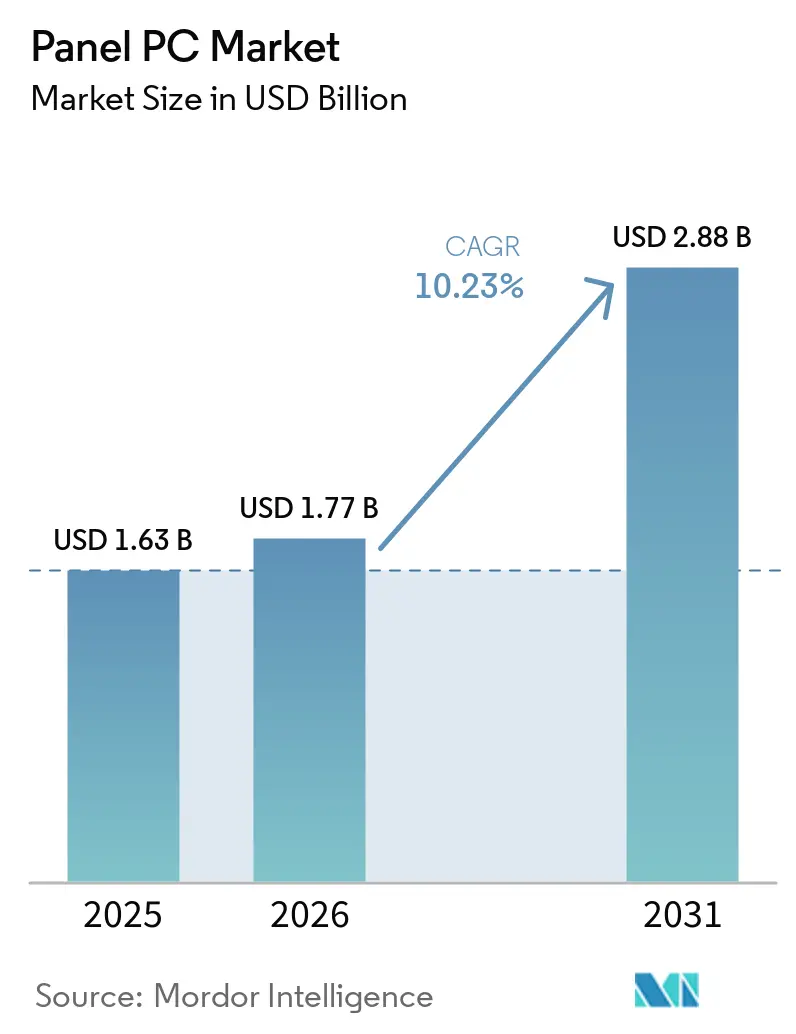
The panel pc market size is projected to expand from USD 1.63 billion in 2025 and USD 1.77 billion in 2026 to USD 2.88 billion by 2031, registering a CAGR of 10.23% between 2026 and 2031. Demand is rising as factories modernize human-machine interfaces, bring edge analytics closer to production lines, and upgrade to fanless, cybersecure terminals that run artificial intelligence workloads at the point of operation. Larger screens that simplify supervisory dashboards, long-lifecycle processors that survive harsh plant environments, and government incentives for localized semiconductor supply are reinforcing shipment momentum. Competitive intensity is rising as Taiwanese platform specialists are cutting prices and accelerating design cycles, while European and North American automation incumbents defend their installed bases with vertically integrated stacks. Simultaneously, end users now treat IEC 62443 security compliance as a purchase prerequisite, pushing vendors to embed secure boot, signed updates, and tamper-proof audit logs as standard features rather than premium options.
Key Report Takeaways
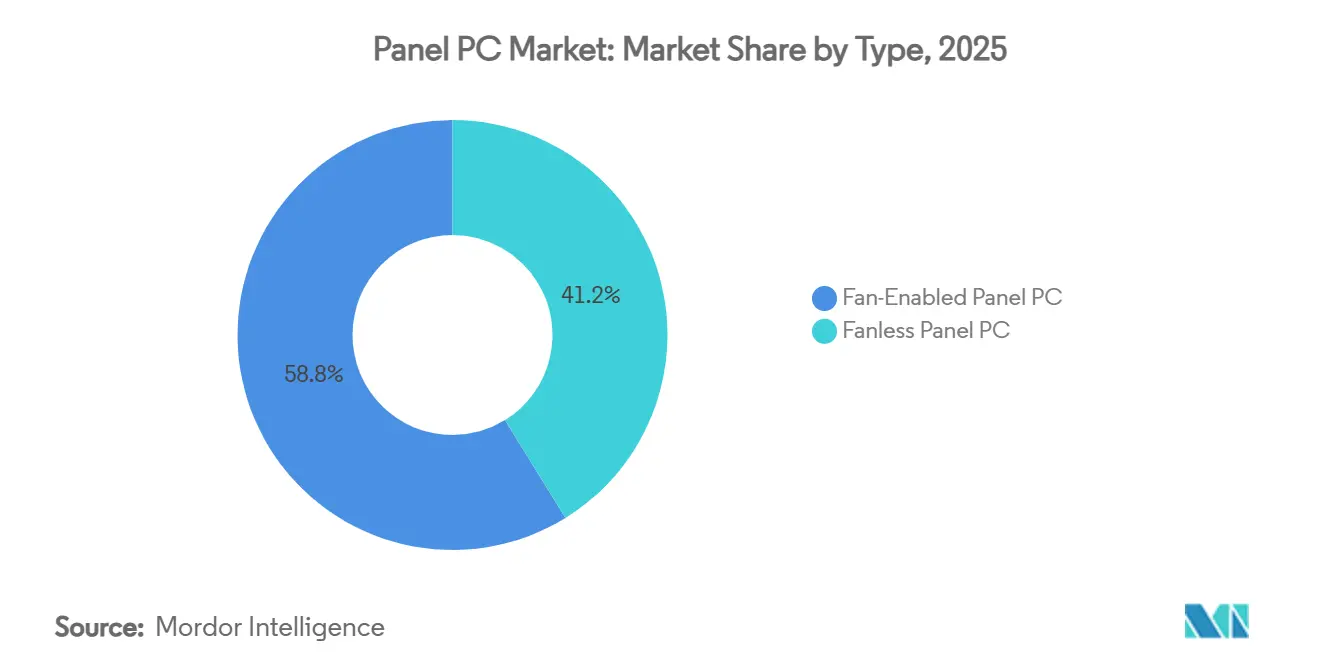
- By type, fan-enabled units led with 58.81% panel pc market share in 2025, while fanless variants are advancing at a 10.63% CAGR through 2031.
- By screen size, the 12-15 inch category accounted for 71.21% of shipments in 2025; displays above 15 inches are expanding at a 10.83% CAGR.
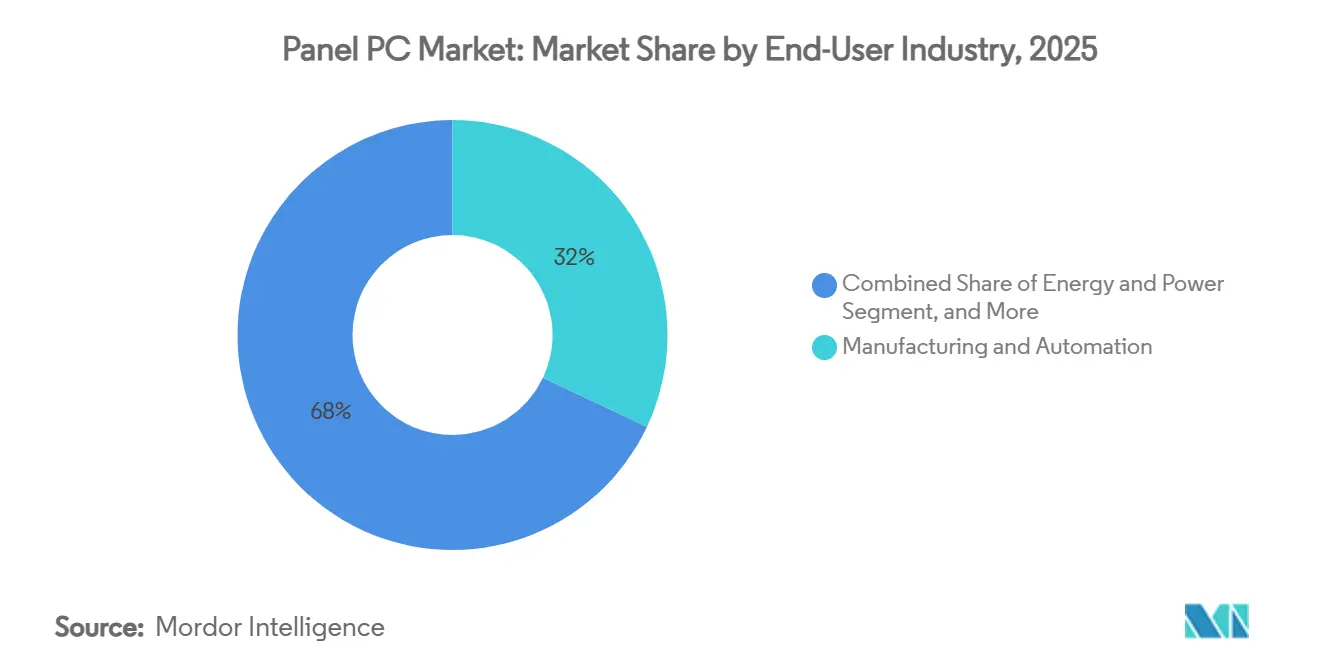
- By end-user, manufacturing and automation held 32.02% revenue in 2025, yet healthcare is forecast to grow at an 11.63% CAGR to 2031.
- By touchscreen technology, capacitive dominated with a 71.98% share in 2025, whereas infrared solutions are growing at a 11.23% CAGR.
- By geography, Asia-Pacific accounted for 46.32% of revenue in 2025, and the Middle East is projected to post an 11.39% CAGR through 2031.
Note: Market size and forecast figures in this report are generated using Mordor Intelligence’s proprietary estimation framework, updated with the latest available data and insights as of January 2026.
Global Panel PC Market Trends and Insights
Drivers Impact Analysis*
| Driver | (~) % Impact on CAGR Forecast | Geographic Relevance | Impact Timeline |
|---|---|---|---|
| Industrial Automation and Industry 4.0 Acceleration | +2.8% | Global, with concentration in Asia-Pacific manufacturing hubs (China, Japan, South Korea) and European automotive corridors (Germany, Italy) | Medium term (2-4 years) |
| Rapid Edge Computing Adoption in Smart Manufacturing | +2.3% | Global, led by North America and Europe for predictive maintenance; Asia-Pacific for machine vision and quality inspection | Medium term (2-4 years) |
| Adoption of Fanless High-Reliability Designs in Harsh Environments | +1.6% | Global, with emphasis on Middle East oil and gas, Asia-Pacific chemicals and mining, North America food processing | Long term (≥ 4 years) |
| Integration of AI and ML for On-Device Quality Inspection | +1.4% | Asia-Pacific core (electronics assembly, automotive), spillover to North America aerospace and Europe pharmaceuticals | Short term (≤ 2 years) |
| National Incentives for Semiconductor and Electronics Localization | +1.2% | United States (CHIPS Act), European Union (Chips Act), China (Made in China 2025), India (PLI scheme) | Long term (≥ 4 years) |
| Shift Toward Cybersecure Rugged HMIs for Critical Infrastructure | +1.0% | North America and Europe (energy, water, transport), Middle East (oil and gas), Asia-Pacific (smart cities) | Medium term (2-4 years) |
| Source: Mordor Intelligence | |||
Industrial Automation and Industry 4.0 Acceleration
Manufacturing execution systems are migrating from central control rooms to distributed edge nodes, prompting factories to install panel PCs that bundle visualization, real-time communication, and embedded analytics on a single device.[1]Beckhoff Automation GmbH and Co. KG, “An advanced, cost-optimized multi-touch series for efficient operating concepts,” Beckhoff.com Beckhoff’s Next multi-touch family embeds EtherCAT, allowing safety buttons to be configured directly from the HMI and shrinking cabinet footprints by 40%. Automotive final-assembly lines now reconfigure torque parameters in real time, while semiconductor fabs shift recipe management to per-wafer adaptive control. Vendors that integrate deterministic operating systems and sub-millisecond latencies are displacing legacy Windows terminals, especially in pharmaceutical plants that require validated, fail-safe configurations.
Rapid Edge Computing Adoption in Smart Manufacturing
On-device inference is redefining the panel pc market as terminals evolve from passive screens into autonomous decision nodes. Advantech’s Arm-based TPC-100W series features SystemReady IR certification, secure boot, and 30% lower power draw than comparable x86 units, helping meet uptime targets in battery-backed machinery. Winmate’s Alder Lake platforms pair high-frequency performance cores for camera analytics with efficiency cores for background services, cutting frame latency 25% in automated optical inspection. Software optimization now dictates success because single-threaded vision libraries under-utilize heterogeneous architectures until integrators recompile code for multithread execution.
Adoption of Fanless High-Reliability Designs in Harsh Environments
Passive cooling removes mechanical failure points and nearly triples mean time between failures, an advantage on offshore rigs that can only be serviced by helicopter. Moxa and Winmate ship ATEX-approved fanless models that withstand explosive atmospheres, while Litemax offers transflective 1,000-nit screens that remain readable in direct sunlight without increasing heat output. Wide-bandgap gallium nitride power converters further lower thermal loads, enabling faster processors inside sealed chassis, although component prices remain 50% higher than silicon equivalents.
Integration of AI and ML for On-Device Quality Inspection
Machine-vision workloads are migrating from rack PCs to panel PCs equipped with neural processing units. AAEON’s Intelli TWL01 Edge drive supports dual 4K displays and fits in a 39-millimeter fanless enclosure, enabling brownfield HMI upgrades without enlarging cabinets. Axiomtek’s alliance with MICROIP showcases a heterogeneous roadmap in which panel PCs orchestrate field-programmable gate arrays and vision accelerators for zero-defect inspection.[2]Axiomtek, “Axiomtek and MICROIP Sign MOU to Advance Edge AI Collaboration,” Axiomtek.com Data labeling still consumes 60% of deployment effort, restricting artificial-intelligence adoption to high-volume runs with stable part geometries.
Restraints Impact Analysis*
| Restraint | (~) Impact on CAGR Forecast | Geographic Relevance | Impact Timeline |
|---|---|---|---|
| High Initial Capital Expenditure and Total Cost of Ownership | -1.8% | Global, with acute impact in cost-sensitive markets (India, Southeast Asia, South America) and small-to-medium enterprises | Medium term (2-4 years) |
| Rapid Technology Obsolescence Outpacing Industrial Refresh Cycles | -1.5% | Global, particularly affecting long-lifecycle industries (oil and gas, utilities, rail transport) | Long term (≥ 4 years) |
| Scarcity of Industrial-Grade Semiconductor Components During Supply-Chain Disruptions | -1.2% | Global, with elevated risk in regions dependent on single-source Asian foundries (North America, Europe) | Short term (≤ 2 years) |
| Rising Cybersecurity Compliance Costs for OT Devices | -0.9% | North America and Europe (regulatory enforcement), Middle East (critical infrastructure), Asia-Pacific (export markets) | Medium term (2-4 years) |
| Source: Mordor Intelligence | |||
High Initial Capital Expenditure and Total Cost of Ownership
Industrial-grade units cost 150%-300% more than consumer all-in-ones, deterring small enterprises in textiles and food processing. Although fanless models remove ongoing fan-replacement labor, their higher upfront price forces trade-offs between capital outlay and lifetime maintenance. Advantech’s modular TPC-B architecture reduces replacement costs by enabling USD 300 processor swaps rather than USD 1,500 full-unit changes. Proprietary interfaces, however, lock buyers into single suppliers and erode the forecast savings if a vendor discontinues modules.
Rapid Technology Obsolescence Outpacing Industrial Refresh Cycles
Processor updates every 18-24 months clash with 10-15 year plant lifecycles, leaving operators to run unsupported software or budget for mid-life hardware upgrades. AAEON’s OMNI-ADN line, based on Intel N-series chips, offers energy efficiency, yet cannot meet machine-vision compute needs that yesterday’s Core-based OMNI-ADP handled. Pharmaceutical plants face a 6-month revalidation when hardware changes, inflating upgrade budgets by as much as USD 200,000 and delaying artificial intelligence adoption.
*Our forecasts treat driver/restraint impacts as directional, not additive. The impact forecasts reflect baseline growth, mix effects, and variable interactions.
Segment Analysis
By Type: Fanless Variants Gain Traction in Continuous Operations
Fanless units are expanding at a 10.63% CAGR, consistently outpacing overall panel PC market growth as pharmaceutical, food, and chemical processors increasingly prioritize maintenance-free uptime. These systems eliminate the need for moving parts, reducing the risk of mechanical failure and ensuring reliable operation in environments where contamination or dust could compromise performance. The fan-enabled class, however, still dominates legacy installations, with a 58.81% share in 2025, as it remains a cost-effective solution for less demanding applications. Despite this, its appeal continues to narrow as operators quantify the downtime and maintenance costs associated with fan failures. Beckhoff’s forthcoming CP57xx-0040 exemplifies the shift toward fanless designs, utilizing aluminum heat sinks to efficiently dissipate heat while hosting mid-range artificial intelligence tasks within a robust IP65-rated enclosure, making it suitable for harsh industrial environments.
Active-cooling designs remain indispensable for high-performance systems that require 150 watts to drive discrete graphics or support large 43-inch monitors. These systems are critical for applications such as supervisory dashboards or high-resolution displays in smart-factory walls, where performance cannot be compromised. For instance, Winmate’s W27IAD7T-GPA1 integrates an Intel Core i7-12700TE processor within a fan-assisted enclosure, ensuring optimal thermal management for demanding workloads. Hybrid heat-pipe solutions are also gaining traction, combining passive and active cooling by transferring heat to external fins. However, these solutions come with trade-offs, such as larger footprints, which complicate panel mounting in confined cabinet spaces, limiting their adoption in compact industrial setups.


By Screen Size: Larger Displays Capture Complex Visualization Demand
Panels above 15 inches are advancing at a 10.83% CAGR as operators increasingly consolidate multi-zone process views onto a single screen to enhance operational efficiency and reduce the need for multiple displays. For instance, Kontron’s 21.5-inch KPanel S introduces advanced features such as 10-finger projected capacitive touch and dual DisplayPort outputs, which enable extended layouts, particularly beneficial in pharmaceutical production lines where precision and clarity are critical. The 12-15-inch bracket continues to dominate the market, retaining 71.21% of shipments in 2025. This size range strikes a balance between providing adequate readability and accommodating space constraints, especially in discrete machines where cabinet-door dimensions limit larger panel installations.
Sub-12-inch models, on the other hand, are becoming increasingly commoditized as smartphone display supply chains drive down prices. This trend has compelled manufacturers to focus on differentiation through rugged certifications, such as IP ratings and durability standards, rather than relying solely on advancements in screen technology. Additionally, the widespread retention of 4:3 XGA resolutions ensures backward compatibility with legacy SCADA software, which remains a priority for many industries. However, this resolution limits the amount of data that can be displayed compared to full-HD wide displays, which offer higher data density. Ultra-HD 4K panels, while offering superior resolution, remain rare in the market. Their adoption is primarily confined to design-review workstations, where the additional graphics workload and higher costs are justified by the need for detailed visual analysis.
By End-User Industry: Healthcare Emerges as Growth Leader
Healthcare is projected to grow at an 11.63% CAGR, driven by the increasing adoption of bedside terminals equipped with antimicrobial glass and the rising demand for FDA 21 CFR Part 11 compliance in pharmaceutical manufacturing facilities. The manufacturing and automation sector accounted for 32.02% of revenue in 2025 and is expected to maintain its scale advantage. However, its growth trajectory is slowing as automotive and electronics production lines approach maturity. Kontron’s stainless-steel KPanel S, featuring a glove-friendly touch interface, now caters to both cleanroom environments and medical device requirements, consolidating its utility into a single SKU.
Energy utilities require devices capable of operating at -40 °C during start-up and supporting PoE inputs for pole-top switchgear applications. Meanwhile, petrochemical refineries prioritize compliance with ATEX Zone 1 requirements to ensure safety in hazardous environments. The transportation sector emphasizes the need for sunlight-readable screens, particularly for dockside tablets, as demonstrated by Litemax’s railway-certified models. Across various sectors, stainless-steel IP69K enclosures command a 30-40% premium over aluminum housings due to their ability to withstand daily caustic washdowns, making them a preferred choice in industries with stringent hygiene and durability requirements.

By Touchscreen Technology: Infrared Touch Gains in Harsh Environments
Capacitive touch control accounted for 71.98% of 2025 shipments, reflecting the widespread consumer familiarity with smartphone-like interfaces. This dominance is driven by the intuitive user experience capacitive technology offers, making it the preferred choice across various industries. However, infrared units are gaining traction, growing at an 11.23% CAGR, as they are highly valued in environments where moisture or the use of thick gloves, such as 5-millimeter gloves, renders capacitive sensors ineffective. Beckhoff’s multi-touch stack leverages the advantages of capacitive technology by incorporating anti-ghosting firmware, which enhances precision for tasks like pinch-zoom programming of robotic paths, ensuring seamless operation in industrial settings.
Resistive screens remain relevant in cost-sensitive logistics applications, where stylus-based signing remains a critical requirement. These screens are also more economical, costing USD 30-50 less than their capacitive counterparts, making them a practical choice for budget-conscious operations. Meanwhile, dual-mode approaches that combine capacitive technology with infrared fallback are emerging as a solution for mission-critical installations. However, the 40% cost premium associated with these hybrid systems limits their adoption to specialized use cases where reliability is paramount. Additionally, antimicrobial ion-doped coatings, increasingly adopted for hygiene-sensitive applications, reduce optical transmittance by 5-8%. This necessitates an increase in backlight output to maintain visibility, which, in turn, tightens thermal budgets, particularly in fanless chassis designs, posing a challenge for manufacturers to balance performance and durability.
Geography Analysis
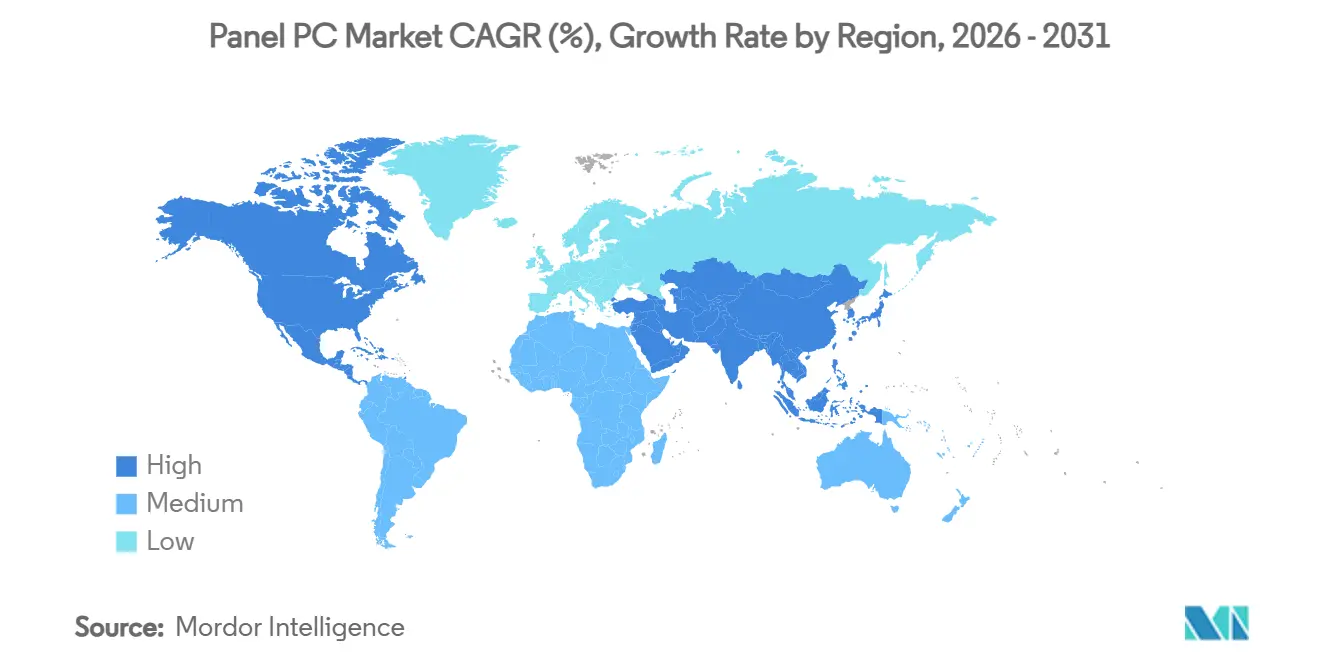
Asia-Pacific generated 46.32% of 2025 revenue as China’s Made in China 2025 and India’s PLI scheme drew assembly lines to regional parks. Beijing is pressuring suppliers to localize chip production, boosting orders for domestic chipmakers such as Rockchip, even though performance still lags Intel by 2 years. Japan’s collaborative-robot initiatives are driving demand for touch-sensitive HMIs with real-time Ethernet support that let operators jog cobot axes directly on screen. South Korea’s mega-fabs secure customized panel PCs with 10-year availability clauses to align with semiconductor tool qualification cycles.
The Middle East is on track for an 11.39% CAGR as Saudi Aramco and ADNOC retrofit offshore platforms with ATEX-certified fanless terminals capable of fiber-optic Ethernet links across 30-kilometer pipelines. Smart-city megaprojects such as NEOM specify BACnet-enabled panel PCs with NFC readers, PoE power, and temperature envelopes of -40 °C to 70 °C. North America’s panel pc market is split between multinational incumbents that bundle Rockwell VersaView with Logix PLCs and mid-tier adopters that gravitate to Advantech for lower total cost of ownership.
European demand benefits from the EUR 80 billion (approximately USD 86.4 billion) Chips Act, which is shortening processor lead times and reducing geopolitical risk.[3]European Commission, “European Chips Act – Update on the Latest Milestones,” Digital-strategy.ec.europa.eu Germany’s Industrie 4.0 subsidies keep Siemens and Beckhoff entrenched, while Italy’s tax credits buoy SME automation retrofits. South America lags due to tariff barriers, yet Brazil’s automakers and Argentina’s miners are testing refurbished fanless models to cut capex, hinting at a gradual lift in regional penetration.

Competitive Landscape
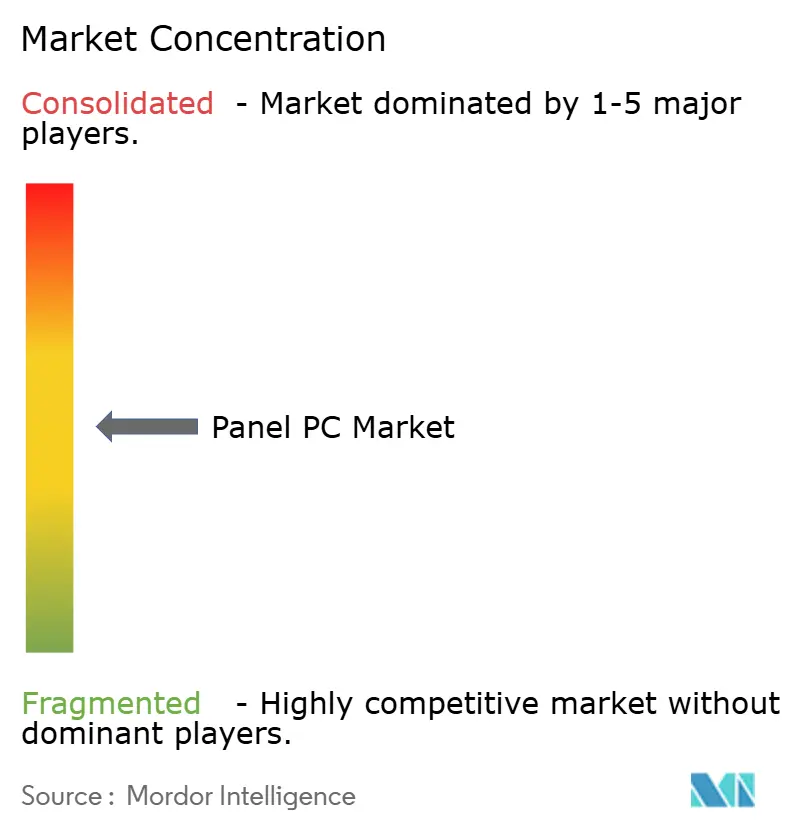
The panel PC market is moderately fragmented, with the top five vendors accounting for roughly half of shipments, but more than 100 regional specialists compete on certifications, enclosure materials, and rapid customization. Siemens and Rockwell marshal vertical integration, pairing panel PCs with proprietary PLCs and engineering suites, an approach that wins risk-averse pharmaceutical and automotive buyers willing to pay 25% premiums for one-vendor accountability. Advantech, AAEON, and Axiomtek counter with modular designs that allow CPU and I/O boards to be swapped independently, shortening lead times from 8 to 4 weeks for custom builds and lowering future upgrade costs.
Beckhoff differentiates through real-time EtherCAT integration, collapsing controller and HMI roles into a single panel PC. The strategy removes standalone PLC hardware, saving cabinet space and wiring time in motion-control cells. Winmate and Teguar exploit healthcare white space by shipping IP69K stainless units with antimicrobial glass, yielding 40% gross margins unmatched in the general industrial segment. Cybersecurity compliance is now a decisive tie-breaker; KontronOS and ISASecure certificates appeal to utilities facing strict liability under the forthcoming EU Cyber Resilience Act.[4]Secure-by-Design Handbook, “IEC 62443 Series Overview,” Securebydesignhandbook.com
Arm-based disruptors are nibbling at the low-end, but software ecosystem gaps in deterministic fieldbus stacks still favor x86 incumbents for mission-critical lines. As neural processing demands climb, vendors that integrate on-board NPUs or discrete GPUs are capturing machine-vision budgets, tilting share toward Axiomtek and APLEX in the electronics inspection market. Overall, price competition is intensifying, yet long-term availability guarantees and certification hurdles preserve moderate entry barriers.
Panel PC Industry Leaders
Advantech Co., Ltd.
Siemens AG
Beckhoff Automation GmbH & Co. KG
Kontron AG
AAEON Technology Inc.
- *Disclaimer: Major Players sorted in no particular order

Recent Industry Developments
- February 2026: Kontron released a 21.5-inch KPanel S model featuring IK06 glass, IP65 protection, and optional KontronOS for secure on-machine visualization.
- January 2026: AAEON launched the Intelli TWL01 Edge multimedia PC with Intel Core N-series processors, dual 4K outputs, and 9-36 V input, aimed at kiosks and interactive billboards.
- April 2025: AAEON introduced the OMNI-ADN modular HMI family on Intel N-series processors with four screen options.
- March 2025: Beckhoff debuted the Next multi-touch panel generation with EtherCAT safety extensions across 7-24 inch sizes.


Global Panel PC Market Report Scope
The Panel PC Market encompasses the development, production, and deployment of integrated industrial computing systems that combine a display interface with embedded computing hardware in a single unit. These systems are designed for industrial and commercial environments, offering durability, compact form factors, and reliable performance for applications such as human-machine interfaces (HMIs), process control, automation, and real-time data monitoring.
The Panel PC Market Report is Segmented by Type (Fan-Enabled Panel PC, and Fanless Panel PC), Screen Size (Below 12-inch, 12-15-inch, and Above 15-inch), End-User Industry (Manufacturing and Automation, Energy and Power, Oil and Gas, Pharmaceuticals, Automotive, Transportation and Logistics, and Other End-User Industries), Touchscreen Technology (Resistive Touch, Capacitive Touch, Infrared Touch, Surface Acoustic Wave Touch, and Other Touch Technologies), and Geography (North America, South America, Europe, Asia-Pacific, and Middle East and Africa). The Market Forecasts are Provided in Terms of Value (USD).
| Fan-Enabled Panel PC |
| Fanless Panel PC |
| Below 12-inch |
| 12–15-inch |
| Above 15-inch |
| Manufacturing and Automation |
| Energy and Power |
| Oil and Gas |
| Pharmaceuticals |
| Automotive |
| Transportation and Logistics |
| Other End-User Industries |
| Resistive Touch |
| Capacitive Touch |
| Infrared Touch |
| Surface Acoustic Wave Touch |
| Other Touch Technologies |
| North America | United States | |
| Canada | ||
| Mexico | ||
| South America | Brazil | |
| Argentina | ||
| Rest of South America | ||
| Europe | United Kingdom | |
| Germany | ||
| France | ||
| Italy | ||
| Spain | ||
| Rest of Europe | ||
| Asia-Pacific | China | |
| Japan | ||
| India | ||
| South Korea | ||
| Rest of Asia-Pacific | ||
| Middle East and Africa | Middle East | United Arab Emirates |
| Saudi Arabia | ||
| Rest of Middle East | ||
| Africa | South Africa | |
| Egypt | ||
| Rest of Africa | ||
| By Type | Fan-Enabled Panel PC | ||
| Fanless Panel PC | |||
| By Screen Size | Below 12-inch | ||
| 12–15-inch | |||
| Above 15-inch | |||
| By End-User Industry | Manufacturing and Automation | ||
| Energy and Power | |||
| Oil and Gas | |||
| Pharmaceuticals | |||
| Automotive | |||
| Transportation and Logistics | |||
| Other End-User Industries | |||
| By Touchscreen Technology | Resistive Touch | ||
| Capacitive Touch | |||
| Infrared Touch | |||
| Surface Acoustic Wave Touch | |||
| Other Touch Technologies | |||
| By Geography | North America | United States | |
| Canada | |||
| Mexico | |||
| South America | Brazil | ||
| Argentina | |||
| Rest of South America | |||
| Europe | United Kingdom | ||
| Germany | |||
| France | |||
| Italy | |||
| Spain | |||
| Rest of Europe | |||
| Asia-Pacific | China | ||
| Japan | |||
| India | |||
| South Korea | |||
| Rest of Asia-Pacific | |||
| Middle East and Africa | Middle East | United Arab Emirates | |
| Saudi Arabia | |||
| Rest of Middle East | |||
| Africa | South Africa | ||
| Egypt | |||
| Rest of Africa | |||


Key Questions Answered in the Report
How large will the panel pc market be by 2031?
It is forecast to reach USD 2.88 billion by 2031, growing at a 10.23% CAGR from 2026.
Which screen size category is expanding fastest?
Displays above 15 inches are projected to register a 10.83% CAGR as factories adopt larger dashboards.
Why are fanless panel PCs gaining popularity?
They eliminate mechanical failures, extend mean time between failures to 100,000 hours, and fit clean-room or hazardous environments without vents.
Which region offers the highest growth opportunity?
The Middle East is expected to post an 11.39% CAGR through 2031, led by oil and gas digitalization projects.
What is the main cost barrier for small manufacturers?
Industrial-grade units are priced 150%-300% above consumer all-in-ones, inflating upfront capital expenditure despite lower lifetime maintenance.
How are vendors addressing cybersecurity demands?
Leading suppliers embed secure boot, signed updates, and hardened Linux distributions to comply with IEC 62443 component standards.
Page last updated on:





