
Malaysia Mobile Virtual Network Operator (MVNO) Market Size and Share
Market Overview
| Study Period | 2019 - 2030 |
|---|---|
| Forecast Data Period | 2025 - 2030 |
| Historical Data Period | 2019 - 2023 |
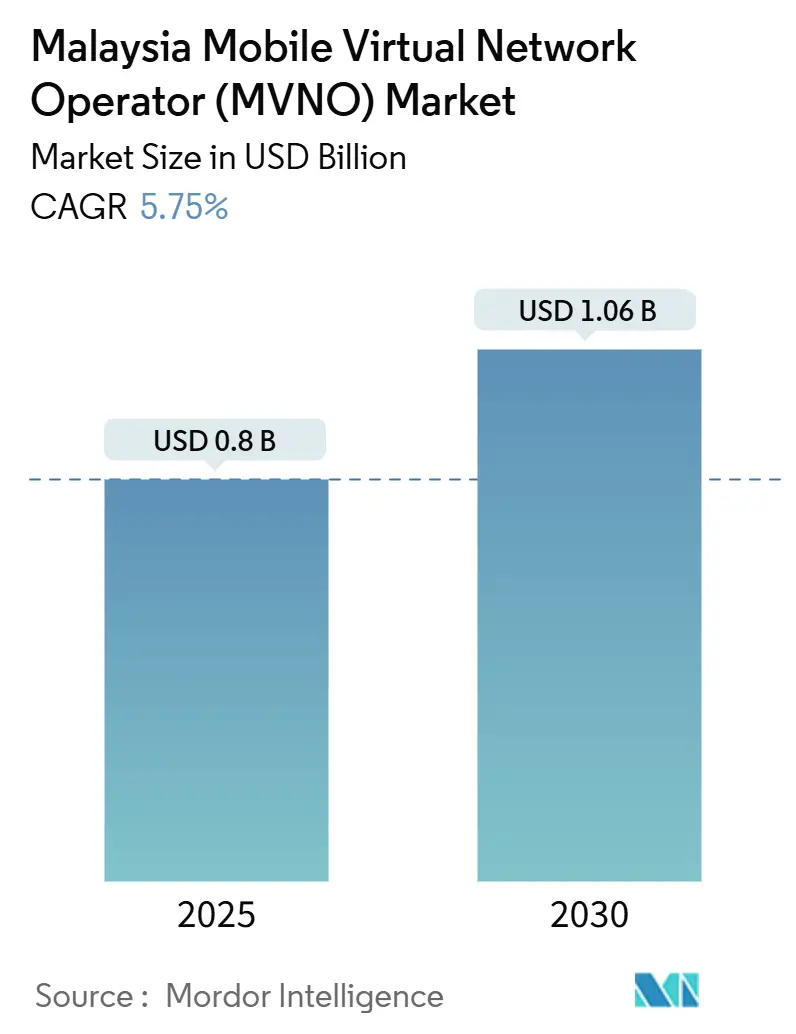
| Market Size (2025) | USD 0.8 Billion |
| Market Size (2030) | USD 1.06 Billion |
| Growth Rate (2025 - 2030) | 5.75 % |
| Market Concentration | Medium |
Major Players *Disclaimer: Major Players sorted in no particular order Image © Mordor Intelligence. Reuse requires attribution under CC BY 4.0. | |
Malaysia Mobile Virtual Network Operator (MVNO) Market Analysis by Mordor Intelligence
The Malaysia MVNO Market size is estimated at USD 0.8 billion in 2025, and is expected to reach USD 1.06 billion by 2030, at a CAGR of 5.75% during the forecast period (2025-2030). In terms of subscriber volume, the market is expected to grow from 6.22 million subscribers in 2025 to 7.79 million subscribers by 2030, at a CAGR of 4.61% during the forecast period (2025-2030). Continued migration toward a dual-wholesale 5G model has removed the pricing opacity that once curbed virtual operator growth, giving the Malaysia MVNO market fresh momentum. Operators are leaning on cloud-native OSS/BSS stacks, eSIM-only distribution, and satellite-terrestrial convergence to widen addressable segments and compress operating costs. Post-pandemic enterprise digitization is expanding premium B2B average revenue per user, while consumer appetite for ultra-low-cost prepaid plans anchors overall subscriber scale. Government programs such as JENDELA keep infrastructure expansion on track and reinforce investor confidence that the Malaysia MVNO market can sustain mid-single-digit compound growth through the decade [1]Malaysian Communications and Multimedia Commission, “JENDELA Quarterly Update,” mcmc.gov.my .
Key Report Takeaways
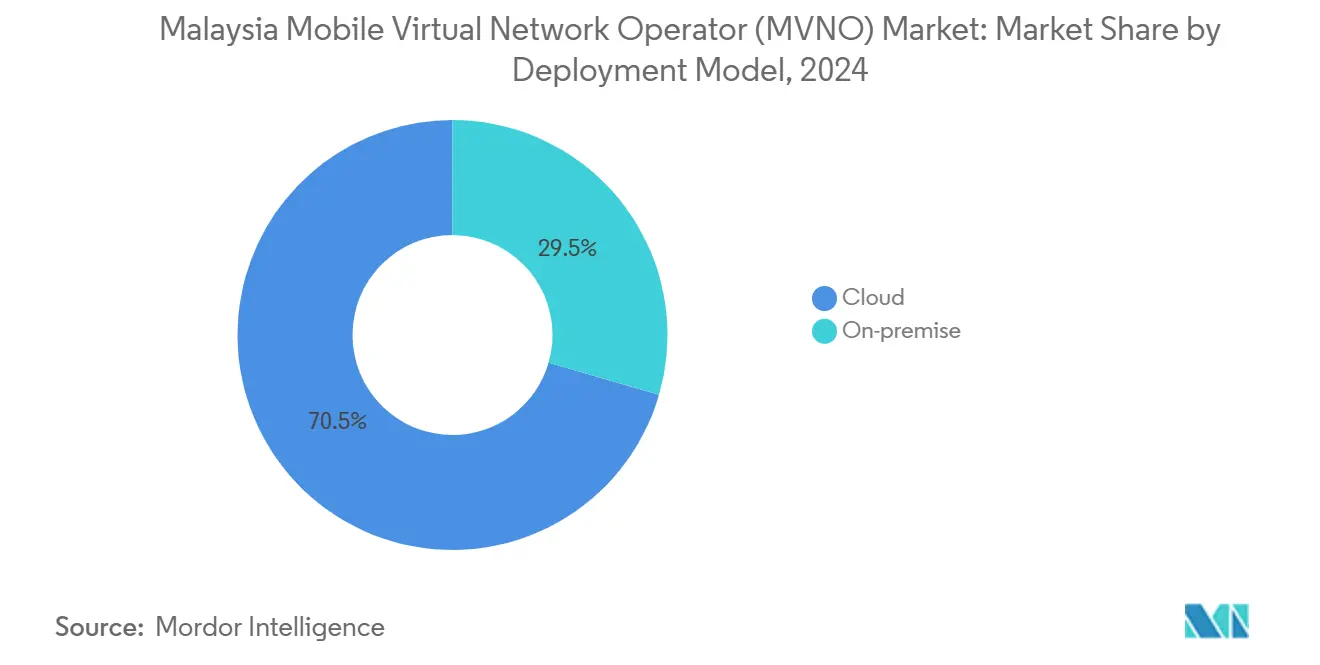
- By deployment model, cloud captured 70.51% of 2024 revenue, and it is forecast to register a 10.14% CAGR to 2030.
- By operational mode, reseller and other light MVNO formats held a 62.33% share in 2024, yet full MVNO structures are set to advance at a 19.19% CAGR through 2030.
- By subscriber type, consumer connections commanded 85.22% of 2024 revenue, whereas IoT-specific lines are poised for a 26.71% CAGR through 2030.
- By application, discount propositions controlled 43.37% of 2024 sales, while cellular M2M will grow fastest at 26.71% CAGR to 2030.
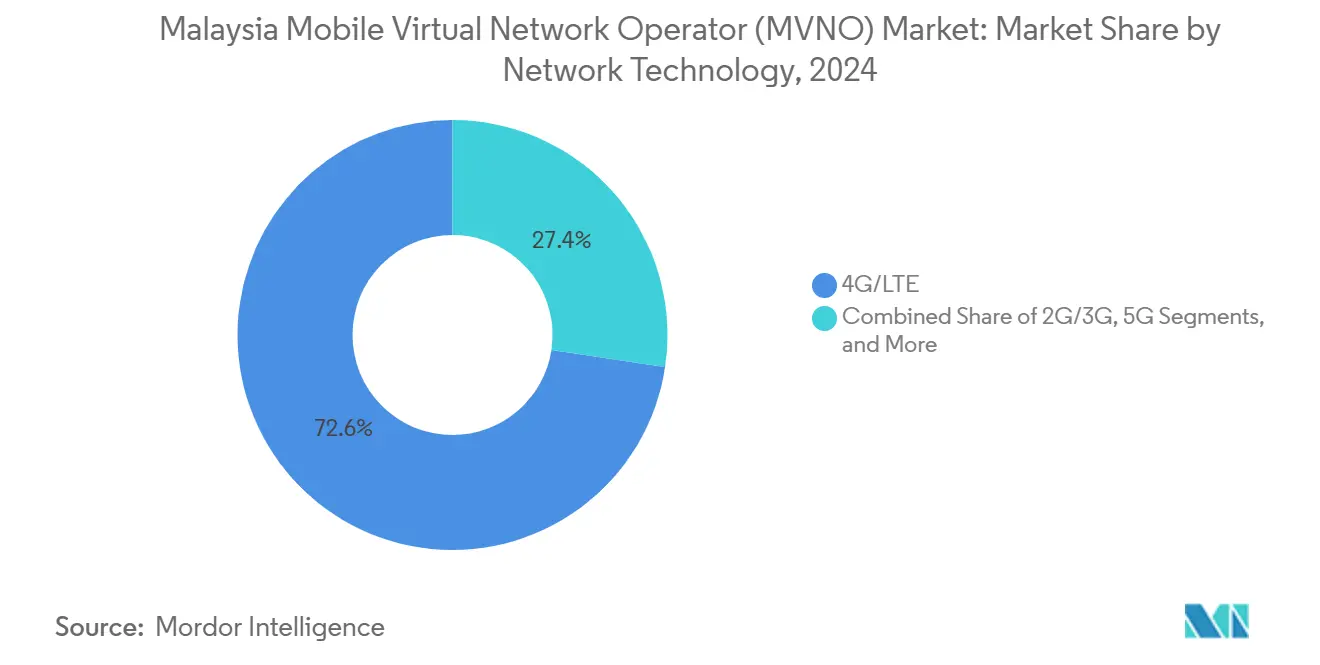
- By network technology, 4G/LTE held 72.62% share in 2024, and satellite/NTN is projected to soar at a 101.31% CAGR over the same horizon.
- By distribution channel, online and digital-only storefronts generated 52.90% of the 2024 value and will expand at a 9.66% CAGR to 2030.
Malaysia Mobile Virtual Network Operator (MVNO) Market Trends and Insights
Drivers Impact Analysis*
| Driver | (~) % Impact on CAGR Forecast | Geographic Relevance | Impact Timeline |
|---|---|---|---|
| Surging demand for ultra-low-cost prepaid plans among Gen-Z and foreign workers | +1.2% | Klang Valley, Johor, Penang | Short term (≤ 2 years) |
| Government’s JENDELA program accelerating nationwide 4G and 5G coverage | +0.9% | National rural focus | Medium term (2-4 years) |
| Post-pandemic enterprise digitization boosting B2B MVNO subscriber ARPU | +0.8% | Urban commercial hubs | Medium term (2-4 years) |
| eSIM-only digital brands reducing distribution costs and time-to-market | +0.7% | National tech-savvy segments | Short term (≤ 2 years) |
| Wholesale 5G access from Digital Nasional Berhad (DNB) leveling the playing field | +0.6% | National | Long term (≥ 4 years) |
| Rise of sharia-compliant and community-centric MVNO propositions | +0.3% | National | Long term (≥ 4 years) |
| Source: Mordor Intelligence | |||
Surging demand for ultra-low-cost prepaid plans among Gen-Z and foreign workers
An estimated 2.3 million foreign workers plus budget-conscious Gen-Z users now anchor the fastest-growing prepaid cohort. CelcomDigi’s RM15 Raja Kombo bundles and U Mobile’s Borneo-specific offers prove that hyper-localized pricing can draw users overlooked by major MNOs [2]CelcomDigi, “Enterprise 5G Solution Portfolio,” celcomdigi.com . MVNOs tap this base through app-only onboarding that lowers credit risk and distribution spend. Digital-first habits encourage self-service top-ups and viral referrals, feeding subscriber momentum. The segment’s scale underpins the Malaysia MVNO market as operators balance razor-thin margins with bulk traffic economics. Increased wholesale 5G options further let brands fine-tune gigabyte tiers without eroding unit cash flow.
Government’s JENDELA program accelerating nationwide 4G and 5G coverage
JENDELA targets 96.9% 4G coverage and contiguous 5G availability by 2025. Rural small-cell deployments using satellite backhaul, such as the Reach Ten-CelcomDigi partnership in Sarawak, expand the Malaysia MVNO market into underserved districts [3]Bernama, “Reach Ten, CelcomDigi Partner on Rural Coverage,” bernama.com. Consistent radio access allows virtual operators to promise comparable service quality nationwide, a prior weakness against incumbents. Policy incentives tied to digital inclusion lower licensing friction and invite niche MVNO entrants. Infrastructure parity also trims churn fears for users outside metro areas, making national MVNO propositions more credible.
Post-pandemic enterprise digitization boosting B2B MVNO subscriber ARPU
Hybrid work, logistics automation, and supply-chain telemetry lifted demand for managed mobility in 2025. CelcomDigi reports strong uptake of verticalized 5G solutions spanning retail, transport, and manufacturing. MVNOs bundle connectivity with device management, data analytics, and cloud security to raise average revenue far above prepaid consumer lines. Longer contract tenures and lower churn stabilize cash flows, freeing capital for network self-optimization. Growth in this segment widens the business mix of the Malaysia MVNO market, reducing over-reliance on ultra-low-cost offerings. Enterprise appetite for rapid rollout favors MVNO agility compared with slower-moving integrated carriers.
eSIM-only digital brands reducing distribution costs and time to market
Touch’n Go eWallet’s travel eSIM launch shows how fintech operators can bolt on virtual connectivity without bricks-and-mortar exposure [4]Touch ’n Go, “eWallet Travel eSIM Launch,” touchngo.com.my. Global eSIM aggregators like Airalo ride wholesale agreements to deliver Malaysian profiles instantly, validating the zero-SIM fulfillment model. Eliminating plastic SIM logistics slices acquisition costs and unlocks borderless scalability. For the Malaysia MVNO market, eSIM uptake accelerates foreign tourist capture and supports fast promotional iteration. The new form factor also simplifies device bundling for IoT asset trackers, smart meters, and wearables, indirectly spurring machine-to-machine line volume.
Restraints Impact Analysis*
| Restraint | (~) % Impact on CAGR Forecast | Geographic Relevance | Impact Timeline |
|---|---|---|---|
| Single-wholesale-network model keeps wholesale pricing non-transparent | -0.8% | National | Medium term (2-4 years) |
| Rising spectrum fees pushing host MNOs to hike access charges | -0.6% | National | Long term (≥ 4 years) |
| Limited number portability awareness curbing churn from MNOs to MVNOs | -0.5% | Rural districts | Short term (≤ 2 years) |
| Intensifying price wars compressing already-thin MVNO margins | -0.7% | Urban markets | Short term (≤ 2 years) |
| Source: Mordor Intelligence | |||
Single-wholesale-network model keeps wholesale pricing non-transparent
Digital Nasional Berhad’s original 5G monopoly made interconnect rates opaque, weakening MVNO bargaining power. Although U Mobile’s entrance as a secondary wholesaler has improved visibility, only two bulk suppliers still limit negotiating leverage. Smaller entrants struggle to model long-term cost curves, delaying promotional investment and network planning. The Malaysia MVNO market, therefore, faces moderate strategic risk until additional wholesale options emerge or a reference pricing regime materializes. Continued dialogue with regulators aims to publish standard rate cards that would inject certainty into virtual operator business plans.
Intensifying price wars compressing already-thin MVNO margins
Market-wide unlimited bundles at sub-RM35 price points prove difficult to cover once traffic spikes. XOX Mobile’s net losses highlight the sector’s vulnerability to discount spirals even as subscriber tallies climb. Aggressive data allowances paired with speed throttling signal value trade-offs that hurt brand perception. MVNOs answer with end-to-end cloud automation and lean staffing to preserve contribution margins, typified by Tune Talk’s 60-70% operating-efficiency target from its new cloud-native stack. Without cost redesign, prolonged tariff battles could knock several subscale players from the Malaysia MVNO market by decade’s end.
*Our forecasts treat driver/restraint impacts as directional, not additive. The impact forecasts reflect baseline growth, mix effects, and variable interactions.
Segment Analysis
By Deployment Model: Cloud Infrastructure Drives Operational Efficiency
Cloud-based operations contributed 70.51% of 2024 revenue, reinforcing the cloud’s primacy within the Malaysia MVNO market size at the network-platform level. The pivot to multitenant architectures cuts capex, accelerates service rollouts, and allows pay-as-you-grow scaling matched to subscriber velocity. Operators exploit containerized microservices to automate provisioning, billing, and customer care, which lowers per-user cost curves as volumes climb. Enhanced analytics and AI-led self-healing keep quality metrics high even during traffic bursts linked to promotional campaigns. On-premise stacks persist in highly regulated enterprise niches where data residency is non-negotiable, yet they absorb the brunt of the shift as total cost of ownership widens against cloud alternatives. Looking ahead, edge computing tie-ins will let MVNOs host latency-sensitive IoT workloads, enlarging the Malaysia MVNO market share for cloud even further.
Second-generation cloud adopters now reshape pricing with real-time policy control and dynamic charging engines. The flexibility lets brands tweak gigabyte thresholds or throttle rules instantly in response to competitor moves, improving gross-margin defense. Public-cloud hyperscaler partnerships also embed disaster recovery and geographic redundancy that were formerly unaffordable to small providers. Together, these capabilities underpin the 10.14% CAGR forecast for cloud deployments, dwarfing legacy system growth and cementing cloud as the long-run default.


By Operational Mode: Full MVNO Growth Signals Market Maturation
Light and reseller formats dominate revenue share as 62.33% in 2024, but full MVNO constructs are scaling at 19.19% CAGR, pushing their slice of the Malaysia MVNO market size toward parity by 2030. Operators move up the value chain to secure control over core elements such as HLR/HSS, policy servers, and steering logic. Greater autonomy enables bespoke quality tiers, quicker feature launches, and diversified wholesale sourcing. The trend illustrates how virtual operators are evolving from pure discount resellers into network orchestrators able to arbitrate between terrestrial and satellite access.
Early movers like Xperanti leverage full-core control to deliver ultra-low-power IoT links over Sigfox, an outcome impossible under a light-MVNO template. The capital burden is recouped through higher enterprise ARPU and service revenue modules, including analytics dashboards. Service-operator hybrids retain relevance for mid-size brands wanting some infrastructure ownership without full packet-core upkeep. Overall, the proliferation of full MVNOs indicates that competitive differentiation in the Malaysia MVNO market now relies on technical depth rather than headline price alone.
By Subscriber Type: IoT-Specific Services Drive Next-Generation Growth
Consumer traffic still furnishes 85.22% of line volume in 2024, yet IoT-centric connections are sprinting ahead with a 26.71% CAGR that will lift their Malaysia MVNO market share materially by 2030. Industrial automation programs, smart-city pilots, and connected-vehicle rollouts propel the surge. U Mobile’s joint initiative with Qualcomm showcases how chipset integration and tailored data packages open manufacturing and logistics verticals to MVNO penetration. Enterprise lines tick upward at a steadier clip as hybrid work and cybersecurity bundles gain traction among medium-sized businesses.
Machine-to-machine contracts often include multiyear lock-ins and stringent service-level agreements. These characteristics smooth cash flow and justify deeper investment in narrowband and satellite fallback capability. Consumer growth remains critical for scale economics, providing wholesale bargaining heft and brand awareness. Yet the strategic narrative has shifted. The Malaysia MVNO market now uses consumer mass to finance specialized IoT playbooks that promise thicker margins and stickier relationships.
By Application: Cellular M2M Mirrors IoT-Specific Growth Trajectory
Discount voice-and-data bundles accounted for 43.37% of 2024 sales volume, an outgrowth of Malaysia’s price-sensitive prepaid culture. Nonetheless, cellular machine-to-machine lines equal the 26.71% CAGR seen in IoT subscriber counts, underlining demand for always-on telemetry. Factory robots, cold-chain pallets, and smart-meter fleets increasingly require nationwide coverage at low energy budgets. MVNOs complement these needs with cloud dashboards and predictive-maintenance APIs that enlarge revenue per SIM without raising data ceilings excessively.
Business-application traffic earns premium margins owing to bespoke service layers like private APNs and encrypted tunnels. The other-applications bucket, including gaming and ad-sponsored data, presents experimental upside but a smaller absolute value. As M2M volumes mount, MVNOs deploy advanced policy engines to manage signaling overhead and balance loads between LTE, NB-IoT, and satellite beams. The result is a diversified top line less exposed to tariff wars in consumer pockets of the Malaysia MVNO market.
By Network Technology: Satellite/NTN Emergence Reshapes Connectivity Paradigm
Despite 4G/LTE’s commanding 72.62% share, satellite and other non-terrestrial networks exhibit a breakneck 101.31% CAGR through 2030, reshaping future Malaysia MVNO market dynamics. Starlink’s local reseller program and research collaborations between Geespace and Altel underscore national appetite for direct-to-device links. Government openness to spectrum policy that enables seamless satellite-terrestrial handover accelerates the timeline toward commercial launches. MVNOs view these constellations as incremental capacity without ground-network opex, particularly valuable in East Malaysian terrain where fiber backhaul is sparse.
5G progresses steadily as the dual-wholesale model matures, offering contiguous mid-band coverage across peninsular corridors. Legacy 2G/3G networks enter sunset, freeing refarmable spectrum. Over the forecast window, satellite traffic will move from niche backup toward mainstream consumer and IoT augmentation, carving out a meaningful share of the Malaysia MVNO market size and giving operators a nationwide coverage claim unmatched by terrestrial-only peers.

By Distribution Channel: Digital-Only Models Sustain Competitive Advantage
E-commerce style onboarding generated 52.90% of 2024 sales and should expand at a 9.66% CAGR as youth cohorts enter purchasing age. App-centric activation slashes commission outlays tied to physical retail and supports flash sales that ride social-media virality. Touch’n Go’s travel eSIM proves fintech gateways can cross-sell connectivity to existing payment users, lowering acquisition cost. Traditional outlets remain vital for document verification and device bundles aimed at older demographics, yet their share shrinks each year.
Carrier sub-brand kiosks adopt a hybrid layout that permits QR-coded self-registration while reassuring customers with in-store staff. Third-party wholesalers knit together convenience stores and petrol chains, a format still relevant for reload vouchers. In aggregate, distribution agility underpins the competitiveness of the Malaysia MVNO market, letting players pivot channel emphasis in near real-time based on campaign analytics.
Geography Analysis
Malaysia’s urban triangle of Klang Valley, Johor Bahru, and Penang anchors premium demand for 5G data allowances and enterprise mobility suites, delivering the highest revenue density per square kilometer in the Malaysia MVNO market. Population density and higher disposable income lift average spend, which raises wholesale volume commitments and supports differentiated tiers such as unlimited social-media passes. Competition is fiercest here; discount brand visibility saturates public transit, online marketplaces, and influencer channels. Operators respond by layering lifestyle perks, cloud gaming passes, and partner-delivered e-wallet cash-backs to edge out rivals.
Rural and deep-interior regions, especially in Sarawak and Sabah, historically lagged in coverage and ARPU. The JENDELA roadmap changes the equation by underwriting 4G and incremental 5G reach, allowing MVNOs to market nationwide plans without disclaimers. Reach Ten and CelcomDigi’s satellite-backhauled small-cell rollout shows how creative radio planning bridges jungles and mountainous areas. Community-centric MVNOs, some positioned around sharia-compliant propositions, pair affordable plans with micro-entrepreneur reseller schemes that inject local employment. These tactics gradually increase rural share within the Malaysia MVNO market size while advancing national digital equity goals.
Border corridors adjoining Singapore, Thailand, and Indonesia add a cross-border layer to growth. Commuters and traders demand affordable roaming or dual-number plans. redONE Mobile leverages wholesale agreements to treat Singapore as an extension of its domestic footprint, illustrating how regional reciprocity grows line count without heavy network spend. The Malaysian regulator supports such strategies via mutual recognition frameworks that hasten spectrum clearance and numbering approval. As economic integration within ASEAN deepens, international visitor flows will supply another tailwind to the Malaysia MVNO market, especially for eSIM-ready tourists who activate service before landing.
Competitive Landscape
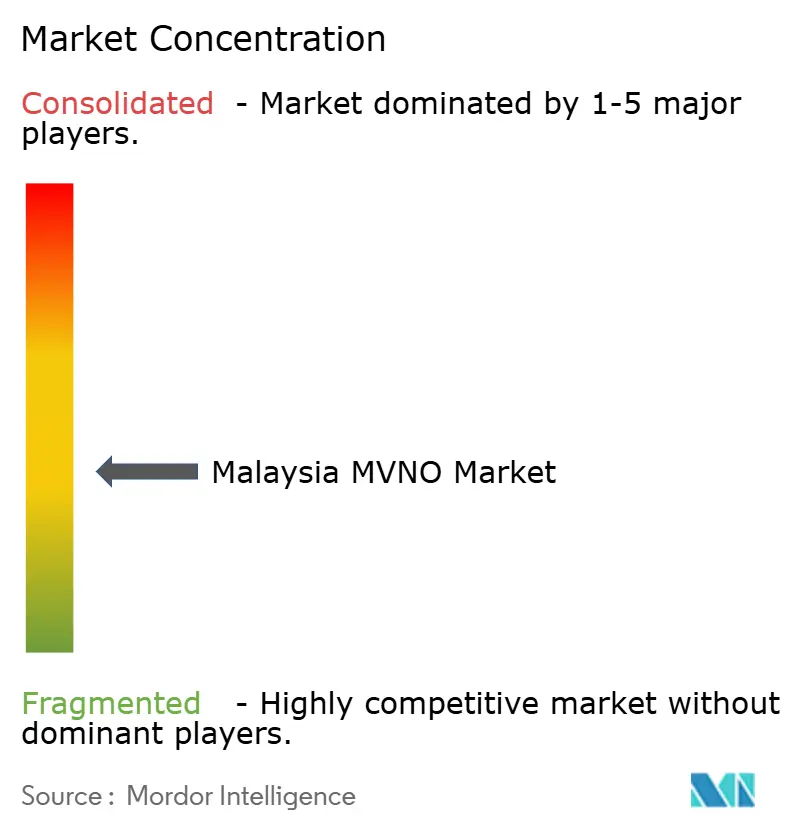
Malaysia presents a semi-consolidated structure in the studied market. Tune Talk, redONE Network, XOX Mobile, and Valyou constitute the first tier by subscriber base, yet none commands a share high enough to dictate pricing. This dispersion keeps the Malaysia MVNO market competitive but also invites periodic tariff shocks when one provider pushes aggressive bundles to grab headlines. Operational efficiency becomes the key survival lever; Tune Talk’s migration to a cloud-native stack with Mavenir targets double-digit cost savings that improve resilience during price wars.
Strategic alliances shape differentiation. redONE taps Celcom’s radio network yet focuses on family plan offers, while XOX leverages merchandising tie-ups with gaming platforms to court youth. New entrants increasingly arrive from non-telecom backgrounds, for example, fintech or logistics firms embedding connectivity into their core app. Satellite innovators collaborate with terrestrial MVNOs to extend direct-to-device reach. Technology investment patterns also diverge. Full MVNOs develop in-house packet cores to tailor quality of service for enterprise verticals, whereas light MVNOs rely on rapid price experiment cycles supported by data-science-driven marketing.
Regulatory policy remains even-handed, fostering open retail competition without mandating wholesale rate freezes. The resulting competitive dance encourages product variety but squeezes margin for smaller brands. Consolidation risk grows toward 2030 as rising spectrum levies and promotional costs test capital adequacy. Operators with multi-market footprints or adjacent service revenues, such as payment processing or cloud hosting, will enjoy a buffer. Overall, the Malaysia MVNO market is expected to stabilize with a core group of well-capitalized, full-stack MVNOs complemented by niche digital labels addressing discrete communities or use cases.
Malaysia Mobile Virtual Network Operator (MVNO) Industry Leaders
Tune Talk Sdn. Bhd.
redONE Network Sdn. Bhd.
XOX Berhad
Valyou (Merchantrade Asia Sdn. Bhd.)
Altel Communications Sdn. Bhd.
- *Disclaimer: Major Players sorted in no particular order

Recent Industry Developments
- April 2025: Reach Ten Holdings and CelcomDigi partnered to deliver 4G coverage across rural Sarawak using small-cell sites powered by satellite backhaul.
- April 2025: Tune Talk introduced “Dum Dum Data SIM” aimed at international travelers seeking instant eSIM activation and flat-rate data bundles.
- May 2024: Regulators confirmed plans to enable satellite direct-to-device service by 2027, flagging spectrum frameworks that support space-based cellular links.
- January 2024: VSTECS became the third official Starlink reseller in Malaysia, adding nationwide distribution for education, health, and public-sector customers.


Malaysia Mobile Virtual Network Operator (MVNO) Market Report Scope
| Cloud |
| On-premise |
| Reseller / Light / Brand MVNO |
| Service Operator |
| Full MVNO |
| Consumer |
| Enterprise |
| IoT-specific |
| Discount |
| Business |
| Cellular M2M |
| Others |
| 2G/3G |
| 4G/LTE |
| 5G |
| Satellite/NTN |
| Online / Digital-only |
| Traditional Retail Stores |
| Carrier Sub-brand Stores |
| Third-Party / Wholesale |
| By Deployment Model | Cloud |
| On-premise | |
| By Operational Mode | Reseller / Light / Brand MVNO |
| Service Operator | |
| Full MVNO | |
| By Subscriber Type | Consumer |
| Enterprise | |
| IoT-specific | |
| By Application | Discount |
| Business | |
| Cellular M2M | |
| Others | |
| By Network Technology | 2G/3G |
| 4G/LTE | |
| 5G | |
| Satellite/NTN | |
| By Distribution Channel | Online / Digital-only |
| Traditional Retail Stores | |
| Carrier Sub-brand Stores | |
| Third-Party / Wholesale |


Key Questions Answered in the Report
What will the Malaysia MVNO market size reach by 2030?
Forecasts show total value climbing to USD 1.06 billion by 2030 on a 5.75% CAGR.
How quickly are IoT-specific MVNO connections expanding in Malaysia?
IoT lines are projected to advance at a 26.71% CAGR between 2025 and 2030, outpacing all other subscriber categories.
Which sales channel contributes the largest share of Malaysian virtual-operator revenue?
Online and digital-only onboarding generated 52.90% of 2024 value and is growing at 9.66% CAGR.
What growth rate do full-core MVNO structures expect over the forecast period?
Full MVNO operations are on track for a 19.19% CAGR through 2030 as providers seek deeper network control.
Which government program is widening 4G and 5G coverage for virtual operators?
The JENDELA initiative aims for 96.9% nationwide 4G coverage and contiguous 5G access by 2025, directly enlarging MVNO addressable territory.
How will satellite connectivity reshape the Malaysian virtual-operator landscape?
Satellite and other non-terrestrial networks carry a 101.31% CAGR outlook to 2030, enabling direct-to-device service that extends reach beyond terrestrial footprints.
Page last updated on:





