
Market Overview
| Study Period | 2020 - 2031 |
|---|---|
| Forecast Data Period | 2026 - 2031 |
| Base Year Market Size (2025) | USD 335.03 Million |
| Market Size (2026) | USD 347.46 Million |
| Market Size (2031) | USD 414.84 Million |
| Growth Rate (2026 - 2031) | 3.61 % |
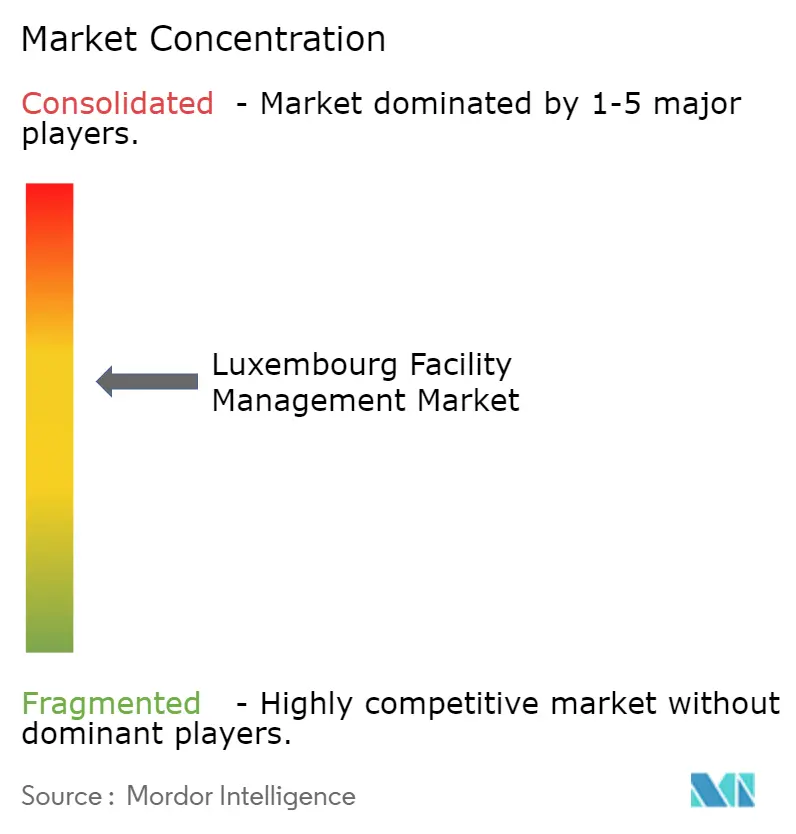
| Market Concentration | Medium |
Major Players *Disclaimer: Major Players sorted in no particular order Image © Mordor Intelligence. Reuse requires attribution under CC BY 4.0. | |
Luxembourg Facility Management Market Analysis by Mordor Intelligence
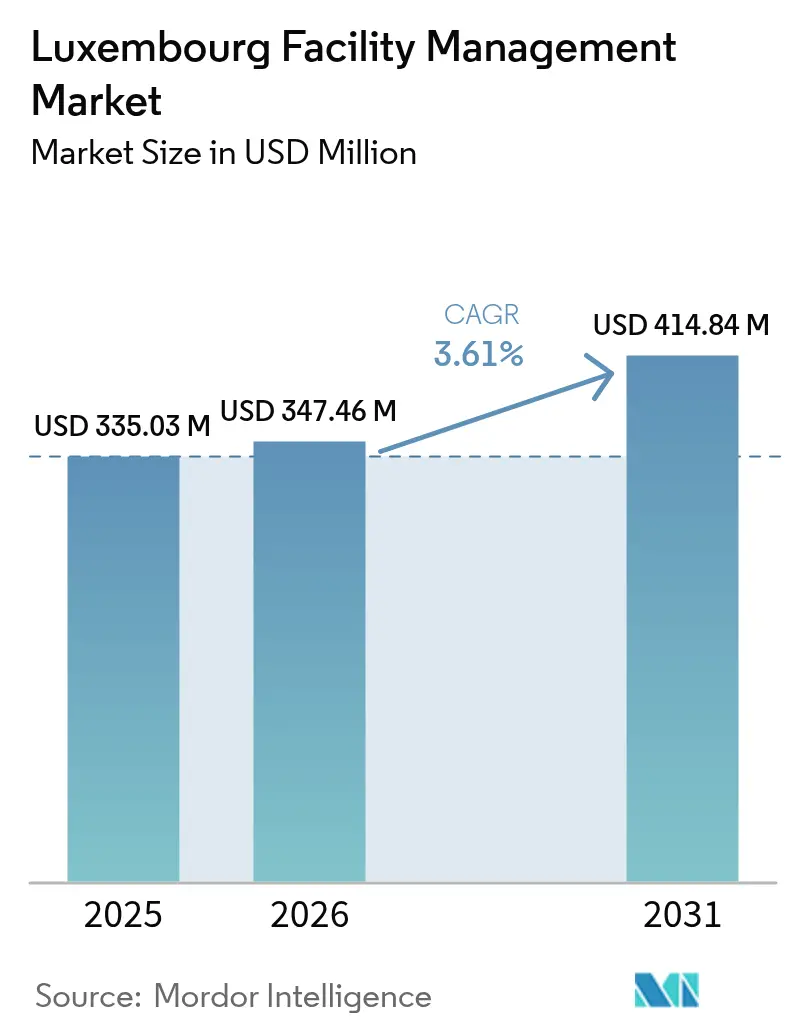
The Luxembourg facility management market size is expected to increase from USD 335.03 million in 2025 to USD 347.46 million in 2026 and reach USD 414.84 million by 2031, growing at a CAGR of 3.61% over 2026-2031. Demand is tilting toward integrated contracts that weave cyber-physical security into building-management systems, reflecting the early impact of the Digital Operational Resilience Act and the EU Taxonomy Regulation. Hard services continue to anchor revenue as landlords retrofit mechanical, electrical and plumbing assets to meet stricter energy-performance thresholds, while soft-service growth benefits from a swelling data-center footprint and hospitality rebound. Outsourcing gains momentum because commercial owners want variable cost structures and turnkey ESG reporting, yet a persistent skills gap and inflation-driven cost pressures curb faster expansion. Competitive differentiation increasingly rests on digital twins, predictive analytics and carbon-accounting modules that reinforce client stickiness within the Luxembourg facility management market.
Key Report Takeaways
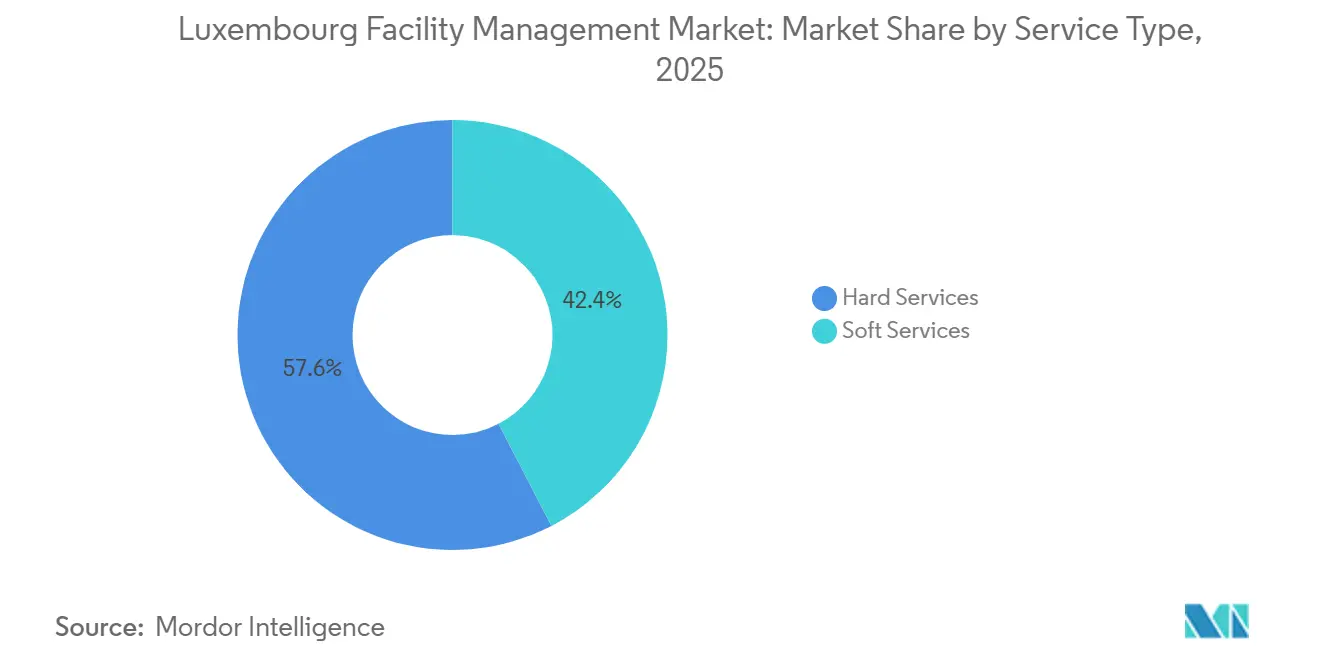
- By service type, hard services commanded 57.61% of the Luxembourg facility management market share in 2025, whereas soft services are projected to expand at a 4.23% CAGR through 2031.
- By delivery model, in-house management held 54.13% of the Luxembourg facility management market in 2025; outsourced contracts are forecast to grow at a 4.04% CAGR over 2026-2031.
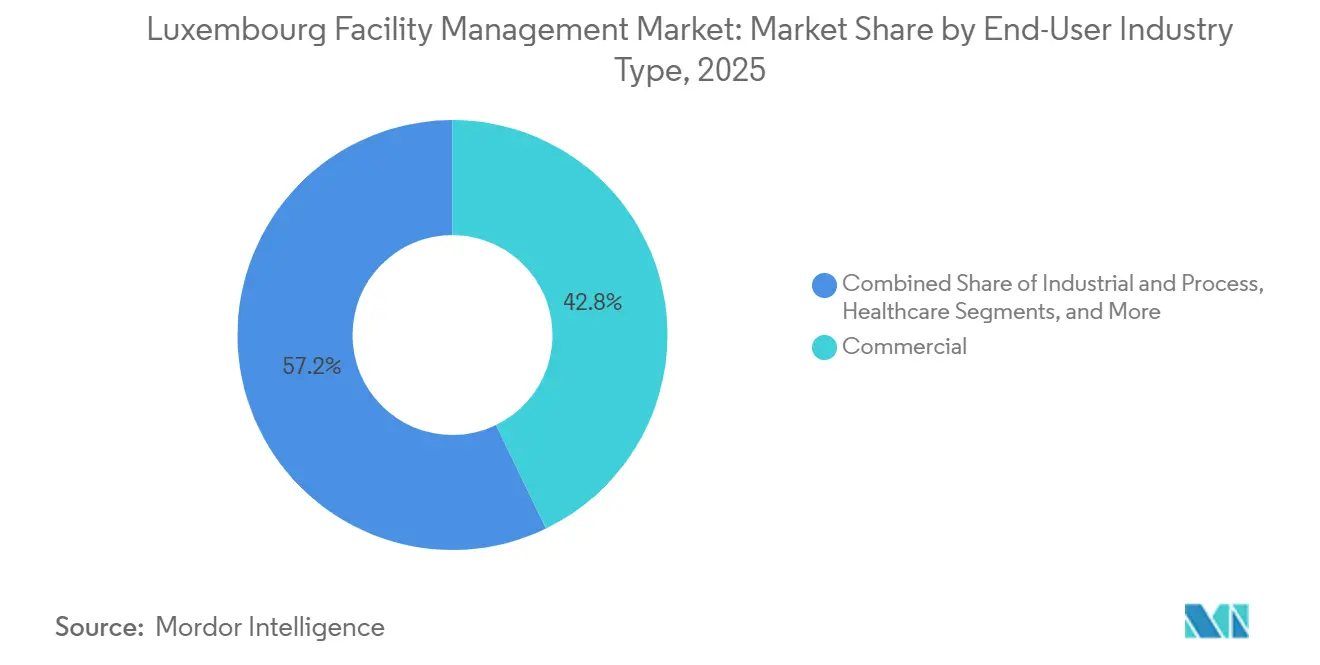
- By end-user industry, the commercial segment accounted for 42.84% of revenue in 2025 and is advancing at a 3.74% CAGR to 2031.
Note: Market size and forecast figures in this report are generated using Mordor Intelligence’s proprietary estimation framework, updated with the latest available data and insights as of 2026.
Luxembourg Facility Management Market Trends and Insights
Drivers Impact Analysis*
| Driver | (~) % Impact on CAGR Forecast | Geographic Relevance | Impact Timeline |
|---|---|---|---|
| Technology-Led Integrated Facility Management Adoption | +1.2% | National, especially Kirchberg and Cloche d'Or | Medium term (2-4 years) |
| ESG Compliance Reshapes Service-Delivery Models | +0.9% | National, aligned with EU Taxonomy and CSRD | Long term (≥ 4 years) |
| Digital Operational Resilience Act Enhances ICT Risk Management | +0.7% | Financial-services corridor | Short term (≤ 2 years) |
| Data-Center Build-Out Fuels Critical-Environment FM Demand | +0.6% | Bettembourg and Betzdorf logistics zones | Medium term (2-4 years) |
| Workforce Transformation Lifts Soft-Services Expansion | +0.5% | National cross-border labor markets | Medium term (2-4 years) |
| Green-Building Incentives Accelerate Sustainable FM Uptake | +0.4% | National PRIMe House and LENOZ programs | Long term (≥ 4 years) |
| Source: Mordor Intelligence | |||
Technology-Led Integrated Facility Management Drives Market Evolution
Integrated building-management platforms that connect HVAC, lighting, access control and occupancy sensors over a single IP backbone are now standard for Grade A offices in the Luxembourg facility management market. Providers embed artificial-intelligence algorithms that predict chiller failures up to 72 hours ahead, trimming unplanned downtime by 30% and delaying capital-equipment spend.[1] Dussmann tested a digital twin in late 2025 for a 15,000 m² mixed-use asset, pulling real-time data from 400 IoT points to fine-tune air-handling schedules and defer a rooftop-unit replacement by 18 months.[2] Tenants favor these capabilities because they must benchmark energy-use intensity under the EU Level(s) framework, while landlords chase the 2030 near-zero-energy target. As government policy phases out fossil-fuel heating in public buildings by 2029, suppliers able to document quantifiable energy savings capture premium fees and longer contracts.
ESG Compliance Reshapes Service-Delivery Models
The EU Taxonomy Regulation requires primary energy demand at least 10% below nearly zero-energy thresholds, inserting sustainability clauses into bid specifications. Contracts now stipulate EU Ecolabel cleaning chemicals, sourcing of catering ingredients within 150 km and monthly waste-diversion reporting. Sodexo’s circular-economy kitchen model diverted 92% of organic waste to anaerobic digestion, earning GRESB 5-Star status in 2025.[3] Bonus-malus payment schemes tied to carbon-intensity reductions convert ESG compliance into revenue upside for providers that invest in low-emission equipment. The Corporate Sustainability Reporting Directive extends Scope 3 disclosure to companies with more than 250 employees in 2026, accelerating demand for auditable facility-level data streams that the Luxembourg facility management market now supplies.
Digital Operational Resilience Act Transforms ICT Risk Management
In force since January 2025, DORA obliges banks and insurers to prove ICT resilience, elevating the physical layer of data protection. Facility partners must guarantee biometric access accuracy, CCTV uptime and redundant power, or risk triggering reportable incidents. Vinci Facilities secured a three-year extension with a Tier 3 data center by integrating building-access logs into the client’s security-information and event-management platform and demonstrating ISO/IEC 27001 conformity.[4] Because DORA forces entities to audit third-party concentration risk, providers advertising operational independence and diversified supply chains win share in the Luxembourg facility management market.
Data-Center Build-Out Fuels Critical-Environment FM Demand
Installed data-center capacity surpassed 60 MW in 2025, positioning Luxembourg as a secondary FLAP-D hub and widening the addressable pool for critical-environment services. Atalian formed a specialised division in 2025, hiring Certified Data Centre Management Professionals and deploying Schneider Electric’s EcoStruxure platform across colocation sites. Hyperscale plans, such as Google’s proposed Bissen campus, will need 15-20 full-time facility staff versed in hot-aisle containment. Grid-capacity constraints could delay some projects, yet the segment’s high service intensity underpins above-market growth for the Luxembourg facility management market.
Restraints Impact Analysis*
| Restraint | (~) % Impact on CAGR Forecast | Geographic Relevance | Impact Timeline |
|---|---|---|---|
| Economic Volatility Constrains Market Expansion | -0.6% | National, Eurozone spillover | Short term (≤ 2 years) |
| Technical Skills Gap Limits Service Sophistication | -0.4% | National cross-border labor markets | Medium term (2-4 years) |
| Fragmented Municipal Regulations Complicate Multi-Site Contracts | -0.3% | 102 communes | Long term (≥ 4 years) |
| Slow Uptake of Performance-Based Contracts Curbs Revenue Scalability | -0.2% | Commercial and institutional sectors | Medium term (2-4 years) |
| Source: Mordor Intelligence | |||
Economic Volatility Constrains Market Expansion
Construction-cost inflation averaged 4.2% in 2024, forcing clients to delay discretionary upgrades while the European Central Bank kept its policy rate near 3.0% into 2026. Wage growth outpaced consumer inflation, squeezing margins for labor-heavy soft services, and some mid-tier providers exited unprofitable accounts. Hospitality operators, still operating below 2019 occupancy, renegotiated contracts with reduced service frequencies, clipping potential revenue for the Luxembourg facility management market.
Technical Skills Gap Limits Service Sophistication
The sector adds roughly 300-350 new technical posts each year, yet training programs graduate fewer than 200 qualified candidates, leaving a structural shortfall. Cross-border recruits face equivalency hurdles; French HVAC technicians must complete a 40-hour course to comply with Luxembourg safety rules. WISAG reported a 90-day average time-to-fill for building-automation roles in 2025, double that of cleaning staff, slowing the rollout of integrated contracts. Data-center certifications are even scarcer, inflating wage premiums and restraining the Luxembourg facility management market’s move up the value chain.
*Our forecasts treat driver/restraint impacts as directional, not additive. The impact forecasts reflect baseline growth, mix effects, and variable interactions.
Segment Analysis
By Service Type: Hard Services Anchor Revenue, Soft Services Accelerate
Hard services held 57.61% of the Luxembourg facility management market in 2025, reflecting the capital intensity of MEP, HVAC and life-safety systems. Soft services are projected to expand at a 4.23% CAGR, outpacing overall growth as data centers and flexible workspaces demand higher cleaning and security frequencies. Within hard services, MEP and HVAC dominate because the F-Gas phase-down is driving an equipment-replacement wave. Fire-safety work benefits from stricter EN 54 false-alarm thresholds, compelling annual third-party smoke-detector testing.
Older building stock pushes envelope retrofits and HVAC upgrades, yet co-working hubs inflate daily cleaning and reception needs. Infection-control protocols triggered adoption of electrostatic disinfection and UV-C air purification, boosting specialized cleaning revenue. Food-cost inflation pressured catering margins, prompting plant-based menus that trim ingredient spend while pleasing ESG-minded tenants. These twin currents position soft services as the fastest-growing slice of the Luxembourg facility management market size through 2031.
By Offering Type: Outsourcing Gains as Clients Seek Risk Transfer
In-house teams managed 54.13% of facilities in 2025, mostly within government and critical-infrastructure owners who value direct control. Outsourced contracts will rise at a 4.04% CAGR as commercial landlords convert fixed labor costs to variable line items and rely on vendors for ESG data. Integrated agreements, about one-fifth of outsourced volume, gain favor by erasing hand-offs between hard and soft services. Bundled contracts suit mid-sized enterprises, while single-service deals persist in hospitality and healthcare.
Labor-transfer rules oblige new vendors to absorb incumbent staff at equivalent terms, limiting cost savings and reinforcing vendor selection on quality and retention. ISS reported 12% staff attrition in 2025, well below the 18% sector average, a statistic that helped it secure new multi-year awards. Stable workforces and auditable data pipelines underpin the competitive edge needed to grow share in the Luxembourg facility management market.
By End-User Industry: Commercial Segment Leads Growth Trajectory
Commercial real estate captured 42.84% of 2025 revenue and will maintain the strongest trajectory with a 3.74% CAGR, thanks to new Grade A completions in Kirchberg and Cloche d'Or. Institutional and public infrastructure contribute roughly one-fifth of sales, characterized by long contracts and prescriptive SLAs. Hospitality accounts for about 13% after lodging demand neared pre-pandemic levels, reviving housekeeping and F&B support.
Healthcare adds roughly 11%, where mandatory daily terminal cleaning inflates service intensity. Industrial users, though a smaller absolute base, pay premium rates for cleanroom upkeep and cold-chain monitoring. Financial services underpin commercial demand: they occupy 26% of office stock and drive above-average euros-per-square-meter spending. This tenant mix cements the commercial segment as the anchor of the Luxembourg facility management market size.

Geography Analysis
The Luxembourg facility management market concentrates within a 30 km corridor stretching from Luxembourg City to Esch-sur-Alzette and Differdange, an area that houses 75% of commercial floor space. Kirchberg commands the highest spending density, with annual outlays of EUR 180-220 (USD 203-248) per m². Cloche d'Or added three BREEAM Excellent towers in 2024-2025, each tendering integrated service packages that blend energy management, security and tenant amenities.
Esch-sur-Alzette is redeveloping metallurgical brownfields into creative campuses, spurring adaptive-reuse service needs. Northern cantons such as Clervaux and Vianden represent less than 5% of demand because their building stock skews residential. Cross-border labor dynamics shape supply; 45% of facility workers commute daily from France, Belgium and Germany, exposing operations to rail or fuel disruptions.
Regulation is national, but enforcement varies across 102 communes. The capital mandates quarterly fire-alarm tests, while some rural areas accept semi-annual cycles, forcing multi-site vendors to juggle disparate checklists. Government decentralization aims to divert 20% of new public-office builds to regional hubs by 2030, potentially diffusing opportunity beyond the city core. Even so, high per-capita GDP and a dense multinational tenant base keep the central corridor pivotal to the Luxembourg facility management market.
Regulatory Landscape
Facility management delivery in Luxembourg is shaped by EU-driven digital resilience and sustainability rules alongside national labor and technical requirements. The Digital Operational Resilience Act (DORA), in force since January 2025, raises the compliance bar for ICT-supported building operations in regulated sectors, which pulls access control, CCTV uptime, incident logging, and third-party oversight into service specifications for financial-services clients. On the sustainability side, Luxembourg is aligning with the EU’s evolving building-energy framework through draft legislation linked to Directive (EU) 2024/1275, tightening performance expectations for non-residential buildings toward 2030 and reinforcing demand for measurable retrofits, metered consumption tracking, and BACS-enabled optimization.
National bodies also anchor day-to-day compliance. ILNAS maintains the Luxembourg adoption of the EN ISO 16484 series (including ILNAS-EN ISO 16484-1:2024 and ILNAS-EN ISO 16484-4:2025), which guides specification, installation, commissioning, and integration practices for building automation and control systems used across HVAC, lighting, and solar protection. On the workforce side, wage floors and working conditions are influenced by collective agreements, including an amendment (Avenant 2) to the 2025-2028 collective bargaining agreement for the building cleaning sector signed in January 2026, which feeds through to outsourced soft-services cost structures and bid pricing.
Value Chain Analysis
The Luxembourg facility management value chain starts with asset owners and occupiers (commercial real estate, financial services, public bodies, and critical environments such as data centers) that define SLAs for uptime, safety, and ESG reporting. Upstream inputs include MEP and life-safety equipment OEMs, BMS and sensor hardware, cleaning consumables that meet tenant sustainability clauses, and a labor pool with a heavy cross-border component. In delivery, large FM integrators and bundled/IFM providers coordinate multi-trade field teams, specialist subcontractors (fire systems testing, HVAC refrigerant handling, security), and helpdesk operations to manage incident response and preventive maintenance across portfolios.
Digital infrastructure is also a central enabling layer in the chain, bringing in technology and connectivity partners alongside traditional hard and soft services. Building operating systems, BIM and digital-twin workflows, and analytics providers (for example, Kardham Digital for smart-building integration and Augment for digital-twin/BIM services) support asset lifecycle data capture and performance optimization, and these tools increasingly interface with client ESG and risk systems. Connectivity and hosting partners such as POST Luxembourg (network and IoT connectivity) and LuxConnect (data center infrastructure) support always-on monitoring, remote operations, and cyber-physical security integration, which are now common requirements in Grade A offices and critical sites.
Competitive Landscape
The Luxembourg facility management market remains moderately concentrated: ISS, Sodexo, Dussmann, Vinci Facilities and Atalian control roughly 60%-65% of 2025 revenue. ISS and Sodexo invest heavily in proprietary platforms that give clients live dashboards for space use, service compliance and carbon footprints, extending average contract terms beyond three years. Dussmann and Vinci target high-spec environments such as data centers and pharma cleanrooms, leveraging ISO 14644 expertise and 24/7 critical monitoring.
Atalian and WISAG compete on cost and agility, focusing on mid-market landlords through streamlined bundles. Smaller firms like Wagner Facility Management carve niches by offering hyper-local response and multilingual support, valuable in a market where 48% of tenants are foreign-owned. IoT sensors and AI analytics raise the capital bar for new entrants yet strengthen incumbents’ moats. Lack of a dominant domestic champion opens the door to cross-border consolidation, although linguistic and labor protections raise integration friction.
White-space opportunities include outcome-based contracts pegged to energy savings, circular-economy waste monetization and management of micro-mobility assets as the city expands bike-share networks. Vendors able to combine technical depth, ESG metrics and digital transparency are best placed to widen their share of the Luxembourg facility management market.
Luxembourg Facility Management Industry Leaders
-
Sodexo SA
-
P. Dussmann Serv Romania S.R.L.
-
ISS Facility Services
-
Vinci facilities
-
Atalian Group
- *Disclaimer: Major Players sorted in no particular order
Market Opportunities and Future Outlook
Opportunities concentrate where owners and tenants need auditable, interoperable facility data for compliance and operational control, rather than only service delivery. Luxembourg’s Digital Government Strategy 2026-2030 (adopted by the Government Council in December 2025 and supported by CTIE) formalizes interoperability and standardized digital infrastructure across public administration, creating whitespace for FM providers that can connect building systems, service desks, and reporting to common data frameworks, while maintaining secure operations in cyber-physical environments. Alongside this, building automation standardization via the ILNAS adoption of the EN ISO 16484 series supports broader rollout of integrated BACS and improves buyer confidence in multi-vendor integration, favoring providers that can specify, commission, and maintain these systems across portfolios.
Energy performance compliance and quantified modernization pathways create a second opportunity lane around continuous measurement and retrofit execution. Luxembourg’s requirements around energy performance certificates for functional buildings and the NZEB framework (including the Grand Ducal Regulation of June 9, 2021 and related calculation tooling such as LuxEeB-F) raise the value of metered consumption analytics, expert-led improvement recommendations, and lifecycle planning for HVAC and building envelope upgrades. Evidence of this shift shows up in smart-building programs such as Kardham Digital’s work on a CFL headquarters smart-building deployment (announced January 2025), which combines occupant-facing service applications with energy-optimization analytics and provides a repeatable model for large office campuses and transport-related facilities.
Recent Industry Developments
- April 2026: ISS announced the expansion of a multi-country contract with a financial services customer across six European countries, with service ramp-up occurring during Q1 2026. The structure reinforces the shift toward cross-border integrated facilities services, and it raises the competitiveness bar for Luxembourg delivery teams that must align local operations with standardized, auditable KPIs and reporting.
- January 2026: Sodexo Luxembourg rolled out a carbon-accounting module across its catering and workplace services to help clients track Scope 3 emissions at meal level. By turning workplace services into a measurable ESG data stream, the move supports integrated FM bids where emissions reporting and supplier transparency are part of procurement requirements.
- May 2024: Dussmann catering in Luxembourg adopted its first collective bargaining agreement for the catering sector, covering 567 employees. The agreement formalizes labor terms in a labor-intensive service line, influencing providers’ cost bases and shaping outsourcing decisions where clients compare service levels against wage-linked pricing.
Research Methodology Framework and Report Scope
Market Definition and Coverage
We size the Luxembourg facility management market as the annual revenues earned from operating, maintaining, and supporting buildings and facilities through hard and soft services, whether delivered in-house or outsourced under contract, within Luxembourg.
Scope exclusions: We exclude pure construction and project contracting revenues, and we also exclude standalone equipment sales that are not tied to an ongoing facility service contract.
Segmentation Overview
- By Service Type
- Hard Services
- Asset Management
- MEP and HVAC Services
- Fire Systems and Safety
- Other Hard Facility Management Services
- Soft Services
- Office Support and Security
- Cleaning Services
- Catering Services
- Other Soft Facility Management Services
- Hard Services
- By Offering Type
- In-House
- Outsourced
- Single Facility Management
- Bundled Facility Management
- Integrated Facility Management
- By End-User Industry
- Commercial
- Hospitality
- Institutional and Public Infrastructure
- Healthcare
- Industrial and Process
- Other End-User Industries
Data Sources, Market Sizing, and Validation
Desk Research
Desk research helped us set clear market boundaries and build starting demand signals for Luxembourg. We referred to public sources such as STATEC (national statistics), Eurostat, the European Commission information on building energy performance, and Luxembourg public procurement portals, to understand how facilities are operated, how services are contracted, and what categories of work are typically outsourced.
We also used general secondary sources such as company annual reports and filings, investor presentations, association publications (such as IFMA and EuroFM), and reputable local press coverage, to validate service scope and how contracts are packaged. In parallel, a paid subscription for company financials and intelligence was used to cross-check revenue mixes and reduce double counting when bundled and integrated contracts were described differently across sources. These examples are not exhaustive, and many other public documents and datasets were also used to collect, validate, and clarify inputs.
Primary Interviews and Surveys
Interviews and surveys with Luxembourg-based facility managers, service providers, procurement specialists, CXOs, functional leaders, and managers help test outsourcing levels, contract values, labor costs, service mix, and demand changes. We use these findings to resolve gaps in public data and to check the model before final analysis.
Distribution of primary research fieldwork respondents
| Company type | Respondent position |
|---|---|
| Top tier: 28% | CXOs: 15% |
| Mid tier: 47% | Functional/Unit leaders: 30% |
| Smaller Players: 25% | Managers: 55% |
Market-Sizing & Forecasting
The model starts with a top-down reconstruction of facility services spending in Luxembourg using building stock cues and service intensity, then it is adjusted using outsourcing penetration by end-use. Inputs that are tracked include nonresidential floor space additions, occupancy and office utilization direction, energy and maintenance compliance needs linked to building-efficiency rules, typical contract durations, and the split between single services, bundled contracts, and integrated facility management.
To keep totals realistic, we corroborated the result with selective bottom-up approximations, including sampled provider revenue ranges mapped to service scope, plus simple price times volume checks for repeatable services (for example, cleaning frequency and security coverage hours in common facility types). Where a provider's financials combine countries or service lines, gaps were handled by allocating using Luxembourg exposure indicators discussed in interviews and supported by public footprint signals.
For forecasting, scenario analysis was used, with the base case reflecting interview views on outsourcing adoption, wage and energy cost pass-through timing, and expected refurbishment activity. This was translated into annual growth paths that match contracting behavior, where price revisions are commonly applied at renewal points rather than continuously.
Data Validation & Update Cycle
Multiple checks are applied before final sign-off so the estimate stays consistent with what the market can realistically support. We compare modeled totals against independent signals such as the direction of commercial real estate activity in Luxembourg, public sector operating spending patterns, and the share of services typically delivered through multi-year contracts, and then outliers are reviewed back to the assumption level.
A second analyst reviews the logic, key inputs, and arithmetic, followed by a final consistency pass so service bundles do not get counted twice across hard, soft, and integrated contracts. Reports are refreshed annually, and interim updates are triggered when material events occur, such as sharp wage shifts, large outsourcing awards, or regulatory changes impacting building operations. Before delivery, an analyst rechecks the model so clients receive the latest updated view.
Mordor Intelligence's Luxembourg Facility Management Market Sizing Compared With Other Published Estimates
Published market sizes for facility management in Luxembourg can vary because the market label is used loosely, and some studies mix adjacent service industries into the same number. Differences also show up when forecasts assume faster outsourcing, use different currency timing, or rely on broad ratios that do not reflect local contracting patterns.
Cleaning-only and landscaping revenues are often bundled into broader building services totals, and they sit outside Mordor Intelligence's scope unless they are contracted as part of a defined facility management offering that includes ongoing site support and management. Another recurring gap comes from how integrated contracts are treated, since some estimates count the full contract value even when pass-through items and non-FM add-ons are included, which can inflate the addressable market.
Benchmark comparison
| Source | Market Size | Gaps in Research Methodology |
|---|---|---|
| Mordor Intelligence | USD 335.03 M (2025) | |
| Specialist Research Firm A | USD 364.81 M (2026) | Uses a later year and a wider service interpretation that explicitly lists workplace planning and consulting, which can pull adjacent advisory work into the total. |
| Industry Database B | USD 164.00 M (2026) | Tracks combined facilities support activities as an industry classification, which typically captures bundled on-site support staff services but does not represent the full FM stack across asset, MEP, and broader outsourced models. |
The spread is mainly explained by what gets counted as FM versus adjacent building services, and by whether advisory and pass-through items are included in contract values. By keeping the scope tied to ongoing facility operations and contract-backed service delivery, the estimate stays traceable to practical demand drivers and can be repeated as assumptions change year to year.
Key Questions Answered in the Report
What is driving demand for integrated contracts in the Luxembourg facility management market?
New EU regulations on digital resilience and sustainability are pushing landlords and tenants to seek single-provider solutions that bundle cyber-physical security and ESG reporting.
How large will the Luxembourg facility management market size be by 2031?
It is projected to reach USD 414.84 million by 2031, expanding at a 3.61% CAGR from 2026.
Which service type is growing fastest in the Luxembourg facility management industry?
Soft services, notably security and cleaning, are forecast to rise at a 4.23% CAGR through 2031.
Why are outsourced models gaining share?
Commercial owners want variable cost structures and turnkey compliance data, prompting a 4.04% CAGR for outsourced contracts.
What segments hold the highest Luxembourg facility management market share today?
Hard services command 57.61% of revenue, while the commercial end-user segment leads with 42.84%.
How concentrated is competition?
The top five vendors control about 60%-65% of revenue, reflecting moderate concentration with room for niche specialists.