
LED Driver Market Size and Share
Market Overview
| Study Period | 2020 - 2031 |
|---|---|
| Market Size (2026) | USD 24.71 Billion |
| Market Size (2031) | USD 67.84 Billion |
| Growth Rate (2026 - 2031) | 22.38 % |
| Fastest Growing Market | Asia Pacific |
| Largest Market | North America |
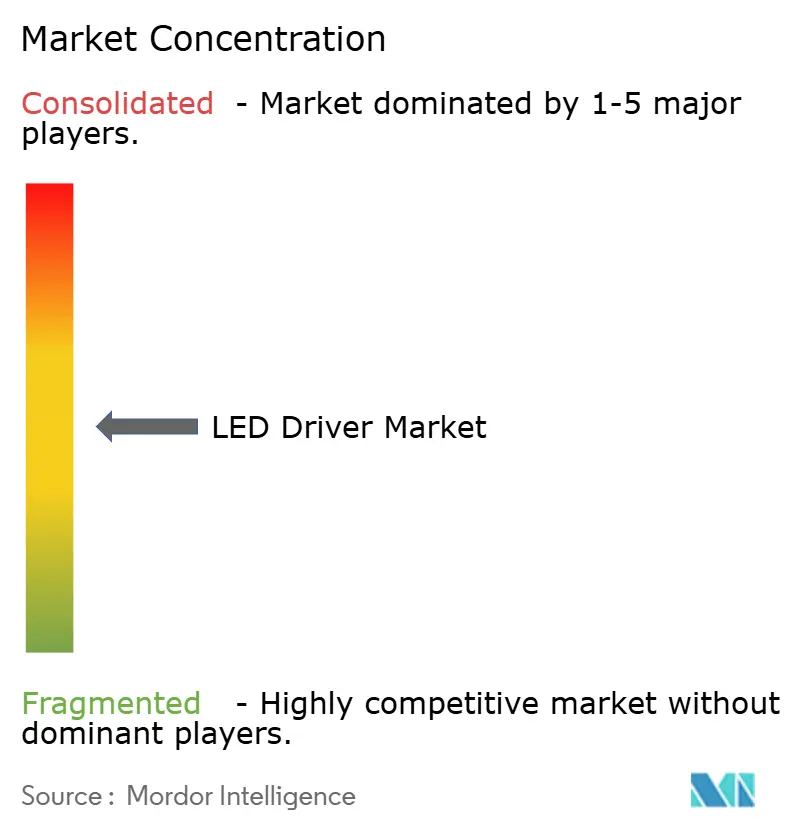
| Market Concentration | Medium |
Major Players *Disclaimer: Major Players sorted in no particular order Image © Mordor Intelligence. Reuse requires attribution under CC BY 4.0. | |
LED Driver Market Analysis by Mordor Intelligence
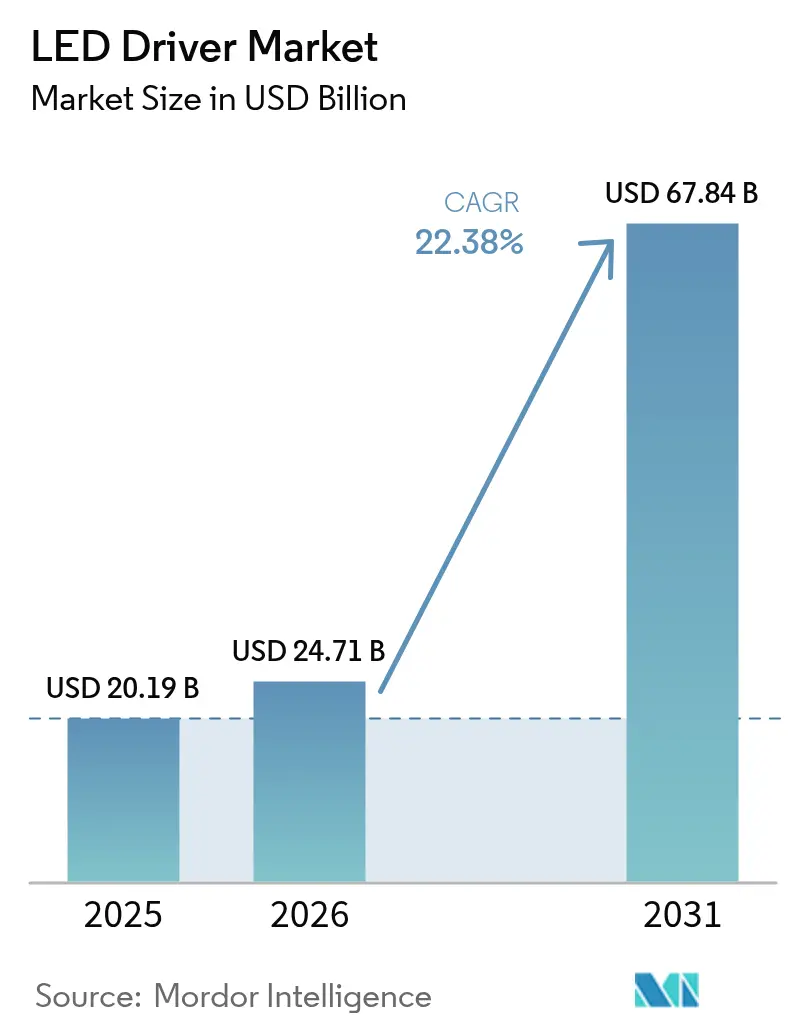
LED driver market size in 2026 is estimated at USD 24.71 billion, growing from 2025 value of USD 20.19 billion with 2031 projections showing USD 67.84 billion, growing at 22.38% CAGR over 2026-2031. This expansion is underpinned by the alignment of national energy-efficiency mandates, accelerating wireless-control adoption and the deployment of silicon-carbide and gallium-nitride semiconductors that raise conversion efficiency and shrink driver footprints. Government-funded retrofit programs, particularly in Asia-Pacific, intersect with net-zero commitments to lift large-scale replacement demand, while new-build codes in North America and Europe push integrated intelligent-lighting specifications. Automotive electrification further widens the addressable base for compact, high-temperature drivers, and Matter/Thread standardization dismantles long-standing interoperability barriers. Collectively, these shifts elevate the LED driver market from a component-supply business to a strategic enabler of connected-building platforms and energy-management services.
Key Report Takeaways
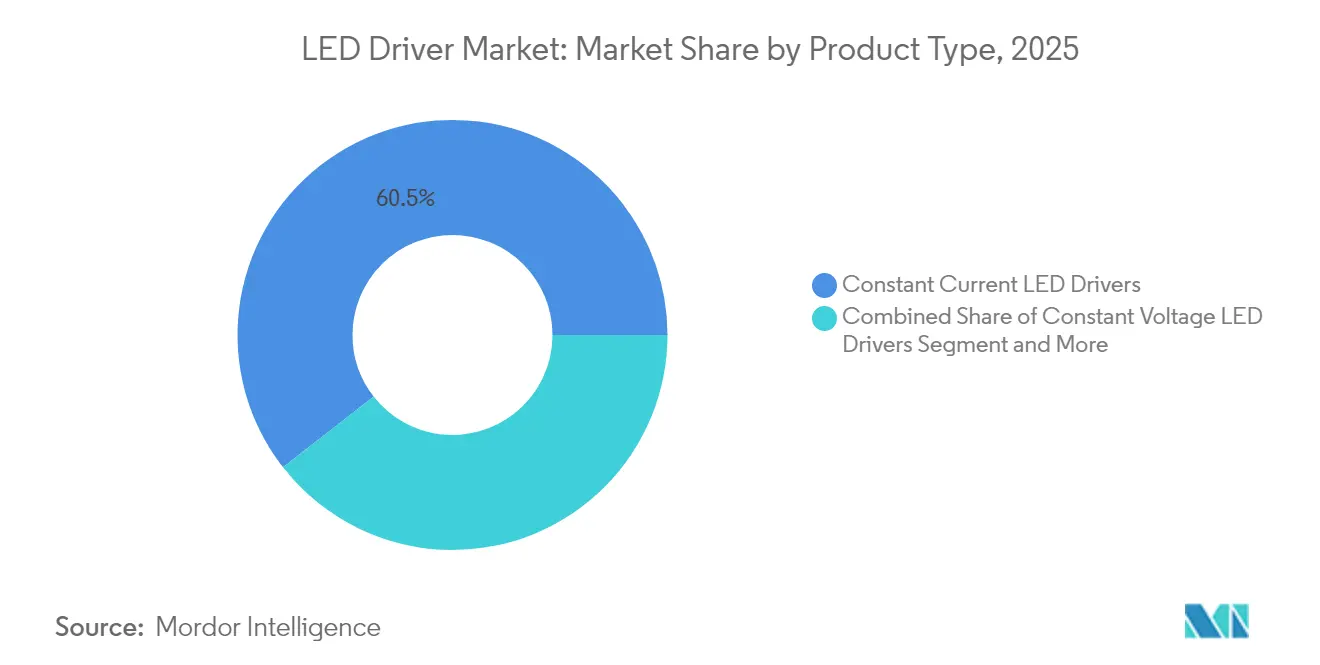
- By product type, constant current devices commanded 60.55% of LED driver market share in 2025; constant power drivers post the fastest 22.96% CAGR through 2031.
- By control feature, wired systems held 64.82% share of the LED driver market in 2025, while wireless protocols expand at a 23.62% CAGR to 2031.
- By power output, the 25-65 W range accounted for 31.74% of the LED driver market size in 2025; sub-25 W units grow at 23.15% CAGR on the back of IoT lighting nodes.
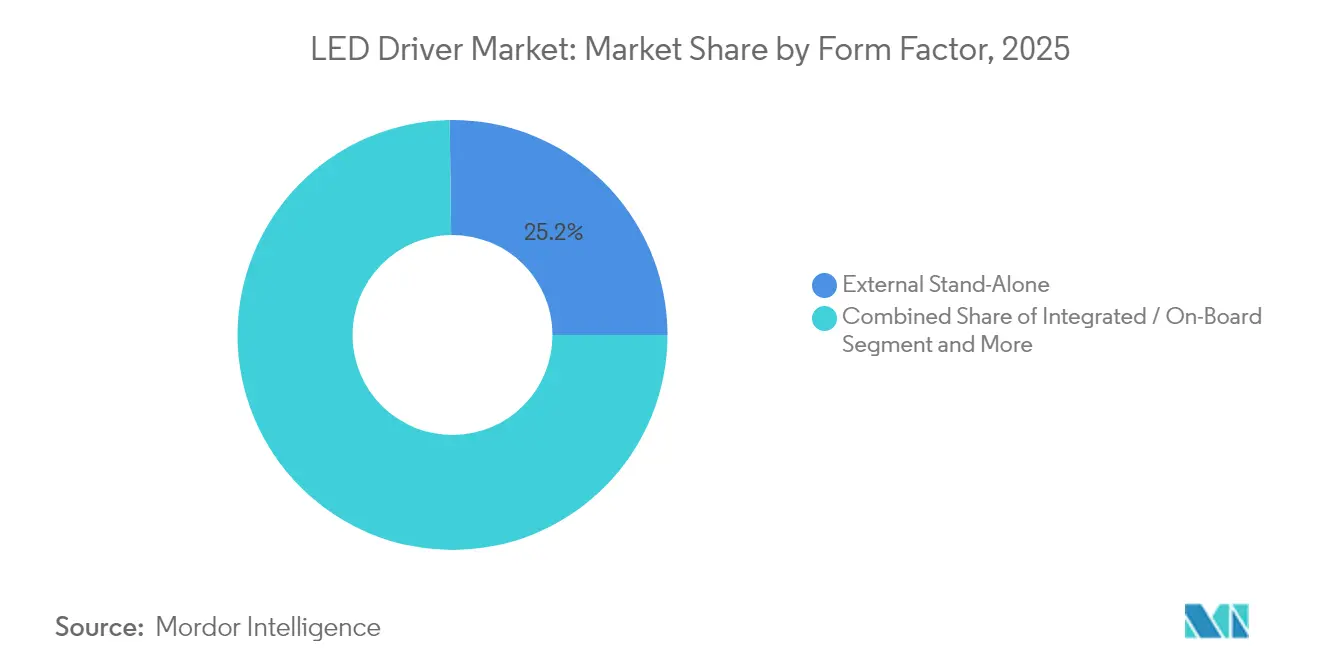
- By form factor, external stand-alone models represented 25.21% share in 2025, whereas compact/module drivers record a 22.85% CAGR through 2031.
- By end-use application, commercial and office lighting delivered 44.68% revenue in 2025; retail and hospitality luminaires accelerate at 24.18% CAGR to 2031.
- By geography, North America generated 31.96% LED driver market revenue in 2025; Asia-Pacific leads growth with a 23.51% CAGR forecast to 2031.
Note: Market size and forecast figures in this report are generated using Mordor Intelligence’s proprietary estimation framework, updated with the latest available data and insights as of 2026.
Market Trends and Insights
Drivers Impact Analysis of LED Driver Market*
| Driver | (~) % Impact on CAGR Forecast | Geographic Relevance | Impact Timeline |
|---|---|---|---|
| Subsidy-fuelled LED retrofit programs (post-2025 roll-outs) | +4.2% | Global, with concentration in Asia-Pacific and Europe | Medium term (2-4 years) |
| Rapid price declines in GaN-on-Si driver ICs | +3.8% | Global, led by North America and Asia-Pacific | Short term (≤ 2 years) |
| Smart-lighting mandates in new-build codes | +3.1% | North America and EU, expanding to Asia-Pacific | Long term (≥ 4 years) |
| Mainstream adoption of Matter/Thread wireless controls | +2.9% | Global, early adoption in North America | Medium term (2-4 years) |
| Surge in EV headlamp LED driver demand | +2.7% | Asia-Pacific core, spill-over to North America and Europe | Medium term (2-4 years) |
| Corporate net-zero targets accelerating industrial upgrades | +2.4% | Global, concentrated in developed markets | Long term (≥ 4 years) |
| Source: Mordor Intelligence | |||
Subsidy-fuelled LED Retrofit Programs Drive Market Acceleration
India’s UJALA initiative illustrates how large-scale distribution of efficient lamps can slash electricity demand by 20 GW and avoid 80 million t of CO₂ annually.[1]U.S. Department of Energy, “ANSI/ASHRAE/IES Standard 90.1-2022,” energy.gov Unlike earlier discount schemes, the program’s market-based approach sustained vendor margins, encouraging continual product upgrades that now emphasize advanced drivers with energy-monitoring functions. Similar schemes in China, Malaysia and the European Union are moving from bulb replacements toward holistic luminaire swaps, triggering demand for drivers that support wireless controls, target power factors above 0.9 and meet IEC flicker criteria. Because early LED waves entered service around 2015, a secondary replacement cycle of 5.8 billion units begins peaking between 2025 and 2028. These programs collectively add momentum to the LED driver market by ensuring predictable, large-volume procurement pipelines over the forecast period.
Rapid Price Declines in GaN-on-Si Driver ICs Enable Mass Adoption
Texas Instruments’ migration from 6-inch to 8-inch GaN wafers cuts die cost while improving yield consistency, pushing power-conversion efficiency beyond 92% and shrinking thermal budgets.[2]LED Lights Data Team, “Impact Analysis of India’s UJALA Scheme,” ledlightsdata.comInfineon’s 300 mm pilot line is expected to reach silicon-parity pricing in 2025, opening mainstream channels such as retail track lighting and appliance illumination. GaN’s higher switching frequencies reduce magnetics size by up to 40%, enabling slimmer luminaire profiles and lowering enclosure temperatures, a critical factor for chip-on-board modules. Automotive headlamp systems benefit from GaN’s resilience at high junction temperatures, supporting adaptive-beam architectures in electric vehicles. These economics support a virtuous cycle of integration: as volumes climb, cost drops deepen, broadening the LED driver market even further.
Smart-Lighting Mandates in New-Build Codes Create Compliance-Driven Demand
ANSI/ASHRAE/IES 90.1-2022 mandates a 9.8% site-energy reduction over the prior edition, compelling developers to specify drivers capable of continuous dimming, occupancy awareness and daylight harvesting.[3]Texas Instruments, “GaN Technology Scaling,” ti.com California’s Title 24 raises the bar by tying performance credits to networked-lighting control capability. In Europe, Ecodesign Regulation 2019/2020 projects 96 TWh annual savings by 2030, obliging separate control gear and modular serviceability. These regulations shift procurement decisions from luminaire efficacy alone to system-level intelligence, favouring drivers with integrated radio modules and diagnostic telemetry. As more jurisdictions pivot to performance-based codes, the compliance incentive becomes a structural driver for the LED driver market.
Mainstream Adoption of Matter/Thread Wireless Controls Standardizes Connectivity
Tridonic’s Matter-certified drivers show how Thread mesh networking can coexist with DALI and Bluetooth in a single PCB footprint. Nordic Semiconductor’s nRF52840 SoC enables concurrent Thread and BLE, simplifying bridge-free upgrades in hybrid networks. MEAN WELL’s XLC-MA platform extends the concept to power classes from 25 W to 60 W, letting OEMs address residential, hospitality and light-commercial scenes with one SKU. Standardized commissioning trims installation labour, cuts interoperability troubleshooting and unlocks data-layer services that monetize lighting assets. Together, these advances accelerate the LED driver market transition toward software-defined luminaires.
Restraints Impact Analysis of LED Driver Market*
| Restraint | (~) % Impact on CAGR Forecast | Geographic Relevance | Impact Timeline |
|---|---|---|---|
| Persistent silicon supply constraints for driver ICs | -2.8% | Global, acute in automotive and industrial segments | Short term (≤ 2 years) |
| Limited interoperability across legacy wired protocols | -1.9% | Global, concentrated in retrofit markets | Medium term (2-4 years) |
| Design-in complexity for non-isolated drivers | -1.4% | Global, affecting compact form factor adoption | Long term (≥ 4 years) |
| High import tariffs on Chinese constant-current modules | -1.2% | North America and Europe primarily | Medium term (2-4 years) |
| Source: Mordor Intelligence | |||
Persistent Silicon Supply Constraints Create Bottlenecks in Driver IC Production
Wolfspeed’s liquidity pressures threaten silicon-carbide wafer availability for high-power lighting and EV applications. Foundries prioritize advanced 3-nm logic, leaving 16-90 nm capacity thin for the mixed-signal processes used in LED drivers. Lead times exceed 40 weeks for common MOSFETs; speciality PMICs stretch beyond a year, forcing design pivots and multi-sourcing strategies. The constraint drives price volatility that squeezes mid-tier OEM margins, dampening near-term shipment potential in segments such as outdoor lighting projects with firm bid ceilings. Until capacity additions in Southeast Asia come online, silicon shortfalls remain a measurable drag on the LED driver market.
Limited Interoperability Across Legacy Wired Protocols Fragments Market Adoption
Commercial facilities often retain DALI, DMX or 0-10 V wiring to avoid tenant disruption, compelling driver makers to maintain protocol-specific SKUs. This fragmentation elevates inventory costs and complicates installer training. Unlike wireless ecosystems rapidly converging on Matter, the wired domain lacks an agreed convergence roadmap. Small manufacturers therefore shoulder disproportionate firmware-validation burdens, delaying product cycles. In high-security sites where wireless is prohibited, the absence of cross-protocol translation hardware will continue to curb the LED driver market’s retrofit velocity.
*Our forecasts treat driver/restraint impacts as directional, not additive. The impact forecasts reflect baseline growth, mix effects, and variable interactions.
LED Driver Market Segment Analysis
By Product Type:
Constant Power Drivers Gain TractionConstant current devices held 60.55% LED driver market share in 2025, driven by decades of design familiarity in high-lumen applications. However, constant power drivers deliver up to 92% conversion efficiency and accommodate variable-voltage LED loads without redesign, supporting a projected 22.96% CAGR between 2026 and 2031. In the automotive front-lighting niche, Infineon’s Litix Power Flex series illustrates the performance jump: SPI-controlled dimming and multi-string protection broaden functionality without thermal penalty.
The rise of adaptive lighting scenarios reinforces the shift. Architectural façades, sports arenas and tunable-white office fixtures benefit when output can adjust dynamically while current remains within diode tolerances. This versatility lowers SKU proliferation for luminaire makers and enhances field-upgrade paths. As wireless protocols proliferate, firmware-selectable power curves make constant power designs the preferred platform in the evolving LED driver market.



By Control Feature:
Wireless Protocols Accelerate Market TransformationWired systems, led by DALI and 0-10 V, accounted for 64.82% of the LED driver market size in 2025 because existing-bearing structures embed control cabling. Yet wireless features head into the steep part of the adoption curve, with a 23.62% CAGR through 2031. Legrand’s Matter-approved wall-box dimmers demonstrate consumer enthusiasm for app-based commissioning.
From a total-cost lens, eliminating control wires trims labour 15–25% in commercial retrofit budgets, often swinging ROI in favour of LED plus controls. Thread’s IPv6 foundation eases building-management integration, and BLE mesh provides low-energy fallback for emergency lighting checks. With over-the-air firmware updates now mainstream, wireless drivers extend operating lifetimes by accommodating future features. These advantages cement wireless as a pillar of the LED driver market.
By Power Output:
Compact Applications Drive Sub-25 W GrowthThe 25-65 W bracket maintained the biggest revenue slice at 31.74% in 2025, covering downlights and linear troffers in offices, schools and supermarkets. Nonetheless, the sub-25 W class grows fastest at 23.15% CAGR thanks to smart bulbs, track spots and decorative fixtures packing sensors, radios and edge processors. Compact drivers integrate step-down regulators for MCUs and maintain flicker-free dimming at deep modulation ratios, critical for HDTV-equipped retail venues.
As hospitality operators pursue human-centric lighting, multi-channel sub-25 W drivers support correlated-color-temperature tuning without bulky external gear. MEAN WELL’s latest constant-power micro-drivers illustrate the density race: power, Thread radio and NFC commissioning occupy a board smaller than a visiting card. These capabilities ensure the growth path for the lower-wattage segment within the LED driver market.
By Form Factor:
Module Integration Transforms Driver ArchitectureExternal stand-alone units still made up 25.21% of 2025 shipments, favored for serviceable streetlights and high-bay luminaires where thermal isolation is paramount. Yet module drivers, shipped as ready-to-embed cassettes, show a 22.85% CAGR outlook. Inventronics’ purchase of OSRAM Digital Systems extends its LED driver industry footprint into fully sealed IP67 modules with native D4i intelligence.
The module trend dovetails with OEM cost-downs: fewer connectors mean faster line throughput and lower field-failure rates. Automotive suppliers likewise migrate toward PCB-embedded drivers to reclaim engine-bay space. As global plastics regulations tighten, integrated metal-core boards also aid recyclability. This convergence positions module solutions as a central growth axis in the LED driver market.
By End-Use Application:
Retail Transformation Drives AdoptionCommercial and office estates generated 44.68% of 2025 revenue, buoyed by tenant fit-out cycles and ESG-linked financing. Yet retail and hospitality lighting captures the speed crown at 24.18% CAGR, leveraging dynamic color and targeted accent zones that boost dwell time. 7-Eleven’s retrofit across 4,760 U.S. stores saves USD 15.3 million yearly while improving shelf visibility and security.
Newer installations deploy multichannel drivers that orchestrate circadian-aligned spectra and per-aisle analytics services only feasible when drivers report telemetry via wireless backhaul. Hotels adopt similar logic, trimming operational expense and enabling guest-controlled ambience through branded mobile apps. These use-case expansions continue to diversify the LED driver market.
Geography Analysis
North America LED Driver Market
North America’s 31.96% revenue share in 2025 derives from rigorous lamp-efficacy rules that raise the bar to 83–195 lm/W, steering specifiers toward high-efficiency drivers. Corporate retrofits such as Coca-Cola Consolidated’s six-facility upgrade realize USD 97,063 annual savings and underline the quick payback narrative. The CHIPS Act allocates USD 200 billion for domestic fabs, improving resilience for analog and power components. Canada and Mexico leverage integrated supply chains to share technical standards and qualification labs, smoothing cross-border shipments.
APAC LED Driver Market
Asia-Pacific exhibits the fastest structural rise, projecting a 23.51% CAGR through 2031. China’s manufacturing depth slashes BOM costs, and its municipal smart-city grants stimulate local demand for drivers with NB-IoT or LoRa gateways. India’s record-scale UJALA program replenishes lamp inventories at end-of-life, kick-starting a second-wave luminaire upgrade cycle. Japan, South Korea and Taiwan channel EV-led headlamp innovations into exportable adaptive-beam drivers. ASEAN markets absorb supply-chain diversification, with Vietnam emerging as a finish-and-assembly hub for North American brands.
EMEA LED Driver Market
Europe sustains momentum through Ecodesign 2019/2020, which targets 96 TWh savings annually by 2030. Germany’s KfW-bank subsidies tie preferential interest rates to intelligent-lighting deployment, accelerating driver replacements in logistics warehouses. Eastern European retrofit pipelines receive cohesion-fund backing, while the United Kingdom’s Building Regulations Part L references dynamic-lighting guidance that favours drivers capable of open-protocol communication. The Middle East and Africa supplement the global LED driver market with Vision 2030 programs, typified by Saudi Arabia’s 9.6% CAGR LED adoption outlook underpinned by local assembly ventures.


Regulatory Landscape
Energy-efficiency and standby-power rules are tightening around the driver, particularly when control gear is handled separately. In the European Union, Commission Regulation (EU) 2019/2020 applies ecodesign requirements to light sources and separate control gear, including no-load and standby power limits (commonly referenced at 0.5 W thresholds) and documentation and market-surveillance expectations that push vendors toward higher-efficiency conversion and lower networked-idle consumption in connected drivers. In the United States, the Department of Energy continues to enforce general service lamp (GSL) efficacy requirements under EPCA, sustaining upstream demand for high-efficacy lighting systems that often require higher-performing, flicker-managed drivers to meet project specifications.
Technical compliance is also influenced by international standards used in procurement and certification. IEC 62384 defines performance requirements for LED control gear, while IEC 62386-250 covers integrated power supply requirements within DALI systems, supporting interoperability for wired controls as DALI-2 and D4i ecosystems expand. In the United Kingdom, the Ecodesign for Energy-Related Products (Lighting Products) Regulations 2021 include a mandated review, with a report due by October 1, 2026, creating a near-term policy checkpoint that suppliers will monitor for potential updates to efficiency, standby-power, and information requirements. Programs such as DesignLights Consortium draft updates (SSL V6.0 and LUNA V2.0 released in April 2025 as drafts) also signal procurement-driven pressure toward longer driver lifetime and higher performance thresholds in commercial projects.
Competitive Landscape
The LED driver marketplace shows moderate concentration: the combined share of the top five suppliers hovers near 45%, reflecting a balance between global incumbents and specialized challengers. Signify capitalizes on Philips Lumileds vertical integration, marketing D4i-ready drivers bundled with Interact IoT services. ams OSRAM sustains premium positioning by pairing high-CRI emitters with OPTOTRONIC constant-power gear, while Acuity Brands extends Atrius cloud analytics across its digitally addressable drivers.
Strategic activity aligns to platform plays. Inventronics’ acquisition of OSRAM Digital Systems extends its footprint into Europe and deepens R&D for modular IP67 devices. Havells Lighting’s 2025 entry into the United States through a joint venture with Krut LED underscores the vertical-integration thesis—own the driver, the fixture and the service layer. Semiconductor specialists likewise eye the lighting channel: Navitas Semiconductor’s 650 V bi-directional GaNFast IC shrinks BOM counts, freeing board space for sensors and radios that differentiate smart luminaires.
Innovation focus migrates from raw efficiency to software extensibility. Patenting trends see an uptick in firmware-defined power curves and secure over-the-air update frameworks, indicating that competitive advantage now lies in lifecycle adaptability rather than static specifications. This evolution keeps pricing pressure moderate yet fosters service-based revenue that enlarges the overall LED driver market envelope.
LED Driver Industry Leaders
Acuity Brands Lighting
Signify
ams OSRAM
Eaton (Cooper Lighting)
Hubbell Incorporated
- *Disclaimer: Major Players sorted in no particular order
LED Driver Market Companies Covered in this Report
- Signify
- ams OSRAM
- Acuity Brands Lighting
- Hubbell Incorporated
- Eaton (Cooper Lighting)
- Lutron Electronics
- Cree LED (SGH)
- MEAN WELL Enterprises
- Inventronics
- Tridonic (Zumtobel)
- Delta Electronics
- Shenzhen Done Power
- ERP Power
- Lifud Technology
- Helvar
- Murata Manufacturing
- Texas Instruments
- ON Semi
- Allegro MicroSystems
- ROHM Semiconductor
- Macroblock Inc.
- TCI Srl
- MOSO Power
- Current (GE)

Market Opportunities and Future Outlook
A clearer whitespace is emerging for drivers that pair high-efficiency power conversion with native multi-protocol control, which can reduce SKU fragmentation across DALI-2/0-10 V, DMX, and Matter/Thread ecosystems. Platform moves are reinforcing this convergence, including Signify expanding Philips Hue Matter support through a collaboration with Silicon Labs that enables concurrent multiprotocol operation (Zigbee and Matter over Thread) on MG26 and SiMG301 SoCs, and Josh.ai adding native DMX and DALI support to broaden integration in higher-end residential and commercial control stacks. For driver and luminaire OEMs, these shifts increase the value of designs that build in secure commissioning, telemetry, and interoperability features in the driver electronics, rather than relying on controls as an external add-on.
Efficiency-led redesign is also being pulled by policy and procurement thresholds. China issued GB 30255-2026 on March 18, 2026 (effective September 1, 2027), adding a future compliance milestone for indoor LED lighting products that creates another adoption check for higher driver efficiency and lower standby losses. On the hardware side, non-isolated architectures and advanced topologies, including GaN-based approaches, are being productized for demanding use cases such as industrial and stadium lighting, illustrated by MOSO Power introducing N7-II/N7L-II non-isolated drivers positioned around high peak efficiency. These threads align with active replacement cycles in retrofits and with new-build code requirements for dimming, occupancy/daylight response, and controllability, leaving room for suppliers that can deliver compliant, interoperable, serviceable driver platforms at scale.
Recent Industry Developments in LED Driver Market
- May 2026: Lumissil Microsystems introduced the IS32FL3776 matrix LED driver aimed at intelligent signal displays and software-defined exterior lighting modules, supporting RGB Mini LED display use cases. The launch highlights a push toward high-channel-count drivers that enable dynamic, addressable lighting functions beyond simple illumination in automotive and signaling applications.
- March 2026: Eaglerise entered a brand-licensing agreement with ams OSRAM to use the OSRAM brand for general lighting LED drivers in APAC and EMEA, effective March 1, 2026. The deal points to how brand and channel strategy is being used to extend reach for LED driver portfolios while aligning manufacturing and go-to-market capabilities across regions.
- April 2024: The US Department of Energy published a final rule in the Federal Register reinforcing and updating enforcement around general service lamp efficiency requirements under EPCA. The action keeps compliance pressure on lighting system efficacy, which feeds through to luminaire and driver selection in regulated applications.


LED Driver Market Report Scope and Research Methodology
Market Definition and Coverage
This market covers the value of LED drivers that regulate power to LED loads, so lighting systems run safely, consistently, and efficiently across indoor and outdoor uses. Revenue is counted for driver units sold as part of new installations and replacements across major regions.
Scope exclusions: Excludes LED light sources, luminaires, and lighting controls that do not include a driver component.
Segments Covered in This Report
- By Product Type
- Constant Current LED Drivers
- Constant Voltage LED Drivers
- Constant Power LED Drivers
- By Control Feature
- Wired
- 0-10 V
- DALI
- DMX
- PLC
- Trailing-Edge
- Wireless
- Wi-Fi
- Bluetooth/BLE
- Zigbee
- Thread / Matter
- Li-Fi
- Wired
- By Power Output
- Less than 25 W
- 25 - 65 W
- 65 -150 W
- Greater than 150 W
- By Form Factor
- External Stand-Alone
- Integrated / On-Board
- Linear Drivers
- Compact / Module Drivers
- By End-Use Application
- Residential
- Commercial and Office
- Retail and Hospitality
- Outdoor and Street Lighting
- Industrial
- Healthcare and Education
- Automotive Lighting Systems
- Horticulture and Agriculture
- Consumer-Electronics Backlighting
- Other Applications
- By Geography
- North America
- United States
- Canada
- Mexico
- South America
- Brazil
- Argentina
- Rest of South America
- Europe
- Germany
- United Kingdom
- France
- Italy
- Spain
- Russia
- Rest of Europe
- Asia-Pacific
- China
- Japan
- South Korea
- India
- Rest of Asia-Pacific
- Middle East and Africa
- Middle East
- Saudi Arabia
- United Arab Emirates
- Turkey
- Qatar
- Rest of Middle East
- Africa
- South Africa
- Egypt
- Nigeria
- Kenya
- Rest of Africa
- Middle East
- North America
Data Sources, Market Sizing, and Validation
Desk Research
Desk research was used to build the starting view on LED driver demand drivers and the supply environment, before assumptions were finalized. We mainly relied on public sources such as US Department of Energy lighting and efficiency updates, US Energy Information Administration electricity price series, International Energy Agency energy efficiency indicators, UN Comtrade trade statistics for relevant electronics categories, and IEC or UL public standards notes that spell out safety and performance requirements.
To keep the model grounded, secondary inputs were also checked through company annual reports and investor presentations, customs and procurement notices for public lighting projects, and reputable press coverage on retrofit programs and smart lighting adoption. Where needed, paid subscriptions for company financials and news, shipment-level import and export checks, and patent database scans were used to confirm product direction and timing. The sources listed here are illustrative, and additional public references were reviewed for data collection, validation, and clarification.
Primary Interviews and Surveys
Primary work focused on interviews and short surveys with manufacturers, component suppliers, distributors, installers, and large buyers who specify drivers for projects. Respondent input was used to validate shifts in driver mix (dimmable, wireless-enabled, power ranges), typical replacement cycles, and ASP movement, then to stress test regional demand assumptions across APAC, EMEA, and the Americas.
Distribution of primary research fieldwork respondents
| Company type | Respondent position | Region |
|---|---|---|
| Top tier: 31% | CXOs: 13% | APAC: 39% |
| Mid tier: 55% | Functional/Unit leaders: 37% | EMEA: 37% |
| Smaller Players: 14% | Managers: 50% | Americas: 24% |
Market-Sizing & Forecasting
Sizing starts with a top-down build where the demand pool is reconstructed from lighting activity and electronics output signals, then filtered by where LED driver content is required. In practice, we map indicators such as LED lighting adoption in key end uses, retrofit intensity in street and commercial lighting, construction and renovation trends, and electrification activity that increases LED usage in vehicles and infrastructure.
Those totals are then corroborated with selective bottom-up approximations so the value line stays realistic, including sampled price points by driver type, channel checks on mix by power output, and a sanity check against supplier revenue exposure where it is clearly disclosed. When coverage gaps exist for smaller geographies or niche applications, we use proxy mix shares from similar markets and then adjust them after primary feedback confirms whether penetration and pricing behave similarly.
For forecasting, scenario analysis was used so growth stays tied to a few understandable levers, then the trajectory was cross-checked against expert expectations on retrofit funding cycles, tightening efficiency standards, smart lighting attachment rates, and component cost trends that influence ASP. We kept assumptions transparent so each year can be re-run with updated indicators without rebuilding the model from scratch.
Data Validation & Update Cycle
Outputs are validated through multiple checks so unusual swings do not enter the final numbers. We compare the model against independent signals such as regional lighting project activity, trade movements for relevant driver categories, and documented regulation changes that can shift replacement demand.
Before sign-off, anomalies are reviewed in steps, first at the variable level and then at the total market level, followed by an internal analyst review so assumptions and math remain consistent. If a large variance shows up versus prior years or external indicators, respondents are re-contacted to confirm whether the change reflects actual demand or timing. Reports are refreshed annually, with interim updates when material events occur, and a final pre-delivery pass is completed so clients receive the latest updated view.
Mordor Intelligence's Led Driver Market Estimate Compared With Other Published Estimates
Published market sizes for LED drivers often do not match because scope is defined differently and the math inputs are updated at different times. Differences usually come from what product forms are counted, which applications are included, and how pricing is handled when technology shifts quickly.
General lighting retrofits, smart control attachment, and regional currency timing are three areas that can move the final value a lot, even when the same years are used. Some estimates include adjacent power electronics or broader lighting system value, while others use aggressive ASP inflation or assume faster penetration in retrofit-heavy regions without re-checking the pace with buyers and channels.
Benchmark comparison
| Source | Market Size | Gaps in Research Methodology |
|---|---|---|
| Mordor Intelligence | USD 24.71 B (2026) | |
| Global Consultancy A | USD 65.81 B (2026) | A broader accounting of value appears to be used, where general lighting and related system content can get blended with driver value, and growth is pushed by a higher assumed smart lighting uplift and longer forecast span. |
| Industry Publisher B | USD 57.87 B (2025) | Uses an earlier base year and a wider segment lens that can fold in more end uses and luminaire-linked totals, and the price and mix path is less transparent around dimmable and wireless driver adoption. |
Luminaire value sits outside Mordor Intelligence's scope, which helps explain why some published totals land much higher even when the same year is referenced. With clearer inclusion rules, mix based pricing, and checks against activity signals, the estimate stays easier to trace back to demand drivers and to refresh when conditions change.


Key Questions Answered in the Report
What is the current LED driver market size and projected growth?
The LED driver market size stands at USD 24.71 billion in 2026 and is expected to reach USD 67.84 billion by 2031, delivering a 22.38% CAGR over 2026-2031.
Which product type leads the LED driver market?
Constant current drivers lead with 60.55% market share in 2025, although constant power designs are the fastest-growing segment at 22.96% CAGR.
Why are wireless LED drivers gaining traction?
Thread- and Matter-based wireless drivers cut installation labour, offer seamless smart-home integration and post a 23.62% CAGR through 2031, outpacing wired alternatives.
Which region exhibits the highest growth rate?
Asia-Pacific shows the fastest expansion, forecast at 23.51% CAGR, fueled by infrastructure investments, policy incentives and expanding manufacturing capacity.
How are GaN devices influencing LED driver design?
Rapid cost declines in GaN-on-silicon driver ICs boost efficiency beyond 92%, reduce form factors by up to 40% and open new high-density applications such as EV headlamps.
Page last updated on:


 Your data is secure and never sold or shared.


