
Kinesiology Tape Market Size and Share
Market Overview
| Study Period | 2020 - 2031 |
|---|---|
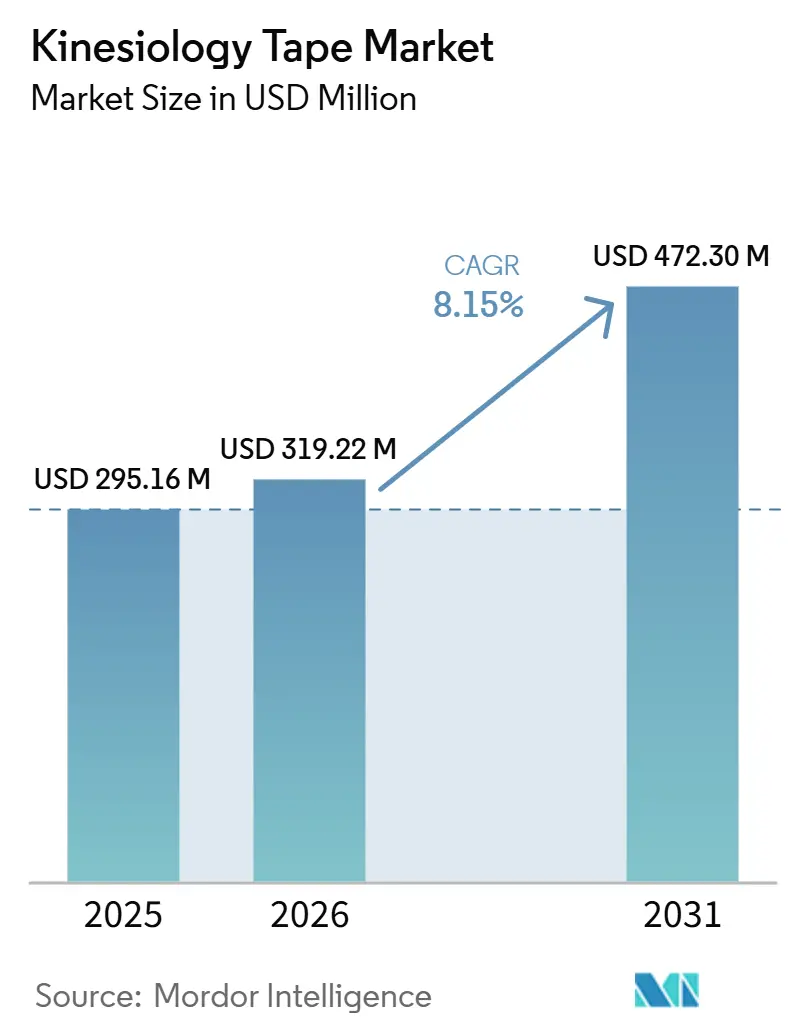
| Market Size (2026) | USD 319.22 Million |
| Market Size (2031) | USD 472.30 Million |
| Growth Rate (2026 - 2031) | 8.15 % |
| Fastest Growing Market | Asia-Pacific |
| Largest Market | North America |
| Market Concentration | Medium |
Major Players *Disclaimer: Major Players sorted in no particular order Image © Mordor Intelligence. Reuse requires attribution under CC BY 4.0. | |
Kinesiology Tape Market Analysis by Mordor Intelligence
The Kinesiology Tape Market size is expected to increase from USD 295.16 million in 2025 to USD 319.22 million in 2026 and reach USD 472.30 million by 2031, growing at a CAGR of 8.15% over 2026-2031.
Rising athlete numbers, expanding physiotherapy networks, and the ascent of direct-to-consumer e-commerce collectively sustain this up-trend. At the same time, regulatory vigilance and raw-material cost swings shape competitive playbooks. Clinical protocols now embed tape alongside exercise therapy, oncology rehabilitation teams are piloting lymphedema taping, and subscription commerce funnels recurrent household demand. Against this momentum, higher cotton and adhesive prices compress margins, and braces or compression garments chip away at share, forcing suppliers to differentiate on hypoallergenic, sustainable, and performance-enhanced materials. Manufacturers able to validate therapeutic claims, secure green certifications, and expand omnichannel reach will be positioned to outpace the headline.
Key Report Takeaways
- By product type, rolls captured 46.28% of the kinesiology tape market share in 2025. Pre-shaped applications are forecast to post an 8.92% CAGR through 2031.
- By material, cotton accounted for 63.30% of the kinesiology tape market size in 2025. Synthetic variants will advance at a 9.11% CAGR to 2031.
- By end user, sports teams and athletes accounted for 38.52% of revenue share in 2025. Home-care settings are set to expand at a 9.28% CAGR between 2026 and 2031.
- By application, sports injury prevention and recovery accounted for 41.35% of the kinesiology tape market in 2025.
- By Distribution channel, pharmacies retained a 36.70% share in 2025, while online stores are climbing at an 8.03% CAGR on the back of subscription and influencer-led commerce.
- North America commanded 41.76% of the kinesiology tape market share in 2025, whereas Asia-Pacific is anticipated to register a 9.80% CAGR over the forecast period.
Note: Market size and forecast figures in this report are generated using Mordor Intelligence’s proprietary estimation framework, updated with the latest available data and insights as of January 2026.
Global Kinesiology Tape Market Trends and Insights
Drivers Impact Analysis*
| Driver | (~) % Impact on CAGR Forecast | Geographic Relevance | Impact Timeline |
|---|---|---|---|
| Sports-injury prevalence and rising athlete population | +1.4% | Global focus on North America, Europe, Asia-Pacific urban centers | Medium term (2-4 years) |
| Increasing clinical adoption across physiotherapy networks | +1.2% | North America, Germany, the United Kingdom, Japan, Australia | Medium term (2-4 years) |
| E-commerce and direct-to-consumer models | +1.0% | North America and Asia-Pacific | Short term (≤ 2 years) |
| Tele-rehabilitation kit integration | +0.9% | North America, Germany, emerging Asia-Pacific | Medium term (2-4 years) |
| Oncology and lymphedema protocols | +0.8% | North America, Europe, spillover to MEA and South America | Long term (≥ 4 years) |
| Sustainable hypoallergenic materials | +0.6% | Europe, North America, select Asia-Pacific markets | Long term (≥ 4 years) |
| Source: Mordor Intelligence | |||
Sports-Injury Prevalence and Rising Athlete Population
Escalating sports participation fuels the kinesiology tape market as musculoskeletal injuries mount across youth and professional cohorts. Track-and-field logged 128,761 lower-extremity cases from 2014-2023, with sprains and strains making up nearly half the incidents. Soccer added 843,063 lower-extremity injuries in the same span, intensifying demand for non-restrictive recovery aids. High-visibility use during the 2024 Paris Games normalized taping on elite athletes and spurred consumer curiosity.[1]World Health Organization, “Global Status Report on Physical Activity 2022,” who.int Manufacturers capitalize on influencer outreach to spread taping techniques, compressing the education curve for first-time buyers. Because new sports infrastructure and youth leagues take 2 to 4 years from planning to full utilization, the volume lift manifests in the medium term.
Increasing Clinical Adoption Across Physiotherapy Networks
Meta-analyses show taping can temper knee edema and pain after total knee arthroplasty while improving post-stroke dysphagia outcomes, nudging hospitals to integrate it into bundled rehabilitation programs. OSHA’s 2024 guidance classifying kinesiology tape as first-aid treatment reduced administrative hurdles in occupational settings. Randomized trials of finger injuries demonstrated superior range of motion and comfort compared with rigid splints, further reinforcing clinician confidence. Such findings widen payer acceptance and strengthen formulary inclusion within outpatient networks.
E-Commerce and Direct-to-Consumer Models Boosting Consumer Uptake
Health Savings Account eligibility, combined with instructional video libraries, positions the kinesiology tape market for accelerated online conversion. Specialist retailers pair product selection with evidence-backed tutorials, aiding safe self-application and repeat purchasing. Major medical distributors, such as Henry Schein, added multiple tape brands to clinician portals, underscoring omnichannel strategies that blur professional and consumer boundaries. Subscription storefronts led by KT Tape collect first-party data, allowing rapid iteration of flavored adhesives, eco-packs, and co-branded athlete lines. Digital channels bypass pharmacy slotting fees, lifting gross margins by 8-10 percentage points for leading brands according to corporate filings.
Tele-Rehabilitation Kit Integration
Fifty-three-patient studies showed appreciable gains in upper-limb function when home exercise programs included guided taping, validating its fit within virtual care bundles. FDA Class I status for elastic bandages simplifies remote shipment and onboarding. Manufacturers respond with pre-cut strips that minimize application errors, supporting therapist-led real-time coaching sessions.
Digital therapeutics reimbursed under Germany’s DiGA framework include kinesiology tape in mailed starter kits, pairing video modules with physical aids that improve engagement. U.S. insurers have yet to codify kit reimbursement, so providers tread cautiously, bundling smaller quantities and leaning on patient-pay models. Manufacturers embed scannable codes linking to platform-approved taping sequences, reducing clinician workload.
Restraints Impact Analysis*
| Restraint | (~) % Impact on CAGR Forecast | Geographic Relevance | Impact Timeline |
|---|---|---|---|
| Inconclusive clinical-efficacy meta-analyses | -0.8% | Global, higher in North America and Europe | Medium term (2-4 years) |
| Substitution by braces, compression, pneumatic systems | -0.6% | Global, especially North America and Europe orthopedic markets | Medium term (2-4 years) |
| Regulatory scrutiny over therapeutic claims | -0.5% | North America, Europe, Asia-Pacific spillover | Short term (≤ 2 years) |
| Volatile cotton and adhesive prices | -0.4% | Cotton-dependent supply chains in India, China, Turkey | Short term (≤ 2 years) |
| Source: Mordor Intelligence | |||
Inconclusive Clinical-Efficacy Meta-Analyses
Several meta-analyses underscore pain relief yet note negligible gains in knee function or proprioception, leading guideline committees to issue cautious recommendations. Scholars argue that placebo components may influence outcomes, and reviewers call for larger randomized designs to delineate mechanisms conclusively. Procurement committees in U.S. hospital networks can bulk purchase or insist on generic brands. Consumer channels remain buoyant because purchase motivation leans on peer anecdotes and social proof. Translation of negative findings into formal guidelines usually spans two to four years, matching the restraint’s medium-term horizon.
Substitution by Braces, Compression Devices, and Pneumatic Systems
Reusable knee braces last six to twelve months, slashing lifetime cost relative to single-use tapes. Graduated compression socks have more substantial evidence for venous return, and home-based intermittent pneumatic compression systems offer programmable pressure cycles, edging out chronic-care regimens for edging tape. Tape retains niche relevance where freedom of motion and low bulk are decisive, such as in volleyball or gymnastics. As clinicians present side-by-side efficacy data, patient preference shifts over multiple seasons, underlining the medium-term drag.
*Our forecasts treat driver/restraint impacts as directional, not additive. The impact forecasts reflect baseline growth, mix effects, and variable interactions.
Segment Analysis
By Product Type: Pre-Cut Convenience Gains on Bulk Rolls
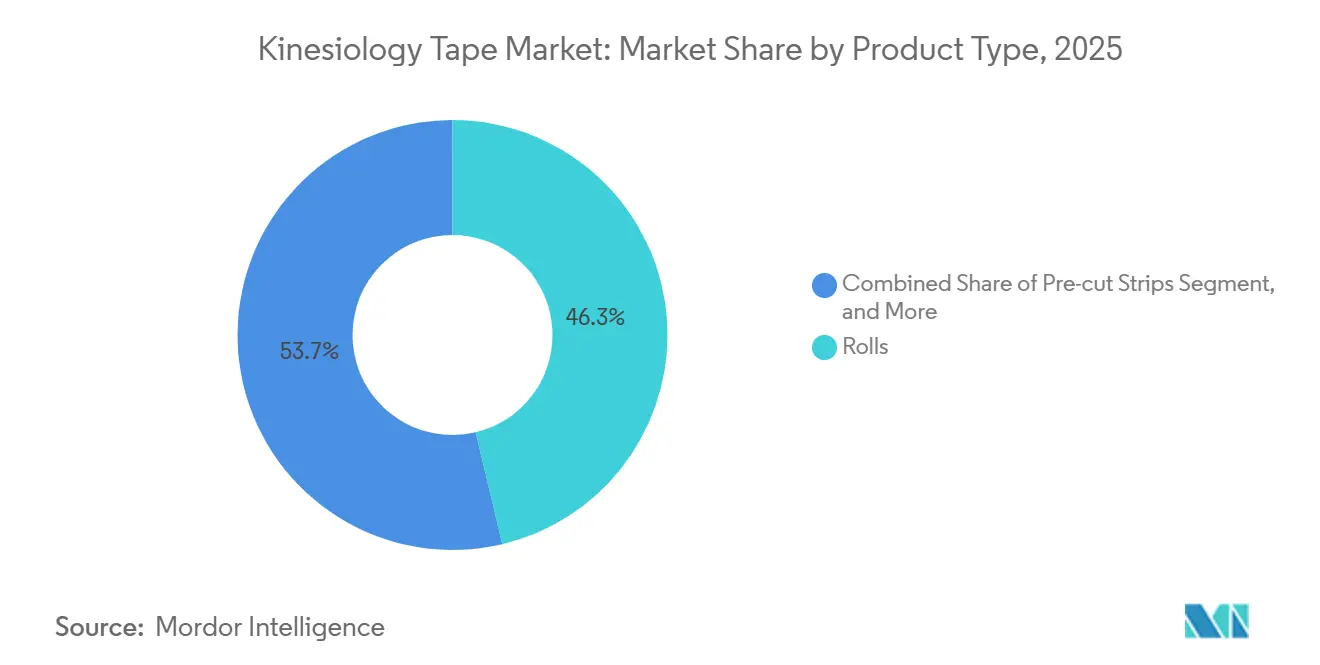
Rolls commanded 46.28% of the kinesiology tape market share in 2025, reflecting the entrenched role of bulk supply within clinics and elite sports facilities. Volume buyers appreciate the 20-30% lower price per linear meter, while practitioners value the freedom to tailor length and shape on the fly. Pre-cut strips are charting an 8.92% CAGR, powered by e-commerce, home fitness, and aging consumers who prefer no-scissor application. Marketing pivots toward anatomy-specific designs, such as pre-formed shoulder patches, that have reframed tape as an accessible self-care accessory rather than a clinician-only tool. Subscription websites often bundle video tutorials to compress the learning curve, increasing the likelihood of a second purchase and raising practical lifetime value.
The product shift alters supply-chain economics. Die-cutting and individual foil wrapping inflate unit costs for pre-cuts, yet higher retail pricing yields net margin parity. Inventory complexity balloons as brands juggle multiple colors, scents, and anatomical SKUs, so cloud-based demand forecasting and print-on-demand packaging solutions are now standard among the top five vendors. Rolls, meanwhile, evolve through QR-coded cores that stream application videos, anchoring their relevance in physiotherapy even as consumer adoption migrates elsewhere. The dual-format approach allows brands to defend legacy institutional contracts while capturing incremental household demand, stabilizing overall kinesiology tape market size growth through 2031.



By Material: Synthetic Blends Challenge Cotton Dominance
Cotton held 63.30% of the kinesiology tape market in 2025 due to its breathability, hypoallergenic properties, and historical familiarity among clinicians. Yet moisture retention under humid or high-sweat conditions accelerates edge lift and bacterial colonization, prompting athletes in tropical climates to trial polyester or rayon options. Synthetic blends are scaling at 9.11% CAGR as R&D advances achieve equal stretch ratios at thinner gauges, resulting in barely-there feel favored by endurance runners. Water-sports federations now specify synthetic tapes in competition kits, tightening demand loops. Hybrid constructions that weave natural fibers with polyester aim to merge comfort with longevity. Silicone-backed variants appear on oncology wards where hypoallergenic imperatives outweigh cost.
Material selection also influences therapist workload: tapes that peel cleanly reduce re-dressing time, a metric tracked by outpatient clinics. Regulatory harmonization via ISO 10993 steers suppliers toward transparent biocompatibility dossiers, indirectly favoring larger firms able to fund comprehensive testing.
By End-User: Home Care Overtakes Institutional Channels
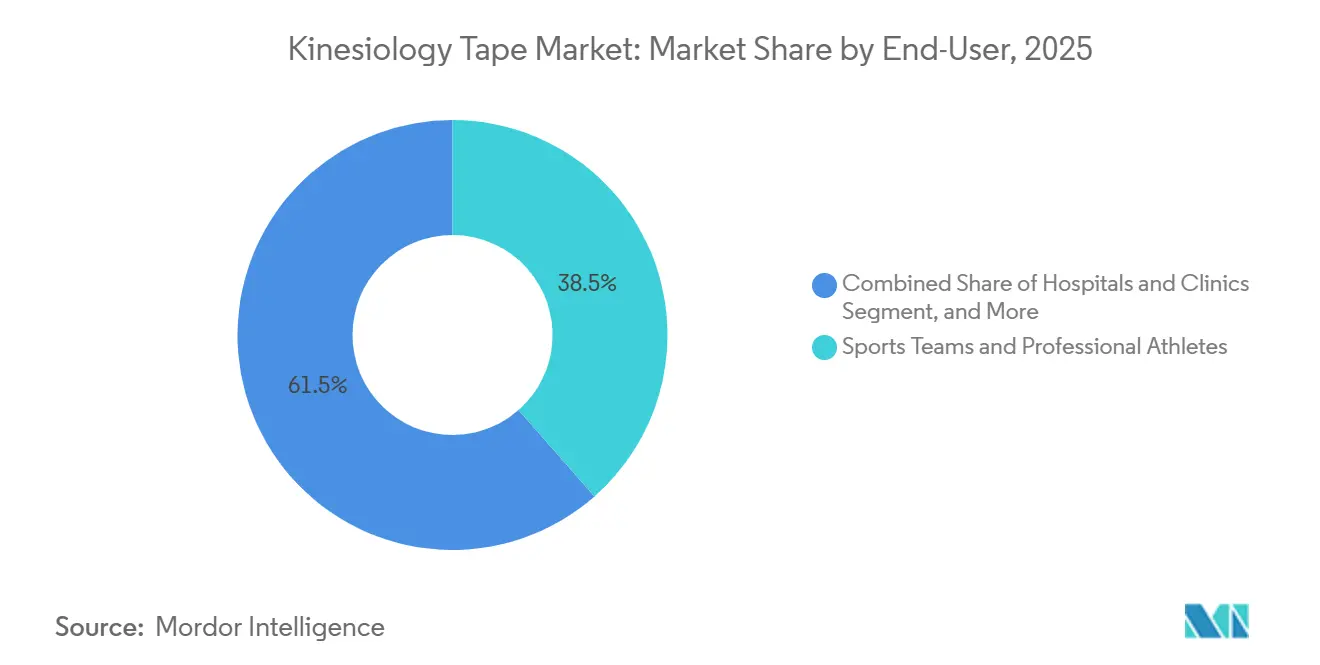
Sports teams and professional athletes accounted for 38.52% of 2025 revenue, reflecting a decades-long culture of courtside taping and rapid turnover of consumables. Brand visibility from televised events sustains aspirational pull, but growth moderates as penetration nears saturation in mature leagues. Home care is accelerating at 9.28% CAGR as retirees manage osteoarthritis flare-ups and desk workers mitigate posture-related strain. Tele-rehabilitation platforms ship starter boxes containing tape and resistance bands, converting passive viewers into active users. Pre-cut strip packs dominate this channel, leveraging user-friendly peel-and-stick formats and smartphone-guided placement tutorials.
Patient adherence depends on perceived benefit and skin reaction. Brands introduce breathable backings and dye-free colorways for sensitive users, while subscription models supply automatic replenishments. As remote monitoring platforms embed taping checklists, compliance data increasingly feed back into payer dashboards, solidifying the modality’s foothold in chronic-condition pathways.
By Application: Post-Operative Protocols Outpace Sports Injury
Sports-injury prevention and recovery accounted for 41.35% of 2025 revenue, driven by ankle, shoulder, and hamstring taping during competitive cycles. However, incremental unit growth is bounded by near-universal adoption among professional teams and rising brace substitution in severe cases. Post-operative and lymphedema management is logging a 9.50% CAGR, underwritten by hospital-based rehab protocols that integrate tape to reduce localized edema and improve scar mobility. Lymphology societies are embedding taping modules into certification courses, seeding grassroots demand among newly credentialed therapists. Surgeons increasingly prescribe taping as an adjunct to manual lymphatic drainage, citing patient-reported comfort improvements. Protocol standardization is emerging, recommending 10% stretch and fan-cut strips for edema channels, which vendors now pre-package for oncology centers.
By Distribution Channel: Online Marketplaces Erode Pharmacy Share
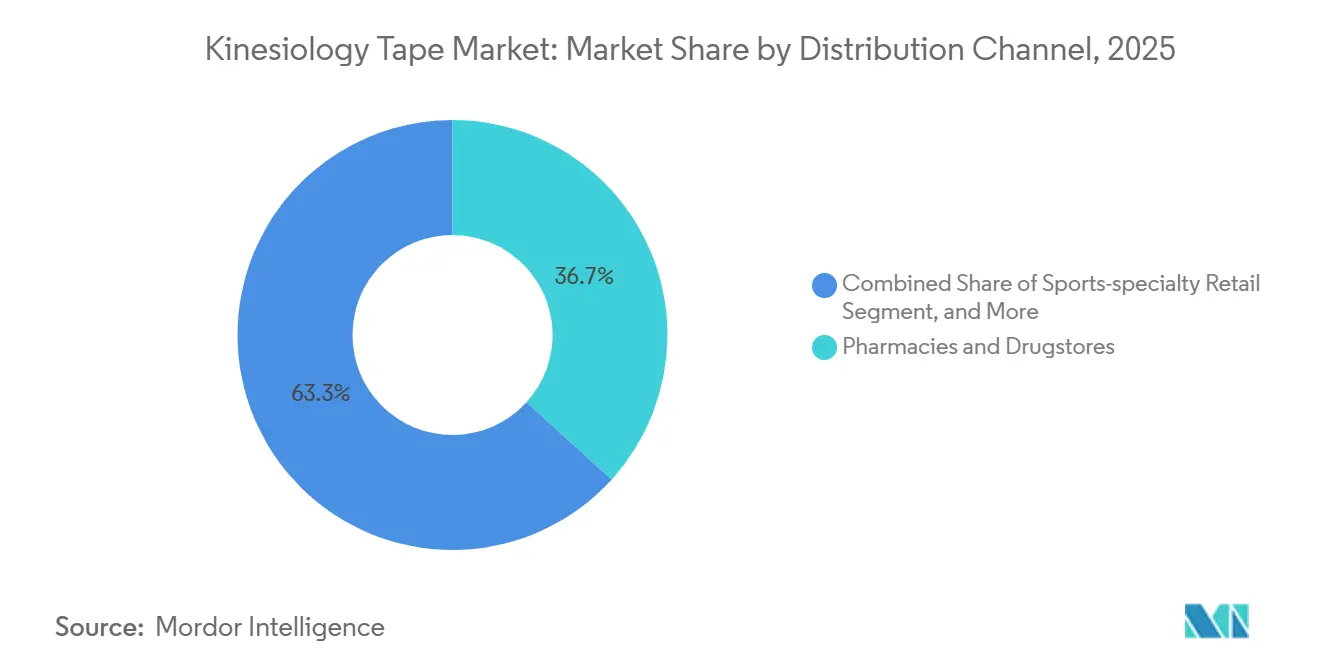
Pharmacies and drugstores maintained a 36.70% revenue share in 2025, driven by walk-in convenience and pharmacist guidance for first-time users. Nonetheless, online marketplaces are riding an 8.03% CAGR, propelled by algorithmic product discovery, video-rich listings, and auto-replenishment discounts that reward loyalty with frictionless restocking. E-tailers display up to 100 SKUs per brand, dwarfing physical shelf capacity and enabling micro-segmentation by color, length, and adhesive type. Counterfeit risk remains, yet serialized packaging and brand-verified seller programs on major platforms mitigate erosion of consumer trust.
Hybrid click-and-collect models are emerging wherein pharmacy chains list complete digital catalogs online, giving shoppers the choice of home delivery or same-day pickup. Brands that harmonize pricing across channels avoid gray-market arbitrage, a tactic critical to sustaining perceived value. Overall, omnichannel strategies that blend doorstep convenience with expert counsel ensure the kinesiology tape market captures both digital natives and traditional buyers.
Geography Analysis
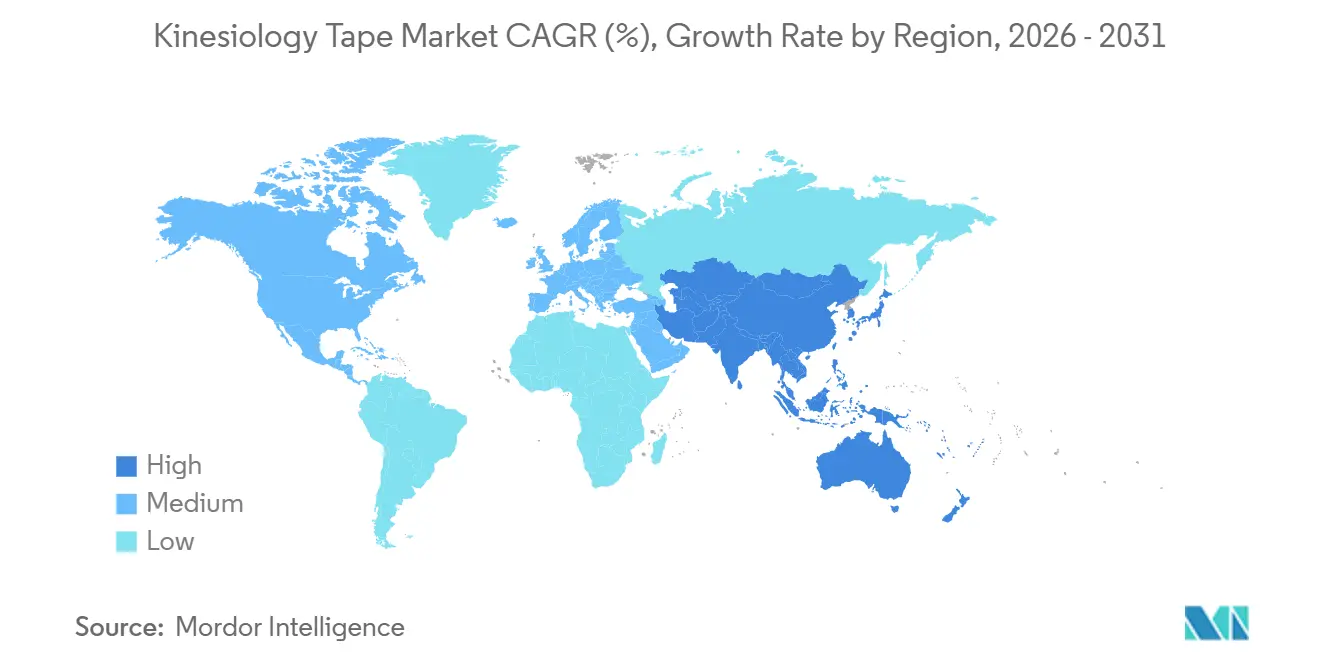
North America generated 41.76% of global revenue in 2025, anchored by U.S. sports participation rates exceeding 60% among adults and Medicare Part B coverage that offsets clinic-based physical therapy costs. Professional leagues remain marquee customers, but the real acceleration stems from Baby Boomers embracing self-directed joint-care routines and Medicare Advantage plans experimenting with remote rehab kits that include tape. Canada follows similar trajectories, while Mexico sees growth through digital cross-border commerce that supplies metropolitan gyms with branded strips.
The EU Medical Device Regulation enforces heightened clinical evidence, elongating product-registration timelines and favoring incumbents with regulatory expertise. Germany’s DiGA reimbursement framework boosts demand by bundling tape into blended digital-analog physiotherapy. Southern European fitness culture and marathon circuits inject consumer sales, but fragmented pharmacy networks moderate the pace. Sustainability mandates under the Green Deal and hospital eco-scorecards spur procurement shifts toward certified organic cotton and recycled polyester substrates, nudging material innovation.
Asia-Pacific records the fastest 9.80% CAGR, driven by government-led fitness campaigns and broadening middle-class spending on wellness. China’s National Fitness Plan funds new public gyms and school sports programs, pumping unit volumes across Tier 2 and Tier 3 cities. India’s e-commerce giants list over 50 domestic and imported kinesiology tape SKUs, bypassing the chaotic brick-and-mortar distribution system. Japan and South Korea display high per-capita usage courtesy of mature physiotherapy ecosystems and aging demographics seeking non-drug pain relief. However, traditional modalities like acupuncture coexist, prompting brands to position tape as complementary rather than competing therapy.

Competitive Landscape
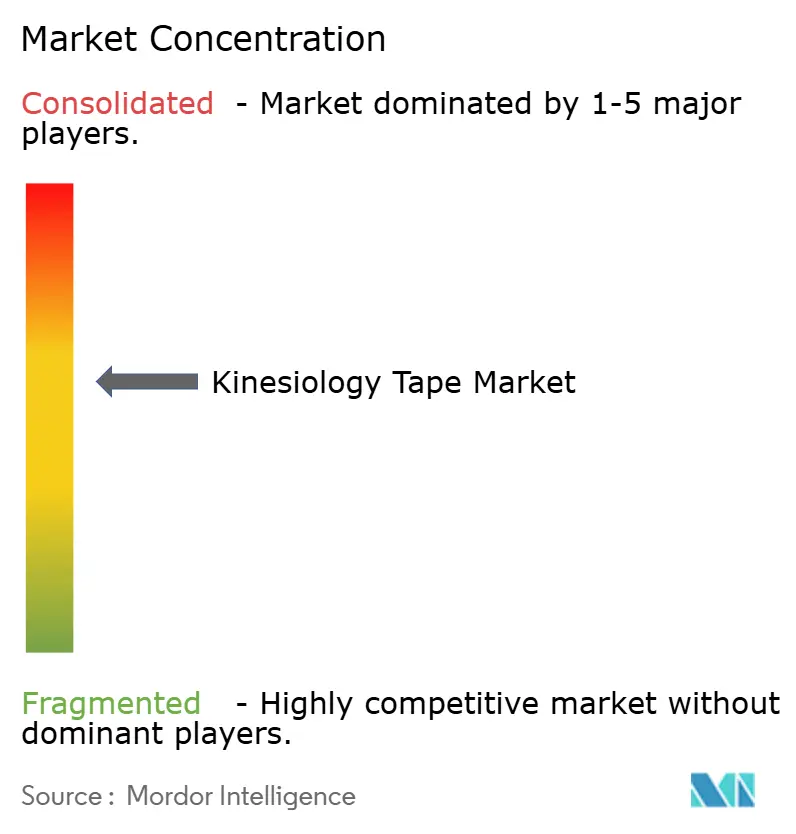
The kinesiology tape market shows moderate concentration; the top five brands controlled half of global revenue in 2024. Kinesio Holding Corporation popularized the modality but now competes with KT Health and Mueller Sports Medicine, both of which invest in intellectual property-protected adhesives and colors. Partnerships with major distributors, such as Henry Schein, expand clinic penetration. Strategic moves include Essity’s capacity expansion in France to localize supply, and Aupcon’s 2024 factory upgrade, which doubles OEM output for private-label accounts.
R&D collaboration intensifies: manufacturers sponsor randomized trials to validate niche protocols, e.g., finger injury management and oncology edema. Some firms are piloting bright-tape-embedded microsensors that relay tension data to mobile apps, targeting elite athletes who demand quantified feedback. Brand switching hinges on adhesion longevity, hypoallergenic performance, and educational support; hence, vendors fund taping certification workshops to lock in practitioner loyalty.
Start-ups target eco-niches with biodegradable substrates and solvent-free adhesives. While not yet mainstream, early adoption among wellness studios signals future differentiation. Price competition remains contained due to value-added training and hospital contract structures that favor multi-year supply agreements.
Kinesiology Tape Industry Leaders
Kinesio Holding Corporation
SpiderTech Inc.
Nitto Denko Corporation
TMAXTape Co.
Mueller Sports Medicine Inc.
- *Disclaimer: Major Players sorted in no particular order

Recent Industry Developments
- January 2026: Team United States medical staff selected biodegradable Kinesiology tape certified to ISO 10993 standards for Winter Games preparation kits, spotlighting performance under sub-zero conditions.
- June 2025: KT Tape partnered with the Women’s Epic Race series to supply co-branded pre-cut kits and on-site athletic trainer expertise at 12 North American endurance events.
- April 2025: KT Tape introduced KT Soothe, a menthol-infused pre-cut strip collection created from direct e-commerce customer feedback on post-workout soreness.
- January 2025: Bridges Consumer Healthcare acquired KT Health LLC, combining KT Tape’s digital storefront with Bridges’ retail channel muscle to broaden omnichannel penetration.


Global Kinesiology Tape Market Report Scope
According to the report's scope, kinesiology tape is an adhesive tape used by therapists to alter muscle tone, facilitate lymphatic fluid flow, correct movement patterns, and enhance posture.
The kinesiology tape market is segmented by type, material, application, end user, distribution channel, and geography. By type, the market is segmented into roll, pre-cut strips, and others. By material, the market is segmented into cotton, synthetic, hybrid, and others. By application, the market is segmented into musculoskeletal pain management, sports-injury prevention & recovery, post-operative and lymphedema management, posture correction, neurological & paediatric uses, and others. By end user, the market is segmented into hospitals and clinics, sports teams and professional athletes, rehabilitation and physiotherapy centres, home care settings, and others. By distribution channel, the market is segmented into franchised stores, e-commerce, and other distribution channels. By geography, the market is segmented into North America, Europe, Asia-Pacific, the Middle-East and Africa, and South America. The market report also covers estimated market sizes and trends for 17 countries across major regions worldwide. The report offers market size and forecasts in value (USD) for the above segments.
| Rolls |
| Pre-cut Strips |
| Others |
| Cotton |
| Synthetic (Polyester/Rayon) |
| Hybrid & Others |
| Hospitals and Clinics |
| Sports Teams and Professional Athletes |
| Rehabilitation and Physiotherapy Centres |
| Home Care Settings |
| Others |
| Musculoskeletal Pain Management |
| Sports-injury Prevention & Recovery |
| Post-operative and Lymphedema Management |
| Posture Correction |
| Neurological & Paediatric Uses |
| Others |
| Pharmacies & Drugstores |
| Online Stores & Marketplaces |
| Sports-specialty Retail |
| Others |
| North America | United States |
| Canada | |
| Mexico | |
| Europe | Germany |
| United Kingdom | |
| France | |
| Italy | |
| Spain | |
| Rest of Europe | |
| Asia-Pacific | China |
| Japan | |
| India | |
| Australia | |
| South Korea | |
| Rest of Asia-Pacific | |
| Middle East and Africa | GCC |
| South Africa | |
| Rest of Middle East and Africa | |
| South America | Brazil |
| Argentina | |
| Rest of South America |
| By Product Type | Rolls | |
| Pre-cut Strips | ||
| Others | ||
| By Material | Cotton | |
| Synthetic (Polyester/Rayon) | ||
| Hybrid & Others | ||
| By End-User | Hospitals and Clinics | |
| Sports Teams and Professional Athletes | ||
| Rehabilitation and Physiotherapy Centres | ||
| Home Care Settings | ||
| Others | ||
| By Application | Musculoskeletal Pain Management | |
| Sports-injury Prevention & Recovery | ||
| Post-operative and Lymphedema Management | ||
| Posture Correction | ||
| Neurological & Paediatric Uses | ||
| Others | ||
| By Distribution Channel | Pharmacies & Drugstores | |
| Online Stores & Marketplaces | ||
| Sports-specialty Retail | ||
| Others | ||
| By Geography | North America | United States |
| Canada | ||
| Mexico | ||
| Europe | Germany | |
| United Kingdom | ||
| France | ||
| Italy | ||
| Spain | ||
| Rest of Europe | ||
| Asia-Pacific | China | |
| Japan | ||
| India | ||
| Australia | ||
| South Korea | ||
| Rest of Asia-Pacific | ||
| Middle East and Africa | GCC | |
| South Africa | ||
| Rest of Middle East and Africa | ||
| South America | Brazil | |
| Argentina | ||
| Rest of South America | ||


Key Questions Answered in the Report
How fast is the kinesiology tape market expected to grow through 2031?
Revenue is projected to move from USD 319.92 million in 2026 to USD 472.30 million by 2031 at an 8.15% CAGR.
Which product format is expanding the quickest?
Pre-cut strips lead with an 8.92% CAGR due to e-commerce convenience and home-care adoption.
Which region offers the strongest future upside?
Asia-Pacific shows the highest 9.80% CAGR, fueled by fitness initiatives and rising disposable income.
What material trends are shaping new product launches?
Synthetic blends that wick moisture and recycled or organic fibers that satisfy eco-procurement mandates are growing in share.
How are online channels affecting traditional pharmacy sales?
Marketplaces and subscription models are capturing incremental buyers, trimming pharmacy share by enabling wider SKU choice and doorstep delivery.
Do clinical studies fully support kinesiology tapes therapeutic claims?
Meta-analyses confirm short-term pain relief but limited functional gains, keeping reimbursement confined to bundled therapy rather than stand-alone codes.
Page last updated on:


 Your data is secure and never sold or shared.


