
Market Overview
| Study Period | 2020 - 2031 |
|---|---|
| Forecast Data Period | 2026 - 2031 |
| Base Year Market Size (2025) | 5.41 Million tonnes |
| Market Volume (2026) | 5.65 Million tonnes |
| Market Volume (2031) | 7.03 Million tonnes |
| Growth Rate (2026 - 2031) | 4.47 % |
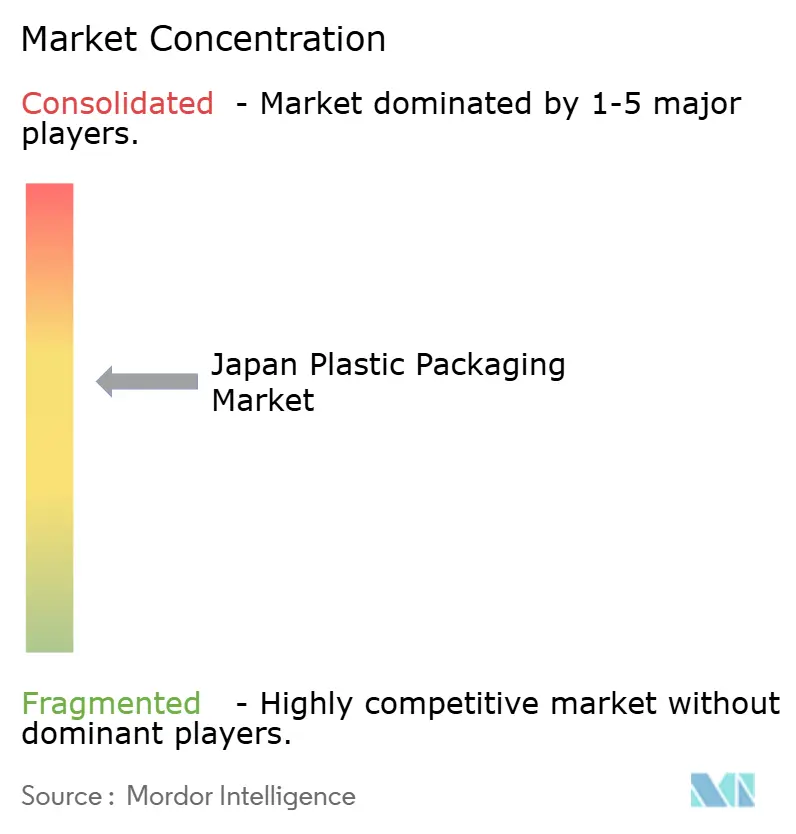
| Market Concentration | Medium |
Major Players *Disclaimer: Major Players sorted in no particular order Image © Mordor Intelligence. Reuse requires attribution under CC BY 4.0. | |
Japan Plastic Packaging Market Analysis by Mordor Intelligence
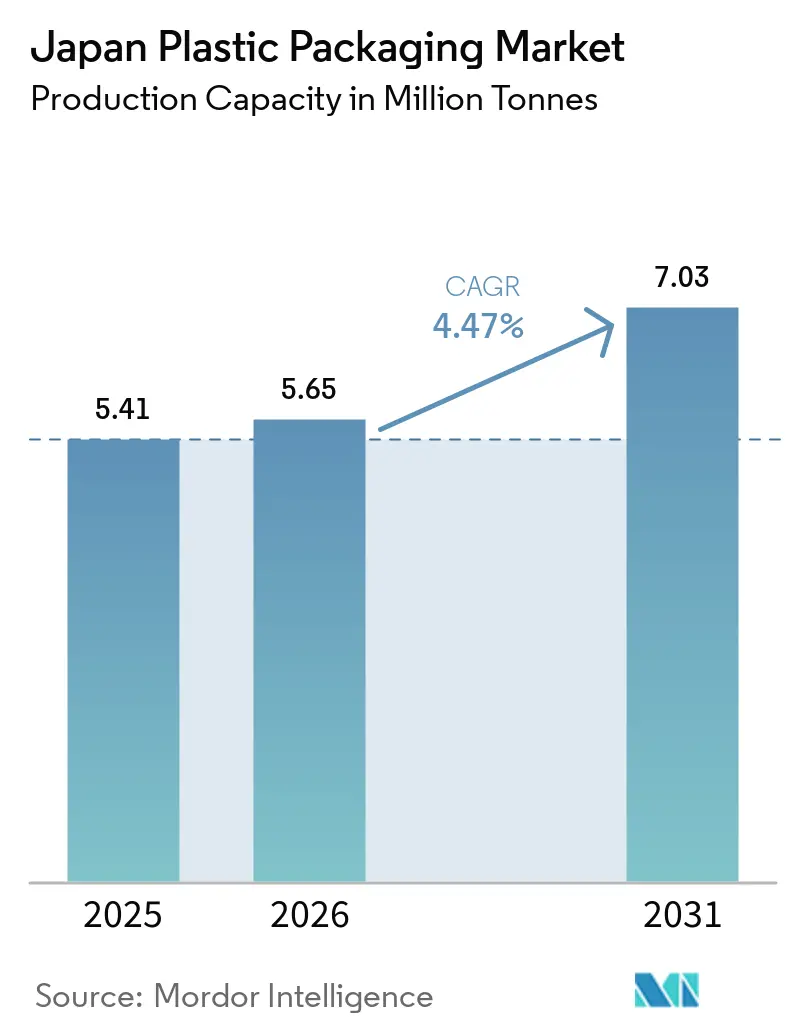
The Japan plastic packaging market size was valued at 5.41 million tonnes in 2025 and estimated to grow from 5.65 million tonnes in 2026 to reach 7.03 million tonnes by 2031, at a CAGR of 4.47% during the forecast period (2026-2031). Persistent demand from e-commerce fulfillment centers, rising pharmaceutical consumption among older citizens, and brand owner commitments to circular-economy goals underpin this growth trajectory.[1] Flexible film converters capitalize on the boom in online grocery and specialty retail, while resin suppliers gain from lightweight bottle programs that stabilize PET volumes despite material-reduction targets. National subsidies for chemical-recycling pilots broaden feedstock options, yet sweeping Extended Producer Responsibility (EPR) fees intensify cost control across the value chain. Tight labor markets accelerate automation, nudging small converters toward mergers with integrated groups that can fund robotics and data-driven quality systems.
Key Report Takeaways
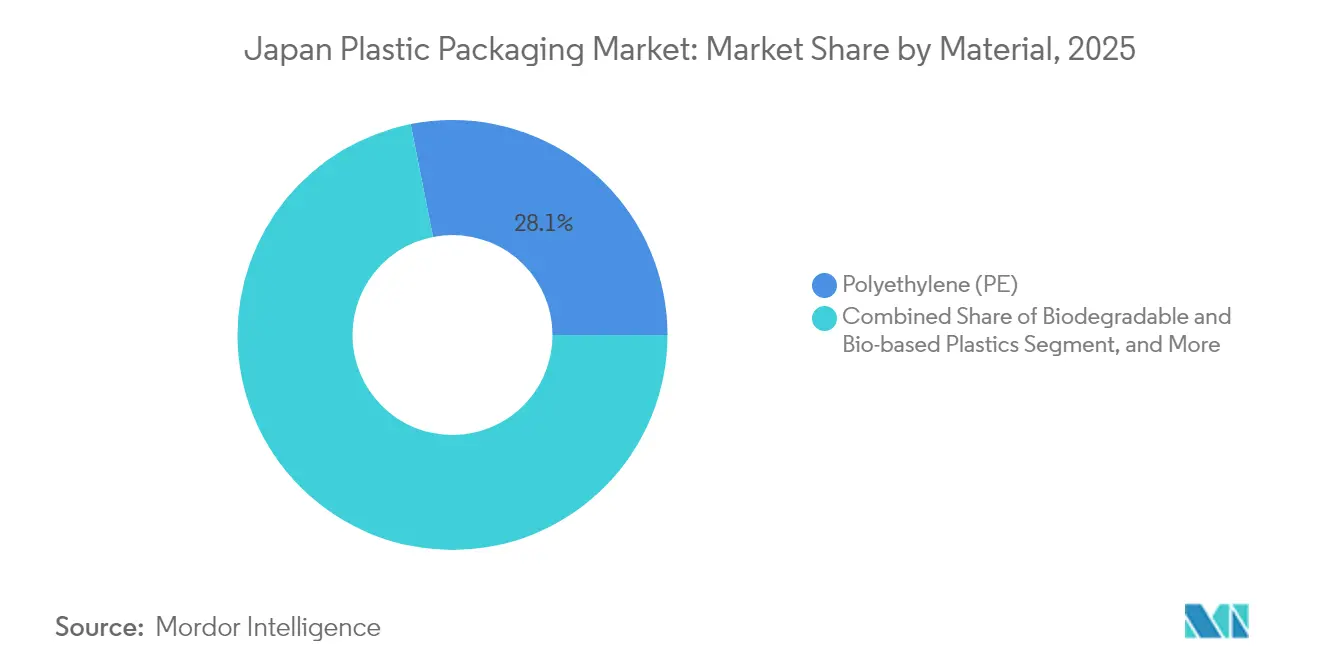
- By material, polyethylene held 28.12% of the Japan plastic packaging market share in 2025, bio-based plastics, though under 5% of tonnage today, post the fastest 4.93% CAGR through 2031.
- By type, the flexible segment accounted for 53.85% of the Japan plastic packaging market size in 2025, leads forecast growth at 5.84% CAGR through 2031.
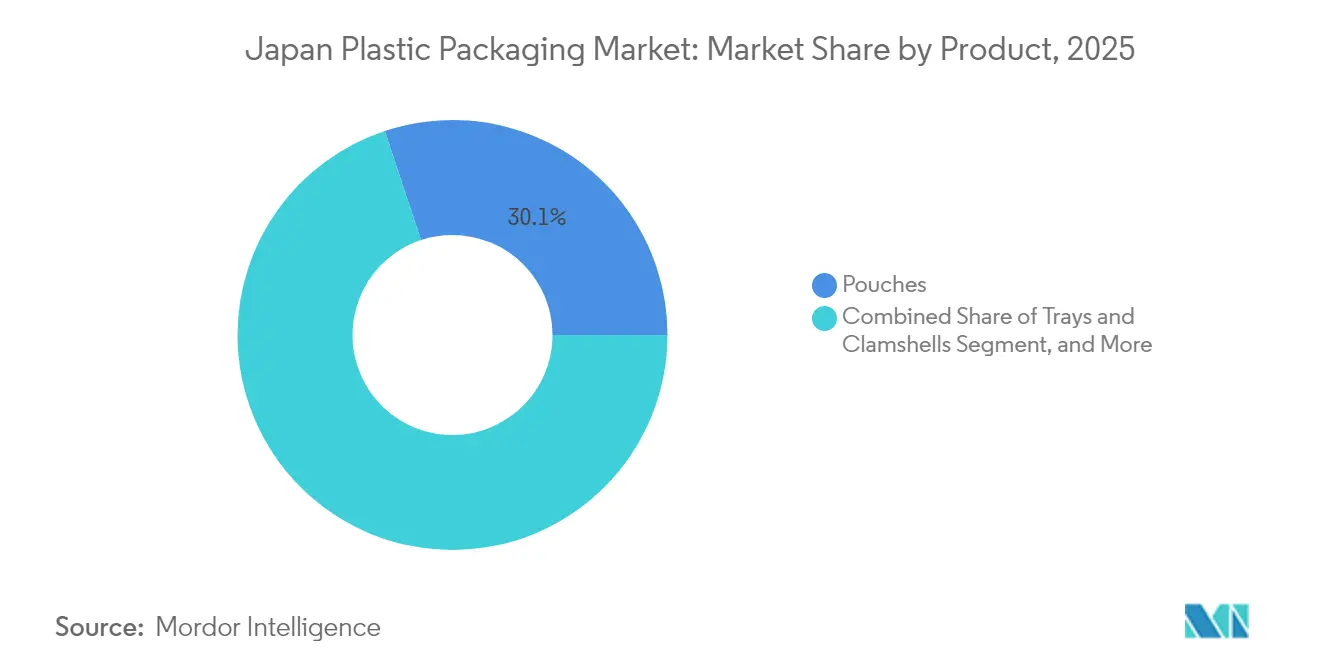
- By product, pouches led with 30.10% of the Japan plastic packaging market size in 2025, grow fastest at 5.21% CAGR through 2031.
- By end-user, food applications captured 29.10% of the Japan plastic packaging market share in 2025, personal care registers the highest 6.18% CAGR through 2031.
Note: Market size and forecast figures in this report are generated using Mordor Intelligence’s proprietary estimation framework, updated with the latest available data and insights as of 2026.
Market Trends and Insights
Drivers Impact Analysis of Japan Plastic Packaging Market*
| Driver | (~) % Impact on CAGR Forecast | Geographic Relevance | Impact Timeline |
|---|---|---|---|
| Growth of e-commerce driving demand for high-barrier flexible packs | +0.8% | Nationwide, strongest in Tokyo–Osaka corridor | Medium term (2-4 years) |
| Ageing population escalating demand for pharma blister and pouch formats | +0.6% | Nationwide, higher in rural prefectures | Long term (≥ 4 years) |
| Beverage PET bottle lightweighting lowering cost and boosting volumes | +0.4% | Nationwide, PET hubs in Kansai and Kanto | Short term (≤ 2 years) |
| Convenience food boom raising use of retort pouches | +0.5% | Large urban areas | Medium term (2-4 years) |
| Government subsidies for chemical-recycling pilot plants | +0.3% | Chiba, Mizushima, Osaka complexes | Long term (≥ 4 years) |
| Spread of plasma-coated mono-material films for 2030 recyclability goals | +0.2% | R&D centers nationwide | Long term (≥ 4 years) |
| Source: Mordor Intelligence | |||
Growth of E-commerce Driving Demand for High-Barrier Flexible Packs
Parcel volumes handled by Japan Post and private couriers continue to set records, prompting online retailers to specify packaging that withstands multistep distribution without overpacking. Plastic packaging film producers answer with multi-layer structures combining EVOH and mLLDPE that deliver oxygen-barrier performance at reduced gauge, thereby trimming logistics emissions and freight cost per unit.[2] The result is steady volume gains for converters specialized in lamination and digital printing, solidifying the e-commerce channel as the single largest new demand node for the Japan plastic packaging market.
Ageing Population Escalating Demand for Pharma Blister and Pouch Formats
Citizens aged 65 and older now represent more than 29% of Japan’s population, lifting prescription volumes and over-the-counter supplement usage. Pharma packagers report double-digit volume growth for push-through blisters with tactile cues and easy-tear pouches that aid seniors with reduced grip strength. Regulatory reforms that encourage home-based care intensify the need for unit-dose compliance packaging, a trend that injects resilient demand into the Japan plastic packaging market.
Beverage PET Bottle Lightweighting Lowering Cost and Boosting Volumes
Domestic beverage leaders have shaved average bottle weight by roughly 20% since 2020 while maintaining shelf stability. Material savings create room for price promotions that defend market share against aluminum cans and glass. Converters benefit because unit sales climb even as resin per bottle falls, holding aggregate PET consumption roughly flat. The Japan plastic packaging market, therefore, enjoys volume insulation despite sustainability targets that emphasize material reduction.
Convenience Food Boom Raising Use of Retort Pouches
Urban consumers with busy schedules increasingly favor heat-and-eat meals from convenience stores. Retort pouches extend shelf life up to 18 months without refrigeration, freeing retailers from cold-chain space constraints. Producers adopt all-polypropylene constructions that survive 121 °C sterilization while qualifying for mono-material recycling streams. Retort demand secures an above-market growth rate for pouches, reinforcing flexible packaging leadership within the Japan plastic packaging market.
Restraints Impact Analysis of Japan Plastic Packaging Market*
| Restraint | (~) % Impact on CAGR Forecast | Geographic Relevance | Impact Timeline |
|---|---|---|---|
| Stricter Extended Producer Responsibility fees on single-use plastics | -0.7% | All municipalities, highest in Tokyo wards | Short term (≤ 2 years) |
| Consumer shift toward paper and glass alternatives | -0.4% | Premium retail in major cities | Medium term (2-4 years) |
| Corporate zero-plastic pledges by FMCG majors | -0.3% | Nationwide | Medium term (2-4 years) |
| Volatility in naphtha prices disrupting resin cost economics | -0.5% | Nationwide | Short term (≤ 2 years) |
| Source: Mordor Intelligence | |||
Stricter Extended Producer Responsibility Fees on Single-Use Plastics
Japan’s EPR law now requires brand owners to finance collection and recycling, lifting compliance outlays by up to 60% for single-use categories. As invoices arrive, food manufacturers labor to redesign packs that cut gram-weight or move toward reusable containers. The near-term burden trims profit margins and tempers volume expansion in the Japan plastic packaging market.
Consumer Shift Toward Paper and Glass Alternatives
Perception outruns science as city-center shoppers equate non-plastic with eco-friendlier. Several premium tea and confectionery brands have switched to paper pouches lined with bio-resin coatings, accepting shorter shelf life in exchange for marketing gains. While plastic remains indispensable for high-barrier needs, the shift siphons demand away from commodity film grades and forces converters to update product portfolios within the Japan plastic packaging market.
*Our forecasts treat driver/restraint impacts as directional, not additive. The impact forecasts reflect baseline growth, mix effects, and variable interactions.
Japan Plastic Packaging Market Segment Analysis
By Material:
PE Retains Scale While Bio-Based Grades AcceleratePolyethylene held a 28.12% share of the Japan plastic packaging market size in 2025, buoyed by versatility across grocery films and industrial liners. Cost advantages and mature processing infrastructure sustain its dominance, yet decarbonization pledges push brand owners to trial drop-in bio-PE made from sugarcane ethanol. Bio-based plastics, though under 5% of tonnage today, post the fastest 4.93% CAGR and attract subsidies that close price gaps with fossil grades.
R&D groups tap cellulose nanofibers from forestry residues to engineer resins that match HDPE stiffness while offering landfill biodegradability. Resin majors aim for 20,000 tonnes of bioethanol-derived output by 2027, positioning Japan to meet the national 2 million-tonne bio-plastic target by 2030. These initiatives introduce fresh feedstocks into the Japan plastic packaging market, diversifying material supply and mitigating crude-derived volatility.

By Type:
Flexible Formats Command Volume and InnovationFlexible packaging captured 53.85% of the Japan plastic packaging market share in 2025 and leads forecast growth at 5.84% CAGR. Material-efficient films minimize freight emissions and storage space, critical for e-commerce parcel density. Advances in solvent-free lamination and digital presses shorten artwork changeovers, letting converters cater to limited-edition SKUs without costly inventory. Rigid categories such as jars and tubs soldier on in ambient staples, yet their growth trails flexible peers given higher resin intensity.
Patented layer-separation films allow post-consumer peel-off that feeds single-polymer streams, eroding recyclability disadvantages historically linked to multi-layer pouches. As national recycling targets tighten, the shift bolsters the flexible segment’s share in the Japan plastic packaging market while containing lifecycle impacts.
By Product:
Pouches Outperform on Convenience and SustainabilityPouches represented 30.10% of the Japan plastic packaging market size in 2025 and grew fastest at a 5.21% CAGR. Stand-up and spouted formats displace rigid bottles in sauces and detergents, delivering 70% lighter pack weight and 80% lower truckload CO₂ emissions. For seniors, easy-tear notches and wide openings facilitate meal preparation, tying demographic shifts to pouch adoption.
Brand owners deploy mono-PP retort pouches that survive high-temperature sterilization and flow seamlessly into material recovery facilities. Smart labels embedded in high-value pharmaceutical pouches monitor humidity, turning packaging into an active quality-control node. These attributes entrench pouches as the lead innovation engine inside the Japan plastic packaging market.
By End-User Industry:
Food Dominates, Personal Care RisesFood applications held 29.10% of the Japan plastic packaging market share in 2025, anchored by strict hygiene codes and a vibrant convenience-store ecosystem. Portion-controlled servings cater to shrinking household sizes, sustaining demand for multilayer films with gas barriers that preserve flavor without refrigeration.
Personal care registers the highest 6.18% CAGR through 2031 as cosmetics groups roll out refill pouches and airless pump packs that promise 50% plastic reduction per use. High-clarity PET jars with recycled content bolster premium positioning while meeting eco-label criteria. These gains reposition personal care from a niche to a growth locomotive in the Japan plastic packaging market.
Geography Analysis
Manufacturing of plastic packaging clusters along the Tokyo-Osaka corridor, where 70% of GDP is generated, enabling converters to tap integrated petrochemical hubs in Chiba and Mizushima for resin feedstock. Efficient Shinkansen freight and expressway arteries ensure one-day delivery to 85% of retail outlets, reducing warehousing requirements and letting brand owners run lean inventories.
Kansai hosts beverage and chemical majors that collaborate on closed-loop PET recycling, with Osaka’s plant-scale depolymerization unit targeted to process 60,000 tonnes annually by 2027. Kyushu’s government offers up to JPY 300 million investment grants (USD 2.0 million) for sustainable packaging ventures, luring dehydrated food processors that export to Southeast Asia.
Uniform national food-contact standards simplify multi-site production, yet local EPR fee schedules vary, compelling brand owners to track municipal ordinances. Inbound raw-material logistics rely on coastal petrochemical terminals, creating exposure to typhoon disruptions, which firms mitigate through dual-sourcing strategies. These geographic dynamics collectively shape supply resilience in the Japan plastic packaging market.
Regulatory Landscape
Japan’s regulatory framework for plastic packaging is anchored by the Act on Promotion of Resource Circulation for Plastics (enacted June 2021, enforced April 2022), which requires design-for-recycling, separate collection, and execution of recycling across municipalities and businesses. A second compliance layer tightened in 2025-2026: the Consumer Affairs Agency’s food-contact “Positive List” for synthetic resins used in apparatus, containers, and packaging became fully effective in June 2025, increasing formulation control and documentation needs for converters and importers supplying food and beverage.
In 2026, standards and program criteria further clarified compliance paths. METI’s certification criteria for beverage bottles, cleaning product containers, and cosmetics packaging took effect on January 24, 2026, linking eco-design and recycled-content signaling to procurement and support mechanisms. For food packs, the revised JIS Z 1500:2026 (issued April 5, 2026) introduced stricter migration testing requirements for high-barrier materials such as aluminum foil composite films and silicon-coated PET, raising the importance of qualified third-party testing and traceability for high-performance flexible structures.
Value Chain Analysis
The value chain runs from petrochemical and specialty-resin suppliers (PET, PE, PP, and emerging bio-based grades) through film and sheet extrusion, lamination/coating, printing, converting, and then brand-owner filling and distribution via retail and e-commerce networks concentrated along the Tokyo-Osaka corridor. Regulatory and customer pull are shifting upstream requirements from virgin-resin optimization toward recycled-feedstock integration and compliance-ready material definitions. With the June 2025 full effectiveness of Japan’s food-contact Positive List, resin and additive suppliers and packaging converters are aligning around approved formulations for food applications.
Downstream, collection and recycling are increasingly connected to product design and brand-owner obligations under the Plastic Resource Circulation Act. The framework allows businesses to submit voluntary collection and recycling plans for ministerial approval, enabling structured take-back and recycling outside standard Waste Management Act pathways. Corporate actions reflect this push toward certified and circular inputs: DNP began manufacturing ISCC PLUS-certified sterile packaging at its Izumizaki Plant in March 2026, while JFE Engineering and Daiichi Sankyo Healthcare reported syngas generation from used medication blister packs in June 2026, indicating deeper integration between healthcare packaging waste streams and industrial recycling processes.
Competitive Landscape
The top five suppliers collectively account for roughly 42% of volume, yielding a moderately concentrated arena where scale coexists with niche specialization. Large groups such as TOPPAN, Toyo Seikan, Amcor Japan, and Toppan Printing leverage integrated extrusion, coating, and converting lines to offer one-stop solutions. Mid-tier firms carve out niches in cosmetics, sampling sachets, or high-shrink labels.
TOPPAN’s USD 1.8 billion purchase of Sonoco’s TFP division in April 2025 vaulted the firm into the global top-three flexible players and deepened high-barrier film capacity.[3] Resin makers tie up with recyclers in chemical-loop consortia, locking in feedstock and meeting Scope 3 emission targets. Strategic priorities converge on automation, with robotics trimming headcount by up to 30% at new pouch lines while boosting traceability.
Intellectual-property battles intensify around oxygen-scavenger additives and plasma coatings that enable mono-material structures. Firms co-develop voluntary carbon-footprint protocols to pre-empt regulatory mandates, turning sustainability compliance into a competitive moat within the Japan plastic packaging market.
Japan Plastic Packaging Industry Leaders
-
Toyo Seikan Group Holdings, Ltd.
-
Takemoto Yohki Co. Ltd.
-
Takigawa Corporation
-
Amcor Group
-
Toppan Inc.
- *Disclaimer: Major Players sorted in no particular order
Japan Plastic Packaging Market Companies Covered in this Report
- Amcor plc
- Toyo Seikan Group Holdings, Ltd.
- Toppan Inc.
- Takigawa Corporation Japan G.K.
- Sealed Air Corporation
- Sonoco Products Company
- Takemoto Yohki Co., Ltd.
- Hosokawa Yoko Co., Ltd.
- Kodama Plastics Co., Ltd.
- Fujimori Kogyo Co., Ltd.
- Nihon Yamamura Glass Co., Ltd.
- Sumitomo Bakelite Co., Ltd.
- Mitsubishi Chemical Group Corporation
- Ube Packaging Materials Co., Ltd.
- Dai Nippon Printing Co., Ltd. (DNP)
- Rengo Co., Ltd. (Plastic Unit)
- Shibusawa Package Co., Ltd.
- Kureha Corporation
- Plastikon Japan Inc.
Market Opportunities and Future Outlook
A near-term whitespace is forming around compliance-ready, high-barrier structures that also meet tighter recyclability and chemical-safety expectations, particularly for food and healthcare packaging where performance requirements remain stringent. The April 5, 2026 revision of JIS Z 1500:2026 raises the bar for migration testing on high-barrier materials, which is translating into demand for material systems and supplier documentation that reduce testing risk and speed approvals for converters serving food, beverage, and pharma customers.
Investment and collaboration programs are also expanding the addressable space for circular plastics within both flexible and rigid formats. METI’s packaging-related certification criteria effective January 24, 2026 support adoption of designs aligned with recycled-content and resource-circulation goals, while private-sector build-outs and pilots improve local availability of specialty substrates. FP Corporation’s April 2026 decision to invest JPY 58 billion in a new plant and distribution center in Bando City, Ibaraki to produce high-rigidity biaxially oriented polypropylene (OPP) sheets points to capacity for lightweight, mono-material oriented structures used in packaging. On the materials side, Zeon’s February 2026 groundbreaking for a new Cyclo-Olefin Polymers plant in Shunan City, Yamaguchi expands domestic capability for high-performance packaging and healthcare-adjacent applications that depend on clarity and barrier performance.
Recent Industry Developments in Japan Plastic Packaging Market
- June 2026: Toyo Seikan Group Holdings announced a supporting partner agreement tied to the J.League All-Star DAZN Cup and started a demonstration at MUFG Stadium to compost paper food containers using biodegradable plastic (PLA). The program provides a real-world testbed for end-of-life pathways and collection logistics that can feed into future packaging designs under Japan’s resource-circulation requirements.
- April 2026: The Ministry of the Environment approved a recycling project plan under Article 48 of the Act on Promotion of Resource Circulation for Plastics (Plastic Resource Circulation Act). This approval mechanism supports business-led collection and recycling schemes, helping brand owners and packaging players operationalize closed-loop models with clearer regulatory treatment.
- April 2025: TOPPAN concluded its USD 1.8 billion acquisition of Sonoco’s TFP business, expanding its global high-barrier film footprint and strengthening scale in flexible packaging. The deal expanded access to high-performance film technologies and supply capacity that feed into Japan’s fast-growing flexible and pouch segments.
Japan Plastic Packaging Market Report Scope and Research Methodology
Market Definition and Coverage
This market covers plastic packaging used in Japan to pack, protect, store, and ship products, across common packaging formats used by producers and brand owners. The sizing is built in volume terms, so the focus stays on physical demand for plastic packaging.
Scope exclusions: We do not count non-plastic packaging materials such as paper, metal, and glass, and we also avoid double counting packaging components across format definitions.
Segments Covered in This Report
- By Material
- Polyethylene Terephthalate (PET)
- Polyethylene (PE)
- High-Density Polyethylene (HDPE)
- Low-Density and Linear-LDPE
- Linear Low-Density Polyethylene (LLDPE)
- Polypropylene (PP)
- Bio-based Plastics
- Other Materials
- By Type
- Rigid Plastic
- Flexible Plastic
- By Product
- Bottles and Jars
- Cans
- Pouches
- Trays and Clamshells
- Caps and Closures
- Other Products
- By End-User Industry
- Food
- Beverage
- Healthcare and Pharmaceuticals
- Retail and E-commerce
- Industrial Manufacturing
- Personal Care and Household
- Other End-User Industries
Data Sources, Market Sizing, and Validation
Desk Research
Desk research was used to set the foundation for Japan packaging demand, the plastics mix, and the rules that shape material choices over time. We referenced public sources such as METI and other Japan government releases, customs and trade statistics, Japan Plastics Industry Federation style association updates, and peer reviewed journals covering polymers, recycling, and packaging performance. These inputs helped us map demand drivers tied to food and beverage packaging needs, healthcare and pharmacy usage, and the pace of e-commerce shipments, which can shift the balance between rigid and flexible formats.
Along with official sources, we also reviewed company annual reports, investor decks, sustainability reports, and press releases to understand capacity moves, resin substitution trends, and packaging redesign activity. In a few places, paid subscriptions were used only for company financial intelligence, patent data, and shipment level trade signals to cross-check direction and timing, and then the assumptions were tested again through interviews. The desk sources listed here are illustrative only, and many other public references were used for data collection, validation, and clarification during the study.
Primary Interviews and Surveys
Primary work focused on validating how much plastic packaging is actually being used in Japan across key end users such as food, beverage, healthcare, and retail distribution. We spoke with a mix of packaging converters, resin and material specialists, brand or product packaging managers, and channel participants, so desk assumptions on volumes, format mix, and substitution could be corrected where needed. Because this is a Japan-only market, the interview questions were structured around domestic demand signals, regulatory impacts, and realistic adoption timing for recycled and bio-based content.
Distribution of primary research fieldwork respondents
| Company type | Respondent position |
|---|---|
| Top tier: 30% | CXOs: 13% |
| Mid tier: 51% | Functional/Unit leaders: 28% |
| Smaller Players: 19% | Managers: 59% |
Market-Sizing & Forecasting
The core build uses a top-down approach where packaging demand is reconstructed from Japan end-use activity and packaging intensity, then translated into plastic packaging volume by applying format and material shares. To keep the totals realistic, the output is corroborated with selective bottom-up approximations, such as sampled converter capacity checks, typical kg-per-pack logic for high-volume formats, and channel feedback on run rates, and then used to adjust any overstatements.
Key inputs that shaped the model included: the rigid versus flexible format split, adoption of mono-material structures, recycled content penetration in mainstream applications, lightweighting rates in bottles and containers, and changes in packaged food and pharmaceutical consumption that influence pack counts. Where data points were missing for a niche product type, we filled gaps using proxied shares from closely comparable formats, followed by an expert check to confirm the direction and the ceiling values.
For forecasting, scenario analysis was used to reflect different speeds of regulation-led change and customer adoption, and then the final path was aligned to the most common expert view on timing. Assumptions were kept stable and traceable so that a client can follow how a change in packaging intensity or recycled content uptake would move the final volume outlook.
Data Validation & Update Cycle
Outputs were validated through several checks before final sign-off, including variance checks versus historical consumption patterns, cross-checks against trade and production signals, and a review of whether the implied per-capita packaging use looks plausible for Japan. When large deviations appeared at a product or format level, we re-checked the conversion logic, revisited the input assumptions, and then re-contacted selected interviewees to confirm what changed in the market.
Each report is refreshed annually, and interim revisions are triggered when there are material events such as major capacity additions, policy shifts affecting plastics, or sharp changes in resin availability. Before delivery, the numbers and narrative receive a fresh analyst pass so clients get the latest consistent view across the model and the written insights.
Mordor Intelligence's Japan Plastic Packaging Market Size Compared With Other Published Estimates
Published market sizes for Japan plastic packaging can look quite different, even when the topic label sounds identical. In our experience, the biggest reasons are the unit of measurement used, the boundary between plastic packaging and the wider packaging sector, and whether the estimate is tied to physical demand signals or mainly built from value assumptions.
By tracking volume in tonnes and keeping the boundary strictly to plastic packaging formats, Mordor Intelligence places the estimate on a demand-linked footing, while some sources mix value-based packaging totals or apply broad material shares that do not reflect format-level shifts in Japan.
Benchmark comparison
| Source | Market Size | Gaps in Research Methodology |
|---|---|---|
| Mordor Intelligence | USD 5.41 M (2025) | |
| Market Analytics Publisher A | USD 3.80 B (2023) | Reported in USD value with an earlier base year, which can compress the size if pricing, resin pass-through, and format mix are not updated consistently, and it may also apply a different product boundary across materials. |
| Industry Report Publisher B | USD 74.37 B (2024) | Represents the total Japan packaging market in value terms, so plastic is only a share within a wider scope that includes non-plastic materials and multiple packaging layers, which inflates the comparable total for plastic-only packaging. |
The spread in the table is mainly explained by scope and unit choices, not by a single disagreement on growth. When the market is kept to plastic packaging only and modeled with clear volume drivers, the size becomes easier to reconcile with end-use activity and practical packaging consumption signals.
Key Questions Answered in the Report
What is the current volume of the Japan plastic packaging market?
The market totals 5.65 million tonnes in 2026.
How fast will the sector grow through 2031?
Forecast calls for a 4.47% CAGR, taking volumes to 7.03 million tonnes.
Which packaging type is expanding quickest?
Flexible formats lead at a 5.84% CAGR owing to e-commerce and convenience-food demand.
Why are pouches gaining popularity among brand owners?
They reduce pack weight by 70%, cut logistics emissions, and now offer mono-material recyclability.
How do EPR fees influence material choice?
Higher fees on single-use plastics push companies to down-gauge films or shift to reusable and recyclable formats.