
Japan ITSM Market Size and Share
Market Overview
| Study Period | 2020 - 2031 |
|---|---|
| Forecast Data Period | 2026 - 2031 |
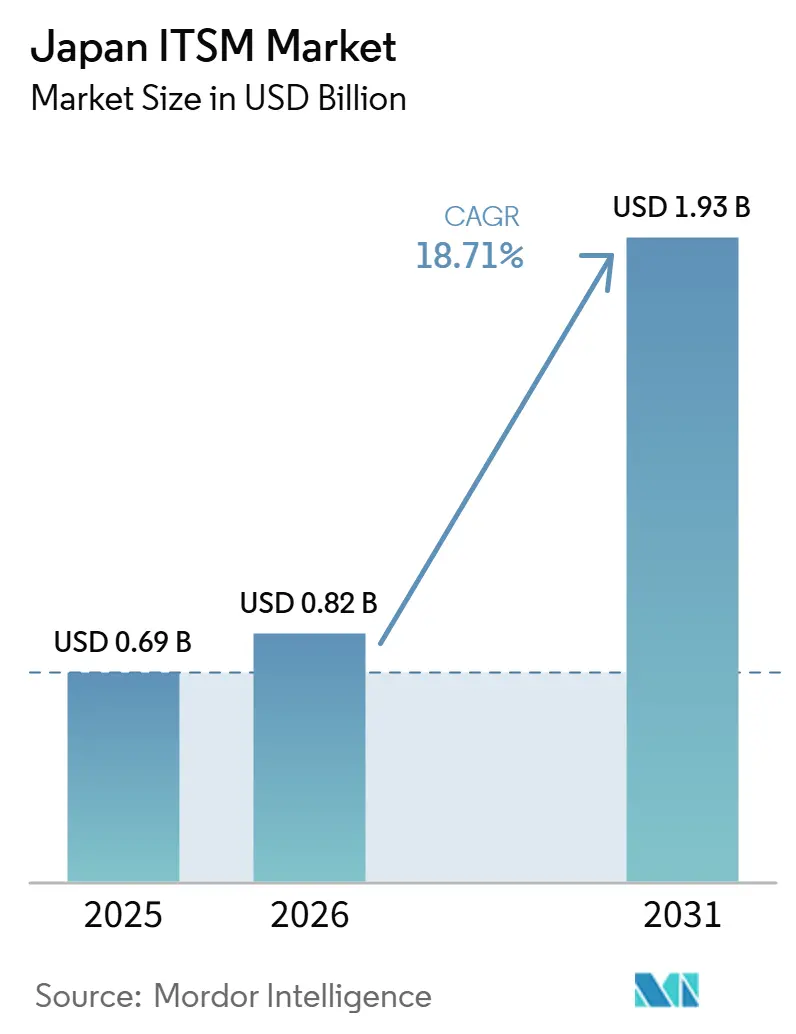
| Base Year Market Size (2025) | USD 0.69 Billion |
| Market Size (2026) | USD 0.82 Billion |
| Market Size (2031) | USD 1.93 Billion |
| Growth Rate (2026 - 2031) | 18.71 % |
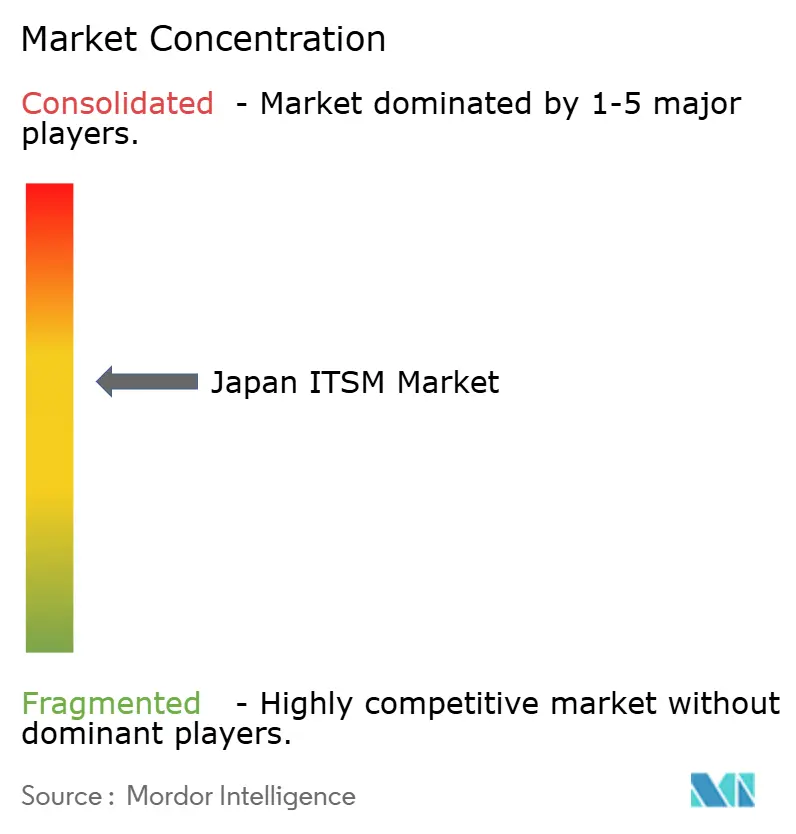
| Market Concentration | Medium |
Major Players *Disclaimer: Major Players sorted in no particular order Image © Mordor Intelligence. Reuse requires attribution under CC BY 4.0. | |
Japan ITSM Market Analysis by Mordor Intelligence
The Japan IT service management market size was valued at USD 0.69 billion in 2025 and is forecast to reach USD 1.93 billion by 2031, growing at a CAGR of 18.71% from 2026 to 2031. Market expansion is being supported by the urgent replacement of legacy workflows built into highly customized enterprise systems that can no longer support current modernization programs. National digital transformation priorities and tighter compliance expectations are also moving service management from a support tool into a broader operating control layer for large organizations. Demand is shifting toward cloud platforms that can coordinate hybrid estates, as many enterprises now need a single service architecture across older systems, private environments, and newer cloud applications. Buyers are also leaning toward managed delivery and outcome-based contracts when internal teams lack sufficient specialist capacity to run complex rollouts on their own. At the same time, the shortage of certified talent and the long procurement process in large enterprises are strengthening vendors that combine strong local delivery, compliance knowledge, and trusted customer relationships.
Key Report Takeaways
- By component, solutions led with a 62.62% revenue share in 2025 of the Japan IT service management market, while services are projected to expand at a 21.31% CAGR through 2031.
- By deployment, cloud held a 58.72% share of the Japan IT service management market in 2025 and is also projected to record the fastest growth at a 21.15% CAGR through 2031.
- By application, service desk and incident management accounted for a 31.82% share in 2025 of the Japan IT service management market, while knowledge management is expected to expand at a 20.34% CAGR through 2031.
- By end-user industry, BFSI held a 25.83% share in 2025 of the Japan IT service management market, while healthcare is projected to grow at a 19.56% CAGR through 2031.
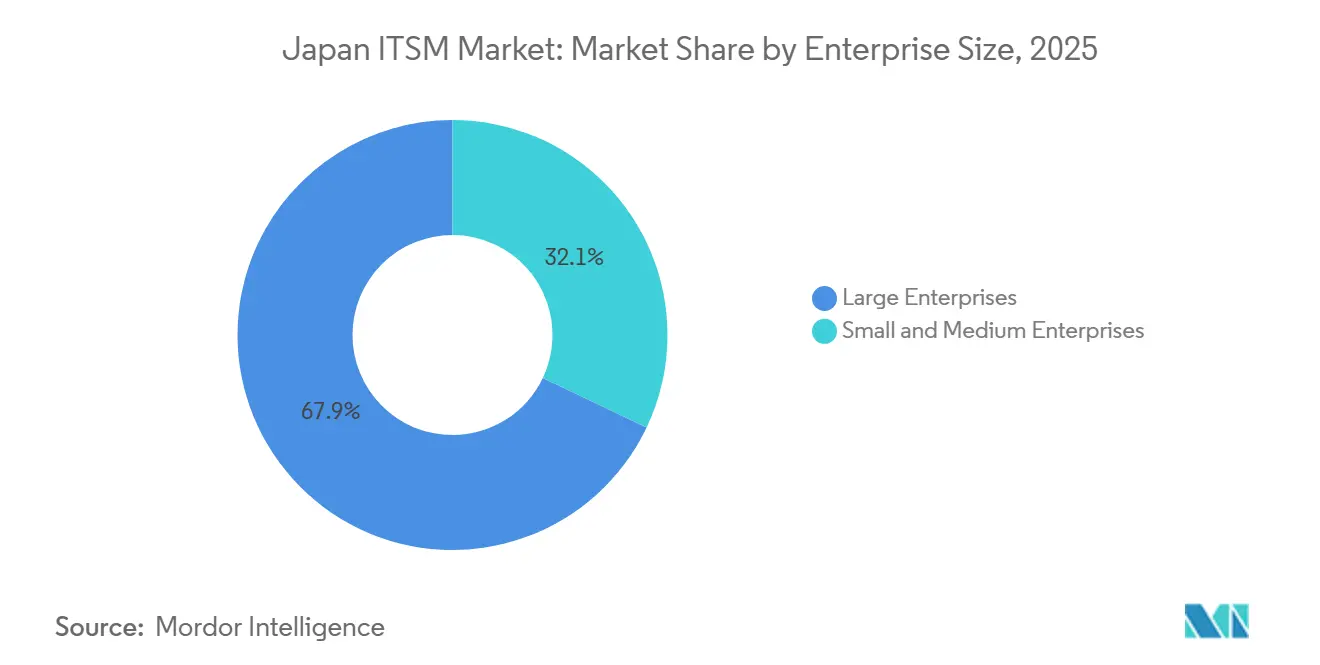
- By enterprise size, large enterprises captured a 67.93% share in 2025 of the Japan IT service management market, while SMEs are expected to expand at a 21.06% CAGR through 2031.
Note: Market size and forecast figures in this report are generated using Mordor Intelligence’s proprietary estimation framework, updated with the latest available data and insights as of January 2026.
Japan ITSM Market Trends and Insights
Drivers Impact Analysis*
| Driver | (~) % Impact on CAGR Forecast | Geographic Relevance | Impact Timeline |
|---|---|---|---|
| Accelerated Replacement Of Legacy ITSM Workflows | +3.8% | National, with concentration in Tokyo, Nagoya, and Osaka metro clusters | Short term (≤ 2 years) |
| Cloud And Hybrid Estate Orchestration Across Japanese Enterprises | +3.4% | National, with early gains in Tokyo, Kinki, and Chubu | Medium term (2-4 years) |
| Rising Need For AI-Assisted Incident Triage And Self-Service | +3.1% | National, concentrated in IT and telecommunications and BFSI verticals | Medium term (2-4 years) |
| Data Residency And Compliance-Driven Preference For Domestic Cloud ITSM | +2.4% | National, strongest in regulated sectors including BFSI, government, and healthcare | Short term (≤ 2 years) |
| Scarcity Of Skilled ITSM And ServiceNow Talent | +1.6% | National, with greatest intensity in Tokyo and Osaka metropolitan areas | Medium term (2-4 years) |
| Outcome-Based Managed ITSM Adoption In Multi-Vendor Environments | +1.2% | National, concentrated in large enterprises across verticals | Long term (≥ 4 years) |
| Source: Mordor Intelligence | |||
Accelerated Replacement Of Legacy ITSM Workflows
Japan's 2025 digital cliff has become an operational deadline for enterprises that still run service processes within aging, proprietary systems.[1] Many modernization programs now have to replace both business applications and service workflows simultaneously, because older processes were built into the same legacy environment. That overlap shortens planning windows and raises demand for implementation partners that can handle migration, workflow redesign, and governance together. ITOCHU Techno-Solutions Corporation launched re: Modern in October 2025 to support legacy asset modernization, cloud migration, and transitions to open-system architectures, demonstrating how directly this demand is being commercialized. METI's ongoing DX guidance also keeps modernization visible at the executive level, making delays harder to justify in board-level planning. This driver is especially strong in the Japan IT service management market where large enterprises want a replacement path that lowers disruption while making control processes easier to audit.
Cloud And Hybrid Estate Orchestration Across Japanese Enterprises
Japanese enterprises in 2026 are no longer managing simple cloud migrations; many now operate a mix of legacy systems, private environments, and hyperscaler resources simultaneously. That complexity increases the need for service platforms that can unify workflows, asset visibility, and operating accountability across a hybrid estate. In January 2026, IFS and NEC announced a collaboration to build Japan-domestic cloud infrastructure for IFS Cloud under the IFS Cloud Kaname managed service, with data storage, processing, and backup designed to stay within Japan.[2] This move shows that cloud ITSM buying decisions are now tied to local hosting, governance alignment, and enterprise confidence, rather than just feature depth. Hybrid architecture is therefore becoming the practical bridge model for the Japan IT service management market, because it lets enterprises modernize without forcing an immediate break from older systems. Vendors with native discovery, configuration management, and cloud operations capabilities are best positioned to benefit from this shift.
Rising Need For AI-Assisted Incident Triage and Self-Service
AI adoption in IT service management is moving from experimentation to practical use in incident and support workflows. ManageEngine's 2025 survey showed that 79% of respondents expected a major AI-driven change in incident management, and 73% expected a major change in knowledge management. In October 2025, Hitachi and NTT Docomo confirmed the effectiveness of an AI agent that detects incidents, analyzes issues, and drafts resolution steps for Docomo's system operations.[3] In September 2025, OPTiM also launched an AI chat agent within its OPTiM Biz platform to automate internal IT support inquiries 24-7. These examples show that enterprises are using AI to manage higher ticket volumes with leaner teams while also improving response consistency. In the Japan IT service management market, that makes AI is a staffing and knowledge continuity tool as much as an efficiency tool.
Data Residency and Compliance-Driven Preference For Domestic Cloud ITSM
Japan's regulatory environment is creating a cloud ITSM market with stronger local compliance requirements than in many other countries. ISMAP has become an important security gate for vendors that want to serve public institutions and highly regulated customers in Japan. APPI also remained a live issue in 2025 through its mandatory 3-year review cycle, which kept attention on how service platforms collect, store, and manage personal data. The FISC Security Guidelines add another layer for banks, insurers, and related vendors by requiring stronger discipline around incident records, change controls, and approval workflows. NEC and IFS built their January 2026 collaboration around Japan-domestic Azure infrastructure specifically to address economic security and data governance requirements. The result is a Japan IT service management market where local hosting, certification readiness, and audit support influence vendor selection almost as much as workflow functionality.
Restraints Impact Analysis*
| Restraint | (~) % Impact on CAGR Forecast | Geographic Relevance | Impact Timeline |
|---|---|---|---|
| Long Procurement And Vendor Validation Cycles | -2.1% | National, most pronounced in large corporate and government procurement | Medium term (2-4 years) |
| Integration Complexity Across Highly Customized Legacy Systems | -1.8% | National, concentrated in manufacturing and BFSI with deep legacy exposure | Long term (≥ 4 years) |
| Security Sensitivity Around Cloud-Native ITSM Data | -1.1% | National, most restrictive in government, defense-adjacent, and financial sectors | Short term (≤ 2 years) |
| Bilingual Delivery And Implementation Capacity Constraints | -0.8% | National, with sharpest impact outside Greater Tokyo and Kinki regions | Long term (≥ 4 years) |
| Source: Mordor Intelligence | |||
Long Procurement and Vendor Validation Cycles
ITSM deployments in Japan often move slowly from vendor selection to go-live because the decision process extends beyond the IT department. Large projects are commonly reviewed by finance, legal, operations, and, in regulated sectors, dedicated compliance teams that want their own validation steps. This structure protects decision quality, but it also limits how many enterprise contracts can be closed within a single year. Multi-round proof-of-concept reviews and ringi-style approvals add more time, especially when customers are evaluating several modules together rather than only a basic service desk deployment. TIS launched its ServiceNow Offering Service in June 2026, with Fit-Gap analysis and a structured menu model, directly addressing this issue by helping customers define scope faster and more clearly. Procurement friction, therefore, remains a real restraint in the Japanese IT service management market, and vendors that simplify evaluation without reducing rigor have a clear advantage.
Integration Complexity Across Highly Customized Legacy Systems
Many Japanese enterprises still operate environments that were customized in small increments over long periods, which makes modern service platforms harder to connect than standard system diagrams suggest. Connectors that work well in cleaner environments often need bespoke adaptation once they meet older workflows, internal approval logic, and mixed data structures. This increases deployment costs, extends timelines, and makes some customers more cautious about broad platform rollouts. METI has repeatedly warned that delayed modernization increases operating burdens and security risks, indicating that integration complexity cannot be avoided indefinitely. CTC's re: Modern launch in October 2025 shows that suppliers are trying to reduce this barrier, but the need for careful mapping and staged migration remains significant. This is a long-term restraint for the Japan IT service management market because legacy complexity affects not only platform implementation, but also the pace at which enterprises can expand into broader workflow automation.
*Our forecasts treat driver/restraint impacts as directional, not additive. The impact forecasts reflect baseline growth, mix effects, and variable interactions.
Segment Analysis
By Component: Services Redefine Delivery Priorities
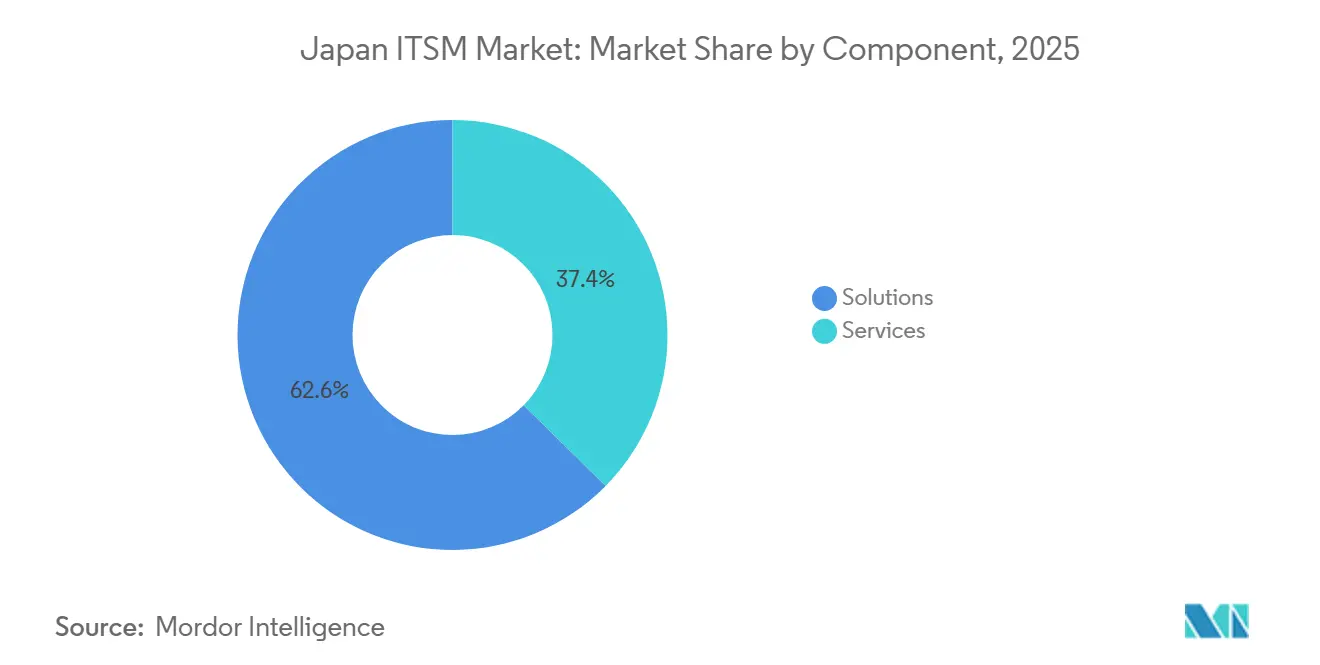
The solutions segment held 62.62% of the Japan IT service management market share in 2025, reflecting the large installed base of software platforms already used by enterprises across finance, manufacturing, and public institutions. Services are projected to grow at a 21.31% CAGR from 2026 to 2031, making them the fastest-growing component during the forecast period. This shift shows that the next phase of demand is being shaped less by first-time software access and more by the need for implementation help, optimization, platform migration, and managed support. Large enterprises are increasingly choosing co-managed models where their internal IT teams work alongside external specialists. SMEs are more likely to move directly into managed offerings because they want enterprise-grade control without building a large in-house team.
In the Japan IT service management industry, delivery capability now matters almost as much as product capability. Japanese integrators benefit from long-standing customer relationships, local language delivery, and better alignment with procurement and compliance expectations. ServiceNow recognized Fujitsu across multiple Japan-specific categories in its 2025 partner awards, underscoring the importance of implementation depth in this space. TIS reinforced the same direction in June 2026 when it launched a structured ServiceNow delivery package targeting JPY 2 billion (USD 14.0 million) in revenue and 10 new enterprise deployments by fiscal year 2027. The component mix in the Japan IT service management market is therefore shifting toward vendors that can combine software access with measurable operating support.
By Deployment: Cloud Leads While Hybrid Adoption Deepens
Cloud deployment accounted for 58.72% share of the Japan IT service management market size in 2025 and is also projected to expand at a 21.15% CAGR from 2026 to 2031. Cloud leads because it enables enterprises to deliver faster updates, scale more easily, and coordinate across distributed environments. It also aligns with current buying preferences, where customers want platforms that can support transformation programs without requiring major new on-premises infrastructure. On-premise deployment still matters in highly sensitive environments where data classification, internal controls, or customer-specific policies remain strict. Hybrid deployment is becoming the practical bridge for large organizations that need to keep older systems running while introducing newer cloud workflows in phases.
ISMAP has created a more visible divide between vendors that can compete for public and highly regulated accounts and those that cannot. That has produced a higher-value procurement tier where certification readiness and local infrastructure are central to vendor screening. NEC and IFS responded with the IFS Cloud Kaname model built on Japan-domestic Azure infrastructure, which directly addressed local data handling expectations. For the Japan IT service management market, this means cloud leadership is being shaped by trust, certification, and architecture choices as much as by standard software capability.
By Application: Service Desk Remains The Entry Point While Knowledge Management Gains Speed
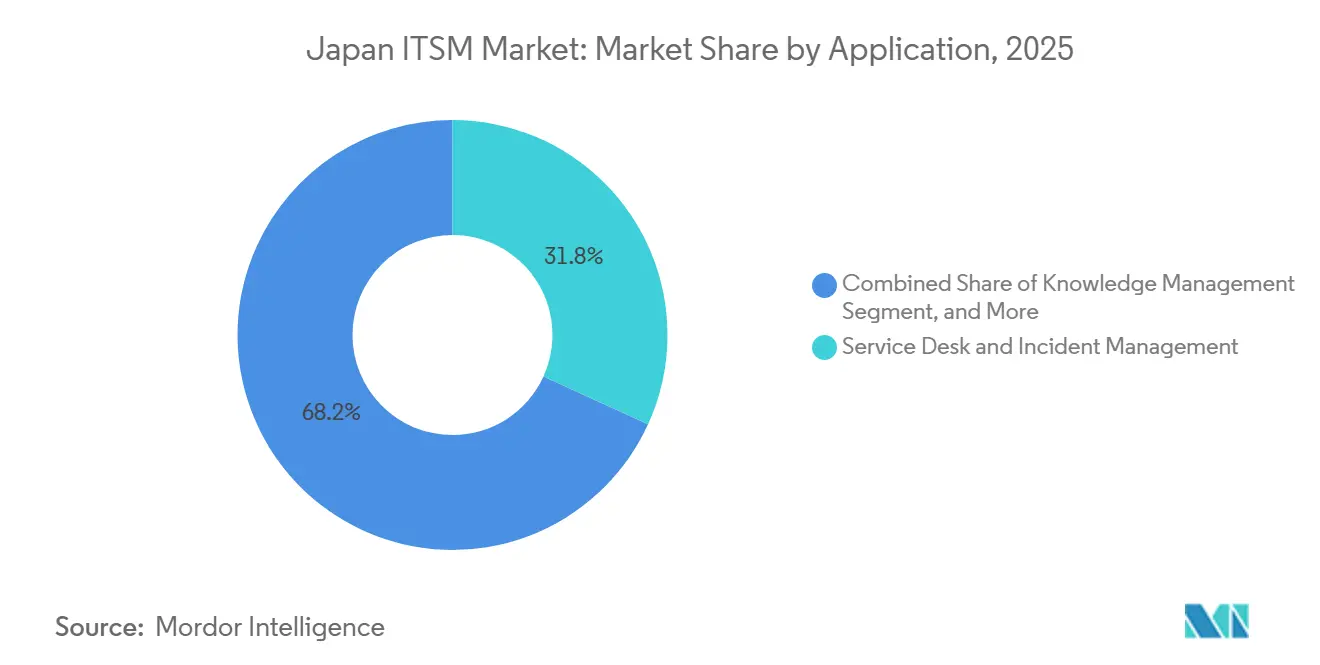
Service desk and incident management accounted for 31.82% of the Japan IT service management market in 2025, making it the main entry point for enterprise adoption. Most organizations still begin with incident handling, user support, and request intake before expanding to more advanced control processes. Knowledge management is projected to grow at a 20.34% CAGR from 2026 to 2031, which makes it the fastest-growing application area. Its role is expanding, as enterprises now treat knowledge bases as both operational repositories and training data for AI-assisted support. ManageEngine's 2025 survey supported this shift by showing strong expectations for AI-led improvement in knowledge management.
The next stage of application expansion typically involves asset and configuration management, service request management, and change and release management. That sequence fits Japan's measured enterprise buying style, where companies prefer to stabilize one operating layer before adding another. Change and release workflows are drawing more attention as legacy renewal and cloud migration create higher change volumes that manual review structures struggle to absorb. Network One Systems demonstrated a related coordination benefit in March 2026 when its ServiceNow Service Bridge linkage with SoftBank reduced average response time by nearly 70 minutes per incident through real-time inter-enterprise synchronization. This shows that application growth in the Japan IT service management market is moving beyond internal ticket handling toward broader service coordination across organizations.

By End-User Industry: BFSI Holds The Largest Base While Healthcare Advances Fastest
BFSI held 25.83% of the Japan IT service management market share in 2025, which made it the largest end-user industry in the market. Financial institutions face a dense compliance environment that keeps incident records, change approvals, audit trails, and service continuity processes under close scrutiny. The FISC Security Guidelines are an important part of that environment because they shape the operating expectations for banks, insurers, securities firms, and their service providers. This makes ITSM an operating governance layer for BFSI rather than only a support platform. Manufacturing remained the second-largest segment because modernization programs are increasingly linking enterprise IT workflows with plant, supply chain, and asset-intensive operating environments.
Healthcare is projected to grow at a 19.56% CAGR from 2026 to 2031, which makes it the fastest-growing end-user segment in the forecast period. The sector is benefiting from stronger digitalization priorities and from large platform efforts that require secure service coordination. In May 2026, SMBC Group, Fujitsu, and SoftBank agreed to build a Japan-developed healthcare data platform targeting 4,000 medical institutions and 60 million users, with a domestic data center hosting built into the plan. Government, public sector, and telecommunications customers are also broadening adoption as compliance transitions and cross-enterprise service linkages become more important. This mix gives the Japan IT service management market a strong regulated core with additional growth coming from sectors that are still expanding their digital operating frameworks.
By Enterprise Size: Large Enterprises Dominate Revenue While SMEs Narrow The Gap
Large enterprises accounted for 67.93% share of the Japan IT service management market size in 2025, reflecting the scale of their IT estates, the weight of their compliance requirements, and their ability to fund multi-phase platform programs. SMEs are projected to grow at a 21.06% CAGR from 2026 to 2031, making them the fastest-growing segment by enterprise size. Cloud-native platforms have reduced the cost and complexity barrier, and subsidy support has also made standardized digital tools easier to justify for smaller firms. SME demand is also becoming more practical, as lean teams need formal workflows, self-service support, and better operational visibility without adding many people. The Japan IT service management market is therefore growing through two tracks at once, deeper platform use among large enterprises and faster first-stage standardization among SMEs.
Channel and services expansion are helping this smaller customer group adopt more quickly. NTT Integration Corporation became a ServiceNow reseller partner in March 2025, which broadened its ability to provide licenses and related modules, including ITSM, ITOM, HR service delivery, customer service management, and security operations support. Structured offerings, such as TIS's menu-based ServiceNow service, also make it easier for smaller organizations to assess scope and expected returns before committing. At the same time, large enterprises are expanding their use of ITSM into HR workflows, customer operations, and enterprise automation, which keeps the revenue base broad at the top end.
Geography Analysis
The Japan IT service management market is most concentrated in Greater Tokyo and the wider Kanto region, where financial headquarters, major corporate offices, and central ministries shape the highest-value enterprise buying decisions. Large institutions in Tokyo often set operating and governance standards that later spread across national branches and affiliate networks. Public sector cloud compliance requirements are also highly visible in the capital, which gives vendors with local certification a stronger position in early-stage evaluations. This makes Kanto the reference point for product selection, partner choice, and service design across much of the country.
The Kinki cluster around Osaka and Kobe forms the second major demand center, supported by financial, healthcare, distribution, and regional corporate groups. The Chubu and Tokai corridor around Nagoya adds strong manufacturing demand, especially where IT renewal is tied to plant systems, supply chains, and long service networks. TIS supported JFE Steel's modernization of its Higashinipon Works core system in November 2025, which shows the type of renewal program that often creates follow-on demand for modern service management. In these regions, ITSM adoption is often driven by the need to coordinate application changes, operational risks, and vendor support across mixed IT and operational environments. As a result, Osaka and Nagoya matter not only for contract volume, but also for more complex use cases than a standard service desk rollout.
Regional markets outside the main metro clusters still face tighter staffing and budget conditions, especially among smaller businesses, but adoption is not stalled. JIPDEC's 2026 enterprise survey confirmed continuing digitalization activity across domestic companies with 50 or more employees, which supports ongoing demand outside the largest urban centers. Cloud delivery is helping regional organizations adopt standardized tools without building large on-premise support structures, which narrows the gap with metropolitan peers. This broadening base supports long-term expansion in the Japan IT service management market even as the largest contracts remain concentrated in Tokyo, Osaka, and Nagoya.
Competitive Landscape
The Japan IT service management market remains concentrated at the top end in software platforms, while delivery and managed services are spread across a much larger group of Japanese integrators. ServiceNow, BMC Software, and Atlassian Corporation remain important platform names, while Fujitsu, NEC, NTT, Hitachi, SCSK, and TIS shape how those platforms are implemented and operated in customer environments. This split means product leadership alone is rarely enough, because enterprise buyers still judge vendors on local delivery depth, compliance handling, and long account relationships. ServiceNow's 2025 partner awards recognized Fujitsu across several Japan-focused categories, underscoring the importance of local execution in competitive positioning.
Vendors are increasingly competing through AI integration, service packaging, and domestic cloud readiness rather than only through basic workflow features. TIS launched its ServiceNow Offering Service in June 2026 with a defined menu structure and Fit-Gap analysis, which shows how partners are trying to shorten sales cycles and make deployment scope easier to approve. NEC and IFS also announced a Japan-domestic Azure environment in January 2026, which turned local hosting and governance alignment into a clearer selling point for regulated accounts. Fujitsu and IBM Japan expanded their systems modernization collaboration in June 2026, which reflects the rising importance of linking legacy renewal with service management change programs. These moves show that strategic advantage in the Japan IT service management market now depends on how well vendors connect modernization, operations, and compliance in one delivery model.
The SME opportunity remains open because many smaller organizations still need lower-cost entry paths, quicker deployment, and more managed support than large enterprises. Vendors that can bundle configuration, onboarding, and ongoing administration into repeatable packages are better placed to win these accounts. ISMAP and sector-specific governance rules continue to protect incumbents that have already invested in local infrastructure and certification, especially in public sector and financial services. This keeps the field active, but it also favors companies that already combine a strong platform ecosystem with trusted Japanese delivery capacity.
Japan ITSM Industry Leaders
-
ServiceNow, Inc.
-
BMC Software, Inc.
-
Atlassian Corporation Plc
-
International Business Machines Corporation
-
Ivanti, Inc.
- *Disclaimer: Major Players sorted in no particular order
Recent Industry Developments
- June 2026: TIS Inc. launched "ServiceNow Offering Service," a structured six-menu implementation package with Fit-Gap analysis designed to optimize ServiceNow adoption scope and demonstrate ROI for prospective customers, the company targets JPY 2 billion (USD 14.0 million) in cumulative revenue and 10 new enterprise deployments by fiscal year 2027, with planned integration of ServiceNow AI Agent Orchestrator capabilities in subsequent releases.
- June 2026: Fujitsu and IBM Japan announced acceleration of their systems modernization collaboration, initially announced in September 2025, combining Fujitsu's domain expertise and IBM's application modernization technologies to deliver integrated legacy transformation services for Japan's enterprise sector.
- May 2026: SMBC Group, Fujitsu, and SoftBank Corp. agreed on a strategic alliance to build a Japan-developed healthcare data platform targeting 60 million users and 4,000 medical institutions, with all patient and health data stored in domestic data centers and architecture compliant with Japan's healthcare digital transformation policies and the Nationwide Healthcare Information Platform.
- April 2026: NEC Corporation launched "AI Platform Service," aggregating over 100 AI support functions into a unified software platform, with software version availability starting May 2026 and AI-as-a-Service deployment from July 2026 at a starting monthly price of JPY 300,000 (USD 2,098), the platform is designed to support AI integration within enterprise IT operations and service management workflows.
Japan ITSM Market Report Scope
The Japan IT Service Management Market is Segmented by Component (Solutions, and Services), Deployment (Cloud, On-Premise, and Hybrid), Application (Service Desk and Incident Management, Asset and Configuration Management, Change and Release Management, Service Request Management, Knowledge Management, and Others), End-User Industry (BFSI, Manufacturing, Government and Public Sector, IT and Telecommunications, Retail and E-Commerce, Healthcare, and Others), and Enterprise Size (Large Enterprises, and Small and Medium Enterprises). The Market Forecasts are Provided in Terms of Value (USD).
| Solutions |
| Services |
| Cloud |
| On-Premise |
| Hybrid |
| Service Desk and Incident Management |
| Asset and Configuration Management |
| Change and Release Management |
| Service Request Management |
| Knowledge Management |
| Other ITSM Applications |
| BFSI |
| Manufacturing |
| Government and Public Sector |
| IT and Telecommunications |
| Retail and E-Commerce |
| Healthcare |
| Travel and Hospitality |
| Other End-User Industries |
| Large Enterprises |
| Small and Mid-Sized Enterprises (SME) |
| By Component | Solutions |
| Services | |
| By Deployment | Cloud |
| On-Premise | |
| Hybrid | |
| By Application | Service Desk and Incident Management |
| Asset and Configuration Management | |
| Change and Release Management | |
| Service Request Management | |
| Knowledge Management | |
| Other ITSM Applications | |
| By End-User Industry | BFSI |
| Manufacturing | |
| Government and Public Sector | |
| IT and Telecommunications | |
| Retail and E-Commerce | |
| Healthcare | |
| Travel and Hospitality | |
| Other End-User Industries | |
| By Enterprise Size | Large Enterprises |
| Small and Mid-Sized Enterprises (SME) |
Key Questions Answered in the Report
What is the current size and future outlook for Japan IT service management?
The Japan IT service management market was valued at USD 0.69 billion in 2025 and is forecast to reach USD 1.93 billion by 2031 at a CAGR of 18.71% from 2026 to 2031.
What is driving adoption of service management platforms in Japan?
The strongest drivers are legacy modernization pressure, hybrid cloud operations, AI-assisted incident handling, and compliance requirements tied to data residency and regulated workflows.
Which deployment model leads in Japan?
Cloud led with a 58.72% share in 2025 and is also the fastest-growing deployment model with a 21.15% CAGR through 2031.
Which application area is growing fastest?
Knowledge management is the fastest-growing application, with a projected 20.34% CAGR through 2031, as enterprises use it for both support accuracy and AI training.
Why does BFSI account for the largest demand base?
BFSI held a 25.83% share in 2025 because Japanese financial institutions need stronger incident records, change controls, audit trails, and service governance under strict compliance frameworks.