
Market Overview
| Study Period | 2020 - 2031 |
|---|---|
| Forecast Data Period | 2026 - 2031 |
| Base Year Market Size (2025) | USD 16.84 Billion |
| Market Size (2026) | USD 18.39 Billion |
| Market Size (2031) | USD 28.57 Billion |
| Growth Rate (2026 - 2031) | 9.21 % |
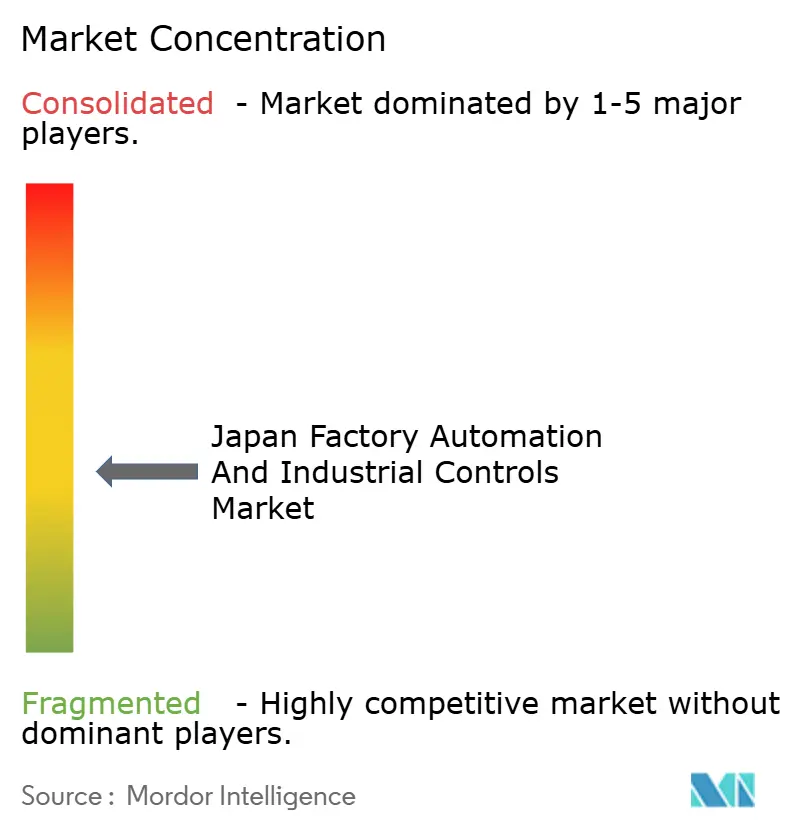
| Market Concentration | Medium |
Major Players *Disclaimer: Major Players sorted in no particular order Image © Mordor Intelligence. Reuse requires attribution under CC BY 4.0. | |
Japan Factory Automation And Industrial Controls Market Analysis by Mordor Intelligence
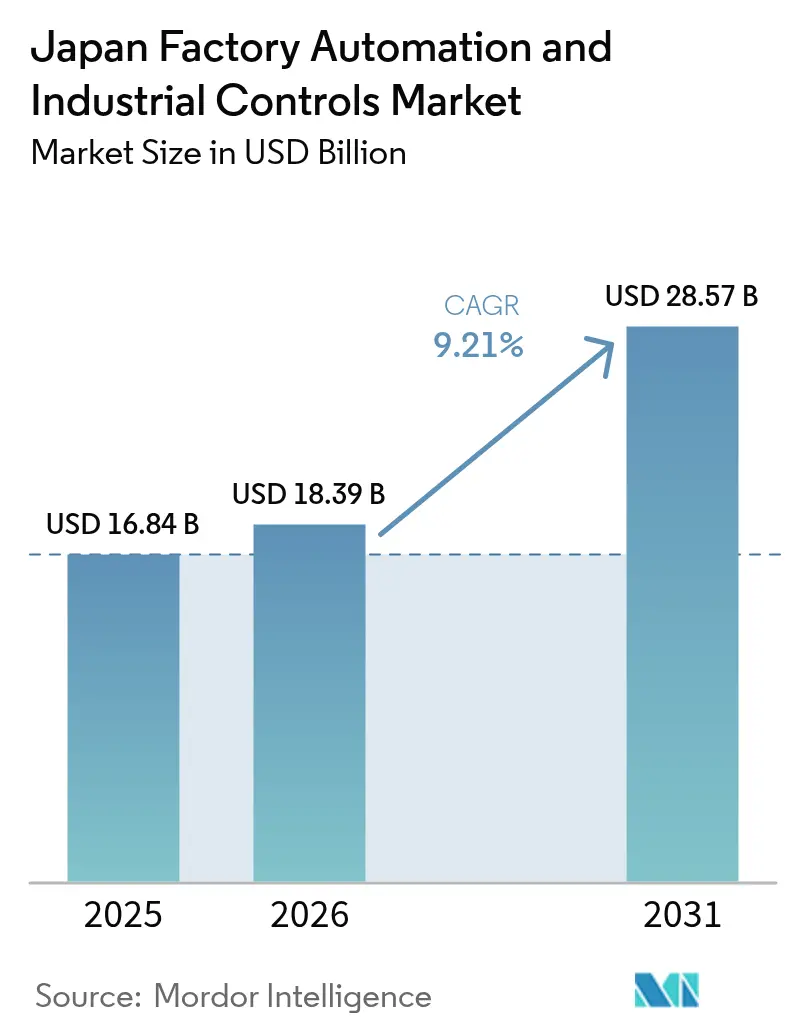
The Japan factory automation and industrial controls market size was valued at USD 16.84 billion in 2025 and estimated to grow from USD 18.39 billion in 2026 to reach USD 28.57 billion by 2031, at a CAGR of 9.21% during the forecast period (2026-2031). Momentum stems from a shrinking labor pool, aggressive decarbonization rules, and unprecedented fiscal incentives that are compressing payback cycles for next-generation robotics, distributed control systems, and edge-computing platforms. Energy-efficiency benchmarks introduced under the amended Energy Conservation Act, combined with the JPY 150 trillion Green Transformation Fund, are steering budgets toward integrated hardware-plus-software packages that guarantee measurable CO₂ cuts. Manufacturers also face rising wage inflation, cybersecurity requirements tied to OPC UA over TSN deployments, and a renewed urgency to localize semiconductor supply, all of which heighten demand for turnkey consulting and predictive-maintenance services. Competitive intensity is rising as domestic incumbents open their ecosystems while European suppliers differentiate through subscription analytics, tilting revenue models away from transactional hardware toward annuity-based service contracts
Key Report Takeaways
- By component, hardware captured 58.12% of the 2025 revenue in the Japan factory automation and industrial controls market, whereas services are advancing at a 10.41% CAGR through 2031.
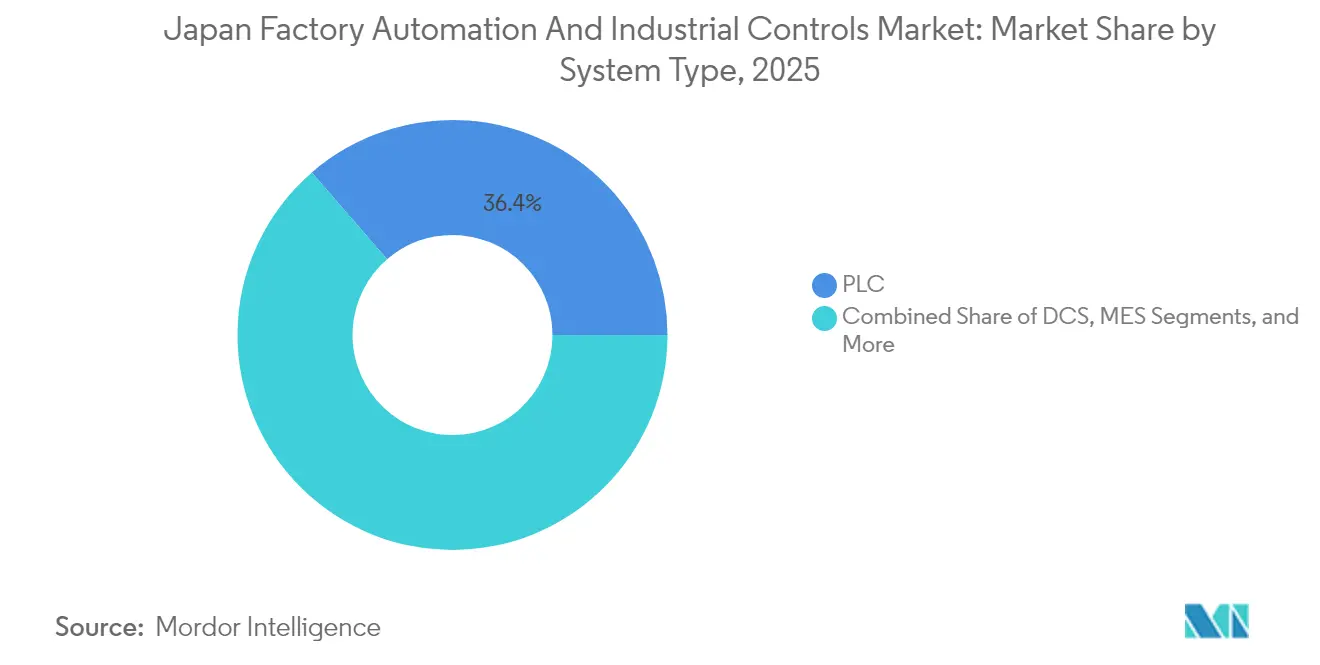
- By system type, PLC solutions accounted for 36.35% of the 2025 revenue in the Japan factory automation and industrial controls market, and the MES segment is expected to accelerate at a 9.95% CAGR.
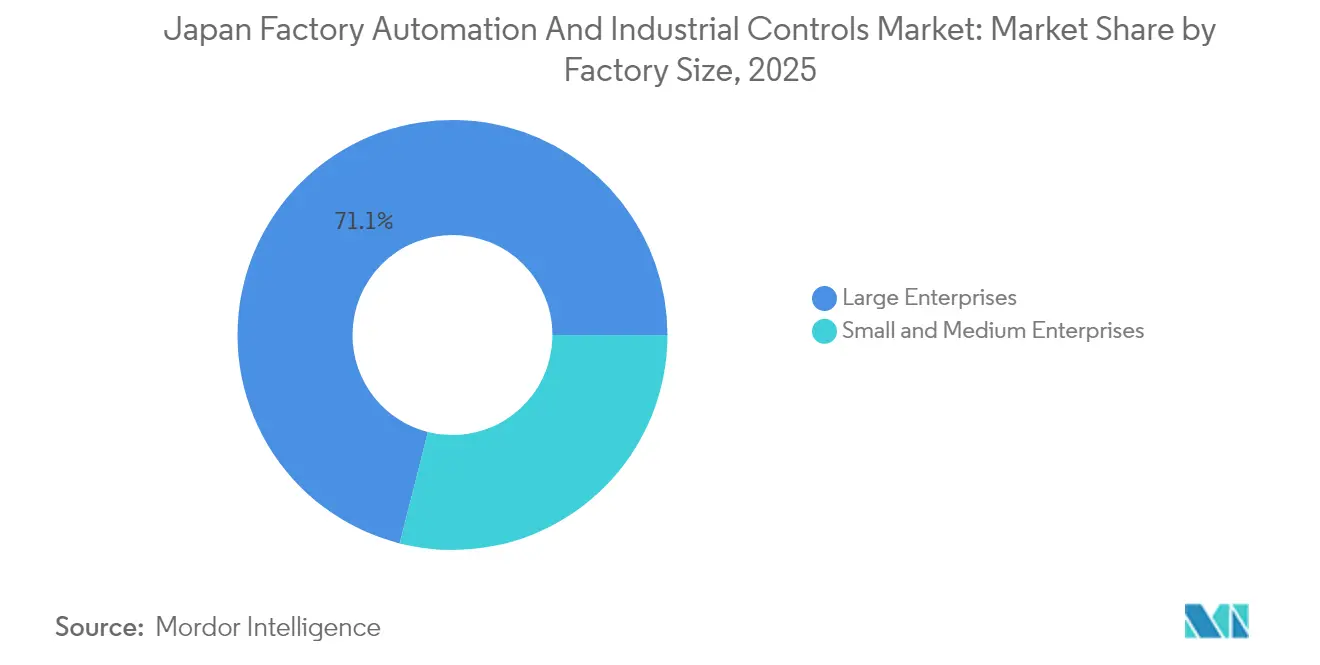
- By factory size, large enterprises secured 71.05% of the 2025 revenue in the Japan factory automation and industrial controls market, while SMEs are expanding at a 10.68% CAGR.
- By end-user industry, automotive and transportation accounted for 30.15% of 2025 demand in the Japan factory automation and industrial controls market; electronics and semiconductor fabrication is forecast to grow at a 9.86% CAGR through 2031.
Note: Market size and forecast figures in this report are generated using Mordor Intelligence’s proprietary estimation framework, updated with the latest available data and insights as of 2026.
Japan Factory Automation And Industrial Controls Market Trends and Insights
Drivers Impact Analysis*
| Driver | (~) % Impact on CAGR Forecast | Geographic Relevance | Impact Timeline |
|---|---|---|---|
| Carbon-neutrality mandates and energy-efficiency regulations | +1.8% | National, strongest in Kanto and Chubu industrial belts | Medium term (2–4 years) |
| Aging workforce and acute labor shortages | +2.1% | National, acute in rural manufacturing clusters | Long term (≥4 years) |
| Government's Society 5.0 / Connected Industries program | +1.5% | National, pilot zones in Osaka, Aichi, Kanagawa | Medium term (2–4 years) |
| Robust demand from automotive and electronics verticals | +1.9% | Concentrated in Aichi (automotive), Kumamoto and Hokkaido (semiconductors) | Short term (≤2 years) |
| Green-DX subsidy programme (GX Fund) accelerates automation | +1.6% | National, prioritizing SMEs in designated green-transition sectors | Short term (≤2 years) |
| Rapid piloting of OPC UA over TSN for shop-floor interoperability | +0.9% | Early adopters in automotive and electronics, limited in chemicals | Long term (≥4 years) |
| Source: Mordor Intelligence | |||
Carbon-Neutrality Mandates And Energy-Efficiency Regulations
Japan’s 2023 Energy Conservation Act revision obliges factories that consume at least 1,500 kiloliters of crude oil equivalent annually to benchmark energy intensity or face fines, which is channeling budgets into variable-frequency drives, regenerative conveyors, and real-time energy-management suites from Schneider Electric and Siemens.[1] The 2024 amendment broadened the scope to Scope 3 emissions, forcing tier-1 automotive suppliers to audit subcontractor footprints and sparking PLC retrofits across second-tier metal shops in Aichi and Shizuoka. Yokogawa’s OpreX Energy Management suite experienced a 340% increase in domestic installations during fiscal 2024, marking a shift from compliance spending to operational cost arbitrage.[2]
Aging Workforce And Acute Labor Shortages
Japan’s working-age population is expected to shrink by 580,000 in 2024, with projections indicating a 12% decline in manufacturing labor by 2030. Collaborative robots are plugging gaps: Fanuc’s CRX-5iA, launched March 2024, enables fence-free assembly, while Omron’s mobile-robot-plus-vision combo cut changeover time 40% on a Panasonic battery line.[3] Rising base wages, up 3.6% in spring 2024 bargaining, have shortened payback on robotics to under 24 months in packaging and logistics, where Yaskawa’s Motoman robots now outnumber humans in 60% of new warehouses.
Government’s Society 5.0 / Connected Industries Program
METI’s Connected Industries framework allocates JPY 100 billion annually to co-fund cyber-physical pilots that integrate IIoT, edge AI, and digital twins across five priority sectors. The 2024 launch of the Ouranos Ecosystem, backed by 47 firms, is standardizing predictive-maintenance data schemas, while Aichi’s Smart Manufacturing Promotion Zone offers 15% automation tax credits in exchange for anonymized production data sharing.
Robust Demand From Automotive And Electronics Verticals
Toyota plans to build 1.5 million battery EVs annually by 2026, necessitating ±0.05 mm placement accuracy only achievable with vision-guided robots. Nissan’s Tochigi plant slashed weld cycle time from 90 seconds to 52 seconds by adding 120 Kawasaki dual-arm robots. On the electronics side, TSMC’s Kumamoto Fab 1 and Rapidus’s Hokkaido project are drawing massive orders for automated material handling and clean-room controls, reinforcing semiconductors as a top-three growth driver into the next decade.
Restraints Impact Analysis*
| Restraint | (~) % Impact on CAGR Forecast | Geographic Relevance | Impact Timeline |
|---|---|---|---|
| High upfront CAPEX for SMEs | -1.2% | National, acute in rural prefectures with limited access to regional banks | Short term (≤2 years) |
| Semiconductor supply-chain disruptions | -0.9% | National, cascading impact on motor drives, sensors, and PLCs | Medium term (2–4 years) |
| Cyber-security skill gap for OT/IT convergence | -0.7% | National, most severe in SMEs lacking dedicated IT staff | Long term (≥4 years) |
| Conservative culture slowing cloud-native control adoption | -0.5% | Concentrated in traditional process industries (chemicals, steel, paper) | Long term (≥4 years) |
| Source: Mordor Intelligence | |||
High Upfront CAPEX For SMEs
SMEs account for 99.7% of manufacturers yet face debt-service ratios below thresholds required by regional banks, making a JPY 8 million PLC-plus-vision cell equal to 6–9 months of profit. While the Monozukuri subsidy covered 1,240 projects in fiscal 2024, approval rates slipped to 32%, forcing many SMEs to defer plans or seek costly lease options.
Semiconductor Supply-Chain Disruptions
Renesas lead times on RX microcontrollers stretched to 38 weeks in late 2024, cascading into servo-drive shortages that delayed 340 SME projects. Domestic capacity additions at TSMC and Rapidus focus on sub-16 nm nodes, leaving mature 40/65 nm processes underserved until METI’s JPY 450 billion subsidy program lures trailing-edge foundries.
*Our forecasts treat driver/restraint impacts as directional, not additive. The impact forecasts reflect baseline growth, mix effects, and variable interactions.
Segment Analysis
By System Type: Software-Defined Control Architectures Gain Traction
PLC solutions captured a 36.35% share of the Japan factory automation and industrial controls market in 2025 and MES is projected to accelerate at a 9.95% CAGR through 2031. Distributed control systems dominate process industries, where Yokogawa holds a 42% domestic share, while Mitsubishi Electric and Omron together control 60% of discrete PLC deployments.
The shift to soft PLCs and cloud historians is expanding the Japan factory automation and industrial controls market size for virtualized edge servers and digital twin platforms. Supervisory control and data acquisition platforms are moving into factories to satisfy real-time carbon reporting, and MES-PLM convergence is rising fastest in battery and semiconductor lines.

By Component: Services Surge As Integration Complexity Escalates
Hardware accounted for 58.12% of 2025 revenue; however, services revenue is growing at a rate of 10.41% per year, the fastest of any component segment. Robotics and machine vision shipped 26% more units in 2024, but OPC UA TSN rollouts, cloud historians, and predictive maintenance workloads are pushing integrators to the forefront.
This pivot is expanding the Japan factory automation and industrial controls market size for annual service contracts that bundle edge AI and cybersecurity monitoring. Hardware duopolies in drives and motors maintain pricing power, yet component-only suppliers risk margin erosion as buyers favor integrated energy-management packages.
By Factory Size: SMEs Narrow The Automation Gap
Large enterprises held 71.05% of 2025 revenue, leveraging multi-site scale and in-house engineering teams, but SMEs are advancing 10.68% annually, the fastest across all cuts. The GX Fund’s 50% subsidy, low-cost collaborative robots under ¥3 million, and plug-and-play programming tools are lowering the threshold for first-time adopters.
These dynamics widen the Japan factory automation and industrial controls market size for modular, redeployable automation cells. Regional gaps persist; Aichi and Shizuoka SMEs deploy robots at 2.5 times the national average, whereas Shimane and Tottori lag due to scarce integrator capacity and longer lead times.
By End-User Industry: Electronics And Semiconductor Fabrication Accelerate
Automotive remained the largest buyer, accounting for 30.15% of 2025 demand, while electronics and semiconductor fabrication posted the fastest growth at a 9.86% CAGR. EV battery lines require micron-level accuracy, driving the uptake of six-axis robots, while wafer fabs order clean-room AMHS and inspection platforms valued at JPY 120 billion through 2027.
These trends are expected to lift the Japan factory automation and industrial controls market share of high-precision robotics, vision systems, and environmental controls. Process-industry retrofits, tied to the High-Pressure Gas Safety Act, add a steady replacement market, although metals and mining remain sluggish outside of AI-assisted blast-furnace pilots.
Geography Analysis
Kanto and Chubu industrial belts accounted for 61.40% of 2025 installations, reflecting dense automotive and electronics clusters surrounding Tokyo and Nagoya. Aichi hosts 4,800 supplier plants that collectively deployed 18,200 robots in 2024, aided by a 15% automation tax credit for participants in the Smart Manufacturing Promotion Zone.
Kumamoto and Hokkaido are emerging semiconductor nodes. TSMC’s JPY 1.2 trillion Kumamoto Fab 1 catalyzed local service centers from Tokyo Electron and Ebara, while Rapidus’s 2 nm project convinced Siemens and ABB to open regional engineering hubs, rebalancing an historically Tokyo-centric support network. Kansai, with Panasonic battery plants and Sharp display fabs, captured 18.25% of 2025 revenue and is retrofitting lines to hit corporate carbon-neutral targets.
Rural Tohoku and Chugoku regions, together 12.10% of 2025 sales, struggle with aging demographics and limited integrator presence, but METI’s JPY 12 billion Regional Revitalization program raised SME automation adoption by 6 points in selected municipalities. Kyushu, at 8.25% of 2025 revenue, benefits from fab construction and EV battery contracts, such as Toyota’s Miyata plant, which installed 140 Fanuc robots in 2024 under a GX-Fund-subsidized project.
Regulatory Landscape
Japan's factory automation and industrial controls environment is shaped by METI-led industrial policy (Connected Industries under the broader Society 5.0 direction), energy and decarbonization compliance, and national standardization. The Industrial Standardization Act underpins Japanese Industrial Standards (JIS), administered by the Japanese Industrial Standards Committee (JISC) under METI, which anchors conformity expectations for equipment, safety, and performance across factory hardware and control systems.
Digital infrastructure and cyber-related requirements also influence OT/IT convergence projects. The Digital Agency's Priority Plan for the Advancement of a Digital Society frames modernization of industrial digital infrastructure and regulatory review themes around AI and robotics, while telecommunications and ICT policy oversight from MIC supports the connectivity and security baseline that industrial networking and data-sharing programs rely on.
Value Chain Analysis
The value chain in Japan spans components and subsystems (sensors, drives, controllers, robots, safety, and machine vision), system design and integration (including OT cybersecurity and interoperability engineering), software layers (SCADA, MES, historians, and digital twins), and lifecycle services (maintenance, spares, and modernization). Domestic suppliers such as Mitsubishi Electric, Fanuc, Yaskawa, Omron, Keyence, and Yokogawa anchor upstream manufacturing and platforms, while system integrators and engineering partners translate multi-vendor requirements into deployable production cells and plant-wide control architectures.
Downstream, deployments increasingly connect production with logistics and enterprise systems, making implementation capability and service coverage a practical bottleneck for SMEs outside core industrial belts. Government programs that target labor shortages and digital modernization, including METI's June 2025 Robotics and Regional Initiative Networking Group (RING Project) and the June 2025 approval of the Priority Plan for the Advancement of a Digital Society, reinforce demand for packaged solutions that combine equipment, software, and integration services rather than standalone hardware purchases.
Competitive Landscape
The top five domestic suppliers, Mitsubishi Electric, Omron, Fanuc, Yokogawa Electric, Keyence, held a combined 48% share in 2024, leaving ample room for multi-vendor procurement strategies. Siemens, ABB, and Schneider Electric are capturing SME mindshare by bundling SaaS analytics with hardware, Siemens grew Japan revenue 19% in fiscal 2024 via MindSphere subscriptions.
Open ecosystems define current strategy. Mitsubishi Electric’s e-Factory alliance reached 4,200 partner products by mid-2024, and its digital-twin patent filing underscores a shift toward platform monetization. Fanuc is doubling collaborative-robot capacity, while Yokogawa secured governance of OPC UA guidelines through its IVI stake, positioning Synaptic Business Automation as a de facto standard for data models.
White-space opportunities include FOUNDATION Fieldbus cybersecurity retrofits worth JPY 180 billion, predictive maintenance for rotating equipment where Hitachi Lumada competes with NEC Industrial IoT, and energy-management SaaS for SMEs where Schneider and Siemens undercut legacy SCADA vendors by 30% on TCO. Preferred Networks’ deep-learning bin-picking algorithm, capitalized at JPY 20 billion in 2024 funding, exemplifies rising AI-native challengers
Japan Factory Automation And Industrial Controls Industry Leaders
-
Rockwell Automation
-
ABB Ltd
-
Emerson Electric
-
Honeywell Intenational Inc
-
Schneider Electric
- *Disclaimer: Major Players sorted in no particular order
Market Opportunities and Future Outlook
A clear opportunity area is the expansion of automation demand tied to Japan's semiconductor and electronics supply chain buildout, where clean-room controls, automated material handling, and advanced inspection drive orders for high-reliability industrial controls and factory software. METI's April 2026 announcement of a JPY 300 billion program to revitalize domestic PCB substrate and advanced packaging capability supports upstream localization, creating incremental need for standardized, traceable, and energy-aware production control across substrate, packaging, and related materials lines.
Another opportunity is the shift from conventional automation to physical AI-enabled automation that blends robotics, sensors, and higher-level software models, increasing the addressable scope for edge platforms, simulation, and integration services. In June 2026, the Cabinet Office and METI advanced an updated AI Robotics Strategy (covering 18 sectors) and METI backed physical-AI foundation model development via support for a consortium including SoftBank, NEC, and Sony, reinforcing demand for interoperable data pipelines, digital twins, and safety-oriented controls that can be deployed across multi-vendor factories and service-adjacent industrial environments.
Recent Industry Developments
- July 2026: Tower Semiconductor announced a USD 3 billion dual-track capacity expansion in Japan for Silicon Photonics and Silicon Germanium, with USD 1 billion in support from the Government of Japan. The project lifts demand for clean-room automation, process control, and advanced facility monitoring that typically pull through controls hardware, software, and long-term services from factory automation suppliers.
- July 2025: Rockwell Automation Japan launched Emulate3D Factory Test in the Japanese market, expanding access to factory-scale virtual controls and digital twin validation. This supports faster commissioning and more standardized replication of automation designs across sites, strengthening software and services pull-through around PLCs, robotics cells, and integrated line control.
- March 2025: Fanuc Corporation announced a JPY 50 billion expansion of its Tsukuba robotics plant. The investment directly increases domestic production capacity for industrial robots and supports shorter lead times for Japanese manufacturers scaling automation to address labor constraints and throughput requirements.
Research Methodology Framework and Report Scope
Market Definition and Coverage
For this study, the Japan factory automation and industrial controls market is defined as the revenue generated from automation and control systems, related hardware, software, and services that monitor, control, and optimize factory operations within Japan.
Scope exclusions: We exclude general-purpose IT equipment and non-industrial consumer devices that do not directly support factory control or automation use cases.
Segmentation Overview
- By System Type
- Distributed Control System (DCS)
- Programmable Logic Controller (PLC)
- Supervisory Control and Data Acquisition (SCADA)
- Product Lifecycle Management (PLM) Software
- Manufacturing Execution System (MES)
- Human-Machine Interface (HMI)
- Other System Types
- By Component
- Hardware
- Machine Vision
- Industrial Robotics
- Sensors and Transmitters
- Motors and Drives
- Safety Systems
- Other Hardwares
- Software
- Services (Integration, Consulting, Maintenance)
- Hardware
- By Factory Size
- Small and Medium Enterprises
- Large Enterprises
- By End-user Industry
- Oil and Gas
- Chemical and Petrochemical
- Power and Utilities
- Food and Beverage
- Automotive and Transportation
- Electronics and Semiconductor
- Pharmaceuticals
- Metals and Mining
- Other End-user Industries
Data Sources, Market Sizing, and Validation
Desk Research
Desk research was used to set the market boundary, map demand, and anchor assumptions to public signals that can be checked in Japan. We relied on Japan and global references such as METI releases, Statistics Bureau of Japan datasets, Japan Customs trade statistics, Bank of Japan industrial indicators, and JIS and IEC standard documents that can affect equipment requirements.
In parallel, we reviewed company annual reports, investor presentations, and earnings transcripts to understand pricing direction, backlog commentary, and which end markets were expanding automation budgets. Patent databases were also used to sense where control, vision, and robotics R&D activity was moving. Where available, we used paid subscriptions for company financials and intelligence, plus shipment-level import and export databases to validate directional volume moves for selected equipment categories. These examples are not exhaustive, and many other sources were also reviewed for data collection, validation, and clarification.
Primary Interviews and Surveys
Primary work focused on interviews and short surveys with automation equipment suppliers, system integrators, plant engineering teams, and procurement leaders in Japan, followed by a second round of clarifications when assumptions did not match what was observed in procurement. We used this input to confirm what is being bought for new lines versus upgrades, how hardware, software, and services are bundled, and how adoption differs between SMEs and large sites across key manufacturing end uses.
Distribution of primary research fieldwork respondents
| Company type | Respondent position |
|---|---|
| Top tier: 32% | CXOs: 12% |
| Mid tier: 53% | Functional/Unit leaders: 41% |
| Smaller Players: 15% | Managers: 47% |
Market-Sizing & Forecasting
Our sizing starts with a top-down build where Japan manufacturing output signals and automation penetration assumptions are used to reconstruct the spending pool for factory control and automation equipment, which is then allocated across system types and components. After that, we checked the outputs with selective bottom-up approximations, such as sampled price times shipment volumes for common hardware, channel checks on project activity, and a light roll-up of disclosed revenues where Japan exposure is discussed.
To keep the model grounded, we used market fingerprints like factory capex direction, replacement and retrofit cycles for control systems, the pace of robotics and machine vision adoption, software and services attach rates, and end-use activity in automotive and transportation, electronics and semiconductor, and power and utilities. Where data was thin for smaller categories, gaps were handled by using bounded ranges that were validated in interviews and then stress-tested so totals stayed consistent with observed spending behavior. Forecasts were produced using scenario analysis supported by a few time series checks, where key drivers (production outlook, labor availability, and energy efficiency investment priorities) were adjusted and reviewed with experts before finalizing the trajectory.
Data Validation & Update Cycle
Validation is done in layers, starting with basic consistency checks, followed by cross-checks against independent indicators like trade flows, manufacturing activity, and publicly stated capex direction. When a segment output moved too far from its historical pattern or implied pricing became unrealistic, we revisited assumptions and re-contacted respondents to confirm what changed.
Before sign-off, the model is reviewed by another analyst to catch logic gaps, unit errors, and scope creep, and then a final variance pass is completed so the story matches the numbers. Reports are refreshed annually, and interim updates are made when material events occur that could move spending, pricing, or adoption. Right before delivery, a fresh check is performed so clients receive the latest updated view.
Mordor Intelligence's Japan Factory Automation and Industrial Controls Market Market Size Compared With Other Published Estimates
Published estimates for this market can look far apart even when the topic sounds similar, mainly because the boundaries around factory controls, field devices, and software and services are not applied the same way. Differences also come from the year used for sizing, how pricing is treated during inflationary periods, and whether retrofit spending is counted consistently.
By tracking system-type spending and refresh cadence in Japan, Mordor Intelligence keeps the total tied to equipment and control software used in factories, rather than folding in broader industrial IT and unrelated enterprise tools. In addition, some sources lean on aggressive expansion cases for long-term growth, while our forecast is constrained by checks on manufacturing output, replacement cycles, and realistic attach rates for software and services.
Benchmark comparison
| Source | Market Size | Gaps in Research Methodology |
|---|---|---|
| Mordor Intelligence | USD 16.84 B (2025) | |
| Industry Publisher A | USD 16.60 B (2025) | Uses a slightly different inclusion boundary for field devices and may apply broader regional coverage assumptions inside Japan, which can shift category totals even when the base year matches. |
| Research Publisher B | USD 10.00 B (2024) | Anchors the series to an earlier base year and appears to use a narrower component scope and a more conservative pricing and adoption path, which reduces the starting value and compresses the growth curve. |
The spread in the table is mainly explained by scope boundaries, base-year choice, and how pricing and retrofit demand are treated. When assumptions are tied back to clear demand indicators and then cross-checked through interviews, the market size becomes easier to reproduce and simpler to defend in decision-making.
Key Questions Answered in the Report
How large is the Japan factory automation and industrial controls market in 2026?
It stands at USD 18.39 billion and is on track to hit USD 28.57 billion by 2031 at a 9.21% CAGR.
Which segment is expanding fastest inside Japanese factories?
Integration, consulting, and predictive-maintenance services are growing 10.41% annually, outpacing hardware demand.
Why are SMEs now adopting automation more quickly?
GX-Fund subsidies, plug-and-play collaborative robots priced below ¥3 million, and easier lease financing have shortened payback periods for smaller firms.
What role does the semiconductor boom play in future demand?
New fabs in Kumamoto and Hokkaido require automated material handling and clean-room controls, making electronics the fastest-growing end-user segment at a 9.86% CAGR.
Which technology standard is key for interoperability?
OPC UA over TSN, ratified as IEC/IEEE 60802, delivers deterministic networking that supports cloud-native control loops across mixed-vendor equipment.