
Japan Aftermarket TPMS Market Size and Share
Market Overview
| Study Period | 2019 - 2031 |
|---|---|
| Forecast Data Period | 2026 - 2031 |
| Base Year Market Size (2025) | USD 139.95 Million |
| Market Size (2026) | USD 160.58 Million |
| Market Size (2031) | USD 319.35 Million |
| Growth Rate (2026 - 2031) | 14.74 % |
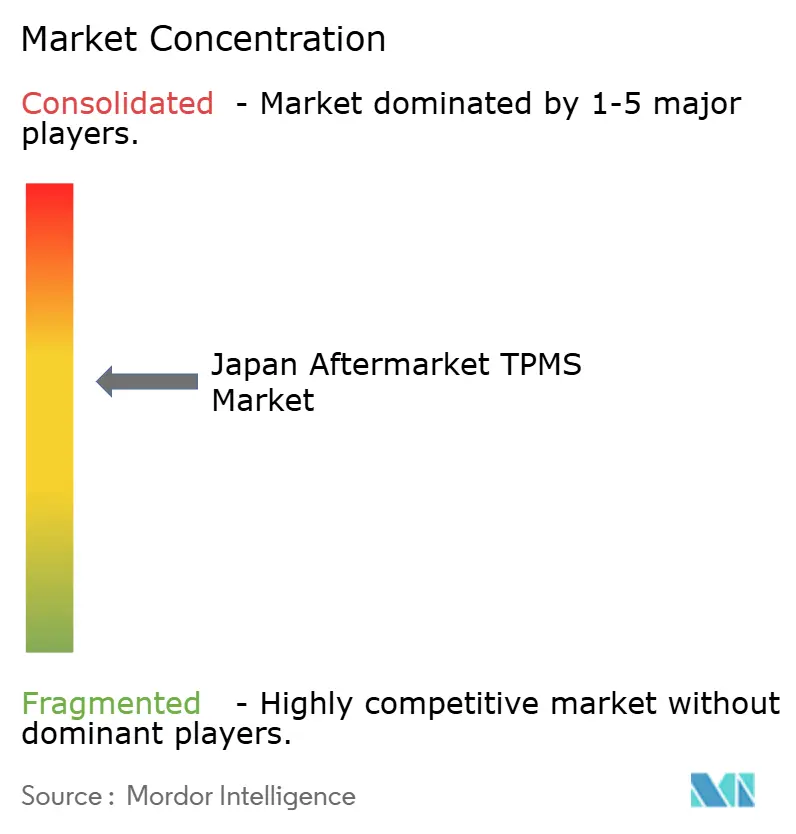
| Market Concentration | Medium |
Major Players *Disclaimer: Major Players sorted in no particular order Image © Mordor Intelligence. Reuse requires attribution under CC BY 4.0. | |
Japan Aftermarket TPMS Market Analysis by Mordor Intelligence
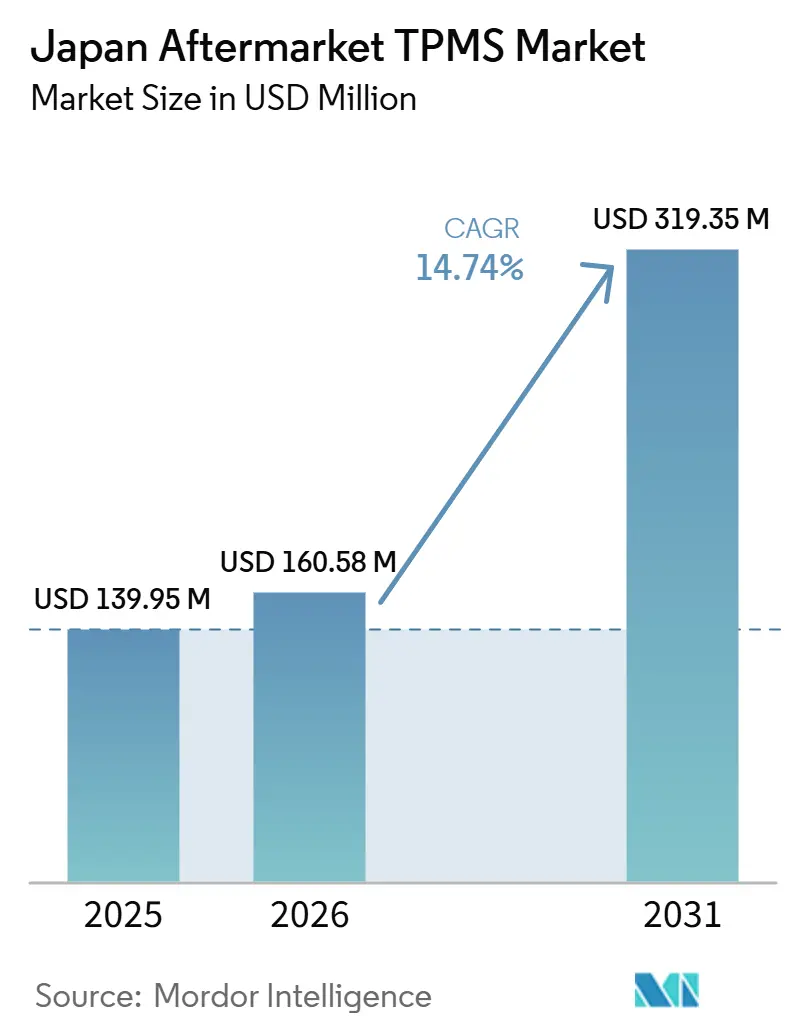
The Japan Aftermarket TPMS Market size is projected to expand from USD 139.95 million in 2025 and USD 160.58 million in 2026 to USD 319.35 million by 2031, registering a CAGR of 14.74% between 2026 to 2031.
The Ministry of Land, Infrastructure, Transport and Tourism (MLIT) introduced a TPMS fitment mandate, and a standard radio frequency was subsequently harmonized across suppliers. These measures, alongside strengthened inspection enforcement, are driving a surge in replacement demand by aligning regulatory, technical, and service requirements. With an average vehicle ownership spanning several years and a significant retention rate beyond a decade, Japan's vehicle parc consistently feeds into sensor end-of-life cycles. Furthermore, with a high percentage of households owning cars, Japan boasts a vast consumer base. The swift rise of e-commerce is evident, with Autobacs reporting a spike in online sales and Yellow Hat witnessing a significant increase in web reservations. This trend not only reduces purchasing friction but also directs customers to service bays that can perform same-day sensor programming and installation. At a more granular level, STMicroelectronics made headlines with its acquisition of NXP Semiconductors’ MEMS sensor line, signaling tighter control over critical pressure-sensing silicon. This move could have reshaped pricing for downstream sensor assemblers.
Key Report Takeaways
- By type, direct TPMS led the Japanese aftermarket TPMS market with an 80.33% share in 2025 and is projected to grow at a 14.62% CAGR through 2031.
- By technology integration, smart/connected units are projected to expand at a 15.83% CAGR, eclipsing stand-alone growth through 2031.
- By vehicle category, commercial vehicles will log the fastest expansion at a 15.16% CAGR, outpacing passenger cars through 2031.
- By distribution channel, online sales are growing at a 16.13% CAGR, even as offline outlets maintained an 85.13% revenue share in 2025.
Note: Market size and forecast figures in this report are generated using Mordor Intelligence’s proprietary estimation framework, updated with the latest available data and insights as of January 2026.
Future direction is shaped by developments occurring across multiple countries and regions, with Japan contributing to the overall trajectory. The outlook on worldwide aftermarket tpms market reflects how these are expected to evolve collectively.
Japan Aftermarket TPMS Market Trends and Insights
Drivers Impact Analysis*
| Driver | (~) % Impact on CAGR Forecast | Geographic Relevance | Impact Timeline |
|---|---|---|---|
| Mandatory TPMS Fitment on New Cars | +4.2% | National | Short term (≤ 2 years) |
| Aging Vehicle Parc Increasing Replacement Demand | +3.8% | National | Medium term (2-4 years) |
| Expansion of E-commerce Auto-Parts Platforms | +2.1% | National | Medium term (2-4 years) |
| Rising Consumer Focus on Fuel Efficiency and Safety | +1.9% | National | Long term (≥ 4 years) |
| Smart-City Parking Systems using TPMS Data | +1.4% | Urban centers | Long term (≥ 4 years) |
| Subscription-Based Telematics Bundles incl. TPMS | +1.3% | National | Medium term (2-4 years) |
| Source: Mordor Intelligence | |||
Mandatory TPMS Fitment Drives Regulatory Compliance Wave
All new passenger cars must now be equipped with TPMS under a mandate from the MLIT [1]. This ruling not only brings the technology into the mainstream but also ignites interest in retrofitting older models, particularly those flagged during Shaken inspections. The retrofitting market is expected to grow as vehicle owners seek to comply with regulations and enhance safety features. Meanwhile, the Ministry of Internal Affairs and Communications has approved a shift in radio-frequency standards. This change enables suppliers to optimize operations with a standardized global sensor design, significantly reducing re-engineering expenses and broadening SKU availability. Additionally, this shift supports the development of more advanced TPMS solutions, fostering innovation in the market. As consumers become more familiar with TPMS, the educational hurdles that once slowed its adoption fade, accelerating its adoption. Service centers are increasingly treating TPMS as a standard safety feature, seamlessly integrating it during tire changes. The growing emphasis on safety and regulatory compliance is expected to further drive TPMS adoption across various vehicle segments.
Aging Vehicle Fleet Intensifies Replacement Cycles
Households often keep cars for extended periods, leading to many sensors nearing battery exhaustion. Pacific Industrial designs its sensors with a set lifespan. Yet, in hotter climates and on busier routes, this lifespan diminishes, frequently resulting in replacements during routine tire rotations. This issue is particularly significant as sensors play a critical role in vehicle safety and performance, making timely replacements essential. In rural regions, where households typically own multiple vehicles, this trend boosts recurring revenue, as each car's sensor replacement occurs at staggered intervals. Additionally, the growing adoption of advanced driver-assistance systems (ADAS) further emphasizes the importance of maintaining functional sensors, as these systems rely heavily on sensor accuracy and reliability.
E-commerce Transformation Reshapes Distribution Dynamics
Autobacs achieved significant online sales growth, predominantly driven by its Buy-Online-Pick-up-in-Store service, where the majority of orders were for tires and electronics, including TPMS. Yellow Hat experienced a notable increase in web reservations for same-day services, highlighting a growing consumer inclination towards the convenience of click-to-install[2]. Meanwhile, Pacific Industrial's cap-type sensor, the PMC-0001, available on Rakuten, offers features such as DIY installation and quick smartphone pairing, catering perfectly to the preferences of digital-first consumers.
Consumer Safety Consciousness Drives Premium Adoption
Fleets faced increased downtime and higher fuel costs due to driver-hour restrictions, a growing challenge for the transportation industry. Sumitomo Rubber's ESP 3.0 app converts sensor data into CFO-friendly ROI dashboards that showcase fuel savings achieved through optimal tire pressure. This innovative solution not only helps reduce operational costs but also enhances fleet efficiency. The Japan Automobile Federation points out that a notable share of highway callouts were tied to tire issues, emphasizing the importance of TPMS as a prudent safety investment. By maintaining proper tire pressure, fleets can improve safety, reduce maintenance costs, and extend tire lifespan.
Restraints Impact Analysis*
| Restraint | (~) % Impact on CAGR Forecast | Geographic Relevance | Impact Timeline |
|---|---|---|---|
| High Retrofit Cost for Older Vehicles | -2.3% | National | Short term (≤ 2 years) |
| Intense Price Competition from Low-Cost Imports | -1.8% | National | Medium term (2-4 years) |
| Proliferation of Counterfeit Sensors | -1.4% | National | Medium term (2-4 years) |
| MLIT Spectrum Re-Allocation Compliance Costs | -0.9% | National | Short term (≤ 2 years) |
| Source: Mordor Intelligence | |||
High Retrofit Costs Create Market Access Barriers
Sensor kits for vehicles without existing TPMS wiring can cost a significant outlay for cash-strapped owners, especially in rural prefectures where disposable incomes lag national averages. The price burden is heavier on fleet operators managing dozens of aging trucks: aggregate retrofit costs quickly climb into millions of yen, delaying widespread adoption. Some workshops offset expenses through government subsidies, but the overall headwind still trims the Japan aftermarket TPMS market growth rate, particularly in segments dominated by price-sensitive customers.
Import Competition Intensifies Pricing Pressures
Online marketplaces are inundated with low-cost imports from mainland China, which are significantly undercutting domestic sensor manufacturers. While a weakened yen has slightly elevated import prices, it hasn't bridged the existing cost disparity. As basic sensors edge towards commoditization, local companies are shifting their focus to premium, connected products, albeit at the expense of their share in the entry-level segment. This strategic split is not only squeezing margins on mid-tier products but also injecting volatility into the pricing dynamics of Japan's aftermarket TPMS market.
*Our forecasts treat driver/restraint impacts as directional, not additive. The impact forecasts reflect baseline growth, mix effects, and variable interactions.
Segment Analysis
By Type: Direct Technology Underpins Market Leadership
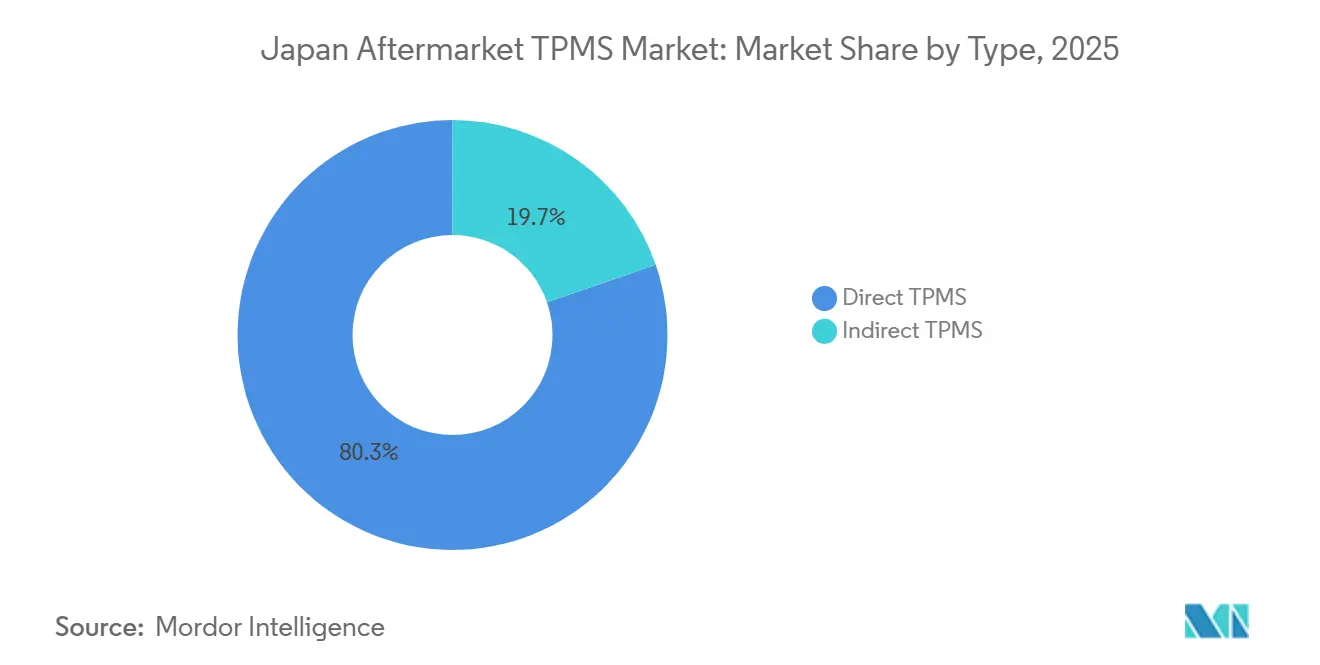
Direct systems captured 80.33% of the Japanese aftermarket TPMS market in 2025, reflecting owner demand for precise per-wheel readings. The Japan aftermarket TPMS market size for direct solutions is forecast to expand at a 14.62% CAGR between 2026 and 2031. While indirect TPMS remains a cost-effective retrofit for cars equipped with ABS, its appeal diminishes for fleets prioritizing accuracy and visibility across multiple tires.
Denso's targeting additional vehicles with its "First Time Fit" initiative highlights OEM suppliers' shift towards replacement cycles amidst stagnating new-car volumes. The introduction of universal programmable sensors has further reduced per-unit prices, challenging the historical cost advantage of indirect systems.
By Technology Integration: Connected Systems Capture Growth Upside
In 2025, stand-alone units accounted for 68.22% of the revenue. However, connected variants are set to surge at a 15.83% CAGR, buoyed by innovations like Sumitomo Rubber’s ESP 3.0 and Schrader’s AirCheck BLE. These advancements are driving the adoption of connected technologies in the market, offering enhanced functionality and real-time data insights.
Commercial operators already using 4G telematics modules can seamlessly stream tire data with only minor hardware additions, speeding up upgrades. This capability reduces operational downtime and improves fleet management efficiency. While smartphone pairing clarifies the value of these sensors for consumers, a growing subscription fatigue limits deeper market penetration. Despite this, the convenience and accessibility provided by smartphone integration continue to attract a significant portion of the consumer base.
By Vehicle Type: Commercial Fleets Accelerate Investment
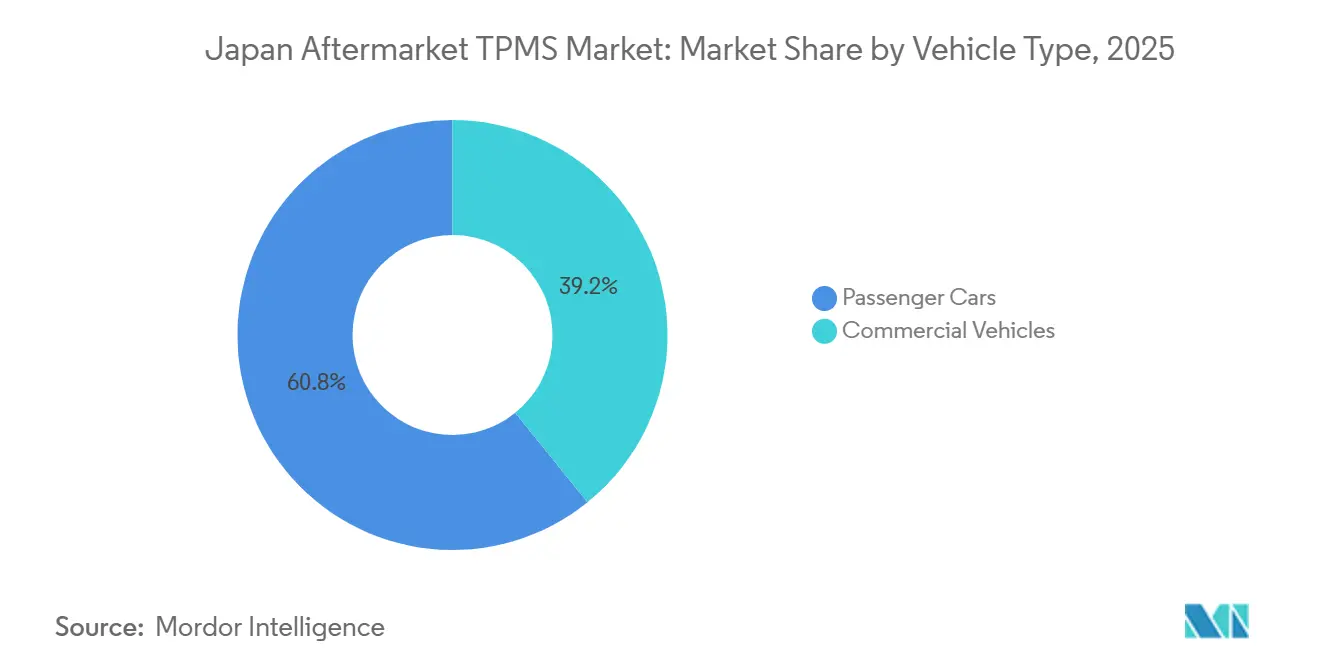
In 2025, passenger cars accounted for 60.77% of demand. However, as driver rest rules tighten, there's a marked shift towards commercial vehicles. Forecasted to grow at a 15.16% CAGR, commercial vehicles are set to outpace passenger cars through 2031.
With companies like Yamato Transport expanding their long-haul operations, trucks and buses are poised to capture a larger share of Japan's aftermarket TPMS market. Fleets, benefiting from reduced downtime, are realizing fuel savings of 2–4%, making retrofitting with an increased number of sensors per axle a financially sound decision.
By Distribution Channel: Digital Expansion Gains Momentum
In 2025, offline outlets accounted for 85.13% of the market share. However, the Japanese aftermarket TPMS market is witnessing a surge in online channel sales, projected to grow at a robust 16.13% CAGR.
The integration of web-to-bay booking streamlines decision-making, and the option for same-day installation addresses the DIY challenges that previously hindered online purchasers. This growth is further supported by increasing internet penetration, rising consumer preference for convenience, advancements in e-commerce platforms, and the availability of competitive pricing and promotional offers online. Additionally, the growing awareness of TPMS benefits and regulatory mandates for vehicle safety are driving demand through digital channels, further accelerating the shift toward online sales.
Geography Analysis
Greater Tokyo, with its dense passenger-car population and advanced repair-shop network, leads Japan's aftermarket TPMS market. Following closely are Osaka and Nagoya, both benefiting from robust commercial-vehicle activities linked to port logistics and manufacturing hubs. Urban pilot programs that integrate TPMS data into smart-parking platforms are boosting adoption rates and enhancing municipal congestion management.
Conversely, rural prefectures lag in upgrades, hindered by lower disposable incomes and limited access to specialized equipment. However, these regions possess a significant number of aging vehicles, suggesting a potential market for replacements once costs become more accessible. In coastal industrial corridors, freight carriers are swiftly retrofitting commercial vehicles, optimizing tire pressures in response to rising fuel costs.
Supply-chain resilience is paramount: Japan's island geography exposes sensor logistics to weather-related disruptions. To counter this, established domestic suppliers are utilizing regional warehousing and maintaining ties with OEMs, allowing them to reduce lead times. This becomes especially crucial when servicing remote islands, where shipping delays can impede timely vehicle inspections.
Analysis of the aftermarket tpms market by Mordor Intelligence spans multiple other regional evaluations across Europe, supported by country-level insights for India, South Korea, China, and United States, wherein local market conditions keep varying from one country to another.
Competitive Landscape
In Japan's aftermarket TPMS market, a few key players dominate. Denso, Pacific Industrial, and Alps Alpine leverage their strong ties with OEMs to obtain first-fit technical documentation, which they then adapt for aftermarket kits. Denso's significant investment in R&D is fueling the development of ASICs that reduce sensor power consumption, thereby extending battery life. While Continental and Sensata bolster their global presence with localized distribution, smaller domestic firms hone in on specialized retrofit markets.
Today's technological edge lies more in data analytics than in the hardware itself. TDK's partnership with Goodyear combines tire performance data with integrated MEMS sensors to offer comprehensive monitoring solutions. STMicroelectronics’ 2026 purchase of NXP’s sensor unit consolidated the silicon supply chain and potentially increased its bargaining power over mid-tier assemblers. The counterfeit threat forces legitimate brands to adopt blockchain labels and retailer vetting, raising compliance costs but strengthening consumer confidence[3].
Price wars escalate as Chinese imports challenge local prices. In retaliation, domestic brands are enhancing their offerings with extended warranties and software updates, creating a barrier for these low-cost competitors. This segmentation strategy results in two distinct paths: premium connected packages and budget-friendly options for older vehicles.
Japan Aftermarket TPMS Industry Leaders
-
Denso Corporation
-
Pacific Industrial Co., Ltd.
-
Continental AG
-
Schrader TPMS Solutions (Sensata)
-
Alps Alpine Co., Ltd.
- *Disclaimer: Major Players sorted in no particular order
Recent Industry Developments
- March 2026: STMicroelectronics signed an agreement to acquire NXP Semiconductors' MEMS sensor portfolio. This acquisition strengthened STMicroelectronics' automotive lineup by adding TPMS pressure sensors and accelerometers.
- March 2026: Denso broadened its portfolio with the launch of new First Time Fit TPMS SKUs, significantly expanding its coverage to include a wider range of vehicles from Nissan, Toyota, Infiniti, and Lexus.
Japan Aftermarket TPMS Market Report Scope
The Japan aftermarket TPMS market report is segmented by type (direct TPMS and indirect TPMS), technology integration (stand-alone TPMS units and smart/connected TPMS), vehicle type (passenger cars and commercial vehicles), and distribution channel (offline and online). The market forecasts are provided in terms of value (USD) and volume (units).
| Direct TPMS |
| Indirect TPMS |
| Stand-alone TPMS Units |
| Smart/Connected TPMS |
| Passenger Cars | Hatchbacks |
| Sedans | |
| SUVs and MUVs | |
| Commercial Vehicles | Light Commercial Vehicles |
| Medium and Heavy Commercial Vehicles | |
| Buses and Coaches |
| Offline (Auto-parts stores, specialty shops, service centers) |
| Online (OEM websites/Apps, e-commerce platforms) |
| By Type | Direct TPMS | |
| Indirect TPMS | ||
| By Technology Integration | Stand-alone TPMS Units | |
| Smart/Connected TPMS | ||
| By Vehicle Type | Passenger Cars | Hatchbacks |
| Sedans | ||
| SUVs and MUVs | ||
| Commercial Vehicles | Light Commercial Vehicles | |
| Medium and Heavy Commercial Vehicles | ||
| Buses and Coaches | ||
| By Distribution Channel | Offline (Auto-parts stores, specialty shops, service centers) | |
| Online (OEM websites/Apps, e-commerce platforms) | ||
Key Questions Answered in the Report
How large will the Japan aftermarket TPMS market be by 2031?
The Japan aftermarket TPMS market size is forecast at USD 319.35 million by 2031, up from USD 160.58 million in 2026, reflecting a 14.74% CAGR over 2026-2031.
Which TPMS type holds the dominant share in Japan?
Direct TPMS commanded 80.33% of Japan aftermarket TPMS market share in 2025 and will stay ahead through 2031.
How are online channels influencing TPMS sales?
E-commerce platforms such as Autobacs’ web store and Yellow Hat Online are lifting the online share, which is growing at a 16.13% CAGR even as offline bays remain vital for installations.
What threat do counterfeit sensors pose?
Brands are turning to authentication labels as counterfeits, devoid of FCC IDs and utilizing pirated software, undermine consumer trust and impact the projected growth rate.