
Islamic Fintech Market Size and Share
Market Overview
| Study Period | 2020 - 2031 |
|---|---|
| Market Size (2026) | USD 222.58 Billion |
| Market Size (2031) | USD 515.06 Billion |
| Growth Rate (2026 - 2031) | 18.27 % |
| Fastest Growing Market | North America |
| Largest Market | Middle East and Africa |
| Market Concentration | Low |
Major Players *Disclaimer: Major Players sorted in no particular order Image © Mordor Intelligence. Reuse requires attribution under CC BY 4.0. | |
Islamic Fintech Market Analysis by Mordor Intelligence
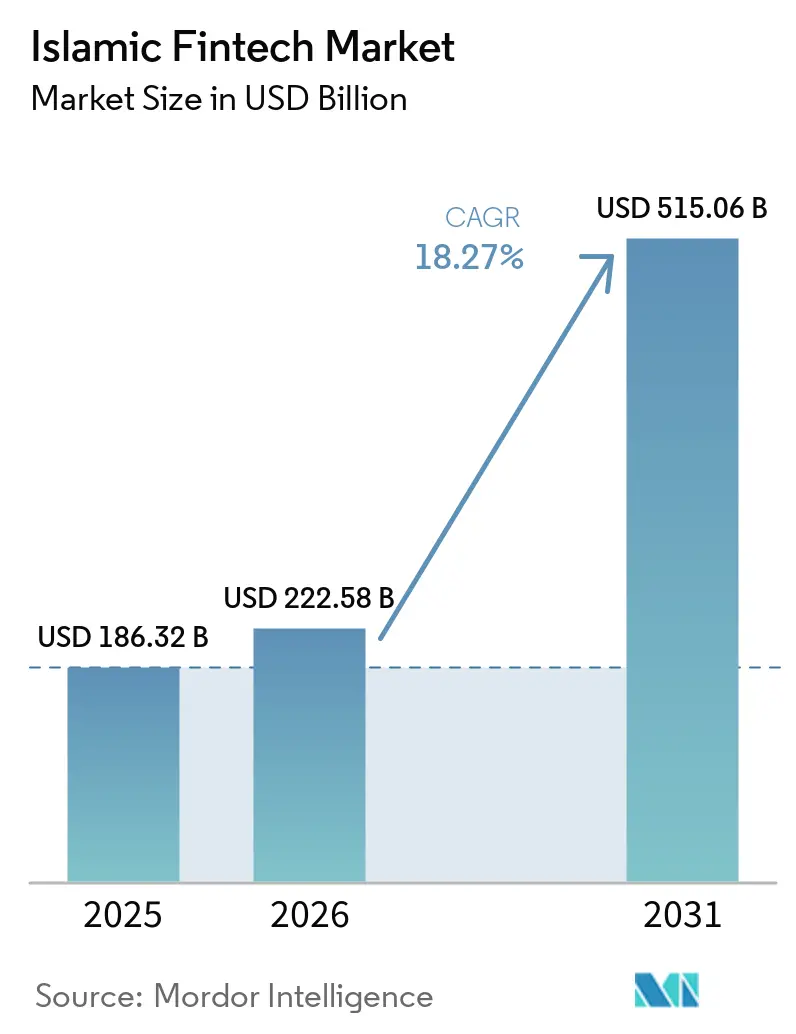
The Islamic Fintech Market size is projected to be USD 186.32 billion in 2025, USD 222.58 billion in 2026, and reach USD 515.06 billion by 2031, growing at a CAGR of 18.27% from 2026 to 2031.
The Islamic fintech market is expanding as digital-first delivery becomes the standard model for financial access across Muslim-majority economies and diaspora markets. In contrast, the halal economy continues to widen the demand base for compliant payment, financing, and wealth solutions. The market is also gaining institutional depth, not just retail scale, as outstanding sukuk crossed USD 1 trillion in Q3 2025, indicating that Shariah-compliant capital market instruments have already reached a level that draws sustained global investor attention. The Islamic fintech market is further supported by government-backed inclusion agendas, regulatory modernization, and growing interest in software-based compliance tools that can lower operating friction across product lines and jurisdictions. At the same time, the Islamic fintech market still faces structural barriers from fragmented Shariah interpretation, high governance costs for early-stage firms, and uneven licensing rules across borders. Even with those constraints, the addressable opportunity remains broad because several underpenetrated Muslim population centers still have limited access to digital Islamic banking and investment products.
Key Report Takeaways
- By service type, digital payments, wallets, and remittances accounted for 54.8% of the Islamic fintech market share in 2025, while RegTech, Shariah governance, and compliance tools are projected to grow at a 24.6% CAGR through 2031.
- By deployment, cloud accounted for 76.4% of the Islamic fintech market share in 2025, while hybrid deployment is projected to grow at 21.5% CAGR through 2031.
- By end user, individuals captured 52.7% of the Islamic fintech market share in 2025, while SMEs are projected to grow at a 22.3% CAGR through 2031.
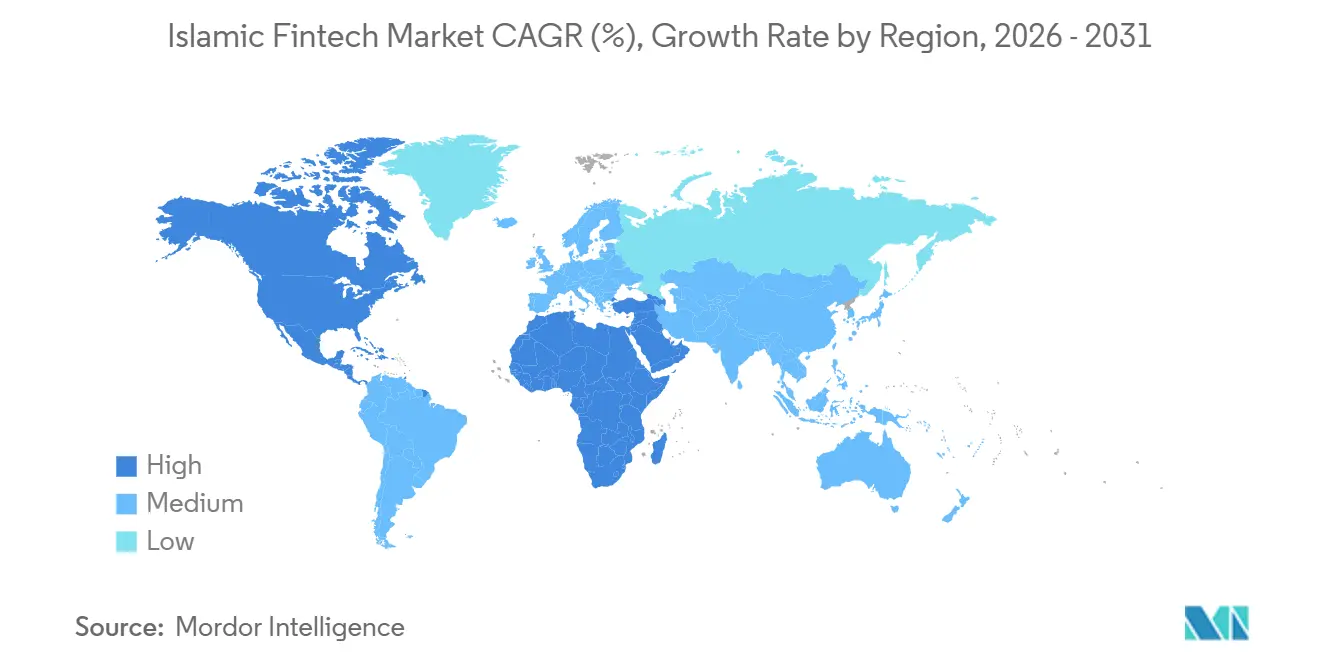
- By geography, the Middle East and Africa accounted for 51.6% of the Islamic fintech market share in 2025, while North America is projected to grow at 22.5% CAGR through 2031.
Note: Market size and forecast figures in this report are generated using Mordor Intelligence’s proprietary estimation framework, updated with the latest available data and insights as of January 2026.
Market Trends and Insights
Drivers Impact Analysis of Islamic Fintech Market*
| Driver | (~) % Impact on CAGR Forecast | Geographic Relevance | Impact Timeline |
|---|---|---|---|
| Rising Demand for Shariah-Compliant Digital Financial Services | +4.5% | Global, concentrated in GCC, Asia-Pacific, and North America diaspora | Short term (≤ 2 years) |
| Halal Economy Expansion Across Payments, Wealth, and Financing | +3.2% | Global, with lead markets in GCC, Southeast Asia, and the United Kingdom | Medium term (2-4 years) |
| Rapid Digitization of Islamic Banking and Fintech Delivery | +3.8% | Saudi Arabia, Malaysia, United Arab Emirates, Indonesia, and secondary in Europe and North America | Short term (≤ 2 years) |
| Venture Funding and Ecosystem Support for Islamic Fintech Startups | +2.5% | United Arab Emirates, Saudi Arabia, Bahrain, secondary in the United Kingdom, and the United States | Medium term (2-4 years) |
| Embedded Finance and API-Based Shariah-Compliant Product Distribution | +2.1% | GCC core, spill-over to Asia-Pacific and Europe | Medium term (2-4 years) |
| Zakat Digitization and Waqf Modernization Creating New Transaction Flows | +1.4% | Malaysia, UAE, Indonesia, India | Long term (≥ 4 years) |
| Source: Mordor Intelligence | |||
Rising Demand for Shariah-Compliant Digital Financial Services
Demand in the Islamic fintech market is tied to long-term demographic and behavioral shifts rather than to short-term funding cycles. The global Muslim population exceeded 1.8 billion, and a large share of that population sits in younger age groups that treat mobile-first banking as a standard expectation. The addressable base also extends beyond faith-based demand because Islamic finance principles such as transparency, asset backing, and risk sharing overlap with broader ethical finance preferences recognized in supervisory frameworks[1]. Indonesia shows how consumer demand can move into policy-backed volume, as Bank Indonesia links Shariah-compliant product penetration to a 90% adult financial inclusion target by 2030. That policy support is helping the Islamic fintech market move from a niche position to a more central role in digital financial distribution across major Muslim-majority economies.
Halal Economy Expansion Across Payments, Wealth, and Financing
The Islamic fintech market is also benefiting from the wider expansion of the halal economy across payments, financing, and asset allocation. What matters here is not only higher transaction volume, but also the fact that compliant payment relationships can now feed directly into financing and investment products inside the same customer journey. The QFC Global Islamic Fintech Report 2025/26 points to this broadening opportunity set and shows that firms are increasingly building broader product ecosystems rather than operating as single-function apps. That pattern is especially relevant in wealth management, where digital channels are opening Shariah-compliant investing to customer groups that were historically underserved. In April 2026, Wahed Invest launched a fully Shariah-compliant single-family residential real estate fund for non-accredited retail investors in the United States, showing that the halal economy is expanding into retail-accessible wealth products in diaspora markets as well[2].
Rapid Digitization of Islamic Banking and Fintech Delivery
Rapid digitization is changing the operating model of the Islamic fintech market by reducing dependence on manual review cycles. New Islamic products have traditionally required separate scholarly review, which has increased launch times and costs as product portfolios expand. IFSB-31, issued in 2025 with a recommended implementation timeline beginning in January 2027, explicitly supports the use of supervisory technology in Shariah governance oversight. The direction is now moving from advisory-heavy governance toward system-embedded controls, which is important for banks and platforms that want to scale across multiple products and jurisdictions. In April 2026, Intellect Design Arena launched eMACH.ai Islamic Banking, a cloud-native, AAOIFI-compliant suite that automates profit-sharing workflows and Shariah-compliant accounting entries, demonstrating how software is increasingly taking on tasks that once relied on repeated manual intervention[3].
Venture Funding and Ecosystem Support for Islamic Fintech Startups
Larger early-stage funding rounds and a more international investor base are also shaping the Islamic fintech market. This matters because product development in compliant finance often requires more capital than standard fintech models due to governance, legal, and licensing needs. In January 2026, Mal raised USD 230 million from Abu Dhabi-based BlueFive Capital to build an AI-native Islamic digital bank focused on global Muslim consumers and underbanked communities[4]. The size and positioning of that round showed that investors are now treating the category as scalable financial infrastructure rather than a narrow regional opportunity. Even so, the QFC Global Islamic Fintech Report 2025/26 still identifies access to capital as a core sector challenge, which means the next phase will depend not only on capital raising but also on how efficiently firms deploy capital across different regulatory markets.
Restraints Impact Analysis of Islamic Fintech Market*
| Restraint | (~) % Impact on CAGR Forecast | Geographic Relevance | Impact Timeline |
|---|---|---|---|
| Fragmented Shariah Interpretation Across Jurisdictions | -2.8% | Global, most acute for cross-border distribution between GCC and Asia-Pacific | Long term (≥ 4 years) |
| Limited Consumer Trust in New-Format Islamic Financial Products | -1.5% | Emerging markets, including Sub-Saharan Africa and South Asia | Medium term (2-4 years) |
| High Compliance and Shariah Governance Costs for Early-Stage Firms | -2.1% | Global, most acute in North America, Europe, and Asia-Pacific emerging markets | Short term (≤ 2 years) |
| Cross-Border Licensing and Data Localization Friction | -1.6% | Asia-Pacific core, with early-stage pressure in the Middle East, and Africa | Medium term (2-4 years) |
| Source: Mordor Intelligence | |||
Fragmented Shariah Interpretation Across Jurisdictions
Fragmented Shariah interpretation remains one of the most significant structural constraints on the scalability of the Islamic fintech market. Product structures approved in one jurisdiction often require re-evaluation in another, slowing cross-border expansion for firms seeking to operate across multiple regulatory environments. IFSB-31 provides a comprehensive framework to strengthen Shariah governance and promote greater supervisory consistency across Islamic financial institutions. However, as the standard is not mandatory across all jurisdictions, differences in fiqh interpretation, regulatory implementation, and national supervisory practices continue to create compliance complexity and limit cross-border standardisation. As a result, fintech providers that develop flexible governance frameworks capable of meeting multiple national Shariah and regulatory requirements are better positioned to scale internationally than those relying on a single jurisdictional approval model.
High Compliance and Shariah Governance Costs for Early-Stage Firms
High compliance costs continue to shape competitive outcomes in the Islamic fintech market, especially at seed and Series A stages. Shariah governance is not a one-time design step, because firms in regulated Islamic finance environments must maintain continuing oversight through qualified supervisory structures. AAOIFI had issued more than 100 Shariah and accounting standards by 2025, and that body of standards increases the legal, accounting, and operational work required for product design and ongoing monitoring. The result is a two-tier structure in which better-capitalized incumbents can spread governance costs across broader product bases, while smaller firms face tighter economics in underserved geographies. The QFC Global Islamic Fintech Report 2025/26 reinforces this challenge and shows why compliance technology is becoming strategic, even though building such tools also favors firms with stronger capital positions.
*Our forecasts treat driver/restraint impacts as directional, not additive. The impact forecasts reflect baseline growth, mix effects, and variable interactions.
Islamic Fintech Market Segment Analysis
By Service Type:
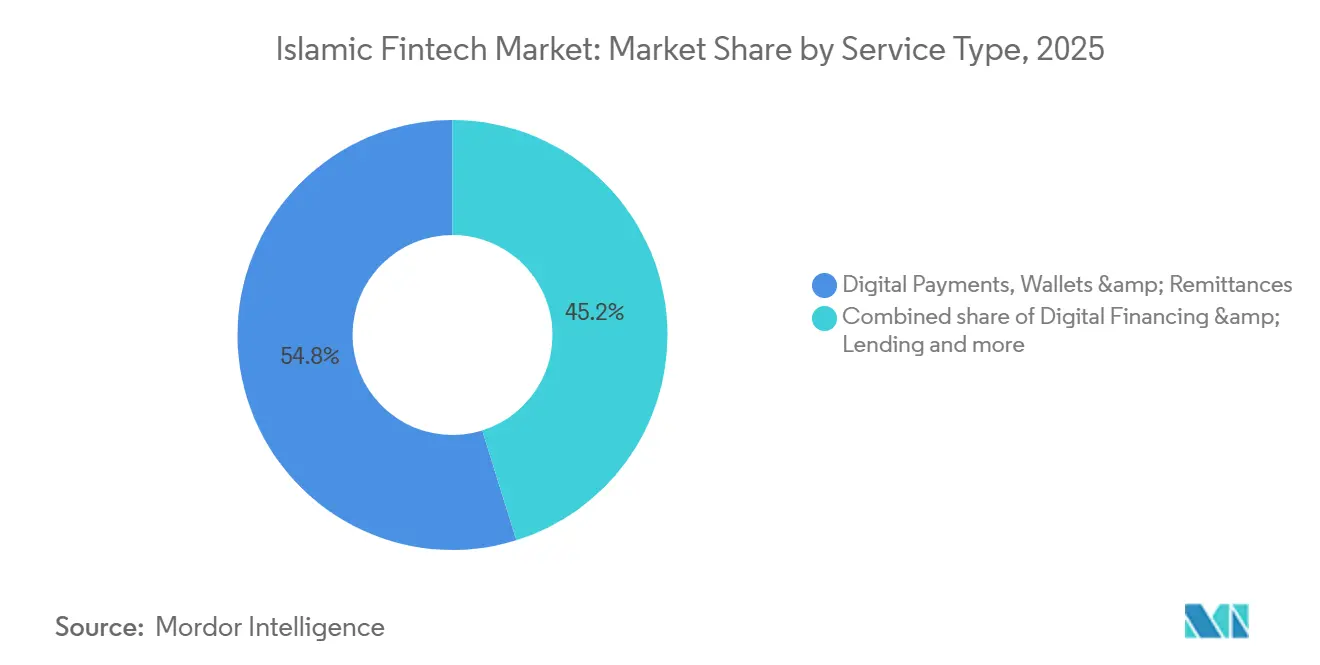
Payments Infrastructure Anchors the Market, but RegTech Rewrites EconomicsDigital payments, wallets, and remittances accounted for 54.8% of revenue in 2025, keeping this category at the center of the Islamic fintech market, as transaction infrastructure was the first area to reach commercial scale and regulatory acceptance. The Islamic fintech market still depends on this layer for user acquisition, because payment activity creates the first compliant relationship that can later support financing, investment, and other services. RegTech, Shariah governance, and compliance tools are projected to expand at a 24.6% CAGR through 2031, which makes this the fastest-growing service category in the Islamic fintech market. That growth reflects a change in how compliance is delivered, with recurring software logic replacing more ad hoc and manually intensive review processes. The shift is likely to deepen as supervisory frameworks give institutions a stronger reason to budget for compliance systems as ongoing operating infrastructure rather than occasional advisory spend.
RegTech is important not only as a revenue segment, but also because it improves the economics of every other service line that depends on Shariah approval, reporting, or audit workflows. The effect is especially visible in Islamic capital markets, where digitally enabled issuance and governance tools can shorten process cycles and widen participation. In April 2026, Khazanah Nasional and the Securities Commission Malaysia priced Malaysia’s first tokenized sukuk at MYR 100 million (USD 25 million) under Wakalah bi al-Istithmar, with Maybank acting as joint lead manager, custodian, and primary subscriber. That transaction matters because it shows that digital infrastructure can support sovereign-backed Islamic capital market instruments at a practical scale. It also aligns with the broader market backdrop, where global sukuk issuance reached USD 205 billion in 2024, and outstanding sukuk crossed USD 1 trillion in Q3 2025, confirming a sizable base for future digitally native capital market activity.
By Deployment:
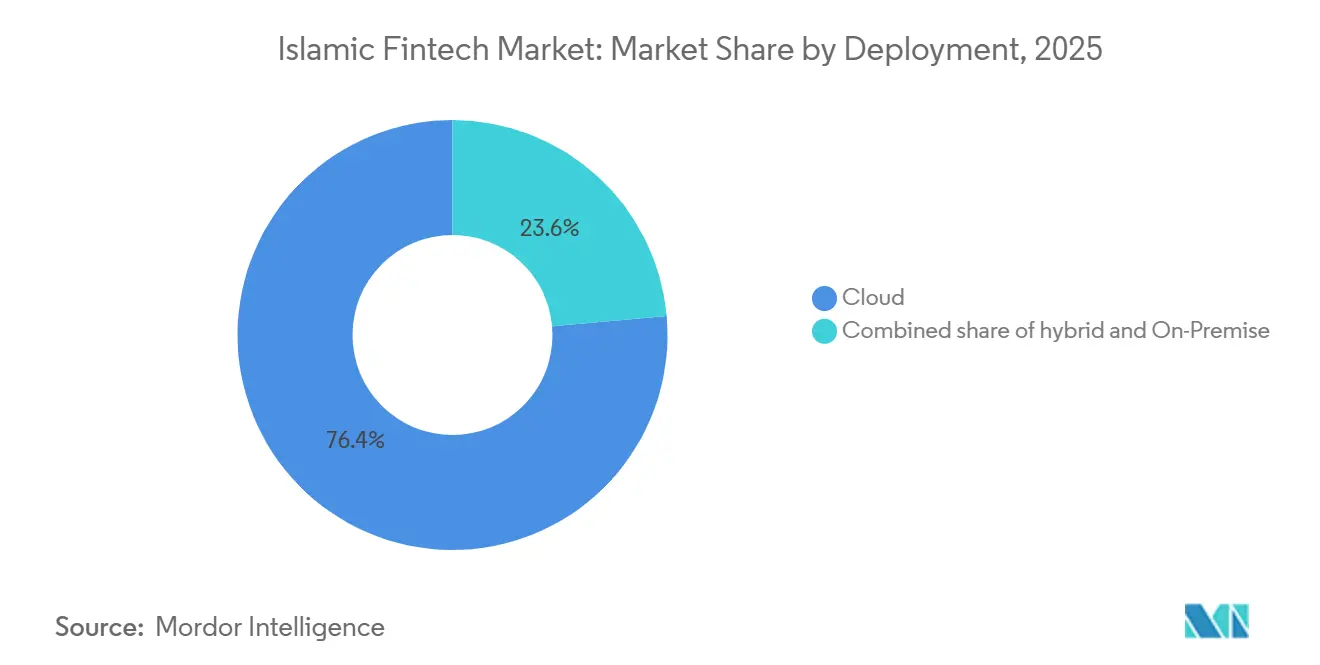
Data Residency Creates Structural Demand for Hybrid ArchitectureCloud deployment accounted for 76.4% of 2025 deployments, which made it the dominant delivery model in the Islamic fintech market as more vendors shifted toward cloud-native banking infrastructure. At the same time, hybrid deployment is projected to grow at a 21.5% CAGR through 2031, indicating that the Islamic fintech market is not moving toward a simple full-cloud model. This pattern reflects the practical reality that some financial and governance records still need to remain on domestically controlled infrastructure even while customer-facing and processing layers move to scalable public cloud environments. The result is a stronger demand for architectures that can separate data location requirements from service delivery speed. In that setting, hybrid design becomes less of a transition step and more of a long-term operating model for institutions handling sensitive Islamic financial records across multiple jurisdictions.
The hybrid trend also creates a clear advantage for technology suppliers who designed their systems with regulatory flexibility from the start. On-premises setups remain relevant for government-linked, public-sector, and development institutions, which still account for significant transaction flows across several Islamic finance ecosystems. This keeps professional services, architecture design, and governance support important, even as core infrastructure becomes more software-driven. For operators in the Islamic fintech industry, the more difficult challenge is not deploying one compliant system, but building a platform that can scale across the GCC and Asia-Pacific without major redesign. That is why the Islamic fintech market is rewarding vendors whose products already reflect data-residency and supervisory realities, instead of those trying to retrofit those controls after expansion begins.
By End-User:
SME Digital Lending Becomes the Market's Highest-Velocity Growth SegmentIndividuals accounted for 52.7% of revenue in 2025, making them the largest end-user group in the Islamic fintech market, while SMEs are projected to grow at a 22.3% CAGR through 2031, representing the fastest-growing demand pool. This split shows that the current scale still comes from retail adoption, especially in payments, wallets, and consumer-facing finance. At the same time, the next stage of expansion is being shaped by business financing needs that conventional channels have not served well in several Muslim-majority economies. Digital Murabaha and istisna platforms are reducing processing frictions and making smaller-ticket Islamic financing more commercially workable for SME-focused lenders. That matters because it turns a historically underserved segment into a more scalable revenue pool for the Islamic fintech market.
The individual user base still drives everyday transaction volume, making it valuable beyond its direct revenue contribution. Payment relationships can serve as distribution channels for wealth and financing products, helping platforms extend customer value without having to start every relationship from scratch. In parallel, the Islamic fintech market is seeing greater interest from public-sector and institutional actors, as policy frameworks and treasury tools shape which products can scale in regulated environments. That role makes government and development institutions smaller in terms of user count but more important in setting the operating conditions for the broader Islamic fintech market. As a result, the Islamic fintech industry is moving on two tracks at once, with mass retail adoption sustaining present volumes and SME financing supporting the strongest forward growth.
Geography Analysis
MEA Islamic Fintech Market
The Middle East and Africa accounted for 51.6% of revenue in 2025, making it the largest regional contributor to the Islamic fintech market and reflecting structural strengths rather than a short-term funding cycle. The region benefits from long-developed Islamic finance regulation, financial inclusion mandates, and patient capital that supports Shariah-compliant digital finance. Saudi Arabia and the wider GCC have moved beyond basic adoption and are now shaping exportable models for compliant digital banking, lending, and capital markets. The same regional strength is evident in governance and infrastructure priorities, where regulators and institutions are backing solutions that can support wider product distribution while maintaining tighter compliance controls. This explains why the Islamic fintech market remains anchored in MEA even as growth opportunities broaden elsewhere.
APAC Islamic Fintech Market
Asia-Pacific offers a different growth profile, with scale coming from large Muslim populations, strong capital market infrastructure, and active policy direction. Malaysia remains central to that picture because its Islamic Capital Market was valued at MYR 2.7 trillion (USD 0.66 trillion), representing 64% of the country’s total capital market, and the country also ranked first on the ICD-LSEG Islamic Finance Development Indicator for 13 consecutive years. Malaysia is also pushing the Islamic fintech market toward more advanced forms of digitalization, as its Capital Market Masterplan 2026-2031 calls for AI-powered digital Shariah screening and a stronger Maqasid al-Shariah orientation in market development. In April 2026, the country’s first tokenized sukuk pilot added a practical template for digitally enabled Islamic capital market issuance. Indonesia also remains important because its inclusion strategy gives Shariah-compliant finance a direct policy role in expanding access across the population.
The Americas and Europe Islamic Fintech Market
North America is projected to grow at a 22.5% CAGR through 2031, making it the fastest-growing regional segment in the Islamic fintech market. That growth reflects unmet demand in diaspora markets where locally licensed Shariah-compliant digital options have been limited. Wahed’s April 2026 launch of a retail-accessible Shariah-compliant residential real estate fund in the United States showed how Islamic wealth products are moving beyond high-net-worth positioning into wider retail access. Europe continues to grow from its established Islamic finance base, especially in the United Kingdom. At the same time, South America remains small but offers a longer-term entry path where halal economy links and diaspora demand expand.
Competitive Landscape
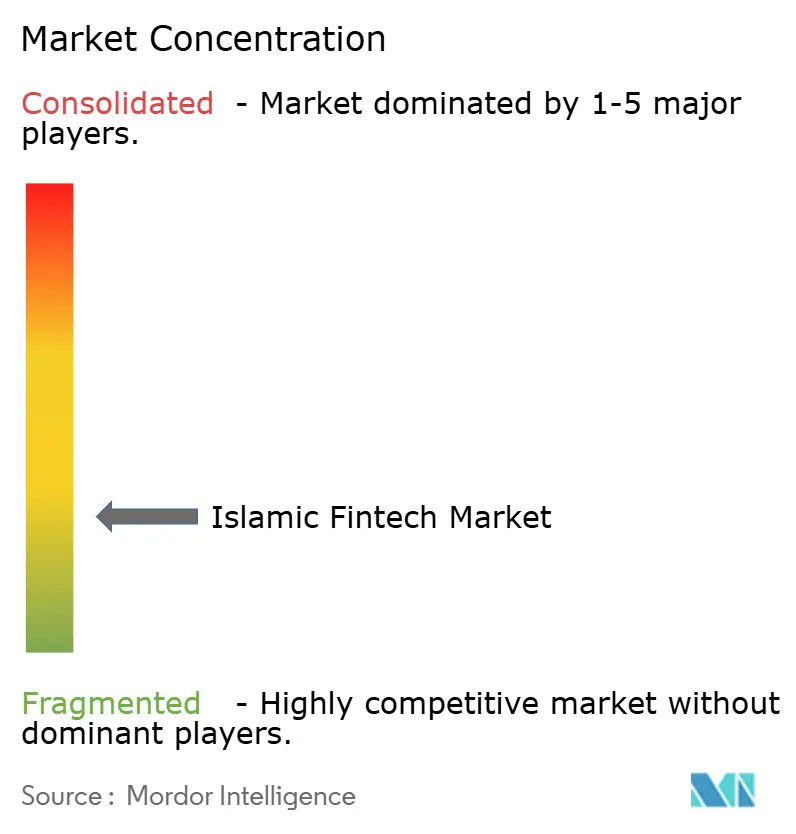
The Islamic fintech market remains fragmented globally, even as consolidation is becoming more visible within specific products and national markets. Large multi-product platforms and infrastructure providers are building stronger positions, but the field still includes many specialists focused on a narrow function or one region. That structure means leadership is not defined by scale alone, but by the ability to connect compliant governance, customer acquisition, and product breadth within a single operating model. Firms that can combine those elements are more likely to defend margins as regulation becomes more formal and customer expectations become broader. This is why the Islamic fintech market is starting to reward platforms that span both distribution and compliance.
Wahed Invest is one example of that direction, as it continues to expand from digital wealth access into more diversified, compliant investment products. The April 2026 launch of a Shariah-compliant single-family residential real estate fund for non-accredited United States investors widened its retail reach. It strengthened its position in a high-potential diaspora market. Intellect Design Arena represents another important layer of competition, as infrastructure vendors that automate Shariah-compliant accounting and profit-sharing workflows can become deeply embedded in institutional operating systems. The April 2026 launch of eMACH.ai Islamic Banking demonstrated how core platform providers are turning compliance functionality into a scalable software proposition rather than a bespoke deployment. In parallel, BlueFive Capital’s USD 230 million backing of Mal in January 2026 signaled that AI-native Islamic digital banking is now viewed as a strategic competitive category rather than a fringe model.
The market’s white space is still clear in underpenetrated Muslim population centers across Sub-Saharan Africa, the Maghreb, and Central Asia, where digital Islamic banking access remains limited relative to demand. Consolidation is also extending to digital assets and adjacent segments, as Paribu acquired CoinMENA in December 2025 in a deal valued at up to USD 240 million, demonstrating that larger regional platforms are willing to buy scale rather than build it slowly. The broader competitive challenge remains the same one identified in the QFC Global Islamic Fintech Report 2025/26: linking compliance-grade Shariah governance with consumer-grade delivery across jurisdictions. In practice, that means the Islamic fintech market is likely to continue favoring firms that can scale both trust and distribution simultaneously.
Islamic Fintech Industry Leaders
-
Wahed Invest Limited
-
Fasset
-
Qardus
-
Beehive P2P Limited
-
Musaffa
- *Disclaimer: Major Players sorted in no particular order
Islamic Fintech Market Companies Covered in this Report
- Wahed Invest Limited
- Fasset
- Qardus
- Beehive P2P Limited
- Musaffa
- NymCaro
- Raqamyah
- Codebase Technologies
- PayHalal
- ShariaPortfolio
- Tabby
- PayTabs
- Sarwa
- CoinMENA
- Rain
- Ruya Bank
- SmartCrowd
- Haball
- Mal
- NymCard
Recent Industry Developments in Islamic Fintech Market
- April 2026: Khazanah Nasional and the Securities Commission Malaysia priced Malaysia's inaugural tokenized sukuk at MYR 100 million (USD 25 million), structured under the Shariah principle of Wakalah bi al-Istithmar and carried on a distributed ledger. CIMB served as the sole principal adviser and lead arranger, and Maybank acted as the joint lead manager, custodian, and primary subscriber. The transaction validates sovereign-backed tokenized sukuk as a scalable capital market model.
- April 2026: Wahed Invest launched the first fully Shariah-compliant single-family residential real estate fund accessible to non-accredited retail investors in the United States, backed by Saudi Aramco's Wa'ed Ventures and Qatar Development Bank. The fund opens Islamic wealth management to the mass-market retail segment in the world's largest Muslim diaspora market.
- April 2026: Intellect Design Arena launched eMACH.ai Islamic Banking, a cloud-native, microservices-based, AAOIFI-compliant core banking suite that automates the full profit-sharing lifecycle and Shariah accounting entries. The platform is designed for Islamic banks that require multi-jurisdictional Shariah regulatory compliance at scale, without the need for bespoke customization for each deployment.
- January 2026: Mal announced a USD 230 million investment led by Abu Dhabi-based BlueFive Capital to launch the UAE's first AI-native Islamic digital bank, targeting the global Muslim population and underbanked communities with a mobile-first platform positioning Shariah governance as an AI operating layer rather than a compliance overlay.
Global Islamic Fintech Market Report Scope
Segmentation Overview
| Digital Payments, Wallets & Remittances |
| Digital Financing & Lending |
| Sukuk & Islamic Capital Markets |
| Takaful & Islamic InsurTech |
| Wealth Management, Robo-Advisory & Digital Investment |
| RegTech, Shariah Governance & Compliance |
| Others (Alternative Finance, Crowdfunding, etc.) |
| Cloud |
| On-Premise |
| Hybrid |
| Individuals |
| Small and Medium Enterprises |
| Large Corporates & Institutional Investors |
| Government, Public Sector & Development Institutions |
| North America | United States |
| Canada | |
| South America | Brazil |
| Rest of South America | |
| Europe | Germany |
| United Kingdom | |
| France | |
| Russia | |
| Rest of Europe | |
| Asia-Pacific | China |
| India | |
| Indonesia | |
| Malaysia | |
| Japan | |
| Rest of Asia-Pacific | |
| Middle East and Africa | Saudi Arabia |
| United Arab Emirates | |
| Qatar | |
| Bahrain | |
| Turkey | |
| South Africa | |
| Rest of Middle East and Africa |
| By Service Type | Digital Payments, Wallets & Remittances | |
| Digital Financing & Lending | ||
| Sukuk & Islamic Capital Markets | ||
| Takaful & Islamic InsurTech | ||
| Wealth Management, Robo-Advisory & Digital Investment | ||
| RegTech, Shariah Governance & Compliance | ||
| Others (Alternative Finance, Crowdfunding, etc.) | ||
| By Deployment | Cloud | |
| On-Premise | ||
| Hybrid | ||
| By End-User | Individuals | |
| Small and Medium Enterprises | ||
| Large Corporates & Institutional Investors | ||
| Government, Public Sector & Development Institutions | ||
| By Geography | North America | United States |
| Canada | ||
| South America | Brazil | |
| Rest of South America | ||
| Europe | Germany | |
| United Kingdom | ||
| France | ||
| Russia | ||
| Rest of Europe | ||
| Asia-Pacific | China | |
| India | ||
| Indonesia | ||
| Malaysia | ||
| Japan | ||
| Rest of Asia-Pacific | ||
| Middle East and Africa | Saudi Arabia | |
| United Arab Emirates | ||
| Qatar | ||
| Bahrain | ||
| Turkey | ||
| South Africa | ||
| Rest of Middle East and Africa | ||
Key Questions Answered in the Report
What is the current size of the global Islamic fintech space?
It stood at USD 186.3 billion in 2025 and is forecast to reach USD 515.1 billion by 2031 at an 18.3% CAGR over 2026-2031.
Which service category leads revenue today?
Digital payments, wallets, and remittances led with 54.8% of 2025 revenue, showing that transaction infrastructure still anchors current demand.
Which service category is growing the fastest?
RegTech, Shariah governance, and compliance tools are expected to grow at a 24.6% CAGR through 2031, reflecting demand for software-based oversight.
Why is Middle East and Africa still the largest regional contributor?
MEA led with 51.6% of 2025 revenue because of stronger Islamic finance regulation, inclusion mandates, and patient institutional capital, especially in the GCC.
Why is North America growing faster than other regions?
North America is projected to expand at a 22.5% CAGR through 2031 because diaspora demand has outpaced the availability of locally licensed Shariah-compliant digital offerings.