
Market Overview
| Study Period | 2020 - 2031 |
|---|---|
| Forecast Data Period | 2026 - 2031 |
| Historical Data Period | 2020 - 2024 |
| Market Size (2026) | USD 2.12 Billion |
| Market Size (2031) | USD 2.69 Billion |
| Growth Rate (2026 - 2031) | 4.95 % |
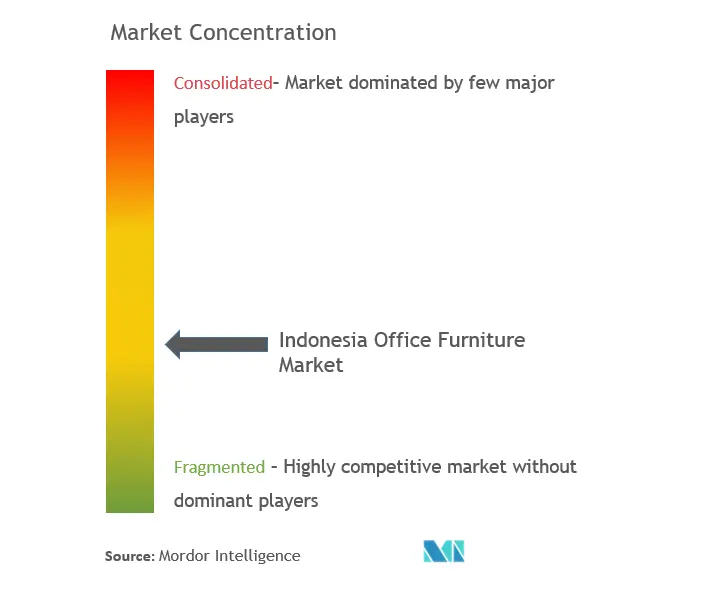
| Market Concentration | Low |
Major Players *Disclaimer: Major Players sorted in no particular order Image © Mordor Intelligence. Reuse requires attribution under CC BY 4.0. | |

Indonesia Office Furniture Market Analysis by Mordor Intelligence
The Indonesia office furniture market size is USD 2.12 billion in 2026 and is projected to reach USD 2.69 billion by 2031, translating into a 4.95% CAGR for the period to 2031. Growth reflects a durable shift in enterprise purchasing patterns toward ergonomic upgrades and modular workstations that support hybrid work, as well as steady furniture demand from government-linked programs and certified suppliers serving public procurement. The IKN Nusantara government office zone introduces a multi-year procurement cycle as state institutions stage their move to East Kalimantan, creating a sizable demand pool for desks, seating, and storage within green and quality-focused specifications.[1] Digital channels continue to expand category reach beyond Java, with marketplaces and integrated payments improving conversion and logistics for premium and value segments alike. E-commerce performance data signals sustained furniture uptake across B2C and small business users, while B2B platforms aligned with TKDN-certified inventories reinforce demand visibility for suppliers that meet domestic-content rules.
Key Report Takeaways
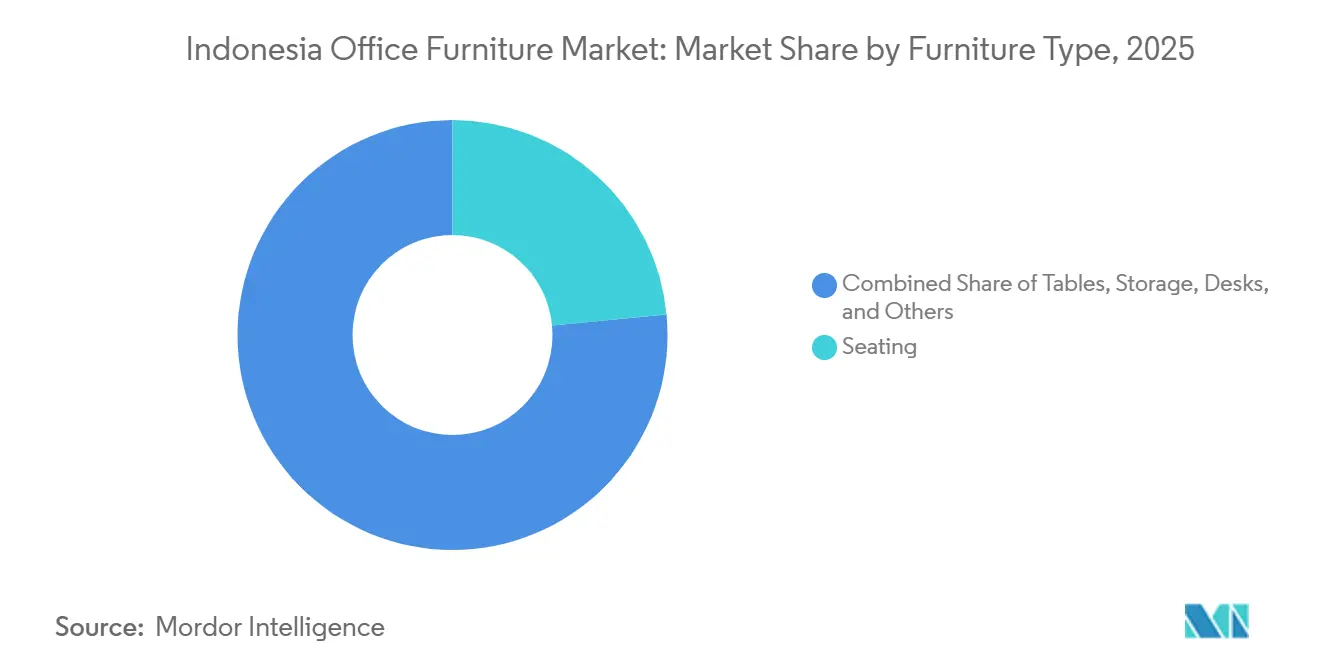
- By furniture type, seating led with 23.48% revenue share of the Indonesia office furniture market in 2025, and desks are forecast to expand at an 11.76% CAGR to 2031.
- By distribution channel, B2C/retail held 38.39% share of the Indonesia office furniture market in 2025 and is projected to grow at a 13.36% CAGR through 2031.
- By geography, Java accounted for a 59.98% share of the Indonesia office furniture market in 2025, and Kalimantan is projected to post a 10.24% CAGR through 2031.
Note: Market size and forecast figures in this report are generated using Mordor Intelligence’s proprietary estimation framework, updated with the latest available data and insights as of January 2026.
Indonesia Office Furniture Market Trends and Insights
Drivers Impact Analysis*
| Driver | (~) % Impact on CAGR Forecast | Geographic Relevance | Impact Timeline |
|---|---|---|---|
| Hybrid Work Adoption and Ergonomic Upgrades | +1.2% | Global, with acute demand in Jakarta, Surabaya, and Bali, where coworking density is highest | Medium term (2-4 years) |
| Flight-To-Quality and Fitted Spaces in Jakarta CBD | +0.9% | Java core, specifically Jakarta CBD and Surabaya central business districts | Short term (≤ 2 years) |
| APAC-Led Commercial Real Estate Expansion and Coworking | +0.8% | Java, Bali, Medan, with spillover to tier-2 cities | Medium term (2-4 years) |
| Digital Channels Enabling Procurement | +1.4% | National, with accelerated penetration in second- and third-tier cities outside Java and Sumatra | Short term (≤ 2 years) |
| Government E-Procurement and TKDN Prioritization | +1.0% | National, benefiting Java-based TKDN-certified manufacturers | Medium term (2-4 years) |
| IKN Nusantara Relocation and New Fitouts | +1.3% | East Kalimantan primary, with procurement influence extending to certified suppliers in Java | Long term (≥ 4 years) |
| Source: Mordor Intelligence | |||
Hybrid Work Adoption Drives Ergonomic Furniture Upgrades Across Corporate and Residential Settings
Enterprises are evolving facilities for hybrid teams, prompting parallel investments in office floors and home setups that support comfort and productivity. A University of Indonesia posture study reported a high prevalence of musculoskeletal issues, which has driven the procurement of AI-enabled ergonomic seating and height-adjustable desks as standard in refreshed layouts for staff and executives.[2] Authorized distributors promote ergonomic systems that scale with headcount changes, including sit-stand workstations and monitor arms designed for rapid reconfiguration and consistent posture support. The Indonesia office furniture market is capturing this shift through premium task chairs, acoustic elements, and modular tables that move quickly from hot desks to enclosed rooms as teams flex across on-site and remote use cases. E-commerce storefronts show sustained traction for mid-tier ergonomic SKUs that balance price, adjustability, and durability, with verified unit sales and high ratings signalling repeatable demand outside corporate projects. The result is a broader addressable base for ergonomic products as employers extend support for workers switching between headquarters, satellite offices, and home environments.
Flight-to-Quality Tenant Behaviour in Jakarta CBD Accelerates Premium Office Refurbishment
Premium fitouts increasingly package furniture with design and installation services to reduce time to occupancy, which favours suppliers that can coordinate specification, assembly, and warranty at predictable budgets. Dedicated B2B programs demonstrate the value of integrated service, with IKEA for Business operating service points that include interior planning, bulk purchase promotions, and assembly support for companies managing compressed timelines. Contract furniture providers with long-standing corporate relationships have reported healthy activity in interiors and fit-out work, highlighting demand for ergonomic seating, modular desks, and collaboration furniture in quality-focused projects. The market benefits when landlords and corporate tenants coordinate turnkey solutions that standardize specifications across towers and floors, since this approach consolidates purchasing and simplifies vendor oversight. Suppliers with branded assortments and proven after-sales processes secure a natural advantage under these procurement models, especially when combined with financing or instalment offers for qualified clients. These dynamic tilts spend toward certified and service-capable brands that meet ergonomic norms while aligning with the sustainability preferences of blue-chip tenants and multinationals.
Coworking Proliferation and Commercial Real Estate Expansion Amplify Flexible Furniture Demand
Flexible workspace operators multiply furniture velocity because their product mixes and floor plans change frequently to serve teams of different sizes and workstyles. GoWork lists locations across Jakarta, Bali, Surabaya, and Medan, and the format relies on ergonomic chairs, modular benching, phone booths, and event-focused layouts that are refreshed more often than traditional leases.[3] WeWork’s Jakarta footprint markets furnished private offices and collaborative spaces sized for small teams through to larger groups, which keeps demand steady for high-turnover seating and configurable desks that can be repurposed without disrupting members. The market gains from recurring refurbishment cycles when operators expand locations or recalibrate event and meeting areas to match occupancy patterns and member preferences. Furniture brands with premium collections aimed at design-led workspaces have also launched targeted offers, including new seating lines positioned for hospitality and coworking use cases in Bali and other hubs where style considerations matter alongside function. These trends create a steady pipeline for ergonomic and modular solutions that deliver durability, acoustic performance, and rapid assembly in high-traffic environments.
IKN Nusantara Relocation Catalyses Multi-Year Government and Private Office Fit-Outs in East Kalimantan
The IKN Authority’s government office zone is targeted for completion in June 2025, with capacity for 9,465 ministerial employees in core state buildings and a broader plan to accommodate 13,810 state apparatus personnel by 2028 through phased relocation. Procurement will prioritize quality, aesthetics, and sustainability, a stance that sets clear expectations for ergonomic standards, finishes, and responsible material sourcing across public offices and supporting facilities. As administrative teams move to the new capital, addressable demand will extend from federal buildings to associated coworking and commercial spaces in the surrounding ecosystem, creating opportunities for certified vendors that can scale deliveries and installation at speed. The Indonesia office furniture market will see incremental orders for desking systems, ergonomic seating, conference tables, and storage as buildings reach practical completion and commissioning phases within the timeline. Suppliers that align with green procurement, legality verification for timber, and documented domestic content alongside reliable after-sales service are positioned to capture repeat work across multiple asset packages.
Restraints Impact Analysis*
| Restraint | (~) % Impact on CAGR Forecast | Geographic Relevance | Impact Timeline |
|---|---|---|---|
| Highly Fragmented Competition | -1.1% | National, most acute in Java, where manufacturer density is highest | Medium term (2-4 years) |
| Office Real Estate Oversupply/Vacancy | -0.7% | Jakarta, non-CBD, and secondary cities in Sumatra/Sulawesi | Short term (≤ 2 years) |
| Timber Legality Compliance Costs (SVLK) | -0.9% | National for all wood furniture producers, export constraint for EU-bound shipments | Medium term (2-4 years) |
| Domestic-Content Thresholds for Non-Compliant Imports | -0.6% | National for government procurement; disadvantages non-certified importers | Long term (≥ 4 years) |
| Source: Mordor Intelligence | |||
Jakarta Non-CBD Office Vacancy and Regional Oversupply Moderate Near-Term Fit-Out Cycles
Fit-out demand varies by location and building grade, as premium properties attract higher specification projects while cost-sensitive offices in secondary areas prioritize basic seating, desks, and storage. Suppliers that concentrate on turnkey or pre-awarded work scopes mitigate exposure to slow spot purchasing in price-sensitive corridors, especially when they lock in specifications before delivery phases begin. Branch networks and long-standing client relationships help firms serve commercial hubs outside Jakarta, with vendors maintaining a presence in Surabaya, Medan, and Makassar to support regional project cycles and after-sales needs. Public procurement pilots outside Java have identified challenges such as high logistics costs and limited availability of compliant furniture, which can delay or cancel purchase programs in certain provinces. The Indonesia office furniture market, therefore, sees uneven near-term momentum across submarkets, and suppliers hedge with a mix of premium frameworks, regional distribution, and online channels to balance the portfolio.
SVLK Timber Legality Compliance Raises Sourcing Costs and Extends Lead Times
Wood-based SKUs must comply with Sistem Verifikasi Legalitas dan Kelestarian, an audited legality verification system that covers documentation, surveillance audits, and shipment-level V-Legal requirements for eligible HS codes. Certification validity differs by company size and requires periodic surveillance, while export documentation is time-bound and must be managed carefully to avoid shipment delays. The framework increases administrative workloads and imposes traceability demands that can be resource-intensive for smaller manufacturers, particularly those with materials from multiple upstream sources. Government-linked green procurement pilots also found limited SVLK-certified furniture availability outside Java, alongside elevated logistics costs that complicated regional purchasing at scale. Companies that maintain both SVLK legality and local-content credentials can address government tenders while keeping export options open if documentation is maintained and audits are completed on schedule. The Indonesia office furniture market continues to invest in compliance and documentation to manage these requirements with predictable costs and timing.
*Our forecasts treat driver/restraint impacts as directional, not additive. The impact forecasts reflect baseline growth, mix effects, and variable interactions.
Segment Analysis
By Furniture Type: Desks Surge as Modular Workstations Redefine Hybrid Office Layouts
Seating captured 23.48% of 2025 revenue, while desks are the fastest-growing subcategory, projected to expand at 11.76% through 2031 as hybrid work drives demand for modular and height-adjustable stations that can be reconfigured quickly for changing team sizes. The market responds with ergonomic chairs that meet posture and support expectations and with benching systems that allow rapid assembly for shared or dedicated desks in agile layouts. Studio-style desking platforms and ergonomic chairs with adjustable features are common bundles that align with procurement needs for consistency and maintainability across floors and departments. Conference and meeting tables see steady usage in office, training, and hospitality spaces, while storage lines maintain relevance for documents and shared equipment despite digitalization. The Indonesia office furniture market includes more specialized items such as desk dividers, office sofas, and stools for breakout areas and reception zones, where comfort and compact dimensions drive purchasing decisions.
The Indonesia office furniture market size for desks is projected to expand at 11.76% CAGR to 2031 due to hybrid work and flexible planning, reinforcing demand for robust mechanisms, cable management, and accessory compatibility that simplify daily use and moves. Buyers also weigh compliance and durability across paints and finishes, with wood products subject to Indonesia’s SVLK legality verification and V-Legal export documents in defined HS categories. Sales events and seasonal promotions play a role in converting small and medium businesses, with bundled offers on office sofas and seating often targeted at budget-sensitive purchases during year-end and new-year planning cycles. Certification portfolios that include SVLK and domestic content credentials ease participation in government and state-owned enterprise tenders, which prioritize compliance and localized value addition within procurement rules. The Indonesia office furniture industry continues to broaden assortments for both premium and value segments, adopting modular designs that support faster reconfiguration without compromising ergonomics or sustainability preferences.

By Distribution Channel: B2C Retail Leads Growth via E-Commerce Penetration in Tier-2 Cities
B2C and retail accounted for 38.39% of 2025 sales and are set to grow at 13.36% through 2031, driven by improved digital infrastructure, mobile penetration, and marketplace-led logistics that serve both metro and non-metro buyers nationwide. The Indonesia office furniture market benefits from store networks that integrate with online tools, as seen in IKEA Indonesia’s locations that support interior consultations, layout planning, and bulk purchase programs to serve small businesses and larger accounts under a single brand experience. Online category growth is underpinned by platform scale and payments adoption, with leading marketplaces combining campaign mechanics and instalment offers that are important for purchases above common price thresholds. Verified brand stores demonstrate sustained demand through high unit sales and ratings, signalling that ergonomic chairs, desks, and storage meet expectations for value and delivery reliability. For cross-border activities, established sellers report serving millions of customers and operating within programs that extend reach to nearby markets, which improves inventory turns and visibility for Indonesia-made furniture.
The Indonesia office furniture market size for B2C retail is forecast to grow at a 13.36% CAGR through 2031, supported by channel rules that favour domestic businesses and focus social platforms on discovery rather than direct sales. B2B and direct channels remain integral for large-scale projects and public sector procurement, where framework agreements and compliance portfolios are decisive in vendor selection. PaDi UMKM and the LKPP e-Katalog replicate consumer-grade convenience for institutional buyers, offering structured comparisons, curated TKDN listings, and fast tender options that improve throughput for compliant vendors. Corporate-focused services, including design support, assembly, and installation plans, make it easier for small and medium enterprises to adopt ergonomic furniture and modular workstations without heavy upfront capital outlays. The Indonesia office furniture industry will keep blending offline showrooms, online catalogues, and B2B procurement portals to reduce friction and extend coverage across regions and customer tiers.
Geography Analysis
Java accounted for 59.98% of 2025 revenue on the strength of Jakarta’s corporate base and a significant manufacturing footprint that supports national distribution, while Kalimantan is set to post the fastest growth pace to 2031 as IKN-related procurement commences in phases. Production and fit-out operations cluster in Java, with large integrated players operating factories and showrooms that anchor premium projects and turnkey deliveries across the archipelago. The coworking ecosystem is also concentrated across Jakarta districts, which accelerates cycles for modular desks, ergonomic seating, and acoustic elements as operators reconfigure to match membership demand. The market benefits from projects that bundle installation and service across multiple floors and facilities, which improves procurement efficiency and after-sales support for enterprise accounts. Java’s manufacturing base and distribution networks continue to serve national demand, with online channels extending reach to outer islands and smaller cities that are not served by local showrooms.
Kalimantan’s role will expand with the IKN Nusantara government office zone reaching completion and welcoming ministerial staff in staged phases, with 9,465 employees accommodated initially and further capacity planned through 2028. The Indonesia office furniture market size in Java and the growth outlook for Kalimantan reflect how public sector developments can influence commercial demand for conference tables, task seating, and storage that meet sustainability and quality criteria. In parallel, suppliers that hold SVLK legality and domestic-content credentials will be placed to engage across administrative complexes and supporting facilities while satisfying legal and sustainability requirements. GoWork’s presence in Balinese and Sumatran locations, and WeWork’s furnished private office model in Jakarta, highlight how flexible formats push frequent refresh cycles across multiple provinces. This pattern underpins recurring volumes for ergonomic and modular lines as operators adjust to workloads in growth corridors within and beyond Java.
Sumatra, Sulawesi, Bali, and other islands each show distinct demand drivers that vendors serve through branches, showrooms, and online logistics. Indovickers maintains operations that support clients in Surabaya, Medan, and Makassar, helping regional buyers access premium and project-grade assortments with after-sales service. Bali’s hospitality and creative sectors sustain premium demand for design-forward furniture, with new collections aimed at coworking and flexible spaces that require adaptive seating and tables. Public procurement pilots have underscored the importance of compliant inventory availability and logistics cost control in regions outside Java, which in some cases has led to project cancellations and rethinking of sourcing footprints. E-commerce reduces friction for out-of-metro buyers through campaign pricing, integrated payments, and delivery options, enabling national brands to serve distributed demand at scale. The Indonesia office furniture market continues to balance premium projects on Java with targeted growth in outer islands supported by digital platforms and government-linked procurement.
Regulatory Landscape
Indonesia office furniture suppliers operate under a compliance stack that ties product standards, legality verification for wood inputs, and public procurement rules. Quality and safety are shaped by Indonesian National Standards (SNI) administered under the national standardization framework, with enforcement emphasis by the Ministry of Industry (Kementerian Perindustrian) supporting formal-market positioning for furniture makers that document conformity and maintain consistent manufacturing controls.
On the trade and procurement side, domestic-content requirements (TKDN) remain central for access to government demand through LKPP e-Katalog and related e-procurement workflows. Import administration has also been updated through the Ministry of Trade, with Permendag No. 47 of 2025 taking effect in January 2026 for goods subject to import limitation and Permendag No. 18 of 2026 introducing tighter validation between import approvals and surveyor reports. Together, these changes raise the documentation bar for importers and distributors competing with TKDN-aligned supply.
Value Chain Analysis
The value chain begins with upstream inputs (timber and panels, rattan, metals, plastics, upholstery, and fittings), then moves to a manufacturing base that includes many fragmented SMEs alongside integrated producers that bundle design, fabrication, finishing, and installation for contract projects. Wood-based production is shaped by legality and traceability requirements (SVLK/V-Legal where applicable), while non-wood components such as mechanisms, casters, and some hardware remain sensitive to import documentation and lead times. As a result, supplier qualification and inventory planning are key to delivery reliability.
Downstream, routes to market split between contract/B2B channels (corporate fit-outs, coworking operators, and government buyers via e-catalog procurement) and B2C/retail (showrooms and online marketplaces). Industry bodies such as HIMKI have emphasized integrated ecosystem development and logistics strengthening, including mid-2026 initiatives discussed in Surabaya and efforts to build marketing and distribution hubs in key export markets. The direction points toward shorter supply chains and faster responsiveness for SMEs that dominate production capacity.
Competitive Landscape
The Indonesia office furniture market is moderately concentrated, with many regional manufacturers and several large integrated players, and competitive positions reflect brand portfolios, compliance credentials, and service capabilities. PT Gema Grahasarana (VIVERE Group) leverages a 40-year heritage with integrated interiors and furniture operations, reports higher revenue from the Interior, Furniture, Mechanical, and Electrical segment through 9M 2025, and highlights partnerships and supplier awards that validate delivery quality for global clients. Chitose Indonesia secured Halal certification for chairs in October 2025 and continued to focus on standardized seating segments where quality and reliability are key purchase drivers for public institutions and private buyers.[4] IKEA for Business adds competitive pressure with corporate-focused services that cover design consultations, assembly, and bulk purchasing, which target budget and time constraints for companies outfitting workspaces. Cross-border marketplace participation extends visibility and sales throughput, with Oscar Living citing multi-million customer reach and cross-border seller status across regional markets. The market thus features multiple go-to-market playbooks, from project-driven frameworks to marketplace-driven retail that compresses lead times and enlarges assortments.
Compliance and certification shape access to public orders and export options, creating moats for brands that invest in documentation and quality systems. SVLK legality remains a must for wood furniture categories, with certification cycles and shipment-level V-Legal documentation to manage alongside internal quality assurance. Domestic-content verification supports access to state-linked projects and is increasingly enforced through the LKPP e-Katalog, where warning notices and vendor management actions are part of procurement oversight. PT Furnindo Inovasi Teknologi’s 40% TKDN certificate and successful furniture projects with regional public institutions offer a practical example of how certification converts into addressable demand. The Indonesia office furniture market rewards brands that can pair certifications with service depth across delivery, assembly, and after-sales support that keeps workspaces operable and compliant. As enterprises and public buyers converge around documented quality and domestic value addition, compliant suppliers improve win rates and reduce friction throughout the bid-to-delivery lifecycle.
Design, innovation, and brand signalling remain important in premium segments, with companies using product launches and awards to reinforce positioning. VIVERE Group and VIVERE Collection showcased new concepts and installations across national design and build shows in 2024 and 2025, and celebrated product design recognition that resonates with eco-conscious corporate buyers. Flexible workspace operators like GoWork and furnished-office providers like WeWork sustain high-turnover demand in Jakarta and key provincial cities, creating ongoing opportunities for premium ergonomic seating and modular desking systems. Public and private exhibitions aimed at the furniture value chain, such as the integrated hardware and interior manufacturing platform in Jakarta, draw global buyers and spotlight Indonesia’s manufacturing capabilities for office and interior categories. The Indonesia office furniture market also benefits from marquee national events like IFEX, which reported sizeable on-the-spot transactions and international attendance that help sustain supplier order books and export pipelines. Brand communication centred on sustainability reports and local community investments further strengthens reputations and aligns with buyer expectations on environmental stewardship.
Indonesia Office Furniture Industry Leaders
-
PT Chitose Internasional Tbk
-
PT. Furnindo International
-
Indachi Office Furniture
-
Vinoti Office
-
Stramm
- *Disclaimer: Major Players sorted in no particular order
Market Opportunities and Future Outlook
Compliance-led sourcing creates whitespace for suppliers that can package documented legality, sustainability, and local-content credentials into ready-to-procure SKUs for both institutional and commercial buyers. Public procurement prioritization through TKDN-linked platforms (including LKPP e-Katalog and aligned B2B procurement portals) continues to reward manufacturers that can evidence domestic value addition, maintain consistent specifications, and support installation and after-sales coverage. This is particularly relevant as multi-site buyers standardize ergonomic seating and modular workstations.
Digitization across production and sales is another practical opportunity area, supported by the Ministry of Industry's June 2026 support for furniture-sector digital transformation initiatives and industry collaborations, including HIMKI-linked programs, focused on productivity and competitiveness improvements. On the supply side, makers that use digital specification, quotation, and project coordination tools can reduce turnaround time for hybrid-office refresh cycles. Meanwhile, compliance-heavy wood documentation and evolving import procedures increase the value of transparent bills of materials, supplier audits, and traceable component sourcing for both domestic procurement and cross-border trade.
Recent Industry Developments
- July 2026: Vinoti launched the Pattern Play collection in partnership with Milliken at IndoBuildTech 2026. The collaboration points to higher-spec, design-forward surface and finish options for premium fit-outs and differentiated workplace interiors.
- April 2026: PT Chitose Internasional Tbk held its Annual General Meeting of Shareholders (RUPST) on April 22, 2026, and communicated its 2026 sales target and capital expenditure budget. The update maintained a focus on portfolio expansion and manufacturing modernization, tying product readiness to institutional and commercial purchasing cycles.
- January 2026: Working by VIVERE officially unified with Vinoti to consolidate design expertise and commercial furniture solutions under a single platform. This integration strengthens end-to-end delivery capability for office projects by combining product, specification support, and broader solution selling for business environments.
Research Methodology Framework and Report Scope
Market Definition and Coverage
For this methodology, the Indonesia office furniture market covers the sales value of furniture mainly used in office and commercial workspaces in Indonesia, including locally made and imported products sold through offline and online channels.
Scope exclusions: We exclude loose home furniture bought for home use only, and we also exclude repair services and non-furniture office equipment.
Segmentation Overview
- By Furniture Type
- Seating
- Tables
- Storage
- Desks
- Other Furniture Type (Desk Divider, Office Sofas, Bookcases, Benches, Stools etc.)
- By Distribution Channel
- B2B/Directly from Manufacturer
- B2C/Retail
- Home Centers
- Specialty Furniture Stores
- Online
- Other Distribution Channel
- By Geography
- Java
- Sumatra
- Kalimantan
- Sulawesi
- Bali & Nusa Tenggara
- Maluku & Papua
Data Sources, Market Sizing, and Validation
Desk Research
Desk research was used to set the market frame and to anchor the model to visible demand and supply signals. We reviewed public releases and data tables from sources such as Statistics Indonesia (BPS), UN Comtrade trade statistics, the World Bank, the Ministry of Industry, and the Ministry of Public Works and Housing for construction and building activity signals that correlate with office fit-outs.
To translate these signals into furniture demand, we also used company annual reports, audited financial statements, investor presentations, and press coverage on commercial real estate and workspace expansion. Where financial splits were not clear, a paid subscription for company financials and intelligence and a shipment-level import and export database were used to cross-check product movement and average value per unit. The sources mentioned here are illustrative only, and many other public datasets and documents were also used to validate and clarify assumptions.
Primary Interviews and Surveys
Primary interviews and structured surveys were used to test what the desk findings could not fully answer, especially around pricing behavior, channel mix, and the timing of demand from office project cycles. We spoke with manufacturers, distributors, large buyers, and project-oriented stakeholders such as procurement teams and fit-out partners across Indonesia, and then we rechecked any gaps through follow-up calls until the assumptions were stable.
Distribution of primary research fieldwork respondents
| Company type | Respondent position |
|---|---|
| Top tier: 31% | CXOs: 17% |
| Mid tier: 51% | Functional/Unit leaders: 26% |
| Smaller Players: 18% | Managers: 57% |
Market-Sizing & Forecasting
The core model uses a top-down build where office-space additions, renovation activity, and office occupancy trends are converted into furniture demand pools, which are then priced using observed ranges by product group. We then corroborate totals with selective bottom-up checks using sampled supplier revenue exposure to office furniture, channel checks from distributors, and volume times price cross-checks inferred from trade statistics.
A few practical inputs help keep the estimate grounded, such as office construction and renovation indicators, commercial real estate absorption and fit-out cycles, import value trends for office furniture categories, local manufacturing output signals, and average selling price movement tied to materials and freight conditions. When interviews showed that contract projects bundle products, we adjusted ASP logic to avoid double counting the same project value across multiple furniture types.
For forecasting, scenario analysis was used so growth is not forced into a straight line. Demand cases were built around expected office leasing momentum, corporate capex sentiment, and public sector procurement steadiness, and then the chosen case was aligned to the consensus view we heard from industry respondents. Where coverage gaps existed in smaller cities or informal channels, we applied conservative uplifts that were limited by visible trade and revenue signals.
Data Validation & Update Cycle
Model outputs are checked against independent signals, including trade values, construction and commercial activity indicators, and the implied spend per office worker or per square meter from interview feedback. If a number looks too high or too low versus these signals, the drivers are reopened, and assumptions are recalculated before sign-off.
A second analyst review is completed to spot inconsistent growth patterns, sudden ASP jumps, or share shifts that do not match real market behavior. Reports are refreshed annually, and interim updates are made when material events occur that can change demand, supply, or pricing. Before delivery, we run a final pass to ensure the latest available public data and fresh interview learnings are reflected.
Mordor Intelligence's Indonesia Office Furniture Market Size Measured Against Other Published Estimates
Published market sizes for office furniture in Indonesia often differ because the counted products, the sales channels, and the timing of pricing assumptions are not the same. Some estimates are also built from trade-only viewpoints or from broader furniture totals that get allocated using simple shares, which can move the final number by a lot.
Key gap drivers here are whether contract and project sales are included fully, how imported versus locally produced goods are treated, and whether the model separates office furniture from adjacent categories like home-office crossover purchases. Currency conversion timing also matters because large parts of pricing are influenced by imported materials, and refresh cadence can shift the market year being treated as the starting point.
Benchmark comparison
| Source | Market Size | Gaps in Research Methodology |
|---|---|---|
| Mordor Intelligence | USD 2.12 B (2026) | |
| Regional Consultancy A | USD 0.90 B (2026) | This figure appears closer to an addressable demand slice that leans on formal corporate purchases and may not fully count project-based contract orders and broad channel coverage, which lowers the total. |
| Trade Data Publisher B | USD 0.02 B (2024) | This number is consistent with an import-value view for a narrow wooden office-furniture code, so it excludes domestic production, non-wood materials, and local distribution markups, which makes the market look much smaller. |
The spread is mainly explained by what is being counted, and whether domestic output plus full project spending are captured along with imports and retail sales. By tying the total to office activity indicators and then cross-checking it with trade movement and interview-led pricing ranges, the estimate stays traceable to repeatable steps, a modeling choice applied by Mordor Intelligence.
Key Questions Answered in the Report
What is the size and growth outlook of the Indonesian office furniture market to 2031?
The Indonesian office furniture market size is USD 2.12 billion in 2026 and is projected to reach USD 2.69 billion by 2031 at a 4.95% CAGR, supported by ergonomic upgrades, digital channels, and government procurement activity.
Which categories lead demand within Indonesia’s office furniture space?
Seating leads with 23.48% of 2025 revenue, while desks are the fastest-growing category due to hybrid work and modular workspace adoption through 2031.
How do online marketplaces influence Indonesia’s office furniture demand?
E-commerce platforms like Shopee and Tokopedia expand coverage into non-metro areas, with integrated payments and logistics increasing conversion and supporting B2C growth at a projected 13.36% CAGR through 2031.
What role will IKN Nusantara play in future furniture procurement?
The IKN government office zone targets substantial staff accommodation through 2028, creating phased demand for desks, ergonomic seating, and meeting furniture aligned with quality and sustainability requirements.
What certifications matter for public sector purchasing in Indonesia?
Domestic-content documentation via TKDN and wood legality via SVLK are critical for access to government e-procurement platforms, with active enforcement and curated TKDN listings on PaDi UMKM and the LKPP e-Katalog.
Which regions are most important for suppliers to prioritize?
Java remains the largest revenue base, while Kalimantan shows the fastest growth outlook due to IKN, and outer islands such as Sumatra, Sulawesi, and Bali require a mix of online channels and regional branch support for coverage.