
Indonesia Business Process Outsourcing Services Market Size and Share
Market Overview
| Study Period | 2020 - 2031 |
|---|---|
| Forecast Data Period | 2026 - 2031 |
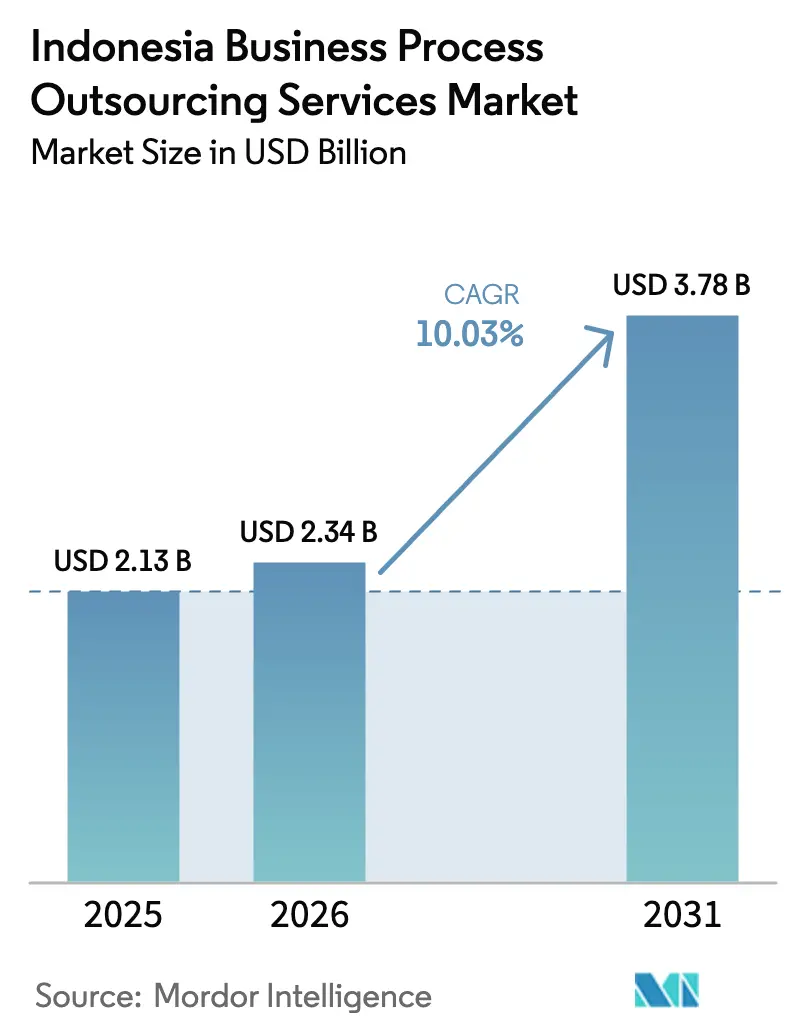
| Base Year Market Size (2025) | USD 2.13 Billion |
| Market Size (2026) | USD 2.34 Billion |
| Market Size (2031) | USD 3.78 Billion |
| Growth Rate (2026 - 2031) | 10.03 % |
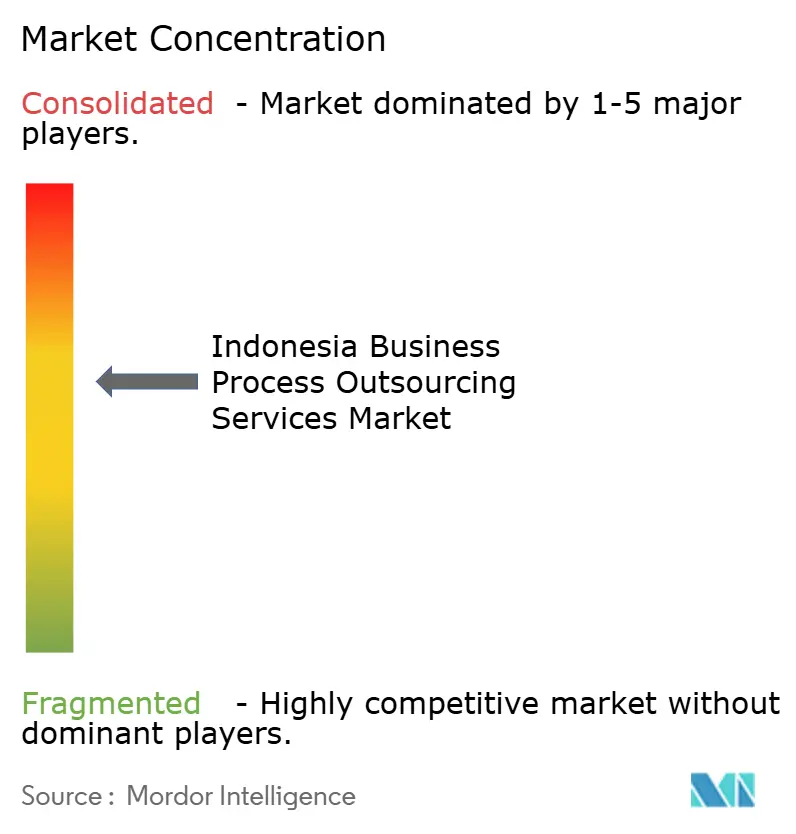
| Market Concentration | Medium |
Major Players *Disclaimer: Major Players sorted in no particular order Image © Mordor Intelligence. Reuse requires attribution under CC BY 4.0. | |
Indonesia Business Process Outsourcing Services Market Analysis by Mordor Intelligence
Indonesia Business Process Outsourcing Services market size in 2026 is estimated at USD 2.34 billion, growing from 2025 value of USD 2.13 billion with 2031 projections showing USD 3.78 billion, growing at 10.03% CAGR over 2026-2031. Steady acceleration comes from a large digital-native labor pool, government programs that aim to digitize 30 million micro-, small- and medium-enterprises, and a domestic e-commerce sector set to generate USD 82 billion in revenue during 2025.[1] Rising adoption of automation, artificial intelligence and multilingual support capabilities strengthens the competitive position of providers, while cost-sensitive enterprises continue to redirect non-core functions to specialist partners. Wage inflation, data-security compliance and uneven telecom infrastructure temper expansion but are outweighed by incentives for rural delivery centers and the rollout of Indonesian-language NLP chatbots that lift service quality.
Key Report Takeaways
- By process, customer care outsourcing led with a 38.14% Indonesia Business Process Outsourcing Services market share in 2025; knowledge process outsourcing is projected to rise at a 10.65% CAGR to 2031.
- By service type, back-office BPO accounted for 41.05% of the Indonesia Business Process Outsourcing Services market size in 2025, while IT-enabled BPO is poised to expand at a 10.74% CAGR through 2031.
- By delivery model, onshore services captured 55.98% share of the Indonesia Business Process Outsourcing Services market size in 2025 and offshore delivery is advancing at an 11.02% CAGR between 2026-2031.
- By end-user industry, the BFSI segment held 22.97% of the Indonesia Business Process Outsourcing Services market share in 2025, whereas healthcare and life sciences shows the fastest 10.36% CAGR to 2031.
Note: Market size and forecast figures in this report are generated using Mordor Intelligence’s proprietary estimation framework, updated with the latest available data and insights as of 2026.
Indonesia Business Process Outsourcing Services Market Trends and Insights
Drivers Impact Analysis*
| Driver | (~) % Impact on CAGR Forecast | Geographic Relevance | Impact Timeline |
|---|---|---|---|
| Rising demand for cost efficiency | +2.8% | National, with concentration in Jakarta, Surabaya, Bandung | Medium term (2-4 years) |
| Increasing focus on core competencies by SMEs | +2.1% | National, strongest in Java and urban centers | Long term (≥ 4 years) |
| Expanding digital economy and e-commerce boom | +3.2% | National, led by Jakarta, with spillover to tier-2 cities | Short term (≤ 2 years) |
| Government incentives for impact-sourcing and rural BPO | +1.5% | Rural areas, Eastern Indonesia, secondary cities | Long term (≥ 4 years) |
| Adoption of Bahasa Indonesia NLP chatbots | +0.8% | National, with early adoption in financial services | Medium term (2-4 years) |
| Emergence of Sharia-compliant BPO services | +0.6% | National, concentrated in Muslim-majority regions | Long term (≥ 4 years) |
| Source: Mordor Intelligence | |||
Rising Demand for Cost Efficiency
Corporations under inflationary pressure are outsourcing customer support, finance and compliance activities to preserve margins while reallocating capital toward digital initiatives. Labor costs in Indonesia remain well below those in developed markets, sustaining an attractive cost-arbitrage despite forecasts of a 6.3% salary increase for 2025.[2] Microsoft’s AI partnerships with DANA, BUMA and Telkom illustrate how cloud and automation amplify cost benefits by trimming routine processing times. Ultra Mikro financing has disbursed IDR 40.94 trillion, compelling lenders to ramp up back-office capacity through outsourcing. These dynamics reinforce the Indonesia Business Process Outsourcing Services market as the de-facto lever for enterprise efficiency agendas.
Expanding Digital Economy and E-Commerce Boom
Indonesia’s digital economy is projected at USD 146 billion by 2025 and e-commerce is the dominant engine, driving volume spikes in multilingual customer service, content moderation and payment reconciliation.[3] Transaction counts climbed 27% year on year to 222.9 million by February 2024, validating sustained service demand Live-commerce already captures one-fifth of Southeast Asian GMV and requires real-time engagement and stream moderation, expanding the service catalog for providers. Government initiatives that onboard offline merchants to marketplaces intensify needs for onboarding and digital marketing support.
Government Incentives for Impact-Sourcing and Rural BPO
Legal reforms simplify licensing, lower tax burdens and reserve 40% of procurement budgets for MSMEs, prompting service providers to open centers in secondary cities. Connectivity upgrades via the Palapa Ring backbone and 4G rollouts across 149,000 locations enhance service reliability outside Java. New-capital city Nusantara offers extra investment incentives alongside relaxed foreign-ownership caps, encouraging early-mover setups. These measures both broaden labor sourcing and address corporate ESG targets by channeling jobs to underserved regions.
Adoption of Bahasa Indonesia NLP Chatbots
Provider competitiveness rises with Bahasa-optimized large-language models that elevate first-call resolution and user satisfaction. Telkom’s “Veronika” chatbot, powered by the Llama model, shows mature Indonesian-language understanding for customer queries. PT Infomedia Nusantara realized 75% time savings in data handling after layering RPA atop its AI stack. National AI ethics guidelines published by the Ministry of Communication give legal certainty around deployment, prompting wider adoption. The capability positions domestic firms for higher-value knowledge work across Southeast Asia’s 200 million Indonesian-speaking population.
Restraints Impact Analysis*
| Restraint | (~) % Impact on CAGR Forecast | Geographic Relevance | Impact Timeline |
|---|---|---|---|
| Data-security and privacy concerns | -1.8% | National, with heightened impact in financial services | Short term (≤ 2 years) |
| Wage inflation in urban talent hubs | -2.2% | Jakarta, Surabaya, Bandung metropolitan areas | Medium term (2-4 years) |
| Sub-optimal telecom infrastructure in secondary cities | -1.1% | Eastern Indonesia, rural areas, tier-3 cities | Long term (≥ 4 years) |
| Cultural and language gaps for high-value KPO | -0.9% | National, affecting offshore client relationships | Medium term (2-4 years) |
| Source: Mordor Intelligence | |||
Data-Security and Privacy Concerns
The Personal Data Protection Law demands explicit consent, local data storage for certain sectors and stiff penalties for breaches. Financial institutions cannot export data without OJK approval, pushing global providers to build or rent domestic data centers. Compliance overhead increases deal cycles and limits leverage of offshore hubs, slowing short-term growth of the Indonesia Business Process Outsourcing Services market.
Wage Inflation in Urban Talent Hubs
Mercer forecasts a 6.3% rise in Indonesian tech salaries for 2025, squeezing cost advantages for Jakarta-based centers. Providers respond by automating high-volume tasks or relocating routine work to cities like Semarang and Makassar to preserve margins. Government digital-skills scholarships are enlarging the talent pool but may raise wage expectations in the near term. Unless offset by productivity gains, inflationary pressure could soften mid-term competitiveness for the Indonesia Business Process Outsourcing Services market.
*Our forecasts treat driver/restraint impacts as directional, not additive. The impact forecasts reflect baseline growth, mix effects, and variable interactions.
Segment Analysis
By Process: Knowledge Services Drive Premium Growth
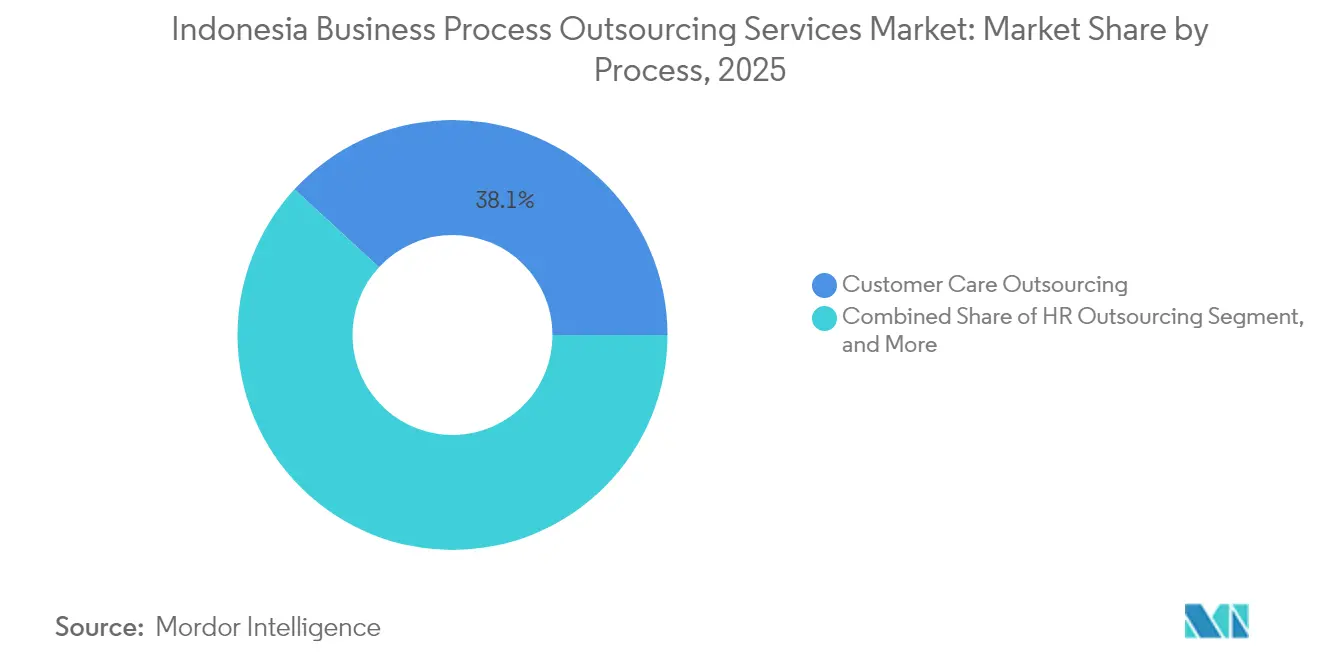
Knowledge process outsourcing is projected to grow at a 10.65% CAGR, fueled by analytics, regulatory research and domain-specific consulting. Customer care retains a 38.14% share of the Indonesia Business Process Outsourcing Services market size thanks to e-commerce service volumes and fintech expansion. Finance and accounting work accelerates as UMKM digitalization raises bookkeeping and tax-filing complexity, while HR outsourcing consolidates changes stemming from the Job Creation Law. AI-enabled bots handle repetitive inquiries, enabling human agents to concentrate on complex cases, which elevates overall service quality. Procurement outsourcing gains relevance through government DigiPay adoption that necessitates supplier onboarding and transaction reconciliation support. Specialized services such as content moderation surge as social-commerce livestreams require culturally attuned oversight.
Overall, the segment mix illustrates how the Indonesia Business Process Outsourcing Services market is moving from scale-based customer interaction work toward knowledge-centric processes. Providers pivot by combining RPA with data science talent, a strategy exemplified by PT Infomedia Nusantara’s 75% cycle-time drop after automation. As clients seek end-to-end digital customer journeys, integrated solutions spanning chatbots, analytics and compliance reporting become the norm, cementing Indonesia’s role in higher-value regional service chains.

By Service Type: IT-Enabled Solutions Accelerate Digital Transformation
Back-office services command a 41.05% share, anchored in document digitization, payroll and claims processing. Yet IT-enabled BPO is the fastest-moving category with a 10.74% CAGR as enterprises migrate workloads to the cloud and deploy AI for intelligent automation. Cloud-native delivery lowers entry barriers for SMEs and allows providers to offer elastic capacity aligned with seasonal peaks. Front-office work expands through multilingual chat and social-media management, especially for cross-border e-commerce players targeting Indonesian consumers.
Rapid data-center development by Telkom’s NeutraDC and Microsoft’s USD 1.7 billion cloud investment underpin latency-sensitive workloads, reinforcing the Indonesia Business Process Outsourcing Services market as a dependable regional node. Cyber-security awareness campaigns create a pipeline for managed security services, compliance audits and digital forensics. As AI governance requirements tighten, consulting around algorithmic bias and data-ethics emerges as a new revenue line, signaling continual deepening of IT-enabled BPO sophistication.
By Service Delivery Model: Offshore Gains Despite Onshore Preference
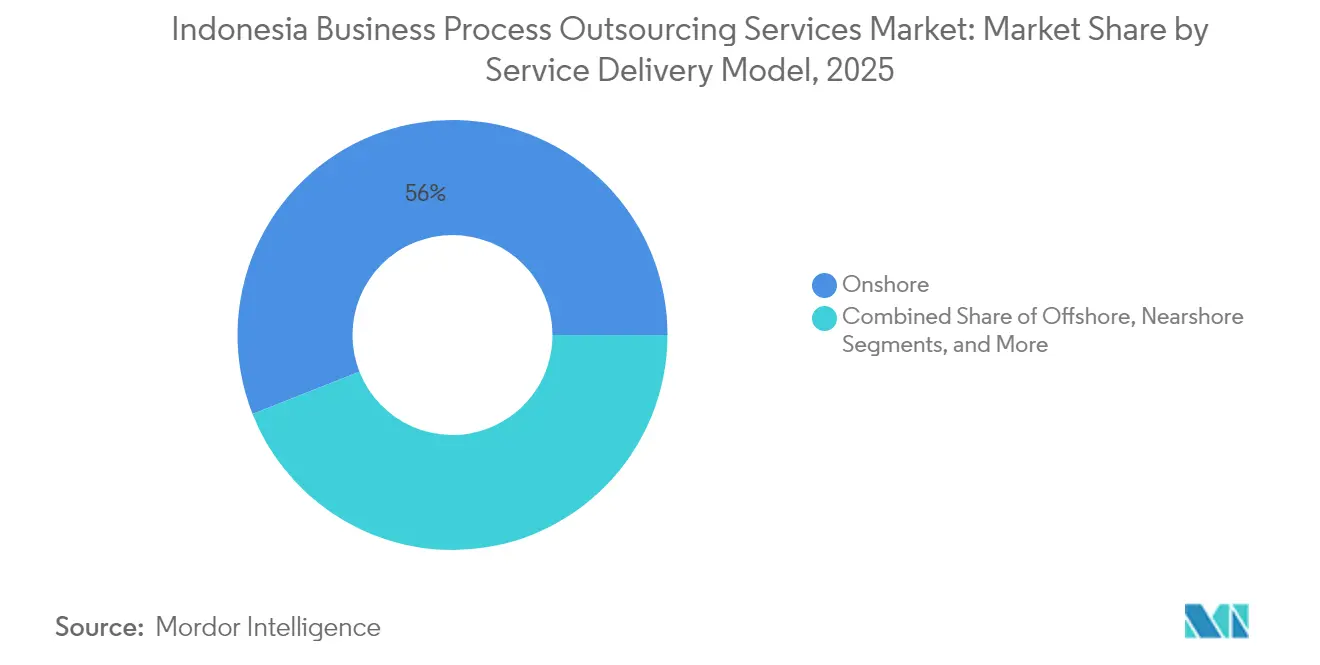
Onshore delivery holds 55.98% share given regulatory comfort and cultural alignment desired by BFSI and healthcare clients. However, offshore operations record an 11.02% CAGR thanks to Australian and New Zealand demand routed through Indonesian centers operating on favorable time zones. Hybrid setups mix nearshore coordination with offshore execution, leveraging fiber-optic and 5G gains to balance cost and responsiveness. The pandemic-driven acceptance of remote work normalizes distributed teams, provided data-protection compliance is respected.
Teleperformance’s Bali facility exemplifies location diversification: beachfront appeal aids talent retention, while proximity to Australia shortens turnaround times. Government fiber investment and secondary-city incentives further support diffusion beyond Java. Going forward, providers that master secure VPN architectures, zero-trust frameworks and local data-center peering will capture the rising portion of offshore work within the Indonesia Business Process Outsourcing Services market.
By End-User Industry: Healthcare Leads Growth Transformation
BFSI contributes 22.97% revenue as banks, insurers and fintechs outsource KYC reviews, loan processing and 24/7 customer care. Healthcare and life sciences register the fastest 10.36% CAGR, fueled by telemedicine uptake and hospital digitization under national health-coverage expansion. Telecom and IT firms rely on outsourced network monitoring and L1 technical support to maintain service uptime during nationwide 5G rollouts. Retail and e-commerce continue to demand high-volume order fulfillment and content curation.
Government ministries themselves emerge as buyers for citizen-services call centers and document digitization, assisted by mandates to allocate procurement budgets to MSMEs. Manufacturing groups seeking to integrate into global supply chains utilize BPO for export documentation and quality-control analytics, while travel and hospitality brands contract multilingual agents to manage booking spikes as international arrivals rebound. As vertical expertise deepens, providers tailor playbooks, such as HIPAA-compliant processes for telehealth or Sharia-aligned workflows for Islamic finance, affirming sector-led segmentation within the Indonesia Business Process Outsourcing Services market.
Geography Analysis
Java dominates volumes, driven by Jakarta’s role as the financial capital and its mature broadband infrastructure. Surabaya and Bandung attract centers focused on lower-cost yet still well-educated workforces, supported by local universities supplying fresh graduates. Bali’s multilingual hub illustrates lifestyle-based talent magnets that appeal to native English speakers and facilitate service for Oceania clients.
Outside Java, Sumatra and Kalimantan provide lower wage structures and growing 4G coverage, ideal for voice-based back-office functions. The Palapa Ring project significantly lowers latency, assisting Eastern Indonesia locations such as Makassar to host rural impact-sourcing centers. New capital Nusantara is marketed as a smart-city cluster offering tax holidays and relaxed foreign-ownership limits to BPO firms that partner with local MSMEs. Cities like Yogyakarta and Malang leverage university ecosystems and lower living costs to attract niche knowledge service work.
Overall, infrastructure spending narrows the urban-rural divide and unlocks nationwide labor pools, ensuring that the Indonesia Business Process Outsourcing Services market’s future growth is geographically diversified rather than Java-centric. Providers adopting hub-and-spoke models will tap cost arbitrage while satisfying data-localization rules, reinforcing Indonesia’s status as Southeast Asia’s preferred nearshore location.
Competitive Landscape
The landscape is moderately fragmented: global titans such as Teleperformance, Concentrix and Genpact coexist with local stalwarts including PT Infomedia Nusantara and PT VADS Indonesia. Customer-care and tech-support lines skew toward higher consolidation, whereas knowledge services remain populated by boutique analytics houses. Strategic focus gravitates to vertical specialization and AI integration: Teleperformance pledged EUR 100 million for multilingual AI and voice biometrics. PT Infomedia Nusantara’s automation cut handling times by 75%, highlighting innovation-led differentiation.
Regulatory demands favor incumbents with local data centers and established compliance frameworks, raising entry barriers for new offshore-centric players. Meanwhile, white-space exists in Sharia-compliant outsourcing and Bahasa-NLP services. Partnerships between global and domestic firms accelerate capability transfer, visible in Microsoft’s USD 1.7 billion cloud expansion that underpins local provider offerings. As clients prioritize resilience, providers with multi-city footprints and hybrid delivery options gain advantage, reinforcing healthy but intense competition inside the Indonesia Business Process Outsourcing Services market.
Indonesia Business Process Outsourcing Services Industry Leaders
-
Genpact Limited
-
Concentrix Corporation
-
EXL Service Holdings Inc.
-
TELUS International (Cda) Inc.
-
Transcosmos digital technology inc.
- *Disclaimer: Major Players sorted in no particular order
Recent Industry Developments
- April 2025: Microsoft committed USD 1.7 billion to cloud and AI infrastructure, including talent initiatives for 800,000 professionals, boosting backbone capacity for service providers.
- February 2025: Teleperformance revealed strong Asia-Pacific growth and announced a EUR 100 million AI partnership plan for 2025.
- January 2025: Telkom Indonesia reorganized into new infrastructure subsidiary while expanding data centers in Cikarang, Batam and 32 regional sites.
- October 2024: Teleperformance opened a 500-employee multilingual hub in Bali, its fifth Indonesian site.
Indonesia Business Process Outsourcing Services Market Report Scope
Business process outsourcing (BPO) involves delegating specific business tasks or processes to third-party service providers. These tasks encompass a wide range of functions like customer support, technical assistance, data management, accounting, and HR services. By outsourcing these functions, companies can streamline their operations, lower expenses, and enhance productivity by tapping into the specialized skills and resources of external providers. In Indonesia, BPO services serve both local and global clients, playing a significant role in driving economic development and creating job opportunities.
The Indonesian business process outsourcing market is segmented by process (HR, sales and marketing, customer care, and others), by end user (BFSI, telecom and it, healthcare, retail, and others), and region (Jawa, Sumatra, Kalimantan, and others). The market sizes and forecasts are provided in terms of value (USD) for all the above segments.
| HR Outsourcing |
| Sales and Marketing Outsourcing |
| Customer Care Outsourcing |
| Finance and Accounting Outsourcing |
| Procurement Outsourcing |
| Knowledge Process Outsourcing |
| Other Process Types |
| Back-office BPO |
| Front-office BPO |
| Knowledge Process Outsourcing |
| IT-enabled BPO |
| Onshore |
| Offshore |
| Nearshore |
| BFSI |
| Telecom and IT |
| Healthcare and Life Sciences |
| Retail and E-commerce |
| Government and Public Sector |
| Travel and Hospitality |
| Manufacturing |
| Other End-user Industries |
| By Process | HR Outsourcing |
| Sales and Marketing Outsourcing | |
| Customer Care Outsourcing | |
| Finance and Accounting Outsourcing | |
| Procurement Outsourcing | |
| Knowledge Process Outsourcing | |
| Other Process Types | |
| By Service Type | Back-office BPO |
| Front-office BPO | |
| Knowledge Process Outsourcing | |
| IT-enabled BPO | |
| By Service Delivery Model | Onshore |
| Offshore | |
| Nearshore | |
| By End-user Industry | BFSI |
| Telecom and IT | |
| Healthcare and Life Sciences | |
| Retail and E-commerce | |
| Government and Public Sector | |
| Travel and Hospitality | |
| Manufacturing | |
| Other End-user Industries |
Key Questions Answered in the Report
How large is the Indonesia Business Process Outsourcing Services market in 2026?
The market stands at USD 2.34 billion in 2026, with a forecast to reach USD 3.78 billion by 2031 at a 10.03% CAGR.
Which process segment grows fastest through 2031?
Knowledge process outsourcing posts the strongest 10.65% CAGR as clients demand analytics and higher-value research work.
Why are healthcare firms increasing outsourcing in Indonesia?
Telemedicine growth, 95.77% health-coverage penetration and plans for AI investments by 74% of health leaders push administrative tasks to BPO partners.
What factors drive offshore delivery growth?
Cost optimization, improved fiber connectivity and time-zone proximity to Australia and New Zealand support an 11.02% CAGR for offshore services.
How does the Personal Data Protection Law affect providers?
It mandates strict consent, localized data storage for sensitive sectors and hefty penalties, raising compliance costs and favoring firms with domestic data centers.