
Application Outsourcing Market Size and Share
Market Overview
| Study Period | 2020 - 2031 |
|---|---|
| Market Size (2026) | USD 142.53 Billion |
| Market Size (2031) | USD 215.46 Billion |
| Growth Rate (2026 - 2031) | 8.62 % |
| Fastest Growing Market | Asia Pacific |
| Largest Market | North America |
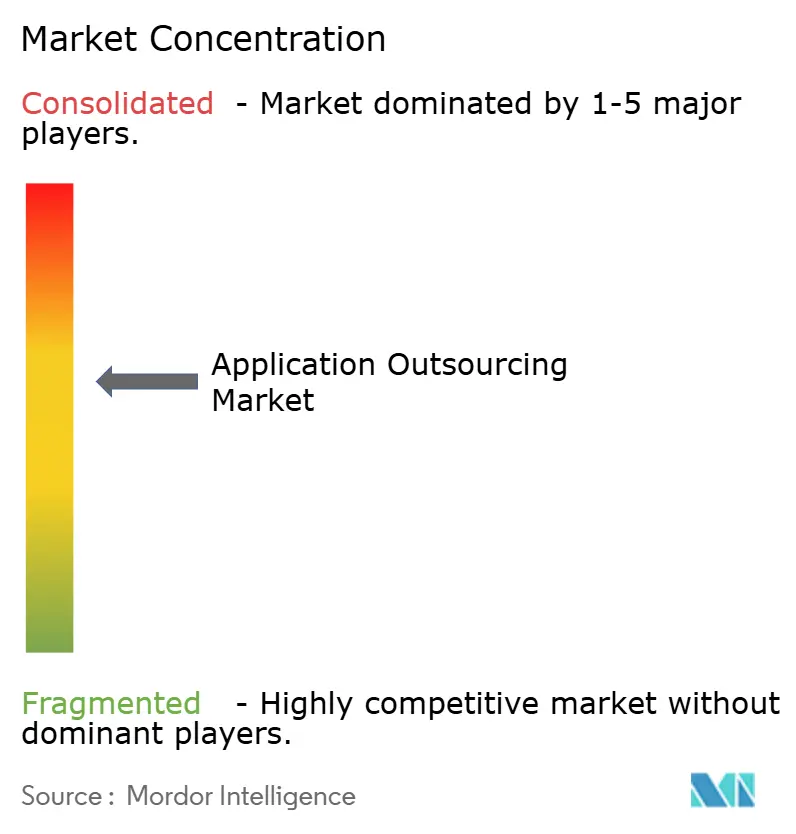
| Market Concentration | Medium |
Major Players *Disclaimer: Major Players sorted in no particular order Image © Mordor Intelligence. Reuse requires attribution under CC BY 4.0. | |
Application Outsourcing Market Analysis by Mordor Intelligence
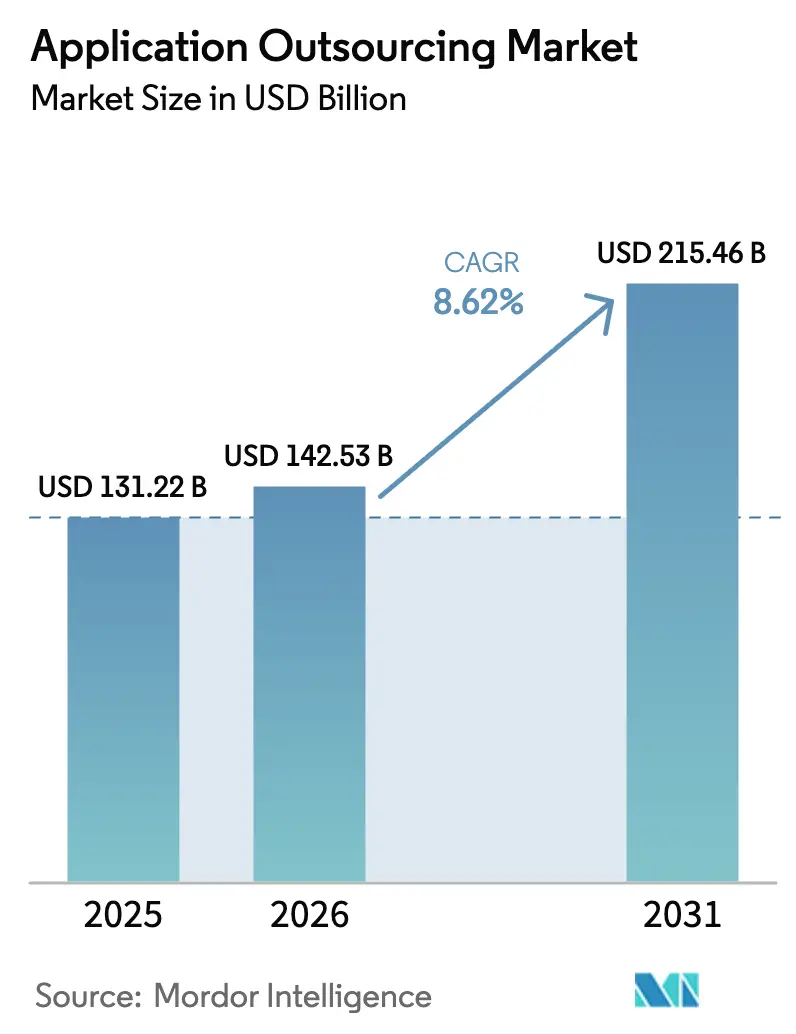
The Application Outsourcing Market size is expected to grow from USD 131.22 billion in 2025 to USD 142.53 billion in 2026 and is forecast to reach USD 215.46 billion by 2031 at 8.62% CAGR over 2026-2031.
This growth reflects how enterprises now treat external application expertise as a core element of digital strategy rather than a cost exercise. Demand is most visible in maintenance, security, and modernization projects that keep critical workloads resilient. Cloud deployments and outcome-based contracts are expanding the total addressable opportunity, while nearshoring and multisourcing make delivery models more diverse. Service providers are upskilling rapidly in generative AI and cybersecurity to retain relevance. Mid-market firms with USD 1–5 billion in revenue add a fresh layer of volume, giving the application outsourcing market headroom in every major region.
Key Report Takeaways
- By service type, Application Maintenance & Support led with 30.85% of the application outsourcing market share in 2025, while Security Services posted the fastest 12.61% CAGR.
- By deployment model, cloud-based solutions captured 56.35% of the application outsourcing market size in 2025; hybrid environments are rising at a 9.81% CAGR through 2031.
- By end-user industry, BFSI accounted for 28.10% of 2025 revenue; Healthcare & Life Sciences is forecast to grow at a 12.55% CAGR to 2031.
- By organization size, large enterprises controlled 61.35% of 2025 revenue; the SME segment is expanding at 10.62% CAGR.
- By contract model, fixed-price engagements held 47.35% revenue in 2025; outcome-based deals are advancing at a 13.68% CAGR.
- By geography, North America held 41.95% revenue in 2025; Asia-Pacific is poised for a 11.85% CAGR through 2031.
Note: Market size and forecast figures in this report are generated using Mordor Intelligence’s proprietary estimation framework, updated with the latest available data and insights as of 2026.
Market Trends and Insights
Drivers Impact Analysis of Application Outsourcing Market*
| Driver | (~) % Impact on CAGR Forecast | Geographic Relevance | Impact Timeline |
|---|---|---|---|
| Surging digital-transformation programmes among SMEs | +5.4% | North America, Europe | Medium term (2-4 years) |
| BFSI pivot to platform banking and open APIs | +5.0% | Global | Medium term (2-4 years) |
| Cloud-native demand for AI/ML workloads | +4.5% | North America, APAC | Short term (≤ 2 years) |
| Cost-optimisation pressure post-2022 tech-margin squeeze | +4.1% | Global | Short term (≤ 2 years) |
| Vendor-consolidation to single-pane service partners | 3.6% | Global, with higher impact in mature markets | Medium term (2-4 years) |
| Near-shore delivery expansion into Latin-America Tier-2 hubs | 3.2% | North America | Medium term (2-4 years) |
| Source: Mordor Intelligence | |||
Surging digital-transformation programmes among SMEs
SMEs now treat outsourcing as the fastest path to modern applications that improve productivity and customer reach. In the United States, 60% of smaller firms plan to outsource software builds in 2025, attracted by flexible consumption models that remove upfront capital barriers. With more than 40,000 companies worldwide generating between USD 500 million and USD 5 billion in revenue, the segment offers a USD 300–400 billion pool for service providers. Providers respond by packaging cloud-first, API-driven offerings that fit limited budgets yet scale easily. As a result, SME revenue is expected to outpace overall application outsourcing market growth through 2030.
BFSI's pivot to platform banking and open-finance APIs
Banks and insurers accelerate application spending to support embedded finance, open-API ecosystems, and cloud-native architectures. JPMorgan Chase reports that moving workloads to the cloud unlocks advanced data capabilities and cements its AI leadership. [2]JPMorgan Chase, “Annual Report 2023,” jpmorganchase.com Nearly 72% of financial institutions already outsource substantial IT functions, and that intensity rises when regulatory deadlines push rapid platform changes. Providers with domain knowledge in risk, compliance, and payments integration gain a competitive edge as BFSI contributes the single largest slice of the application outsourcing market.
Cloud-native application demand for AI/ML workloads
More than half of 2024 digital service contracts included an AI proof of concept, confirming that enterprises want production-grade machine-learning applications. [3]Nasscom, “Digital Enterprise 2025: Advancing to an AI-First Enterprise,” nasscom.in Cloud-native design is mandatory to run scalable AI pipelines and integrate real-time data. Service firms led by TCS have retrained hundreds of thousands of staff in generative AI to keep pace. [1]Tata Consultancy Services, “Integrated Annual Report 2023-2024,” tcs.com The collision of AI urgency and cloud economics enlarges the application outsourcing market well beyond traditional ADM budgets.
Cost-optimisation pressure post-2022 tech-margin squeeze
Margin compression in 2022 left CIOs searching for rapid savings. Outsourcing now targets operational efficiency rather than pure labor cost. Outcome-based contracts tie fees to measurable business metrics and reduce time spent on change orders. Healthcare providers, for example, outsource revenue-cycle applications to lower bad-debt rates while improving patient experience. By attacking both cost and agility, enterprises cement the application outsourcing market as a core line item through 2030.
Restraints Impact Analysis of Application Outsourcing Market*
| Restraint | (~) % Impact on CAGR Forecast | Geographic Relevance | Impact Timeline |
|---|---|---|---|
| Rising compliance costs for cross-border data transfer | -3.6% | Global, with higher impact in EU, China & Russia | Medium term (2-4 years) |
| Talent attrition and wage inflation in offshore hotspots | -3.2% | India, Philippines, Eastern Europe | Short term (≤ 2 years) |
| Heightened cyber-supply-chain breach incidents | -2.7% | Global | Medium term (2-4 years) |
| AI-driven low-code platforms cannibalising traditional ADM | -2.3% | North America, Europe | Long term (≥ 4 years) |
| Source: Mordor Intelligence | |||
Rising compliance costs for cross-border data transfer
Tighter data-sovereignty rules such as GDPR, CCPA, and sector-specific mandates force enterprises to redesign delivery models and sometimes split workloads by region. Legal counsel warns that non-compliance fines and remediation can offset labor arbitrage gains. [4]Morgan Lewis, “Outsourcing and Technology 2025: Key Takeaways,” morganlewis.com Providers answer with regional cloud zones and nearshore centers, yet extra encryption, audit, and transfer-impact assessments still raise project costs and slow deal cycles.
Talent attrition and wage inflation in offshore hotspots
Intense hiring for cloud, cybersecurity, and AI stems from a limited global talent pool. Indian tier-1 hubs report yearly raises of 8-12% for advanced roles, and attrition tops historical averages. Some customers shift work to Eastern Europe or Latin America to stabilize rates. Others push vendors to invest in automation that offsets higher wages. Continuous pressure on margins may force new pricing structures inside the application outsourcing market.
*Our forecasts treat driver/restraint impacts as directional, not additive. The impact forecasts reflect baseline growth, mix effects, and variable interactions.
Application Outsourcing Market Segment Analysis
By Service Type:
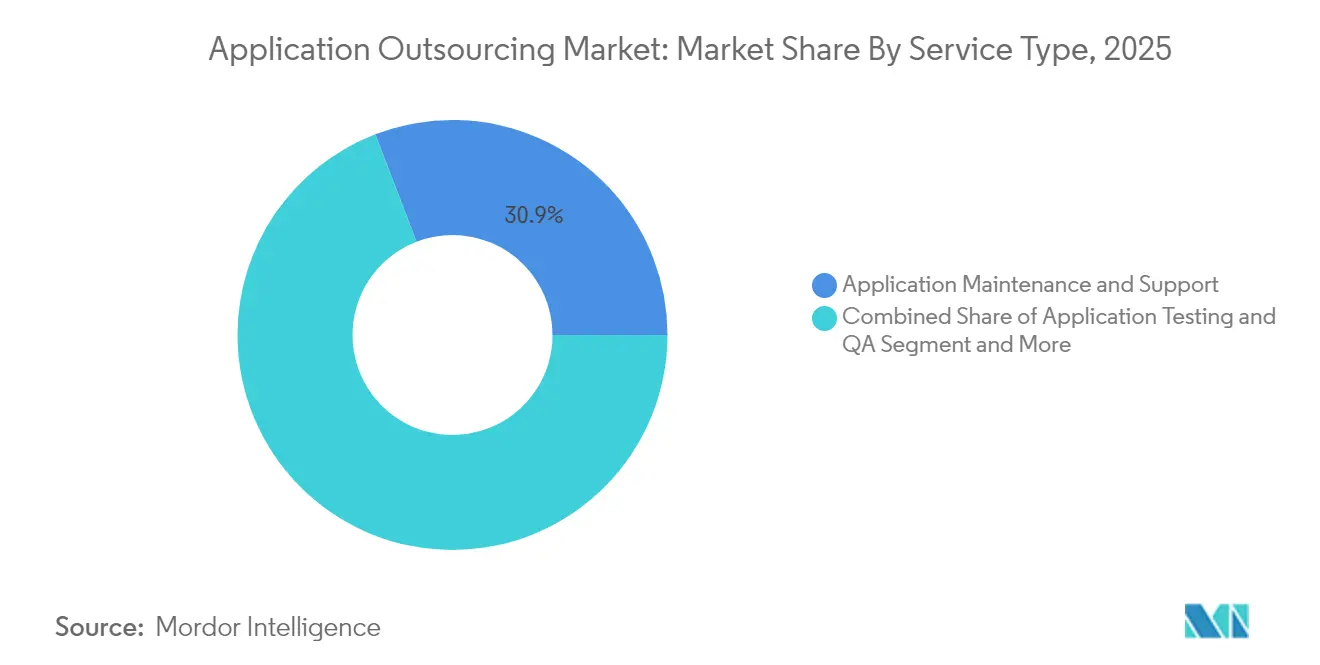
Security Gains Traction Over MaintenanceApplication Maintenance & Support contributed USD 40.49 billion in 2025, translating to 30.85% of the overall application outsourcing market. Long-running ERP, CRM, and supply-chain platforms still require dependable uptime and incremental upgrades, which keeps steady demand for managed services. Yet rising zero-day exploits and regulatory fines move security from an ancillary service into a growth engine.
Application Security Services expand at 12.61% CAGR as boards elevate cyber risk. Enterprises prefer external specialists who combine code-scanning tools with 24×7 SOC talent. As a result, the application outsourcing market size for security projects is forecast to climb sharply, while maintenance’s share slowly contracts. Development, integration, modernization, and testing services round out the portfolio, with 92% of firms planning some level of legacy refactoring before 2030.



By Deployment Model:
Hybrid Becomes the Pragmatic DefaultCloud deployments own 56.35% of 2025 revenue, equivalent to USD 73.96 billion, underscoring how subscription infrastructure and automated scaling now define modernization roadmaps. Enterprises moving analytics, digital commerce, and collaboration workloads to the cloud create the largest single contributor to the application outsourcing market.
Hybrid models rise at a 9.81% CAGR because regulated industries cannot abandon on-premises systems overnight. Providers deliver Kubernetes-based toolchains that bridge data centers and hyperscaler regions, keeping latency and compliance in check. As this balance matures, the application outsourcing market share for on-premises environments gradually declines, yet on-premises remains relevant for ultra-low-latency or sovereign data tasks. The segment keeps providers busy governing network, identity, and observability layers across mixed estates.
By End-user Industry:
Healthcare Accelerates After BFSIBFSI generates USD 36.86 billion in 2025 and remains the anchor vertical, propelled by open-API ecosystems and stringent uptime standards. Its sizable budgets give banks leverage to demand outcome-linked contracts that improve fraud detection and customer onboarding speed. With 28.10% of 2025 revenue, BFSI remains the benchmark for large-scale deals inside the application outsourcing market.
Healthcare & Life Sciences grows fastest at 12.55% CAGR as providers digitize patient journeys and secure sensitive records. Rapid telehealth adoption, clinical-trial data platforms, and AI-enabled diagnostics lift demand for HIPAA-compliant cloud architectures. The application outsourcing market size committed by hospitals and pharma firms is projected to exceed USD 16.2 billion by 2031. Retail, manufacturing, telecom, and public sector generate incremental growth, each requiring verticalized accelerators that compress time-to-value.
By Organization Size:
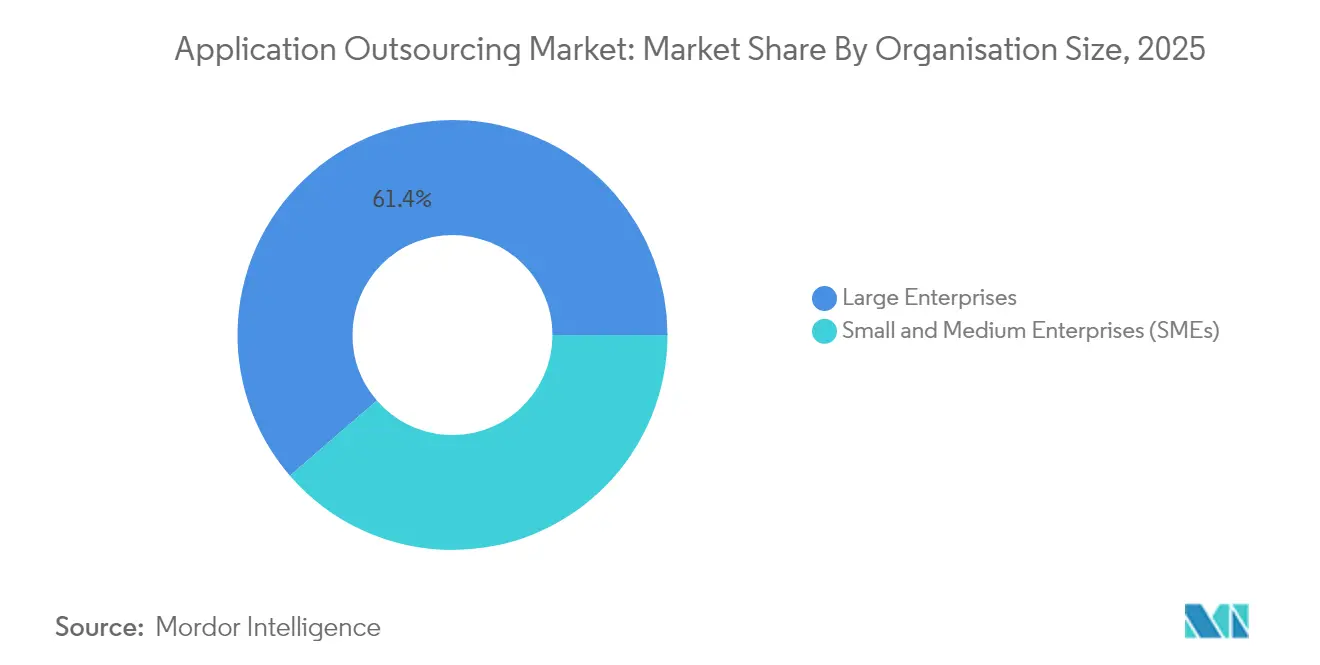
SMEs Move from Ad Hoc to StrategicLarge enterprises accounted for USD 80.49 billion in 2025, or 61.35% of revenue, because they manage sprawling portfolios across multiple business units. Their projects often span modernization, AI pilots, and cybersecurity in a single multi-year agreement, feeding scale to tier-1 vendors.
SMEs exhibit 10.62% CAGR, the highest in the application outsourcing market, as cloud platforms lower entry thresholds. Modern billing lets smaller firms switch fixed capital costs to predictable opex. Providers craft templated microservices and DevOps pipelines that fit mid-market budgets yet meet enterprise-grade security. The emphasis on ease of engagement reshapes go-to-market motions and expands total volume.
By Contract Model:
Outcomes Trump InputsFixed-price contracts still dominate with 47.35% of 2025 revenue because CFOs value budget accuracy. Even so, outcome-based agreements grow 13.68% CAGR and may represent a quarter of the application outsourcing market size by 2031. These deals tie revenue to performance metrics such as user adoption, release velocity, or cost per claim processed.
Time-and-material arrangements remain useful for exploratory builds, and Build-Operate-Transfer structures attract firms seeking eventual insourcing. A shift toward experience-level agreements focuses on employee satisfaction scores instead of pure uptime. Providers upgrade governance frameworks to monitor KPIs continuously, using observability tooling to prove delivered value.
Geography Analysis
The Americas Application Outsourcing Market
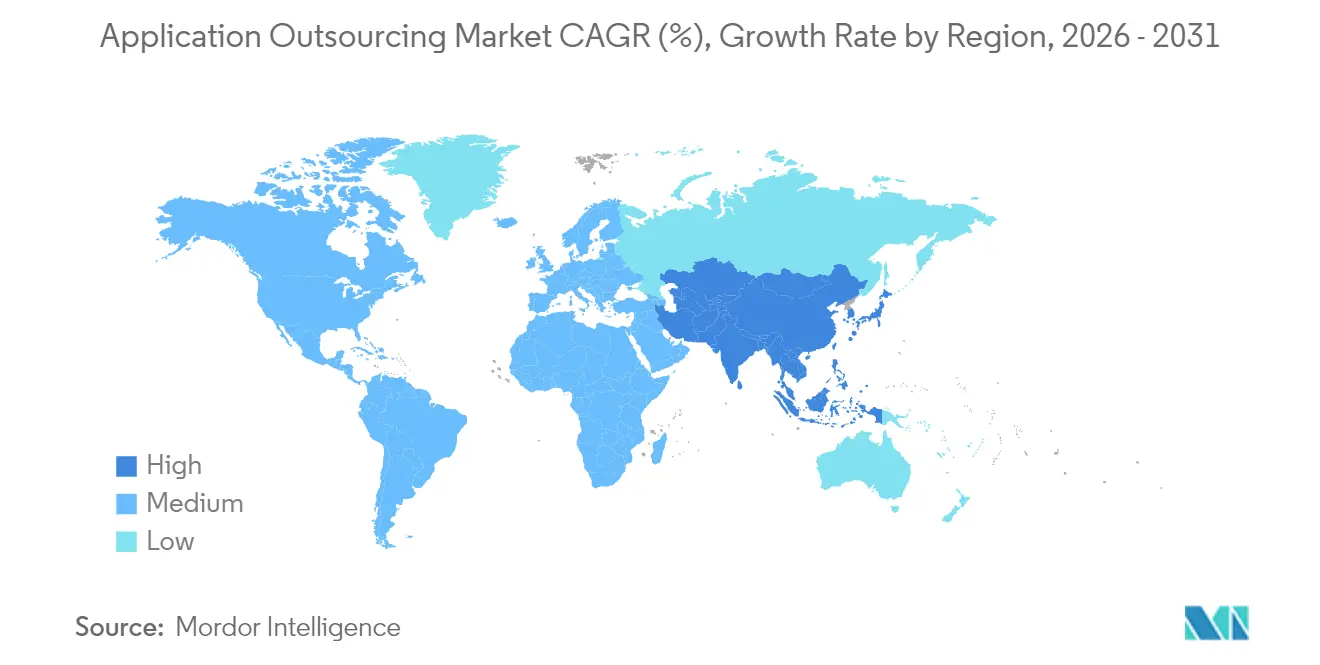
North America generated USD 55.05 billion, equating to 41.95% of 2025 revenue within the application outsourcing market. Enterprises adopt AI, event-driven architectures, and zero-trust security at scale. Nearshore centers across Mexico, Colombia, and Costa Rica grow close to 20% annually, easing time-zone friction for agile teams.
APAC Application Outsourcing Market
Asia-Pacific posts the fastest 11.85% CAGR, with India, Vietnam, and the Philippines anchoring delivery. India alone targets USD 20.81 billion in software exports by 2029. China’s domestic cloud push opens fresh consulting work, while Australia and Singapore become regional hubs for regulated workloads. Wage inflation and attrition keep vendors investing in automation and second-tier cities.
Europe Application Outsourcing Market
Europe shows steady demand, shaped by data-sovereignty directives. Germany and the United Kingdom remain top buyers, and Poland, Romania, and Ukraine attract nearshore budgets from Western clients thanks to linguistic alignment. The Netherlands BPO market is tracking a 6.7% CAGR through 2025. Local cloud regions built by hyperscalers remove earlier latency barriers and support edge analytics deals.
LATAM and MEA Application Outsourcing Market
Latin America, the Middle East, and Africa represent newer growth theaters. Brazil, Chile, and Argentina offer cost-competitive agile squads for North American firms. Gulf governments fund large digital services programs, creating demand for cloud and cybersecurity know-how, while South Africa and Nigeria develop fintech and telecom coding bases. Regulatory clarity and network capacity improvements will decide how much of the wider application outsourcing market these regions capture by 2030.

Regulatory Landscape
Regulation for application outsourcing is tightening around data sovereignty, third-party risk, and public sector cloud assurance, shaping both delivery location choices and how contracts are governed. In the European Union, the Digital Operational Resilience Act (DORA) is being operationalized through detailed technical standards, including Commission Delegated Regulation (EU) 2025/532 (March 2025) for subcontracting ICT services by financial entities, which increases documentation and oversight requirements across multi-vendor delivery chains.
In 2026, multiple policy actions reinforced the shift toward controlled cross-border delivery. The European Commission introduced the Cloud and AI Development Act (CADA) on June 3, 2026, establishing mandatory Union assurance levels for cloud services used by public sector authorities and raising the bar for providers serving government workloads. In India, the Reserve Bank of India set April 10, 2026, as the compliance deadline for regulated entities to align existing IT outsourcing agreements with updated Master Directions. In ASEAN, a February 2026 framework on cross-border cloud computing principles (including a Trusted Data Corridor concept) was published to formalize regulated data flows among participating member states.
Value Chain Analysis
The application outsourcing value chain begins with client demand owners (CIO, CISO, and business product teams) defining modernization, maintenance, security, and managed operations scope, followed by contracting and governance that increasingly embed outcome-linked KPIs. Prime service providers, including global SIs and managed service firms, orchestrate delivery using a blended footprint of onshore consulting, nearshore agile pods, and offshore engineering, while cloud hyperscalers and platform vendors supply the underlying runtime, security, and observability layers.
Execution also relies on an ecosystem of cloud and platform partners, vertical specialists, and talent supply channels. Recent transactions point to deeper integration across the chain, such as CGI and Telia agreeing to transfer cloud and capacity services with nearly 250 employees moving to CGI (June 2026). Larger multi-year, automation-led engagements also show the direction of travel, including HCLTechs USD 1.14 billion contract for an AI-driven operating model for digital workplace and enterprise networks (July 2026). Bottlenecks center on scarce AI, cloud security, and compliance skills, along with higher assurance and audit demands that drive vendors to standardize tooling, strengthen third-party controls, and expand nearshore capacity for regulated and time-zone-sensitive work.
Competitive Landscape
The market remains moderately concentrated: the top 10 suppliers account for roughly 45% of 2024 revenue. Accenture leads, drawing USD 64.9 billion from work that blends cloud migration, managed security, and generative AI accelerators. NTT Data and Tata Consultancy Services follow, each near USD 30 billion. Their wide channel relationships and multi-continent delivery give them scale unmatched by pure-play application specialists.
Mid-tier players such as EPAM, LTI, and Luxoft focus on sector depth in automotive, banking, or embedded engineering. They win by supplying niche capabilities that larger providers integrate into end-to-end programs. Strategic alliances with hyperscalers become key: TCS formed its AI.Cloud unit to bundle domain-specific GenAI services with cloud landing zones. IBM’s USD 6.4 billion acquisition of HashiCorp boosts policy-as-code and multi-cloud automation.
Competitive intensity also rises in security, testing, and design. Boutique firms such as Cloudify, Mav3rik, and CloudDev are being absorbed to enrich consulting benches. Nearshore providers market cultural alignment and English fluency to pick up agile sprint overflow from U.S. clients. Price-led rivalry declines as outcome-driven KPIs push differentiation toward intellectual property and reference architectures.
Application Outsourcing Industry Leaders
Accenture Plc
IBM Consulting (IBM Corporation)
Tata Consultancy Services (TCS) Ltd.
Cognizant Technology Solutions Corporation
Wipro Limited
- *Disclaimer: Major Players sorted in no particular order
Application Outsourcing Market Companies Covered in this Report
- Accenture Plc
- IBM Consulting (IBM Corporation)
- Tata Consultancy Services (TCS) Ltd.
- Cognizant Technology Solutions Corporation
- Wipro Limited
- Capgemini SE
- DXC Technology
- HCL Technologies
- Infosys Limited
- NTT DATA Group Corporation
- Atos SE
- CGI Inc.
- Fujitsu Limited
- Tech Mahindra Limited
- LTIMindtree Limited
- Sopra Steria Group SA
- EPAM Systems Inc.
- Endava PLC
- Globant S.A
- Persistent Systems Limited
- Softtek Ltd.
- UST Global
- Hexaware Technologies Limited
- Virtusa Corporation
- Mphasis Limited
- Unisys Corporation

Market Opportunities and Future Outlook
Outcome-based, AI-enabled managed application services create whitespace for providers that can package modernization, security, and operational automation into a single commercial offer. HCLTech signing a five-and-a-half-year, USD 1.14 billion engagement (effective July 2026) to run an AI-driven operating model for global digital workplace and enterprise networks, and CGI entering a strategic partnership with Telia in June 2026 that shifts responsibility for enterprise cloud and capacity services while transferring nearly 250 employees, both indicate that buyers are willing to hand over operational accountability alongside assets and talent.
Sovereignty and regulated cross-border delivery are also opening targeted opportunities tied to compliant architectures and regional operating models, not just generic offshoring. The European Commissions June 2026 introduction of CADA (Union assurance levels for public sector cloud) and the RBI-driven alignment of outsourcing agreements (April 2026 compliance deadline) increase demand for application outsourcing partners that can evidence controls, manage subcontractor governance, and segment workloads across hybrid estates. Within delivery, nearshoring and structured talent transfer models, including CGI-Telia, support continuity of service while modernizing legacy environments and tightening cyber-supply-chain controls.
Recent Industry Developments in Application Outsourcing Market
- July 2026: Accenture received a five-year task order worth up to USD 821 million to support integration for the U.S. Department of Defenses War Data Platform under the GSA ALLIANT 2 contract vehicle. The work centers on integrating data and applications at scale in a high-security environment, raising the bar for vendors positioning application outsourcing around mission-critical modernization and secure operations.
- April 2026: Wipro secured a multi-year strategic transformation engagement with Olam Group to deliver end-to-end transformation services supported by Wipro Intelligence AI-powered platforms. The engagement highlights how large buyers are bundling application change, operations, and AI-led productivity into fewer strategic partnerships rather than fragmented, project-by-project outsourcing.
- May 2025: Accenture acquired Cloudify for USD 420 million to deepen European cloud-migration capabilities. The move strengthened Accenture’s ability to execute application modernization programs in cloud-led delivery models and supported scale-up of multi-country European engagements where compliance and delivery localization requirements are increasing.


Application Outsourcing Market Report Scope and Research Methodology
Market Definition and Coverage
We define the application outsourcing market as the value of fee-based contracts where enterprises shift application development, maintenance, modernization, or managed application operations to an external service provider, delivered onshore, nearshore, or offshore. The sizing is captured as service revenue tied to a specific application scope.
Scope exclusions: We exclude in-house shared services, pure infrastructure hosting, one-time software licenses, pure business-process outsourcing, hardware break-fix, and generic cloud hosting services.
Segments Covered in This Report
- By Service Type
- Application Development and Integration
- Application Maintenance and Support
- Application Testing and QA
- Application Modernisation and Migration
- Application Security Services
- Others
- By Deployment Model
- On-premise
- Cloud
- Hybrid
- By End-user Industry
- BFSI
- Healthcare and Life Sciences
- Media and Entertainment
- Logistics and Transportation
- Retail and E-commerce
- Manufacturing
- Government and Public Sector
- IT and Telecom
- Other End-User Industries
- By Organisation Size
- Large Enterprises
- Small & Medium Enterprises (SMEs)
- By Contract Model
- Fixed-price
- Time and Material
- Outcome-based / Managed Services
- Build-Operate-Transfer (BOT)
- By Geography
- North America
- United States
- Canada
- Mexico
- South America
- Brazil
- Argentina
- Chile
- Rest of South America
- Europe
- Germany
- United Kingdom
- France
- Russia
- Italy
- Spain
- Rest of Europe
- Asia-Pacific
- China
- India
- Japan
- South Korea
- Australia
- Malaysia
- Singapore
- Rest of Asia-Pacific
- Middle East and Africa
- Middle East
- United Arab Emirates
- Saudi Arabia
- Turkey
- Rest of Middle East
- Africa
- South Africa
- Nigeria
- Rest of Africa
- Middle East
- North America
Data Sources, Market Sizing, and Validation
Desk Research
Desk work starts with public signals that explain how demand is forming, and where budgets are being spent in enterprise software services. We use sources such as the World Bank, OECD, and IMF for macro context, along with IT and services trade statistics where available to sanity check cross-border delivery patterns.
To ground the service scope, we also refer to sources such as the US Bureau of Labor Statistics for IT services employment and wage trends, and the International Organization for Standardization for commonly used service management terminology. Annual reports, earnings call transcripts, and investor decks help map service mix shifts across development, maintenance, and modernization work, then to cross-check pricing language and contract duration patterns. In a few places, we also use paid subscriptions that provide company financials and news intelligence, plus patent databases to spot where modernization and application lifecycle tooling is accelerating. These desk sources are illustrative only, and we reviewed many additional public documents and datasets to collect, validate, and clarify assumptions.
Primary Interviews and Surveys
Primary discussions were run with service providers, enterprise buyers, and channel or advisory participants who see large application portfolios being built, run, and modernized. We use these interviews to confirm what gets counted as application outsourcing versus adjacent IT outsourcing, and to lock practical ranges for contract sizes, renewal cycles, and the typical split between run and change work across regions.
Distribution of primary research fieldwork respondents
| Company type | Respondent position | Region |
|---|---|---|
| Top tier: 31% | CXOs: 19% | APAC: 43% |
| Mid tier: 47% | Functional/Unit leaders: 39% | EMEA: 37% |
| Smaller Players: 22% | Managers: 42% | Americas: 20% |
Market-Sizing & Forecasting
The model is built using a top-down and bottom-up blend, where the demand pool is reconstructed from enterprise IT and application services spending, and then filtered into outsourced application work using adoption and delivery mix checks. To keep the numbers realistic, we corroborate the totals with selective bottom-up approximations using sampled provider revenue splits, channel checks on typical contract values, and ASP-by-effort proxies (rate cards and managed service fees) applied to validated volume indicators.
A few variables that strongly shape the sizing include outsourced share of application development and maintenance budgets, renewal and rebid cycles for managed application services, the pace of application modernization programs, shifts toward cloud and hybrid delivery in application work, and regional cost and utilization differences that affect realized pricing. When a bottom-up view has gaps, the missing pieces are handled through conservative interpolation using peer group ratios that were confirmed in interviews, and then adjusted back to the demand-led ceiling.
For forecasting, we rely on scenario analysis supported by simple regression-style relationships between macro indicators, enterprise IT spend direction, and modernization intensity. We then review the final growth paths against what practitioners expect for deal pipelines and renewals over the next few years. Where inputs disagree, the forecast is held to the most repeatable drivers that can be traced back to budgets, delivery mix, and contract cadence.
Data Validation & Update Cycle
Outputs are checked through triangulation across the demand pool build, provider-side reasonableness checks, and independent signals such as budget commentary, employment trends in IT services, and visible modernization cycles. Any large variance triggers a step back into the assumptions, where we re-check definitions, currency timing, and whether a scope item drifted into infrastructure or BPO by mistake.
Before sign-off, the model is reviewed by another analyst for logic consistency, and a second pass is run to make sure regional totals reconcile to global numbers without hidden overlaps. The report is refreshed annually, and interim updates are made when material events shift budgets or delivery models in a way that would move the market trajectory. Right before delivery, we perform a final refresh pass so the view reflects the most recent public disclosures and validated primary feedback.
Mordor Intelligence's Global Application Outsourcing Market Sizing Compared With Other Published Estimates
Published market sizes for application outsourcing can look far apart, even when the topic name appears similar, because the counting rules are not always aligned. Differences usually come from what is included as application work, how contract value is recognized, and how fast assumptions get refreshed as delivery models change.
By tracking deal structures, currency timing, and service boundary checks in the model, Mordor Intelligence keeps application outsourcing limited to fee-based application scope work and avoids blending in infrastructure hosting or pure BPO, which is a common reason totals drift upward in some publications. The spread also depends on whether estimates treat modernization as a separate bucket, how they step from broad IT outsourcing to application outsourcing using share assumptions, and whether ASP progression is tied to wage and utilization signals or held flat across regions.
Benchmark comparison
| Source | Market Size | Gaps in Research Methodology |
|---|---|---|
| Mordor Intelligence | USD 131.22 B (2025) | |
| Global Consultancy A | USD 159.80 B (2025) | Uses a wider IT outsourcing frame and allocates a share to applications, which can unintentionally pull in infrastructure-managed services and bundled cloud operations that are not application-scope outsourcing. |
| Industry Association B | USD 118.40 B (2025) | Counts mainly large, reportable contract awards and renewals, which can understate smaller managed application contracts and distributed modernization work delivered through multi-vendor panels. |
The table mainly points to boundary and recognition choices, rather than a disagreement on demand direction. When scope is kept tight to application development, maintenance, modernization, and managed application operations, and when price and renewal cadence are validated with interviews, the resulting size stays easier to replicate and explain across regions.


Key Questions Answered in the Report
What is the current value of the application outsourcing market?
The market is valued at USD 142.53 billion in 2026 and is forecast to reach USD 215.46 billion by 2031.
Which service segment is growing fastest?
Application Security Services lead growth with a 12.61% CAGR as enterprises prioritize cyber risk mitigation.
Why are hybrid deployment models gaining traction?
Hybrid models balance cloud scalability with on-premise compliance, expanding at a 9.81% CAGR to meet data-sovereignty mandates.
How are outcome-based contracts changing vendor relationships?
They link fees to business results such as release velocity, opening a 13.68% CAGR opportunity for managed services.
Which region shows the highest growth rate?
Asia-Pacific expands at 11.85% CAGR due to rapid digital adoption and its established outsourcing talent base.
What is driving SME adoption of application outsourcing?
Access to specialized skills, cloud-first pricing, and the need for rapid digital transformation push SME outsourcing at an 10.62% CAGR.
Page last updated on:


 Your data is secure and never sold or shared.


