
Indonesia IT Services Market Size and Share
Market Overview
| Study Period | 2020 - 2031 |
|---|---|
| Forecast Data Period | 2026 - 2031 |
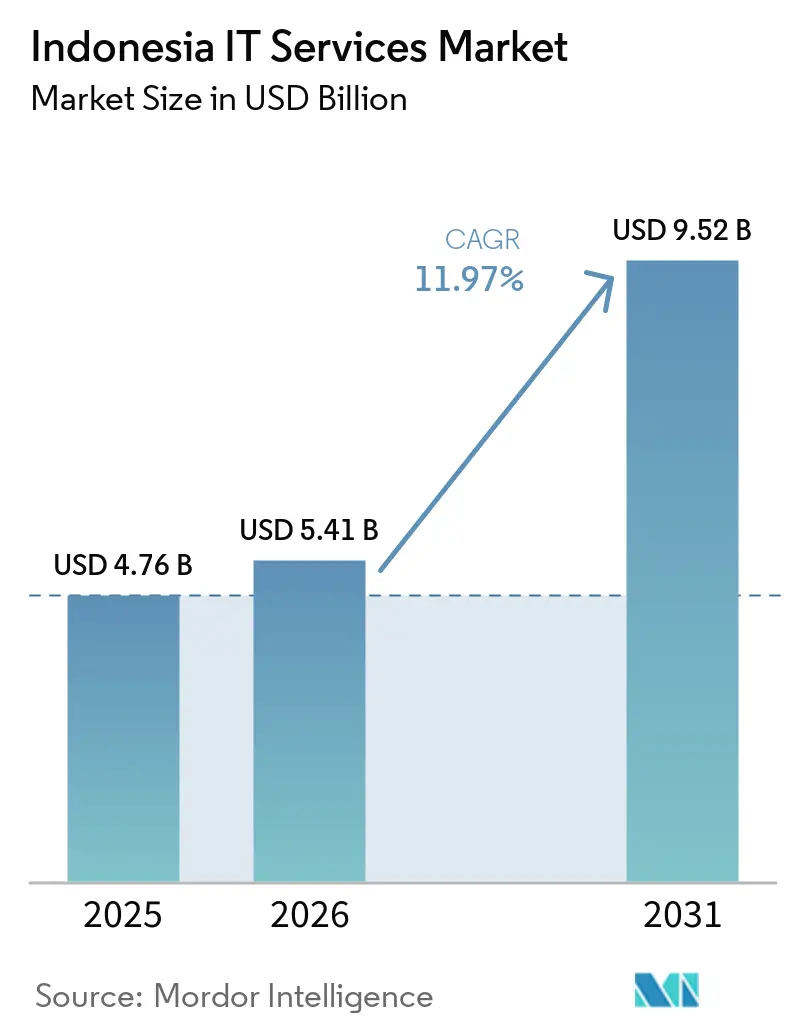
| Base Year Market Size (2025) | USD 4.76 Billion |
| Market Size (2026) | USD 5.41 Billion |
| Market Size (2031) | USD 9.52 Billion |
| Growth Rate (2026 - 2031) | 11.97 % |
| Market Concentration | Medium |
Major Players *Disclaimer: Major Players sorted in no particular order Image © Mordor Intelligence. Reuse requires attribution under CC BY 4.0. | |
Indonesia IT Services Market Analysis by Mordor Intelligence
The Indonesia IT services market size is expected to increase from USD 4.76 billion in 2025 to USD 5.41 billion in 2026 and reach USD 9.52 billion by 2031, growing at a CAGR of 11.97% over 2026-2031. Rapid cloud adoption, rising demand for production-grade artificial intelligence, and state-sponsored build-operate-transfer data-center agreements are reshaping revenue streams and compressing legacy maintenance spending. Financial-sector mandates on domestic data residency, combined with the Ministry of Communication and Informatics’ sovereign AI roadmap, push enterprises toward hybrid environments that blend local compliance with global scalability. Hyperscale investments by Microsoft, Google Cloud, and Telkom Group are improving regional latency, supporting nationwide e-commerce expansion and real-time digital payments. Meanwhile, persistent shortages in DevSecOps and cloud-security talent elevate consulting rates and encourage long-term managed-services contracts that stabilize integrator cash flows.
Key Report Takeaways
- By service type, Cloud Services and SaaS Implementation led with 29.47% revenue share in 2025, while Artificial Intelligence and Machine Learning services are projected to register the fastest expansion at a 12.55% CAGR through 2031.
- By enterprise size, large enterprises accounted for 61.29% of 2025 spending, whereas small and medium enterprises represent the fastest-growing customer group at a 12.97% CAGR to 2031.
- By industry, Banking, Financial Services, and Insurance captured 22.37% of 2025 value, while healthcare shows the strongest forecast momentum with a 12.75% CAGR during 2026-2031.
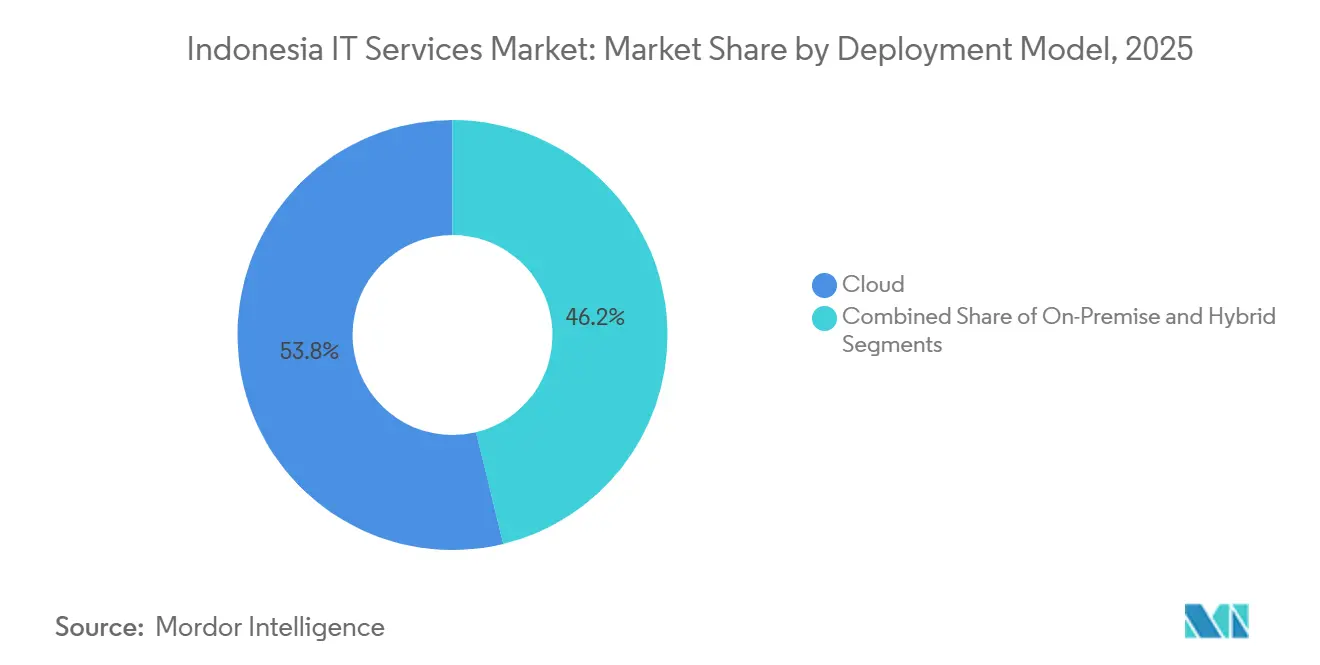
- By deployment model, cloud environments contributed 53.79% of 2025 revenue, yet hybrid architectures are expected to expand the quickest at a 12.83% CAGR through 2031.
- By technology, cloud computing generated 27.81% of 2025 revenue, but Artificial Intelligence and Machine Learning technologies are forecast to grow the fastest at a 13.04% CAGR over the same period.
Note: Market size and forecast figures in this report are generated using Mordor Intelligence’s proprietary estimation framework, updated with the latest available data and insights as of 2026.
Indonesia IT Services Market Trends and Insights
Drivers Impact Analysis*
| Driver | (~) % Impact on CAGR Forecast | Geographic Relevance | Impact Timeline |
|---|---|---|---|
| Rapid Enterprise Digital-First Strategies | +3.20% | National, concentrated in Jakarta, Surabaya, Bandung | Medium term (2-4 years) |
| Surge in Cloud-Native Application Migration | +2.80% | National, with Jakarta and Batam as primary cloud regions | Medium term (2-4 years) |
| Government "Making Indonesia 4.0" Incentives | +2.10% | National, with priority zones in Java and Batam | Long term (≥ 4 years) |
| Accelerated Fintech and E-Commerce Expansion | +1.90% | National, urban centers leading adoption | Short term (≤ 2 years) |
| Data-Center Build-Operate-Transfer Deals with SOEs | +1.40% | Jakarta, West Java, Batam | Medium term (2-4 years) |
| Mandated Domestic Disaster-Recovery Hosting for Critical Data | +0.90% | National, compliance-driven across all sectors | Short term (≤ 2 years) |
| Source: Mordor Intelligence | |||
Rapid Enterprise Digital-First Strategies
Indonesian corporations now replace incremental upgrades with holistic overhauls that bundle cloud ERP, customer data platforms, and AI-driven analytics into unified architectures. A 2025 IBM survey found 62% of domestic firms piloting AI, well above regional peers.[1]IBM Corporation, “Indonesia AI Adoption Study 2025,” ibm.com Digital-native leaders such as GoTo Financial completed full cloud migrations in mid-2025, showing incumbents the performance gap that arises without end-to-end modernization. Multi-year managed-services contracts accompany these programs, securing predictable revenue and mitigating hardware refresh volatility. Certified integrators with ISO 27001 and SOC 2 documentation enjoy a bidding advantage because banks and telecom operators must pass strict regulatory audits.[2]Bank Indonesia, “Bank Indonesia Regulation No.2/2024,” bi.go.id Consequently, service providers emphasize consult-build-operate models that embed long-term account control.
Surge in Cloud-Native Application Migration
Google Cloud’s Jakarta region expansion in May 2025 catalysed a wave of microservices refactoring projects requiring Kubernetes and serverless skills.[3]Google Cloud, “Jakarta Region Expansion Announcement,” cloud.google.com Microsoft’s USD 1.7 billion commitment, including training for 840,000 Indonesians, signals confidence that platform-as-a-service demand will outpace lift-and-shift workloads.[4]Microsoft Corporation, “USD 1.7 Billion Indonesia Investment Announcement,” microsoft.com Enterprises adopting cloud-native patterns report 20% faster release cycles and 50% lower unplanned downtime, metrics that justify premium DevOps consulting fees. Bank Indonesia Regulation No.2/2024 compels banks to re-platform core systems on cloud infrastructure with domestic data residency, tripling average project value. Required certifications under ISO 27001 increase entry barriers, concentrating high-margin work among established integrators.
Government Making Indonesia 4.0 Incentives
Fiscal incentives tied to Manufacturing 4.0 compel factories in automotive, electronics, and textiles to digitalize production lines with IoT, AI, and digital twins. The National AI Roadmap targets 100,000 specialists annually by 2029, creating a domestic talent pipeline that lowers long-run delivery costs. Danantara, the sovereign wealth fund, earmarks capital for AI infrastructure, anchoring future hyperscale requirements. Streamlined licensing via the Online Single Submission system shortens market entry, although local procurement rules still vary by province. Presidential Regulation No.82/2022 further narrows supplier pools by requiring vital-information infrastructures to source only from providers meeting stringent resilience standards.
Accelerated Fintech and E-Commerce Expansion
Indonesia’s e-commerce gross merchandise value hit USD 71 billion in 2025 and is on track for USD 95 billion in 2026, overloading legacy IT and pushing retailers to cloud-based order management platforms. Digital payment volume climbed to USD 538 billion in 2025, creating heavy demand for fraud analytics and real-time settlement engines. Fintech lenders regulated under OJK rules deploy machine-learning credit models, opening advisory niches around model governance. Social-commerce convergence, exemplified by TikTok Shop integrations, drives omnichannel platform spending that synchronizes inventory across physical and digital storefronts in real time. Global integrators have responded by forming Jakarta-based fintech practices aimed at rapid MVP rollouts.
Restraints Impact Analysis*
| Restraint | (~) % Impact on CAGR Forecast | Geographic Relevance | Impact Timeline |
|---|---|---|---|
| Persistent Domestic Skills Gap in Advanced Cloud and DevSecOps | -1.80% | National, acute in tier-2 and tier-3 cities | Medium term (2-4 years) |
| Ageing Legacy Infrastructure Outside Tier-1 Cities | -1.30% | Provincial regions, outer islands | Long term (≥ 4 years) |
| Fragmented Provincial Procurement Standards | -0.70% | Provincial and municipal levels | Medium term (2-4 years) |
| Rising Electricity Tariffs Impacting Hyperscale Economics | -0.50% | Jakarta, West Java, Batam | Short term (≤ 2 years) |
| Source: Mordor Intelligence | |||
Persistent Domestic Skills Gap in Advanced Cloud and DevSecOps
Nearly half of large enterprises report shortages in cloud-security expertise despite surging AI adoption. Universities produce fewer than 5,000 cybersecurity graduates a year, while the National Cyber and Crypto Agency tracked 403 million anomalous traffic events in 2023. Until the AI roadmap delivers sizable cohorts, integrators import expatriate talent at two to three times local salaries, squeezing margins. Skill scarcity lengthens project timelines, particularly for SME clients that cannot absorb premium rates. Providers hedge by opening remote security-operations centers in lower-cost Asian locations, a move that introduces latency and data-sovereignty concerns.
Ageing Legacy Infrastructure Outside Tier-1 Cities
Jakarta and West Java house about 80% of national data-center capacity, leaving outer islands dependent on pre-2020 gear lacking the density needed for AI model training. Satellite links produce latencies above 100 milliseconds, hampering ERP rollouts and telemedicine. Fragmented procurement across 34 provinces forces integrators to duplicate compliance paperwork and delays kick-offs by up to six months. Rising industrial power tariffs further erode hyperscale economics in provincial sites. Execution risks are evident in the National Data Center at Cikarang, which missed its June 2025 onboarding target for ministerial systems.
*Our forecasts treat driver/restraint impacts as directional, not additive. The impact forecasts reflect baseline growth, mix effects, and variable interactions.
Segment Analysis
By Service Type: Cloud and AI Elevate Revenue Mix
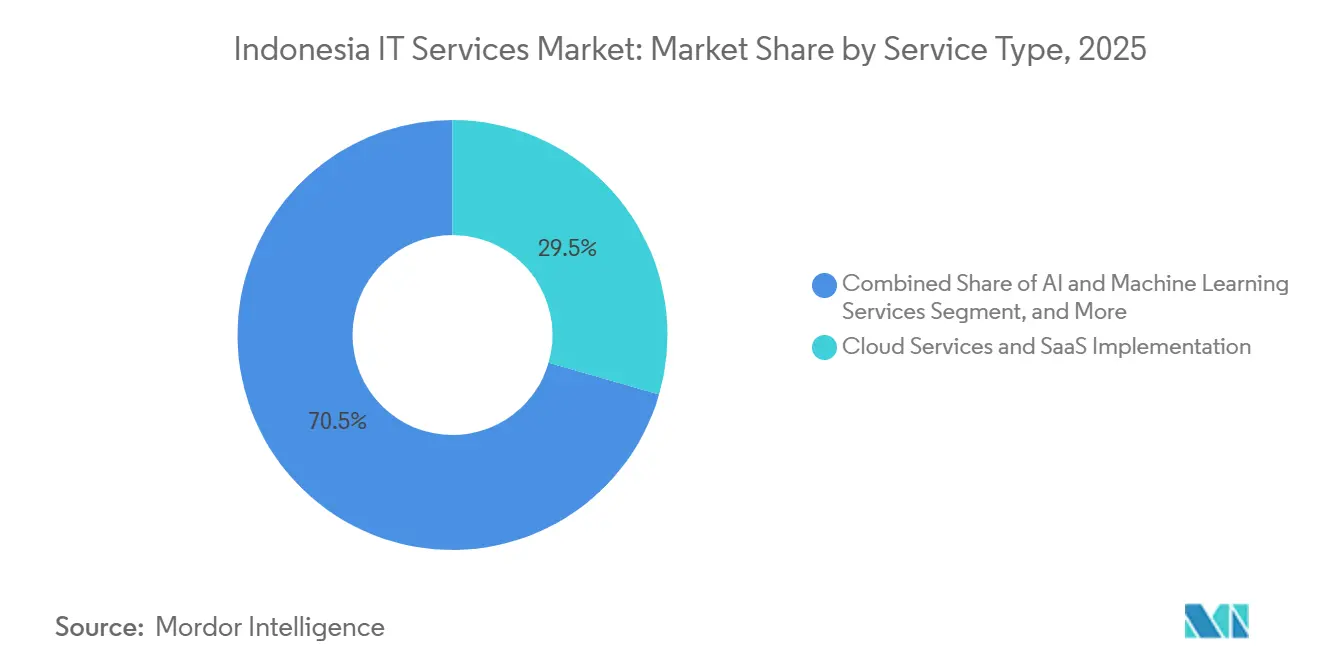
Cloud Services and SaaS Implementation held 29.47% of 2025 revenue in the Indonesia IT services market, showing enterprises’ strong preference for utility pricing over capex-heavy on-premises deployments. Artificial Intelligence and Machine Learning engagements grow at 12.55% annually, thanks to banks, retailers, and manufacturers moving pilot models into production. IT Consulting and Implementation remains foundational, guiding clients through microservices re-architecture and business-process redesign. Business Process Outsourcing is shifting toward AI-assisted credit underwriting and claims processing, lifting provider margins. IT Outsourcing and Managed Services anchor recurring income, although price competition from offshore vendors pressures local firms to differentiate via 24/7 Indonesian-language support and on-site response.
Other Service Types, dominated by legacy hardware break-fix, continue to contract yet still underpin mission-critical systems that cannot migrate in a single release. Telkomsigma’s pivot from classic integration to cloud-native consulting, and its AWS and Google Cloud partner badges, illustrates how incumbents can refresh portfolios while protecting embedded bases. Bank Indonesia’s residency mandate accelerates movement from perpetual licenses to SaaS, positioning integrators that manage hybrid entitlements for long-term relevance. As AI accelerates, cloud and data-platform expertise becomes the primary gatekeeper to high-value transformation deals.



By Enterprise Size: Mid-Market Volume, Large-Cap Value
Large enterprises contributed 61.29% of 2025 revenue in the Indonesia IT services market, reflecting regulatory burdens, larger IT estates, and capacity to fund multi-million-dollar projects. Banks, telecom operators, and diversified conglomerates sign multi-tower deals that bundle consulting, migration, and managed services for 3-to-7-year terms. They increasingly rationalize supplier rosters, awarding core transformation work to firms offering certified security frameworks and audited delivery processes.
SMEs expand at a 12.97% CAGR as government digital-voucher schemes offset advisory fees and cloud providers launch SME pricing tiers. Typical engagements focus on point solutions such as inventory SaaS or IoT-enabled machinery telemetry, favouring modular delivery and rapid payback. Microsoft’s nationwide skills academies nurture a future pool of cloud-ready SME owners, while hybrid models bridge connectivity gaps in provincial areas. The widening SME opportunity prompts local boutiques to package templated offerings with fixed-fee implementation, enhancing affordability without deep customization.
By Industry: BFSI Dominates, Healthcare Accelerates
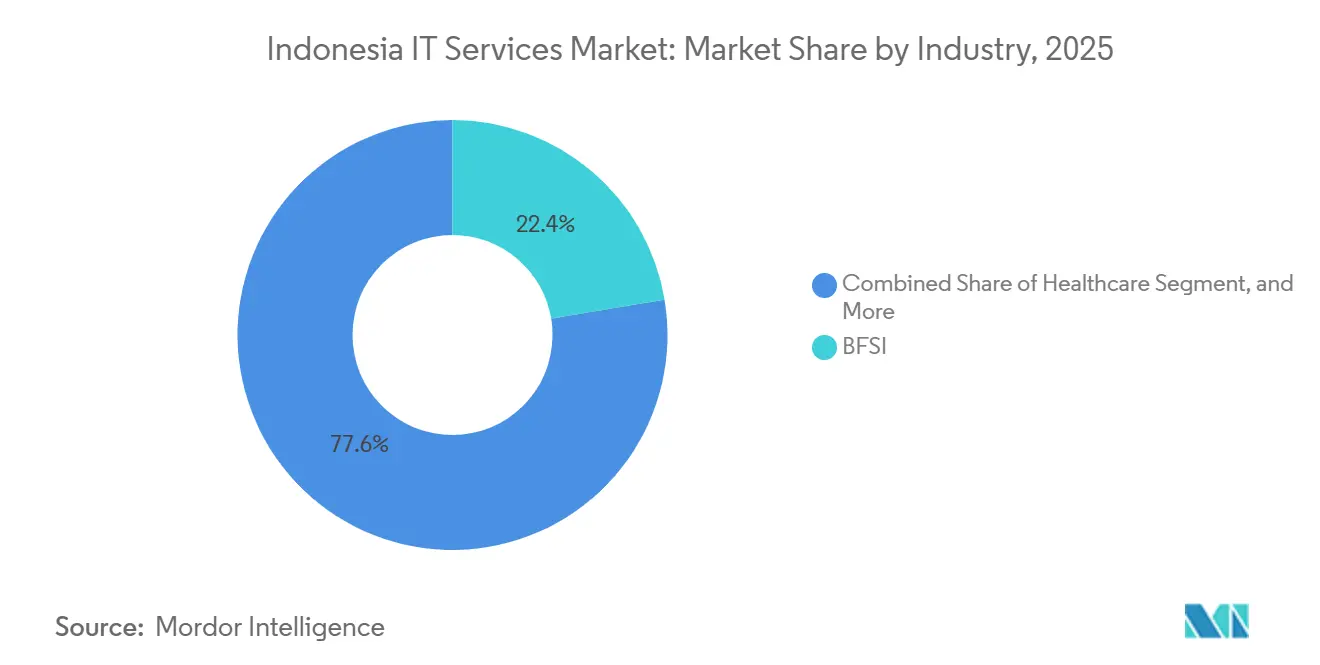
Banking, Financial Services, and Insurance commanded 22.37% of 2025 spending in the Indonesia IT services market, fuelled by mandates for cloud adoption, real-time payments, and fraud analytics. Core-system re-platforming, regulatory audits, and continuous security testing produce steady demand for consulting and managed services. Digital-payment volume of USD 538 billion in 2025 sustains spend on settlement engines and anti-money-laundering analytics.
Healthcare grows at 12.75% CAGR as the Ministry of Health connects 10,000 facilities to the SATUSEHAT data exchange. Hospitals procure electronic records, telemedicine, and interoperability middleware, creating greenfield revenue for specialized integrators. Manufacturing pursues Industry 4.0 programs focusing on predictive maintenance and digital twins, though adoption concentrates in automotive and electronics clusters. Government spending proceeds under the SPBE digital-government framework, but provincial fragmentation tempers scale. Retail and e-commerce race to deploy omnichannel platforms that bind social-commerce, store, and warehouse systems.
By Deployment Model: Hybrid Bridges Compliance and Scale
Cloud deployments represented 53.79% of 2025 revenue, confirming the Indonesia IT services market’s shift toward consumption economics. Yet hybrid architectures grow at 12.83% CAGR because the Personal Data Protection Law allows sensitive workloads to remain on premises while analytics leverages public clouds. Banks keep core-banking hosts on private clusters while streaming customer insights into public-cloud AI engines.
Hybrid complexity rewards integrators versed in workload placement, encryption, and policy management across heterogeneous environments. Google Cloud’s extra Jakarta zones enable enterprises to architect regional disaster-recovery pairs without leaving national borders. On-premises estates persist in defense and critical infrastructure where air-gapped mandates apply, but many now add private-cloud orchestration to deliver self-service provisioning. Edge computing is emerging as a hybrid extension for factory and retail sites requiring sub-20-millisecond latency.
By Technology: AI-ML Outpaces All Other Toolsets
Cloud computing contributed 27.81% of 2025 revenue, encompassing IaaS, PaaS, and container orchestration. Artificial intelligence and machine learning grow 13.04% annually as enterprises shift from pilots to production, driving demand for data engineering, model validation, and continuous retraining. Cybersecurity services accelerate in parallel with rising incident counts and stricter audit regimes by the National Cyber and Crypto Agency.
Internet of Things deployments in manufacturing and logistics unlock predictive maintenance and asset tracking, although high upfront sensor costs restrict adoption to larger firms. Big-data platforms underpin AI, with organizations investing in data lakes and governance frameworks. Blockchain remains niche, limited to pilots in supply-chain traceability and digital identity, but a potential central-bank digital currency could expand its role. Robotic process automation and low-code tools democratize workflow creation, altering required skill profiles for future consultants.
Geography Analysis
Jakarta and West Java account for about 80% of the Indonesia IT services market size, driven by the concentration of banks, ministries, and multinational headquarters. Batam is an emerging secondary hub, leveraging submarine-cable proximity to Singapore for cross-border latency advantages. The Tier-4 National Data Center in Cikarang, slated to host 40 petabytes, remains pivotal to future public-sector consolidation despite onboarding delays.
Surabaya and Bandung form tertiary clusters supplying regional enterprises yet lag Jakarta by three to five years in power density and network redundancy. Outer islands such as Kalimantan and Sulawesi rely on satellite backhaul, which constrains telemedicine and real-time analytics, though the Palapa Ring fiber project aims to narrow the digital divide. Provincial procurement fragmentation stretches sales cycles, prompting providers to centralize compliance teams.
Edge-computing pilots in tier-2 cities process industrial IoT data locally, lowering backhaul cost and meeting latency targets. Hyperscale’s’ renewable-powered campuses in Batam and Bekasi help mitigate rising electricity tariffs, yet power availability remains a gating factor for capacity beyond Java. Microsoft’s skills investments across multiple provinces seek to ease talent disparities, though initial cohorts still cluster around Java-based universities. As infrastructure and skills diffuse, regional opportunities should mature beyond Jakarta’s orbit.
Regulatory Landscape
Indonesia’s IT services delivery is shaped by electronic-system governance, public-sector digital standards, and sector-specific data and security rules. Electronic System Providers are overseen by the Ministry of Communication and Digital Affairs (Komdigi, formerly under MOCI frameworks) under Government Regulation No. 71 of 2019 and MOCI Regulation No. 5 of 2020, which drive registration, accountability, and operational obligations for digital platforms and hosted services. In the financial sector, Bank Indonesia Regulation No. 2/2024 reinforces auditability and domestic hosting expectations for regulated workloads, amplifying demand for compliant hybrid architectures and certified service providers.
Public-sector demand is steered through Komdigi regulations and procurement rules that standardize how government systems are built and sourced. Komdigi Minister Regulation No. 6 of 2025 sets technical standards and development procedures for electronic-based government systems, while Komdigi Minister Regulation No. 5 of 2025 defines requirements for public-sector electronic system providers, shaping eligibility for managed services, systems integration, and cloud operations tied to government workloads. Presidential Regulation No. 46 of 2025 maintains the procurement framework under LKPP, and 2026 Komdigi measures such as Minister Regulation No. 7 of 2026 (biometric-based subscriber registration) and Ministerial Decree No. 142 of 2026 (risk assessment standards for digital products accessible by children, set in March 2026) add compliance workstreams that spill over into identity, security testing, governance, and monitoring service lines.
Competitive Landscape
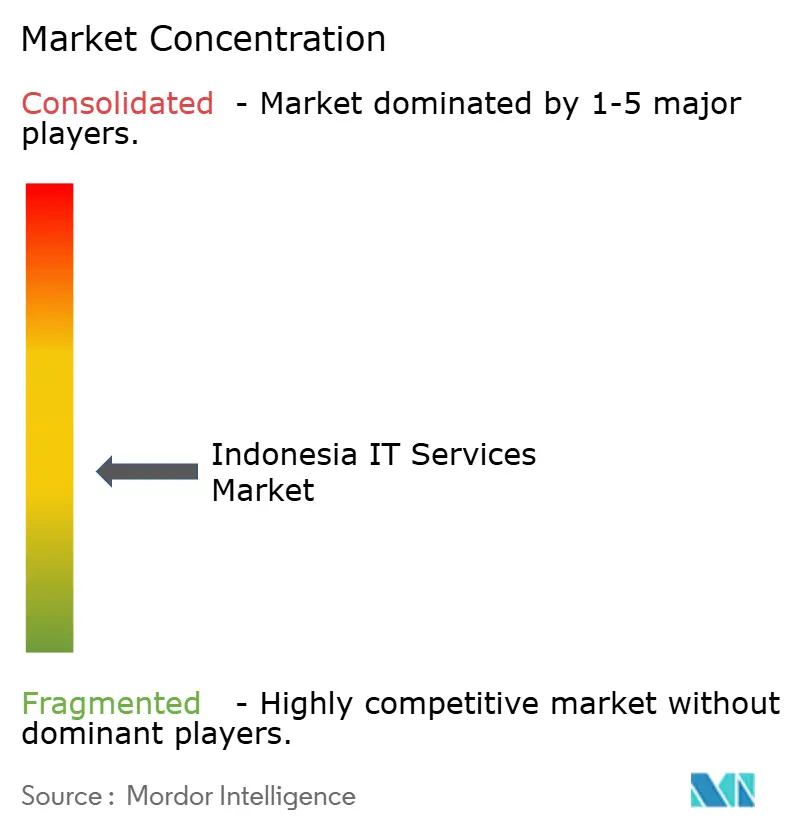
The Indonesia IT services market features moderate concentration: Telkomsigma controls just over 11% of digital services through ministerial partnerships, while Accenture closed 62 transformation deals above USD 100 million in early 2025. Global firms such as IBM, Microsoft, and TCS differentiate through proprietary AI toolkits and industry accelerators that expedite modernization roadmaps. Local integrators Metrodata Electronics and Multipolar Technology leverage city-level service points in 130-plus locations to capture SME contracts unreachable by global peers.
Partnership ecosystems with AWS, Google Cloud, and Microsoft Azure represent the main competitive lever, commoditizing lift-and-shift migrations but placing premium on application modernization and managed security. Smaller challengers like Biznet Gio and Cloud4C attract mid-market customers with consumption-based pricing and turnkey SaaS blueprints. Regulatory emphasis on ISO 27001 and SOC 2 compliance filters out uncertified players, implicitly raising barriers to entry.
White-space prospects include edge nodes for factory IoT, sovereign AI infrastructure, and hybrid orchestration within regulated industries. Nvidia’s alliance with Indosat seeds the high-performance AI infrastructure layer, prompting services partners to build model-training offerings. Rising electricity tariffs pressure hyperscale ROI, motivating operators to explore liquid-cooling and renewable power purchase agreements that can become bundled consulting opportunities.
Indonesia IT Services Industry Leaders
PT Telekomunikasi Indonesia Tbk (Telkomsigma)
PT Multipolar Technology Tbk
PT Mitra Integrasi Informatika (MII)
PT Metrodata Electronics Tbk
PT Phintraco Technology
- *Disclaimer: Major Players sorted in no particular order

Market Opportunities and Future Outlook
Compliance-led hybrid and sovereign delivery creates clear whitespace for providers that combine cloud engineering with audit-ready governance. Domestic residency and critical-infrastructure requirements increase demand for local hosting, managed security, and continuous compliance services that map to Bank Indonesia’s audit posture and Presidential Regulation No. 82/2022 requirements for resilient vital-information infrastructure. The Indonesia National Data Center (PDN) program in Cikarang also underpins public-sector consolidation work: completion of handover and a security assessment by BSSN in June 2025 provide a concrete anchor for systems migration, integration, and operations opportunities around government platforms governed by Komdigi Minister Regulation No. 6 of 2025.
Public procurement and local-content obligations reshape partnering models and service packaging. The government’s reliance on SPSE and the E-Catalogue for domestic procurement of vital-information infrastructure elevates opportunities for locally established integrators to productize repeatable service bundles (implementation plus managed operations) that fit standardized buying routes. At the same time, expanding TKDN requirements that increasingly touch AI systems, SaaS platforms, and cloud infrastructure by 2030 create demand for localization programs such as Indonesian-language operations, local support, domestic data processing, and co-delivery with Indonesian entities, pushing global vendors and system integrators to deepen alliances and build in-country delivery capacity rather than selling standalone software licenses.
Recent Industry Developments
- June 2026: PT Multipolar Technology Tbk was recognized as Software Partner of the Year at F5 Indonesia Partner Connect 2026. The milestone reinforces Multipolar Technology’s positioning in application delivery and security modernization programs, which are increasingly bundled into cloud migration and managed services engagements.
- April 2026: PT Mitra Integrasi Informatika (MII) announced a strategic partnership with PT Yonyou Network Indonesia to provide AI-based ERP solutions. The collaboration broadens MII’s enterprise application transformation scope beyond infrastructure and platforms, pulling more data, integration, and managed-operations work into ERP-led programs.
- September 2024: Alibaba agreed to run GoTo workloads on Alibaba Cloud for at least five years. This multi-year commitment supports longer-horizon cloud operations and application modernization services for a leading digital ecosystem player, strengthening demand for cloud governance, security, and performance engineering in Indonesia.


Research Methodology Framework and Report Scope
Market Definition and Coverage
This market covers the value of paid IT services delivered to organizations in Indonesia, where external providers support planning, building, running, and improving IT environments and business applications across major industries.
Scope exclusions: this sizing excludes pure hardware resale, packaged software license-only revenue without services, and telecom connectivity charges when billed as standalone services.
Segmentation Overview
- By Service Type
- IT Consulting and Implementation
- Business Process Outsourcing Services
- IT Outsourcing and Managed Services
- Cloud Services and SaaS Implementation
- Other Service Types
- By Enterprise Size
- Small and Medium Enterprises
- Large Enterprises
- By Industry
- BFSI
- IT and Telecom
- Manufacturing
- Healthcare
- Government and Public Sector
- Retail and E-Commerce
- Energy and Utilities
- Education
- Other Industries
- By Deployment Model
- On-Premise
- Cloud
- Hybrid
- By Technology
- Cloud Computing
- Artificial Intelligence and Machine Learning
- Internet of Things
- Cybersecurity Services
- Big Data and Analytics
- Blockchain and Emerging Tech
- Other Technologies
Data Sources, Market Sizing, and Validation
Desk Research
Desk research is used to set the economic and digital context that influences IT services budgets in Indonesia, then to anchor the model to observable signals. We leaned on public sources such as Statistics Indonesia (BPS) for macro indicators and business structure, Bank Indonesia releases for FX and broad activity signals, and Ministry of Communication and Informatics (Kominfo) publications for national digital programs and policy direction.
To cross-check demand conditions, we also referred to sources such as World Bank country data, OECD and ITU digital indicators where available, and regulatory updates connected to data protection and IT risk practices in relevant sectors. Additional secondary inputs came from company annual reports, audited financial statements, investor presentations, and reputable press coverage of large transformation programs. In a few cases, paid subscriptions were used only as supporting inputs, mainly for company financial intelligence, patent databases, and shipment-level import and export reads that help validate technology adoption pace. This list is illustrative and not exhaustive, since many other public documents and filings were used for data collection, validation, and clarification.
Primary Interviews and Surveys
Primary work focused on checking what is actually being bought in the country and how contracts are being priced, renewed, and expanded. We spoke with service providers, channel and implementation partners, and buyer-side IT leaders across large enterprises and SMEs, then used feedback to fill gaps around adoption timing, project sizes, and the share shifting from on-premise to cloud and hybrid delivery.
Because service catalogs can overlap, the interviews also helped us separate consulting and implementation work from ongoing managed services. We then validated how cloud and SaaS-related services are counted when bundled into larger programs.
Distribution of primary research fieldwork respondents
| Company type | Respondent position |
|---|---|
| Top tier: 25% | CXOs: 13% |
| Mid tier: 61% | Functional/Unit leaders: 30% |
| Smaller Players: 14% | Managers: 57% |
Market-Sizing & Forecasting
The market is built using a combined top-down and bottom-up approach, where overall IT and digital spending signals are first translated into an addressable services pool for Indonesia, and then checked against real world commercial patterns. In the top-down build, national enterprise digitization intensity, cloud migration pace, and outsourcing propensity are used to reconstruct likely services demand by major customer groups.
Once the topline is formed, we corroborate it with selective bottom-up approximations, such as sampled contract values from public deal disclosures, provider revenue splits discussed in filings, and channel checks on typical rates for consulting, implementation, and managed services. Where revenue is bundled, for example cloud plus integration plus support, allocation rules are applied based on primary feedback. Gaps are handled by using conservative ranges that are tightened during validation.
For forecasting, scenario analysis is used so different paths for exchange rates, enterprise IT budget growth, and public sector digitization execution can be tested without overcomplicating the model. Key inputs tracked in the forecast include cloud and hybrid adoption, cybersecurity service attach rates, large program conversion cycles, inflation-linked pricing adjustments, and talent tightness that moves billing rates. These inputs are reviewed with industry experts before final sign-off.
Data Validation & Update Cycle
Validation is done through triangulation across the model, desk indicators, and what respondents confirm about pricing and buying cycles. Outputs are checked for unusual jumps by service line and by end-user industry, then variance is reviewed against independent signals such as large project announcements, regulatory deadlines, and broader digital economy momentum.
A multi-step review is followed, where assumptions are revisited when interview feedback conflicts with desk inputs. Re-contacts are triggered when a major gap remains unresolved. Reports refresh annually, and interim updates are made when material events occur, such as policy shifts, major currency moves, or step changes in cloud investment. Before delivery, a fresh analyst pass is done so clients receive the latest updated view.
Mordor Intelligence's Indonesia IT Services Market Size Compared Against Other Published Estimates
Published market values for Indonesia IT services can differ even when the topic label sounds the same, because each estimate may count a different bundle of services and apply different price and currency handling. In practice, the spread often comes from what is treated as IT services versus ICT, how cloud-related services are booked when bundled, and whether the base year is updated after new provider disclosures.
A refresh-led gap also shows up when exchange rate timing and annual price revisions are treated differently, since multi-year services contracts may be repriced and rebundled during renewals. By updating the base year with the latest provider splits, applying consistent USD conversion timing, and re-checking blended ASP logic through follow-up calls, Mordor Intelligence ends up closer to the observable demand pool than estimates that keep older currency assumptions or fold data center services into the same bucket.
Benchmark comparison
| Source | Market Size | Gaps in Research Methodology |
|---|---|---|
| Mordor Intelligence | USD 4.76 B (2025) | |
| Government Trade Brief A | USD 6.14 B (2025) | The figure groups IT services with cloud computing and data center services, which can pull adjacent infrastructure-related revenues into the same line item and lift the total versus services-only boundaries. |
| Industry Report B | USD 5.10 B (2024) | The estimate uses a different base year and may apply a single blended growth and pricing path across service towers, which can miss year-specific repricing, rebundling, and currency timing effects. |
Across the three figures, most of the difference is explained by boundary choices around cloud and data center related revenue, followed by base-year selection and the way prices and FX are updated. Using clear inclusion rules and repeatable checks on pricing and contract structure helps keep the output understandable, and it also makes the forecast easier to re-run when new disclosures or policy changes occur.


Key Questions Answered in the Report
How large is the Indonesia IT services market in 2026?
The Indonesia IT services market size is projected at USD 5.41 billion in 2026, on its way to USD 9.52 billion by 2031.
Which customer group is expanding fastest?
Small and medium enterprises are forecast to grow at a 12.97% CAGR through 2031, outpacing large-enterprise expansion.
Why are hybrid deployments gaining popularity?
Hybrid architectures let organizations keep sensitive data on-premise to satisfy residency rules while moving analytics to cost-efficient public clouds.
What drives the surge in AI and ML services?
Banks, retailers, and manufacturers are moving generative-AI pilots into production, boosting demand for data engineering, model governance, and retraining services.
Who holds the largest share of Indonesias digital services?
Telkomsigma accounts for just over 11% of the digital segment, leveraging exclusive partnerships with state ministries and enterprises.
What is the main growth restraint outside Jakarta?
Ageing data-center infrastructure and limited connectivity in outer islands raise latency and restrict adoption of real-time applications.
Page last updated on:




