
Market Overview
| Study Period | 2021 - 2031 |
|---|---|
| Forecast Data Period | 2026 - 2031 |
| Base Year Market Size (2025) | USD 0.97 Billion |
| Market Size (2026) | USD 1.02 Billion |
| Market Size (2031) | USD 1.28 Billion |
| Growth Rate (2026 - 2031) | 4.74 % |
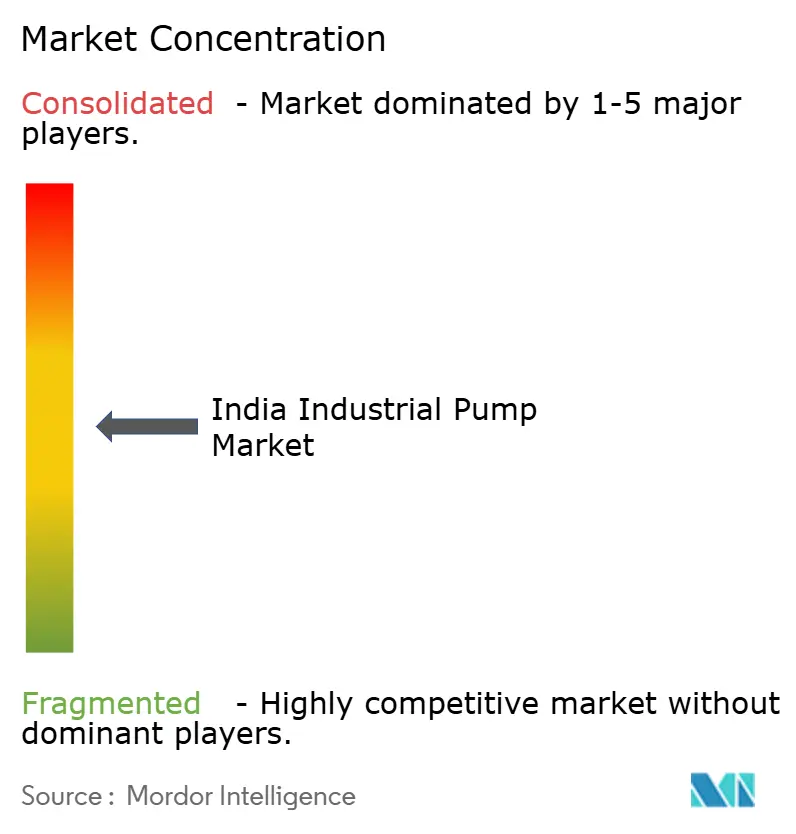
| Market Concentration | Medium |
Major Players *Disclaimer: Major Players sorted in no particular order Image © Mordor Intelligence. Reuse requires attribution under CC BY 4.0. | |
India Industrial Pump Market Analysis by Mordor Intelligence
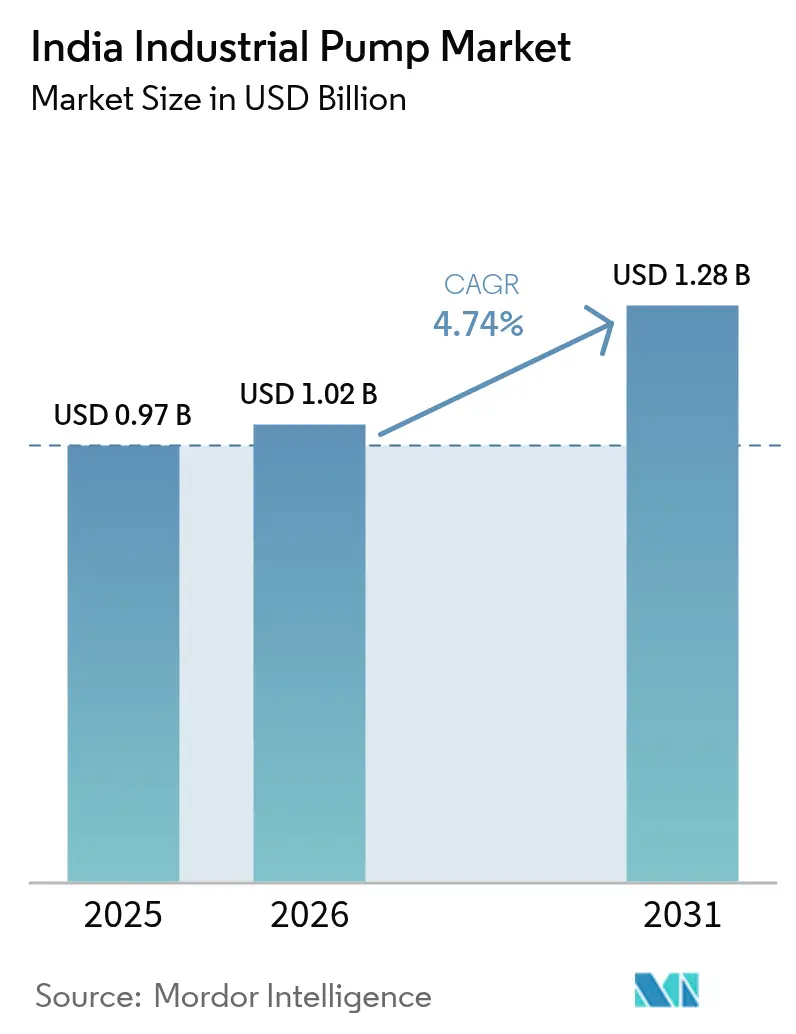
The India industrial pump market size was valued at USD 0.97 billion in 2025 and estimated to grow from USD 1.02 billion in 2026 to reach USD 1.28 billion by 2031, at a CAGR of 4.74% during the forecast period (2026-2031).[1]Ministry of Finance, “Union Budget 2024-25,” INDIABUDGET.GOV.IN The solid growth stems from sustained government capex under the National Infrastructure Pipeline, widening wastewater treatment coverage, and the steady shift toward smart, energy-efficient pumping systems. Centrifugal designs still dominate high-volume applications, yet positive-displacement variants are advancing quickly as specialty chemicals, mining, and refinery upgrades call for precise, high-pressure flow. Solar-powered installations are also scaling, aided by falling photovoltaic costs and industrial decarbonization targets under PM-KUSUM, while volatile steel prices and low-cost Chinese imports continue to weigh on profit margins. Competition hinges on service depth, API 610 compliance, and Industrial IoT integration, all of which favour incumbents with R&D and nationwide after-sales networks.
Key Report Takeaways
- By pump type, centrifugal models held 65.02% of the India industrial pump market share in 2025, whereas positive-displacement pumps are projected to post a 6.79% CAGR through 2031.
- By end-user, water and wastewater treatment captured 28.86% of the India industrial pump market size in 2025, while mining is expected to expand at a 7.18% CAGR to 2031.
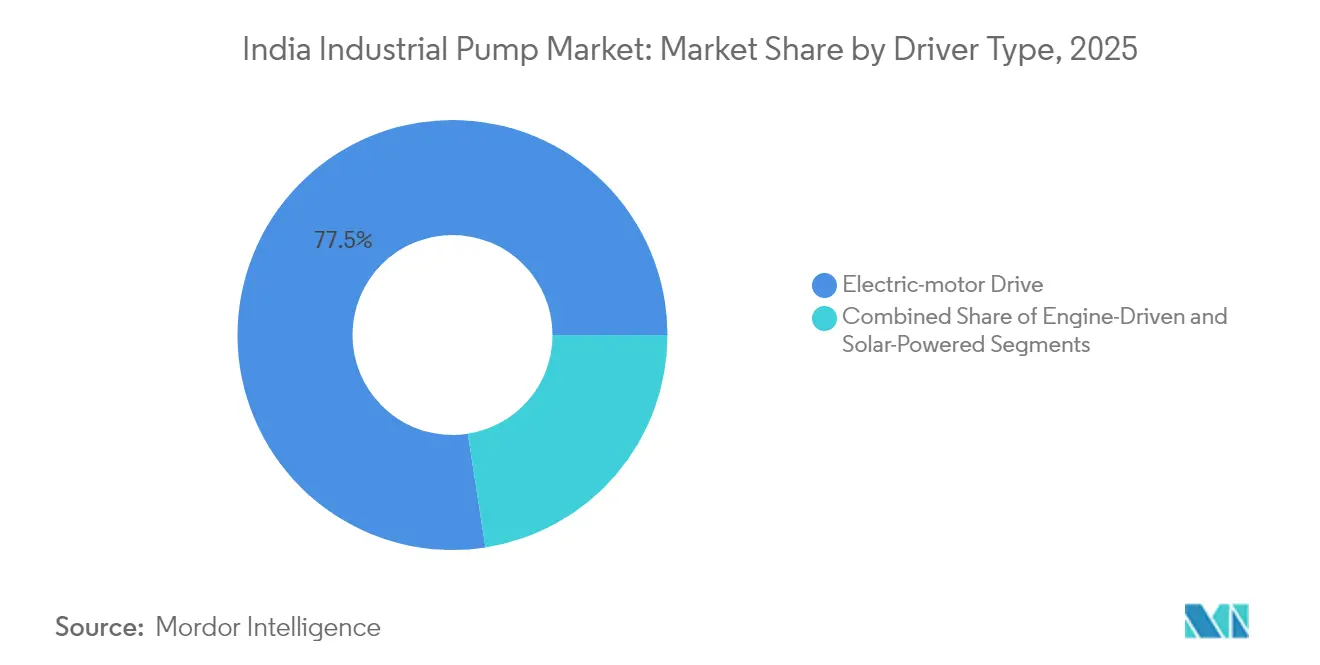
- By driver type, electric-motor units commanded 77.45% of the 2025 value, yet solar-powered systems are on track for an 10.75% CAGR through 2031.
- By installation, surface pumps accounted for 57.52% of 2025 demand; submersible variants are forecast to grow at a 7.28% CAGR between 2026 and 2031.
Note: Market size and forecast figures in this report are generated using Mordor Intelligence’s proprietary estimation framework, updated with the latest available data and insights as of 2026.
India Industrial Pump Market Trends and Insights
Drivers Impact Analysis*
| Driver | (~) % Impact on CAGR Forecast | Geographic Relevance | Impact Timeline |
|---|---|---|---|
| Government cap-ex under National Infrastructure Pipeline (NIP) | +1.20% | National, with concentration in Gujarat, Maharashtra, Tamil Nadu | Medium term (2-4 years) |
| Rapid expansion of wastewater treatment capacity | +0.90% | National, with early gains in Mumbai, Delhi, Bangalore | Short term (≤ 2 years) |
| Brown-field expansion in Indian refineries | +0.70% | Gujarat, Maharashtra, Odisha, Assam | Medium term (2-4 years) |
| Increasing solar-powered pump installations in industries | +0.80% | Rajasthan, Gujarat, Karnataka, Uttar Pradesh | Long term (≥ 4 years) |
| Shift toward API 610/ISO 13709-compliant pumps | +0.50% | National, with focus on petrochemical clusters | Medium term (2-4 years) |
| Industrial IoT-enabled predictive-maintenance adoption | +0.60% | National, with early adoption in automotive, chemicals | Long term (≥ 4 years) |
| Source: Mordor Intelligence | |||
Government Capex Under the National Infrastructure Pipeline Accelerates Industrial Pump Demand
The INR 111 lakh crore National Infrastructure Pipeline (NIP) earmarked through 2025 has permanently changed pump procurement behaviour by embedding digital-performance requirements in every new utility, refinery upgrade, and industrial park. Public-private partnerships now expect suppliers to guarantee uptime metrics, pushing vendors to bundle Industrial IoT sensors, API 610 compliance, and long-term service contracts. Paradip refinery’s INR 24,000 crore brown-field project illustrates the new norm, specifying remote diagnostics and predictive-maintenance dashboards with every pump skid. The model favours enterprises that maintain nationwide service crews and cloud-ready control platforms while elevating entry barriers for low-spec imports lacking data gateways or standardized protocols. As NIP disbursements progress, centrifugal pump retrofits give way to condition-based replacements, sustaining aftermarket revenue even after capital outlays taper.
Rapid Expansion of Wastewater Treatment Capacity Drives Specialized Pump Requirements
Wastewater coverage is slated to reach 70% by 2030 from 37% in 2024, triggering record procurement of corrosion-resistant, solids-handling pumps rated above 75% efficiency. Mumbai Metropolitan Region alone has budgeted INR 25,000 crore for decentralized sewage lifting and sludge dewatering, demanding more than 2,000 precision pumps able to operate unattended in corrosive environments. Operators now stipulate variable-frequency drives to match fluctuating influent loads, creating premium niches for manufacturers with metallurgy know-how and VFD bundles. Tightened Central Pollution Control Board norms further elevate demand for real-time monitoring and redundancy, placing centrifugal offerings with leak-free magnetic drives at a competitive edge.
Brown-field Expansion in Indian Refineries Creates High-Value Pump Opportunities
Over INR 1.2 lakh crore in refinery upgrades through 2030 aims to process heavier crudes and integrate petrochemical chains, raising call-offs for API 610-compliant, high-temperature pumps. Kochi’s 400-pump revamp underscores a shift toward modular packages that fit narrow maintenance windows and tackle variable viscosities. Vendors with rapid-deployment skids, exotic metallurgy, and redundant seal designs win bids as reliability overrides upfront cost. Advanced control logic that optimizes energy draw under fluctuating feedstock qualities is becoming standard, strengthening the position of suppliers offering turnkey automation.
Increasing Solar-Powered Pump Installations Transform Industrial Energy Economics
Industrial solar pump orders crossed the 12,500-unit mark in 2024 after Shakti Pumps won Uttar Pradesh’s INR 450 crore bid. Component-C of PM-KUSUM injects INR 17,500 crore to subsidize rooftop and ground-mount arrays, driving adoption in textile, food, and metals processing plants seeking sub-4-year paybacks. Differing from agricultural kits, industrial solutions require higher head, grid-sync inverters, and battery buffers for peak-shaving. Consequently, pump makers with in-house PV engineering and single-vendor warranties corner the fast-growing segment and lock in aftermarket parts.
Restraints Impact Analysis*
| Restraint | (~) % Impact on CAGR Forecast | Geographic Relevance | Impact Timeline |
|---|---|---|---|
| Import surge of low-cost Chinese pumps | -0.80% | National, with higher impact in price-sensitive segments | Short term (≤ 2 years) |
| High total cost of ownership (energy + maintenance) | -0.60% | National, with focus on energy-intensive industries | Medium term (2-4 years) |
| Volatility in steel and copper prices | -0.40% | National, affecting all manufacturers | Short term (≤ 2 years) |
| Lengthy approval cycles in public sector projects | -0.50% | National, with higher impact in infrastructure projects | Long term (≥ 4 years) |
| Source: Mordor Intelligence | |||
Import Surge of Low-Cost Chinese Pumps Pressures Domestic Market Dynamics
Chinese models undercut domestic equivalents by 30-40%, capturing commodity water and HVAC orders and compressing gross margins. Shorter lead times and flexible credit terms lure SMEs, compelling Indian producers to automate fabrication and trim overhead. However, inconsistent after-sales service and spares unavailability offer incumbents a service-oriented counterpunch, especially as the Bureau of Indian Standards tightens ISI enforcement.
High Total Cost of Ownership Constrains Market Expansion in Energy-Intensive Applications
Industrial tariffs averaged INR 6.5 per kWh in 2024, pushing lifecycle economics to the fore. Pumps in textiles and chemicals can soak up 15-20% of production expenses, making energy labels and VFD readiness critical. Smaller factories balk at the premium for high-efficiency models even though predictive maintenance tools promise downtime reductions. The resulting volume shift toward mid-efficiency lines dampens revenue growth until tariff reforms or incentive schemes soften paybacks.
*Our forecasts treat driver/restraint impacts as directional, not additive. The impact forecasts reflect baseline growth, mix effects, and variable interactions.
Segment Analysis
By Pump Type: Centrifugal Dominance Faces Positive-Displacement Challenge
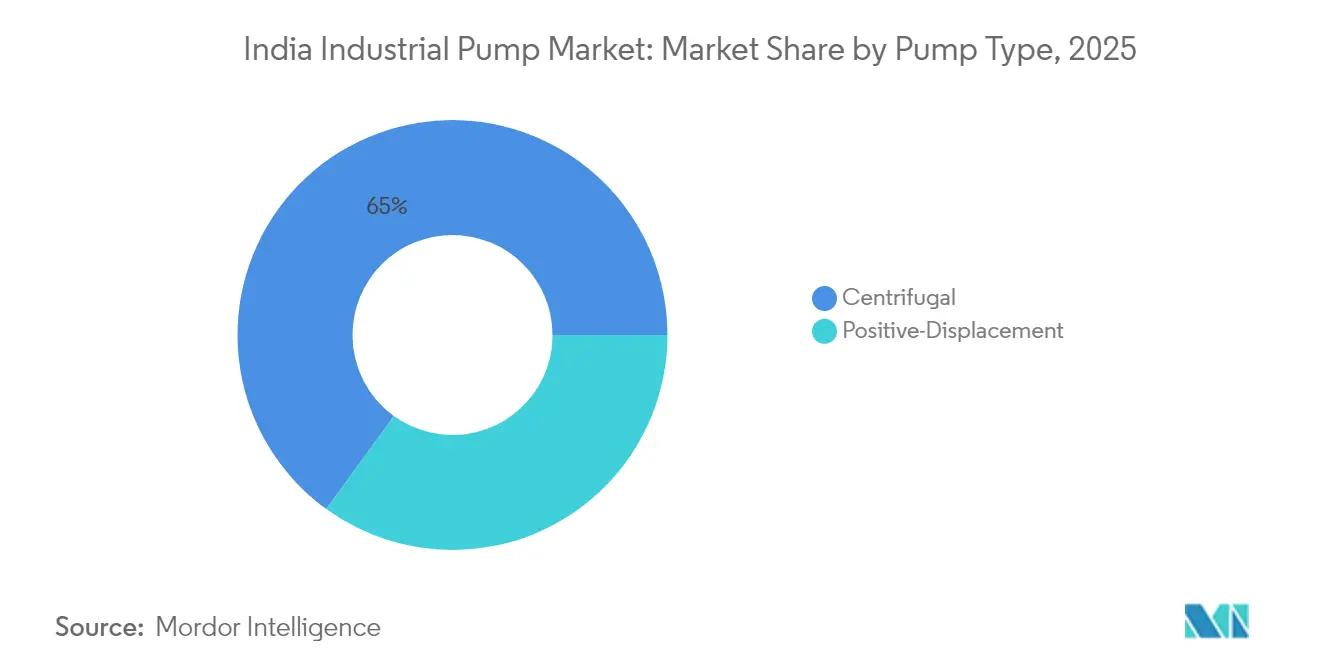
Centrifugal models commanded 65.02% of 2025 revenue of the India industrial pump market size, because they efficiently move large flows at moderate heads in water, cooling, and general process loops. Positive-displacement pumps, though only 34.98% of shipments, are set for a 6.79% CAGR by 2031, outstripping centrifugal’s 3.95% pace as specialty chemical and pharma customers demand precise metering under variable viscosities. Vendors are closing the gap by adding magnetic drives and ceramic bearings to centrifugal lines, while PD makers push higher-speed, compact skids for brown-field retrofits. IoT retrofits blur lines further, letting operators benchmark efficiency in real time and switch technologies based on duty cycle analytics. Over the forecast, centrifugal unit volumes will still dwarf PD counts, yet PD value share will rise on premium pricing for exotic alloys and seamless architectures that curb fugitive emissions.



By End-User Industry: Mining Surge Reshapes Demand Patterns
Water and wastewater accounted for 28.86% of the India industrial pump market share in 2025 on the back of Jal Jeevan and urban STP investments valued above INR 3.6 lakh crore. Mining, though only 8.40% of current sales, leads with a 7.18% CAGR as Coal India and steel majors increase mechanized output. Dewatering, slurry, and tailings lines call for abrasion-resistant elastomers and duplex stainless steels, lifting ASPs. Oil and gas remain a steady buyer through refinery upgrades, while chemicals leverage import-substitution policies to spur PD pump adoption. Regional clusters such as Chhattisgarh iron-ore belts or Odisha chromite pits will show double-digit spends, whereas mature thermal power plants mostly allocate capex for replacements rather than expansions.
By Driver Type: Solar Revolution Transforms Energy Landscape
Electric-motor systems formed 77.45% of 2025 shipments, aided by grid reliability in western and southern industrial corridors. Nevertheless, solar pump arrays are racing ahead, set to cross 9% share by 2031 as the India industrial pump industry pivots to onsite renewables. Falling module prices, MNRE subsidies, and stringent ESG audits spur breweries, dairies, and auto OEMs to install hybrid solar-battery packages. Engine-driven units, historically popular for remote mines and standby firefighting, will slip below a 10% share as diesel prices exceed INR 100 per liter and emission norms tighten. Hybrid diesel-solar solutions may emerge in off-grid mines, yet pure solar is expected to outstrip them once battery costs sink another 20%.
By Installation: Submersible Growth Reflects Space Constraints
Surface pumps held 57.52% of billings in 2025, yet city-fringe real-estate premiums and deeper borewells are lifting submersible sales at a 7.28% CAGR. Metro-area factories prefer submersibles for noise abatement and smaller footprints, while mining dewatering benefits from motors located underwater for better cooling. Advanced seal rings and high-chrome casings resolve past reliability doubts, and IoT sensors now relay motor temp and vibration even when submerged. Surface designs maintain relevance where easy maintenance trumps space, particularly in mega-capacity desal plants. The choice increasingly hinges on total installed cost: submersibles tally higher hardware but lower civil works, whereas surface units flip the equation.
Geography Analysis
Gujarat and Maharashtra absorbed 34.62% of 2025 shipments owing to petrochemical giant complexes at Jamnagar and the Pune-Mumbai auto belt. The India industrial pump market in southern states is the fastest growing at 6.05% CAGR to 2031 as Tamil Nadu electronics clusters and Karnataka’s clean-energy hubs demand precision pumps and utility upgrades. Northern states led by Uttar Pradesh and Haryana draw capex from the Delhi-Mumbai Industrial Corridor, funnelling pump orders for effluent treatment and cooling water loops. Eastern territories such as Odisha log healthy mining-related demand but lag in basic infrastructure, capping growth. Electricity tariffs and state pollution norms shape purchasing, strict discharge limits in Maharashtra tilt demand toward corrosion-resistant PD pumps, while relaxed standards in some eastern pockets keep commodity centrifugal units viable. Emerging industrial parks in Rajasthan and Madhya Pradesh offer long-run upside as they court manufacturing diversification away from coastal congestion.
Regulatory Landscape
India industrial pump compliance is increasingly shaped by mandatory product quality and safety requirements administered by the Bureau of Indian Standards (BIS). The Pumps (Quality Control) Order, 2023 designates BIS as the certifying and enforcing authority for specified pump categories, raising the importance of Indian Standard compliance and ISI marking for market access, alongside buyer-driven requirements such as API 610/ISO 13709 in hydrocarbons and process industries.
On the trade side, import conditions for pump-related machinery have seen additional administrative scrutiny through Ministry of Commerce and Industry actions, including DGFT Notification No. 40/2025-26 (effective November 1, 2025), which amended import policy conditions for certain items under Chapter 84. Parallel discussions around machinery safety standardization, including the Machinery and Electrical Equipment Safety Omnibus Technical Regulations Order, 2024 (draft/reference), reinforce a tighter direction for conformity, documentation, and traceability across liquid-handling equipment and assemblies.
Competitive Landscape
The India industrial pump market displays moderate fragmentation: the top five suppliers control roughly 45%, assigning a 6/10 concentration score. Domestic stalwarts Kirloskar Brothers, CRI, and Shakti Pumps collectively hold close to 25%, leveraging price agility and dense service depots. Multinationals KSB, Grundfos, and Xylem command another 20% by offering API 610-ready skids and advanced analytics platforms. Chinese imports seize share in standard water applications but struggle in lifecycle tenders that mandate service guarantees. Strategic differentiators now include remote diagnostics, energy-efficiency certifications, and turnkey solar integration. Kirloskar’s FY25 profit jump of 89.88% reflects its pivot to high-margin refinery retrofits, while Grundfos and Xylem intensify IoT rollouts targeting OPEX savings. Solar-centric Shakti Pumps is capitalizing on PM-KUSUM orders, whereas V-Guard’s 2025 entry signals impending price battles in mid-duty segments. The race to localize exotic alloys and integrate additive-manufactured impellers may redraw market lines by 2030.[4]ABB, “Water company in Brazil gets 25% energy savings and better uptime,” NEW.ABB.COM
India Industrial Pump Industry Leaders
Usha International Limited
Crompton Greaves Consumer Electricals Limited
CRI Pumps Pvt. Ltd.
Grundfos AS
Kirloskar Brothers Limited
- *Disclaimer: Major Players sorted in no particular order

Market Opportunities and Future Outlook
Opportunity is clustering around delivery reliability, localized customization, and lifecycle services for specialized duties, supported by continued investments in domestic manufacturing and engineering capability. In January 2026, Kirloskar Brothers Limited inaugurated a new factory building at its Kaniyur facility in Tamil Nadu to enhance productivity and incorporate sustainability measures, reflecting capacity alignment with higher-spec applications that increasingly bundle performance guarantees and digital monitoring.
Capability-led growth is also visible in niche pump technologies for complex fluids and continuous-process industries, where lead times and application engineering often influence vendor selection as much as price. In March 2026, NETZSCH Pumps and Systems inaugurated a new production facility in Goa on a 45,000 square meter site, doubling local manufacturing capacity for progressing cavity, rotary lobe, multi-screw, and peristaltic pumps. These investments sit alongside demand pull from wastewater expansion, refinery brownfield upgrades, and solar-integrated pumping packages under programs such as PM-KUSUM, creating room for suppliers that can deliver complete skids with controls, instrumentation, and service networks rather than standalone pump supply.
Recent Industry Developments
- July 2026: Kirloskar Brothers Limited, through its UK subsidiary SPP Pumps Ltd, secured a GBP 11.7 million contract from Saipem for vertical pumps and spare parts. The win expands KBL's exposure to engineered vertical pump packages and strengthens its position in international EPC project supply chains.
- August 2025: CRI Pumps received an order from Maharashtra State Electricity Distribution Company Limited (MSEDCL) to supply 10,714 off-grid DC solar pumping systems under PM-KUSUM and Magel Tyala Saur Krushi Pump schemes. The order highlights government program-led growth in solar pumping and expands CRI Pumps' service footprint and installation scale.
- December 2024: CRI Pumps expanded its Coimbatore plant capacity by about 30 percent to increase API 610 certified manufacturing capability. The expansion supports higher spec pump supply to refinery and process segments where metallurgy, documentation, and compliance are critical.


Research Methodology Framework and Report Scope
Market Definition and Coverage
For this methodology, the India industrial pump market covers revenue generated from pumps sold for industrial and infrastructure fluid-handling duties within India, counted when the equipment is intended for industrial end users and projects.
Scope exclusions: We exclude purely household pumping and do not count agriculture-only irrigation pump demand unless the unit is specified and sold as an industrial-grade pump for industrial use cases.
Segmentation Overview
- By Pump Type
- Centrifugal
- Positive-Displacement
- By End-user Industry
- Oil and Gas
- Water and Wastewater
- Chemicals and Petrochemicals
- Power Generation
- Mining
- Other End-User Industry
- By Driver Type
- Electric-motor Driven
- Engine-Driven (Diesel/CNG)
- Solar-Powered
- By Installation
- Surface Pumps
- Submersible Pumps
Data Sources, Market Sizing, and Validation
Desk Research
Desk work started with building a clean demand map for where pumps get installed in India, and then linking it to public indicators that move each year. We relied on sources such as India's Ministry of Statistics and Programme Implementation for industrial output context, Central Water Commission and Central Pollution Control Board for water and wastewater activity, and the Directorate General of Commercial Intelligence and Statistics trade statistics to sanity-check import and export direction.
To keep assumptions grounded, we also used pump and process-equipment association publications and standards references, plus listed-company annual reports, investor presentations, and credible business press. These were used to understand capacity additions, replacement cycles, and pricing pressure. Where available, paid subscriptions covering company financials and another covering shipment-level import and export records were used as supporting checks for revenue ranges and product mix signals. These examples are illustrative only, and many other public and subscription sources were also used for data collection, validation, and research clarification.
Primary Interviews and Surveys
Primary discussions were used to convert high-level indicators into sizing inputs, especially where public data stays aggregated. We spoke with participants across manufacturing, distribution, and large end-user industries in India, so pricing, specification mix (surface vs submersible, centrifugal vs positive displacement), and replacement timing assumptions could be confirmed and adjusted where needed.
Distribution of primary research fieldwork respondents
| Company type | Respondent position |
|---|---|
| Top tier: 29% | CXOs: 13% |
| Mid tier: 50% | Functional/Unit leaders: 42% |
| Smaller Players: 21% | Managers: 45% |
Market-Sizing & Forecasting
Sizing began with a top-down build that reconstructs the addressable demand pool from India's industrial activity and project-led spending, and then narrows it to pump-relevant categories such as water and wastewater, oil and gas, chemicals, mining, and power. Where the macro build was ready, we checked it with selective bottom-up approximations, including sampled average selling price ranges by pump type and installation type, and then stress-tested the totals using channel feedback on volumes and replacement intensity.
A few variables mattered most in the model, and they were treated explicitly so the math stays traceable. These include investment pace in wastewater treatment and industrial water reuse, refinery and chemical capacity additions, thermal and renewables-linked balance-of-plant spending that pulls pumping equipment, mining output direction, and the shifting mix between electric-motor driven, engine-driven, and solar-powered pumping in industrial and infrastructure contexts. Forecasting used scenario analysis supported by expert consensus on capital spending cadence and price movement, followed by annual smoothing so one-off project spikes do not overstate the trend. When bottom-up checks had coverage gaps, we applied conservative uplift factors guided by interview inputs and then re-ran sensitivity cases on price and utilization to keep totals within realistic bounds.
Data Validation & Update Cycle
Outputs were validated by comparing implied market totals with independent signals such as trade direction, announced project pipelines, and the expected replacement share in mature industrial facilities in India. We also ran variance checks across end-user industries and pump categories, so unusually high growth in one pocket is questioned and corrected before it reaches the final number.
Before sign-off, the model and key assumptions are reviewed in more than one internal pass, and respondents are re-contacted when pricing, lead times, or policy changes create a visible break from prior trends. The report is refreshed annually, and interim updates are made when material events occur. Right before delivery, a final data sweep is completed so clients receive the latest view aligned to the most recent public signals.
Mordor Intelligence's India Industrial Pump Market Size Compared With Other Published Estimates
It is common to see different published market sizes for industrial pumps in India, even when the topic label looks similar. Most of the spread usually comes from how the market is defined, which years are used as the base, and how prices and volumes are converted into USD.
The main gap comes from whether the estimate mixes industrial pumps with broader pump demand such as agriculture, residential, and small commercial use, and from how solar-powered pumping is counted across use cases. By keeping scope tied to industrial and infrastructure end uses and by treating solar-powered units as in-scope only when they are sold for industrial-grade duties, Mordor Intelligence avoids inflating totals with adjacent pump categories that follow a different buying cycle.
Benchmark comparison
| Source | Market Size | Gaps in Research Methodology |
|---|---|---|
| Mordor Intelligence | USD 0.97 B (2025) | |
| Trade Journal A | USD 1.14 B (2028) | Uses a forward-year point estimate and limited scope detail, so it is harder to confirm which industrial-only use cases are included and how average selling prices were moved to USD over time. |
| Industry Publisher B | USD 2.90 B (2024) | Appears to cover the total India pump market across industrial, agricultural, commercial, and residential segments, which naturally produces a larger number than an industrial-only market definition. |
The comparison shows that the widest differences are explained first by scope choices, then by timing choices such as which year is used and how price progression is handled. With clearly stated inclusions, repeatable demand indicators, and cross-checks against trade and project signals, our estimate stays easier to trace back to what is actually purchased for industrial use in India.


Key Questions Answered in the Report
What is the forecast value of the India industrial pump market in 2031?
The market is projected to reach USD 1.28 billion by 2031 based on a 4.74% CAGR.
Which pump type currently holds the largest share?
Centrifugal pumps account for 65.02% of 2025 revenue due to versatility in water and process duties.
Which end-user segment will grow the fastest through 2031?
Mining is expected to register a 7.18% CAGR as coal and iron-ore projects expand mechanization.
How fast are solar-powered pumps growing?
Solar-powered installations are projected to advance at an 10.75% CAGR through 2031 as firms pursue renewable energy savings.
Which regions are driving the highest demand?
Gujarat and Maharashtra lead with 34.62% combined share, while Tamil Nadu and Karnataka are the fastest expanding at a 6.05% CAGR.
What factors most influence purchasing decisions?
Lifecycle energy costs, API 610 compliance, and Industrial IoT readiness are the top criteria for industrial buyers.
Page last updated on:


 Your data is secure and never sold or shared.


