
Market Overview
| Study Period | 2020 - 2031 |
|---|---|
| Forecast Data Period | 2026 - 2031 |
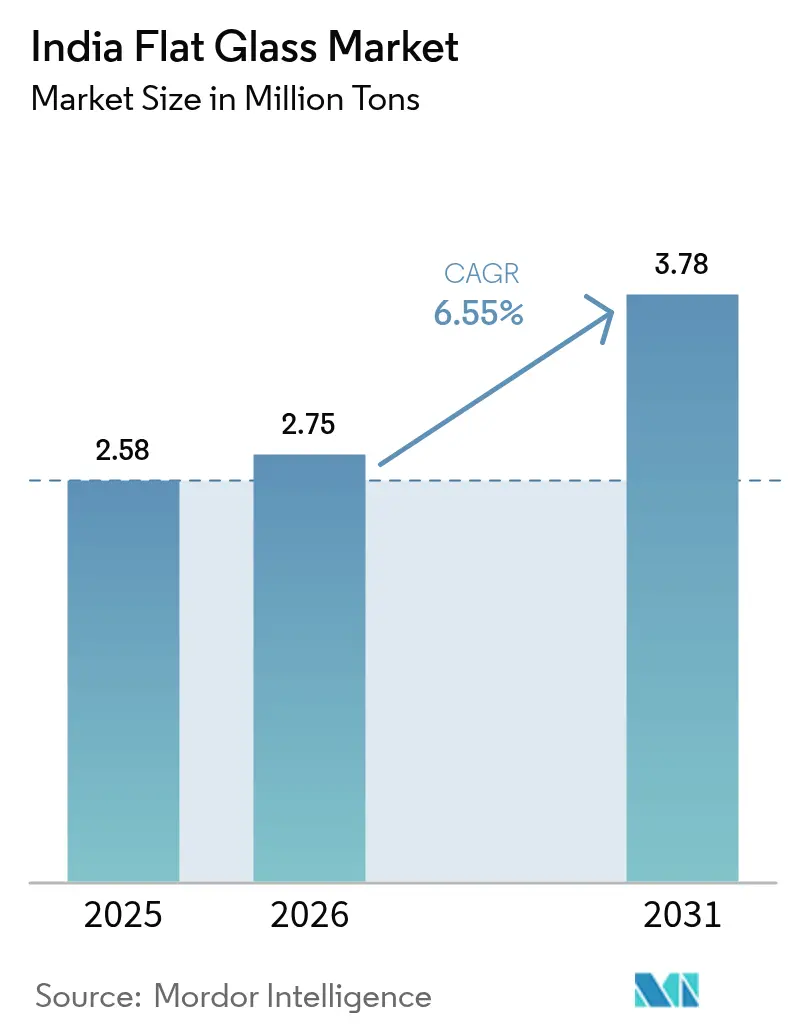
| Base Year Market Size (2025) | 2.58 Million tons |
| Market Volume (2026) | 2.75 Million tons |
| Market Volume (2031) | 3.78 Million tons |
| Growth Rate (2026 - 2031) | 6.55 % |
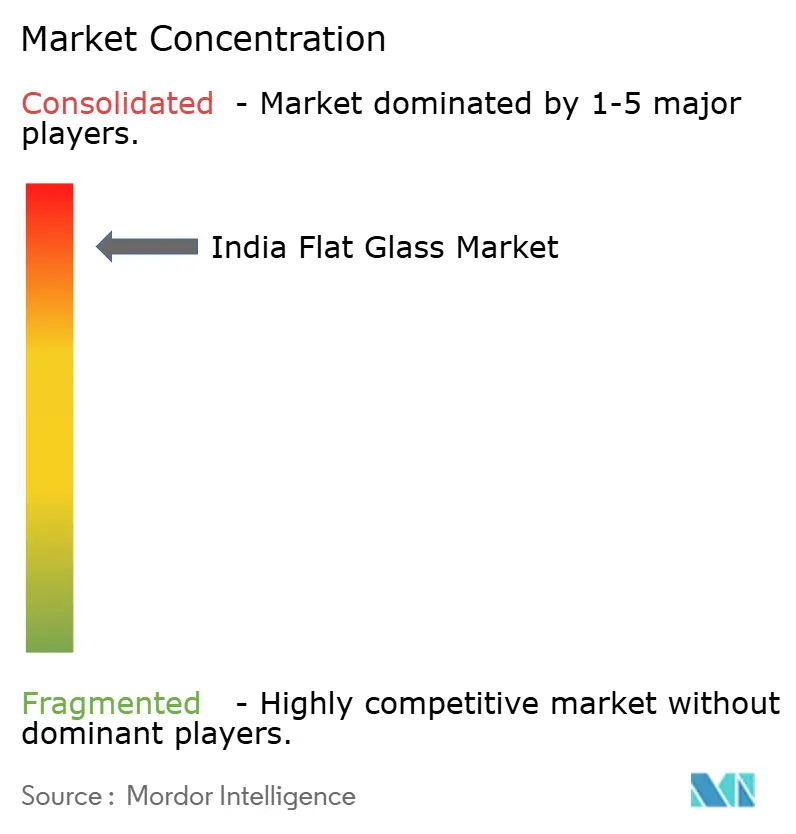
| Market Concentration | High |
Major Players *Disclaimer: Major Players sorted in no particular order Image © Mordor Intelligence. Reuse requires attribution under CC BY 4.0. | |
India Flat Glass Market Analysis by Mordor Intelligence
The India Flat Glass Market size is expected to grow from 2.58 million tons in 2025 to 2.75 million tons in 2026 and is forecast to reach 3.78 million tons by 2031 at 6.55% CAGR over 2026-2031. Urbanization, large-scale infrastructure projects, and government incentives aimed at renewable energy deployment collectively underpin this volume-driven expansion of the India flat glass market. Developers of commercial real estate in tier-1 and tier-2 cities increasingly specify energy-efficient facade systems to comply with evolving building codes, while global automotive OEMs continue to scale up output from India-based plants, keeping glazing demand on an upward trajectory. Domestic manufacturers are adding new float lines and processed-glass capacities to correct a supply-demand gap that left the India flat glass market reliant on USD 236 million of net imports in 2022. At the same time, high natural-gas costs and volatility in soda-ash supply keep pressure on margins, forcing industry players to adopt fuel-mix optimization and forward-buying strategies. The interplay of rising demand and input-cost stress is accelerating the shift toward high-value processed glass, which commands stronger pricing power and has become the strategic focus for most large plants.
Key Report Takeaways
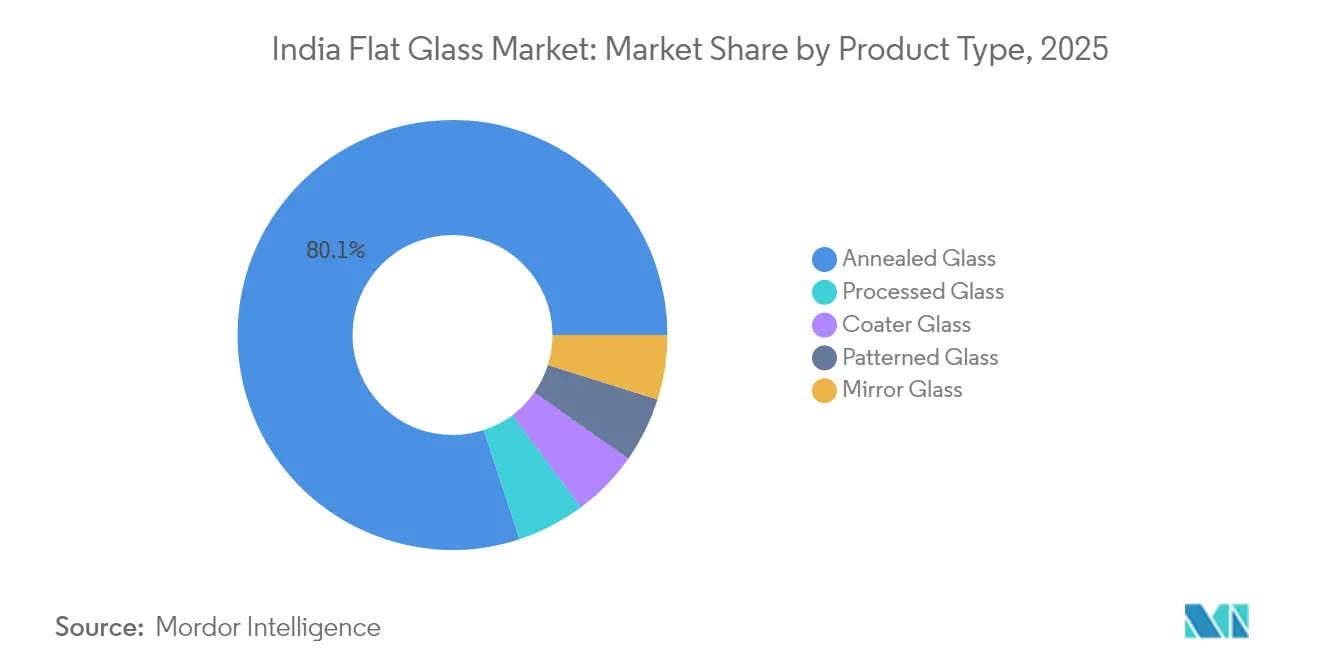
- By product type, annealed glass led with an 80.05% India flat glass market share in 2025, whereas processed glass is forecast to register the fastest 7.05% CAGR through 2031.
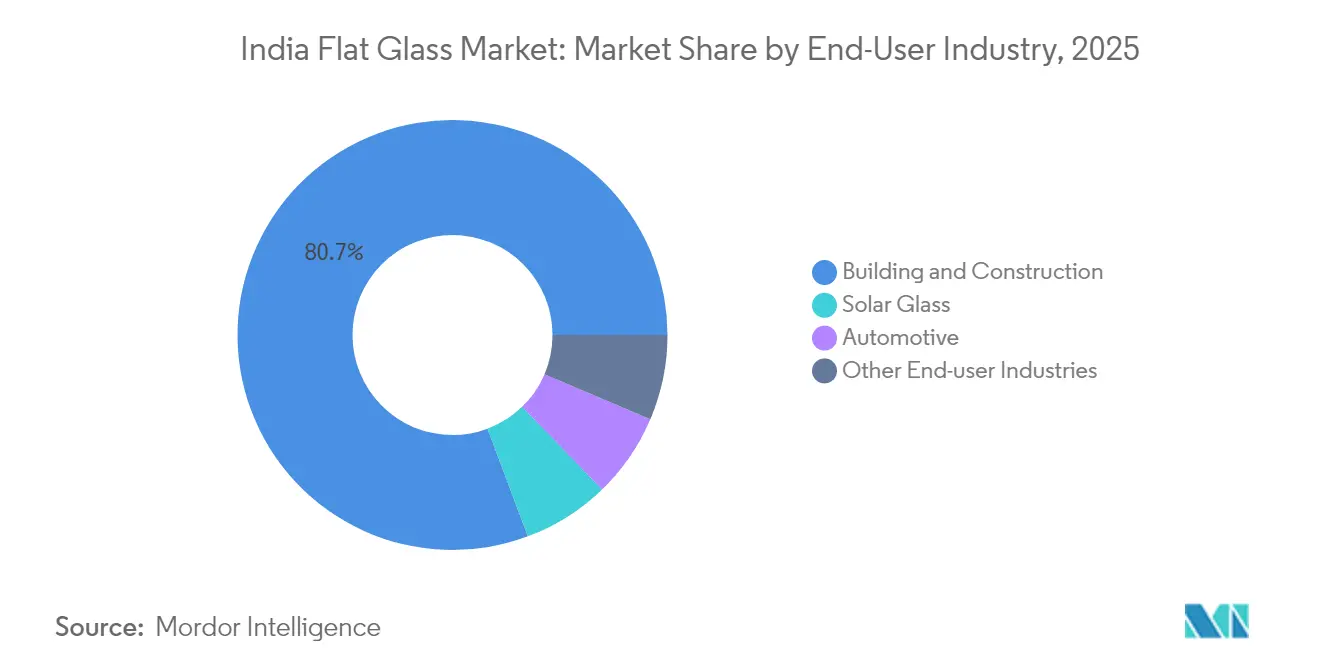
- By end-user industry, building and construction captured 80.70% of the India flat glass market size in 2025, while solar glass is advancing at an 8.55% CAGR toward 2031.
Note: Market size and forecast figures in this report are generated using Mordor Intelligence’s proprietary estimation framework, updated with the latest available data and insights as of 2026.
Market Trends and Insights
Drivers Impact Analysis of India Flat Glass Market*
| Driver | (~) % Impact on CAGR Forecast | Geographic Relevance | Impact Timeline |
|---|---|---|---|
| Urban infrastructure boom and Smart Cities push | +1.80% | Mumbai, Chennai, Bengaluru, Hyderabad | Medium term (2-4 years) |
| Automotive glazing demand from rising vehicle production | +1.20% | Gujarat, Tamil Nadu, Maharashtra automotive corridors | Short term (≤ 2 years) |
| National solar-PV targets spurring solar glass capacity | +2.10% | Gujarat, Rajasthan, Tamil Nadu | Long term (≥ 4 years) |
| Data-centre construction driving high-performance facade glass | +0.90% | Mumbai, Chennai, Bengaluru, Hyderabad | Medium term (2-4 years) |
| PLI schemes for electronics propelling speciality display glass | +0.70% | Tamil Nadu, Karnataka | Long term (≥ 4 years) |
| Source: Mordor Intelligence | |||
Urban Infrastructure Boom & Smart Cities Push
India’s Smart Cities Mission has approved 8,016 projects worth INR 1.64 trillion, which is translating into large procurement lots for low-emissivity, solar-control, and laminated facades that reduce HVAC load in public and private buildings. Policy mandates for green ratings have expanded specification depth, compelling architects to select glazing solutions with certified U-values and visible-light-transmittance benchmarks. Domestic contractors now tender facade packages earlier in project cycles, giving glass processors longer visibility of order pipelines and supporting capacity planning. As smaller municipalities replicate smart-city guidelines to draw investment, demand for certified glass spreads beyond major metros. International consortium partners from Europe and Japan transfer cutting-edge facade engineering know-how, nudging local processors toward triple-silver coatings and warm-edge spacer technologies that once were confined to premium offices. This diffusion of best practice heightens competitive pressure on legacy float-line operators to upgrade to magnetron sputtering or outsource coating to specialist toll coaters.
National Solar-PV Targets Spurring Solar Glass Capacity
India targets 500 GW of non-fossil power by 2030, of which solar constitutes the largest share, generating durable offtake for anti-reflective patterned glass used in photovoltaic modules. Anti-dumping duties on Chinese imports shield domestic players during scale-up, allowing them to pass through soda-ash cost spikes. Technological upgrades such as dual-textured rolling and online pyrolytic coating boost light transmission above 93%, enabling module efficiencies that rival imported glass. Manufacturers also integrate tin-bath waste-heat recovery to shave fuel costs and lower Scope 1 emissions. Export prospects brighten as Indian modules penetrate U.S. and European markets that require traceable, low-carbon glass inputs. Consequently, the India flat glass market gains a high-growth specialty branch that buffers against cyclicality in construction demand.
Data-Centre Construction Driving High-Performance Facade Glass
Hyperscale providers plan roughly 500 MW of new server capacity in Mumbai, Chennai, Bengaluru, and Hyderabad through 2029, each facility mandating facades that optimize daylight while holding stringent thermal transmittance and electromagnetic shielding thresholds[1]. Curtain-wall contractors order double-silver low-E, low-iron units paired with argon-filled cavities to cut cooling loads that consume up to 60% of data-center energy. Blast-resistant laminated configurations are also specified to protect critical assets. Indian processors respond by installing jumbo-size tempering furnaces and autoclaves that accommodate 3.3 m × 6 m lites, aligning with global hyperscale specifications. Smart-glass solutions integrating electro-chromic coatings move from pilot to commercial scale in a few data centers, signaling an emerging demand pocket. As operators pursue net-zero certifications, facade glass suppliers leverage Environmental Product Declarations to differentiate bids, embedding sustainability metrics into competitive dialogues.
PLI Schemes for Electronics Propelling Specialty Display Glass
Government incentives worth INR 38,000 crore under the electronics PLI program spur investment in mobile, laptop, and display plants located primarily in Tamil Nadu and Karnataka manufacturing clusters. Thin-rolled alkali-aluminosilicate substrates are critical to these value chains, prompting flat-glass producers to install down-draw fusion and overflow fusion lines historically absent in India. Tight dimensional tolerances and surface-defect thresholds under 5 microns drive adoption of automated optical inspection and Class-100 cleanrooms. As integrated display fabs reach commercial throughput, local glass suppliers capture import substitution demand and mitigate currency exposure for downstream device makers. Over the long term, the specialization channel enriches the product mix of the India flat glass industry, raising average realization per ton and insulating revenue streams from construction cycles.
Restraints Impact Analysis of India Flat Glass Market*
| Restraint | (~) % Impact on CAGR Forecast | Geographic Relevance | Impact Timeline |
|---|---|---|---|
| Volatile prices of soda ash and natural gas | -1.40% | National, with higher impact on Gujarat, Maharashtra production centers | Short term (≤ 2 years) |
| Stringent emission norms elevating compliance costs | -0.80% | National, particularly affecting older manufacturing facilities | Medium term (2-4 years) |
| High inbound freight for heavy float glass across regions | -1.10% | National, with higher impact on inland states like Madhya Pradesh, Rajasthan, Uttar Pradesh distant from production hubs | Short term (≤ 2 years) |
| Source: Mordor Intelligence | |||
Volatile Prices of Soda Ash & Natural Gas
India imported more than 10 million tons of soda ash in FY 2024 to supplement domestic output of 2.5 million tons, exposing glassmakers to global price swings linked to energy costs and shipping disruptions. A 62% jump in domestic natural-gas prices in 2021 raised furnace-fuel costs, eroding EBITDA margins, especially for legacy float lines with specific-energy consumption above 5 GJ per ton. Manufacturers respond by forward-contracting soda-ash deliveries and blending petcoke or furnace oil when policy allows, though each alternative requires burner and emission-control retrofits. Spot gas volatility also complicates new-capacity project budgeting, prompting some investors to delay final investment decisions. The corresponding working-capital strain increases borrowing needs at a time when interest rates are elevated, pressuring free cash flows and slowing greenfield expansions that would otherwise help resolve domestic supply deficits.
Stringent Emission Norms Elevating Compliance Costs
India’s progressive alignment with global best-available-technology guidelines for glass furnaces requires the installation of baghouse filters, continuous emission monitoring, and low-NOx burners[2]. Plants built before 2010 often lack adequate space or structural provisions for such retrofits, making compliance capital-intensive. Regulatory deadlines spaced over 2025-2028 compel staggered shutdowns for upgrades, temporarily reducing effective capacity and tightening supply. Smaller regional players face the highest risk of shutdown due to limited access to low-cost finance, accelerating industry consolidation. Larger operators embed investments in electric-boosting and oxy-fuel technologies, which can reduce energy intensity by 20% but carry a multi-year payback. While the long-term outcome is cleaner production, near-term capex commitments compress return profiles and may slow the cadence of incremental capacity additions.
*Our forecasts treat driver/restraint impacts as directional, not additive. The impact forecasts reflect baseline growth, mix effects, and variable interactions.
India Flat Glass Market Segment Analysis
By Product Type:
Value-Added Glass Outpaces Basic AnnealedAnnealed Glass retained an 80.05% India flat glass market share in 2025, anchored by its ubiquitous use in residential windows and cost-sensitive commercial builds. The segment’s scale benefits stem from established float-line infrastructure and minimal downstream processing. Yet Processed Glass is set to log a 7.05% CAGR through 2031, ensuring that its slice of the India flat glass market size widens meaningfully over the forecast horizon. Growth stems from the convergence of energy codes, architectural aesthetics, and vehicle-safety norms that require tempering, lamination, or functional coatings. The wider adoption of double-glazed units and solar-control coatings in premium offices drives coated-glass offtake, while mirrored and patterned variants cater to interior applications and decorative facades.
The shift carries strategic implications for margin profiles. Processed-glass realization often doubles the ex-factory price of annealed equivalents, enabling faster return on incremental capex for downstream lines. Several domestic producers now route as much as 45% of float output to their own tempering or lamination facilities, capturing integrated value. The India flat glass industry also observes increased licensing of sputter-coating technology from European firms, unlocking local production of low-E coatings once fully imported. Annealed-glass volumes are expected to persist in mass housing, yet their share gradually declines as code-compliant fenestration becomes mainstream in both new construction and retrofit markets.

By End-User Industry:
Solar Glass Emerges as Fastest-Growing SegmentBuilding and Construction accounted for 80.70% the India flat glass market size in 2025, supported by government spending on metro rail, airports, and commercial towers. Steady urban migration drives residential demand, while corporate space absorption rebounds in major metros, reinforcing baseline growth. Automotive applications provide a stable second pillar, with vehicle production gains feeding demand for safety and solar-control glazing across sedans, SUVs, and trucks. Solar Glass stands out within the renewable space with an 8.55% CAGR through 2031, outpacing all other end-user segments. Protectionist tariffs on imported modules and PLI incentives spur integrated manufacturing, channeling predictable orders to domestic solar-glass makers.
Other industrial users embrace specialty glass in electronics enclosures, appliance doors, and greenhouse agriculture, but their combined volumes remain relatively small. Even so, these niches offer superior margins due to tight tolerance requirements and chemical strengthening processes. As India’s electronics ecosystem matures under Make-in-India, demand for display and cover glass supplies additional impetus to the processed-glass category, reinforcing the broader product-mix upgrade observed within the India flat glass market.
Geography Analysis
The India flat glass market exhibits a pronounced west-to-south corridor in manufacturing capacity, anchored by Gujarat, Maharashtra, and Tamil Nadu. Gujarat hosts multiple float lines leveraging local silica-sand deposits and petrochemical feedstock clusters, supplying construction and automotive customers across western and northern demand centers. Maharashtra complements with downstream processing facilities that cater to the neighboring automotive hubs of Pune and Aurangabad. Tamil Nadu supports integrated complexes near Chennai that feed OEM car plants, electronics parks, and the expanding solar-glass ecosystem.
Northern states like Rajasthan and Uttar Pradesh offer long-term capacity options as Smart-City projects and industrial corridors raise local consumption. The India flat glass market size for northern India remains underserved relative to demand, which has prompted feasibility studies for new float lines closer to Delhi-NCR gateways. Coastal locations with port access, such as Mundra and Ennore, retain strategic relevance, enabling the import of soda ash and the export of processed units to Middle-East and ASEAN customers.
Although India remained a net importer of float glass worth USD 236 million in 2022, several greenfield projects now under construction could shift the balance toward self-sufficiency by 2028. Logistics economics also favor regional clustering, given that finished glass is weighty and prone to breakage, translating into freight costs that can reach 8% of invoice value over distances exceeding 1,000 km. Consequently, manufacturers often locate dispatch warehouses adjacent to primary highways to shrink last-mile risk. Looking ahead, the geographic dispersion of Smart-City developments, covering 100 urban centers, ensures that demand growth will spill beyond traditional metros, fostering the rise of tier-2 consumption nodes that call for agile distribution networks.
Regulatory Landscape
India regulates flat glass quality and market access largely through the Bureau of Indian Standards (BIS) under the BIS Act, 2016, using mandatory Quality Control Orders (QCOs). Under the QCO framework, products such as flat transparent sheet glass and transparent float glass must carry the ISI mark and be covered by BIS certification for manufacture, import, or sale in India, with compliance in force since 1 April 2022. Commonly referenced standards include IS 2835:1987 (flat transparent sheet glass) and IS 14900:2018 (transparent float glass), alongside safety-glass standards used in building and architectural applications.
Trade remedies form the second pillar. The Directorate General of Trade Remedies (DGTR) continues to use anti-dumping and countervailing investigations to address low-priced imports, including actions involving clear float glass supply into India. In November 2025, DGTR recommended extending anti-dumping duties on clear float glass imports from Malaysia for five years. In September 2025, DGTR initiated a countervailing duty investigation into clear float glass imports from Malaysia and Indonesia following petitions from domestic producers (including Şişecam Flat Glass India, Gold Plus Glass Industry, and Saint-Gobain India), reinforcing an environment that favors compliant, locally produced glass.
Value Chain Analysis
The India flat glass value chain starts with raw materials (silica sand, soda ash, limestone/dolomite) and energy inputs, where soda ash sourcing and fuel costs remain key variables for furnace economics. Manufacturing is centered on float lines that produce annealed glass, with a growing linkage to captive or nearby downstream processing for tempering, lamination, and coatings to meet higher-specification architectural and automotive requirements. The supply side is concentrated among large integrated players and established processors, including Saint-Gobain Glass India, Asahi India Glass (AIS), and other processors serving regional construction and industrial demand.
Downstream, distribution typically splits between direct supply to OEMs (notably automotive), project-based supply through facade and glazing contractors in building and construction, and retail or service networks supporting replacement demand. Trade-defense measures shape import competition as well, especially in processed categories: the Ministry of Finance issued Notification No. 11/2025-Customs (ADD) on 8 May 2025 imposing anti-dumping duties on textured tempered glass from China PR and Vietnam, and Notification No. 03/2025-Customs (CVD) dated 10 May 2025 imposing countervailing duties on the same category from Vietnam. These actions support domestic processors and encourage more local conversion of float output into value-added products.
Competitive Landscape
The India flat glass market is highly consolidated. Global majors Saint-Gobain, Guardian Industries Holdings, and Şişecam lead premium architectural and automotive niches through scale float lines, sputter-coating facilities, and robust R&D pipelines. Domestic leader Asahi India Glass (AIS) leverages entrenched OEM relationships to dominate passenger-vehicle glazing, while Borosil Renewables has carved out a stronghold in solar-glass manufacturing and is now pursuing international acquisitions to triple capacity. Gold Plus, Hindustan National Glass, and several mid-sized processors target region-specific construction markets with competitively priced annealed and tempered offerings.
Strategic moves emphasize vertical integration and energy efficiency. Borosil Renewables channels INR 950 crore into a Gujarat expansion that lifts solar-glass output by 600 TPD, reducing reliance on imports and supporting domestic module producers. Saint-Gobain inks a 25-year green-power purchase deal with Sembcorp to decarbonize its massive Sriperumbudur complex, trimming operating costs while meeting customer sustainability criteria. Gold Plus inaugurates a Karnataka float line with an eye on solar-glass diversification, capitalizing on proximity to southern photovoltaic clusters. Many operators adopt waste-heat-recovery boilers and electric-boosting elements to offset gas volatility, with capex partially financed through green bonds tied to emission-reduction milestones.
Innovation acts as another competitive lever. Guardian installs an online CVD coating unit to introduce tri-silver low-E products produced domestically, reducing lead times for high-performance facade projects. Şişecam pilots oxy-fuel combustion at one of its western India lines, cutting NOx emissions and securing regulatory goodwill. Smaller processors differentiate via quick-turn customization services for interior fit-out contractors. The industry also witnesses heightened collaboration with façade consultants and automotive designers early in project cycles, embedding proprietary glass solutions into specifications and creating lock-in effects that defend share against late-stage substitutes.
India Flat Glass Industry Leaders
-
Saint-Gobain
-
Asahi India Glass Limited.
-
Borosil Renewables
-
Gold Plus Group
-
Guardian Industries Holdings
- *Disclaimer: Major Players sorted in no particular order
India Flat Glass Market Companies Covered in this Report
- Asahi India Glass Limited.
- Borosil Renewables
- Emerge Glass
- FUSO
- Gold Plus Group
- Guardian Industries Holdings
- Hindustan National Glass & Industries Limited
- Hi-Tech glass Industries
- Nippon Sheet Glass Co., Ltd
- Saint-Gobain
- SCHOTT
- Şişecam
Market Opportunities and Future Outlook
Opportunities concentrate where demand is shifting from commodity annealed glass toward certified, high-performance and processed formats, driven by energy-efficiency and safety specifications in buildings, autos, and solar. A clear whitespace is replacing imports with domestic capacity in higher-value subsegments: India recorded USD 236 million in net float-glass imports in 2022, while multiple manufacturers have moved toward integrated hubs combining float, coating, and processing. Asahi India Glass (AIS) is one example, with capex approval of up to INR 2,000 crore for greenfield expansions across float, coatings, and processing (January 2026), and localization progress through commissioning a 700 TPD automotive float glass plant at Soniyana, Rajasthan that supplies around 60% of its automotive raw glass requirement (July 2026).
Solar glass and advanced architectural coatings also represent an actionable opportunity pocket supported by capacity programs and trade actions that ease import price pressure. Borosil Renewables has been advancing a 600 TPD solar glass expansion in Gujarat (two 300 TPD furnaces, SG-4 and SG-5) with a stated commissioning target of December 2026, expanding domestic availability of solar-grade glass aligned with India’s renewable targets. In parallel, the build-out of larger coating and float capacity at established sites points to expanding addressable demand for coated and facade-grade glass, including initiatives such as Gujarat Guardian Limited starting construction at Ankleshwar (May 2026) for an additional float line and coater capacity aimed at higher-performance products used in modern building envelopes.
Recent Industry Developments in India Flat Glass Market
- July 2026: Asahi India Glass Limited (AIS) highlighted the commissioning of a 700 tonnes-per-day automotive float glass plant at Soniyana, Rajasthan, and indicated it supplies about 60% of AIS's automotive raw glass needs. The move reinforces import substitution for automotive-grade float and supports tighter integration between float production and downstream processing in India.
- May 2026: Borosil Renewables reiterated the commissioning timeline for its 600 TPD solar glass expansion in Gujarat, aligning the ramp-up with FY 2026-27 execution milestones. This program expands domestic availability of solar glass and supports module manufacturers seeking local, traceable supply for utility-scale deployments and export-linked value chains.
- May 2025: Borosil Renewables initiated an INR 950 crore expansion project in Gujarat to increase solar glass production capacity by 600 tons per day (TPD). The investment targets a major uplift in domestic solar glass supply, reducing reliance on imports and tightening integration with India's expanding solar manufacturing ecosystem.
India Flat Glass Market Report Scope and Research Methodology
Market Definition and Coverage
For this study, the India flat glass market covers flat glass supplied to Indian end users, counted in terms of produced and imported volume that is available for domestic consumption.
Scope exclusions: We exclude glass packaging and containers, glass fiber, laboratory glassware, and purely decorative items that do not follow flat-glass production and consumption patterns.
Segments Covered in This Report
- By Product Type
- Annealed Glass
- Coater Glass
- Processed Glass
- Mirror Glass
- Patterned Glass
- By End-user Industry
- Building and Construction
- Automotive
- Solar Glass
- Other End-user Industries
Data Sources, Market Sizing, and Validation
Desk Research
Desk research was used to build the first structure of the model, so the inputs match how flat glass is made, traded, and consumed in India. We relied on public datasets and reference materials such as the Ministry of Commerce and Industry trade statistics, MOSPI macro indicators, the Ministry of Road Transport and Highways vehicle registration releases, the National Building Code and related energy-efficiency guidance, and association publications from Indian glass manufacturer bodies.
Along with these, we reviewed company annual reports, investor decks, press releases, and credible press coverage to track capacity additions, furnace rebuild cycles, and product mix shifts. In places where public data is not granular enough, we referenced paid subscriptions for company financials and intelligence, patent databases, and shipment-level trade databases to cross-check reported volumes and directionally validate price movement. These examples are not exhaustive, and many other sources were also consulted to collect, validate, and clarify data points.
Primary Interviews and Surveys
Primary work was used to test the desk inputs and close gaps that are common in flat glass, especially around utilization, import substitution, and how much processed glass stays in-country. Interviews were conducted with manufacturers, processors, distributors, and large buyers from building and construction and automotive supply chains, and follow-up checks were used to align assumptions on capacity ramps, yield loss, and typical thickness and grade mix across India.
Distribution of primary research fieldwork respondents
| Company type | Respondent position |
|---|---|
| Top tier: 29% | CXOs: 13% |
| Mid tier: 54% | Functional/Unit leaders: 43% |
| Smaller Players: 17% | Managers: 44% |
Market-Sizing & Forecasting
The core sizing is built using a top-down approach where production capacity, operating rates, and net trade are used to reconstruct the domestic supply available to end users, then adjusted for processing yield and inventory movement. After the total is formed, we corroborate it with selective bottom-up approximations, including roll-ups from a sample of suppliers and processors, channel checks on throughput, and a volume times average selling price logic to confirm directional consistency.
Key inputs used in the model include announced and commissioned float line capacity, furnace shutdown and rebuild timelines, capacity utilization ranges, import and export volumes by relevant glass categories, and demand indicators tied to construction activity and vehicle production. Since the report page presents market size in volume, we keep the primary model in tons, and any value view is treated as a derived check using realistic pricing progression and mix shifts rather than a standalone base.
For forecasting, scenario analysis is applied around capacity additions and demand absorption, and the base case is anchored to expert consensus from interviews on how quickly new lines stabilize and what mix shift is expected toward higher processed output. Where bottom-up inputs are incomplete, gaps are handled by using conservative penetration ranges and then re-testing the totals against trade flow direction and utilization signals.
Data Validation & Update Cycle
Outputs are checked in several steps so the totals do not drift away from real-world signals. We compare model results with independent indicators such as capacity announcements, trade movement direction, and demand-side proxies, and then unusual jumps are reviewed and corrected through documented assumption changes.
Before sign-off, a separate analyst review is completed to confirm arithmetic, units, and year alignment, followed by targeted re-contact if any key variable shifts fall outside expected ranges. Reports are refreshed annually, with interim updates triggered by material events such as large capacity starts, major policy shifts affecting imports, or sudden demand shocks. Before delivery, a final pass is done so clients receive the most current view available at that time.
Mordor Intelligence's India Flat Glass Market Size Compared With Other Published Estimates
Published market numbers for India flat glass do not always match because each publisher draws the boundary differently and uses different evidence to anchor the model. The most common reasons are the unit of measurement used, whether processed glass is counted as a separate market, and how trade flows and utilization are treated.
Production capacity movement, import and export direction, and observed furnace utilization were the checks that kept Mordor Intelligence's estimate tied to the domestic supply available pool in tons, instead of mixing in value-only assumptions. Gaps also come from how some studies convert to USD using broad average prices, which can overstate totals when thickness and coated-product mix are assumed too aggressively or when currency timing is not aligned to the base year.
Benchmark comparison
| Source | Market Size | Gaps in Research Methodology |
|---|---|---|
| Mordor Intelligence | USD 2.75 M (2026) | |
| Industry Report A | USD 3.30 B (2022) | Reported in USD value for an earlier year, with unclear separation between flat glass and higher-value processed categories, which can lift the total when average price assumptions are applied broadly. |
| Industry Study B | USD 3.70 B (2024) | Uses a value-based statement without a visible reconciliation to capacity, utilization, and net trade, so the implied volume and price mix may not align with domestic supply availability. |
The spread in the table is mainly explained by unit choice and category boundaries, since the baseline is volume-led and the other figures are value-led and likely fold in richer mixes. When the model is tied back to capacity, utilization, and net trade, the steps are easier to repeat year after year and the key drivers can be tested in a straightforward way.
Key Questions Answered in the Report
What is the current volume of the India flat glass market?
The India flat glass market size was 2.75 million tons in 2026 and is on track to reach 3.78 million tons by 2031.
Which segment shows the fastest growth within flat glass demand in India?
Solar glass is projected to expand at an 8.55% CAGR through 2031, making it the fastest-growing end-user segment in the country.
How dependent is India on flat glass imports?
India recorded USD 236 million in net float-glass imports in 2022, though new domestic capacity under construction may close this gap by 2028.
What major factor is pressuring glass manufacturing costs?
Volatile prices for soda ash and natural gas accelerate input-cost swings, directly affecting furnace operations and end-product pricing.
Which states dominate flat glass production in India?
Gujarat, Maharashtra, and Tamil Nadu host the majority of float and processed-glass capacity because of resource access and proximity to key end-use industries.