
Market Overview
| Study Period | 2020 - 2031 |
|---|---|
| Market Volume (2026) | 86.48 Million tons |
| Market Volume (2031) | 105.14 Million tons |
| Growth Rate (2026 - 2031) | 3.98 % |
| Fastest Growing Market | Asia Pacific |
| Largest Market | Asia Pacific |
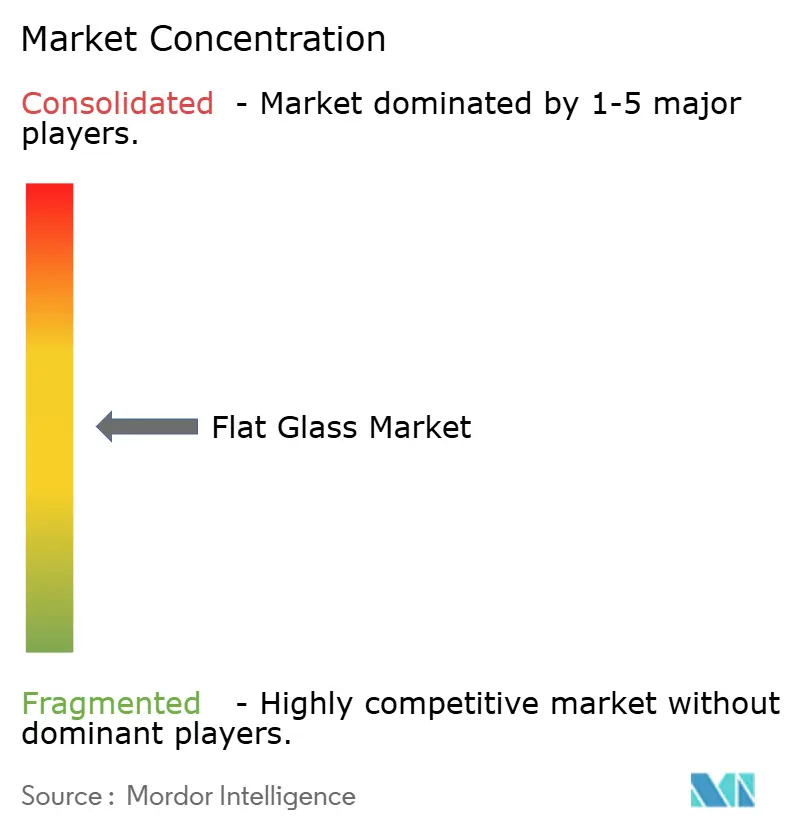
| Market Concentration | Medium |
Major Players *Disclaimer: Major Players sorted in no particular order Image © Mordor Intelligence. Reuse requires attribution under CC BY 4.0. | |
Flat Glass Market Analysis by Mordor Intelligence
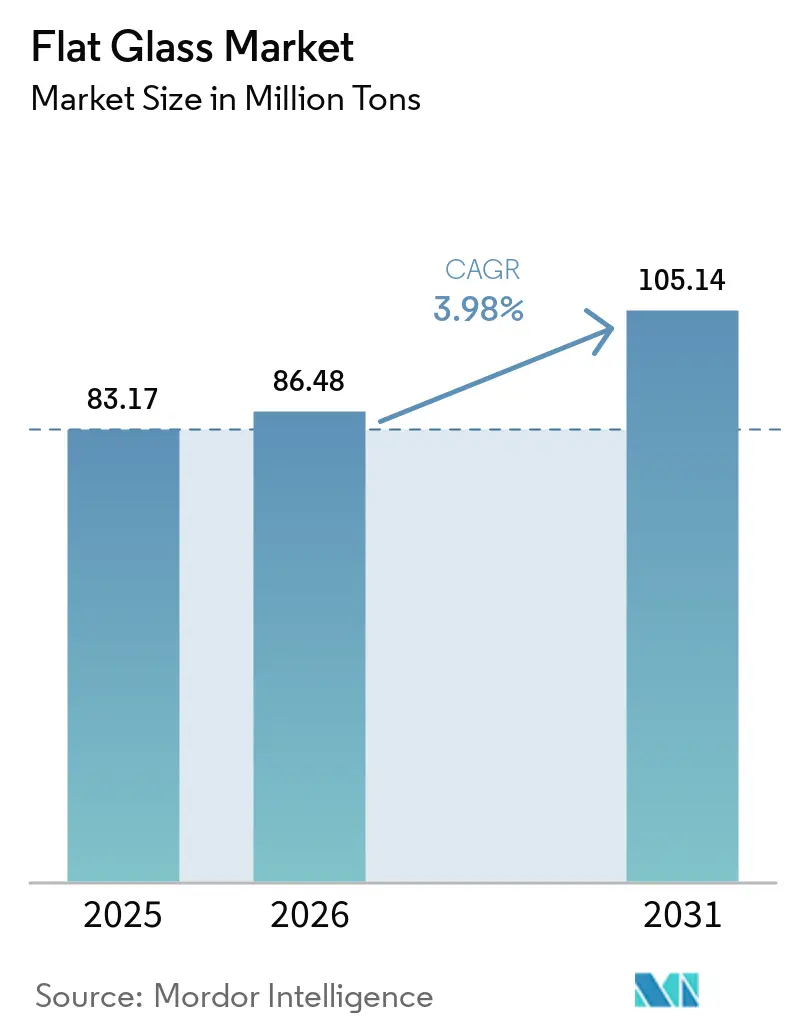
The Flat Glass market size is expected to grow from 83.17 Million tons in 2025 to 86.48 Million tons in 2026 and is forecast to reach 105.14 Million tons by 2031 at 3.98% CAGR over 2026-2031. Demand resilience stems from stricter construction energy codes, rapid photovoltaic build-outs, and automotive lightweighting that favors advanced glazing. Manufacturers are shifting toward low-carbon melting, green hydrogen trials, and oxy-electric hybrid furnaces to secure price premiums in sustainability-conscious tenders. Solar module glass, antimicrobial coatings for healthcare facilities, and ultra-thin triple units for high-rise retrofits are expanding the revenue mix. Asia-Pacific anchors both production and consumption, while North America and Europe invest in furnace electrification to counter energy-price swings and looming carbon tariffs.
Key Report Takeaways
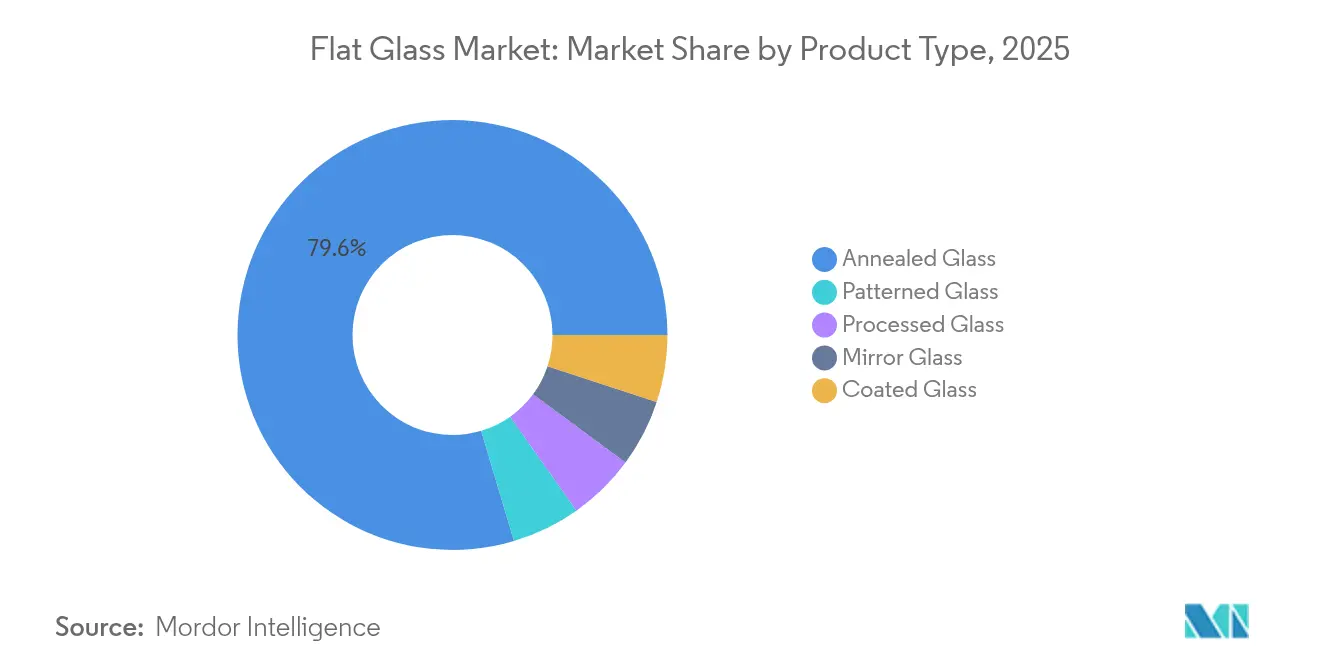
- By product type, annealed glass led with 79.62% of the flat glass market share in 2025, whereas processed glass is projected to grow at a 4.65% CAGR to 2031.
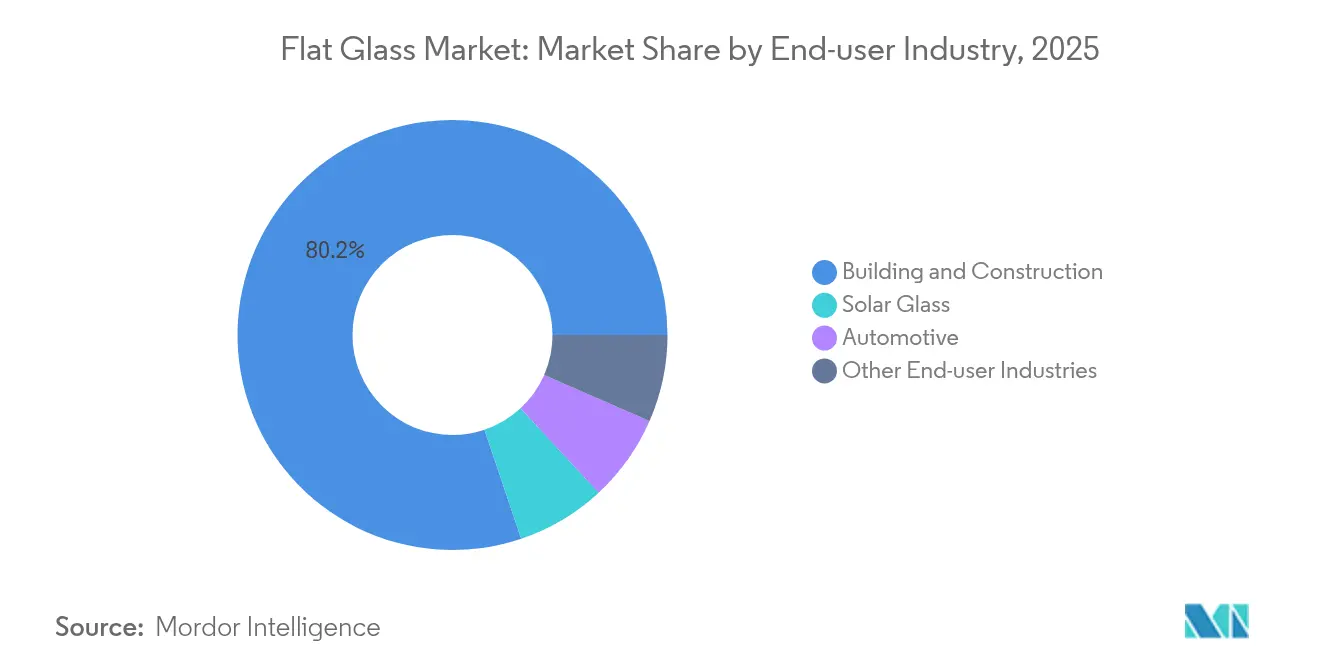
- By end-user industry, building and construction accounted for 80.18% of the flat glass market size in 2025; solar glass is advancing at a 6.45% CAGR through 2031.
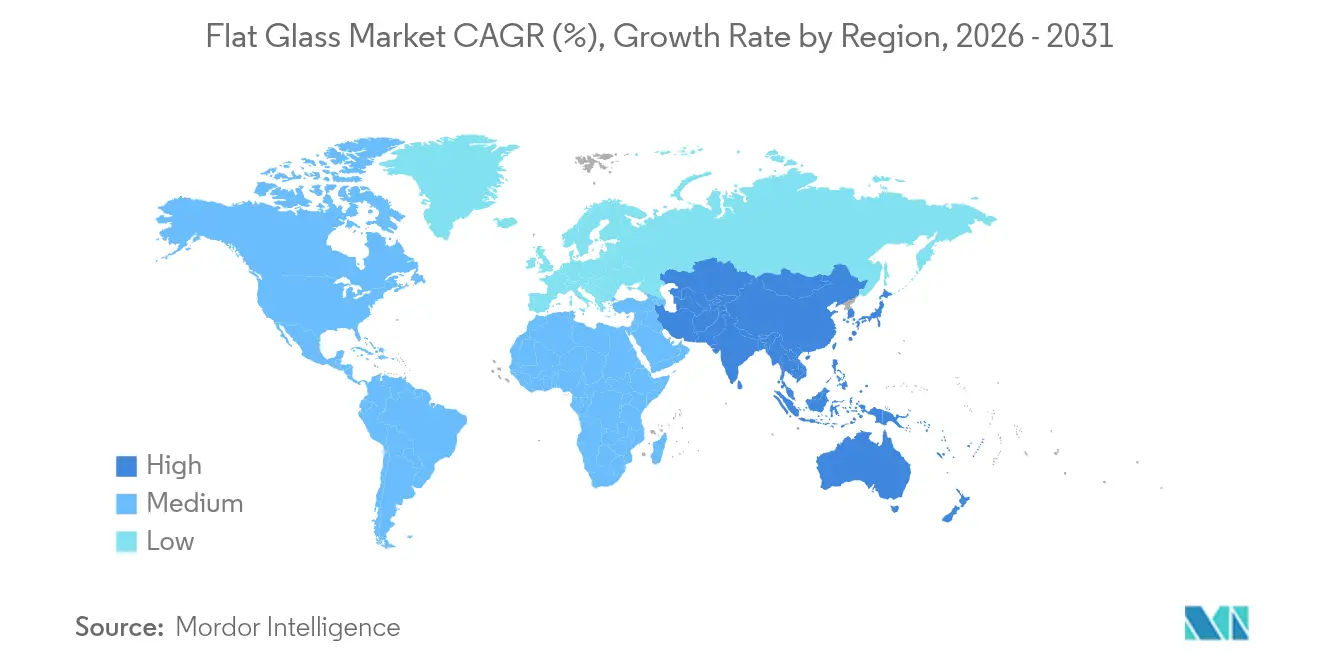
- By geography, Asia-Pacific commanded 63.88% revenue in 2025, while also topping the growth table with a 4.63% CAGR to 2031.
Note: Market size and forecast figures in this report are generated using Mordor Intelligence’s proprietary estimation framework, updated with the latest available data and insights as of 2026.
Market Trends and Insights
Drivers Impact Analysis of Flat Glass Market*
| Drivers | (~) % Impact on CAGR Forecast | Geographic Relevance | Impact Timeline |
|---|---|---|---|
| Construction spending rebound | +1.2% | APAC and North America | Medium term (2-4 years) |
| EV glazing and lightweighting | +0.8% | China, Europe, North America | Medium term (2-4 years) |
| Solar-grade glass capacity surge | +1.0% | APAC core, spill-over to Europe and North America | Long term (≥ 4 years) |
| Energy-efficient building codes | +0.7% | Europe and North America, expanding to APAC | Long term (≥ 4 years) |
| Antimicrobial glass uptake | +0.3% | Developed markets worldwide | Short term (≤ 2 years) |
| Source: Mordor Intelligence | |||
Growing Investments in Commercial and Residential Construction
Global construction outlays are forecast to climb, aided by lower borrowing costs and an uptick in developer sentiment. Multifamily starts accelerate in response to single-family affordability gaps, channeling sustained demand for curtain wall and window systems that integrate Low-E and triple-glazed units. Developers specify higher-performance glass to secure LEED credits, driving volume growth for sputter-coated and argon-filled insulating products. The flat glass market, therefore, benefits directly from code-driven window-to-wall ratios that favor advanced glazing solutions.
Rising Automotive Glazing Requirements for EV Safety and Lightweighting
Electric vehicle platforms intensify structural glazing needs while mandating lighter glass to offset battery mass. Fuyao committed CNY 9.1 billion (USD 1.26 billion) in 2024 for two new plants aimed at new-energy vehicle demand. Thin laminated windshields, panoramic roofs, and heads-up display-ready windscreens expand processed glass penetration. Embedded sensor packages elevate value per car, creating a lucrative growth pocket inside the broader flat glass market. Aerodynamic gains from slimmer profiles further align with range optimization, cementing glass as a critical lightweight substrate over the forecast horizon.
Rapid Capacity Additions for Solar PV Module Glass
Global PV deployments surpassed 1.6 TWdc by end-2023, and regional makers are retrofitting float lines for low-iron solar sheets[1]. NSG and Vitro invested USD 180 million to upgrade furnaces for transparent conductive oxide coatings, while the segment already represents 5% of floated output. With solar installations projected to exceed 240 GW annually by 2030, the flat glass market gains a durable, high-margin outlet for specialized ultra-clear products.
Energy-Efficient Building Codes Boosting Low-E and Triple Glazing Demand
The 2024 International Energy Conservation Code trims allowable fenestration air leakage to 0.35 cfm/ft² and tightens U-factor bands in temperate zones. ASHRAE 90.1-2019 lowered U-values a further 17% for some assemblies, fueling triple-pane adoption. Glaston’s 0.5 mm center-glass IGU delivers 20% better thermal performance at lower frame loads. Vacuum insulating units now achieve 0.5 W/m²·K but remain premium-priced. Each revision embeds higher-value coated glass into project specifications, enlarging the addressable flat glass market.
Restraints Impact Analysis of Flat Glass Market*
| Restraints | (~) % Impact on CAGR Forecast | Geographic Relevance | Impact Timeline |
|---|---|---|---|
| Availability of polymer, acrylic and polycarbonate substitutes | -0.5% | Global, with higher impact in automotive applications | Medium term (2-4 years) |
| Volatile soda-ash and natural-gas input costs | -0.8% | Global, with acute impact in Europe and North America | Short term (≤ 2 years) |
| EU Carbon Border Adjustment Mechanism compliance costs | -0.3% | Europe and exporters to EU markets | Long term (≥ 4 years) |
| Source: Mordor Intelligence | |||
Availability of Polymer, Acrylic and Polycarbonate Substitutes
Automakers trial polycarbonate side windows and panoramic roofs that weigh up to 50% less than comparable glass panels. Optical clarity and UV stability have improved, yet scratch resistance and thermal tolerance still lag glass. Stringent windshield regulations keep polycarbonate use niche, confining substitution risk mostly to non-load-bearing glazing. Glass recycling advantages and tighter end-of-life circularity goals further insulate flat glass market volumes.
Volatile Soda-Ash and Natural-Gas Input Costs
Soda ash spot prices fell amid oversupply, but the input remains prone to price swings that compress margins. WE Soda’s USD 1.425 billion deal for Genesis Alkali consolidated 9.5 million tons of natural trona capacity, potentially stabilizing supply yet concentrating purchasing power. European producers face added strain from natural-gas volatility, spurring trials with biofuel and electric melting. O-I Glass completed a 100% biofuel furnace run in 2025, proving an alternative path to de-risk energy costs.
*Our forecasts treat driver/restraint impacts as directional, not additive. The impact forecasts reflect baseline growth, mix effects, and variable interactions.
Flat Glass Market Segment Analysis
By Product Type:
Processed Glass Drives InnovationProcessed glass generated the fastest 4.65% CAGR between 2026 and 2031, outpacing the broader flat glass market. Laminated and tempered variants supply automotive windscreens, curtain walls, and security facades where impact resistance is critical. Annealed output still dominated in 2025 with 79.62% of volume because it serves as the base substrate for downstream upgrades. The segment’s cost edge keeps it central to commodity construction, yet its share is set to moderate as codes and safety norms elevate demand for value-added treatments.
Coated, reflective, and Low-E sheets advance in parallel due to mandatory thermal standards. AGC Glass Europe’s 5.5 kg CO₂ eq/m² Low-Carbon Glass exemplifies product differentiation that commands premium bids. Tinted glass usage in EVs supports cabin cooling and battery efficiency. Mirror and patterned glass remain niche but attractive for interior and privacy applications. Altogether, specialization raises average selling prices, widening the processed share in the flat glass market size over the forecast horizon.

By End-user Industry:
Solar Glass Accelerates GrowthBuilding and construction remained the anchor at 80.18% of demand in 2025, yet solar glass is on track for a 6.45% CAGR through 2031, the fastest among all end-users. Utility-scale and rooftop installations require ultra-clear, low-iron sheets with anti-reflective layers, prompting float line conversions worldwide. AGC’s tie-up with recycling firm ROSI will channel retired PV cover glass back into new float batches, reinforcing circular supply.
Commercial retrofits, housing densification, and mixed-use projects bolster architectural glazing volumes, especially where Low-E and triple units meet stricter codes. Automotive demand allies with EV adoption, using heads-up display-compatible windscreens and thinner laminates to trim mass. Appliance, furniture, and antimicrobial hospital partitions add steady baseline consumption. These dynamics diversify revenue streams and cushion the flat glass market against cyclical shocks in any single sector.
Geography Analysis
APAC Flat Glass Market
The Asia-Pacific region secured 63.88% of 2025 shipments and is expanding at a 4.63% CAGR, the highest among regions. China Flat Glass demand and India is scaling new float lines while testing green hydrogen furnaces under a 20-year offtake pact between Asahi India Glass and INOX Air Products.
Europe and North America Flat Glass Market
Europe focuses on decarbonization leadership. Saint-Gobain and AGC started trials of a hybrid furnace that cuts CO₂ by 75% through 50% electrification and oxy-fuel combustion, supported by the EU Innovation Fund. Carbon Border Adjustment Mechanism fees, effective 2026 incentivize local sourcing, potentially boosting intra-regional sales. North American producers, led by Vitro’s USD 180 million modernization and O-I’s UK investment, upgrade lines to withstand gas-price volatility and ESG scrutiny.
MEA and South America Flat Glass Market
South America, the Middle East, and Africa post rising urbanization but face infrastructure deficits and competition from Asian imports. Green-field float projects remain selective, though regional builders prefer local panes to avoid freight surcharges, supporting gradual volume growth. Altogether, geographic shifts keep Asia unchallenged in volume share while other regions chase value-added specialties within the flat glass market.
Regulatory Landscape
Regulation is increasingly shaping both demand (through building energy performance requirements) and supply (through emissions accounting and trade enforcement). In the United States, the EPA Greenhouse Gas Reporting Program (GHGRP) Subpart N for glass production was updated in April 2024, expanding reporting granularity for glass manufacturing emissions. In Europe, the Energy Performance of Buildings Directive framework has been reinforced with Commission Delegated Regulation (EU) 2026/52 (published December 2025), tightening the calculation basis for life-cycle global warming potential and increasing the compliance pull for higher-performance glazing in regulated building stock.
On the supply and trade side, the United States issued antidumping and countervailing duty orders on float glass products from China and Malaysia effective April 6, 2026, following final affirmative determinations by the US International Trade Commission, which raises the cost of imports into the US market. In China, standardization is moving toward measurable decarbonization: GB/T 47395-2026 (published March 31, 2026; effective October 1, 2026) defines technical evaluation requirements for energy saving and carbon reduction in the flat glass industry, while JC/T 2937-2026 introduces unified carbon-footprint quantification requirements for flat glass products, increasing pressure to document and reduce product-level emissions.
Value Chain Analysis
The flat glass value chain starts with upstream mining and processing of silica sand, soda ash (natural or synthetic), limestone/dolomite, and additives, supported by energy supply (natural gas and electricity) that is critical because float furnaces run continuously. Midstream manufacturing centers on float lines and annealing lehrs, followed by downstream processing such as tempering, laminating, sputter coating (Low-E/solar control), and insulating glass unit (IGU) assembly. End users span building and construction, automotive, solar glass, and other industrial applications. Logistics typically move from plants to regional processors/fabricators and glazing-system makers, with quality assurance and compliance documentation (including EPDs and product carbon footprint methods in some markets) acting as an additional gating step for specification-driven projects.
Recent operating and investment activity indicates where value is accruing and where constraints persist. In June 2026, Sisecam commissioned its TR9 float glass line in Tarsus, Turkey, with 1,200 metric tonnes/day capacity, supporting ongoing scale economics in primary float output. In Europe, the VOLTA hybrid furnace at the Barevka plant (Saint-Gobain Glass and AGC Glass Europe) reached one year of industrial-scale operation by June 2026, combining partial electrification with high cullet use, which links decarbonization capability to midstream melting and cullet procurement. Bottlenecks remain concentrated in energy availability and pricing, along with furnace repair cycles, while downstream processors weigh higher-value coated and IGU demand against order variability and regional construction cycles.
Competitive Landscape
The global flat glass market is moderately fragmented. AGC, Saint-Gobain, Guardian Industries, and Fuyao leverage multi-continent furnace networks and in-house coating technologies to deliver differentiated portfolios. Fuyao’s automotive focus secures global contracts, while Guardian’s vacuum insulating unit patents position it for premium retrofit demand. Saint-Gobain and AGC co-develop hybrid furnaces that could slash energy consumption, sharpening their sustainability brand. New entrants target niche segments like antimicrobial coatings and ultra-thin vacuum insulating glazing. Barriers include capital intensity and multiyear permitting cycles, but collaboration models with equipment suppliers shorten ramp-ups.
Flat Glass Industry Leaders
-
AGC Inc.
-
Saint-Gobain
-
Guardian Industries
-
Nippon Sheet Glass Co. Ltd
-
Xinyi Glass Holdings Limited
- *Disclaimer: Major Players sorted in no particular order
Flat Glass Market Companies Covered in this Report
- Adamant Holding Company
- AGC Inc.
- Cardinal Glass Industries Inc.
- Central Glass Co., Ltd.
- China Glass Holdings Limited
- Euroglas
- Fuyao Group
- Guardian Industries
- Nippon Sheet Glass Co. Ltd
- Phoenicia
- Saint-Gobain
- SCHOTT
- Şişecam
- Taiwan Glass Industry Corporation
- Vitro
- Xinyi Glass Holdings Limited
Market Opportunities and Future Outlook
White-space is concentrating in (i) low-carbon and traceable flat glass supply for regulated building envelopes and procurement frameworks, and (ii) capacity additions that integrate coating and downstream finishing to lift the share of value-added products. Europe is also tying industrial competitiveness to decarbonization pathways, with Glass for Europe advocating for EU ETS reforms that keep a business case for sustainable manufacturing. In parallel, EPBD-linked calculation rules under EU 2026/52 increase the importance of product environmental declarations and whole-life metrics in glazing selection.
Capacity projects and commissioning activity point to where supply is being positioned for architectural, coated, and regional import-substitution demand. In March 2026, Sisecam commissioned the TR9 line in Tarsus, Turkiye (1,200 metric tonnes/day; EUR 315 million), expanding large-scale float output across the wider EMEA region. In May 2026, Gujarat Guardian Limited began construction of a second float glass line and a wet coating facility in Ankleshwar, India, adding 1,000 metric tonnes/day of capacity and reinforcing India as an expansion geography for both commodity and coated architectural glass. Supply formation is also visible in Africa: in February 2026, Keda Industrial Group started work on a USD 250 million float glass facility in Shama, Ghana (initial phase 600 tonnes/day), which supports local availability where freight and lead-time penalties have historically favored imports.
Recent Industry Developments in Flat Glass Market
- April 2026: AGC Inc. demonstrated Japans first horizontal recycling of window glass within the same building at the Nippon Life Higashi-Yaesu Building, collecting and recycling 5.7 tons of waste flat glass. The effort provides a practical, project-level pathway to increase cullet recovery and cut embodied carbon for architectural glazing supply. It also shows how glassmakers are working with building owners to secure higher-quality recovered glass streams.
- March 2026: AGC Inc. started a circular model demonstration project in the Kansai region with Sekisui House and Daiei Kankyo to recycle window glass recovered from home renovations. The program extends recycling from single-building pilots into a regional collection and processing model, which can improve cullet availability for float operations. It strengthens downstream links between renovation activity, demolition waste handling, and new flat glass production.
- December 2025: Guardian Glass (GulfGuard) announced plans to develop a second float glass line and a second glass coater at its Jubail Industrial City site in Saudi Arabia. The combined float and coating expansion is intended to increase local supply of coated architectural glass, tightening lead times for regional construction and facade projects. The expansion also raises competitive pressure on imported coated glass into the Gulf by adding in-region finishing capacity.
Flat Glass Market Report Scope and Research Methodology
Market Definition and Coverage
For this study, the flat glass market covers flat, sheet-style glass made through standard processes and then supplied as annealed, coated, processed, mirror, or patterned glass for use in buildings, vehicles, and solar-related applications across major regions.
Scope exclusions: Excluded from this sizing are non-flat glass forms such as container glass and glass fiber products.
Segments Covered in This Report
- By Product Type
- Annealed Glass
- Clear Glass
- Tinted Glass
- Coated Glass
- Reflective Glass
- Low-E Glass
- Processed Glass
- Laminated Glass
- Tempered Glass
- Mirror Glass
- Patterned Glass
- Annealed Glass
- By End-user Industry
- Building and Construction
- Automotive
- Solar Glass
- Other End-user Industries
- By Geography
- Asia-Pacific
- China
- India
- Japan
- South Korea
- Malaysia
- Thailand
- Indonesia
- Vietnam
- Rest of Asia-Pacific
- North America
- United States
- Canada
- Mexico
- Europe
- Germany
- United Kingdom
- Italy
- France
- Spain
- Nordic Countries
- Turkey
- Russia
- Rest of Europe
- South America
- Brazil
- Argentina
- Colombia
- Rest of South America
- Middle-East and Africa
- Saudi Arabia
- Qatar
- United Arab Emirates
- Nigeria
- Egypt
- South Africa
- Rest of Middle-East and Africa
- Asia-Pacific
Data Sources, Market Sizing, and Validation
Desk Research
Desk research helped set the outer limits of demand and supply, and kept assumptions tied to observable market behavior. We reviewed public sources such as the USGS mineral and materials statistics, UN Comtrade trade flows for glass categories, World Bank and IMF macro indicators for construction and manufacturing cycles, and energy and building efficiency references from agencies such as the IEA.
To ground the industry view, we also used company annual reports, investor presentations, and press releases to understand capacity additions, furnace rebuild cycles, and regional footprint shifts. Patent databases were referenced to sense where coating and processing innovations are being filed, and an import/export shipment-level database was used selectively to cross-check trade direction when customs categories were too broad. The sources listed above are illustrative only, and other public references were also used during data collection, validation, and clarification.
Primary Interviews and Surveys
Primary work was used to test the desk assumptions that most affect tonnage, such as regional demand mix across construction, automotive glazing, and solar glass, and how quickly coated or processed products are replacing plain annealed sheets. We spoke with manufacturers, processors, distributors, and downstream buyers, and we balanced coverage across APAC, EMEA, and the Americas so the same variables could be checked under different operating conditions.
Distribution of primary research fieldwork respondents
| Company type | Respondent position | Region |
|---|---|---|
| Top tier: 28% | CXOs: 12% | APAC: 38% |
| Mid tier: 56% | Functional/Unit leaders: 41% | EMEA: 35% |
| Smaller Players: 16% | Managers: 47% | Americas: 27% |
Market-Sizing & Forecasting
Sizing started with a top-down reconstruction of the demand pool in tons by tying building activity, vehicle output, and solar installation momentum to typical glazing area and glass intensity, then adjusting for replacement demand and regional product mix. Once the demand pool was established, we converted it into market tonnage after checking practical constraints such as furnace capacity, utilization ranges, and trade balance direction.
To keep the total believable, we corroborated it with selective bottom-up approximations, such as sampling manufacturer and processor volumes discussed in interviews and checking implied tonnage against reported capacity announcements and trade signals. Key model inputs included float line capacity additions and rebuild cycles, coating and processing penetration in architectural glass, automotive production trends and glazing content shifts, solar module build-out signals, and regional import dependence that alters the local supply share. Forecasting used scenario analysis supported by primary feedback on how fast construction pipelines normalize, how solar demand holds up, and how energy code adoption influences coated glass uptake.
Data Validation & Update Cycle
Validation was done in several steps so no single source or assumption could drive the final number. Model outputs were compared against independent signals such as regional trade direction, announced capacity ramps, and end-use activity indicators, and then outliers were reviewed before sign-off.
When a mismatch was found, assumptions were re-checked and, where needed, follow-up calls were triggered to confirm the practical explanation (for example, short-term furnace downtime or a temporary demand pause in a major end-use). Reports are refreshed annually, and interim updates are made when material events occur, such as large capacity additions, trade policy changes, or sharp swings in construction starts. Before delivery, a final analyst pass is completed so clients receive the latest updated view.
Mordor Intelligence's Flat Glass Market Estimate Compared With Other Published Estimates
Published market sizes for flat glass can look far apart because the underlying unit of measure and what gets counted as flat glass changes from publisher to publisher. Some studies present the market in value terms, while others report volume in tons, and that alone can create a wide numerical spread.
Household appliances and refrigeration glass, interior furniture glass, and other downstream processed applications are often bundled into some revenue studies, which inflates totals when compared with a tonnage-led model. By keeping processed use-cases outside the flat-glass scope and staying in physical volume, Mordor Intelligence reports 86.48 million tons (2026) for the global market, rather than a converted revenue figure that depends heavily on assumed pricing and product mix.
Benchmark comparison
| Source | Market Size | Gaps in Research Methodology |
|---|---|---|
| Mordor Intelligence | USD 86.48 M (2026) | |
| Global Consultancy A | USD 311.44 B (2024) | Uses revenue-based sizing with broad inclusion of processed and downstream application glass (for example, appliances and interior uses) and relies on ASP assumptions that can shift results when product mix and currency timing change. |
| Industry Publisher B | USD 329.19 B (2025) | Value estimates typically fold multiple product categories and higher-value processing steps into one total, which can overstate flat-glass-only demand when compared with a pure tonnage view tied to construction, automotive output, and solar deployment. |
The comparison indicates that most of the difference comes from unit choice and what is included in the market basket, not from growth-direction assumptions. When the market is expressed in tons and anchored to end-use activity checks, the logic is easier to replicate, and it is clearer how changes in construction, vehicles, and solar projects affect the total.
Key Questions Answered in the Report
What is the current size of the flat glass market in volume terms?
The flat glass market size reached 86.48 million tons in 2026 and is forecast to hit 105.14 million tons by 2031.
Which region leads global demand for flat glass?
Asia-Pacific led with 63.88% of 2025 shipments and is also the fastest-growing region at a 4.63% CAGR.
Which flat glass segment is expanding the fastest?
Solar glass is projected to grow at a 6.45% CAGR through 2031, outpacing all other end-user segments.
How are sustainability targets influencing flat glass production?
Producers are piloting hybrid oxy-electric furnaces, green hydrogen firing, and recycled cullet programs to cut CO? emissions by up to 75%.
Who are the major players in the flat glass market?
AGC, Saint-Gobain, Guardian Industries, and Fuyao Group lead the market, backed by global furnace networks and advanced coating technologies.
What are the main raw-material risks for glassmakers?
Volatile soda-ash prices and fluctuating natural-gas costs can erode margins, prompting firms to secure trona supply and trial alternative fuels.