
Market Overview
| Study Period | 2020 - 2031 |
|---|---|
| Forecast Data Period | 2026 - 2031 |
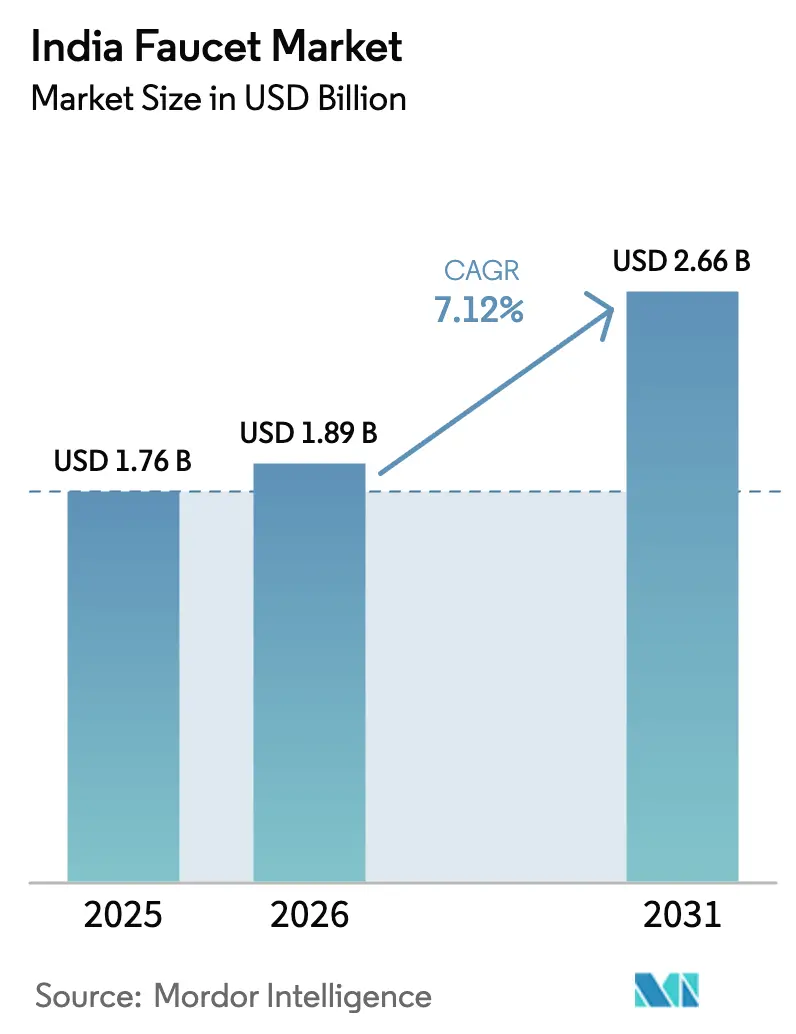
| Base Year Market Size (2025) | USD 1.76 Billion |
| Market Size (2026) | USD 1.89 Billion |
| Market Size (2031) | USD 2.66 Billion |
| Growth Rate (2026 - 2031) | 7.12 % |
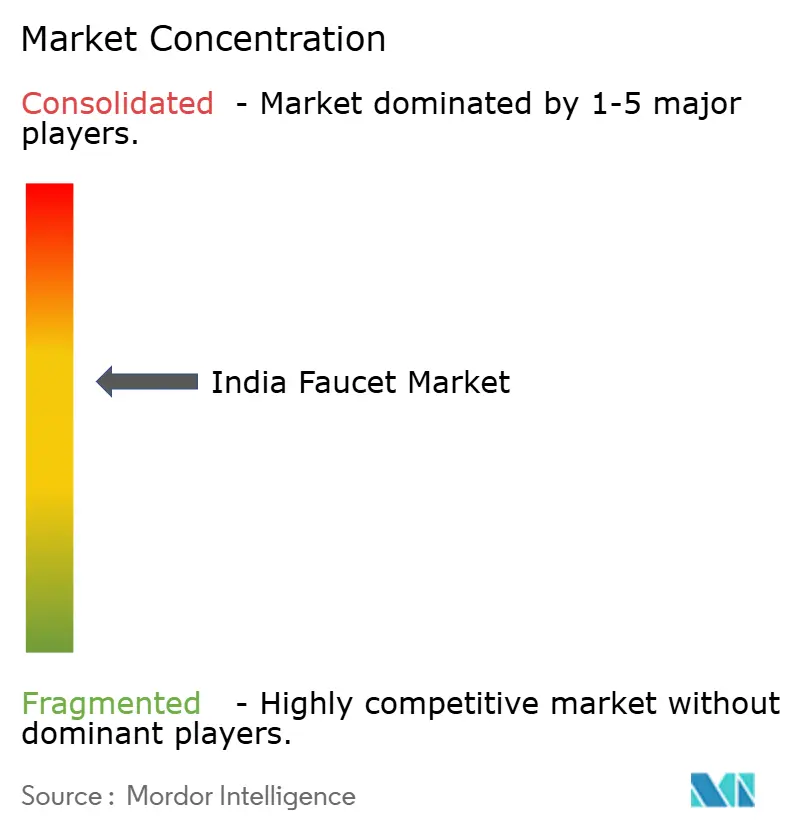
| Market Concentration | Medium |
Major Players *Disclaimer: Major Players sorted in no particular order Image © Mordor Intelligence. Reuse requires attribution under CC BY 4.0. | |
India Faucet Market Analysis by Mordor Intelligence
India faucets market size in 2026 is estimated at USD 1.89 billion, growing from 2025 value of USD 1.76 billion with 2031 projections showing USD 2.66 billion, growing at 7.12% CAGR over 2026-2031. Urbanization, government housing schemes, and shifting consumer preferences toward premium fixtures explain most of this rise. Smart Cities Mission spending funnels institutional orders directly to large manufacturers, smoothing demand cycles and encouraging capacity investments. Rising disposable income supports upgrades from basic taps to designer models, while digital retail channels lower discovery costs and broaden reach. Organized brands gain visibility through e-commerce, yet unorganized suppliers still compete on price in rural and semi-urban zones.
Key Report Takeaways
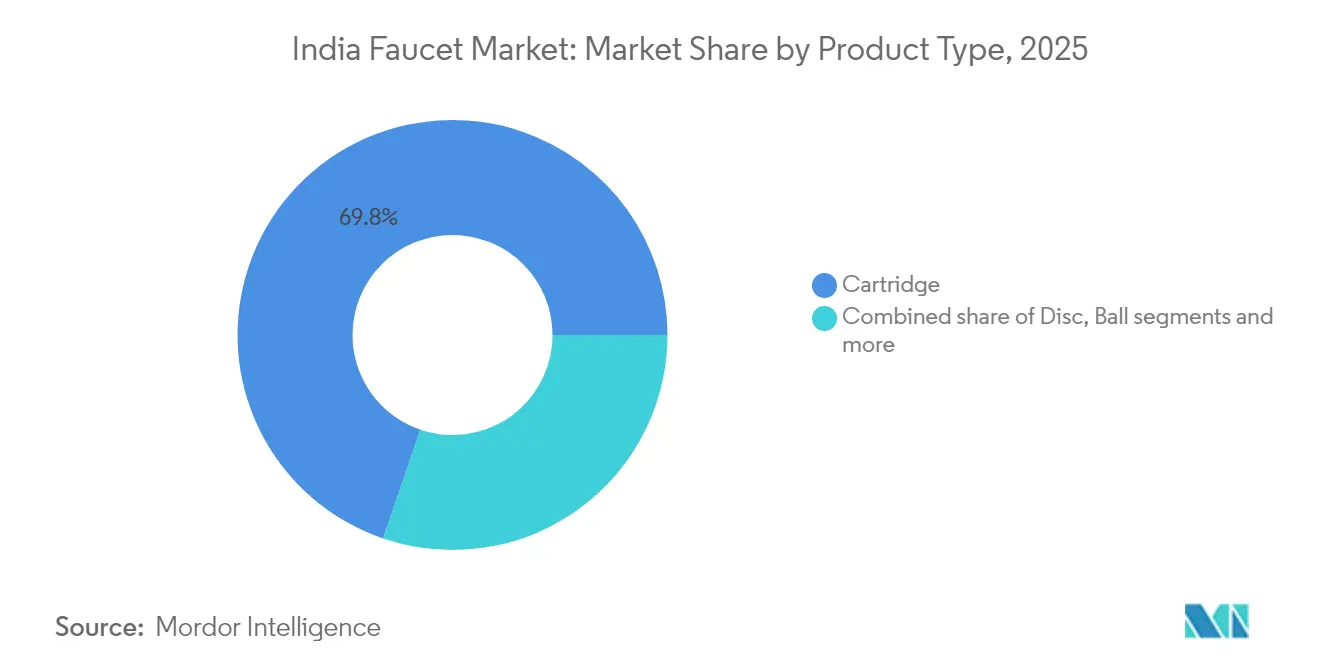
- Cartridge faucets commanded 69.78% of the India faucets market share in 2025, while ceramic disc models are expected to grow at a 7.18% CAGR through 2031.
- Brass units accounted for 48.71% of revenue in 2025; stainless-steel pieces are forecast to expand at a 7.45% CAGR over the same period.
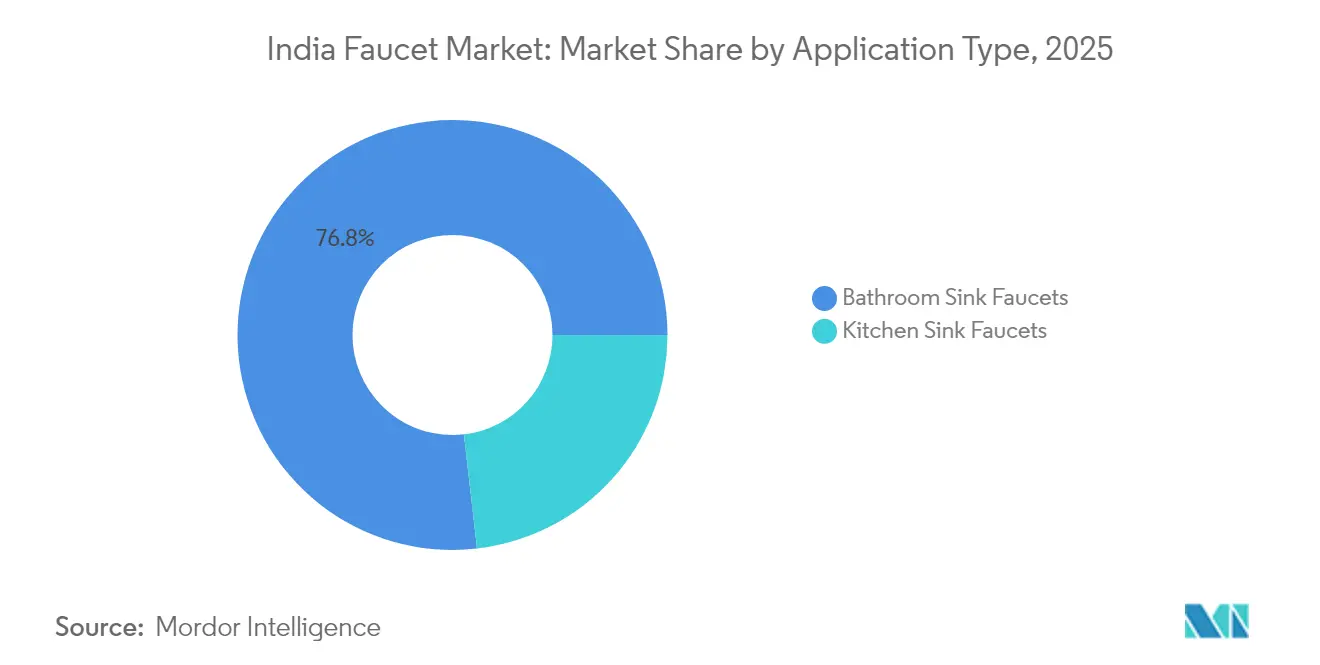
- Bathroom sink installations contributed 76.82% of 2025 revenue, yet kitchen sink faucets are projected to advance at a 7.52% CAGR to 2031.
- Residential buyers generated 67.65% of 2025 turnover, whereas commercial end-users are set to rise at 7.60% CAGR during the outlook period.
- South India captured 34.12% of the India faucets market in 2025; North India is positioned for an 8.21% CAGR to 2031.
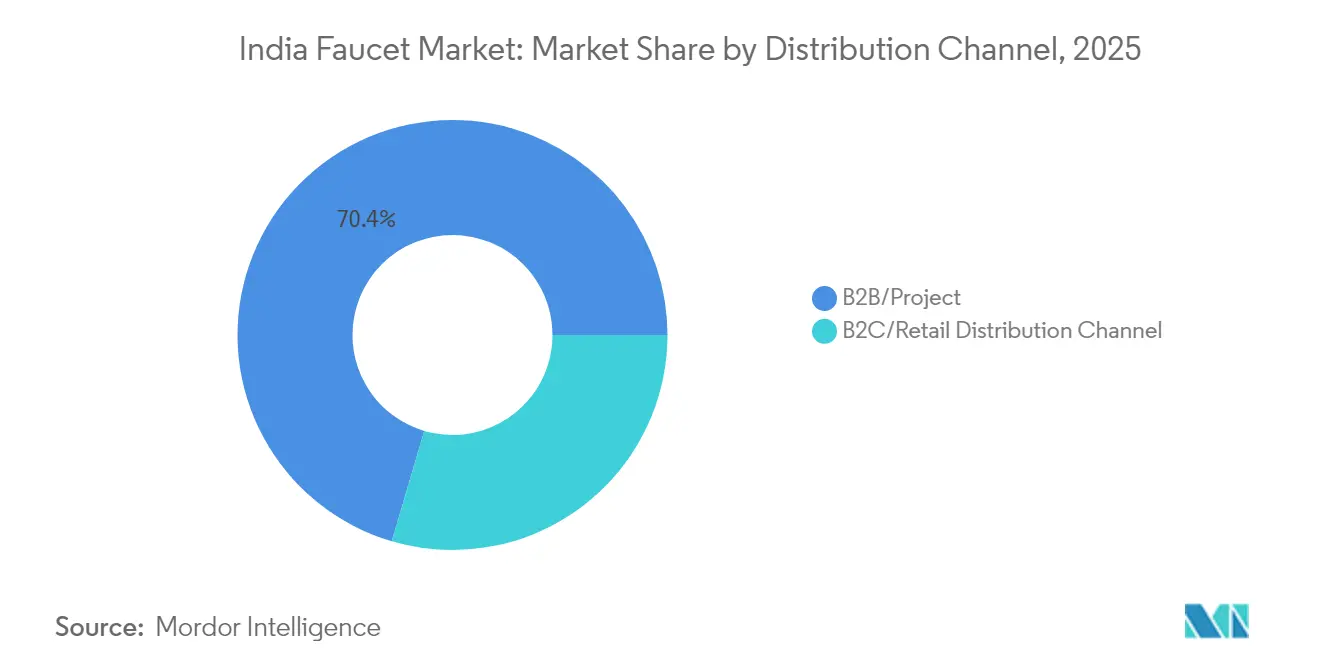
- B2B/project channels held 70.44% revenue share in 2025; B2C/retail channels are likely to post a 7.36% CAGR on the back of e-commerce penetration.
Note: Market size and forecast figures in this report are generated using Mordor Intelligence’s proprietary estimation framework, updated with the latest available data and insights as of 2026.
Market Trends and Insights
Drivers Impact Analysis of India Faucet Market*
| Driver | (~) % Impact on CAGR Forecast | Geographic Relevance | Impact Timeline |
|---|---|---|---|
| Rapid urban housing projects & Smart Cities Mission | +1.2% | National, with early gains in Delhi NCR, Pune, Chennai | Medium term (2-4 years) |
| Rising hotel-hospital capex in Tier-2/3 cities | +0.8% | Central & Western India core, spill-over to Eastern regions | Medium term (2-4 years) |
| E-commerce accelerating branded faucet penetration | +0.9% | National, with higher impact in metros and Tier-1 cities | Short term (≤ 2 years) |
| Water-scarcity push for low-flow & WaterSense-style products | +0.7% | Western & Southern India, expanding to Northern states | Long term (≥ 4 years) |
| IoT-enabled "smart" kitchens & bathrooms adoption | +0.5% | Metro cities and premium housing segments nationally | Long term (≥ 4 years) |
| GST-credit advantage shifting share to organised players | +0.6% | National, with stronger impact in tax-compliant regions | Medium term (2-4 years) |
| Source: Mordor Intelligence | |||
Rapid Urban Housing Projects & Smart Cities Mission
Government programs reshape faucet demand through scale procurement that locks in standard specifications. The Smart Cities Mission earmarked INR 5,961 crore for smart water systems, triggering bulk orders for sensor-ready fixtures. PMAY-U approvals covering 12.2 million units stabilize long-run volumes and favor firms with reliable supply chains. Institutional buyers insist on water-efficient models, speeding mainstream adoption of aerators and flow restrictors. Predictable tender cycles allow factories to plan tooling upgrades and reduce per-unit costs. Compliance requirements also edge out informal makers that lack certification infrastructure.
Rising Hotel-Hospital Capex in Tier-2/3 Cities
Secondary cities witness brisk hotel construction as leisure and business travel disperse beyond metros. Developers specify sturdy, stylish faucets that endure high footfall yet match premium décor. Parallel healthcare spending adds demand for touchless units that enhance infection control. Stainless steel gains traction for its durable finish and low-maintenance profile in intensive-use settings. Regional OEMs with quick service networks win contracts by cutting downtime for maintenance calls. The combined pipeline lifts commercial sales faster than housing replacements through 2030.
E-commerce Accelerating Branded Faucet Penetration
Digital marketplaces, with their transparent pricing, vivid imagery, and doorstep delivery, empower brands to bypass dealer mark-ups. These platforms provide consumers with a seamless shopping experience, offering a wide range of options and competitive pricing. In India, online sales in the faucets market are surging at an annual rate of 9.12%, outpacing offline growth. This growth is driven by increasing internet penetration, rising smartphone usage, and the convenience of e-commerce platforms. Even for premium SKUs, consumer reviews, especially when paired with on-site installation services, bolster trust and encourage purchases. Additionally, brands leverage clickstream data to fine-tune designs and predict color trends, all with reduced lead times, enabling them to stay ahead of market demands. Omnichannel strategies, including showroom pickups for online orders, are not only slashing last-mile costs but also expanding coverage, ensuring a more comprehensive reach to diverse consumer segments.
Water-Scarcity Push for Low-Flow & WaterSense-Style Products
TERI studies show aerators can trim water use by 55%, resonating with households facing tiered tariff hikes[1]. In Maharashtra and Karnataka, city utilities are incentivizing faucet replacements through rebate schemes, which refund a portion of the replacement costs. These initiatives aim to encourage the adoption of water-efficient fixtures among consumers. The Bureau of Indian Standards (BIS) is in the process of formulating a voluntary star-label program, akin to the U.S. WaterSense initiative, signaling a potential move towards obligatory efficiency regulations. This program is expected to provide consumers with clear information about water-efficient products, fostering informed decision-making. In regions susceptible to drought, builders are proactively installing low-flow taps, not only to comply with anticipated regulations but also to sidestep future retrofit costs. This approach helps them align with evolving water conservation norms while minimizing long-term expenses. Meanwhile, corporate campuses are increasingly opting for flow-controlled models as part of their strategy to achieve Environmental, Social, and Governance (ESG) water targets.
Restraints Impact Analysis of India Faucet Market*
| Restraint | (~) % Impact on CAGR Forecast | Geographic Relevance | Impact Timeline |
|---|---|---|---|
| Unorganised/grey market price competition | -1.1% | National, with higher impact in rural and semi-urban areas | Short term (≤ 2 years) |
| Volatile copper & zinc alloy input prices | -0.8% | National, affecting all manufacturers | Short term (≤ 2 years) |
| Fragmented plumbing channel beyond metros | -0.6% | Tier-2/3 cities and rural markets | Medium term (2-4 years) |
| Delay in BIS water-efficiency labelling roll-out | -0.4% | National, with stronger impact on premium segments | Medium term (2-4 years) |
| Source: Mordor Intelligence | |||
Unorganised/Grey Market Price Competition
Micro-scale workshops, which avoid paying GST, offer products priced approximately 18% lower than branded SKUs. This pricing strategy appeals to cost-conscious buyers, particularly in non-metro regions. Local plumbers often recommend these taps because they earn higher profit margins compared to the commissions they receive from selling branded products. Additionally, the shorter delivery distances associated with these workshops reduce freight costs and enable same-day restocking, making them a convenient option. However, the inconsistent quality of alloy grades used in these taps results in higher failure rates, which gradually diminishes buyer confidence. The government's initiative to implement e-invoicing is expected to reduce these price differences after 2026.
Volatile Copper & Zinc Alloy Input Prices
Copper breached INR 905/kg in 2024 and remains choppy, inflating brass faucet costs. Smaller firms lack hedging desks and absorb shocks in margin erosion or abrupt list-price hikes[2]. Zinc swings compound risk when makers juggle multi-metal portfolios. Frequent repricing irritates channel partners who print catalogues annually, nudging them toward steel-based collections. Meanwhile, tier-one producers find some relief through long-term supply contracts and scrap-recycling efforts, which help mitigate cost pressures and ensure a more sustainable supply chain. These strategies also position them better to navigate the challenges posed by volatile raw material markets.
*Our forecasts treat driver/restraint impacts as directional, not additive. The impact forecasts reflect baseline growth, mix effects, and variable interactions.
India Faucet Market Segment Analysis
By Product Type:
Cartridge Dominance Faces Disc InnovationCartridge assemblies held 69.78% of the India faucets market share in 2025 on the back of familiarity, easy replaceability, and broad price coverage from entry to mid-premium. Yet disc mechanisms posted the quickest momentum at a 7.18% CAGR, adding roughly 4 percentage points to the overall India faucets market by 2031. Consumers in metros value ceramic discs for mineral-build-up resistance and feather-touch operation, ideal for hard-water zones in Delhi NCR. Manufacturers integrate dual-ceramic seals that last up to 500,000 cycles, halving lifetime maintenance versus conventional cartridges. Price compression from Chinese imports and localized disc production in Tamil Nadu narrow the upfront cost gap. Retailers now market disc faucets as “install-and-forget” options, fostering higher ticket sizes.
At the same time ball and compression faucets retain a foothold in rental housing and heritage renovations, respectively. Local authorities restoring colonial structures in Kolkata specify compression types to match historical authenticity, keeping this sub-segment alive. However, rising GST scrutiny and evolving consumer education tilt incremental volumes toward disc and cartridge hybrids that merge field-service simplicity with ceramic sealing. The India faucets market continues to favor modular valves where handles can interchange across designs, pushing OEMs to standardize spindle dimensions for cartridge and disc formats alike.

By Material:
Stainless Steel Challenges Brass LeadershipBrass covered 48.71% of the India faucets market in 2025 due to its machinability, corrosion tolerance, and perceived premium finish. Nonetheless, stainless-steel SKUs are forecast to outpace the broader India faucets market, gaining 7.45% CAGR as urban homeowners gravitate to a contemporary brushed aesthetic. The alloy’s lead-free nature aligns with potable-water directives, strengthening its institutional pull in school and hospital contracts. Stainless items also resist fingerprint smudges, vital for high-traffic food-service restrooms.
Brass remains entrenched in luxury villas where heritage gold-tone plating and intricate knurling rule design briefs. OEMs counter stainless momentum by offering low-lead brass blends certified under IS 1264:2021, retaining upscale luster while meeting health norms. Chrome-plated zinc caters to budget refurbishments, though scratch susceptibility limits its commercial usage. PTMT polymer enjoys tax incentives under the government’s plastics processing cluster scheme, carving cost-driven demand in semi-urban self-build homes. Across all materials, recyclability considerations grow salient, pressuring producers to adopt take-back programs and closed-loop smelting for scrap brass.
By Technology:
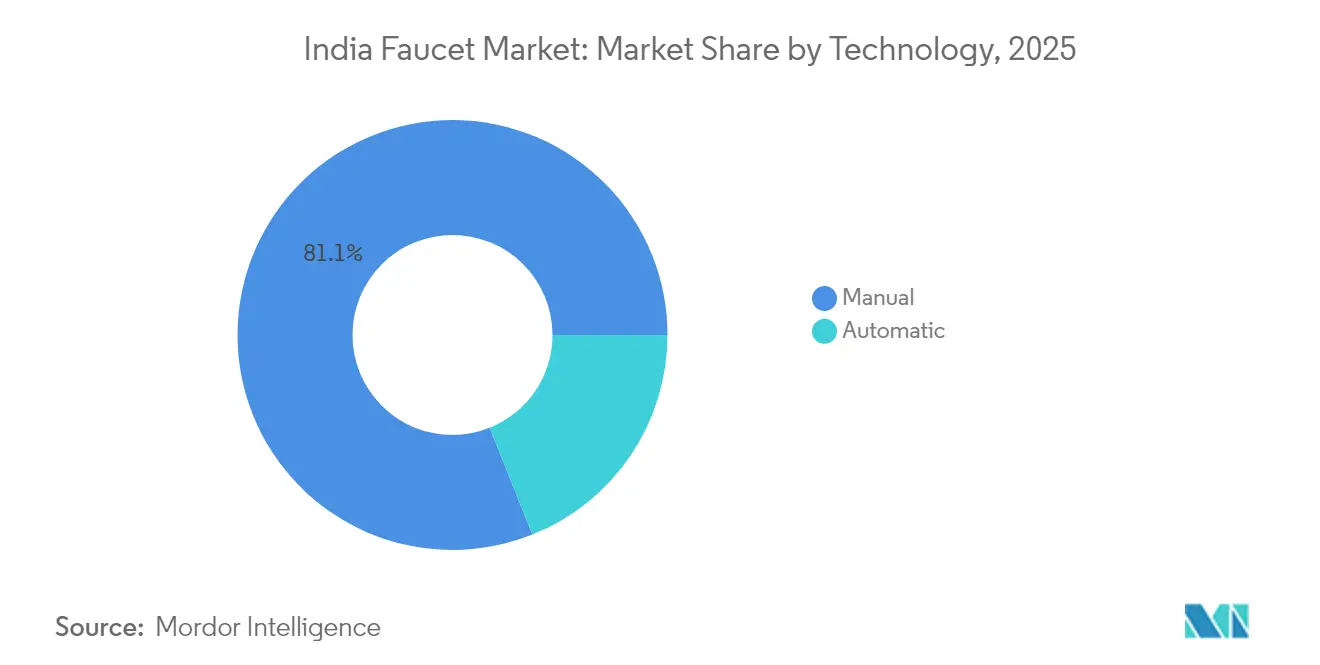
Automatic Systems Gain TractionManual valves dominated 81.06% of 2025 shipments as price sensitivity defines the mass segment. Yet the automatic cohort is registering an 8.04% CAGR, twice the broader India faucets market pace, aided by falling infrared sensor costs and battery lives now exceeding 300,000 activations. Hotels in Jaipur report water-use cuts of 28% after migrating to touchless taps, translating to one-year payback that resonates with asset managers. Government guidelines for infection control in healthcare also stipulate hands-free operation in ICU suites, driving institutional tenders toward automatic options.
Integration features climb up the specification ladder: Bluetooth modules feed facility dashboards, and solar trickle charging eliminates scheduled battery swaps in office campuses. For residential buyers, inductive recharge cables simplify maintenance anxiety that previously curbed sensor uptake. Domestic brands strike licensing deals with Taiwanese chip makers, embedding AI-based occupancy algorithms that calibrate flow duration to usage patterns. These innovations keep automated formats on an upswing even as manual valves retain baseline volume, ensuring a steady technology mix within the India faucets market.
By Installation Type:
Deck Mount Preferences Reflect Design TrendsIn 2025, deck mounts captured a dominant 75.12% of the market demand, underscoring a trend towards under-counter basins and quartz countertops. Their design, featuring concealed plumbing, allows for easy access post-installation. This is particularly advantageous for franchise hotels that prioritize minimal downtime. The deck mount segment is witnessing a robust expansion, growing at a 7.28% CAGR. This growth aligns with the rising trend of modular kitchen installations, where sink cut-outs are now designed to accommodate pre-drilled faucet templates. Additionally, the increasing adoption of deck mounts is driven by their compatibility with modern kitchen designs, which emphasize functionality and aesthetics. Manufacturers are also focusing on offering customizable options to cater to diverse consumer preferences, further fueling the segment's growth.
In Mumbai's compact apartments, wall mounts continue to be the preferred choice, conserving valuable counter space. Architects, when designing co-living units, opt for wall-mounted solutions equipped with concealed stop-cocks, simplifying maintenance tasks. However, challenges arise when retrofitting; upgrading to wall mounts often involves chiseling tiles, which significantly increases labor costs. This has led renovation projects to favor deck adaptations as a more cost-effective alternative. To address these challenges, the India faucets market has seen OEMs introducing convertible rough-in kits. These kits enable dealers to stock a single body that can accommodate either deck or wall spouts, optimizing inventory management. Furthermore, the growing focus on urbanization and the rise in co-living spaces are expected to sustain the demand for wall-mounted faucets, particularly in metropolitan areas where space optimization is critical.
By Application Type:
Kitchen Segment Accelerates GrowthIn 2025, bathroom sink faucets accounted for 76.82% of the revenue, but their growth lagged behind that of kitchen faucets. Forecasts predict a 7.52% CAGR for kitchen faucets, driven by homemakers' preference for single-lever, pull-down sprayers that simplify meal preparation. Additionally, appliance showrooms are boosting sales by bundling faucets with quartz sinks, which has significantly increased attachment rates and enhanced consumer convenience.
Urban millennials, inspired by restaurant workflows, are increasingly opting for commercial-style spring-neck designs. These designs not only offer a professional aesthetic but also provide enhanced functionality, making them a popular choice in urban households. Taps that offer integrated filtration and boiling water can command prices up to three times that of standard kitchen units, reflecting the growing demand for premium and multi-functional products. The kitchen segment is emerging as a testing ground for IoT features, with innovations like voice-controlled dispense volumes that sync with recipe apps. These advancements cater to tech-savvy consumers seeking convenience and efficiency in their kitchens. As a result, these gains in the kitchen segment are compensating for stagnant growth in bathroom faucets, ensuring a steady revenue stream for suppliers in India's faucet market. Furthermore, the shift toward multi-functional and technologically advanced faucets highlights the evolving consumer preferences and the increasing importance of innovation in maintaining market competitiveness.
By End-User:
Commercial Growth Outpaces Residential BaseIn 2025, residential projects accounted for 67.65% of receipts, buoyed by ongoing metro-led apartment launches. This dominance highlights the sustained demand for residential developments, particularly in urban areas where infrastructure expansion continues to drive growth. However, the commercial sector is projected to achieve a 7.60% CAGR through 2031, driven by burgeoning hospitality pipelines in Tier-2 cities and expansive state healthcare rollouts. These factors underscore the increasing investment in commercial infrastructure, which is expected to contribute significantly to the overall market dynamics. Hotels are opting for high-polish stainless units, rigorously tested for 200,000 handle cycles, ensuring durability and compliance with stringent quality standards. Meanwhile, hospitals are turning to laminar-flow aerators to reduce aerosolization, addressing critical hygiene and safety requirements in healthcare facilities.
Government office complexes are adopting low-flow faucets, seamlessly integrated into building-management systems for precise water budget monitoring. This integration not only supports sustainability goals but also enhances operational efficiency by providing real-time data on water usage. In Hyderabad, corporate campuses are embedding usage data into their ESG dashboards, showing a clear preference for brands that provide API-ready devices. This trend reflects the growing emphasis on environmental, social, and governance (ESG) considerations in corporate decision-making. While residential projects form the bedrock of India's faucet market, a strategic shift towards premium commercial kits is not only enhancing the average revenue per unit but also providing a buffer against material cost fluctuations. This mix improvement is expected to strengthen the market's resilience and profitability over the forecast period.
By Distribution Channel:
B2B Dominance Faces Retail ChallengeIn 2025, B2B and project sales accounted for a significant 70.44% of turnover, driven largely by bulk purchases for housing societies and civic infrastructure projects. Developers are locking in multi-year rate contracts, which play a pivotal role in shaping factory utilization plans. These contracts provide manufacturers with predictable demand, enabling better resource allocation and operational efficiency. Furthermore, direct supply agreements have become essential, especially highlighted during the pandemic, as they mitigate risks associated with distributor stock-outs. By bypassing intermediaries, companies ensure a steady supply chain, which is critical for meeting project deadlines and maintaining customer trust.
On the other hand, the retail sector is poised for growth, with a projected CAGR of 7.36%, largely attributed to innovative omnichannel strategies. In Bengaluru, flagship stores are introducing augmented-reality configurators, allowing customers to visualize products in real-time, which enhances the shopping experience and reduces decision-making time. Additionally, e-commerce platforms are enhancing their offerings by bundling installation services at checkout, effectively tackling the final-mile challenge and improving customer satisfaction. Despite the digital shift, regional hardware shops continue to dominate, moving half of the rural volume, thanks to their strong community connections and localized expertise. These shops remain a critical distribution channel, especially in areas where digital penetration is limited.
Geography Analysis
South India captured 34.12% of 2025 revenue, reflecting the proximity of faucet foundries in Chennai and Bengaluru that slash logistics overheads and speed prototype iterations. The cluster benefits from mature component ecosystems for gaskets, ceramic discs, and electroplating, letting regional OEMs release design refreshes every eight months. Consumer willingness to pay for premium matte-black finishes outstrips national averages, underpinning sustained showroom upgrades.
North India is on track for the strongest expansion, recording an 8.21% CAGR through 2031 as Delhi NCR’s township corridors absorb smart-city subsidies. Early Phase-I smart projects in Lucknow and Varanasi include sensor-faucet specifications that ripple into adjacent Tier-3 districts as aspirational benchmarks. Manufacturing investments in Haryana’s Kundli industrial belt foster supply-side depth, cutting lead times to high-rise construction sites.
West India draws upon Maharashtra’s auto parts metallurgy expertise and Gujarat’s brassware export heritage, serving both domestic and Middle-East orders. Mumbai’s water tariffs rose 10% in 2025, propelling low-flow retrofits across gated communities. Meanwhile, East India lags but shows green shoots: the Kolkata-Asansol corridor’s logistic parks attract migrant workers whose rising incomes feed into bathroom renovation cycles. State subsidies for SME foundries in Odisha encourage localized production that can shave freight costs by 7%, potentially redefining competitive equations within the India faucets market.
Regulatory Landscape
Faucet specifications and quality compliance in India are anchored to Bureau of Indian Standards (BIS) product standards used across plumbing fittings, including IS 8931 for copper alloy fancy single taps and IS 1795 for pillar taps, along with standards for plastic taps and valves. For water conservation, BIS also maintains a voluntary water-efficiency star rating framework for plumbing products, which supports the market shift toward low-flow designs and makes certification readiness relevant for participation in organized retail and institutional procurement.
On the trade side, imports are governed under the Customs Tariff Act, 1975 and related import policy administration, while the Directorate General of Trade Remedies (DGTR) under the Ministry of Commerce and Industry can administer safeguard measures when invoked. Taken together, BIS conformity and the evolving trade-remedy environment influence supplier selection in projects, with tenders favoring manufacturers that can provide testing, documentation, and consistent batch quality.
Value Chain Analysis
The India faucet value chain starts with raw materials, notably copper and zinc for brass, stainless steel inputs, plating chemicals, and polymer resins for PTMT. This is followed by casting and forging, machining of bodies and spouts, cartridge and aerator integration (including ceramic disc components), surface finishing such as chrome and PVD coatings, assembly, testing, and packaging. A split remains between integrated manufacturers with captive foundry and finishing capabilities and assembly-led brands that source machined blanks and sub-assemblies, which affects margin control and lead-time reliability as metal prices and component availability shift.
Distribution is dominated by two routes, project or B2B procurement and B2C retail. In project procurement, manufacturer-to-developer or institutional supply agreements can bypass layers of wholesale distribution, while retail sales rely on multi-brand dealers, exclusive brand outlets, and online platforms that expand assortment visibility and drive installation-led conversions. BIS IS-code compliance and water-efficiency frameworks act as gate checks during testing and go-to-market, and geographic clustering of metalworking and finishing ecosystems, such as brass-focused production pockets and southern finishing networks, supports faster product refresh cycles and improved parts and service availability for plumbers and facility managers.
Competitive Landscape
In 2025, the top five organized vendors in India's faucets market are projected to command a combined share of approximately 42%. Jaquar, with a turnover of INR 7,493 crore (USD 909 million) for FY 2024-25, achieved this milestone on an annual output of 45.9 million units, showcasing the potential of merging vertical integration with brand equity. The company's strong performance highlights the importance of operational efficiency and brand positioning in driving growth. Meanwhile, Hindware and Cera are automating their factories, successfully reducing yield losses to under 1.5% on their high-volume plating lines, in their pursuit of market leadership. These advancements in automation not only enhance production efficiency but also improve product quality, enabling these brands to cater to the growing demand for premium faucets in India.
Strategic acquisitions are broadening product offerings: Prince Pipes' acquisition of Aquel allows them to combine piping with brassware, and Somany Ceramics' purchase of Schablona India integrates tiles with sanitaryware. These strategies create comprehensive portfolios that resonate with project specifiers, who often prefer single-source procurement. Such acquisitions also enable companies to expand their market presence and strengthen their competitive positioning. The competition extends to sensor modules; collaborations with Korean chipsets empower local brands with exclusive firmware, steering clear of open-source risks. This focus on proprietary technology not only enhances product security but also provides a competitive edge in the rapidly evolving smart faucets segment.
Regional players like Kerala-based Johnson Faucets thrive by servicing grey-market plumbers with 24-hour part delivery. Their ability to cater to niche markets with quick turnaround times has helped them maintain a strong foothold despite the challenges posed by larger organized players. GST compliance gaps are narrowing but still provide a haven for these smaller outfits in cash-heavy micro-markets. However, increasing enforcement and the adoption of e-invoicing are expected to pressure informal players, potentially driving market consolidation. To stay competitive, brands are leveraging influencer marketing through architecture-award tie-ins, signaling design leadership that appeals to premium buyers. This approach aligns with the ongoing premiumization of the India faucets market, where consumers are increasingly prioritizing aesthetics and functionality in their purchasing decisions.
India Faucet Industry Leaders
-
Jaquar Group
-
Hindware Home Innovation
-
Cera Sanitaryware
-
Kohler India
-
Grohe India (LIXIL)
- *Disclaimer: Major Players sorted in no particular order
India Faucet Market Companies Covered in this Report
- Jaquar Group
- Hindware Home Innovation
- Cera Sanitaryware
- Kohler India
- Grohe India (LIXIL)
- Roca Parryware
- Delta Faucet (Masco)
- Hansgrohe SE
- American Standard (LIXIL)
- Moen (Fortune Brands)
- Toto Ltd
- Jaquar Artize
- Dornbracht
- Vitra
- Johnson Bathrooms
- Kerovit (Kajaria)
- Ess Ess (Asian Paints)
- Eauset
- Waterman
- Prayag Polymers
Market Opportunities and Future Outlook
Large government housing and sanitation programs continue to generate standardized replacement and new-installation demand pools that organized faucet brands can address with certified, water-efficient assortments. Cabinet approval of PMAY-U 2.0 (June 2024) includes an investment outlay of INR 10 lakh crore to assist 1 crore families, and the PMAY-G milestone of 2.99 crore completed houses (March 2026), alongside household toilet completion reported at over 12.14 crore by June 2026, expands the addressable base for value-engineered faucets and retrofit upgrades. Where public procurement specifies water-saving aerators and flow restrictors, the compliance-linked product segment gains stronger pull.
A second opportunity lies in expanding local manufacturing and engineering for premium and technology-enabled faucetware, which can reduce dependence on imported sub-assemblies and improve project fulfillment speed. In January 2026, Kohler announced a three-year INR 800 crore investment plan for expanding manufacturing capacity at its Gujarat plant, strengthening engineering teams, and widening retail presence, pointing to deeper localization for higher-spec products. Alongside this, there is room for affordable sensor and conversion kits that can be adapted to legacy plumbing lines, consistent with the wider uptake of touchless and water-efficient fixtures across hospitality, healthcare, and urban residential upgrades.
Recent Industry Developments in India Faucet Market
- June 2026: Hindware Home Innovation approved the acquisition of the remaining equity shares in Hintastica Private Limited, making it a wholly owned subsidiary. The company also sanctioned an investment via a rights issue and extended a corporate guarantee to support Hintastica's working capital. Greater control over this entity supports tighter coordination of go-to-market and supply planning for linked bathroom and home improvement categories.
- May 2026: Cera Sanitaryware outlined a faucetware capacity increase through debottlenecking, raising output from about 4.3 lakh pieces per month to 5 lakh pieces per month with limited brownfield capex. This adds incremental supply for both mass and premium lines while keeping capital intensity low, which can improve the brand's ability to respond to project and retail demand shifts.
- September 2024: HomeLane acquired Design Cafe via a share swap and raised INR 225 crore from Hero Enterprise and WestBridge Capital. The transaction strengthened an organized home interiors platform that influences kitchen and bathroom specification decisions. A broader interior-design footprint can steer branded faucet selection through bundled renovation and installation workflows.
India Faucet Market Report Scope and Research Methodology
Market Definition and Coverage
For this report, the India faucet market covers the value of faucets sold for kitchen, bathroom, and other wash areas across India. We count these sales at the point of sale from manufacturers to channels and projects, then consolidate them into a single country total.
Scope exclusions: We exclude adjacent bathroom products such as showers, sanitaryware, cisterns, valves, and piping fittings unless they are sold as part of a faucet unit.
Segments Covered in This Report
- By Product Type
- Ball
- Disc
- Cartridge
- Compression
- By Material
- Chrome
- Stainless Steel
- Brass
- Polytetra Methylene Terephthalate (PTMT) Plastic
- Other Materials
- By Technology
- Manual
- Automatic
- By Installation Type
- Deck Mount
- Wall Mount
- By Application Type
- Kitchen Sink Faucets
- Bathroom Sink Faucets
- By End-User
- Residential
- Commercial
- By Distribution Channel
- B2C/Retail Distribution Channel
- Multi-Brand Stores
- Exclusive Brand Outlets
- Online
- Local Hardware Stores
- B2B/Project
- B2C/Retail Distribution Channel
- By Region
- North India
- South India
- West India
- East India
Data Sources, Market Sizing, and Validation
Desk Research
Desk work started with public building and housing indicators that explain where faucet demand comes from, such as MOSPI construction statistics, PMAY program updates, and CPWD tender and procurement notices. We also reviewed standards and compliance signals that shape product mixes, using sources such as BIS standards pages and notifications.
To connect demand with supply, we used import and export statistics from DGFT and Indian Customs trade data for relevant metal and plastic plumbing goods, plus company annual reports, investor presentations, and credible business press coverage. We also scanned patent databases to understand direction of touchless and water-saving designs. We further used a paid subscription for company financials and news to normalize revenue splits and track expansion activity, while keeping assumptions tied to public signals. These examples are not exhaustive, and many other sources were referenced to collect data, validate numbers, and clarify open questions.
Primary Interviews and Surveys
Primary inputs came from interviews and short surveys with faucet manufacturers, distributors, multi-brand retailers, project-focused sellers, plumbing contractors, and commercial buyers, so we could check the channel picture and pricing logic end to end. To close gaps left by desk sources, we asked about material mix shifts, typical price bands, project versus retail shares, and how demand differs between metro areas and fast-growing Tier 2 and Tier 3 cities.
Distribution of primary research fieldwork respondents
| Company type | Respondent position |
|---|---|
| Top tier: 30% | CXOs: 16% |
| Mid tier: 48% | Functional/Unit leaders: 26% |
| Smaller Players: 22% | Managers: 58% |
Market-Sizing & Forecasting
Sizing was built using a top-down and bottom-up approach. We first reconstructed the country demand pool from construction and renovation activity, then validated results using selective supplier and channel checks. On the top-down side, we linked new housing completions, urban renovation intensity, and commercial build-outs to estimated faucet replacement and new installation needs, and then converted units to value using price bands discussed in interviews.
The model uses practical inputs that can be refreshed each year, including residential versus commercial share, the shift toward wall mount versus deck mount in key cities, manual versus automatic penetration for premium projects, the brass versus stainless steel versus PTMT material mix, and typical retail and project discount patterns. Forecasting relied mainly on scenario analysis, so base, conservative, and faster-build cases could be run against housing starts, infrastructure spending direction, and premiumization pace, then tuned using what industry participants expect for the next 3 to 5 years. Where bottom-up data was incomplete, we filled gaps by applying channel share ranges and price ranges that were cross-checked with multiple respondent types, and then adjusted totals only after the variances became explainable.
Data Validation & Update Cycle
Validation is done through multiple checks, so one data series does not drive the final output on its own. We compare the modeled value against independent signals such as trade movements for relevant categories, visible capacity expansion announcements, and the direction of organized retail and project activity reported in public documents.
When a region, channel, or price band moves too sharply, we recheck the drivers and re-contact respondents to confirm whether it is a real shift or a modeling artifact. Before sign-off, the work is reviewed in steps by another analyst, and large variances are reconciled back to input assumptions. Reports are refreshed annually, and interim updates are triggered when material events occur, such as policy changes, sharp raw material moves that affect faucet pricing, or major channel disruptions.
Mordor Intelligence's India Faucet Market Size Versus Other Published Estimates
Published market numbers for faucets in India can look different because each study chooses its own product boundary, pricing basis, and mix assumptions, and then updates them on a different schedule. The year used for currency conversion, and whether project sales are treated the same as retail, also tends to create noticeable spreads.
The table points to a clear gap driver, which is whether only faucets are counted, or whether adjacent bath fittings are bundled in, and whether values reflect street pricing or a blended realized price after discounts. Another common reason is the way automatic faucets are treated, since some estimates assume faster penetration in commercial sites without validating current installation rates across cities and segments.
Benchmark comparison
| Source | Market Size | Gaps in Research Methodology |
|---|---|---|
| Mordor Intelligence | USD 1.76 B (2025) | |
| Industry Association A | USD 2.05 B (2025) | This figure appears to bundle faucets with other bath fitting lines for the same customer, which can lift the total when accessories and related fixtures are included. |
| Trade Journal B | USD 1.52 B (2025) | This estimate likely uses a narrower channel view that undercounts B2B and project demand, and it may apply more conservative realized pricing by assuming higher discounting across premium mixes. |
The comparison shows that scope and pricing treatment explain most of the spread. In Mordor Intelligence's model, the count is limited to faucet products across retail and project channels, with value built from interview-checked price bands and mix splits. With those choices documented and refreshed on a set cadence, the output stays traceable to a few clear demand signals and can be repeated when new housing and renovation data is released.
Key Questions Answered in the Report
What is the current value of the India faucets market?
The India faucets market size stands at USD 1.89 billion in 2026 and is projected to grow steadily through 2031.
How fast will automatic sensor faucets grow?
Automatic variants are forecast to expand at an 8.04% CAGR thanks to falling sensor costs and hygiene regulations in commercial facilities.
Which region is the most lucrative for faucet vendors?
South India leads with 34.12% revenue share due to its manufacturing clusters and higher home-improvement spending.
Which product type dominates sales?
Cartridge faucets hold the biggest slice of 2025 revenue, capturing 69.78% of the India faucets market share.
How is e-commerce reshaping faucet distribution?
Online platforms enable direct brand access, transparent pricing, and bundled installation services, driving a 7.36% CAGR in retail-channel sales through 2031.
What raw-material risks affect faucet manufacturers?
Volatile copper and zinc prices squeeze brass faucet margins, encouraging some producers to pivot toward stainless-steel alternatives.