
India Decorative Laminates Market Size and Share
Market Overview
| Study Period | 2020 - 2031 |
|---|---|
| Forecast Data Period | 2026 - 2031 |
| Base Year Market Size (2025) | USD 1.32 Billion |
| Market Size (2026) | USD 1.39 Billion |
| Market Size (2031) | USD 1.81 Billion |
| Growth Rate (2026 - 2031) | 5.35 % |
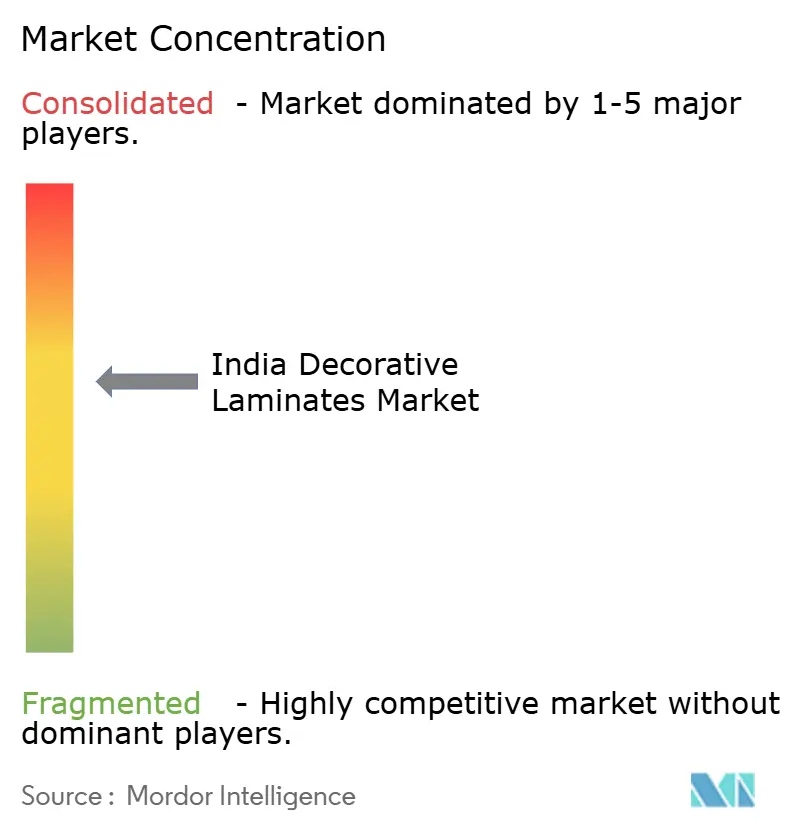
| Market Concentration | Medium |
Major Players *Disclaimer: Major Players sorted in no particular order Image © Mordor Intelligence. Reuse requires attribution under CC BY 4.0. | |
India Decorative Laminates Market Analysis by Mordor Intelligence
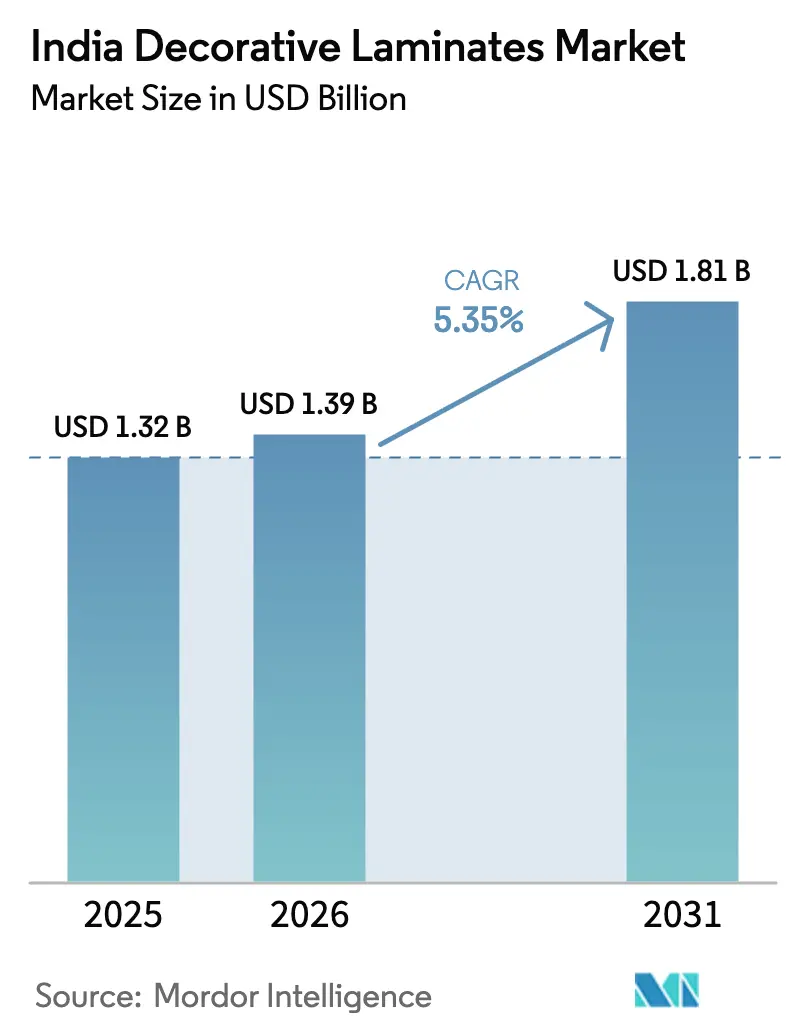
The India Decorative Laminates Market size was valued at USD 1.32 billion in 2025 and estimated to grow from USD 1.39 billion in 2026 to reach USD 1.81 billion by 2031, at a CAGR of 5.35% during the forecast period (2026-2031). Ongoing residential construction, rising modular furniture penetration, and regulatory moves toward ultra-low formaldehyde grades are driving steady volume growth while increasing input cost complexity. Particle board and medium-density fiberboard remain the core substrates; however, adhesive suppliers are capturing incremental value as manufacturers reformulate to meet the IS 12592:2023 emission limits. Digital printing is enabling mid-tier producers to offer premium aesthetics at lower minimum order sizes, thereby fragmenting design leadership. At the same time, sharp swings in phenolic and melamine resin prices are compressing margins and rewarding players with backward integration or long-term supply contracts. Competitive pressure remains intense because unorganized factories still dominate the volume, although capacity additions by organized leaders signal an accelerating formalization.
Key Report Takeaways
- By raw material, the Wood Substrate segment accounted for 42.02% of India decorative laminates market share in 2025. Adhesives are forecasted to grow at the fastest rate within raw materials, with a 6.05% CAGR through 2031.
- By application, Furniture led with 55.78% revenue share of India decorative laminates market size in 2025. Wall panels are expected to post the highest growth rate at a 6.26% CAGR through 2031.
Note: Market size and forecast figures in this report are generated using Mordor Intelligence’s proprietary estimation framework, updated with the latest available data and insights as of 2026.
Worldwide, activity is shaped by contributions from multiple countries and regions, with India representing one among them. The global report on decorative laminates market by Mordor Intelligence reflects how these countries and regional layers combine into a single system.
India Decorative Laminates Market Trends and Insights
Drivers Impact Analysis*
| Driver | (~) % Impact on CAGR Forecast | Geographic Relevance | Impact Timeline |
|---|---|---|---|
| Rapid expansion of residential real-estate and affordable-housing schemes | +1.8% | Maharashtra, Gujarat, Karnataka, Tamil Nadu | Medium term (2-4 years) |
| Shift to modular furniture and organised retail channels | +1.5% | Mumbai, Delhi, Bengaluru, Pune, Ahmedabad | Short term (≤ 2 years) |
| Digital-printing tech enabling mass-premium custom decors | +0.9% | Early adoption in Gujarat and Maharashtra | Medium term (2-4 years) |
| Government incentives for low-VOC / E0 grade surfaces | +0.7% | National | Long term (≥ 4 years) |
| Export boom from India under “China-plus-one” sourcing | +0.6% | Gujarat, Andhra Pradesh, Punjab | Long term (≥ 4 years) |
| Source: Mordor Intelligence | |||
Rapid Expansion of Residential Real-Estate and Affordable-Housing Schemes
India delivered 406,889 new homes in fiscal 2025, representing a 33% year-over-year increase, while the luxury category saw sales growth of 28-85% across major metros[1]India Brand Equity Foundation, “Real Estate Annual Update 2025,” ibef.org. This build-out feeds direct demand for laminates in kitchens, wardrobes, and wall panels. Developers favor pre-laminated particle board and MDF to shorten project cycles and control budgets, locking in high-volume purchases from organized distributors. Government programs such as Pradhan Mantri Awas Yojana enhance momentum in the sub-₹50 lakh bracket. As urbanization pushes India’s city population above 600 million by 2030, manufacturers that secure supply agreements with turnkey fit-out firms are positioned for sustained sheet-volume gains.
Shift to Modular Furniture and Organised Retail Channels
Factory-built modular units are replacing on-site carpentry, reshaping laminate specification and distribution. Large chains, including IKEA, Pepperfry, and Godrej Interio, are scaling into tier-2 cities, demanding certified laminates with uniform quality for flat-pack logistics. Dealer expansion models such as CenturyPly’s “Fix Day Fix Route” have added more than 500 outlets in a single fiscal year, cementing channel reach. Each urban modular kitchen consumes 15-25 sheets, and penetration has risen to an estimated 25% of new homes in metropolitan areas. Rising expectations around anti-fingerprint coatings and synchronized wood-grain textures are pushing unorganized mills to either upgrade or exit.
Digital-Printing Tech Enabling Mass-Premium Custom Decors
Investments in single-pass inkjet lines enable photo-realistic wood, stone, and fabric finishes without the need for expensive rotogravure cylinders, thereby cutting design lead times from months to days. Launches such as Greenlam’s Mikado collection and Merino’s Decowood underscore how mid-volume runs now command a premium. Capital outlays of INR (50-100) crore per press limit participation to well-capitalized firms, accelerating consolidation. Interior designers gain freedom to order short-run bespoke patterns, expanding the addressable pool for premium-priced sheets.
Government Incentives for Low-VOC / E0 Grade Surfaces
IS 12592:2023 sets an E0 cap of ≤0.5 mg/L formaldehyde, down from E1’s ≤1.5 mg/L threshold, and dovetails with Quality Control Orders due in 2024 and 2025[2]Bureau of Indian Standards, “IS 12592:2023 Formaldehyde Emission Standard,” bis.gov.in. Compliance drives adhesive reformulation costs up 8-12%, yet allows producers to charge 10-15% price premiums on IGBC LEED or GRIHA projects. Fiscal incentives worth ₹329 crore have been offered to Greenlam’s Andhra Pradesh plant, highlighting state-level support tied to environmental benchmarks. Early movers anticipate dominating institutional and export tenders that require low-VOC certification.
Restraints Impact Analysis*
| Restraint | (~) % Impact on CAGR Forecast | Geographic Relevance | Impact Timeline |
|---|---|---|---|
| Intensifying competition from PVC boards and engineered stone | -0.8% | Coastal and humid regions (Kerala, Goa, West Bengal) | Short term (≤ 2 years) |
| Volatility in phenolic/melamine resin prices | -0.6% | National | Short term (≤ 2 years) |
| Tightening formaldehyde-emission norms (IS 12592:2023) | -0.4% | National | Medium term (2-4 years) |
| Source: Mordor Intelligence | |||
Intensifying Competition from PVC Boards and Engineered Stone
Polyvinyl chloride boards and wood-plastic composites offer termite and moisture resistance, capturing a significant share of the kitchen and bath market in coastal states. Engineered quartz worktops, priced at INR (565-1,400) per sq ft versus laminates at about INR 150, are pulling premium consumers toward stone finishes, especially in metropolitan renovations. Laminate producers are countering with compact panels and fire-retardant grades, but these niches require customer education and higher production costs.
Volatility in Phenolic/Melamine Resin Prices
Phenol traded above INR 100 per kg in 2024 amid a 15,000-tonne domestic supply shortfall, resulting in a reliance on imports. Melamine experienced double-digit quarterly swings as global supply and demand shifted. Producers with captive resin lines or locked-in contracts typically realize a 5-8% cost advantage, while smaller firms often suffer margin shocks. Unpredictable raw material outlays complicate pricing strategies for the India decorative laminates market.
*Our forecasts treat driver/restraint impacts as directional, not additive. The impact forecasts reflect baseline growth, mix effects, and variable interactions.
Segment Analysis
By Raw Material: Substrate Dominance Amid Adhesive Innovation
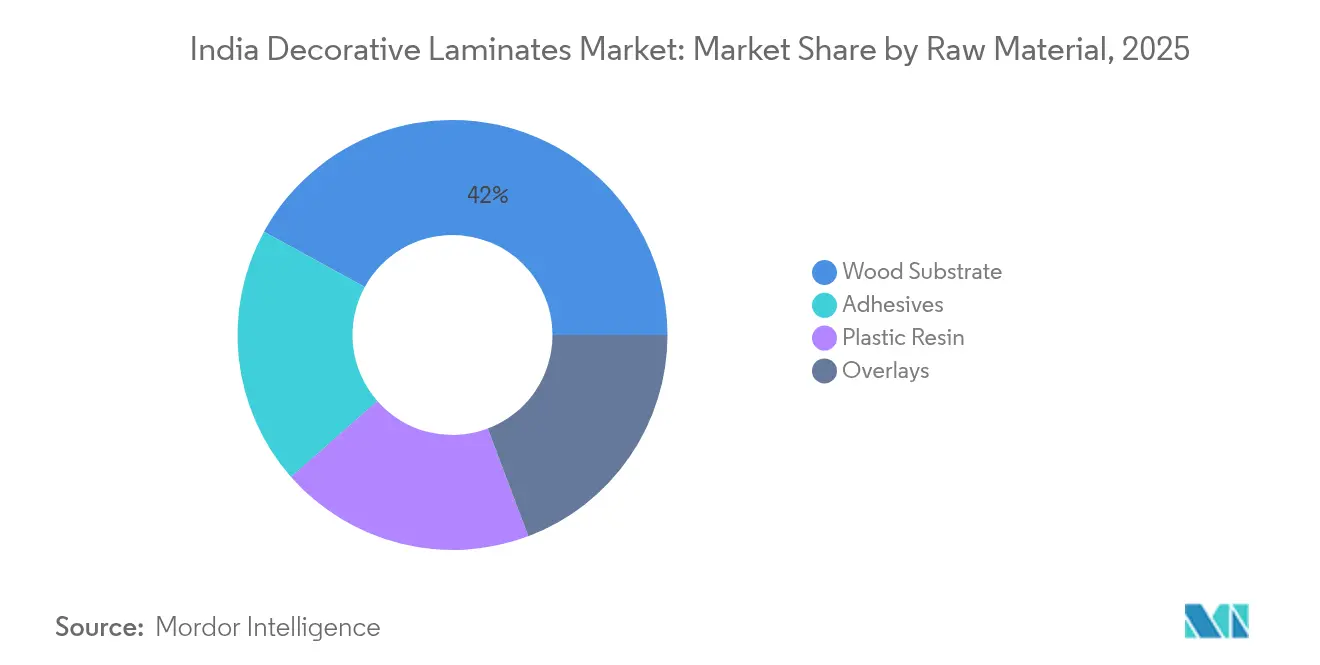
Wood substrate held a 42.02% India decorative laminates market share in 2025, anchored by the cost advantage of particle board and MDF. Domestic board makers can deliver at INR (25-35) per sq ft, reinforcing their grip on value-conscious projects. Adhesives, though a smaller revenue pool today, are forecast to post a 6.05% CAGR, supported by the mandated shift to formaldehyde-free chemistries. Multinationals such as Henkel and Pidilite have introduced soy- and lignin-based binders that enable manufacturers to hit E0 thresholds without compromising bond strength.
Continuous-press particle-board lines, like the one Greenlam is installing in Andhra Pradesh, produce denser panels with tighter tolerances, helping laminators reduce sanding loss and improve yield. In parallel, antimicrobial additive packages embedded in adhesive layers, exemplified by CenturyPly’s ViroKill, open premium price windows in healthcare and hospitality projects. As sustainability audits become mainstream, board and resin suppliers offering FSC or PEFC chain-of-custody documentation will unlock access to export orders and green-building projects, raising the strategic value of backward integration.



By Application: Furniture Leads, Wall Panels Surge
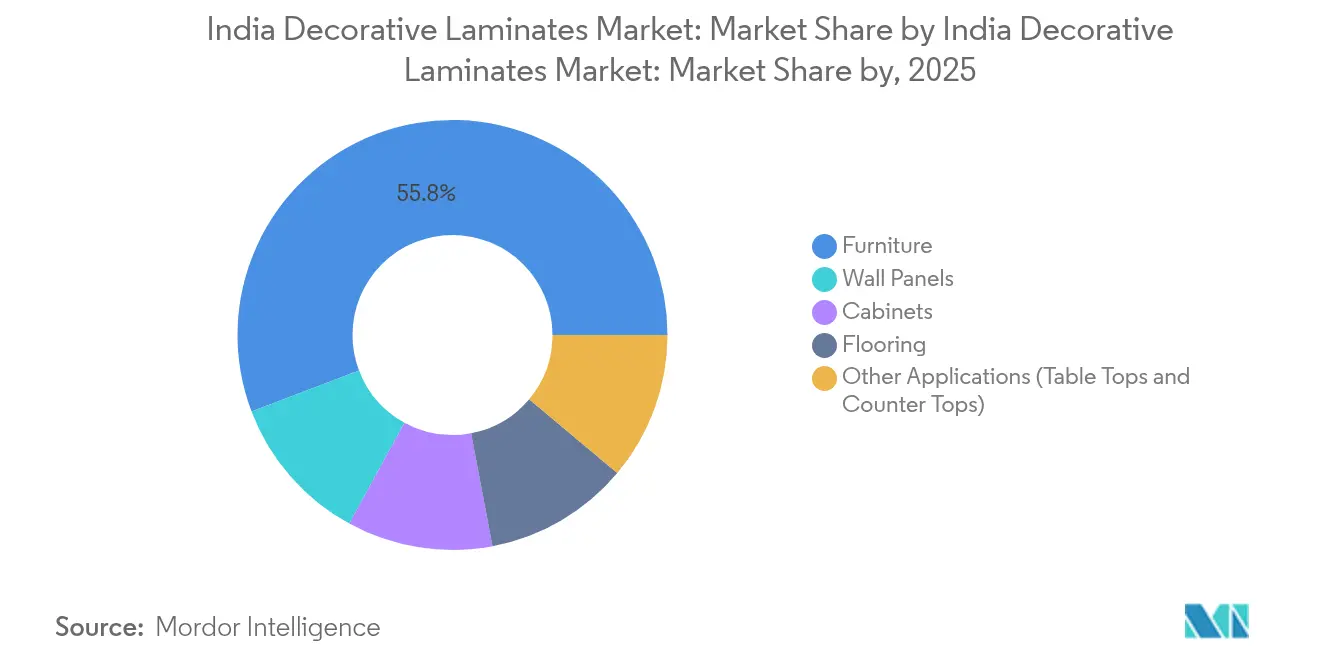
Furniture accounted for 55.78% India decorative laminates market size in 2025, riding the modular-kitchen boom that now touches roughly one-quarter of new urban homes. Ready-to-assemble cabinetry relies on laminates for shutters, carcass cladding, and slim worktops, keeping volume growth synchronized with housing deliveries. Organized fit-out specialists specify abrasion-class ratings and synchronized grain alignment, prompting greater design differentiation.
Wall panels are set to expand at 6.26% CAGR, the fastest among applications, as hospitality and office interiors pivot toward quick-install decorative cladding. Single-pass digital printing lets designers order bespoke textures that previously required imported veneer or fabric panels. Compact laminates with self-supporting thicknesses of 6-25 mm are penetrating high-traffic corridors and elevator lobbies, adding durability attributes that justify higher per-sheet pricing.
Geography Analysis
Western and southern states drive roughly two-thirds of India decorative laminates market demand. Maharashtra tops consumption, buoyed by Mumbai’s dominance in residential and commercial construction approvals; over 30 million sq ft of office space is slated to open across its IT parks and mixed-use complexes by 2027. Organized laminate showrooms cluster in Pune and Mumbai, where modular-kitchen retailers record their highest sales density.
Gujarat is emerging as a powerhouse in production and exports. The Morbi-Ahmedabad corridor attracted investments topping INR 2.83 lakh crore in fiscal 2023, while proximity to Kandla and Mundra ports lowers export logistics costs. Rushil Décor’s Gandhinagar complex exemplifies this orientation, having booked overseas contracts soon after its commissioning. Smart-city programs in Ahmedabad and Surat are stimulating demand for E0-grade surfaces in municipal and institutional buildings.
Southern hubs—Karnataka, Tamil Nadu, and Andhra Pradesh—are emerging as next-generation growth centers. Greenlam’s Naidupeta site will be South India’s largest high-pressure laminate plant, supported by state incentives covering about 30% of project capex. Bengaluru’s tech corridor is fueling corporate fit-out volumes, while Chennai and Hyderabad add housing starts that favor pre-laminated boards. Northern clusters in Punjab and the Delhi-NCR region continue to leverage long-standing manufacturing bases; CenturyPly’s expansion in Hoshiarpur strengthens supply into North and East markets.
Mordor Intelligence provides coverage of the decorative laminates market across other key regional markets, including Europe, each with their regulatory frameworks and demand patterns. Detailed country-level analysis extends to United States incorporating local coverage and market participation, as required.
Value Chain Analysis
The India decorative laminates value chain starts with upstream chemicals and paper inputs (phenolic and melamine resins, specialty overlays/decor papers, and additives) and wood-panel substrates such as particle board and MDF. It then moves through impregnation, hot-pressing/lamination, finishing (texture, coating, trimming), quality testing, and packaging. Input-cost exposure is material, since phenolic and melamine resin volatility affects laminate producers and raises the value of sourcing discipline, captive resin capability, and long-term procurement. Adhesive reformulation is also increasing technical collaboration between resin/adhesive suppliers and laminate manufacturers as the market targets ultra-low emission requirements.
Midstream manufacturing is split between organized players with continuous-press and digital-printing investments and a large unorganized base that competes on price and lead time. Organized leaders increasingly use in-house labs and standardized product systems to serve modular furniture and institutional specifications. Downstream, distribution runs through company-owned showrooms, franchise outlets, and multi-brand dealers to carpenters, fabricators, and modular-furniture OEMs, with project pull-through from developers and fit-out contractors. Cross-border linkages are becoming more visible: Aica Kogyo completed the acquisition of a 40% stake in Stylam Industries on June 17, 2026, a move that can tighten governance and connect Stylam to broader global procurement and technology networks, influencing how premium decor papers, resins, and manufacturing know-how flow into Indian supply chains.
Competitive Landscape
The Indian Decorative Laminates Market is moderately concentrated. Greenlam, CenturyPly, and Merino headline the organized tier, each investing in capacity, digital printing, and low-VOC compliance. Technology and compliance are separating leaders from laggards. Continuous-press board lines, single-pass inkjet printers, silver-ion antimicrobial formulations, and in-house test labs confer both cost and pricing power. The march toward mandatory E0 certification is likely to hasten consolidation, as undercapitalized mills either upgrade at compressed margins or exit the Indian decorative laminates industry.
India Decorative Laminates Industry Leaders
Greenlam Industries Limited
Aica Laminates India Pvt. Ltd.
Merino India
CenturyPly
Stylam
- *Disclaimer: Major Players sorted in no particular order

Market Opportunities and Future Outlook
A clear whitespace is in certified low-emission, specification-led laminates for modern retail, institutional fit-outs, and green-building projects, where buyers increasingly ask for repeatable performance (formaldehyde emission limits, abrasion and surface durability, and consistent batch quality) rather than aesthetics alone. Manufacturers have been reallocating capex and product development toward higher-value surfaces and compliance. Greenlam Industries reported consolidated annual revenues exceeding INR 3,000 crore for the fiscal year ended March 31, 2026, alongside ongoing investments in capacity and capability, while the market formalizes as larger brands expand channels and push standardization into tier-2 and tier-3 demand centers.
A second opportunity is premiumization through faster design cycles and export-oriented offerings, enabled by digital printing, compact laminate formats, and synchronized textures that can compete with imported decors while reducing minimum order constraints for designers and OEMs. Q4 FY2026 industry snapshots characterized laminates as the highest-margin sub-segment within Indian wood panels, supporting continued investment in design libraries and coating technologies such as anti-fingerprint and antimicrobial, along with integrated substrate-plus-surface solutions. At the same time, partnerships and equity participation by global materials groups, such as Aica Kogyo in Stylam, create room for technology transfer, broader sourcing of specialty papers and resins, and strengthened export readiness for Indian producers through more consistent quality and documentation.
Recent Industry Developments
- June 2026: Aica Kogyo Company, Limited completes acquisition of 40% equity stake in Stylam Industries Limited (off-market) and appoints new directors. The action integrates global material capabilities with Stylam's production, signaling potential supply-chain and governance implications.
- April 2026: Greenlam Industries Limited expanded retail footprint in Vapi, India with the launch of a new Greenlam Shoppe retail outlet. The expansion supports direct-to-market presence and consumer exposure, with potential impact on regional demand and pricing power.
- April 2026: Merino Industries Ltd. launched a new brand campaign featuring actor Pankaj Kapur to highlight health, durability, and everyday reliability of Marine Board products. The campaign increases consumer awareness, with potential premiumization of Merino’s Marine Board line.


Research Methodology Framework and Report Scope
Market Definition and Coverage
For this study, the market covers decorative laminate sheets and related surfacing products sold in India for interior finishing across homes and commercial spaces, measured in value at the point of sale by manufacturers and distributors.
Scope exclusions: This sizing does not count natural wood veneers, solid surface materials, paints and wallpapers, or furniture and panel boards sold without a laminate surfacing layer.
Segmentation Overview
- By Raw Material
- Plastic Resin
- Overlays
- Adhesives
- Wood Substrate
- By Application
- Furniture
- Cabinets
- Flooring
- Wall Panels
- Other Applications (Table Tops and Counter Tops)
Data Sources, Market Sizing, and Validation
Desk Research
Desk research starts by mapping the India demand pool using construction activity, renovation indicators, and momentum in furniture manufacturing, then translating that activity into laminate usage patterns. We referenced public sources such as MOSPI and National Accounts data for housing and consumption signals, DPIIT and Ministry of Commerce trade statistics for import and export trends, and BIS standards updates relevant to interior materials. We also used papers and technical notes in journals that discuss laminate performance and emission norms.
After that, company documents were reviewed to understand capacity additions, product mix, and pricing movement, using annual reports, investor presentations, and credible press coverage. A few paid subscriptions were used in a limited way for company financial intelligence, shipment level import-export checks, and patent landscaping to see where design and surface technology investments are being made. These desk sources are illustrative, and many other public references were used during data collection, clarification, and cross-checking.
Primary Interviews and Surveys
Primary work focused on validating how laminate demand tracks residential fit-outs, modular furniture growth, and commercial refurbishment cycles across India. We spoke with a mix of manufacturers, distributors, dealers, fabricators, and large buyers, and the discussions were used to confirm price bands, channel margins, and how product substitution happens across applications.
Distribution of primary research fieldwork respondents
| Company type | Respondent position |
|---|---|
| Top tier: 34% | CXOs: 13% |
| Mid tier: 52% | Functional/Unit leaders: 41% |
| Smaller Players: 14% | Managers: 46% |
Market-Sizing & Forecasting
Sizing begins with a top-down build where construction and interior finishing spend is reconstructed for India, then filtered into a laminate addressable pool using penetration rates by common end uses like furniture, cabinets, and wall panels. To keep the totals practical, we also corroborate them with selective bottom-up approximations such as sampled channel sell-through, indicative sheet consumption per project type, and sanity checks using reported capacities and utilization ranges.
Key inputs that shaped the model include the pace of new residential completions and renovation activity, the share shift toward modular furniture, movement in raw material costs for resins and overlays that influence pricing, import dependence for certain inputs, and the mix movement between higher pressure and lower pressure product types. Where direct volume signals were patchy, we handled the gaps by using distributor coverage patterns and regional build-rate proxies, then corrected them after interview feedback.
For forecasting, we used scenario analysis supported by trend smoothing on the main demand drivers, then adjusted the path using expert views on construction cycles, channel inventory behavior, and price pass-through timing. The output is produced in USD value terms with consistent currency conversion assumptions across the time series.
Data Validation & Update Cycle
Outputs are checked using multiple passes where model totals are compared with independent signals such as trade movement, announced capacity additions, and plausible price bands seen in the channel. If the model shows sharp jumps, inputs are rechecked, assumptions are reviewed by a second analyst, and follow-up calls are triggered with selected respondents to confirm what changed.
The report is refreshed annually, and interim updates are done when material events can shift demand or pricing, such as major resin cost swings, policy changes, or large capacity start-ups. Before delivery, we do a final review pass so the numbers reflect the latest available information and consistent assumptions.
Mordor Intelligence's India Decorative Laminates Market Size Measured Against Other Published Estimates
It is normal to see different published numbers for India decorative laminates because authors do not always count the same product set, selling level, or time window. Some sources also mix laminates with broader wood panel categories. Differences can also come from how average selling prices are derived, whether informal channel volumes are treated as fully captured, and how currency conversion is applied across years.
Some public write-ups lean on a broader definition that blends decorative laminates with adjacent surfacing or interior material buckets, which often pushes the value higher. Mordor Intelligence counts only decorative laminate products sold for applications like furniture, cabinets, flooring, and wall panels in India, and it keeps the forecast tied to channel validated price bands and a 2026-2031 refresh cycle rather than long-horizon extrapolations.
Benchmark comparison
| Source | Market Size | Gaps in Research Methodology |
|---|---|---|
| Mordor Intelligence | USD 1.32 B (2025) | |
| Trade Media A | USD 1.80 B (2023) | Uses a wider segmentation set that can blend decorative laminates with related interior surfacing buckets, and the time window starts earlier, which can inflate totals when price cycles differ. |
| Industry Source B | USD 1.05 B (2024) | Often reflects an organized-market leaning view or manufacturer-only billing values, and it can undercount unorganized flow and dealer-level markups that are visible in channel checks. |
The spread across the three figures is mainly explained by scope and the selling level being priced, then reinforced by different base years and update timing. By keeping the counted products and end uses consistent, and by stress-testing the totals against channel pricing and demand signals, the estimate stays traceable to clear inputs and repeatable steps.


Key Questions Answered in the Report
What is the current value of the India decorative laminates market?
The India decorative laminates market size stands at USD 1.39 billion in 2026 and is forecast to reach USD 1.81 billion by 2031.
Which raw-material segment dominates sales?
Wood substrates, primarily particle board and MDF, captured 42.02% India decorative laminates market share in 2025.
Which application segment is growing the fastest?
Wall panels are projected to expand at a 6.26% CAGR between 2026 and 2031.
How will IS 12592:2023 affect producers?
The E0 emission mandate raises production costs 8-12% but enables premium pricing on green-certified projects.
Which states host the largest laminate plants?
Major capacities are concentrated in Gujarat’s Gandhinagar corridor and Andhra Pradesh’s Naidupeta manufacturing hub.
Page last updated on:


 Your data is secure and never sold or shared.


