
Market Overview
| Study Period | 2020 - 2031 |
|---|---|
| Forecast Data Period | 2026 - 2031 |
| Base Year Market Size (2025) | USD 0.72 Billion |
| Market Size (2026) | USD 0.79 Billion |
| Market Size (2031) | USD 1.27 Billion |
| Growth Rate (2026 - 2031) | 9.98 % |
| Market Concentration | Medium |
Major Players *Disclaimer: Major Players sorted in no particular order Image © Mordor Intelligence. Reuse requires attribution under CC BY 4.0. | |
India Particle Board Market Analysis by Mordor Intelligence
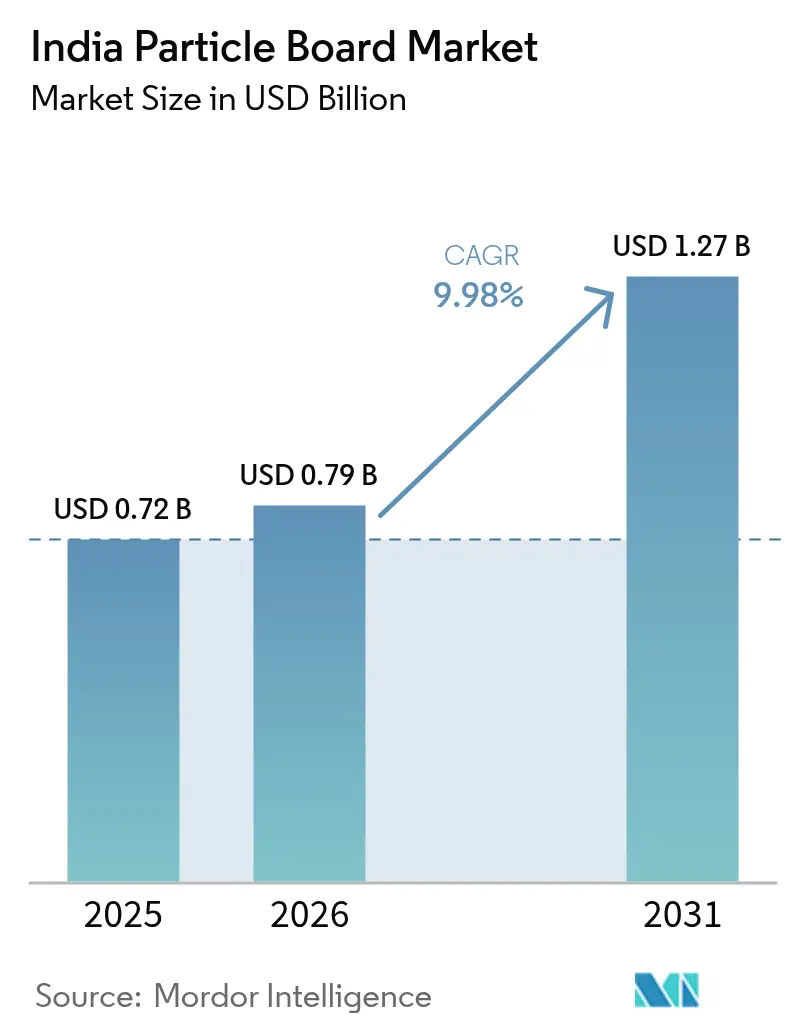
The India Particle Board Market size was valued at USD 0.72 billion in 2025 and estimated to grow from USD 0.79 billion in 2026 to reach USD 1.27 billion by 2031, at a CAGR of 9.98% during the forecast period (2026-2031). Current demand growth stems from urban housing starts, organized furniture retail, and export compliance pressures that reward quality upgrades. Regulatory milestones such as the February 2025 Bureau of Indian Standards (BIS) Quality Control Orders are accelerating the shift from a fragmented, price-sensitive supply base toward a consolidated, technology-driven ecosystem[1]. Government incentives, including the Production Linked Incentive (PLI) scheme for furniture components, reinforce capital spending on capacity additions that embed AI-enabled automation and emission-controlled resin technologies. Large producers are front-loading investments to pre-empt the BIS deadline, while medium-scale firms are pivoting to waste-based feedstocks to protect margins from imported log price swings. Export opportunities tied to CARB Phase 2 and EN 120 formaldehyde limits have created a dual-market strategy.
Key Report Takeaways
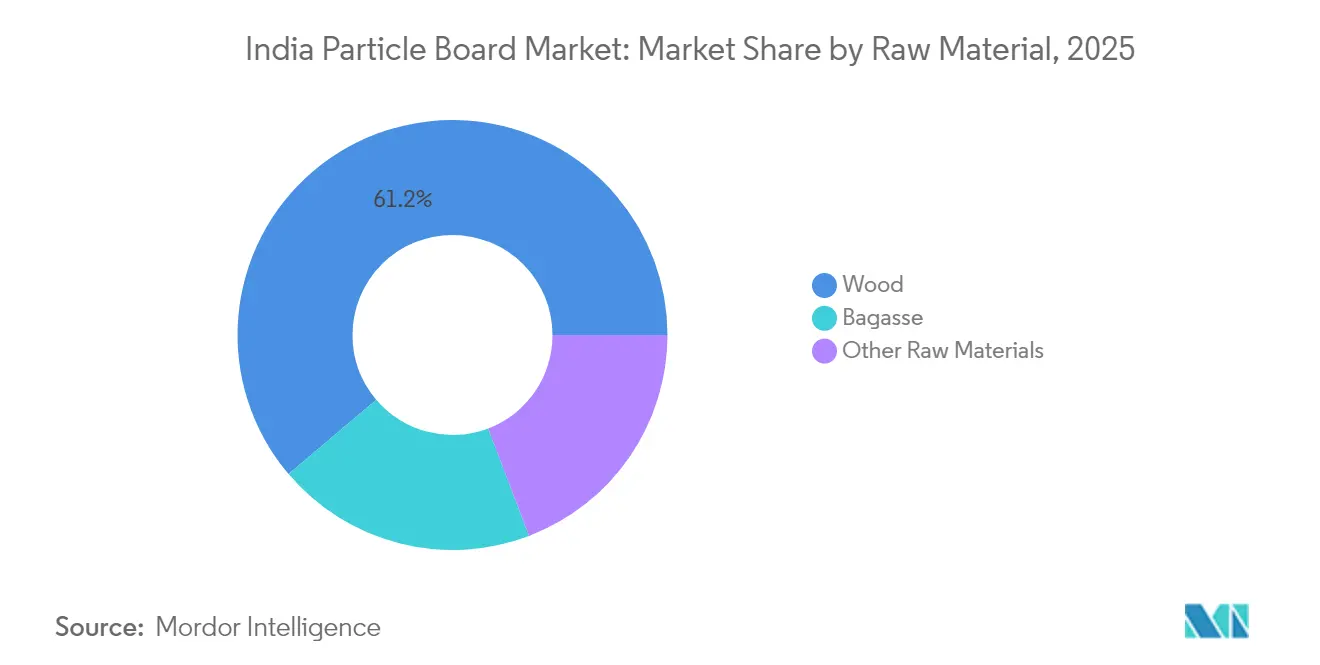
- By raw material, wood commanded 61.20% of India particle board market share in 2025, whereas bagasse is forecast to accelerate at a 12.32% CAGR through 2031.
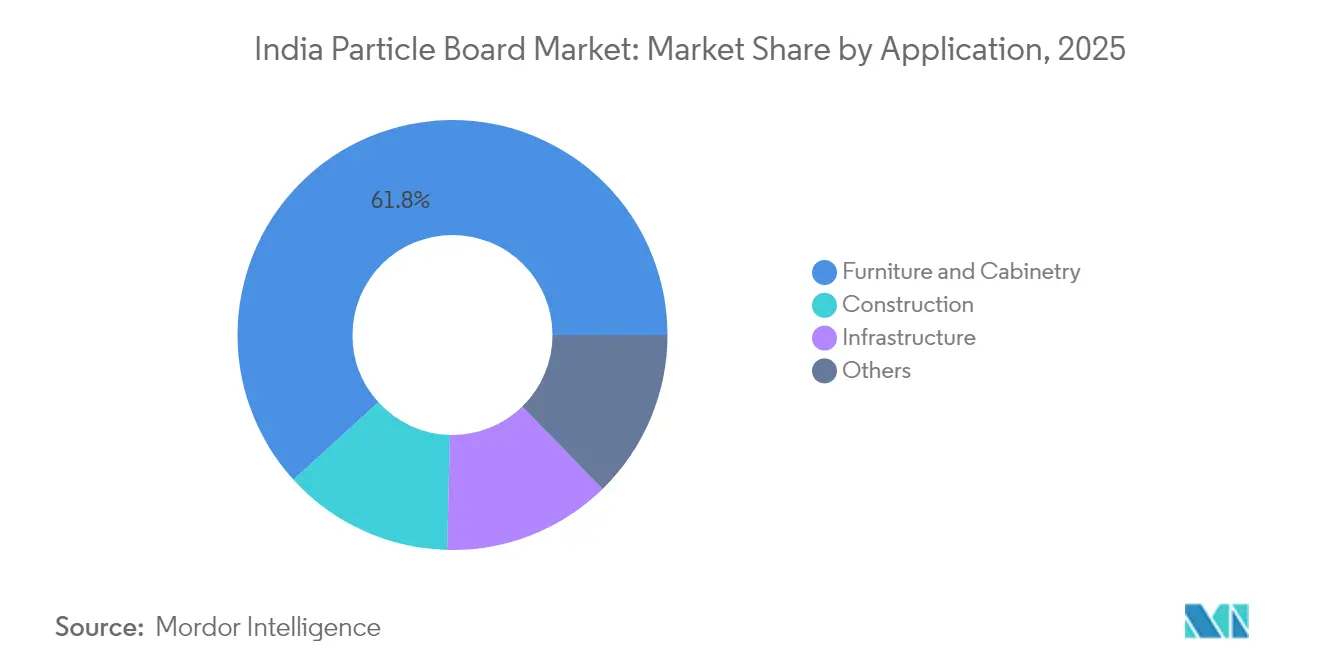
- By application, furniture and cabinetry accounted for 61.75% of the India particle board market size in 2025 and is expected to expand at an 11.52% CAGR to 2031.
Note: Market size and forecast figures in this report are generated using Mordor Intelligence’s proprietary estimation framework, updated with the latest available data and insights as of 2026.
Market Trends and Insights
Drivers Impact Analysis of India Particle Board Market*
| Drivers | (~) % Impact on CAGR Forecast | Geographic Relevance | Impact Timeline |
|---|---|---|---|
| Rising office, hospitality and retail furniture demand | +2.8% | National, with concentration in Tier-1 and Tier-2 cities | Medium term (2-4 years) |
| Urban-housing push and smart-city projects | +2.1% | 100 smart cities and major urban agglomerations | Long term (≥ 4 years) |
| Government PLI incentives for furniture components | +1.9% | Manufacturing clusters in Gujarat, Maharashtra, Tamil Nadu | Short term (≤ 2 years) |
| EU/US low-emission export opportunity | +1.7% | Export-oriented manufacturing hubs | Medium term (2-4 years) |
| AI-enabled panel-line automation cuts unit cost | +1.2% | Large-scale manufacturing facilities | Long term (≥ 4 years) |
| Source: Mordor Intelligence | |||
Rising Office, Hospitality, and Retail Furniture Demand
Commercial refurbishment cycles have shortened as enterprises adopt modular workstations that rely on standardized board dimensions, ensuring steady call-offs from panel suppliers. Hospitality chains replacing custom millwork with easily replaceable particle board (chip board) fixtures now place multi-year blanket orders that stabilize factory throughput. Organized retail is scaling ready-to-assemble furniture lines whose flat-pack logistics favor particle board over plywood because of weight and cost advantages. E-commerce sellers bundle fittings and fasteners with pre-laminated panels to serve budget-conscious consumers, deepening consumption in Tier-2 growth corridors. Corporate occupiers migrating to secondary cities extend this driver beyond traditional metropolitan catchments.
Urban-Housing Push and Smart-City Projects
Smart-city spending packages interior fit-outs for public transit stations, administrative offices, and community centers into the civil works budget, adding a non-cyclical layer of demand for certified boards. Affordable-housing schemes under PMAY integrate modular kitchens that specify E1-grade particle board, linking social policy with industrial growth. Industrial corridor nodes blend residential and commercial real-estate approvals, creating contiguous demand pools for board-based cabinetry. Green-building scorecards increasingly reward low-emission engineered wood, allowing compliant producers to bid at premium prices. The pipeline of 12 new industrial nodes sustains long-range order visibility that justifies new continuous-press lines.
Government PLI Incentives for Furniture Components
PLI rebates covering up to 8% of incremental sales encourage furniture exporters to lock in domestic panel suppliers that satisfy ISO and FSC chain-of-custody requirements, thereby reducing reliance on Southeast Asian imports. Long-term offtake contracts arising from PLI awards have shortened payback periods for new presses to under four years, catalyzing green-field plants in Tamil Nadu and Maharashtra. Board makers are collaborating with downstream assemblers to co-design low-waste panel sizes. Regional governments layer additional land and power subsidies, concentrating capacities in designated clusters where logistics infrastructure already exists. This confluence of fiscal incentives and guaranteed demand expedites the scaling of export-grade production lots.
EU/US Low-Emission Export Opportunity
Formaldehyde emission caps of 0.05 ppm under CARB Phase 2 align with India’s limits, enabling dual-certified plants to serve domestic and overseas buyers without parallel SKUs. Export premiums shield margins from domestic price volatility and finance the installation of melamine-urea-formaldehyde blends that cut emissions by 40%. U.S. home-improvement chains source private-label particle board furniture exclusively from compliant facilities, opening multi-container monthly lanes for qualified Indian producers. European distributors require third-party audits, compelling suppliers to digitize traceability all the way to plantation forests, which in turn raises the entry bar for non-compliant mills. As emission ceilings in key markets tighten, early movers could lock in share before late adopters upgrade equipment.
Restraints Impact Analysis of India Particle Board Market*
| Restraints | (~) % Impact on CAGR Forecast | Geographic Relevance | Impact Timeline |
|---|---|---|---|
| MDF cannibalisation in premium cabinets | -1.8% | Urban markets with higher disposable income | Medium term (2-4 years) |
| Volatile imported log and resin prices | -2.3% | National, affecting import-dependent manufacturers | Short term (≤ 2 years) |
| Tightening global formaldehyde limits | -1.1% | Export-oriented and premium domestic segments | Long term (≥ 4 years) |
| Source: Mordor Intelligence | |||
MDF Cannibalisation in Premium Cabinets
MDF’s finer fiber matrix yields crisper routed edges that premium kitchen makers prefer for shaker-style doors, leading to a share shift at the cabinetry market's upper end. Urban consumers tolerate a 15-20% price uplift when the perceived quality jump aligns with rising disposable incomes. Particle board suppliers respond with higher-density grades and improved surface sanding to shrink the aesthetic gap, while staying 8-10% below MDF on delivered cost. Moisture-prone zones such as under-sink panels remain MDF strongholds, but board makers accelerate research and development on hydrophobic additives to claw back share. Cannibalisation, therefore, remains contained to premium SKUs rather than mass-market furniture.
Volatile Imported Log and Resin Prices
Hardwood log imports priced in EUR expose mills to currency swings that can inflate landed cost by up to 12% within a quarter. Resin inputs linked to global crude benchmarks push glue cost swings onto margins that smaller mills cannot hedge. CITES restrictions on specific hardwood species force abrupt sourcing shifts that disrupt chip geometry and press calibrations. Some producers offset volatility by ramping bagasse content, yet seasonal availability necessitates inventory buffers that tie up working capital. Larger producers negotiate annual resin contracts and diversify feedstock through recycled wood streams, but smaller units face squeeze-outs during price spikes.
*Our forecasts treat driver/restraint impacts as directional, not additive. The impact forecasts reflect baseline growth, mix effects, and variable interactions.
India Particle Board Market Segment Analysis
By Raw Material:
Wood Dominance Faces Sustainability PressureWood-based feedstocks retained 61.20% of India particle board market share in 2025, anchoring process yields through centuries-old sawmill linkages that guarantee chip consistency. However, climate commitments and biomass incentives propel bagasse to a 12.32% CAGR, outpacing all other materials and narrowing wood’s hegemony each successive year. The India particle board market size attributable to bagasse could grow purely on the back of sugar-mill waste monetization once planned storage silos and dryers come online. Simultaneously, recycled wood chips from construction debris enter the mix, providing feedstock hedges against imported log shortages.
Bagasse-centric plants compile carbon-credit dossiers to monetize greenhouse-gas offsets, adding a supplementary revenue stream that cushions price cycles. University trials demonstrate comparable rupture and internal-bond strength modulus between bagasse and eucalyptus boards when press parameters are optimized, nullifying earlier quality concerns. Several western-India mills have committed capex for dedicated depithing and cleaning units, anticipating preferential procurement from green-label furniture exporters. As BIS audit teams expand post-2025, feedstock traceability standards will favor mills with digitized bagasse procurement records.

By Application:
Furniture Leadership Drives Market EvolutionFurniture and cabinetry absorbed 61.75% of the India particle board market in 2025, driven by organized retail and e-commerce bundles that embed ready-to-assemble concepts into urban lifestyles. This application segment is forecast to grow at a 11.52% CAGR through 2031. Construction fix-outs, such as drywall backing and mezzanine flooring, deliver year-round offtake that stabilizes mill utilization when furniture orders dip seasonally. Infrastructure interiors for rail terminals and civic buildings represent a pipeline that widens geographic penetration beyond major metros.
Furniture makers increasingly demand pre-laminated E1-grade panels that speed assembly and reduce downstream lamination labor, compelling board suppliers to integrate short-cycle press lines. Online brands co-design knock-down formats with panel producers to minimize waste across the nesting layout. Though price sensitive, construction panels offer lower defect tolerances, pushing mills to install in-line sanding and defect-mapping scanners that simultaneously raise overall plant yields. As smart-city tenders stipulate low-formaldehyde surfaces, infrastructure applications will effectively mirror the quality threshold set by export furniture.
Geography Analysis
Western and southern clusters anchor most of India's particle board market output. Tamil Nadu’s share is rising after a USD 662 million integrated complex came online, adding 320,000 m³ of annual capacity and reinforcing the state’s position as a gateway for export consignments moving through Chennai and Tuticorin ports. Maharashtra plants leverage Mumbai’s port to access imported pine logs while maintaining just-in-time deliveries to Pune’s fast-growing modular kitchen assemblers.
Northern units around Haryana and Punjab draw on poplar plantations and recycled demolition wood, catering to Delhi-NCR’s refurb market and supplying decorative pre-lam boards to local OEMs. These plants often serve as feeders to export container consolidation yards in Nhava Sheva, ensuring backward integration with laminated surface printers. Eastern and northeastern states present untapped bamboo and agro-waste reserves, yet infrastructure gaps limit scale efficiencies; pilot lines funded under viability-gap grants aim to address this over the next two years. Therefore, the India particle board (chip board) market is evolving toward a multi-hub configuration that balances raw-material concentration with end-use proximity.
The government’s industrial corridor program will add 12 new nodes, unlocking land parcels with pre-approved environmental clearances that cut permitting times to under six months. Mills sited in these nodes can co-locate with furniture exporters, reducing freight cost and turnaround, thereby positioning themselves for PLI incentives. State-level power subsidies differ widely, giving plants in renewable-rich Gujarat and Tamil Nadu a 50-70 basis-point energy-cost edge over coal-dependent regions. As BIS inspectors scale operations, compliance scores skew higher in established hubs, making location choice a strategic bet on future regulatory enforcement intensity.
Value Chain Analysis
The value chain begins with feedstock procurement from sawmill residues (chips, shavings, sawdust) and increasingly from agricultural residues such as sugarcane bagasse, with recycled wood streams also used to hedge against imported log volatility. Upstream availability and consistency are shaped by seasonality and logistics, with monsoon disruptions and variable chip geometry affecting drying efficiency and panel quality. This raises the importance of collection yards, preprocessing, and quality sorting near raw-material hubs.
On the manufacturing side, producers manage chip preparation and drying, glue kitchen and resin dosing, mat forming, and multi-daylight or continuous press lines, followed by sanding, cutting, and (for value-added lines) lamination and surface finishing. The organized segment prioritizes automation and emission-controlled resin systems to meet BIS-aligned requirements and export-grade specifications, while the unorganized segment competes primarily on price but faces higher compliance and consistency hurdles. Distribution is handled through direct institutional supply (furniture OEMs, large developers) and traditional dealer networks. Direct-to-mill procurement is also gaining traction in tier-2 demand centers, compressing layers in the channel and shifting bargaining power toward large, certified producers.
Competitive Landscape
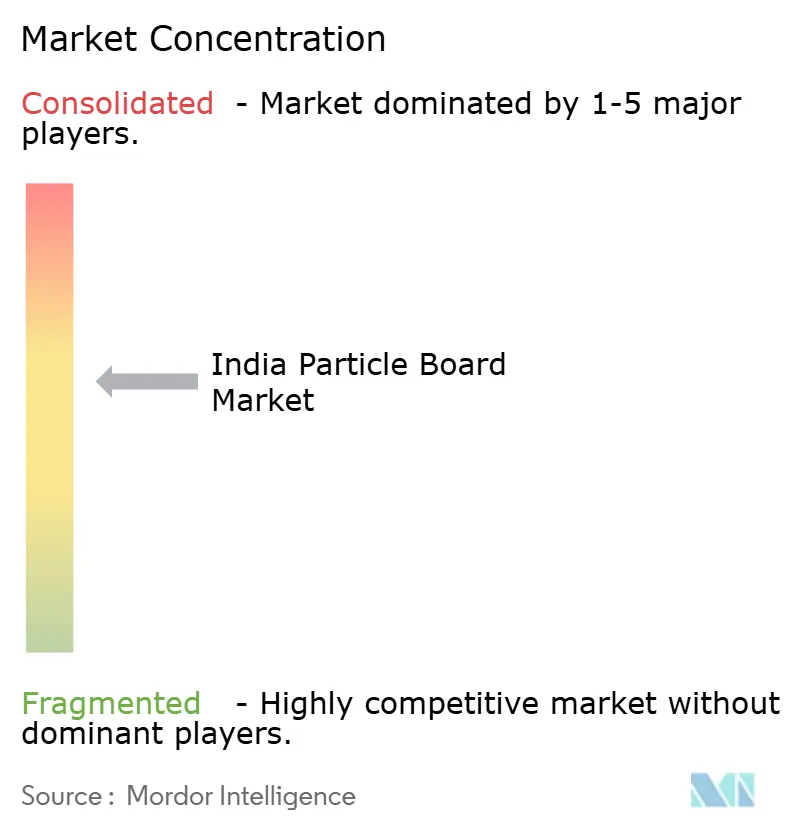
The India Particle Board Market is moderately consolidated. Strategic capex trends reveal a pivot toward integrated complexes combining MDF and particle board under one roof, allowing feedstock flexibility depending on market spreads. Sustainability certifications—from FSC chain-of-custody to EPD declarations—serve as differentiators in export tenders, prompting midsize firms to invest in audit readiness. Meanwhile, niche entrants target moisture-resistant and fire-retardant grades where regulatory mandates create protected segments. Competition is shifting from price wars to compliance, service reliability, and innovation in low-emission chemistries.
India Particle Board Industry Leaders
-
CenturyPly (Century Prowud)
-
Shirdi Panel Industries Ltd.(ASIS)
-
Action TESA
-
Merino Industries
-
Associate Décor Ltd.
- *Disclaimer: Major Players sorted in no particular order
India Particle Board Market Companies Covered in this Report
- Action TESA
- ARCHIDPLY DECOR
- Asian Prelam Industries Pvt. Ltd
- Associate Décor Ltd.
- Bajaj Hindusthan Sugar Ltd
- CenturyPly (Century Prowud)
- DMK Particleboard LLP
- Evergreen Boardlam Pvt. Ltd.
- Krifor Industries Pvt. Ltd.
- Lamikon Woodlam LLP
- Merino Industries
- Niramay Woodlam
- Shirdi Panel Industries Ltd.(ASIS)
Market Opportunities and Future Outlook
Compliance-led consolidation and product upgrading are creating room for certified, low-emission and specialty grades, particularly as buyers look for predictable performance and documented compliance. The BIS quality regime (IS 3087) and the January 2026 review of QCO implementation (with 2,473 domestic units reported as licensed) point to an operating environment where investment in in-house testing, traceability, and tighter process control has tangible advantages, especially for E1/E0 emission-aligned panels used in modular furniture and export-linked supply chains.
Feedstock diversification and a green positioning angle offer another opportunity lane, notably for bagasse-based particle boards supported by a lower 5% GST classification and ongoing efforts to standardize performance. In March 2026, FIPPI convened a technical meeting with IBBMA and IWST to review property evaluations of bagasse-based particle boards, indicating active work to broaden acceptance and specifications. Capacity build-outs in newer geographies also suggest additional hub potential: in May 2026, Century Plyboards proposed a new unit in Odisha with an investment exceeding INR 870 crore, including a 240,000 CBM per year particle board facility, reflecting continued interest in expanding beyond established western and southern clusters and improving proximity to emerging demand centers.
Recent Industry Developments in India Particle Board Market
- May 2026: Century Plyboards (India) Limited proposed a new manufacturing unit in Odisha with a planned investment exceeding INR 870 crore, including a 240,000 CBM per year particle board facility. The project indicates capacity migration beyond the most established western and southern clusters and supports shorter lead times to under-served regional demand pockets. It also reinforces the industry shift toward larger, integrated, compliance-ready platforms as certification and traceability requirements tighten.
- July 2025: CenturyPly commissioned a particle board manufacturing plant at Therovy Kandigai near Chennai, Tamil Nadu, with a daily capacity of 800 cubic meters. The facility strengthens southern supply for organized furniture and cabinetry, while leveraging port-linked logistics for export-grade shipments. New large-scale capacity also raises the competitive bar on cost, quality consistency, and certification readiness for smaller mills.
- May 2024: Action TESA launched MOIST-MASTER, a high moisture-resistant particle board positioned for humid and coastal applications, with low formaldehyde emissions and termite and borer resistance. The product move highlights a shift toward differentiated grades in modular kitchens and replacement fit-outs where durability specifications matter. It also pushes competitors to expand specialty portfolios alongside standard pre-laminated offerings.
India Particle Board Market Report Scope and Research Methodology
Market Definition and Coverage
This market covers particle board sold and used in India, measured in value terms. The scope follows the engineered wood board made from wood particles or agricultural residues that are bonded using resin and pressed into sheets for use in furniture and building interiors.
Scope exclusions: The sizing excludes plywood, MDF, OSB, laminates, and furniture as finished goods, and it also excludes informal, unreported trade that cannot be validated through repeatable public signals.
Segments Covered in This Report
- By Raw Material
- Wood
- Sawdust
- Shavings
- Flakes
- Chips
- Bagasse
- Other Raw Materials
- Wood
- By Application
- Furniture and Cabinetry
- Construction
- Infrastructure
- Others
Data Sources, Market Sizing, and Validation
Desk Research
Desk work was used to set the demand and supply context for particle board in India, before assumptions were tested through interviews. We relied on public sources such as Indian government statistics on industry and housing activity, DGFT and customs trade releases for wood and wood product flows, and Indian Standards documentation that clarifies board specifications and test methods.
To keep the model aligned with observed market behavior, we also used forestry and wood-product publications from national institutes, trade association updates for panel products, and peer reviewed papers that discuss raw material use like bagasse and recycled wood. Company annual reports, investor presentations, and plant announcements helped map capacity additions and product mix. For company financials, news screening, patent lookups, and shipment level trade checks, we used a limited set of paid databases where it was necessary. These are illustrative sources and not exhaustive, since many other public documents and clarification references were used during data collection and cross checks.
Primary Interviews and Surveys
Primary discussions were run across the value chain, including board manufacturers, distributors, furniture and interior workshops, and large institutional buyers, so pricing logic and channel margins could be checked against how transactions are described in practice. We used these inputs to confirm product mix, utilization changes, and demand drivers by end use, and then to close gaps where public statistics do not split particle board cleanly from adjacent panels.
Distribution of primary research fieldwork respondents
| Company type | Respondent position |
|---|---|
| Top tier: 35% | CXOs: 14% |
| Mid tier: 50% | Functional/Unit leaders: 36% |
| Smaller Players: 15% | Managers: 50% |
Market-Sizing & Forecasting
Sizing was built using top-down logic where production capacity, utilization signals, and trade flows were used to reconstruct the available supply pool in India, and then aligned to end use shares from interviews. After forming the annual value, we checked it using selective bottom-up approximations, such as sampled channel price lists multiplied by plausible volume ranges, and supplier roll ups for the better disclosed participants.
Key model inputs included announced and operating capacity by plant, average utilization by year, import and export direction for wood based panels, average realized price progression by thickness and grade, and the share of demand coming from furniture and interior fit outs versus construction related uses. Where direct volume splits were missing, ratios were imputed using a combination of trade proxies, regional consumption patterns from buyers, and consistency checks against board pricing cycles. Forecasts were built using scenario analysis, where housing and commercial fit out activity, capacity ramp ups, and resin and wood input cost direction were translated into volume and ASP paths, and then confirmed through expert feedback so the assumptions stayed practical.
Data Validation & Update Cycle
Outputs were validated through multiple checks, including comparing implied consumption against trade and capacity signals, and rechecking price and margin assumptions when the model showed unusual jumps. A second analyst review was used to test whether the logic holds across different end uses, and whether any single assumption was driving the total too heavily.
The study is refreshed annually, and interim updates are made when material events occur, such as large capacity additions, sharp input cost changes, or policy shifts that affect wood supply. Before delivery, we do a fresh pass of key indicators and re contact sources if a variance threshold is crossed, so the final view reflects the latest market conditions.
Mordor Intelligence's India Particle Board Market Size Measured Against Other Published Estimates
Published market values for India particle board often do not match because the underlying scope and the way prices are built can be different. Differences usually come from whether adjacent panels are included, how imports and exports are treated, and how quickly pricing is assumed to move each year.
Some published figures appear to combine a wider set of wood panels or count downstream fabrication and installation value. In Mordor Intelligence, the market total is limited to particle board sheet value in India, and it is tied back to capacity and utilization signals plus trade checks, with price validated through channel interviews.
Benchmark comparison
| Source | Market Size | Gaps in Research Methodology |
|---|---|---|
| Mordor Intelligence | USD 0.72 B (2025) | |
| Global Publisher A | USD 0.64 B (2024) | Uses a different base year and a shorter forecast window, and the published summary does not clarify how imports versus domestic output are reconciled, which can shift the starting value. |
| Industry Publisher B | USD 0.80 B (2025) | Focuses on end use sectors like residential and commercial with limited detail on product boundaries, and the ASP path may embed downstream value or different grade mix assumptions, leading to a higher 2025 figure. |
Across the three views, the spread can be explained mostly by product scope choices, base year selection, and how pricing is carried forward from one year to the next. By keeping the steps traceable to capacity, trade direction, and interview checked price points, the estimate stays easier to repeat and to audit when new plants, resin cycles, or channel shifts show up.
Key Questions Answered in the Report
What is the current value of the India particle board market?
The India particle board market reached USD 0.79 billion in 2026 and is projected to reach USD 1.27 billion by 2031.
How fast is demand expected to grow over the forecast horizon?
The market is forecast to post a 9.98% CAGR from 2026-2031, driven by urban housing, organized furniture retail, and export compliance premiums.
Which raw material segment is expanding the quickest?
Bagasse-based boards are growing at a 12.32% CAGR as sugar-mill waste monetization and sustainability incentives gain traction.
Why are BIS Quality Control Orders significant for manufacturers?
The February 2025 BIS mandate requires compliance licenses, effectively phasing out non-compliant mills and accelerating industry consolidation.
How do export regulations influence domestic production standards?
Alignment with CARB Phase 2 and EN 120 formaldehyde limits enables dual-compliant plants to earn 25-30% price premiums in EU and U.S. markets, prompting industry-wide upgrades.
Which regions dominate manufacturing capacity?
Gujarat, Maharashtra, and Tamil Nadu collectively host more than 70% of capacity owing to raw-material proximity, port access, and supportive state policies.