
Decorative Concrete Market Size and Share
Market Overview
| Study Period | 2020 - 2031 |
|---|---|
| Market Size (2026) | USD 20.55 Billion |
| Market Size (2031) | USD 26.87 Billion |
| Growth Rate (2026 - 2031) | 5.51 % |
| Fastest Growing Market | Asia Pacific |
| Largest Market | Asia Pacific |
| Market Concentration | Medium |
Major Players *Disclaimer: Major Players sorted in no particular order Image © Mordor Intelligence. Reuse requires attribution under CC BY 4.0. | |
Decorative Concrete Market Analysis by Mordor Intelligence
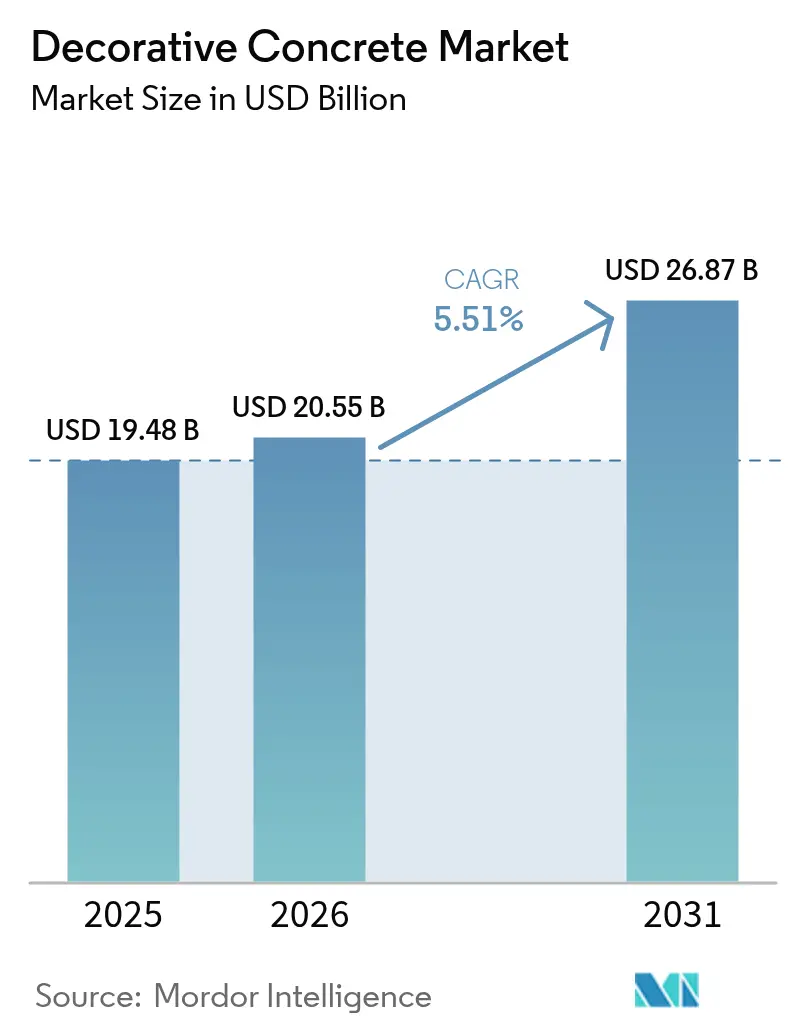
The Decorative Concrete market size is expected to grow from USD 19.48 billion in 2025 to USD 20.55 billion in 2026 and is forecast to reach USD 26.87 billion by 2031 at 5.51% CAGR over 2026-2031. This sustained expansion reflects a decisive shift in global construction priorities toward materials that marry long-term durability with design versatility, especially as residential remodeling budgets remain elevated and commercial facilities continue to modernize. Heightened post-pandemic home-improvement outlays, an aging housing stock with a median age of 41 years, and growing preference for low-maintenance surfaces are reinforcing demand. In parallel, commercial refurbishments are adopting polished and stamped concrete to meet foot-traffic durability targets, while net-zero building mandates push producers toward bio-based admixtures and low-VOC mixes. Tariffs on imported cement, coupled with volatile pigment supply, amplify cost pressures but also open opportunities for vertically integrated suppliers and innovators in carbon-reduced formulations.
Key Report Takeaways
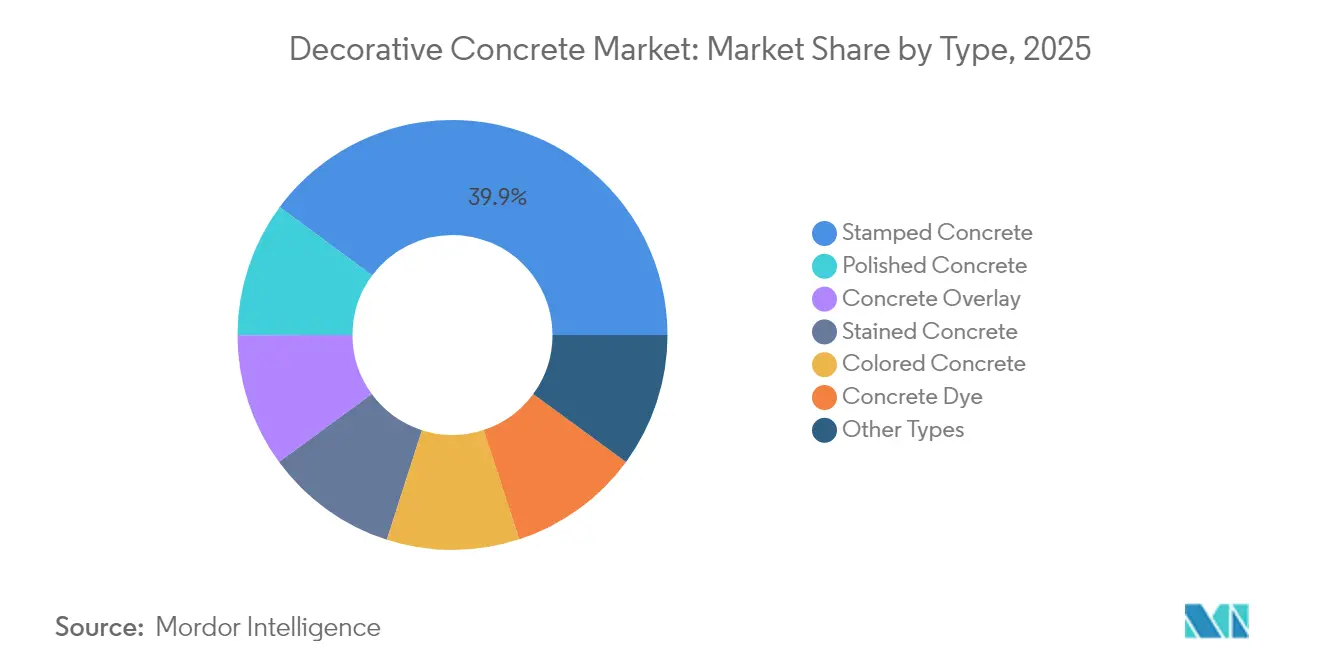
- By product type, stamped concrete led with 39.86% of decorative concrete market share in 2025; polished concrete is projected to expand at a 6.12% CAGR through 2031.
- By application, floor installations accounted for 54.72% of the decorative concrete market size in 2025 and are advancing at a 5.95% CAGR through 2031.
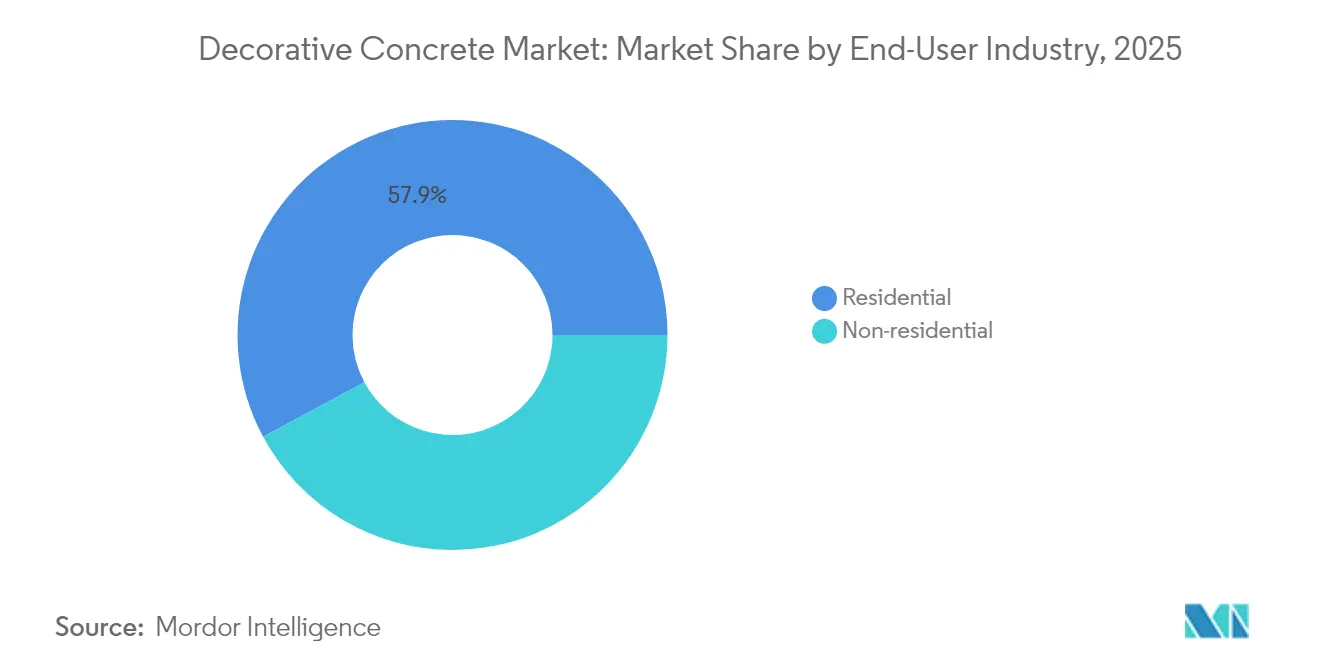
- By end-user industry, residential construction held 57.85% of 2025 revenue, while the non-residential segment records the highest projected CAGR at 6.17% to 2031.
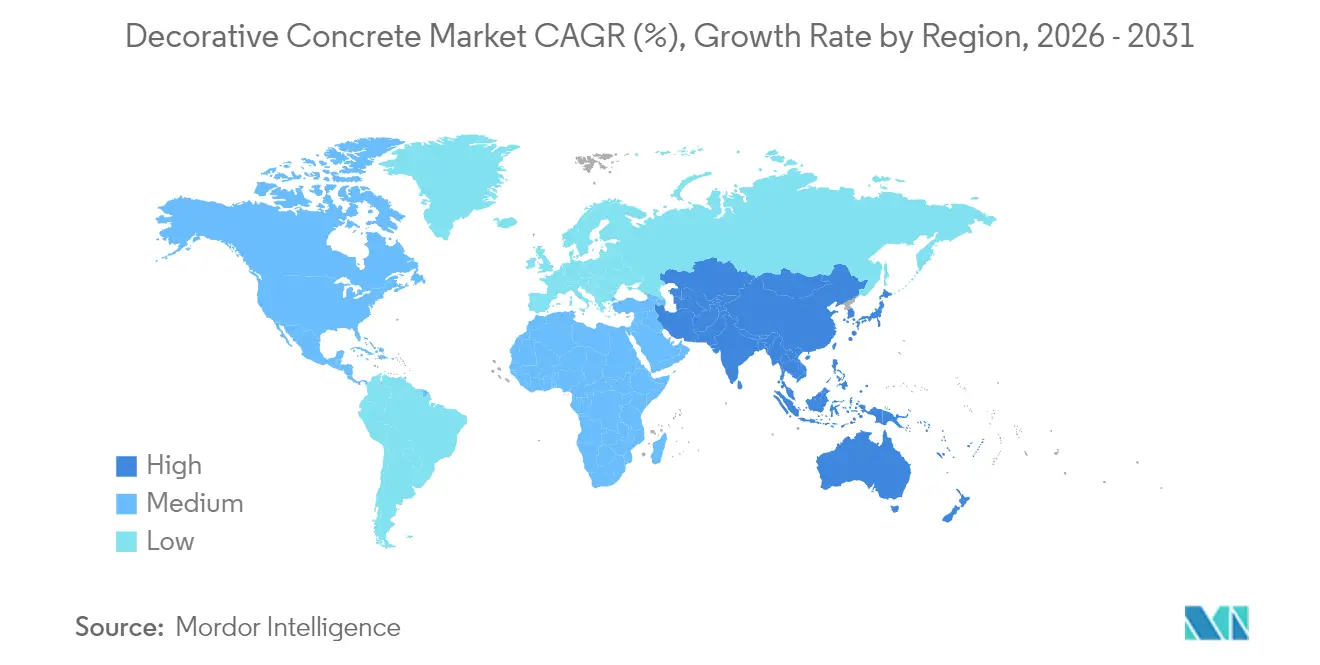
- By geography, Asia-Pacific commanded 37.60% revenue in 2025 and maintains the fastest pace with a 6.44% CAGR through 2031.
Note: Market size and forecast figures in this report are generated using Mordor Intelligence’s proprietary estimation framework, updated with the latest available data and insights as of 2026.
Market Trends and Insights
Drivers Impact Analysis of Decorative Concrete Market*
| Driver | (~) % Impact on CAGR Forecast | Geographic Relevance | Impact Timeline |
|---|---|---|---|
| Rising residential remodeling and refurbishment spend post-pandemic | +1.2% | North America & Europe, spill-over to APAC | Medium term (2-4 years) |
| Preference for stamped concrete in new-build outdoor living spaces | +0.9% | Global, with early gains in North America, Europe, APAC | Long term (≥ 4 years) |
| Net-zero and green-building certification pushing colored/low-VOC mixes | +0.8% | Europe & North America core, expanding to APAC | Long term (≥ 4 years) |
| Growth of decorative concrete overlays in fast-track renovation projects | +0.7% | Global, particularly North America residential | Short term (≤ 2 years) |
| Adoption of bio-based admixtures to cut embodied-carbon footprint | +0.6% | Europe regulatory-driven, North America voluntary adoption | Medium term (2-4 years) |
| Source: Mordor Intelligence | |||
Rising Residential Remodeling and Refurbishment Spend Post-Pandemic
Elevated remodeling budgets have shifted toward fewer but higher-value projects, strengthening demand for surface upgrades that combine aesthetics with long service life. Average homeowner spend increased 12% in 2023 despite a brief dip in overall project volume, signaling a willingness to pay for premium finishes that raise property value and support aging-in-place needs. Decorative concrete aligns well because its 20–30-year life span outperforms many alternative pavements, limiting future repair cycles. An aging housing stock motivates extensive outdoor and basement renovations where stamped slabs and polished floors deliver quick visual impact. Mortgage rates trending toward 5.5% by mid-2025 should further unlock renovation funding, amplifying demand throughout the forecast window.
Preference for Stamped Concrete in New-Build Outdoor Living Spaces
Advances in stamping mats and integral coloring have dispelled dated perceptions of stamped surfaces and now enable convincingly natural textures that last beyond two decades when properly sealed. Unit installation costs retain a favorable spread versus quarried stone, enabling contractors to target broader demographic segments. Cool-tone pigments and geometric templates resonate with modern landscaping trends while permeable variants address storm-water mandates in dense urban projects. Integrated LED channels and metallic highlights differentiate premium installations, particularly around pool decks where cooler surface temperatures and slip resistance improve safety.
Net-Zero and Green-Building Certification Pushing Colored/Low-VOC Mixes
Europe’s Energy Performance of Buildings Directive mandates on-site zero emissions in new dwellings from 2030, spurring uptake of cement-replacement admixtures and low-VOC sealers that can secure LEED, BREEAM, or DGNB credits. The Ecodesign for Sustainable Products Regulation obliges product-specific carbon disclosure, rewarding suppliers with transparent digital passports. Admixtures such as bio-based binders or slag blends lower embodied carbon without compromising compressive strength, meeting EU Taxonomy thresholds that now demand 70% waste recovery on large projects. U.S. green-building assessments echo this trajectory, placing colored but VOC-compliant mixes in competitive specification shortlists[1]Passive House Plus Team, “EPBD Revision Sets 2030 Zero-Emission Target,” passivehouseplus.ie.
Growth of Decorative Concrete Overlays in Fast-Track Renovation Projects
Overlay systems have grown popular because they can transform worn substrates with minimal demolition. Polymer-modified micro-toppings achieve strong adhesion, while spray-down and trowel-down variants install in days, making them ideal where business operations cannot pause for full slab replacement. Although unit pricing is higher than basic resurfacing, the reduced downtime offsets upfront cost in restaurants, retail, and institutional settings. Multi-layer stenciling and acid-free staining broaden design options without extending curing schedules, sustaining momentum for overlays in both residential patios and commercial lobbies.
Restraints Impact Analysis of Decorative Concrete Market*
| Restraint | (~) % Impact on CAGR Forecast | Geographic Relevance | Impact Timeline |
|---|---|---|---|
| High upfront cost of specialty pigments, molds and sealers | -0.8% | Global, particularly emerging markets | Short term (≤ 2 years) |
| Volatility in cement and pigment supply chains inflating prices | -1.1% | Global, acute in North America due to tariffs | Short term (≤ 2 years) |
| Shortage of certified decorative concrete installers | -0.7% | North America & Europe, emerging in APAC | Medium term (2-4 years) |
| Source: Mordor Intelligence | |||
High Upfront Cost of Specialty Pigments, Molds and Sealers
Decorative concrete commands USD 200–300 per cubic yard against USD 100–150 for standard mixes, a gap driven by expensive iron-oxide pigments, silicone molds, and multi-layer sealing systems. Contractors pass these costs to homeowners and small developers, curbing uptake in price-sensitive regions. Labor premiums also arise because stamped or polished finishes require slower placement rates and specialized finishing skills. Smaller contractors hesitate to purchase proprietary stamp libraries or diamond-polishing equipment, limiting service availability in secondary cities and slowing rural penetration[2]Evenson Concrete Systems, “2025 Price Guide for Decorative Finishes,” evensonconcretesystems.com.
Volatility in Cement and Pigment Supply Chains Inflating Prices
The 25% tariff imposed in February 2025 on cement imports from Canada and Mexico tightened North American supply, lifting delivered prices and compressing ready-mix margins. Simultaneous steel import levies elevate rebar and formwork costs, compounding total project budgets. Larger vertically integrated producers have absorbed part of the increase by reallocating clinker between regions, but smaller plants face spot-market volatility that translates into quotation surcharges. Pigment supply is equally exposed to freight disruptions and energy-price swings, prompting architects to specify color ranges with contingency allowances.
*Our forecasts treat driver/restraint impacts as directional, not additive. The impact forecasts reflect baseline growth, mix effects, and variable interactions.
Decorative Concrete Market Segment Analysis
By Type:
Stamped Concrete Dominance Drives InnovationStamped concrete retained a 39.86% decorative concrete market share in 2025, underpinned by its adaptability across driveways, patios, and commercial plazas. Enhanced tool libraries offer slate, timber, and even integrated logo impressions, enabling contractors to court hospitality and branded retail chains. Polished concrete, while holding a smaller base, is forecast to grow at a 6.12% CAGR to 2031 as facility managers appreciate seamless floors that resist forklift abrasion and ease cleaning protocols. Decorative concrete market size benefits from overlays that extend surface life without structural demolition, and from emerging self-healing capsules that release lime to seal microcracks and prolong service intervals. Overall, diversified type options help suppliers meet both budget and performance briefs, reinforcing the decorative concrete market’s resilience.
Continued R&D targets color-fast dyes and rapid-cure sealers that shorten turnover cycles. Colored mixes leverage finer pigment dispersions to avoid streaking, whereas translucent dye systems permit artistic gradients favored in boutique venues. Fiber-reinforced designs alleviate shrinkage cracking, while UV-resistant topcoats guard against fade in open-air entertainment spaces. Collectively, these advances widen use cases and deepen penetration into high-visibility architectural elements, bolstering long-term decorative concrete market growth.



By Application:
Floor Applications Drive Revenue Growth in 2024Floors accounted for 54.72% of revenue in 2025 and carry the highest growth rate at 5.95% CAGR, cementing their status as the largest and fastest-advancing category. Developers of distribution centres, schools, and airports gravitate toward polished finishes that tolerate constant foot and trolley traffic while cutting life-cycle maintenance spend. The decorative concrete market size for floors is widening as matte sealers satisfy gloss reduction requirements in healthcare settings that struggle with overhead glare.
Pool decks, patios, and driveways follow closely, benefitting from heat-reflective options that reduce surface temperatures up to 7 °C compared with conventional grey slabs. LED-ready joint configurations unlock lighting design freedom for premium residential backyards, while slip-resistant micro-textures meet evolving building-code thresholds. Wall and vertical-cast elements remain niche but are gaining traction in feature façades where integral coloring and sand-blasted reveals offer visual focal points with minimal upkeep.
By End-User Industry:
Residential Construction Drives Decorative Concrete Demand in 2024Residential construction generated 57.85% of 2025 demand thanks to homeowners’ desire for curb-appeal upgrades and aging-in-place investments that favor low-maintenance surfaces. Decorative concrete market share within single-family renovations continues to climb as homeowners replace wooden decks prone to rot with stamped slabs that require only periodic resealing. Detached garage conversions and basement waterproofing projects further expand residential scope by integrating polished or stained finishes that tolerate moisture.
The commercial segment is projected to outpace residential at a 6.17% CAGR through 2031 as office retrofits, logistics hubs, and hospitality refurbishments specify polished or epoxy-guarded decorative floors that support heavy loads and scrubbing machines. Federal infrastructure stimulus funnels capital into civic plazas, transit stations, and school expansions, each representing substantial square footage. Green-leasing models are also nudging landlords to favor durable, low-VOC surfaces that ease compliance reporting and attract ESG-aligned tenants, accelerating commercial uptake of decorative concrete.
Geography Analysis
APAC Decorative Concrete Market
Asia-Pacific held 37.60% of 2025 revenue and posts a leading 6.44% CAGR to 2031, reinforcing its dual role as market leader and primary growth driver. China alone consumed 6.6 gigatons of cement between 2011–2013, dwarfing 20th-century U.S. usage, and still accounts for more than half of global output. Massive housing-relocation schemes and megaprojects such as Indonesia’s USD 5 billion industrial park underscore structural demand, while permeable decorative slabs respond to stringent storm-water ordinances in rapidly urbanizing cities. Local producers are scaling low-clinker binders to align with national decarbonization pledges, broadening the product mix and tempering import dependence.
North America Decorative Concrete Market
North America faces pronounced cost volatility after 2025 import tariffs but retains growth potential supported by mortgage-rate easing and continued public-sector outlays. An aging housing stock boosts residential resurfacing, while the Bipartisan Infrastructure Law extends opportunities in public plazas and transit hubs. Supply-chain headwinds encourage integrated suppliers to expand captive quarry and terminal capacity, securing raw materials and stabilizing decorative concrete market pricing.
EMEA and South America Decorative Concrete Market
Europe’s stringent carbon directives recalibrate specifications toward low-embodied materials, catalyzing uptake of bio-based admixtures and recycled aggregates. Producers investing in waste-heat recovery kilns and bio-char co-firing earn procurement preference under EU Taxonomy rules, reinforcing regional competitive advantages. Meanwhile, Middle East, Africa, and South America register steady gains anchored by urban population growth, though currency volatility and limited installer capacity temper immediate upside potential. Across all regions the decorative concrete market demonstrates capacity to align with local policy imperatives and construction-sector cycles, sustaining a broad demand base.

Value Chain Analysis
Decorative concrete value creation starts upstream with cement and SCMs (fly ash, slag, limestone), aggregates, water, and performance chemistries, notably synthetic iron-oxide pigments and admixtures used to support workability, color uniformity, and durability. Color systems and surface performance packages (integral color, hardeners, stains/dyes, sealers, and protective coatings) are commonly supplied by specialty chemical and coatings players such as Sika, Chryso, and Euclid Chemical, while ready-mix producers and precast manufacturers convert these inputs into decorative mixes, architectural panels, pavers, and floor slabs aligned with specification requirements (including pigment standards such as ASTM C 979).
Midstream production and downstream execution are constrained by time and logistics. Precast and decorative finishing workflows face throughput bottlenecks linked to curing cycles that occupy floor space, mold availability for short-run designs, and QC delays, while distribution remains sensitive to service radius and just-in-time delivery windows because concrete and many overlay systems are schedule-critical. Downstream, certified installers and contractors (stamping, polishing, overlay application) translate design intent from architects and owners into finished surfaces, with performance hinging on placement discipline, finishing skill, and reseal or maintenance programs. These dependencies raise the value of bundled technical support and integrated product systems that reduce batch variability and rework.
Competitive Landscape
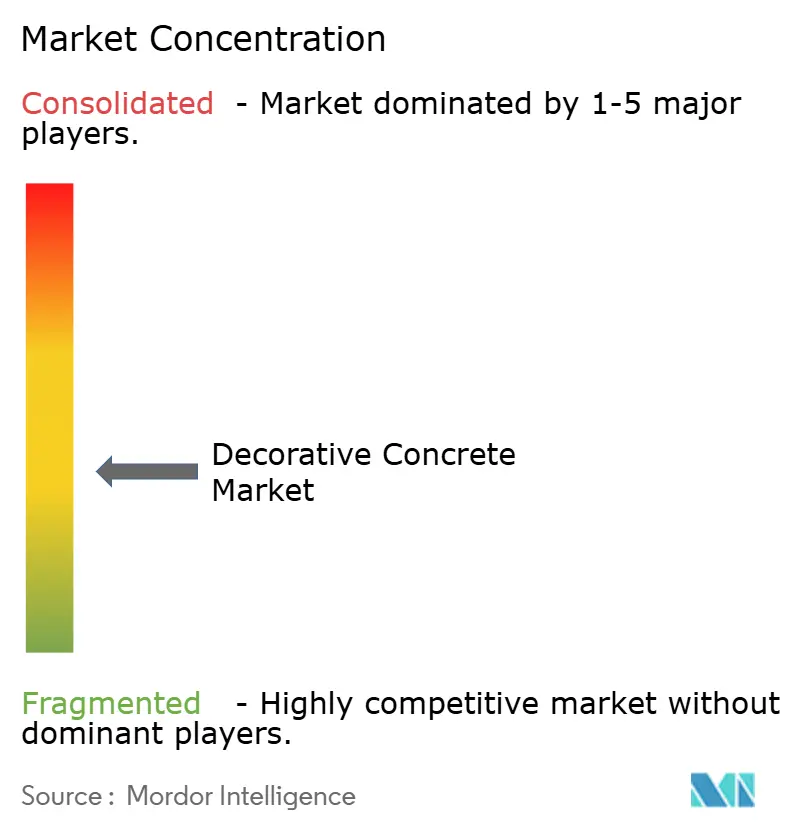
The decorative concrete market remains fragmented, with innovation, vertical integration, and sustainability credentials acting as the main competitive levers. Sika’s 2023 acquisition of MBCC Group broadened its admixture portfolio and is projected to yield CHF 180–200 million in annual synergies by 2026, illustrating how consolidation strengthens R&D scale and raw-material bargaining power. Holcim US added quarries in the Mid-Atlantic to secure aggregate supply, buffering against haulage cost spikes and ensuring feedstock for its ready-mix operations. CEMEX, leveraging Microsoft Azure OpenAI, launched an AI-enabled sales assistant to shorten quotation cycles and upscale cross-selling of decorative solutions, reflecting the sector’s digitalization trend.
Sustainability-focused chemistry provides another differentiation path. BASF’s MasterFiber synthetic-fiber line reduces steel-mesh usage and speeds placement, particularly attractive for fast-track warehouse slabs. PPG Industries reported USD 18.2 billion in 2023 net sales, underscoring the scale at which coatings firms are aligning colorant systems and low-VOC sealers with decorative concrete installers. Smaller disruptors pursue carbon-negative admixtures such as Solid Carbon’s BioLock, appealing to projects seeking to outperform carbon baselines. Across the board, firms that can cushion tariff-driven cost swings and offer verifiable carbon-footprint reductions are best placed to capture incremental decorative concrete market share.
Decorative Concrete Industry Leaders
Sika AG
RPM International Inc.
BASF
CEMEX S.A.B. de C.V.
Heidelberg Materials
- *Disclaimer: Major Players sorted in no particular order
Decorative Concrete Market Companies Covered in this Report
- 3M
- BASF
- Boral
- CEMEX S.A.B. de C.V.
- Dex-O-Tex
- Elite Crete Systems
- Heidelberg Materials
- Holcim
- Palermo Concrete Inc
- Parchem Construction Supplies
- PPG Industries Inc
- RPM International Inc.
- Saint-Gobain
- Sika AG
- Subana Technologies Pvt. Ltd.
- Tarmac
- The Euclid Chemical Company
- The Sherwin-Williams Company
- UltraTech Cement Ltd.

Market Opportunities and Future Outlook
Integrated decorative concrete systems are gaining traction, particularly for floors and fast-track renovation overlays where downtime has a measurable cost. The emerging emphasis is on combining admixtures, pigments, and surface treatments under unified technical support to reduce color variation and placement risk. This direction has shown up in supplier activity highlighted in 2026, including Chryso presentations pairing Interstar pigments with admixture solutions for consistent decorative finishes, and in product work aimed at improving workability control for complex placements, such as MAPEI introducing Dynamon XTEND 4047 (April 2026) to extend slump life and finishability in precast and ready-mix concrete.
A second opportunity centers on lower-carbon decorative specifications that preserve aesthetics while aligning with stricter project reporting and procurement criteria, with Europe a key pull factor due to embodied-carbon disclosure and green-building frameworks. Portfolio moves that broaden access to certified lower-footprint inputs support this path, such as BASF expanding certified biomass-balanced additives for architectural coatings (July 2026), which can be relevant to low-VOC and protective topcoat systems used over decorative concrete. Product and process innovation also opens premium niches, including design printing approaches on concrete elements using inorganic pigments (covered in 2026 patent literature), which can differentiate architectural surfaces beyond traditional stamping mats or multi-step staining workflows.
Recent Industry Developments in Decorative Concrete Market
- July 2026: BASF expanded its certified biomass-balanced additives portfolio, including Dispex AA 4145 MB, Rheovis PU 1333 MB, and Rheovis HS 1169 MB, to reduce product carbon footprints for architectural coatings. The expansion supports lower-footprint coating and sealer formulations that are often specified to protect and enhance decorative concrete surfaces in commercial and residential projects.
- April 2026: RPM International reported record sales in its Construction Products Group in the fiscal 2026 third quarter ended February 28, 2026, with performance attributed in part to strength in North America and categories that include concrete admixtures. Improved throughput and investment capacity at a major construction-chemicals supplier can increase competitive intensity in admixtures and surface systems used alongside decorative concrete installations.
- May 2025: BASF highlighted cementitious and mortar solutions including Acronal 4624, positioned to help decorative stamped concrete applications by preventing latex bleeding and supporting uniform color development. This formulation focus targets an installer pain point by reducing aesthetic defects that drive callbacks and rework in decorative flooring and flatwork.


Decorative Concrete Market Report Scope and Research Methodology
Market Definition and Coverage
For this study, the decorative concrete market covers the revenue generated from concrete finishing systems that improve the look and surface performance of concrete in new build and remodeling, across residential and non-residential end users and major regions.
Scope exclusions: It excludes structural ready-mix concrete sold without a decorative finish, along with standalone tools and equipment used to apply finishes.
Segments Covered in This Report
- By Type
- Stamped Concrete
- Polished Concrete
- Concrete Overlay
- Stained Concrete
- Colored Concrete
- Concrete Dye
- Other Types
- By Application
- Footpath and Driveway
- Patio
- Pool Deck
- Floor
- Wall
- Other Applications
- By End-user Industry
- Residential
- Non-residential
- By Geography
- Asia-Pacific
- China
- India
- Japan
- South Korea
- Rest of Asia-Pacific
- North America
- United States
- Canada
- Mexico
- Europe
- Germany
- United Kingdom
- France
- Italy
- Rest of Europe
- South America
- Brazil
- Argentina
- Rest of South America
- Middle East and Africa
- Saudi Arabia
- South Africa
- Rest of Middle East and Africa
- Asia-Pacific
Data Sources, Market Sizing, and Validation
Desk Research
Desk research was used to set the market boundaries and build the first set of demand and pricing assumptions that can be checked in the field. We relied on public construction and materials indicators, along with trade and macro signals, to understand where decorative finishes are being specified more often and how input costs were moving.
Typical sources included US Census construction spending series, Bureau of Labor Statistics price indexes tied to construction materials, USGS cement and mineral statistics, customs and port-trade releases for pigments and additives, and technical publications such as ACI resources and peer-reviewed journals that cover concrete performance. We also reviewed company annual reports, investor presentations, and credible industry press, and we used paid subscriptions for company financials and intelligence, patents, and shipment-level trade checks to sanity test a few parameters. These examples are not exhaustive, and many other public and paid sources were also referenced for data collection, validation, and research clarification.
Primary Interviews and Surveys
Primary work was run with people who specify, supply, or install decorative concrete, so the model is anchored to real project behavior rather than just broad construction growth. We spoke with a mix of manufacturers, distributors, contractors, applicators, and design-side stakeholders across APAC, EMEA, and the Americas to confirm finish-type mix, the split between new and renovation projects, and realistic pricing progression assumptions.
Distribution of primary research fieldwork respondents
| Company type | Respondent position | Region |
|---|---|---|
| Top tier: 29% | CXOs: 12% | APAC: 40% |
| Mid tier: 54% | Functional/Unit leaders: 28% | EMEA: 37% |
| Smaller Players: 17% | Managers: 60% | Americas: 23% |
Market-Sizing & Forecasting
Sizing started with a top-down build where construction activity, renovation intensity, and decorative-finish penetration were used to reconstruct the addressable demand pool across regions and end uses, and then value was derived using typical installed-price ranges by finish family. To keep this grounded, results were corroborated with selective bottom-up approximations, such as sampled contractor run-rates, distributor channel checks, and a volume times ASP cross-check for a few high-visibility applications.
Key inputs that were tracked (illustrative) included residential remodeling spend, non-residential flooring and hardscape activity, cement and pigment price trends, sealers and overlay adoption in refurbishment work, and observed mix shifts between stamped, stained, polished, overlays, and dyes. Where direct visibility was limited for smaller local applicators, gaps were handled through region-level penetration ranges validated in interviews and then constrained using construction intensity indicators.
Forecasts were prepared using scenario analysis, because demand is sensitive to construction cycles and remodeling confidence. The final path was then aligned to expert views on pricing pass-through, finish preference trends, and the pace of commercial refurbishment.
Data Validation & Update Cycle
Outputs were checked through triangulation across independent signals, including construction spend direction, materials price movement, and implied decorative-finish consumption per project type. When a region or finish line showed a sharp step-change, the drivers were re-reviewed and a re-contact was triggered with relevant respondents to confirm whether the move was real or a modeling artifact.
Before sign-off, the model goes through a multi-step analyst review where assumptions, formulas, and year-to-year bridges are tested for variance and internal logic. The report is refreshed annually, and interim updates are made when material events occur, followed by a final pre-delivery pass so clients receive the latest updated view.
Mordor Intelligence's Decorative Concrete Market Sizing Compared With Other Published Estimates
Published market values for decorative concrete can vary even when the topic label looks the same, because each publisher may count different finish systems, different points in the value chain, and different timing for prices and currency conversion. Some estimates also anchor the base year earlier or later, which changes how much inflation and construction-cycle effects are baked into the stated number.
Ready-mix concrete sold for plain slabs sits outside Mordor Intelligence's scope, which is why studies that blend structural concrete value into decorative finishes often land at a different 2024 to 2026 level even if the growth rate looks similar.
Benchmark comparison
| Source | Market Size | Gaps in Research Methodology |
|---|---|---|
| Mordor Intelligence | USD 20.55 B (2026) | |
| Global Consultancy A | USD 18.27 B (2024) | Uses an earlier base year and a different forecast window, and its definition appears to lean on broader finish bundles (including epoxy-type treatments) which can shift the counted value across categories. |
| Industry Publisher B | USD 18.61 B (2024) | Reports a 2024 base with longer-dated forecasting, and the scope description suggests a wider inclusion of adjacent concrete materials and applications, which can inflate totals when compared on a like-for-like finish-only basis. |
Taken together, the spread is mostly explained by differences in year, scope boundaries, and what gets counted as decorative value versus general concrete work. By tying value back to construction activity, finish penetration, and realistic installed-price ranges that are rechecked with practitioners, the estimate stays traceable and can be repeated with clear steps.


Key Questions Answered in the Report
What is the current Decorative Concrete Market size?
The market is valued at USD 20.55 billion in 2026 and is projected to reach USD 26.87 billion by 2031.
Which product type leads the decorative concrete market?
Stamped concrete holds the top position with 39.86% of 2025 revenue.
Which application segment is growing fastest?
Floor installations post the strongest outlook, advancing at a 5.95% CAGR through 2031.
Why is Asia-Pacific so influential in this industry?
Asia-Pacific commands 37.60% of revenue and enjoys the highest regional CAGR at 6.44% thanks to large-scale infrastructure development, particularly in China and Southeast Asia.
Page last updated on:


 Your data is secure and never sold or shared.


