
Market Overview
| Study Period | 2020 - 2031 |
|---|---|
| Forecast Data Period | 2026 - 2031 |
| Base Year Market Size (2025) | USD 0.87 Billion |
| Market Size (2026) | USD 0.91 Billion |
| Market Size (2031) | USD 1.13 Billion |
| Growth Rate (2026 - 2031) | 4.42 % |
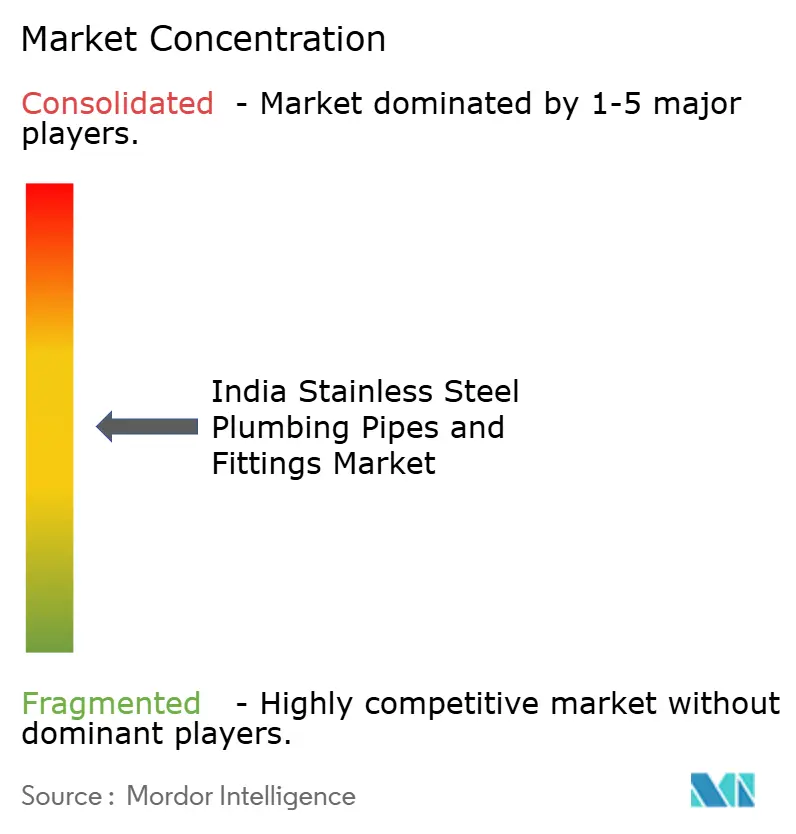
| Market Concentration | Medium |
Major Players *Disclaimer: Major Players sorted in no particular order Image © Mordor Intelligence. Reuse requires attribution under CC BY 4.0. | |
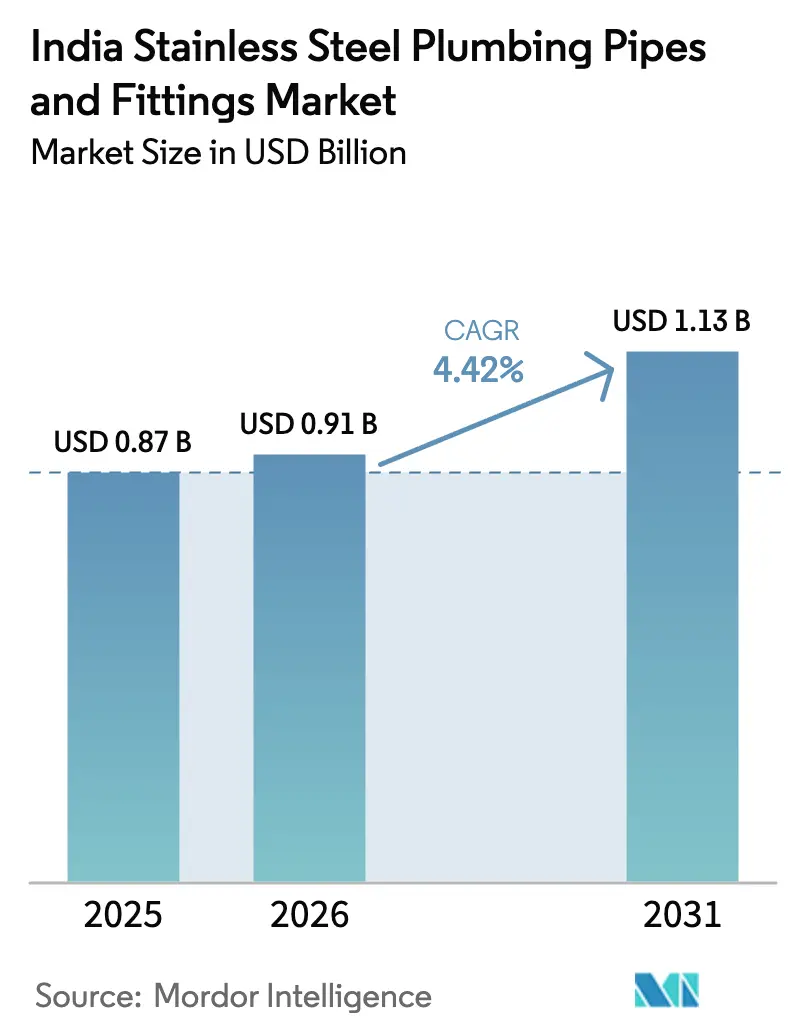
India Stainless Steel Plumbing Pipes And Fittings Market Analysis by Mordor Intelligence
The India Stainless Steel Plumbing Pipes and Fittings Market size in 2026 is estimated at USD 0.91 billion, growing from 2025 value of USD 0.87 billion with 2031 projections showing USD 1.13 billion, growing at 4.42% CAGR over 2026-2031. Quality-driven public programs such as the Jal Jeevan Mission and large private housing projects are shifting demand away from price-only decisions toward total-cost-of-ownership considerations, lifting premium material penetration. Developers cite stainless steel’s resilience against monsoon-driven corrosion, its compatibility with Internet-of-Things water meters, and its compliance with emerging lead-free mandates as the decisive advantages over galvanized iron and plastic rivals. The India stainless steel plumbing pipes and fittings market also benefits from abundant domestic melt capacity, which insulates supply chains from global shortages in the near term while still exposing producers to nickel price swings. Competitive intensity remains moderate because BIS certification and alloy-grade traceability deter opportunistic entrants even as organized players expand distribution into Tier 2 and Tier 3 cities.
Key Report Takeaways
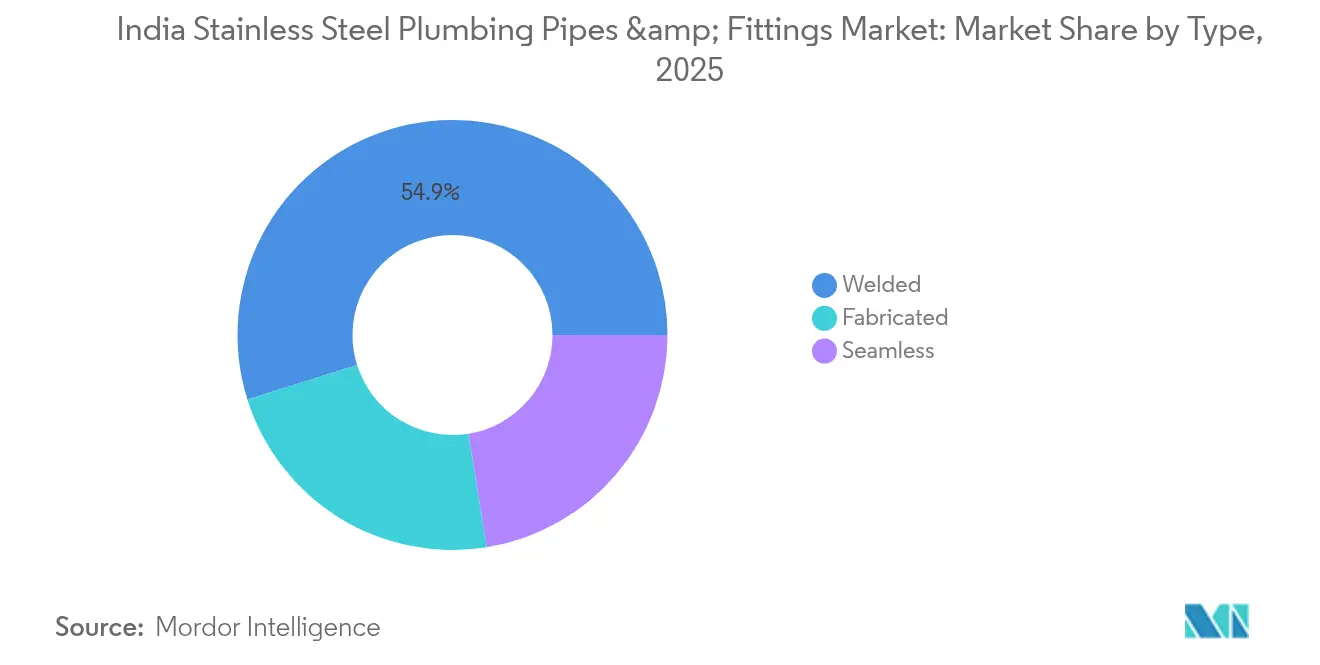
- By type, welded pipes captured 54.85% of the India stainless steel plumbing pipes and fittings market share in 2025, whereas fabricated products are forecast to expand at a 4.93% CAGR to 2031.
- By market structure, organized manufacturers held 59.65% of value in 2025, and the same cohort is projected to grow at a 4.55% CAGR through 2031.
- By diameter, small-bore pipes (less than or equal to 50 mm) made up 44.85% of shipments in 2025, while medium-bore lines (50-100 mm) are forecast to rise at a 4.71% CAGR through 2031.
- By sales channel, retail outlets secured 55.10% of 2025 turnover and are on course for a 5.02% CAGR to 2031 as organized chains penetrate underserved cities.
- By application, potable-water systems led with 40.10% of revenue in 2025; fire-sprinkler and hydrant installations are set to post the fastest 4.88% CAGR through 2031.
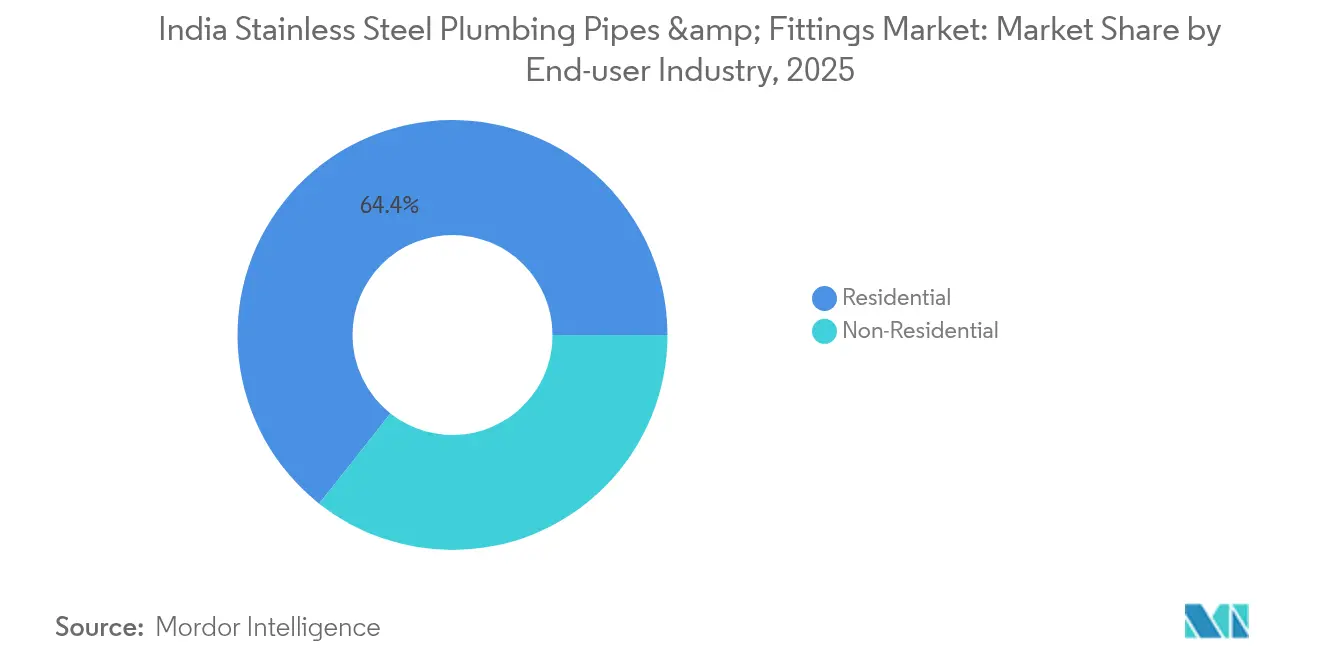
- By end-user industry, residential demand accounted for 64.35% of 2025 revenue, while non-residential applications are advancing at a 4.63% CAGR to 2031.
Note: Market size and forecast figures in this report are generated using Mordor Intelligence’s proprietary estimation framework, updated with the latest available data and insights as of 2026.
India Stainless Steel Plumbing Pipes And Fittings Market Trends and Insights
Drivers Impact Analysis*
| Drivers | (~) % Impact on CAGR Forecast | Geographic Relevance | Impact Timeline |
|---|---|---|---|
| Rapid urbanization and smart-city roll-outs | +1.2% | Mumbai, Delhi, Bangalore and emerging satellite towns | Medium term (2-4 years) |
| Surge in large real-estate and infra projects | +0.8% | Maharashtra, Gujarat, Tamil Nadu, Karnataka | Short term (≤2 years) |
| Superior corrosion and temperature resistance | +0.9% | Coastal and high-humidity states | Long term (≥4 years) |
| Mandatory lead-free plumbing (Jal Jeevan) | +1.1% | Rural clusters and peri-urban districts | Medium term (2-4 years) |
| High-rise fire-safety compliance | +0.7% | Metro and Tier 1 cities | Short term (≤2 years) |
| Hygienic solar-water systems in hospitality | +0.6% | Tourism hubs | Medium term (2-4 years) |
| Source: Mordor Intelligence | |||
Rapid Urbanization and Smart-City Roll-Outs
Smart-city blueprints funded under the USD 15 billion national mission allocate nearly one-quarter of budgets to water supply upgrades. Planners now specify stainless steel piping for municipal loops longer than 10 years, citing the alloy’s low electromagnetic interference that safeguards IoT meter accuracy. Pune and Surat have already mandated stainless steel mains above 150 mm, setting procurement precedents that private developers replicate. With India’s urban population swelling at 2.3% annually to 2030, the India stainless steel plumbing pipes and fittings market stands to capture recurring demand from both new districts and brownfield retrofits in satellite towns. Contractors further highlight the alloy’s fire-safety credentials, linking it with higher insurance ratings that improve project viability.
Surge in Large Real-Estate and Infrastructure Projects
Commercial real-estate investment touched USD 5.7 billion in 2024, complemented by a USD 1.4 trillion National Infrastructure Pipeline earmarking 16% for water and sanitation. Developers now preset stainless steel for projects exceeding 500 units because it halves lifetime maintenance outlays versus galvanized iron. LEED and GRIHA certification matrices, which weigh material durability, further amplify this preference. The India stainless steel plumbing pipes and fittings market therefore gains predictable volume from high-rise clusters and industrial parks scheduled through 2028.
Superior Corrosion and Temperature Resistance
Average annual rainfall surpasses 1,000 mm across 70% of India, and chloride-rich groundwater is common in west-coast states. Chromium-rich alloys neutralize these stresses, while PVC and galvanized iron fail within 15 years under similar exposure. Stainless steel also retains ductility across 5 °C to 45 °C swings common in North India, avoiding micro-cracking seen in rigid plastics. Reduced biofilm formation further lowers pump energy by 15-20% over a 25-year cycle.
Mandatory Lead-Free Plumbing (Jal Jeevan Mission)
The government’s USD 50 billion Jal Jeevan Mission bans lead-bearing pipes for 192 million rural household taps[1]Ministry of Jal Shakti, “Jal Jeevan Mission Progress Report 2024,” jaljeevanmission.gov.in. BIS code IS 4985:2019 cites stainless steel Grades 304 and 316L as compliant materials, placing the alloy at the top of procurement shortlists. Because rural service calls are logistically costly, local authorities prefer one-time stainless steel installations that last longer than plastic alternatives susceptible to UV degradation.
Restraints Impact Analysis*
| Restraints | (~) % Impact on CAGR Forecast | Geographic Relevance | Impact Timeline |
|---|---|---|---|
| Low-cost PVC/PEX substitution threat | -0.9% | Price-sensitive markets and rural areas | Short term (≤ 2 years) |
| Nickel-price volatility inflates SS costs | -0.7% | National, affecting all manufacturers | Medium term (2-4 years) |
| Installer skill-gap in Tier-2/3 cities | -0.5% | Tier-2/3 cities and rural markets | Medium term (2-4 years) |
| Molybdenum import-supply risk | -0.4% | National, particularly Grade 316L applications | Long term (≥ 4 years) |
| Source: Mordor Intelligence | |||
Low-Cost PVC/PEX Substitution Threat
PVC and PEX systems undercut stainless steel by as much as 50% on upfront cost, drawing budget-constrained homeowners toward plastic. Organized PVC producers expanded 2024 sales by 12% through extended warranties and trade-in schemes. Flexible PEX lines also reduce labor time by 30%, tempting contractors on tight schedules. Marketing campaigns accentuate corrosion immunity but seldom mention PEX’s 65 °C service-temperature ceiling or UV vulnerability.
Nickel-Price Volatility Inflates Stainless Steel Costs
Nickel averaged USD 16,000-28,000 per tonne during 2024, reflecting Indonesian export curbs and EV battery demand. Grade 304 uses 8-10% nickel, so alloy surcharges can swing monthly quotes by 12-15%. Smaller mills lacking hedge cover pass spikes downstream, occasionally ceding share to plastics when quotations overshoot budget thresholds. Molybdenum required for 316L is equally volatile, reinforcing procurement risk.
*Our forecasts treat driver/restraint impacts as directional, not additive. The impact forecasts reflect baseline growth, mix effects, and variable interactions.
Segment Analysis
By Type: Welded Dominance Meets Fabricated Innovation
Welded pipes held 54.85% of 2025 value thanks to standardized dimensions preferred in mass-housing blocks. Fabricated lines are poised for a 4.93% CAGR to 2031 as architects demand bespoke risers in complex HVAC and fire-safety grids. The India stainless steel plumbing pipes and fittings market size for seamless pipes remains smaller but commands premium pricing in gas and high-pressure loops where zero defects are non-negotiable.
Scaling economics favor welded production: Jindal Stainless lifted welded capacity by 40% in 2024 to serve affordable-housing builders aiming for 15-50 mm diameters. Fabrication houses compensate by offering site-specific spools that minimize fit-up errors during retrofits. While BIS certificates apply to all, fabricated assemblies need part-wise testing, extending approval cycles but ensuring traceable quality that contractors welcome.



By Market Structure: Organized Players Consolidate Share
Organized manufacturers owned 59.65% revenue in 2025, and their share is expanding at a 4.55% CAGR to 2031 as GST compliance erodes informal-sector price gaps. Their long-term nickel contracts buffer price shocks, allowing steadier project quotes and reinforcing brand trust. The India stainless steel plumbing pipes and fittings market size in the unorganized tier is shrinking as buyers weigh warranty coverage, which organized labels readily provide.
Quality Stainless exemplifies mid-tier success by occupying the space between high-end brands and untested local fabricators. Organized firms further leverage digital catalogs and engineer hotlines, helping contractors navigate complex alloy-grade charts. As BIS tightens plant audits, entry costs climb, accelerating consolidation.
By Diameter: Medium-Bore Growth Reflects Infrastructure Scale
Small-bore (less than or equal to 50 mm) still captures 44.85% share for everyday household taps, yet medium-bore (50-100 mm) pipelines are climbing at a 4.71% CAGR through 2031. Multi-tower complexes channel higher flow rates across fewer vertical stacks, elevating demand for 65-90 mm diameters that balance pressure drop and material cost.
Tata Steel’s tubes arm crossed the 1 million-tonne milestone in 2024, buoyed by medium-bore shipments that made up 35% of its volume increase. Installation crews favor these sizes because larger borelines cut the number of joints, mitigating leak points and reducing commissioning times.
By Sales Channel: Retail Expansion Drives Market Access
Retail stores controlled 55.10% of 2025 turnover and should log a 5.02% CAGR to 2031 as organized chains move beyond metros. In-store plumbing consultants demystify grade selection, an edge that pure e-commerce lacks. Direct B2B contracts remain entrenched for mega-projects where volumes justify factory-gate shipments.
While online portals like IndiaMART aid price discovery, bulky shipments and onsite inspection needs slow digital adoption for diameters beyond 100 mm. Retail chains, meanwhile, bundle credit facilities and installer networks, attracting small contractors who dominate India’s building sector. The India stainless steel plumbing pipes and fittings industry thus leverages omnichannel reach to stabilize order books.
By Application: Fire Safety Drives Premium Growth
Potable water lines generated 40.10% of turnover in 2025, but fire-sprinkler loops are on track for a 4.88% CAGR through 2031 as metro skylines densify. The India stainless steel plumbing pipes and fittings market size attributed to fire-safety projects gains from mandatory NBC 2016 compliance for any building taller than 15 meters.
Waste-water, HVAC, and fuel-gas loops diversify revenue streams, softening cyclical swings in housing permits. ASHRAE studies confirm stainless steel’s smoother bore trims pump energy by 15-20%, a quantifiable benefit that appeals to green-building scorecards. Sprinkler designers prefer 316L in coastal towers because chloride attack could impair sprinkler integrity in alternatives.
By End-User Industry: Non-Residential Acceleration
Residential construction delivered 64.35% of 2025 demand yet non-residential lines are rising at a 4.63% CAGR to 2031 on the back of office, hospitality, and data-center builds. The India stainless steel plumbing pipes and fittings market share within offices is growing because chilled-water loops favor the alloy’s low friction head.
Hotel chains including Taj and Oberoi mandate stainless steel risers for hygiene and brand protection. Industrial campuses seek 316L to prevent chemical-induced pitting, thereby avoiding unscheduled shutdowns. Healthcare renovations amplify demand too, citing infection-control guidelines that discourage micro-scratched plastics.
Geography Analysis
Maharashtra leads national off-take, buoyed by Mumbai–Pune real-estate corridors and proximity to Jajpur’s melt shops that guarantee steady coil feedstock. Gujarat’s consumption is growing on the back of petrochemical clusters requiring corrosion-resistant process water lines. Tamil Nadu and Karnataka represent the fastest-growing pockets as IT parks in Bangalore and the Chennai auto belt specify premium fire-sprinkler and HVAC piping.
Coastal humidity in western and southern belts accelerates galvanized-iron corrosion, making stainless steel economically compelling over 20-year valuations. Chennai municipal codes now recommend stainless steel for potable mains within 10 km of the seafront, driving rapid substitution. Northern states such as Delhi, Haryana, and Uttar Pradesh are catching up thanks to smart-city pilots in Lucknow and Kanpur and Jal Jeevan rural pipelines that prioritize lead-free materials.
Extreme temperature swings from 5 °C winters to 45 °C summers in the north fracture rigid PVC systems, elevating stainless steel adoption among utility boards. Pharmaceutical and food-processing zones in Uttar Pradesh further lean toward stainless steel for hygiene compliance, widening the regional footprint of organized suppliers.
Regulatory Landscape
India’s stainless steel plumbing pipes and fittings market operates under a tightening quality-and-traceability regime led by the Bureau of Indian Standards (BIS) and administered through Ministry of Steel Quality Control Orders (QCOs). The QCO framework makes BIS certification and ISI marking mandatory for stainless steel tubes and pipes, anchored to Indian Standards such as IS 17875:2022 (seamless) and IS 17876:2022 (welded). This raises compliance costs for unorganized suppliers while improving buyer confidence in pressure integrity and alloy conformance.
Policy levers are also shaping upstream availability and downstream pricing. The Ministry of Steel launched the PLI Scheme 1.2 for Specialty Steel on November 4, 2025, covering stainless steel flat and long products with incentives, and revised the Domestically Manufactured Iron & Steel Products (DMI&SP) policy on December 17, 2025 with melt-and-pour requirements for Chapter 72 products. In 2026, the Ministry of Steel issued targeted QCO exemptions for specific stainless steel inputs (notified on April 8, 2026 and April 27, 2026). These exemptions can temporarily ease procurement bottlenecks for certain project-linked or specialty grades, while certification remains the default route for plumbing-grade supply.
Value Chain Analysis
The value chain starts with stainless steelmaking (melt shops and hot-rolled coil/plate), followed by cold rolling, tube making (seamless or welded), and conversion into plumbing formats through forming, cutting, end finishing, and fitting fabrication. India’s domestic melt capacity is a key buffer for plumbing-grade availability, but the chain remains exposed to nickel and molybdenum volatility, which can feed into alloy surcharges and contractor quote revisions.
Downstream, value addition concentrates in pipe and tube mills, fabrication units producing spools/manifolds and fittings, and testing/inspection workflows aligned to BIS requirements, including alloy-grade traceability and plant audit readiness. Distribution typically moves through a mix of direct institutional/B2B sales for large projects and retail-led channels for residential replacement and small contractors. Organized players strengthen last-mile pull via branded assurance programs and co-branded channel partnerships, and Installer capability remains an important link in performance outcomes. Training, tool access, and standardized installation practices therefore differentiate suppliers in Tier 2 and Tier 3 markets.
Competitive Landscape
The India stainless steel plumbing pipes and fittings market shows moderate fragmentation. Jindal Stainless and Tata Steel anchor the field with captive nickel and chromium streams that shave 8-12% off alloy surcharges versus non-integrated rivals. Mid-scale challengers such as Quality Stainless are scaling via regional depots and custom-fabrication cells. Product innovation is another lever: Aeroflex captured niche share with flexible stainless hoses that simplify retrofit jobs in cramped mechanical shafts. BIS Quality Control Orders effective 2022 now make ISI stamping compulsory, raising capex bars for late entrants and validating established players’ research and development outlays.
India Stainless Steel Plumbing Pipes And Fittings Industry Leaders
APL Apollo
Jindal Stainless Ltd
Nippon Steel Corporation
Ratnamani Metals & Tubes Limited
Viega India Private Limited
- *Disclaimer: Major Players sorted in no particular order

Market Opportunities and Future Outlook
White space is widening where procurement increasingly rewards certified quality, lifecycle value, and anti-counterfeit assurance rather than lowest upfront price. The BIS QCO structure around IS 17875:2022 and IS 17876:2022, combined with buyer concerns around spurious material in commodity channels, supports opportunities for organized manufacturers and distributors to scale certified SKUs, with visible traceability and contractor-facing verification at the point of sale. Jindal Stainless has moved in this direction with consumer-facing branding and channel trust mechanisms, pointing to active competitive investment behind authentication and retail conversion.
Infrastructure durability and corrosion management also create an opportunity layer beyond housing-led demand. Industry bodies have publicly called for a National Stainless Steel Policy and a National Anti-Corrosion Policy, and the Government has signaled work on a new national steel policy with emphasis on premium and green steel, including stainless steel. These policy discussions, alongside on-ground public programs that prioritize long-life water and sanitation assets, support higher penetration of corrosion-resistant stainless plumbing in coastal and high-humidity applications, as well as more value-added fabricated assemblies that reduce site work and leakage risk in dense urban and high-rise projects.
Recent Industry Developments
- May 2026: Jindal Stainless Ltd launched its first stainless steel fabrication facility in Patalganga near Mumbai, operated by Jindal Stainless Steelway Limited, with an investment of INR 125 crore. The move expands local fabrication capacity for plumbing pipes and fittings, improving regional serviceability and reducing lead times for Tier-2 and Tier-3 city projects.
- May 2026: Ratnamani Metals & Tubes Limited reported a stand-alone order book of INR 2,162 crore as of May 1, 2026, including stainless steel products valued at INR 531 crore. The development indicates growing demand for stainless steel plumbing components and related instrumentation tubes, signaling a strong project pipeline and potential capacity utilization in infrastructure and industrial segments.
- May 2026: Jindal Stainless commissioned a 1.2 million tonnes per annum melt shop in Indonesia and announced an additional investment of INR 900 crore to augment cold rolled stainless steel capacities in India. This expansion strengthens upstream supply and supports broader availability of stainless steel for plumbing applications in domestic and regional markets.


Research Methodology Framework and Report Scope
Market Definition and Coverage
This market covers stainless steel pipes and fittings used for plumbing and potable water distribution in buildings and connected infrastructure across India, valued at first sale level through both organized and unorganized channels.
Scope exclusions: Stainless steel tubes meant mainly for oil and gas, boilers, heat exchangers, and other non-plumbing industrial piping are not counted.
Segmentation Overview
- By Type
- Seamless
- Welded
- Fabricated
- By Market Structure
- Organised
- Unorganised
- By Diameter
- Less than or equal to 50 mm (Small-Bore)
- 50-100 mm (Medium)
- More than 100 mm (Large-Bore)
- By Sales Channel
- Retail
- E-commerce
- Direct Institutional/B2B
- By Application
- Potable Water Supply
- Waste-water and Drainage
- Fire-sprinkler and Hydrant
- Gas and Fuel Lines
- HVAC and Chilled Water
- By End-User Industry
- Residential
- Non-Residential
Data Sources, Market Sizing, and Validation
Desk Research
Desk work started by mapping the demand pool for building plumbing, then narrowing it to stainless steel use so the model stays tied to construction and water-supply activity in India. Inputs were taken from public and official source types including the Ministry of Jal Shakti program dashboards on household tap connections, MoSPI construction and macro series, Ministry of Steel statistical releases, BIS standards and certification notifications for pipes and fittings, and customs trade statistics for stainless steel tubes and pipe fittings.
To translate these signals into market value, filings and investor notes were reviewed for manufacturers and distributors, along with association websites and reputable press releases that indicate product mix and pricing moves. Where available, paid subscriptions were used for company financials and company intelligence, and an import-export shipment-level database was used as a directional cross-check for inbound fittings and specialty pipe. This list is illustrative and not exhaustive, and other public and paid sources were also used for data collection, validation, and clarification.
Primary Interviews and Surveys
Primary work was used to confirm what part of plumbing demand is actually served by stainless steel, and how that share differs by city tier, end use, and diameter range. Interviews and surveys were conducted with manufacturers, distributors, fabricators, plumbing contractors, project specifiers, and facility teams to validate assumptions on price realization, tender specifications, and replacement cycles across India.
Distribution of primary research fieldwork respondents
| Company type | Respondent position |
|---|---|
| Top tier: 32% | CXOs: 16% |
| Mid tier: 50% | Functional/Unit leaders: 37% |
| Smaller Players: 18% | Managers: 47% |
Market-Sizing & Forecasting
Sizing was built using a top-down demand reconstruction that starts from India's building and water-supply activity, then applies stainless steel penetration factors validated in interviews. To keep the totals realistic, we corroborated selected bottom-up checks such as sampled channel throughput by major city clusters, typical project bill-of-quantity splits for pipes versus fittings, and observed average selling price bands by grade and diameter.
Key inputs that shape the model include new housing and commercial completions, Jal Jeevan Mission connections and pipeline work pace, the split between retrofit and new-build plumbing, mix shifts between welded, seamless, and fabricated products, and stainless steel price movement drivers that affect realized pricing. Forecasts were developed using scenario analysis, where base case adoption and pricing paths were adjusted using expert consensus on government program execution, real estate momentum, and substitution versus plastic or GI. When bottom-up visibility was weaker for unorganized flows, we used calibrated ranges and then anchored them back to construction and distribution indicators.
Data Validation & Update Cycle
Outputs were checked against independent signals, including trade directionality for relevant stainless items, public program progress markers, and observed channel pricing behavior, before the final number was signed off. Variances were reviewed in multiple steps, and we re-contacted sources when penetration, pricing, or volume assumptions drifted beyond acceptable bounds for a given year.
The report is refreshed annually, and interim updates are made when material events change demand or pricing (for example, a major standards change or a sharp alloy price swing). Before delivery, an analyst performs a fresh validation pass so clients get the latest updated view.
Mordor Intelligence's India Stainless Steel Plumbing Pipes and Fittings Market Size Compared With Other Published Estimates
Published market sizes for this space can look far apart because teams define the market boundary differently and then apply different adoption and pricing logic. In practice, the differences often trace to wider pipe categories included in some estimates, a faster assumed shift to premium plumbing, or a different timing of stainless price assumptions.
Jal Jeevan Mission connection progress, building completion series, and channel price checks are used as evidence to keep Mordor Intelligence aligned to plumbing-grade stainless pipes and fittings sold into Indian building water systems, instead of including stainless tubes used mainly in industrial non-plumbing lines.
Benchmark comparison
| Source | Market Size | Gaps in Research Methodology |
|---|---|---|
| Mordor Intelligence | USD 0.87 B (2025) | |
| Regional Consultancy A | USD 0.49 B (2026) | Uses a longer forecast window and appears to undercount organized distribution pricing, which can suppress the near-term value when stainless realization is moving with alloy costs. |
| Industry Research Group B | USD 3.21 B (2025) | Looks like it rolls up a broader stainless pipe segment under plumbing, which likely includes non-plumbing industrial tubes and thereby inflates the India value beyond plumbing-grade pipes and fittings. |
The spread across the table mainly comes from scope boundaries and how quickly stainless adoption and realized pricing are assumed to move. By anchoring the model to plumbing use cases and validating penetration and price bands through repeatable checks, the estimate stays transparent and easier to reconcile year to year.


Key Questions Answered in the Report
What is the current value of the India stainless steel plumbing pipes and fittings market?
The market is valued at USD 0.91 billion in 2026 with a forecast to reach USD 1.13 billion by 2031.
How fast is demand for stainless steel fire-sprinkler systems growing?
Fire-sprinkler and hydrant applications are projected to post a 4.88% CAGR through 2031, the fastest among all end-uses.
Which pipe type holds the largest share today?
Welded stainless steel pipes lead with 54.85% of 2025 revenue.
Why are medium-bore pipes gaining popularity?
Medium-bore (50-100 mm) sizes support higher flow in multi-tower complexes and are forecast to grow at a 4.71% CAGR to 2031.
How are Quality Control Orders affecting market entry?
Mandatory BIS certification under IS 17876:2022 increases compliance costs and favors established producers with accredited testing facilities.
Page last updated on:


 Your data is secure and never sold or shared.


