
Americas Boiler Control Market Size and Share
Americas Boiler Control Market Analysis by Mordor Intelligence
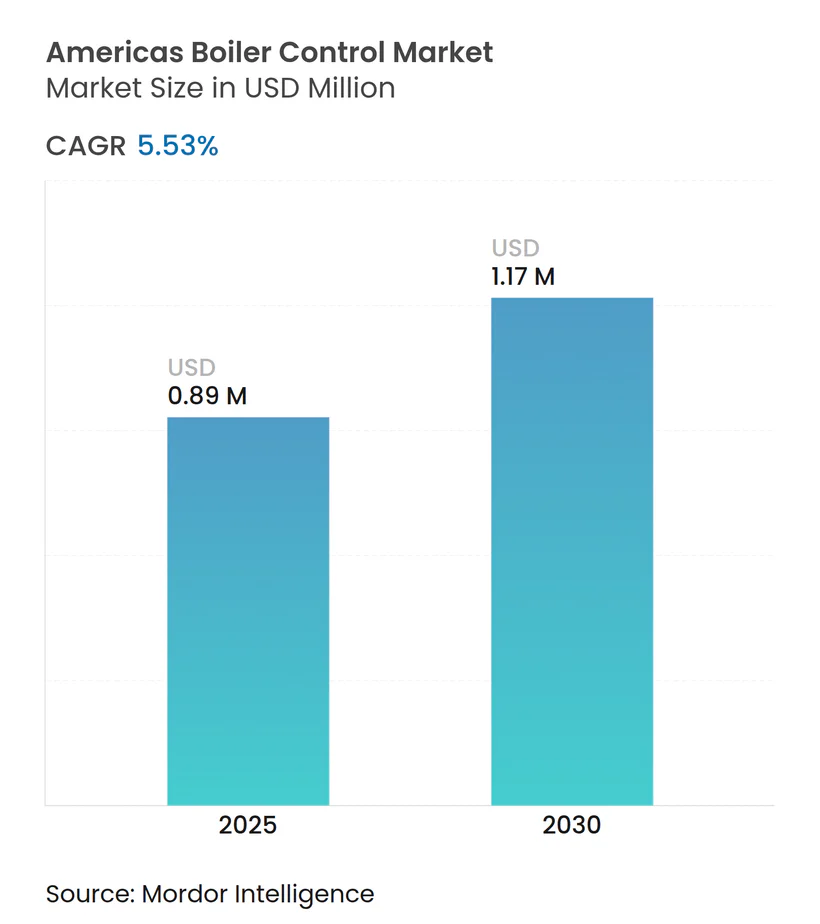
At manufacturer or system integrator selling prices, the Americas boiler control market size stands at USD 628.8 million in 2026, with an estimated USD 651.3 million in 2027 and a forecast USD 789.7 million by 2032, representing a 3.93% CAGR over 2027-2032. Replacement controls, connected monitoring and selected industrial expansions underpin that increase. The commercial opportunity centers on improving boilers already operating, alongside supplying controls for new steam and heating capacity.
Equipment sales and supplier profitability point to a measured rise from 2026 to 2027. A. O. Smith reported 13% growth in North American boiler sales in the third quarter of 2026, with pricing also supporting its regional business.[1] Miura's interim filing showed a different picture for its Americas business. Revenue rose 3.2% in the six months ended September 2026, while segment profit fell 35.7% because of sales mix and higher personnel costs. Replacement demand is active at A. O. Smith, and the cost of delivering equipment and services is under pressure at Miura, which together shape growth in Americas boiler control.
Key Report Takeaways
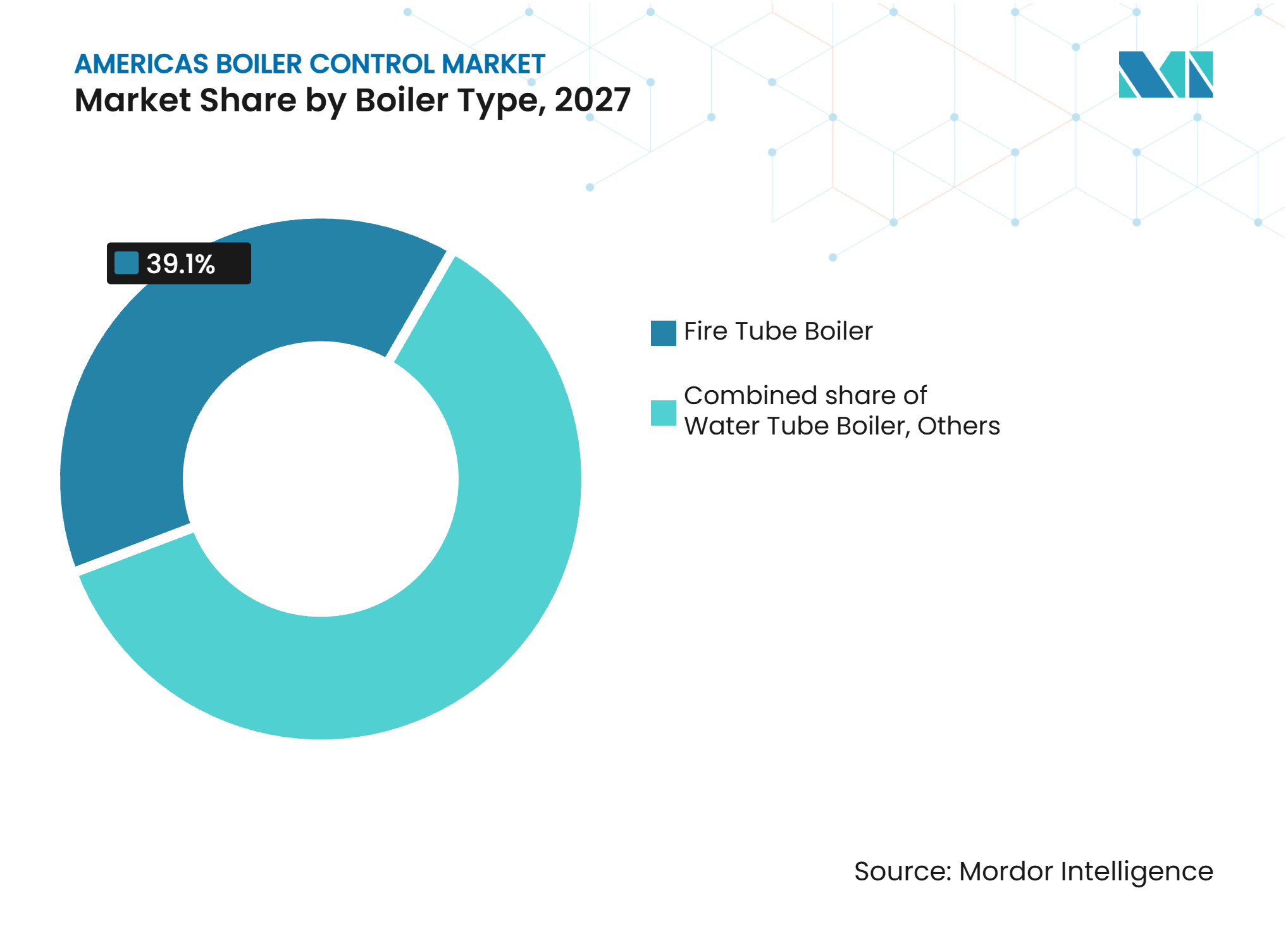
- Fire-tube applications are estimated to capture 39.10% of the Americas boiler control market share in 2027 and are forecast to grow at 4.02% annually over 2027-2032, supported by packaged process-steam installations.
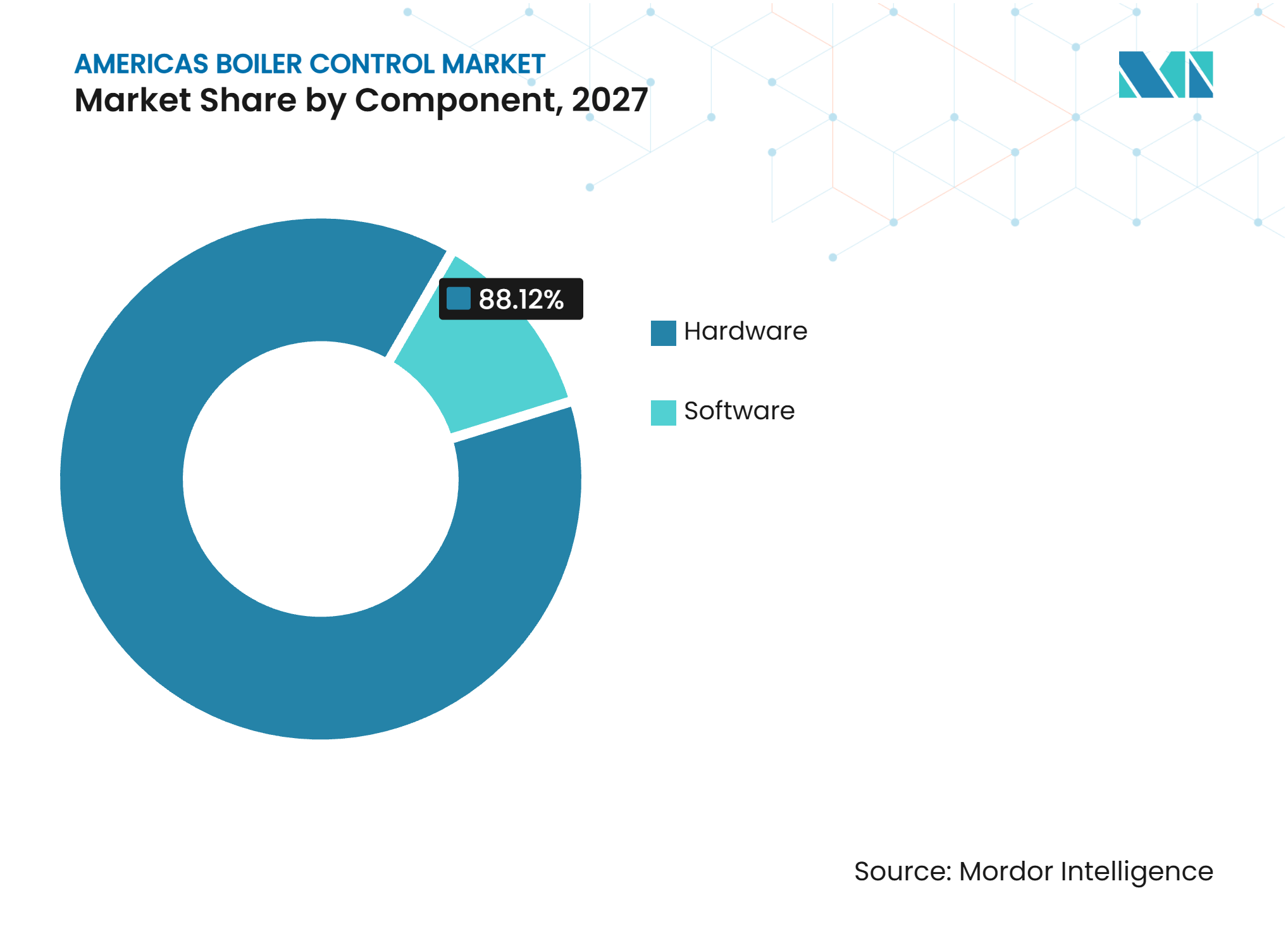
- Hardware represents an estimated 88.12% of the Americas boiler control market size in 2027, while software is forecast to expand faster at a 6.21% CAGR over 2027-2032 as monitoring attaches to installed control equipment.
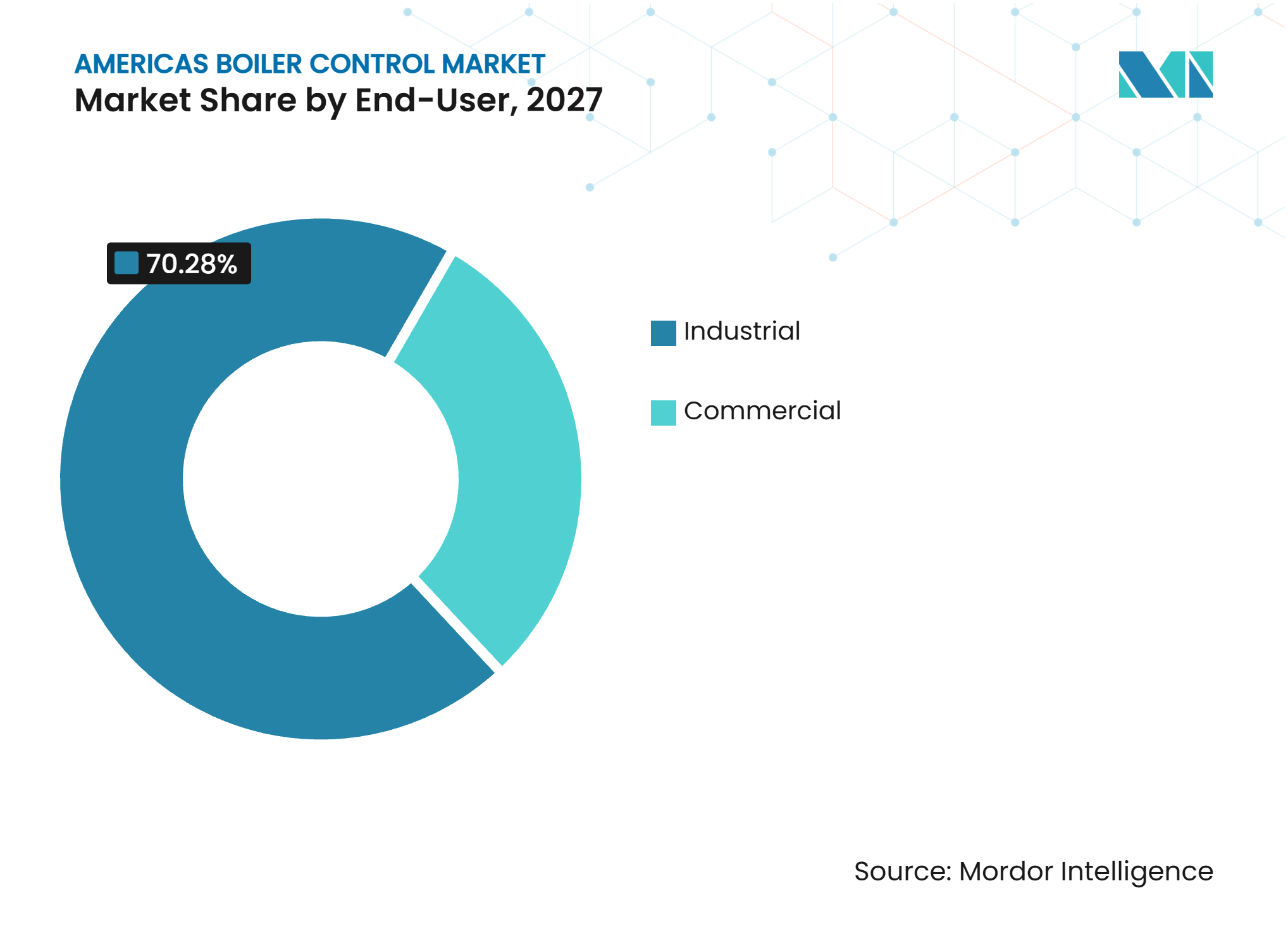
- Industrial owners are expected to generate 70.28% of the Americas boiler control market share in 2027, with the segment also forecast to lead end-user growth at a 3.99% CAGR through 2032.
- The United States accounts for an estimated 75.09% of the Americas boiler control market size in 2027, while Brazil is forecast to record the fastest country growth at 6.23% over 2027-2032.
- Remote monitoring and BACnet integration provide the largest identified growth contribution, adding approximately 0.5 percentage points to the forecast CAGR.
- Mill and refinery closures subtract approximately 0.3 percentage points from forecast growth, making retention of operating industrial sites central to aftermarket demand.
Note: Market numbers in this report are based on Mordor Intelligence's proprietary estimation framework, which combines nine months of actuals with Q4 projections for base year 2026.
Market Trends and Insights
Baseline growth is 3.3% annually, supported by equipment replacement, a broadly stable US boiler population, US price inflation of approximately 2.8% and faster underlying expansion in Latin America. Market forces together lift the forecast growth rate approximately 0.63 percentage points above that baseline to 3.93% over 2027-2032. Each impact in the driver and restraint tables adds to or takes from baseline growth. Smaller forces and changes in product mix account for the remaining difference.
Drivers Impact Analysis of Americas Boiler Control Market*
| Driver | (~) % Impact on CAGR Forecast | Geographic Relevance | Impact Timeline |
|---|---|---|---|
| Building performance standards in force tightening large-building emissions limits | +0.1% | US cities with building performance standards | Medium term (2-4 years) |
| Aging boiler base running flame-safeguard controls past designed lifetime | +0.3% | United States and Canada, particularly industrial and institutional installations | Long term (≥ 4 years) |
| Brazilian pulp mill and corn ethanol plant construction pipeline | +0.1% | Brazil | Medium term (2-4 years) |
| Chemical industry capital spending forecast to recover | +0.1% | United States, Canada and selected Latin American industrial centers | Medium term (2-4 years) |
| Announced US pharmaceutical and biologics plant investment programs | +0.1% | United States | Medium term (2-4 years) |
| Remote monitoring and BACnet connectivity being added to boiler controls | +0.5% | United States and Canada, with adoption extending into Latin America | Long term (≥ 4 years) |
| Source: Mordor Intelligence | |||
Remote Monitoring and BACnet Connectivity Being Added to Boiler Controls
Remote monitoring and BACnet connectivity are reaching smaller boiler rooms through products built for existing installations. Miura America's November 2025 Connect Lite launch provided remote monitoring and local Modbus and BACnet outputs for building automation integration. Watts' November 2026 tekmar 294BAC launch likewise combined native BACnet communications with remote notifications for commercial boiler plants. BACnet is a communications standard that lets building equipment exchange operating information, so a boiler controller that supports it can join a facility-wide operating system. Retrofit-ready connectivity widens the base of installed boilers that can carry monitoring.
Connected products also change what boiler control suppliers can sell after commissioning. Miura's launch linked its gateway to Basic and Plus monitoring subscriptions, while Watts connected the tekmar controller to its Nexa platform. Both place continuing monitoring services alongside the initial hardware sale. Software revenue in the Americas boiler control market grows through attachment to installed equipment and service relationships.
Aging Boiler Base Running Flame-Safeguard Controls Past Designed Lifetime
Aging industrial boilers create a large inspection and replacement need for safety controls. The Environmental Integrity Project's May 2025 study found that 73% of the 185 large US pulp and paper mills examined had boilers older than 15 years, and the average boiler with age information was 41 years old.[2] Its June 2025 refinery study classified 739 of 845 boilers and heaters with age data at the highest-emitting refineries as outdated. The age of the equipment carrying the controls strengthens demand for assessments of flame detection, shutdown functions and replacement-part availability at US pulp, paper and refinery sites.
Obsolete legacy controls add a practical trigger to that inspection cycle. TCI Supply's August 2025 replacement guide identified phased-out Honeywell flame-safeguard families and mapped them to newer replacements. At Green Plains' Central City biorefinery, an October 2026 project account described upgraded burner controls and flame safeguards across a multi-boiler installation. Owners can replace the safety and combustion-control layer while keeping serviceable parts of the wider steam boiler system, which makes layer-by-layer retrofits a main route for aging-boiler demand.
Building Performance Standards in Force Tightening Large-Building Emissions Limits
Building performance standards give commercial boiler owners a recurring reason to examine boiler operation. New York City's Department of Buildings confirmed in April 2026 that Local Law 97 emissions penalties and eligible offset certificates cost USD 268 per metric ton of carbon emissions above the applicable allowance. Boston's BERDO program entered its first emissions-compliance period in 2025, according to the city's implementation framework, and applies limits by building use. Annual building-level obligations support demand for sequencing, scheduling and combustion adjustments that cut fuel use within an existing plant. Controls offer an early operating improvement before an owner commits to a larger heating-system conversion, which gives commercial control suppliers an opening where owners need documented savings from equipment that stays in service.
Brazilian Pulp Mill and Corn Ethanol Plant Construction Pipeline
Brazil's pulp mill and corn ethanol plant construction pipeline supports new control packages for steam-intensive production. Valor International reported in October 2026 that Arauco's Sucuriú pulp project was under construction, with planned capacity of 3.5 million metric tons annually and operations targeted for late 2027. Valor's June 2026 reporting placed FS's Campo Novo do Parecis corn ethanol plant under construction, with planned ethanol capacity of 540 million liters annually and a December 2026 startup target. Both projects create demand for combustion, feedwater, pressure and safety controls before full production begins.
Project maturity decides when the Brazilian pipeline becomes control-system revenue. Cultivar reported in September 2026 that Coamo's corn ethanol plant was more than 60% complete, with startup targeted for March 2027. CMPC's Nature pulp project remained at the preliminary-licensing stage in October 2026, according to BNamericas. Suppliers serving Brazilian process plants face a mix of near-term commissioning work and longer-lead engineering opportunities.
Restraints Impact Analysis of Americas Boiler Control Market*
| Restraint | (~) % Impact on CAGR Forecast | Geographic Relevance | Impact Timeline |
|---|---|---|---|
| Fossil heating bans for new buildings in force locally | -0.1% | Selected US cities and Canadian municipalities | Medium term (2-4 years) |
| Pulp, paper and refinery closures shrinking the industrial boiler base | -0.3% | United States and Canada | Medium term (2-4 years) |
| Boiler emissions rule amendments pending and federal efficiency deduction ended | -0.1% | United States | Medium term (2-4 years) |
| Shift to modular condensing boilers with embedded controls | -0.1% | United States and Canada | Long term (≥ 4 years) |
| Source: Mordor Intelligence | |||
Pulp, Paper and Refinery Closures Shrinking the Industrial Boiler Base
Permanent mill closures remove future maintenance and retrofit demand from suppliers' installed customer bases. Domtar announced the permanent closure of its Crofton mill in December 2025, identifying approximately 380,000 air-dried metric tons of annual pulp capacity affected. Canfor announced Northwood's closure in July 2026, covering approximately 300,000 metric tons annually, and its November update continued to anticipate closure by year-end. Both cases reduce the population of operating industrial sites available for future boiler-control upgrades.
Closure exposure also changes the economics of the remaining service network. International Paper announced staged shutdowns of its Savannah and Riceboro mills in August 2025, identifying substantial containerboard capacity removals in Georgia. Together with the Canadian pulp reductions, these announcements spread pressure across multiple industrial customers and locations. Suppliers with geographically concentrated mill-service businesses face a smaller recurring workload even when surviving plants continue to invest.
Fossil Heating Bans for New Buildings in Force Locally
Local fossil heating bans reduce the addressable market for combustion controls in new commercial buildings. Massachusetts' fossil-fuel-free demonstration program had active ordinances across participating municipalities by 2025, while metropolitan Montreal's framework extended restrictions to new buildings in April 2025. Research and medical facilities receive exemptions in some Massachusetts communities, according to 2026 reporting by Governing. New fossil-fired boiler packages shrink in these locations, while industrial and exempt applications keep different demand conditions.
Electrification also redirects part of control spending toward a different boiler architecture. Cleaver-Brooks' 2026 commercial product lineup included medium-voltage electric boilers alongside controls for hybrid heat-pump and boiler operation. Electric units still require temperature, pressure, sequencing and protection functions, but they remove the burner and flame-safeguard equipment used by fuel-fired systems. Growth in the electric boiler market changes the component mix available to control suppliers, moving spending away from burner and flame-safeguard equipment.
*Our forecasts treat driver/restraint impacts as directional, not additive. The impact forecasts reflect baseline growth, mix effects, and variable interactions.
Americas Boiler Control Market Segment Analysis
By Boiler Type:
Packaged Fire-Tube Applications LeadFire-tube applications are estimated to command 39.10% of the Americas boiler control market share in 2027 and are forecast to expand at a 4.02% CAGR over 2027-2032. Their position rests on packaged process-steam installations serving food processing, manufacturing and institutional loads. Nationwide Boiler's July 2026 account of a California food producer described a completed fire-tube package combining a boiler, an ultra-low-NOx burner (built for low nitrogen-oxide emissions) and emissions-compliance testing. In fire-tube applications each sale is a commissioned control and combustion package, which gives hardware and integration suppliers a substantial role in every installation.
Water-tube applications are close behind in revenue and are forecast to grow at a 3.86% CAGR over 2027-2032. Nationwide Boiler's separate July 2026 food-processing project paired a 180,000 lb/hour water-tube boiler with emissions-treatment equipment, a larger operating duty than a packaged fire-tube unit. Rentech's September 2026 industry commentary likewise associated water-tube designs with higher industrial pressure and temperature requirements. Water-tube control demand places greater weight on coordinated combustion, feedwater, drum-level and safety functions.
Other boilers cover electric, thermal-fluid, sectional and condensing commercial designs, and they rely on controls built in at the factory. Cleaver-Brooks' 2026 product lineup showed both electric steam generation and hybrid hydronic (hot-water) operation, while AERCO's 2026 condensing launches incorporated factory-integrated sequencing and building-system communications. Integrated sequencing and communications make the controls a built-in feature of these boilers, and the other-boiler segment holds a smaller position than either tube design.



By Component:
Hardware Anchors Connected ServicesHardware is estimated to account for 88.12% of the Americas boiler control market size in 2027, including bundled installation and commissioning. Nationwide Boiler's October 2026 description of its PLC-based (programmable logic controller) combustion packages placed burner management, operator interfaces and operating supervision within an integrated control system. Cleaver-Brooks' February 2025 EOS 500 launch similarly combined parallel positioning, flame safeguards and actuator control in a burner-control package. Boiler control buyers continue to pay mainly for equipment that measures operating conditions, executes control actions and provides safe shutdown, which keeps hardware the largest component.
Software is forecast to grow at a 6.21% CAGR over 2027-2032 as monitoring and analytics attach to those installations. Miura's February 2026 newsletter described the integration of Miura Connect into its BP-201 plant-control panel, removing the need for a separate Connect panel in that configuration. The arrangement shows software expanding while hardware architecture becomes more integrated. Software suppliers gain recurring revenue through monitoring levels, diagnostics and ongoing support, and hardware remains the entry point for those sales in the Americas.

By End-User:
Industrial Steam Duty Sustains SpendingIndustrial owners are expected to account for 70.28% of the Americas boiler control market share in 2027, and the segment is forecast to lead growth at a 3.99% CAGR over 2027-2032. Process plants buy controls around production continuity, safe combustion and stable steam conditions. Pacific Rim Mechanical's November 2025 MilliporeSigma case study described a completed expansion that added high-pressure steam boilers and heating-hot-water equipment within an operating biopharmaceutical facility. In industrial boiler control, production-sensitive installations support demand for commissioning, integration and service alongside the control hardware.
Commercial demand is forecast to increase at a 3.79% CAGR over 2027-2032, supported by hospitals, campuses, hotels and other centralized heating users. Plenary Americas reported financial close in June 2026 on the University of Kentucky's new central utility plant, designed to provide steam and chilled water for campus and hospital expansion. AERCO's June 2026 MFC II launch also targeted hospitals, campuses and other facilities requiring fuel flexibility and building-system integration. Suppliers serving commercial boilers compete on reliable sequencing, commissioning support and compatibility with wider building operations.
Geography Analysis
United States: Installed-Plant Upgrades Carry the Largest Opportunity
The United States is estimated to represent 75.09% of the Americas boiler control market size in 2027. Industrial retrofit work, such as the Green Plains biorefinery upgrade, and institutional utility projects, such as the University of Kentucky plant, provide complementary sources of spending. The Kentucky construction program extends toward 2029, so the US opportunity spans immediate replacement work and multi-year project delivery.
US boiler control suppliers also face a changing distribution structure. Cleaver-Brooks completed its partnership agreement with R.F. MacDonald in October 2026, bringing a California and Nevada sales-and-service business into the group. The transaction extends direct access to customers requiring installation, troubleshooting and subsequent upgrades. Local service capability remains a route to securing the next control-package sale within the country's large installed base.
Brazil: New Capacity and Modernization Accelerate Demand
Brazil is forecast to grow at a 6.23% CAGR over 2027-2032, the fastest rate among the countries analyzed. New pulp and ethanol facilities contribute to that outlook, while operating mills create modernization work. Klabin announced in November 2026 that Monte Alegre's new recovery boiler, which burns spent pulping liquor to generate steam, had entered operation in October. It replaced equipment in service since 1978 and introduced a new control-system generation with advanced process controls. The project shows that Brazil's control demand includes replacement of operating industrial infrastructure alongside capacity expansion.
Brazilian agro-processing also supports smaller, targeted upgrades. BNDES-approved financing reported in August 2026 for Agrovale included modernization of boiler combustion, automation, instrumentation and monitoring at its Bahia operation. The financing was an approved investment program, while Klabin's recovery-boiler project was already operating. Suppliers serving the biomass boiler market encounter different sales cycles in Brazil for new plant construction, boiler replacement and control-layer modernization.
Canada and Other Americas: Replacement and Selective Electrification
Canada combines institutional replacement demand with pressure on parts of its industrial boiler base. The University of Saskatchewan reported in August 2026 that its heating-plant project would replace boilers dating from 1953 and 1957, with completion targeted for January 2027. The project serves a campus heating network that includes hospitals, giving commissioning continuity a high operating priority. Canadian suppliers can pursue long-lived institutional assets while mill closures reduce opportunities elsewhere.
Argentina and Mexico provide more selective industrial opportunities. Eco de los Andes described an operating electric process-steam boiler at its Mendoza plant in January 2026 reporting, while Argentina's November 2026 efficiency-incentive framework added qualifying high-efficiency boilers. Mexico's January 2026 Aztema announcement described a cogeneration project supplying useful steam and hot water to tire manufacturing. Growth in Argentina and Mexico depends on identifiable plant investments, efficiency programs and changes in industrial heat supply.
Competitive Landscape
Market Concentration
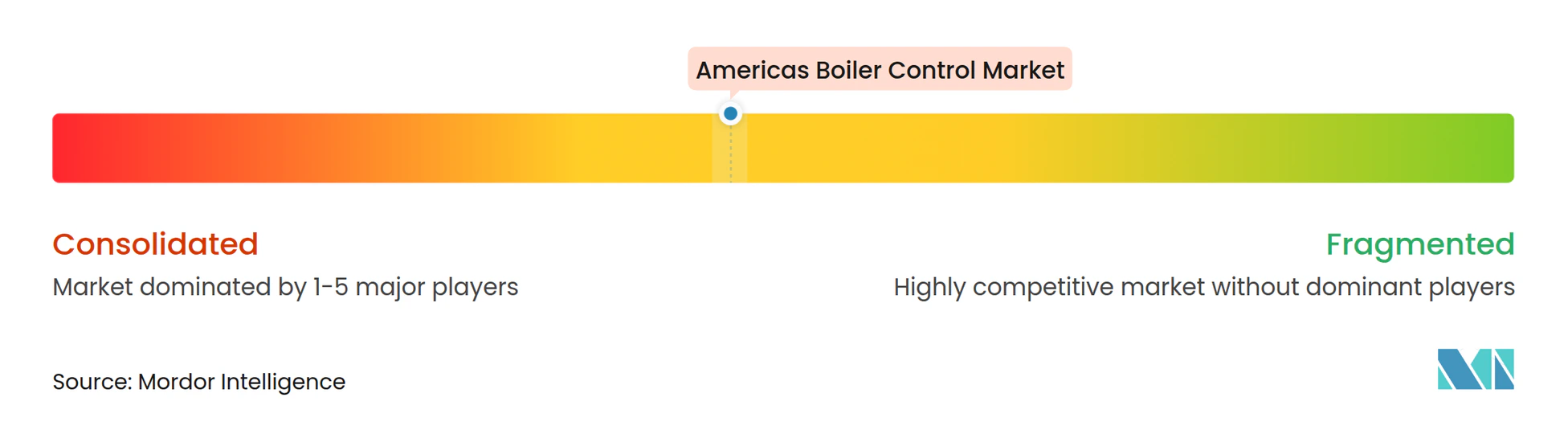
Competition spans automation platforms, boiler manufacturers, combustion specialists and local system integrators. The leading profiled companies are GE Vernova, ABB Ltd., Toshiba Corporation, Emerson Electric Co and Bosch Industriekessel GmbH, and their exposure to dedicated boiler control differs. GE Vernova's November 2026 Mark VIe materials emphasize turbine and integrated plant control, so its boiler-dedicated participation sits within a wider plant-control offer. Toshiba's published Houston Thermal Energy Corporation case describes boiler combustion and burner-management upgrades integrated with TOSDIC-CIE supervision, which gives it a direct central-plant integration role.
ABB supplies industrial boiler safety instrumentation, including flame-scanning equipment, while Emerson competes through safety controllers, fuel-train devices and control platforms. Emerson's fiscal 2026 Form 10-K reported USD 4.58 billion in Control Systems & Software sales, a broad platform business that includes equipment used for boiler automation.[3] Bosch Industriekessel's BCO and SCO systems address the boiler and boiler house respectively, including feedwater, condensate and fuel-system coordination, according to its January 2025 product case material. Platform breadth helps these suppliers serve complex projects, while only boiler-specific engineering adds to Americas boiler control revenue.
The 5 named suppliers are estimated to account jointly for approximately 15% of 2026 market value. The low combined position reflects substantial supply through specialist combustion-control vendors, boiler OEMs and regional panel builders. Fireye's March 2026 acquisition of Energy Technology & Control added air-fuel management, multi-boiler management and diagnostic capabilities, showing consolidation within that specialist layer. Competitive advantage in boiler control increasingly combines safe control execution with access to the installed customer base and technicians who can commission upgrades.
Americas Boiler Control Industry Leaders
-
GE Vernova
-
ABB Ltd.
-
Toshiba Corporation
-
Emerson Electric Co
-
Bosch Industriekessel GmbH
- *Disclaimer: Major Players sorted in no particular order
Americas Boiler Control Market Companies Covered in this Report
- GE Vernova
- ABB Ltd.
- Toshiba Corporation
- Emerson Electric Co
- Bosch Industriekessel GmbH
- Thermon Group Holdings, Inc.
- Nationwide Boiler, Inc.
- Siemens AG
- HBX Control Systems Inc
- Valmet Oyj
- List of Other Prominent Companies
- Market Ranking Analysis
Compliance Upgrade Economics
Tighter future emissions allowances make the timing of boiler-control upgrades commercially important under New York City's Local Law 97. The consolidated rule implies a multifamily allowance of 675 metric tons annually for a 100,000 sq ft building during 2024-2029, falling to 334.7 metric tons during 2030-2034. The reduction of 340.3 metric tons equals a calculated 50.42% tightening of the initial allowance. That second-period step stands behind the building-performance driver's approximately +0.1 percentage-point contribution to forecast growth and puts upgrade timing at the center of commercial boiler control demand in New York.
Completed projects show owners combining operational changes with larger thermal-system investments. A June 2025 account of St. James's Tower described a boiler-room overhaul that approximately halved annual gas use, while Trane Technologies reported reduced steam use and utility costs following the September 2025 completion of its 55 Water Street project. Both involved broader plant changes, so their savings come from the whole project, controls included. In commercial compliance planning, some savings come from operating changes to existing controls and the rest require replacement equipment.
Connected Retrofit Economics
Measured portfolio savings strengthen the commercial case for connected boiler controls. Entech reported in June 2026 that its S2 system generated USD 5.09 million in heating-energy savings across 401 New York City apartment buildings during 2025. Dividing the reported savings by the building count gives a calculated average of approximately USD 12,693 per building annually. This vendor-reported result links software-based boiler control to operating-cost savings in large apartment portfolios.
Monitoring also creates value by identifying specific operating adjustments. Cleaver-Brooks' April 2025 case reporting described an Ohio food processor where standby and night-setback reconfiguration was projected to save approximately USD 9,200 annually. That projected result differs from Entech's completed portfolio measurement, but both connect control spending to avoidable energy consumption. Savings claims for monitoring in industrial and commercial boilers depend on commissioning and follow-up service from suppliers.
Recent Industry Developments in Americas Boiler Control Market
- Oct 2026: Cleaver-Brooks announced completion of its partnership agreement with R.F. MacDonald, expanding its owned boiler sales-and-service channel in California and Nevada.
- Mar 2026: Fireye announced its acquisition of Energy Technology & Control, adding combustion-efficiency, multi-boiler management and diagnostic capabilities.
- Aug 2025: Emerson introduced the PACSystems RX3i CPS400 Safety Controller for applications including burner management, with support for Safety Integrity Level 2 strategies.
Americas Boiler Control Market Report Scope and Research Methodology
Market Definition and Coverage
The market covers control systems for industrial and commercial water-tube, fire-tube and other boilers, including electric, thermal-fluid, sectional and condensing commercial designs. Products include burner management and flame safeguards, combustion and oxygen-trim controllers, boiler PLCs, sequencing panels, boiler-specific sensors and analyzers, flame scanners, boiler-house software and remote monitoring. Sales serve boiler and burner OEMs installing new equipment and owners undertaking retrofits, upgrades or software subscriptions.
Utility power-station boilers, residential boilers and thermostats, and general plant distributed control systems without dedicated boiler scope are excluded. Market value is measured in USD at the manufacturer's or system integrator's selling price of the boiler control package or retrofit. A transaction represents a boiler's control package, a retrofit or a software subscription, with bundled installation and commissioning included in hardware value.
Segment allocation follows the boiler application, the purchased component and the boiler owner. Condensing commercial boilers are counted in other boiler types even when their heat exchangers use fire-tube construction. Dedicated boiler-control portions of larger automation projects are included, while unrelated plant automation is excluded. Industrial captive-power applications are classified by the industrial owner, while heat-only district and municipal plants fall under commercial users.
Segments Covered in This Report
- By Boiler Type
- Water Tube Boiler
- Fire Tube Boiler
- Others
- By Component
- Hardware
- Burner Management and Flame Safeguard Systems
- Combustion and Boiler Controllers
- Sensors, Analysers and Field Devices
- Software
- Hardware
- By End-User
- Industrial
- Food, Beverage and Agro-processing
- Chemicals, Petrochemicals and Refining
- Pulp, Paper and Textiles
- Other Industries
- Commercial
- Commercial and Institutional Buildings
- District and Municipal Heating
- Industrial
- By Geography
- United States
- Canada
- Brazil
- Argentina
- Rest of Americas
Data Sources, Market Sizing, and Validation
Desk Research
Public research draws on the US Department of Energy, Oak Ridge National Laboratory, the US Environmental Protection Agency, the American Boiler Manufacturers Association, New York City's Department of Buildings and Brazil's BNDES. Regulatory material establishes compliance obligations, while engineering publications, project records and equipment inventories inform application boundaries and replacement demand. Older benchmark inventories remain reference points where no equivalent current census exists, with subsequent developments reviewed separately.
Company annual reports, quarterly filings, product documentation, acquisition announcements and project releases provide evidence on sales direction, control architecture and investment timing. Sources include boiler OEMs, automation suppliers, system integrators and industrial or institutional owners. These sources are not exhaustive, and further sources inform data collection, validation and clarification.
Primary Interviews and Surveys
Analysts interview boiler and burner manufacturers, combustion-control suppliers, panel builders, system integrators, distributors and service companies. Discussions with industrial energy managers and commercial facility operators validate replacement cycles, package pricing, commissioning requirements and monitoring adoption. Interview findings are triangulated with public records and supplier disclosures to test the consistency of market assumptions.
Distribution of primary research fieldwork respondents
| Company type | Respondent position | Region |
|---|---|---|
| Top tier: 35% | CXOs: 20% | North America: 70% |
| Mid tier: 45% | Functional/Unit leaders: 30% | South America: 25% |
| Smaller Players: 20% | Managers: 50% | Central America and Caribbean: 5% |
Market-Sizing & Forecasting
Market sizing starts with the installed industrial and commercial boiler population and annual control spending per boiler across the countries covered. Estimates distinguish boiler design, end-user application, new equipment versus the installed base, hardware packages and software spending. Public procurement awards, supplier prices and project records inform control-package expenditure, with country estimates adjusted for local purchasing conditions.
Forecasts apply price changes and underlying activity to the installed-base spending framework, then incorporate replacement, connectivity, industrial investment, regulation and plant closures. Baseline growth is supplemented by the identified market forces, with smaller influences and mix changes completing the forecast. Equipment-sales trends, OEM results, project pipelines and supplier-channel developments provide outside checks on the resulting trajectory.
Confidence is strongest in the United States, where the longstanding EEA/ORNL industrial and commercial boiler inventory supplies a benchmark. Latin American boiler populations require more estimation and project-level triangulation. The competitive concentration assessment is an analyst estimate based on supplier roles, OEM integration, specialist participation and the distribution of retrofit work, since dedicated Americas boiler-control revenue is generally not separately disclosed.
Data Validation and Update Cycle
Country estimates are reconciled across boiler type, component and end-user totals, then checked against regional aggregation. Analysts review unusual movements against acquisitions, plant closures, major projects, price changes and shifts between embedded controls and separately sold packages. Conflicting observations are assessed at their stated scope, including distinctions between equipment sales, orders, service revenue and announced investment.
The market is refreshed annually using the latest available company and public-sector information. Major acquisitions, regulatory changes and industrial commissioning or closure events trigger interim reviews. Forecast assumptions are revised when those events materially change the addressable boiler population or spending per installation.
Comparison with Published Estimates
Regional Research Publisher A measures a closely related Americas boiler-control market, but its industrial coverage includes power generation without the explicit utility power-station exclusion applied here. That broader application boundary is the clearest stated reason for its higher valuation, even though its reference year is earlier. Neither comparator states a public selling-price basis, so a quantified price-chain adjustment is not applied.
Comparison with Published Estimates
| Publisher | Market Size | Key gap |
|---|---|---|
| Mordor Intelligence | USD 628.8 million in 2026 | Industrial and commercial boiler-specific packages, retrofits and software at manufacturer or system integrator selling prices. |
| Regional Research Publisher A | USD 877.5 million in 2025 | Americas industrial and commercial boiler controls. Its industrial narrative includes power generation, and the public price basis is unspecified. |
| Global Research Publisher B | USD 2,996.8 million in 2025 | Calculated sum of its North American and South American boiler-control estimates. Its definition explicitly includes utility boilers and services. |
Global Research Publisher B also measures boiler controls, but includes utility boilers and services within its product definition. Large power-station control projects and wider service revenue create a substantially larger value pool than industrial and commercial boiler-specific packages alone. The comparison therefore tests the effect of coverage before attributing the difference to growth assumptions. Consistent application boundaries and selling-price definitions provide the most useful basis for comparing published market values.
Key Questions Answered in the Report
What is the Americas boiler control market size?
The market is worth USD 628.8 million in 2026. It is estimated at USD 651.3 million in 2027 and forecast to reach USD 789.7 million by 2032, at a 3.93% CAGR over 2027-2032.
How much of the Americas boiler control market share does the United States hold?
The United States is estimated to hold 75.09% in 2027, supported by industrial retrofits, institutional utility projects and commercial boiler installations.
Which boiler type leads control-system demand?
Fire-tube applications lead estimated 2027 revenue at 39.10%, with water-tube applications close behind. Packaged process-steam installations support demand for integrated combustion, safety and operating controls.
Why is boiler-control software growing?
Remote monitoring, operating alerts and diagnostics add continuing services to installed hardware. Software revenue is forecast to grow at a 6.21% CAGR over 2027-2032.
Which country is growing fastest in the Americas boiler control market?
Brazil is forecast to grow fastest, at a 6.23% CAGR over 2027-2032. New pulp mills and corn ethanol plants add capacity, and projects such as Klabin's new Monte Alegre recovery boiler, which replaced equipment in service since 1978, add modernization work.
Which force takes the most from market growth?
Pulp, paper and refinery closures take approximately 0.3 percentage points from the forecast CAGR. Domtar's Crofton mill closure, announced in December 2025, and Canfor's Northwood closure, announced in July 2026, remove operating industrial sites from the boiler-control upgrade base.