
Boiler Market Size and Share
Market Overview
| Study Period | 2020 - 2031 |
|---|---|
| Forecast Data Period | 2026 - 2031 |
| Historical Data Period | 2020 - 2024 |
| Growth Rate | 5.03 % |
| Fastest Growing Market | Asia-Pacific |
| Largest Market | North America |
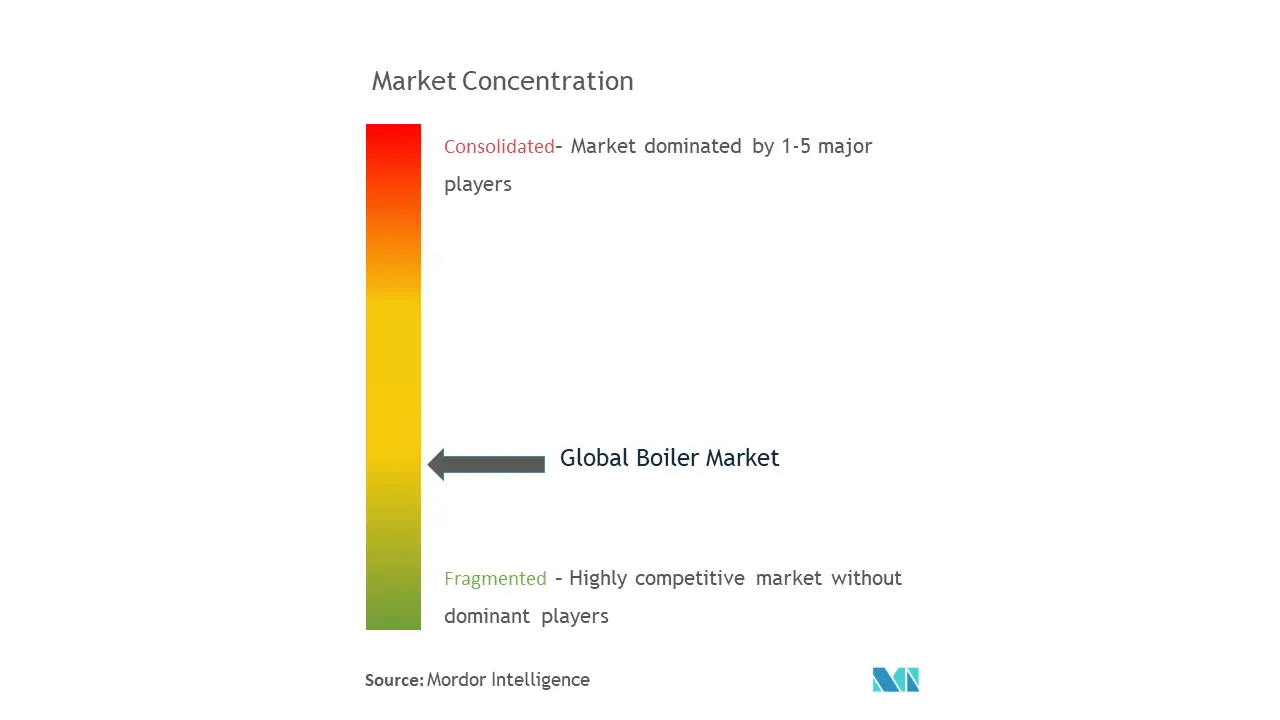
| Market Concentration | Medium |
Major Players *Disclaimer: Major Players sorted in no particular order Image © Mordor Intelligence. Reuse requires attribution under CC BY 4.0. | |
Boiler Market Analysis by Mordor Intelligence
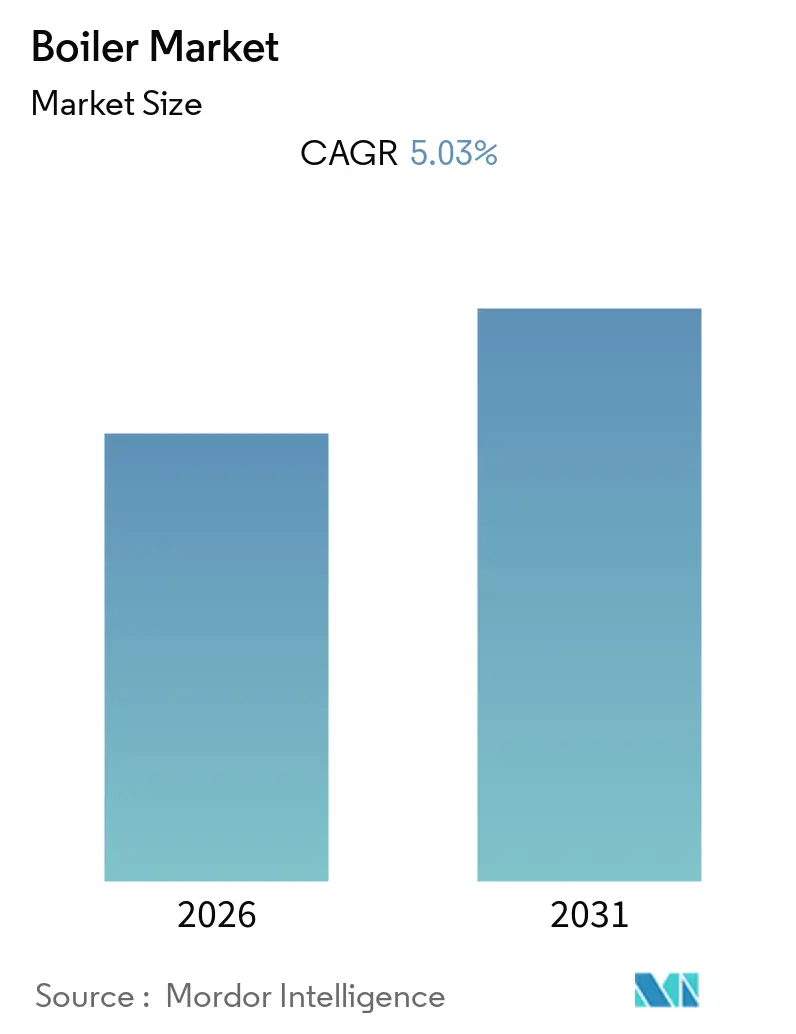
The Boiler Market size is expected to register a CAGR of 5.03% during the forecast period.
- The expansion of the food processing industry pushes the boiler market forward. Several government initiatives are also driving market expansion in their respective regions. For instance, the Government of India offers tax benefits to small and medium-sized food processing companies to encourage them to establish and grow their operations.
- Rising investments in various industries, such as petrochemical, in developing countries such as China and India drive up demand for boilers. The market is predicted to expand further due to increased demand for energy-efficient systems, which will complement the business growth, According to the Chemicals & Petrochemicals Manufacturers Association. The petrochemical project of Indian Oil Corporation Limited in Paradeep, Odisha, accounted for an investment of nearly USD 2.7 million as of 2021.
- The COVID-19 outbreak has impacted negatively the global boiler market. This is attributed to the halting of manufacturing activities, residential construction & maintenance activities, halt in logistics services, and decreased consumer spending on the replacement of old heating systems and. The sharp decline in the industrial and commercial business is negatively impacting the growth of the global boiler market
- One of the reasons impeding the growth of the boiler market is the rigorous regulation imposed by government agencies on emission limits. Furthermore, fluctuating raw material prices and high installation cost for the boiler appears to be a market restraint. For example, In India According to Commission for Air Quality Management (CAQM), industries cannot use bio-mass fuel over 80mg/Nm3 in boilers, and they should limit emissions to 50mg/Nm3. Such regulation imposed by government agencies will hinder market growth.
Note: Market size and forecast figures in this report are generated using Mordor Intelligence’s proprietary estimation framework, updated with the latest available data and insights as of 2026.
Global Boiler Market Trends and Insights
Demand for Residential Boilers to Hold a Major Market Share
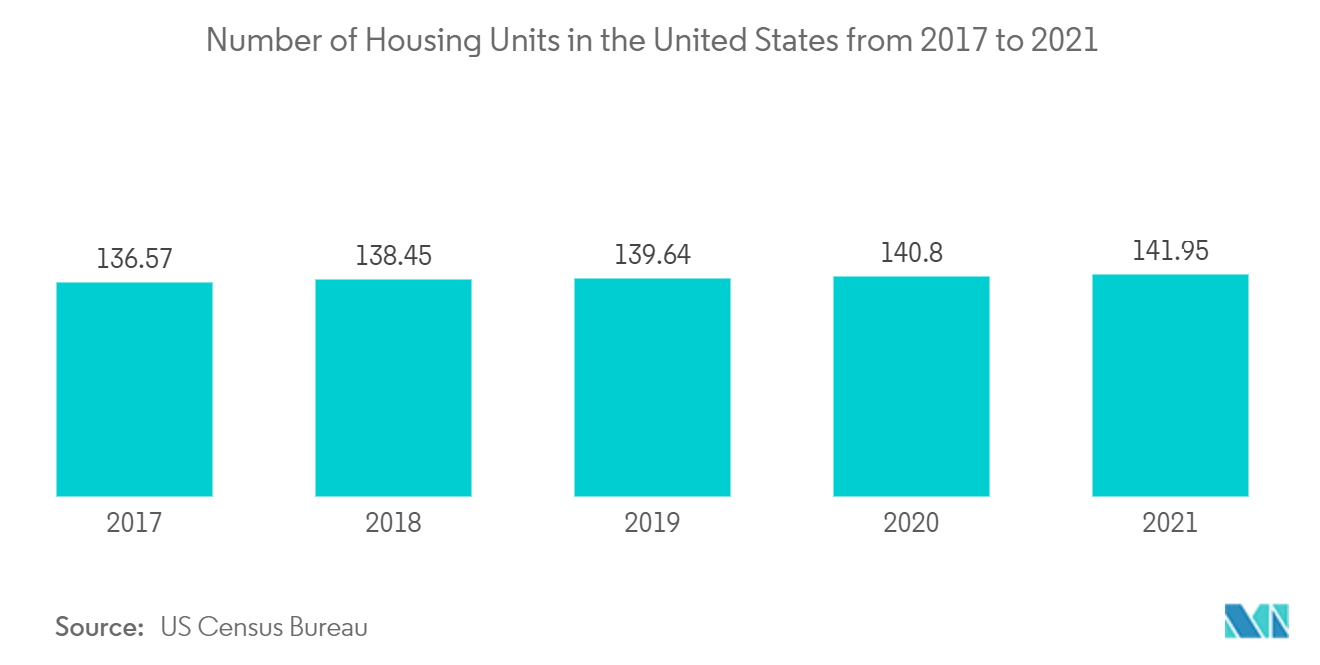
- The strong growth demand from the real estate sector in the United States, Germany, India, and China is expected to drive demand for boilers in the residential segment, and Rising urbanization and a rapidly growing population in emerging nations like India, China, and Brazil are expected to drive global boiler market. For instance, According to US Census Bureau, the number of housing units in the united stated increased from 136.57 million in 2017 to 141.95 million in 2021, which is expected to drive demand for boilers
- Rising worries about the heat and pollution produced by boilers have driven governments in several countries to launch severe programs to promote the construction of green buildings and the use of electric boiler systems and other eco-friendly residential boilers as sustainable heating technologies.
- For instance, UK government has launched Boiler Upgrade Scheme (BUS), The plan enables property owners to transition away from their dependency on fossil fuel systems and towards a cleaner, more efficient heating system in a cost-effective manner. The BUS provides GBP 5,000 off the cost and installation of a biomass boiler for rural households.
- To produce energy-efficient boilers, major manufacturers are focused on the development of new technologies for boiler coating that will bring benefits such as rapid heating and corrosion resistance. A.O. Smith, prominent water treatment and boiler manufacturer, is continually improving its blue diamond glass coating technique to combat sediment, scale, and residue buildup on the surface of the boiler tank. These reasons are fueling the expansion of the residential global boiler market.
- The US Department of Energy took a fantastic initiative in 2020 to regulate energy conservation rules and regulations for water heater makers and manufacturers. Residential boilers, according to DOE, should be standardized as important energy-saving devices. Every customer should be able to afford and use these boilers, both technologically and financially. The DOE has provided additional assistance to manufacturers in developing innovative boilers that will save energy and money.


Asia-Pacific Expected to Hold a Major Market Share
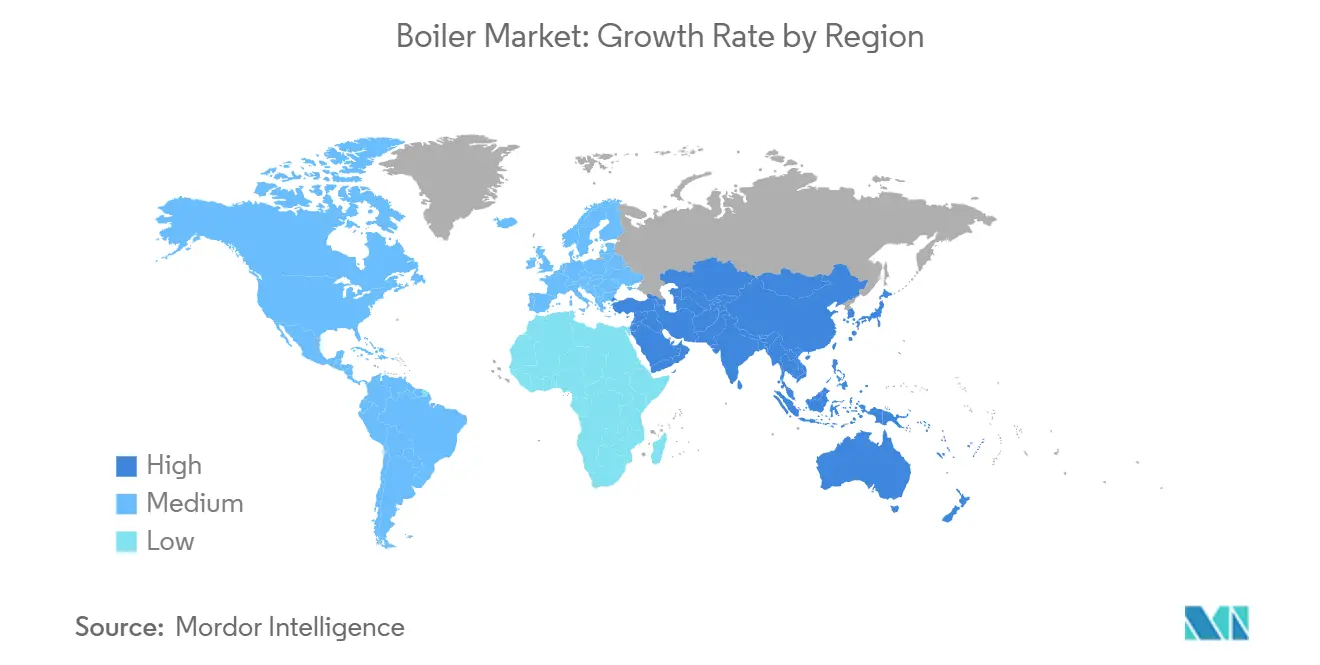
- The Asia Pacific is predicted to have significant growth due to growing urbanization and rising disposable income. The continued expansion of sustainable building projects and achieving zero-emission building targets will increase the boiler market in this region.
- Asia-Pacific dominated the market with the highest thermal power plants and refineries as of 2021. With the region's growing population and urbanization, the demand for energy and power is expected to rise during the forecast period.
- Apart from power plants, according to BP Statistics, the region contributes to nearly 37.3% of the global refining capacity and is expected to add to its refining capacity during the forecast period. China is the major country in the region that will contribute 18.3% of the world's oil refining capacity in 2021. Moreover, the country is planning to make up 44% of the crude oil refining capacity in the region in 2023. This is expected to drive the demand for the market studied.
- According to The World Bank report 2021, the increase in electricity demand and the rise in gas, coal, and carbon prices have resulted in climbing energy prices in Asia, which is a primary reason for the growing interest in energy management. Adding extra power transmission or generation capacity might help to achieve efficient energy management. Energy-efficient industrial boilers are a good illustration of efficient energy management.
- Pulau Muara Besar Refinery & Petrochemical Complex with a capacity of 14 million tons per annum is expected to be commissioned in 2022. Furthermore, the Jieyang refinery is another refinery that is under construction and is likely to be commissioned during the forecast period and is expected to increase the demand for steam boilers. With several projects upcoming in power, oil, and gas refining sector, Asia-Pacific is expected to dominate the market in the forecast period.

Competitive Landscape
Top manufacturers dominate the Global boiler market, which is highly concentrated. Due to technological improvements, industry players seek to enhance their market share by developing new products and improving existing product lines.
Boiler Industry Leaders
Mitsubishi Power, Ltd.
Valliant Group
Thermax Limited
A. O. Smith Corporation
Weil-McLain
- *Disclaimer: Major Players sorted in no particular order

Recent Industry Developments
- July 2026: Mitsubishi Power announced a contract to supply boiler components for a fuel-conversion project at the Jeddah South and Shuqaiq power plants in Saudi Arabia. The scope centers on upgrading existing thermal assets, supporting ongoing demand for retrofit and conversion boiler equipment in utility-scale applications.
- March 2026: Thermax Limited reported that its subsidiary, Thermax Babcock & Wilcox Energy Solutions, secured a boiler package order of around INR 16 billion for a 1x800 MW ultra-supercritical thermal power project in Madhya Pradesh, India. The win points to continued procurement activity for large-capacity, high-pressure boiler islands in India’s thermal power buildout and upgrades.
- February 2025: Panasonic announced measures to accelerate its heating business in Europe, including expansion around hydronic heating solutions for residential applications. This aligns supplier focus on heating-system portfolios where boilers and adjacent hydronic components compete and integrate into lower-carbon retrofit pathways in key European markets.


Research Methodology Framework and Report Scope
Market Definition and Coverage
For this study, the global boiler market is defined as the revenue generated from new boiler systems sold for producing steam or hot water for residential, commercial, and industrial heating and process needs across major regions.
Scope exclusions: We exclude aftermarket service contracts, most stand-alone parts, and fuel supply costs, and we avoid double counting when boilers are bundled inside a larger turnkey project.
Segmentation Overview
- By Boiler Type
- Hot Water Boilers
- Gas Boiler
- Steam Water Boilers
- End User
- Residential
- Commercial
- Industrial
- Geography
- North America
- Europe
- Asia-Pacific
- Rest of the World
Data Sources, Market Sizing, and Validation
Desk Research
Desk research was used to set the market frame, map demand drivers, and keep the model tied to public indicators that move boiler shipments and pricing. We leaned on sources such as the International Energy Agency for fuel and heat related trends, the World Bank for macro indicators, UN Comtrade for trade flows of boiler equipment categories, and energy efficiency or emissions rulebooks published by agencies such as the US EPA and the European Commission.
We also reviewed manufacturer annual reports, investor presentations, and credible trade publications to understand ordering patterns, product mix shifts between steam and hot water units, and the effect of efficiency upgrades. Where gaps existed in public disclosure, we used paid subscriptions selectively for company financials and intelligence, patent databases, and shipment level import-export views to sanity check regional supply movement. The specific list above is not exhaustive, and we referred to many other sources for data collection, validation, and research clarification.
Primary Interviews and Surveys
Primary inputs came from interviews and short surveys with executives, product managers, sales leaders, plant engineers, EPC participants, and channel partners across APAC, EMEA, and the Americas. These conversations helped confirm replacement cycles, typical boiler capacity needs by end use, regional price movement, and how emission and efficiency rules are changing near-term buying decisions.
Distribution of primary research fieldwork respondents
| Company type | Respondent position | Region |
|---|---|---|
| Top tier: 36% | CXOs: 16% | APAC: 38% |
| Mid tier: 45% | Functional/Unit leaders: 27% | EMEA: 36% |
| Smaller Players: 19% | Managers: 57% | Americas: 26% |
Market-Sizing & Forecasting
Sizing starts with a top-down build that reconstructs the addressable boiler demand pool by linking end-use activity to equipment replacement and new build needs, then applying region level adoption patterns for steam and hot water systems. The totals are corroborated with selective bottom-up approximations, such as supplier revenue sampling, channel checks on project activity, and a price times volume sanity check for representative boiler classes, before final adjustments are made.
A few practical inputs do most of the work in the model, and we kept them traceable so they can be explained on a client call. These include industrial production and construction activity, commercial floor space additions, heating degree day patterns that influence replacement urgency, fuel mix and energy price signals that shift technology choice, and efficiency and emission compliance timing that can pull forward orders. When product pricing was not visible, we filled gaps using ranges validated by interviews, and we applied regional currency conversion consistently for the sizing year.
Forecasting uses scenario analysis supported by expert views on capex cycles, regulation enforcement timing, and expected efficiency upgrade rates. The short term outlook is anchored to project pipelines and replacement demand, and the outer years are guided by macro indicators that were already tested against the historical period.
Data Validation & Update Cycle
Validation is handled through repeated cross checks so the final number does not rely on one data stream. Our team compares outputs against independent signals such as trade flows, major end-use capex cues, and observed price movements, then investigates any step changes that do not match known market events. If a variance cannot be explained, respondents are re-contacted and assumptions are revisited before sign-off.
Each report is refreshed annually, and interim updates are triggered when material events occur, such as major policy changes, sharp fuel price moves, or supply disruptions that alter ordering. Right before delivery, an analyst runs a final pass to ensure the latest public releases and the most recent interview learnings are reflected in the model.
Mordor Intelligence's Global Boiler Market Estimate Compared With Other Published Estimates
Published numbers for boilers often differ even when they sound like they cover the same topic, and the gaps usually come from scope choices and how pricing is treated across regions. We also see differences when one publisher updates assumptions more frequently than another, especially in years with fast changes in energy costs and equipment lead times.
Some external estimates combine boilers with steam generators or include a wider set of heat equipment that sits next to boilers in industrial plants. In Mordor Intelligence's model, only boiler systems are counted, and adjacent equipment plus recurring service revenue is excluded, which reduces scope inflation and keeps the value tied to equipment sales.
Benchmark comparison
| Source | Market Size | Gaps in Research Methodology |
|---|---|---|
| Mordor Intelligence | USD 17.30 B (2026) | |
| Global Research Portal A | USD 71.50 B (2025) | Uses a much broader category labeled as world boiler, which likely pulls in additional heating equipment and related revenue streams beyond standalone boiler system sales, and it also reflects a different base year. |
| Industry Data Publisher B | USD 31.91 B (2024) | Defines the space as boilers and steam generators, which can add non-boiler equipment and shift the result upward, and the base year and CAGR window differ, which changes price and volume normalization. |
The table shows that the spread is mainly driven by what is counted as a boiler market versus a wider heat generation equipment market, and by the year used for pricing and currency timing. With the scope tied to boiler system revenue, and by checking totals against trade movement and end-use demand signals, we aimed for a number that is repeatable and easy to audit.


Key Questions Answered in the Report
What is the current Global Boiler Market size?
The Global Boiler Market is projected to register a CAGR of 5.03% during the forecast period (2026-2031)
Who are the key players in Global Boiler Market?
Mitsubishi Power, Ltd., Valliant Group, Thermax Limited, A. O. Smith Corporation and Weil-McLain are the major companies operating in the Global Boiler Market.
Which is the fastest growing region in Global Boiler Market?
Asia-Pacific is estimated to grow at the highest CAGR over the forecast period (2026-2031).
Which region has the biggest share in Global Boiler Market?
In 2025, the North America accounts for the largest market share in Global Boiler Market.
What years does this Global Boiler Market cover?
The report covers the Global Boiler Market historical market size for years: 2019, 2020, 2021, 2022, 2023 and 2024. The report also forecasts the Global Boiler Market size for years: 2026, 2027, 2028, 2029, 2030 and 2031.
Page last updated on:


 Your data is secure and never sold or shared.


