
Ice Cream Market Analysis by Mordor Intelligence
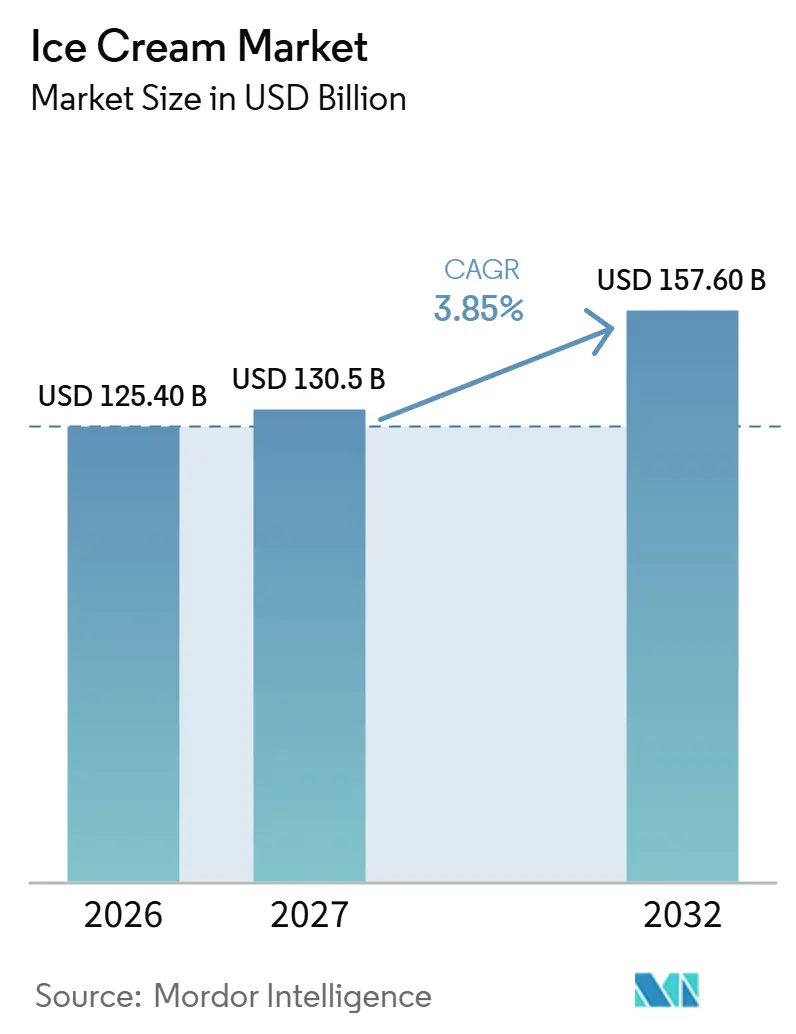
The ice cream market size is expected to increase from USD 125.4 billion in 2026 to USD 130.5 billion in 2027 and reach USD 157.6 billion by 2032, growing at a CAGR of 3.85% over 2027-2032. The ice cream market volume is expected to increase from 19.59 billion Liters in 2026 to 20.1 billion Liters in 2027 and reach 22.85 billion Liters by 2032, growing at a CAGR of 2.6% over 2027-2032.
Health-focused recipes in the United States and accessible premium treats in Africa, the Middle East and Asia create differentiated reasons to buy ice cream. Combining flavors with pints and sharing formats can develop more dessert occasions. Cold-chain dependence makes the quality delivered to consumers commercially consequential. Brands responding with pints, sharing formats and premium lines therefore compete on delivered quality as much as on flavor, which favors producers that control the frozen route to the shelf.
Key Report Takeaways
- By type, standard ice cream led with a 41.1% ice cream market share in 2026, while specialty/artisanal ice cream is forecast to grow fastest at a CAGR of 4.35% over 2027-2032.
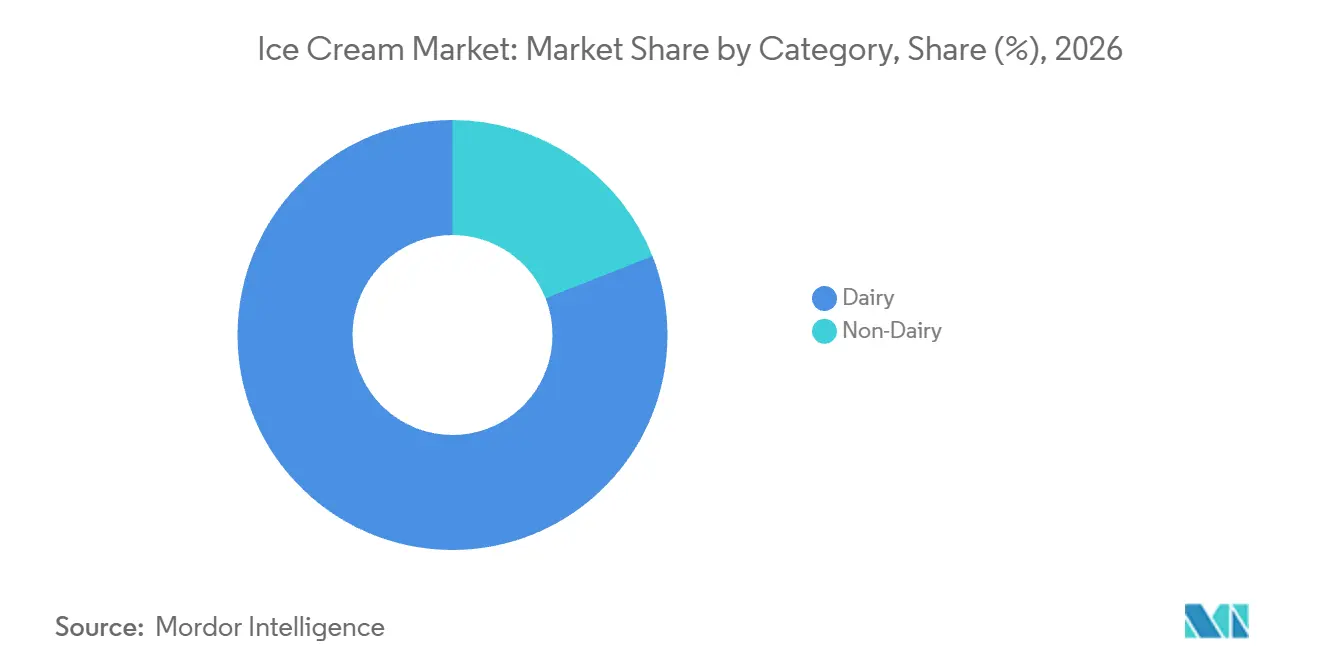
- The dairy category accounted for an 80.98% share of the ice cream market size in 2026, while non-dairy is expected to grow fastest at a CAGR of 5.2% over 2027-2032.
- Among packaging types, tubs/cups led with 72.06% of market value in 2026, and pints are projected to grow fastest at a CAGR of 4.8% over 2027-2032.
- Off-trade distribution accounted for 78.4% of market value in 2026, while on-trade is forecast to grow fastest at a CAGR of 5.4% over 2027-2032.
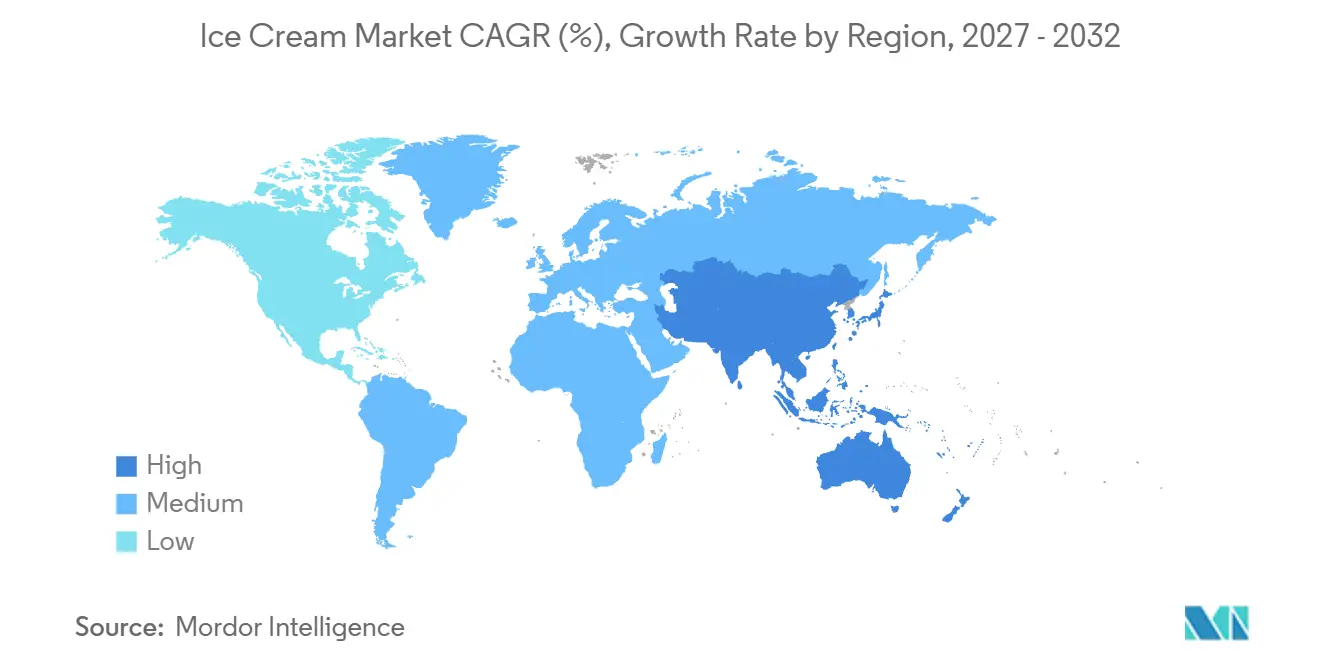
- Across geographies, North America held 30.56% of market value in 2026, and Asia-Pacific is expected to grow fastest at a CAGR of 5.6% over 2027-2032.
Note: Market numbers in this report are based on Mordor Intelligence's proprietary estimation framework, which combines nine months of actuals with Q4 projections for base year 2026.
Market Trends and Insights
Drivers Impact Analysis of Ice Cream Market*
| Driver | (~) % Impact on CAGR Forecast | Geographic Relevance | Impact Timeline |
|---|---|---|---|
| Increasing demand for health-focused ice creams | +1.1% | The United States | Medium term (2-4 years) |
| Preference for clean-label and natural ingredients | +0.8% | The United States | Medium term (2-4 years) |
| Innovation in products and flavor experimentation | +1.2% | Europe, North America and Asia-Pacific | Short term (≤ 2 years) |
| Growing demand for premium, high-end, and artisan ice cream products | +1.4% | Europe, Asia, Middle East and Africa | Medium term (2-4 years) |
| Trends in customization and experiential consumption | +0.6% | The United States | Short term (≤ 2 years) |
| Focus on sustainability and ethical sourcing | +0.4% | United States, Netherlands, Madagascar and Côte d’Ivoire | Long term (≥ 4 years) |
| Source: Mordor Intelligence | |||
Increasing demand for health-focused ice creams
Health-focused ice cream creates a revenue opportunity around a defined nutritional proposition within an established dessert category. U.S. high-protein ice-cream retail sales reached USD 354.6 million in 2025, rising 9.9% year on year and 57.3% from 2021, according to Agriculture and Agri-Food Canada.[1] In H1 2026, The Magnum Ice Cream Company reported double-digit growth for its high-protein, low-calorie Yasso offering after expansion from sticks to pints. It linked the U.S. pint launch to growing demand for healthier scoopable frozen desserts. That connects nutritional positioning with expansion into another serving format. A successful health-focused stick can therefore become a broader product platform, giving producers a route into scoopable desserts while retaining its nutritional positioning.
Preference for clean-label and natural ingredients
Clean-label positioning can broaden demand when ingredient choices accompany a distinctive dessert experience. Alec’s Ice Cream reported immediate Whole Foods sellouts after launching its Culture Cup clean-label cups in May 2025. DairyReporter linked the demand to the combination of gut-health positioning and a tactile chocolate shell. In 2026, founder Alec Jaffe reported that the line expanded to 1,250 Target stores across the United States. That progression gives suppliers a commercial example of a differentiated ingredient proposition moving beyond its initial retail launch into a wider selling network. The opportunity extends from recipe design to distribution scale, with the eating experience providing a concrete reason for the clean-label product to earn a place in a retailer’s range.
Innovation in products and flavor experimentation
Flavor experimentation can increase demand by giving an established brand additional ways to participate in a dessert occasion. Ben & Jerry’s introduced 25 new flavor and format combinations across pints, mini cups, sharing tubs, scooping and snackable bites in 2025. Its parent, The Magnum Ice Cream Company, linked those introductions to organic brand sales growth of over 3% that year. The breadth of formats matters commercially because development can change the portion and serving proposition alongside the taste. For producers, the combination creates room to develop distinct products for individual, sharing and scooped occasions within one brand. Ben & Jerry’s organic growth of over 3% came in a year when its launches changed format as well as flavor, so the demand case rests on added serving options as much as on taste.
Growing demand for premium, high-end, and artisan ice cream products
Premium demand increases the opportunity to earn more from a small discretionary treat. Froneri’s 2025 report links growing interest in accessible everyday luxury to longer-term premium ice-cream growth. The Magnum Ice Cream Company reported 10.9% organic sales growth in its Africa, Middle East and Asia region in 2025, supported partly by premium innovations including Magnum cones and Cornetto. Manufacturers can develop that opportunity by giving consumers a tangible reason to trade up within an established dessert occasion. A premium range must connect the additional appeal to the eating experience, since accessibility is part of the luxury proposition itself. Familiar cones can therefore carry the premium proposition, allowing producers to pursue trade-up demand through formats consumers already recognize.
Restraints Impact Analysis of Ice Cream Market*
| Restraint | (~) % Impact on CAGR Forecast | Geographic Relevance | Impact Timeline |
|---|---|---|---|
| Dependence on cold chain and storage limitations | -0.7% | North America, Europe and Asia-Pacific | Medium term (2-4 years) |
| High sensitivity to temperature fluctuations | -0.5% | North America, Europe, Asia-Pacific and Middle East | Short term (≤ 2 years) |
| Short shelf life compared to ambient desserts | -0.2% | The United States | Medium term (2-4 years) |
| Regulatory scrutiny on additives and labeling | -0.3% | United States and European Union | Short term (≤ 2 years) |
| Source: Mordor Intelligence | |||
Dependence on cold chain and storage limitations
Cold-chain dependence makes reliable product availability contingent on coordinated production, transport and storage rather than factory output alone. In its 2025 risk disclosure, The Magnum Ice Cream Company warned that supply-chain disruptions could challenge temperature control and cause production delays, reduced availability and higher operating costs. For an ice-cream supplier, that combination can constrain the amount of saleable product reaching an outlet even when manufacturing capacity exists. The company reported using connected sensors and automated monitoring across production, transport and storage in 2025 to safeguard cold-chain integrity. Such oversight addresses detection, but the commercial exposure remains the cost and potential delay of maintaining a temperature-controlled route through every handoff.
High sensitivity to temperature fluctuations
Temperature sensitivity places a quality constraint on distribution even when ice cream reaches its destination. University of Guelph research explains that temperature fluctuations during storage and distribution can enlarge ice crystals, produce coarse, icy texture and affect consumer acceptance. This mechanism makes the condition of the delivered dessert commercially important alongside the quantity delivered. For brands differentiated by texture, an impaired serving can weaken the product experience that supports the sale. The restraint therefore operates through saleable quality as well as physical availability, with the severity dependent on handling conditions. Maintaining that quality requires control through storage and distribution, leaving suppliers exposed to the cost of protecting a product whose texture can deteriorate before consumption.
*Our forecasts treat driver/restraint impacts as directional, not additive. The impact forecasts reflect baseline growth, mix effects, and variable interactions.
Ice Cream Market Segment Analysis
By Type:
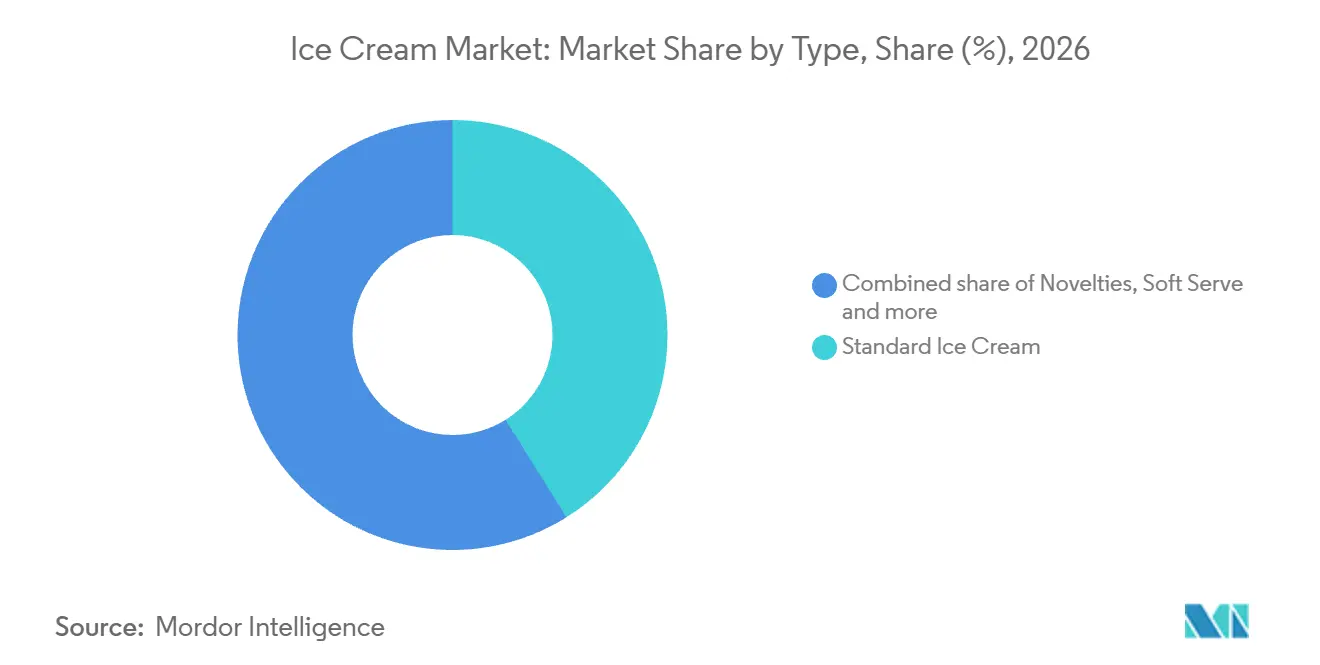
Production Scale and Artisanal Expansion Serve Different DemandStandard ice cream accounted for a 41.1% share of the ice cream market size in 2026, making it the largest segment. USDA recorded 845.1 million gallons of U.S. regular ice-cream production in 2025, down 9.2% from 2024. The output shows a large U.S. manufacturing base, but its decline qualifies the commercial strength of this established product type. For U.S. producers, defending regular ice cream’s existing business therefore matters even when its global category holds the leading share.
Specialty/artisanal ice cream is the fastest-growing segment, with a forecast CAGR of 4.35% over 2027-2032. The Italian Gelato Association reported that global artisanal gelato sales rose 8.5% in 2025.[2] Outside Europe, the network of gelato shops, bars, restaurants and hotels offering artisanal gelato expanded 8% to more than 45,000 points of sale, while average turnover per outlet rose 2%. The figures distinguish network expansion from sales productivity, which place different demands on an artisanal operator’s expansion model. The faster increase in outlet count puts more weight on replicable serving locations than on assuming large revenue gains at each site.

By Category:
Dairy Scale Meets a Selective Plant-Based OpportunityDairy represented an 80.98% ice cream market share in 2026 and was the largest segment. USDA counted 393 U.S. plants producing regular hard ice cream in 2025, a category requiring at least 10% milkfat and a weight of at least 4.5 pounds per gallon. This combination of production infrastructure and a defined composition gives established dairy suppliers a specific formulation environment. Recipes sold within that regular-hard category must preserve its milkfat and physical specifications while accommodating product development. The shared composition floors make ingredient sourcing and process efficiency practical areas of differentiation across this large U.S. production base.
Non-dairy is the fastest-growing segment, forecast to record a 5.2% CAGR over 2027-2032. Greenyard Hasselt introduced Gigi pure-plant tubs in spring 2025, pairing white pumpkin, banana and cinnamon in one combination and cucumber, avocado and dill in another. Greenyard Frozen Hasselt produces hundreds of dairy-free innovations for European retailers and foodservice companies, providing a route for broader plant-based recipes through private-label supply. However, the Good Food Institute found that plant-based ice cream and frozen novelties reached 9% of U.S. households in 2025, with 52% of those households repurchasing, while dollar and unit sales declined. Plant-based suppliers therefore need recipes that earn repeat dessert purchases, since extending the range does not by itself convert household trial into sustained category spending.
By Packaging Type:
Tub Purchasing and Pint Differentiation Shape DemandTubs/cups held 72.06% of market value in 2026, making them the largest segment. Froneri reported that U.S. Häagen-Dazs consumers increased units purchased, shopping frequency and units per trip in tubs during 2025. Those separate purchasing dimensions give established suppliers several ways to develop revenue within the same container format. More frequent trips and greater units per trip can reinforce each other, making recurring consumption commercially relevant alongside the package’s physical capacity. Because Häagen-Dazs gains came from units, trips and units per trip together, the tub’s lead rests on purchase intensity rather than on package novelty.
Pints are the fastest-growing segment, with a projected CAGR of 4.8% over 2027-2032. Instacart reported that Alec’s and Van Leeuwen increased their shares of U.S. ice-cream orders by 50% and 37%, respectively, from 2024 to 2025. It identified premium and better-for-you pints among its strongest-growing brands on that order-share measure. Alec’s and Van Leeuwen gained order share on Instacart with premium and better-for-you pint propositions. On Instacart, these gains support premium and nutritional pint development within an established container, directing investment toward the dessert proposition rather than requiring a packaging change.
By Distribution Channel:
Retail Scale and Foodservice Execution DivergeOff-trade was the largest segment, accounting for 78.4% of market value in 2026. In the United Kingdom, supermarkets, discounters and convenience stores account for most ice-cream volume, according to ICAEW. In May 2026, Marks & Spencer began refreshing its own-label ice-cream offering within a broader frozen-range expansion aimed at family weekly shopping.[3] This positions ice cream within a recurring household food shop and gives the retailer’s product development a direct role in the category proposition. Because M&S’s range is entirely own label and developed in-house, manufacturers supplying that expansion must work within the retailer’s product proposition.
On-trade is the fastest-growing segment, with an expected CAGR of 5.4% over 2027-2032. GoTo Foods’ Carvel brand operates more than 350 franchised and foodservice locations serving premium soft-serve and hand-dipped ice cream. That footprint illustrates an established serving network, while U.S. foodservice sales reached USD 1.41 trillion in 2025 in inflation-adjusted dollars, up 73.0% from 1997 and growing faster than food retailing. For ice-cream operators, that wider channel’s expansion creates room for serving occasions, provided the outlet proposition can be repeated across locations. Carvel’s soft-serve and hand-dipped menu shows that on-trade sells a served dessert rather than a packaged product, which ties growth to opening and keeping locations.
Geography Analysis
North America Ice Cream Market
North America held a 30.56% share of the ice cream market size in 2026, making it the largest geography. An International Dairy Foods Association (IDFA) survey conducted April 7-9, 2026 found that 97% of 2,205 U.S. adults loved or liked ice cream, with a margin of error of ±2 percentage points. On September 22, 2026, IDFA said dozens of makers representing more than 90% of the U.S. market were on track to remove certified artificial colors from real-milk ice cream and frozen dairy desserts sold at food retail by end-2027. That coverage puts much of the U.S. producer base on a shared retail reformulation timetable, concentrating ingredient-transition work before the deadline.
Asia-Pacific Ice Cream Market
Asia-Pacific is the fastest-growing geography, with a forecast CAGR of 5.6% over 2027-2032. Yili reported that its ice-cream revenue rose approximately 20% in Indonesia and doubled in the Philippines in H1 2026 compared with H1 2025. In Japan, manufacturer shipment value rose 2.8% in FY2025 while volume fell 2.2%, with premium products and price revisions supporting higher value. Yili and Sam’s Club also co-developed Fresh Milk Mung Bean Ice Cream, which topped the retailer’s frozen-dessert category in China during summer 2025. Yili’s country-level gains and its China retail collaboration point to local operations and jointly developed products as growth routes, while Japan’s higher shipment value reflects premium products and price revisions despite fewer units.
Europe combines a manufacturing base with changing commercial ownership, with EU ice-cream output reaching 3.44 billion liters in 2025, up 1.9% from 2024. In Portugal, The Magnum Ice Cream Company acquired Unilever Fima’s separated ice-cream marketing and sales operations on April 1, 2026, while the sourcing-unit acquisition remained subject to additional regulatory and operational approvals in its July 30, 2026 half-year results. South America has a distinct seasonal demand example in Brazil, where ABIS reported sales increases of up to 50% in certain periods of summer 2024-25. In the Middle East and Africa, Saudi Arabia’s Almarai reported expanding its ice-cream position in 2025 through product innovation and an expanding cold chain. Brazil’s weather-driven summer peaks put pressure on supply readiness, while Almarai’s cold-chain expansion and Portugal’s separate sourcing approvals make distribution and sourcing control central to serving demand.
Regulatory Framework and Outlook
The comparison examines selected jurisdictions from the perspective of packaged ice-cream manufacturers and importers. Current attractiveness balances defined compliance routes against constraints on formulation, product naming, nutrition information and claims. Germany’s composition guidelines are nonbinding, while the U.S. identity standard governs use of the standardized ice-cream name. China’s ice-cream quality benchmark is recommended, making its commercial role different from mandatory packaged-food labeling.
Regulatory Table of Ice Cream Market
| Decision factor | United States | Germany | China | Brazil | Saudi Arabia |
|---|---|---|---|---|---|
| Primary authority | U.S. Food and Drug Administration | Länder food-control authorities and local food and veterinary inspection offices | State Administration for Market Regulation | ANVISA | Saudi Food and Drug Authority |
| Key instruments or direction | 21 CFR 135.110; Red No. 3 food authorization withdrawal from January 15, 2027 | Nonbinding 2026 ice-cream guidelines; Regulation (EU) 2025/40 packaging-label transition | Recommended GB/T 31114-2024; mandatory GB 7718-2025 from March 16, 2027 | RDC 429/2020 and IN 75/2020; proposed nutrition-label review | GSO 9:2022/Amd1:2025; nutrition-label and SFDA 2333 claims rules; adopted 2233:2025 edition from January 1, 2028 |
| Commercial effect | Meet identity conditions and adapt affected Red No. 3 recipes by the deadline | Align names with composition conventions and prepare applicable packaging-label changes | Prepare labels for required disclosure of 8 allergen classes when directly used as ingredients | Meet nutrition-table, claim and applicable front-of-pack requirements | Verify labels and claims at import clearance; seek evaluation for novel claims |
| Current policy attractiveness | Medium | Medium | Medium | Medium | Medium |
| Future direction of policy attractiveness | Hardening | Hardening | Hardening | No change | No change |
| Source: Mordor Intelligence | |||||
The U.S. assessment reflects product-identity conditions and the January 15, 2027 withdrawal for affected Red No. 3 recipes, while China’s March 16, 2027 transition makes directly used listed allergens subject to mandatory disclosure. Regulation (EU) 2025/40 requires a harmonized material-composition label on packaging placed on the German market from August 12, 2028, or 24 months after specified implementing acts enter into force, whichever is later, excluding deposit-return packaging and transport packaging except e-commerce packaging. Brazil’s continuity assessment rests on RDC 429/2020 and IN 75/2020, in force since October 9, 2022, because the Q4 2027 consultation and final decision on revision leave those nutrition-label duties unchanged until a decision is taken. Saudi import clearance retains GSO 9, SFDA.FD 2233 and SFDA.FD 2333, so the January 1, 2028 transition to SFDA.FD 2233:2025 continues the nutrition-labeling framework through an edition update.
Value Chain Stages
The comparison follows the capabilities that turn ingredients into a finished frozen product and carry it to the buyer. DFA Ingredient Solutions supplies dairy ingredients, while GEA configures and installs ice-cream process lines through packaging and storage. These roles separate earnings from ingredient sales and installed equipment from the revenue earned on the dessert itself. Temperature-controlled distribution adds another service relationship, making preservation of the finished product part of the supplier earning structure.
Value Chain Analysis Table of Ice Cream Market
| Primary activity | Key participants | Value capture | Bottleneck | Resilience response |
|---|---|---|---|---|
| Ingredient preparation and supply | Dairy-ingredient suppliers such as DFA Ingredient Solutions | Ingredient sales and specialty formulation supply | Matching ingredient specifications to the intended recipe | Qualify ingredients against the recipe before manufacturing |
| Process-line integration | Equipment suppliers and systems integrators such as GEA | Equipment sales and installation fees | Handling diverse ingredients across a connected process | Configure the line around ingredient-handling requirements |
| Finished-product manufacturing | Integrated dairy and ice-cream producers such as Dairy Farmers of America and Yili Group | Sales of manufactured ice cream | Coordinating processing, packaging and frozen storage | Match production release to packaging and storage readiness |
| Cold storage and transport | Temperature-controlled logistics providers such as Lineage and Americold | Warehousing, transport and distribution service fees | Maintaining frozen condition through distribution handoffs | Coordinate temperature requirements across warehouse and transport operations |
| Retail sale | Omnichannel grocery retailers such as Walmart | Retail sales of finished products | Preserving the frozen product through the final retail handoff | Align retail receiving with temperature-controlled replenishment |
| Source: Mordor Intelligence | ||||
Supplier value depends on which capability a company owns, with ingredient producers, systems integrators and logistics providers earning through different transactions. Dairy Farmers of America also performs downstream distribution, showing how a manufacturer can retain responsibility beyond processing and packaging. This makes integration commercially useful where it reduces coordination gaps between stages, although an integrated supplier must also carry those operating responsibilities. Dairy Farmers of America’s reach from ice-cream plants to temperature-controlled trucks shows the integrated route, while GEA and specialist cold-storage providers can capture equipment and warehousing revenue independently of finished-dessert sales.
Competitive Landscape
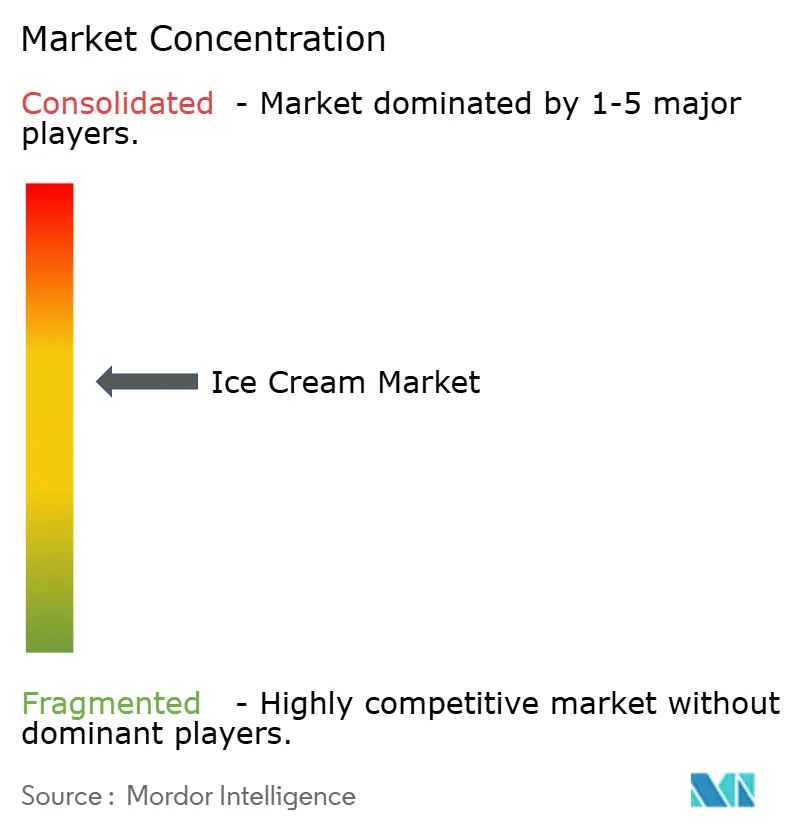
The moderately concentrated competitive structure includes international businesses such as Nestlé S.A. and General Mills, Inc., which competes in super-premium ice cream through Häagen-Dazs in markets outside the United States and Canada. Blue Bell Creameries, L.P., operates 67 distribution branches serving parts of 24 U.S. states through direct store distribution. Ferrero-owned Wells Enterprises, Inc., produces more than 200 million gallons annually and distributes across all 50 U.S. states. Lotte Wellfood Co., Ltd.’s Indian business includes Lotte India’s Havmor division, which reported 87,000 dealers and pushcarts and more than 250 parlors in FY2024-25. These different operating footprints make access to frozen retail channels a substantive competitive capability alongside ownership of a recognizable dessert brand.
Portfolio decisions by Nestlé and General Mills are reshaping prospective ownership and the routes through which brands reach consumers. Nestlé classified its ice-cream businesses as held for sale in H1 2026 as sale processes progressed, leaving the prospective transfer to Froneri unresolved at that reporting date. General Mills agreed in June 2026 to sell its mainland-China Häagen-Dazs shops and gifting operations to a group including Ningji, with closing expected in 2026 subject to regulatory approvals and customary conditions, while retaining other Chinese retail and foodservice operations. The prospective division between shop operation and other distribution makes channel execution central to the deal’s competitive effect, even with a common consumer brand.
Wells and Blue Bell compete on different assets, with Wells drawing on Ferrero’s Nutella brand and Blue Bell operating plants and direct store distribution. Ferrero-owned Wells made Nutella Ice Cream available nationwide in the United States on May 13, 2026, connecting Ferrero’s Nutella brand with cones and 14-fluid-ounce containers. Blue Bell’s 3 manufacturing plants hold BRCGS certification, providing a separate example of production assurance. Under 21 CFR 117.130, covered U.S. food facilities must conduct and document a hazard analysis for each food to determine whether preventive controls are needed. Those safety duties establish an entry baseline, while brand assets and delivery reach give challengers distinct competitive capabilities to match.
Ice Cream Industry Leaders
-
Nestlé S.A.
-
General Mills, Inc.
-
Blue Bell Creameries, L.P.
-
Wells Enterprises, Inc.
-
Lotte Wellfood Co., Ltd.
- *Disclaimer: Major Players sorted in no particular order
Ice Cream Market Companies Covered in this Report
- Nestlé S.A.
- General Mills, Inc.
- Lotte Wellfood Co., Ltd.
- Blue Bell Creameries, L.P.
- Wells Enterprises, Inc.
- Mars, Incorporated
- Danone S.A.
- Yili Group
- Meiji Holdings Co., Ltd.
- Turkey Hill Dairy
- Dairy Farmers of America
- Amul (GCMMF)
- Blue Bunny
- Morinaga Milk Industry
- Oatly Group AB
- Van Leeuwen Ice Cream
- Jeni’s Splendid Ice Creams
- Halo Top
- Cold Stone Creamery / Kahala Brands
- Unilever
Recent Industry Developments in Ice Cream Market
- Sep 2026: The Magnum Ice Cream Company commissioned a Ben & Jerry’s pint line at Heppenheim, Germany, adding European production capacity as part of an ongoing site expansion.
- Aug 2026: Ferrero-owned Wells Enterprises, Inc., completed the first 2 of 4 Dunkirk, New York, expansion phases, including initial production infrastructure, freezer capacity and a chocolate facility, with full completion expected in 2028.
Scope and Methodology
Segmentation Overview
By Type
| Standard Ice Cream |
| Novelties |
| Soft Serve |
| Specialty/Artisanal Ice Cream |
By Category
| Dairy |
| Non-Dairy |
By Packaging Type
| Pints |
| Tubs/Cups |
| Sticks |
| Others |
By Distribution Channel
| On-trade | |
| Off-trade | Convenience Stores |
| Specialist Retailers | |
| Supermarkets and Hypermarkets | |
| On-line Retail | |
| Others |
By Geography
| North America | United States |
| Canada | |
| Mexico | |
| Rest of North America | |
| Europe | Germany |
| United Kingdom | |
| Italy | |
| France | |
| Spain | |
| Netherlands | |
| Poland | |
| Belgium | |
| Sweden | |
| Rest of Europe | |
| Asia-Pacific | China |
| India | |
| Japan | |
| Australia | |
| Indonesia | |
| South Korea | |
| Thailand | |
| Singapore | |
| Rest of Asia-Pacific | |
| South America | Brazil |
| Argentina | |
| Colombia | |
| Chile | |
| Peru | |
| Rest of South America | |
| Middle East and Africa | South Africa |
| Saudi Arabia | |
| United Arab Emirates | |
| Nigeria | |
| Egypt | |
| Morocco | |
| Turkey | |
| Rest of Middle East and Africa |
| By Type | Standard Ice Cream | |
| Novelties | ||
| Soft Serve | ||
| Specialty/Artisanal Ice Cream | ||
| By Category | Dairy | |
| Non-Dairy | ||
| By Packaging Type | Pints | |
| Tubs/Cups | ||
| Sticks | ||
| Others | ||
| By Distribution Channel | On-trade | |
| Off-trade | Convenience Stores | |
| Specialist Retailers | ||
| Supermarkets and Hypermarkets | ||
| On-line Retail | ||
| Others | ||
| By Geography | North America | United States |
| Canada | ||
| Mexico | ||
| Rest of North America | ||
| Europe | Germany | |
| United Kingdom | ||
| Italy | ||
| France | ||
| Spain | ||
| Netherlands | ||
| Poland | ||
| Belgium | ||
| Sweden | ||
| Rest of Europe | ||
| Asia-Pacific | China | |
| India | ||
| Japan | ||
| Australia | ||
| Indonesia | ||
| South Korea | ||
| Thailand | ||
| Singapore | ||
| Rest of Asia-Pacific | ||
| South America | Brazil | |
| Argentina | ||
| Colombia | ||
| Chile | ||
| Peru | ||
| Rest of South America | ||
| Middle East and Africa | South Africa | |
| Saudi Arabia | ||
| United Arab Emirates | ||
| Nigeria | ||
| Egypt | ||
| Morocco | ||
| Turkey | ||
| Rest of Middle East and Africa | ||
Market Definition
- Butter - Butter is a yellow-to-white solid emulsion of fat globules, water, and inorganic salts produced by churning the cream from cows’ milk
- Dairy - Dairy product include milk and any of the foods made from milk, including butter, cheese, ice cream, yogurt, and condensed and dried milk.
- Frozen Desserts - Frozen dairy dessert means and includes products containing milk or cream and other ingredients which are frozen or semi-frozen prior to consumption, such as ice milk or sherbet, including frozen dairy desserts for special dietary purposes, and sorbet
- Sour Milk Drinks - Sour milk is thick, curdled milk, with a sour taste, obtained from the fermentation of milk. Sour milk drinks such as kefir, laban, buttermilk have been considered in the study
| Keyword | Definition |
|---|---|
| Cultured Butter | Cultured butter is prepared by having the raw butter go through chemical processing and has been added with certain emulsifiers and foreign ingredients. |
| Uncultured Butter | This type of butter is one which has not been processed in any way |
| Natural Cheese | The type of cheese in its most natural form. It is made from natural and simple products and ingredients, including fresh and natural salts, natural colors, enzymes, and high-quality milk. |
| Processed Cheese | Processed cheese undergoes the same processes as natural cheese; however, it requires more steps and many different forms of ingredients. Making processed cheese involves melting natural cheese, emulsifying it, and adding preservatives and other artificial ingredients or colorings. |
| Single Cream | Single cream contains around 18% fat. It’s a single layer of cream that appears over boiled milk. |
| Double Cream | Double cream contains 48% fat, more than double the amount of fat of single cream. It’s heavier and thicker than single cream |
| Whipping Cream | This has a much higher fat percentage than single cream (36%). Used to top cakes, pies, and puddings and as a thickener for sauces, soups, and fillings. |
| Frozen Desserts | Desserts that are meant to be eaten in frozen condition. E.g., sherbets, sorbets, frozen yogurts |
| UHT Milk (Ultra-high temperature milk) | Milk heated at a very high temperature. Ultra-high-temperature processing (UHT) of milk involves heating for 1–8 sec at 135–154°C. which kills the spore-forming pathogenic microorganism, resulting in a product with a shelf-life of several months. |
| Non-dairy butter/Plant-based butter | Butter made from plant-derived oil such as coconut, palm, etc. |
| Non-dairy Yogurt | Yogurt made from typically made from nuts, like almonds, cashews, coconuts, and even other foods like soybeans, plantains, oats, and peas |
| On-trade | It refers to restaurants, QSRs, and bars. |
| Off-trade | It refers to supermarkets, hypermarkets, on-line channels, etc. |
| Neufchatel cheese | One of the oldest kinds of cheese in France. It is a soft, slightly crumbly, mold-ripened, bloomy-rind cheese made in the Neufchâtel-en-Bray region of Normandy. |
| Flexitarian | It refers to a consumer preferring a semi-vegetarian diet, that is centered on plant foods with limited or occasional inclusion of meat. |
| Lactose Intolerance | Lactose intolerance is a reaction in digestive system to lactose, the sugar in milk. It causes uncomfortable symptoms in response to the consumption of dairy products. |
| Cream Cheese | Cream cheese is a soft and creamy fresh cheese with a tangy taste made from milk and cream. |
| Sorbets | Sorbet is a frozen dessert made using ice combined with fruit juice, fruit purée, or other ingredients, such as wine, liqueur, or honey. |
| Sherbet | Sherbet is a sweetened frozen dessert made with fruit and some sort of dairy product such as milk or cream. |
| Shelf stable | Foods that can be safely stored at room temperature, or "on the shelf," for at least one year and do not have to be cooked or refrigerated to eat safely. |
| DSD | Direct Store Delivery is the process in supply chain management wherein the product is delivered from manufacturing plant directly to the retailer. |
| OU Kosher | Orthodox Union Kosher is a kosher certification agency based in New York City. |
| Gelato | Gelato is a frozen creamy dessert made with milk, heavy cream and sugar. |
| Grass-fed Cows | Grass-fed cows are allowed to graze in pastures, where they eat a variety of grasses and clover. |
Research Methodology
Mordor Intelligence follows a four-step methodology in all our reports.
- Step-1: Identify Key Variables: In order to build a robust forecasting methodology, the variables and factors identified in Step 1 are tested against available historical market numbers. Through an iterative process, the variables required for market forecast are set, and the model is built on the basis of these variables.
- Step-2: Build a Market Model: Market-size estimations for the forecast years are in nominal terms. Inflation is not a part of the pricing, and the average selling price (ASP) is kept constant throughout the forecast period for each country.
- Step-3: Validate and Finalize: In this important step, all market numbers, variables, and analyst calls are validated through an extensive network of primary research experts from the market studied. The respondents are selected across levels and functions to generate a holistic picture of the market studied.
- Step-4: Research Outputs: Syndicated Reports, Custom Consulting Assignments, Databases & Subscription Platforms


