Dairy Products Market Analysis by Mordor Intelligence
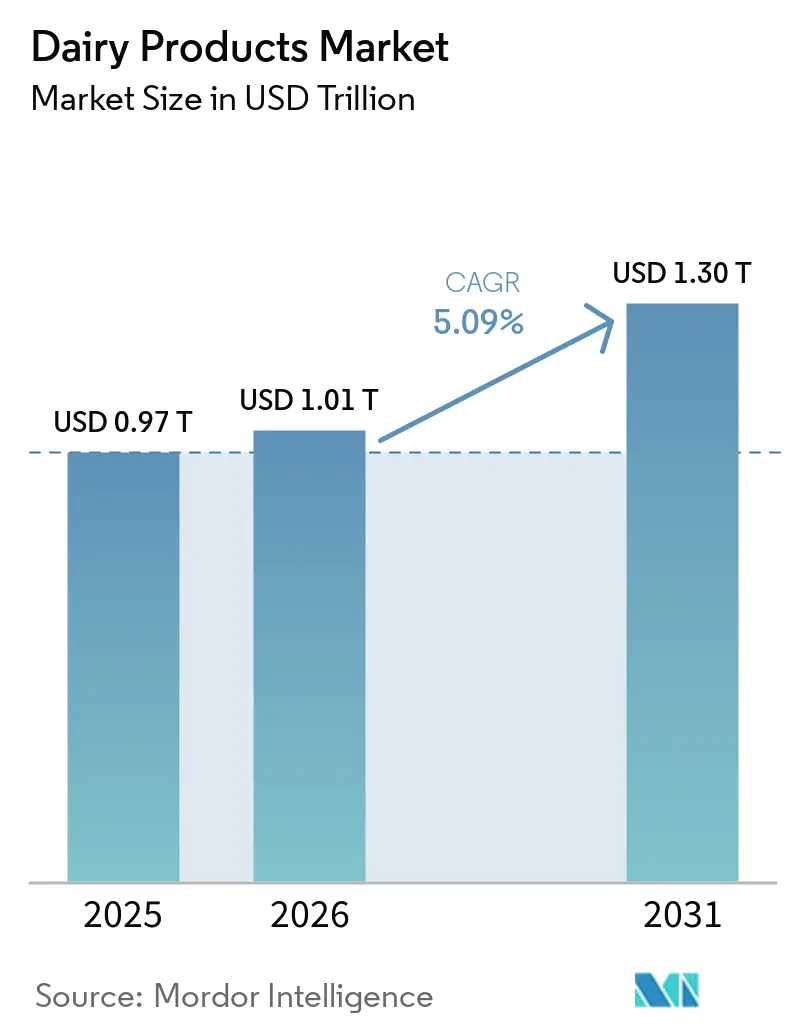
The dairy products market size is estimated at USD 1.01 trillion in 2026 and is projected to be USD 1.06 trillion in 2027, reaching USD 1.34 trillion by 2032, growing at a CAGR of 4.85% from 2027 to 2032.
Growth depends on dairy products that combine nutritional positioning with accommodation of digestive needs. In the United States, lactose-free milk provides a route to expansion in physical retail sales. Fermented-food demand and dairy ingredients in packaged foods create additional outlets beyond conventional drinking milk. Processors can respond through specialized production, foodservice expertise, and brand acquisitions, although raw-milk volatility complicates the economics of additional supply. Processors that bring lactose-adjusted formats to retail can pursue physical-sales growth even as dairy avoidance limits the addressable demand for conventional fluid milk.
Key Report Takeaways
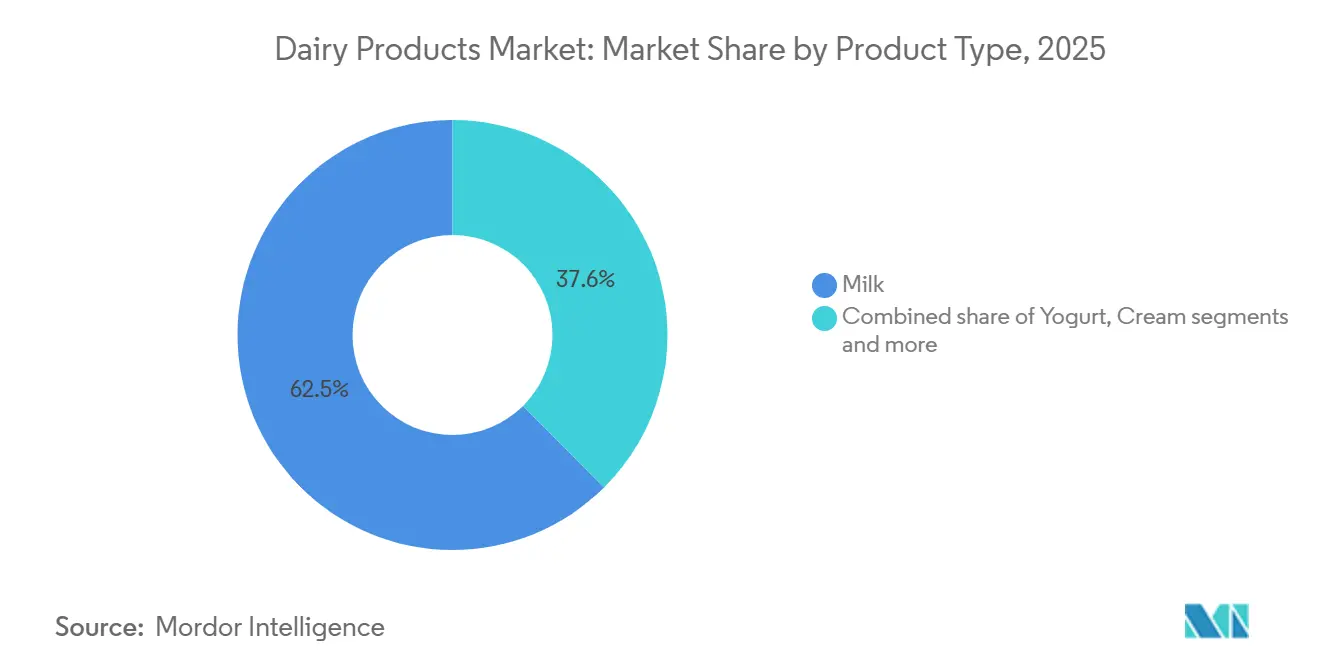
- By product type, milk led with a 62.39% dairy products market share in 2026, while yogurt is forecast to be the fastest-growing segment at a CAGR of 5.6% from 2027 to 2032.
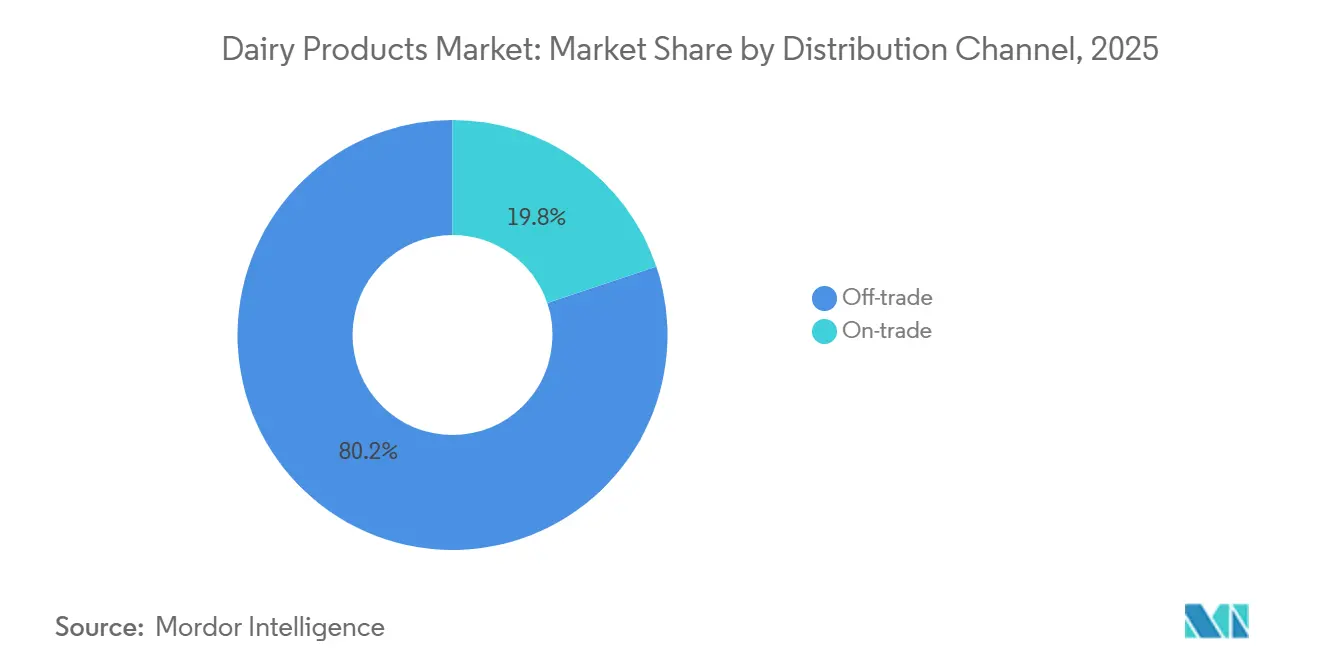
- Across distribution channels, off-trade accounted for an 80.02% share of the dairy products market size in 2026, and on-trade is projected to be the fastest-growing segment with a CAGR of 5.65% from 2027 to 2032.
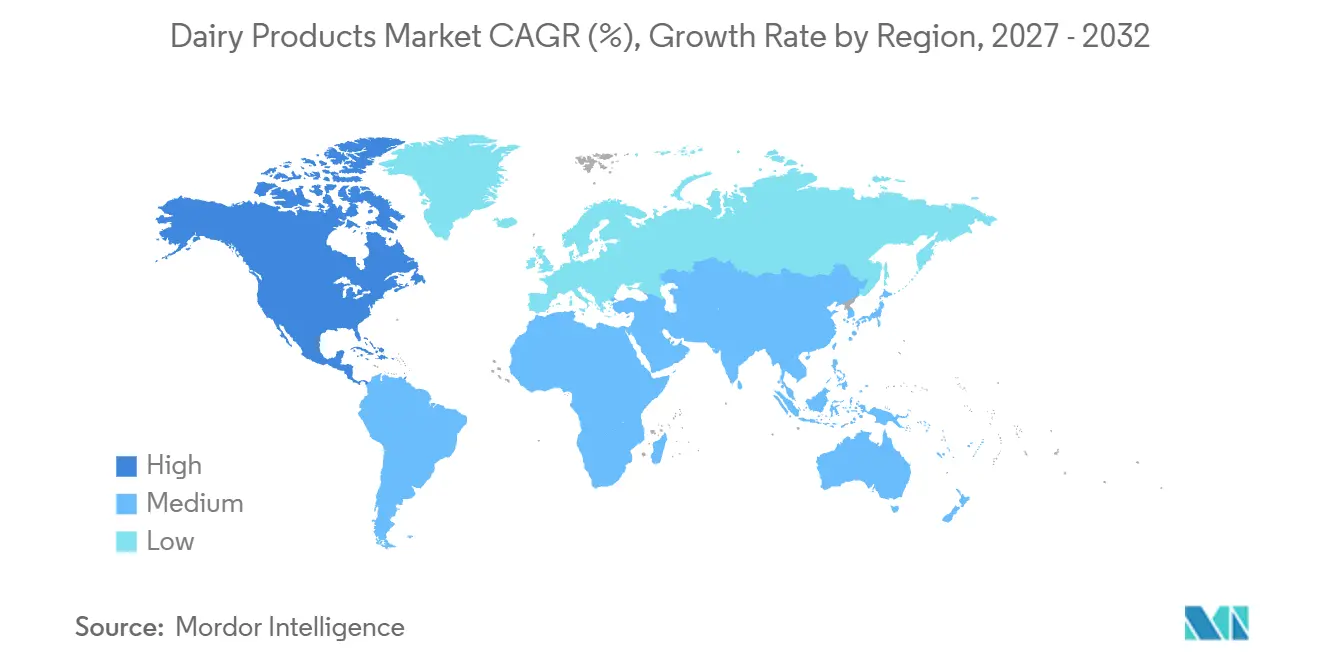
- Geographically, Asia-Pacific held the largest market share at 36.77% in 2026, whereas North America is forecast to be the fastest-growing region at a CAGR of 5.85% from 2027 to 2032.
Note: Market numbers in this report are based on Mordor Intelligence's proprietary estimation framework, which combines nine months of actuals with Q4 projections for base year 2026.
Market Trends and Insights
Drivers Impact Analysis of Dairy Products Market*
| Driver | (~) % Impact on CAGR Forecast | Geographic Relevance | Impact Timeline |
|---|---|---|---|
| Increasing demand for probiotic and functional dairy | +2% | Markets in the United States | Short term (≤ 2 years) |
| Growing availability of dairy variants for dietary needs | +1.6% | Retail markets in the United States | Medium term (2-4 years) |
| Rising use of dairy ingredients in packaged foods | +1.5% | Food-producing regions of the United States | Medium term (2-4 years) |
| Government support for dairy development and supply stability | +1.2% | Milk-producing regions of India | Long term (≥ 4 years) |
| Increasing adoption of sustainable and ethical dairy options | +0.6% | United States and Great Britain | Medium term (2-4 years) |
| Expansion of lactose-digestive aids supporting dairy intake | +0.3% | Markets across Mexico | Short term (≤ 2 years) |
| Source: Mordor Intelligence | |||
Increasing demand for probiotic and functional dairy
Fermented probiotic foods can support specialist scale when physical sales accompany growth in revenue. Lifeway Foods, a US supplier of kefir and fermented probiotic foods, reported company-wide net sales growth of 24.1% in Q2 2026 compared with Q2 2025. It described that performance as volume-led and reported its 27th consecutive quarter of year-over-year growth. Repeated volume-led growth gives a processor an operating history against which to size an expansion, because output requirements follow units sold rather than selling prices alone. Lifeway's company-wide result shows commercial momentum at a specialist supplier of kefir and fermented probiotic foods.
Growing availability of dairy variants for dietary needs
Dietary variants can broaden dairy sales while allowing suppliers to differentiate within the same dietary requirement. US retail lactose-free milk volume increased from 208.2 million gallons in 2021 to 282.4 million in the 52 weeks ending December 2025. Within that population, the high-protein variant rose from 60.1 million gallons to 98.1 million over the same period. These volumes support a commercial distinction between simply removing lactose and combining that adjustment with a protein-focused formulation. Circana data reported by FoodNavigator in July 2026 showed US lactose-free milk sales up 7.3% by value and 4.1% by volume over the prior year, while conventional milk volume fell 0.4%.
Rising use of dairy ingredients in packaged foods
Higher-protein reformulation gives dairy processors a route into packaged foods beyond products sold primarily as dairy. A June 2026 report described food companies introducing higher-protein foods and whey protein becoming a prominent ingredient in that trend. Separately, US domestic use of whey protein concentrate rose 30.1% in the first half of 2025 compared with the first half of 2024 across applications. These developments support investment in supplying concentrated dairy ingredients to food manufacturers. For processors, separation and concentration capabilities can capture processing value by turning milk components into ingredients suited to manufacturers' packaged-food formulations.
Government support for dairy development and supply stability
Public support can expand the supply base by reducing the capital burden of organized milk collection. As of August 2026, India's National Programme for Dairy Development (NPDD) provided 50% grant assistance for strengthening milk procurement, chilling, and quality-assurance infrastructure.[1] The program had organized 36,611 new dairy cooperative societies by June 2026, extending its intervention to village-level collection structures. It had also created about 16.8 million liters per day of milk chilling capacity by that date. Together, those measures can make investment in collection networks more feasible for participating cooperatives. By aiming to increase organized procurement, the grant can widen the milk base from which Indian processors build dairy-product volumes.
Restraints Impact Analysis of Dairy Products Market*
| Restraint | (~) % Impact on CAGR Forecast | Geographic Relevance | Impact Timeline |
|---|---|---|---|
| Rising lactose intolerance and dairy sensitivities | -0.9% | Selected cities in Peru | Long term (≥ 4 years) |
| High volatility in raw milk prices | -0.8% | European Union and China | Short term (≤ 2 years) |
| Increasing competition from plant-based alternatives | -0.4% | Retail markets in the United States | Medium term (2-4 years) |
| Frequent quality and adulteration issues | -0.3% | Markets across India | Short term (≤ 2 years) |
| Source: Mordor Intelligence | |||
Rising lactose intolerance and dairy sensitivities
Perceived digestive intolerance can remove buyers from the dairy category before suppliers compete over the attributes of individual products. In a survey of adults in selected Peruvian cities from April to June 2026, 203 of 1,619 participants reported no dairy consumption. Among those nonconsumers, 46.8% cited perceived lactose intolerance as a reason for avoidance. For producers, avoidance of the entire category removes multiple potential product sales simultaneously, making the concern a customer-acquisition constraint across dairy formats. Expanding assortment alone can therefore divide existing dairy spending without bringing these nonconsumers back into the customer base.
High volatility in raw milk prices
Raw-milk price reversals can make cheaper supply commercially difficult for processors holding inventory. In the EU excluding the United Kingdom, monthly prices paid to raw cow's milk producers changed by -5.9% in January 2026, +2.3% in August, and an estimated +0.9% in September.[2] That changing direction complicates the relationship between procurement timing and product pricing. In its 2025 annual report, China's Macqueer Group warned that raw-milk volatility could impair milk inventory if demand recovery fell short or prices stayed low. For an integrated producer, lower input prices can therefore coexist with exposure to the value of existing stock. This risk can constrain commitments to additional supply even when the latest milk price appears favorable.
*Our forecasts treat driver/restraint impacts as directional, not additive. The impact forecasts reflect baseline growth, mix effects, and variable interactions.
Dairy Products Market Segment Analysis
By Product Type:
Milk Scale and Cultured Dairy ExpansionMilk accounted for a 62.39% share of the dairy products market size in 2026, making it the largest segment. Almarai reported a first-place position and 67.5% value share in Saudi Arabia's fresh-milk business in 2025, illustrating an established national supplier position. The company also said its 2024 long-life dairy line expansions enabled it to bring 22% of production volumes back from external suppliers in 2025. Bringing production in-house changes who performs manufacturing rather than establishing additional consumer purchases. Almarai's fresh-milk position and dairy insourcing together show how a national milk incumbent can combine consumer reach with control over manufacturing value.
Yogurt is forecast to be the fastest-growing segment, with a CAGR of 5.6% from 2027 to 2032. US production of plain and flavored yogurt totaled 5.29 billion pounds in 2025, 8.5% above 2024. Sour milk drinks showed a distinct retail development in Norway, where kefir sales volume in grocery and service retail rose 40.8% from 2023 to 2025, compared with 7.2% for sour milk overall. That contrast gives Norwegian suppliers a reason to prioritize kefir within their sour milk drink offerings. For yogurt processors, the added US output increases the volume that must find buyers through retail and foodservice channels.

By Distribution Channel:
Retail Reach and Foodservice ApplicationsOff-trade represented an 80.02% dairy products market share in 2026, making it the largest segment by distribution channel. UK household purchases averaged 1,462 milliliters of milk, including milk products, and 129 grams of cheese per person per week in the financial year ending in 2025. In November 2025, Lifeway Foods reported that its Farmer Cheese was available in 2,000 Walmart stores nationwide in the United States. UK household purchasing shows the weekly grocery buying that sustains off-trade dairy volume in that country. In the United States, Lifeway's Walmart relationship gives a specialist access to retail buyers through one national chain.
On-trade is forecast to be the fastest-growing segment, with a CAGR of 5.65% from 2027 to 2032. Fonterra's Foodservice channel reported external sales volume of 240 million kilograms of milk solids in the year ended July 31, 2026, up 2.1% from the previous fiscal year. Fonterra described combining dairy expertise with chef-led application capability and customer partnerships across Greater China and Southeast Asia. For foodservice suppliers, application-led customer relationships offer a route to expanding dairy throughput, linking culinary support to the physical volume growth illustrated by Fonterra's results.
Geography Analysis
Asia-Pacific Dairy Products Market
Asia-Pacific accounted for a 36.77% share of the dairy products market size in 2026, making it the largest regional market. The US Department of Agriculture forecast India's domestic fluid-milk consumption at 221.4 million metric tons in calendar year 2026. China's farm-level milk output reached 40.91 million metric tons in 2025, providing a substantial input base for dairy processing. India's forecast is more than 2% above its 2025 level of 216.5 million metric tons, whereas China's farm milk output rose 0.3% in 2025. For processors seeking additional fluid-milk sales, India's forecast consumption increase provides a more direct commercial signal than the scale of China's farm milk output.
North America Dairy Products Market
North America is forecast to be the fastest-growing regional market, with a CAGR of 5.85% from 2027 to 2032. US domestic disappearance, a proxy for consumption, increased from 2014 to 2025 on both milk-fat and skim-solids milk-equivalent bases. In May 2026, Hiland Dairy began production at its expanded Tyler, Texas, facility, adding dairy-processing and filling capabilities with initial runs, final checks, and ramp-up in progress. For regional suppliers, domestic use and the added filling and storage capacity at Tyler provide a route to serve customers across Texas and surrounding markets.
Europe's processing base includes the EU, which produced 10.8 million metric tons of cheese and 2.7 million metric tons of milk powder in 2025. Those outlets can give milk suppliers more than one path into finished dairy products. In South America, Brazil's ultra-high-temperature (UHT) milk, milk-powder, yogurt, and cheese supply chains are closely interconnected. In the Middle East and Africa, South African retail quantities and prices both rose across all 9 dairy products evaluated from April 2025 to March 2026.
Regulatory Framework and Outlook
This comparison examines selected jurisdictions from the perspective of established dairy processors operating under formal inspection. The obligations differ between entry licensing, establishment approval, upstream credential or milk checks, and product-specific standards. Those differences affect whether expansion requires an additional authorization, a compliant supply base, or adaptation of a finished product.
Regulatory Table of Dairy Products Market
| Decision factor | Canada | Germany | India | Brazil | Saudi Arabia |
|---|---|---|---|---|---|
| Primary authority | Canadian Food Inspection Agency for federal requirements | Länder food-inspection and veterinary authorities | Food Safety and Standards Authority of India and central/state enforcement authorities | Department of Inspection of Products of Animal Origin (DIPOA), under the Secretariat of Agricultural Defense within the Ministry of Agriculture and Livestock | Saudi Food and Drug Authority |
| Key instruments or direction | Safe Food for Canadians Regulations for interprovincial dairy activities | Regulation (EC) No. 853/2004, Article 4 | March 2026 milk-producer and vendor credential-verification advisory | Decree 9,013/2017, Normative Instructions 76 and 77/2018, and UHT-milk Portaria 783/2025 | UHT and pasteurized-camel-milk standards, plus Food Hygiene Requirements |
| Commercial effect | Interprovincial processing requires a license, preventive controls and plans, and traceability | Establishment registration, with approval where required | Registration/license checks for milk vendors and producers, except registered dairy cooperative members selling all milk to their society | At least monthly raw-milk analysis for producers supplying officially inspected establishments, plus UHT identity compliance | Product-standard conformity and regulated raw-milk handling |
| Current policy attractiveness | Medium | Medium | Medium | Medium | Medium |
| Future direction of policy attractiveness | No change | No change | No change | No change | No change |
| Source: Mordor Intelligence | |||||
Canada's established interprovincial controls and Germany's operative establishment-approval framework support Medium ratings and continuity in core market-entry duties. India's Medium rating and continuity reflect March 2026 verification of an existing registration duty, preserving the exemption for registered dairy cooperative members selling all milk to their society and advising periodic chiller inspections. Brazil's Medium rating and continuity reflect at least monthly raw-milk testing in its inspected supply chain alongside a UHT identity rule already effective in April 2025. Saudi Arabia's Medium rating and continuity reflect raw-milk handling duties and product-standard amendments effective from adoption, keeping the commercial burden within operative collection and product controls.
Value Chain Stages
This comparison follows milk collection, processing, and distribution to show where suppliers earn revenue and where continuity can fail. Fonterra's farmer-owners supply milk and receive payments measured in kilograms of milk solids collected, alongside annual dividends. That ownership model links farm returns to both milk supplied and the performance of the cooperative.
Value Chain Analysis Table of Dairy Products Market
| Primary activity | Key participants | Value capture | Bottleneck | Resilience response |
|---|---|---|---|---|
| Milk procurement and collection | Milk-collection cooperatives such as Fonterra Co-operative Group | Raw-milk sales to processors | Number of rural establishments selling raw milk to industry or processing it in licensed agroindustries in Rio Grande do Sul fell 12.3% from 2023 to 2025 | Broaden collection relationships and secure longer-term milk access |
| Processing and product sales | Dairy producers such as Almarai Company, and consumer-business owners such as Groupe Lactalis | Processed dairy-product sales | Mismatch between milk access and product-filling capacity | Coordinate filling expansion with secured milk supply |
| Distribution | Integrated dairy distributors such as Almarai Company | Delivered dairy-product sales | Limited depot and temperature-controlled transport reach | Add depots and routes, with refrigeration matched to the product |
| Source: Mordor Intelligence | ||||
In March 2026, Fonterra's agreements to supply Lactalis specified minimum terms of 10 years for raw milk and 6 years for ingredients and other products, both renewing automatically until terminated. These arrangements can preserve upstream sales across a change in consumer-business ownership. Almarai's aseptic filling line for protein and long-life dairy bottles reached maximum output capacity of 40 million liters in 2025 following investment in 2024. Fonterra can capture upstream supply value without owning the consumer business, while Almarai's integrated filling and distribution place processing and delivery margin opportunities within one company.
Competitive Landscape
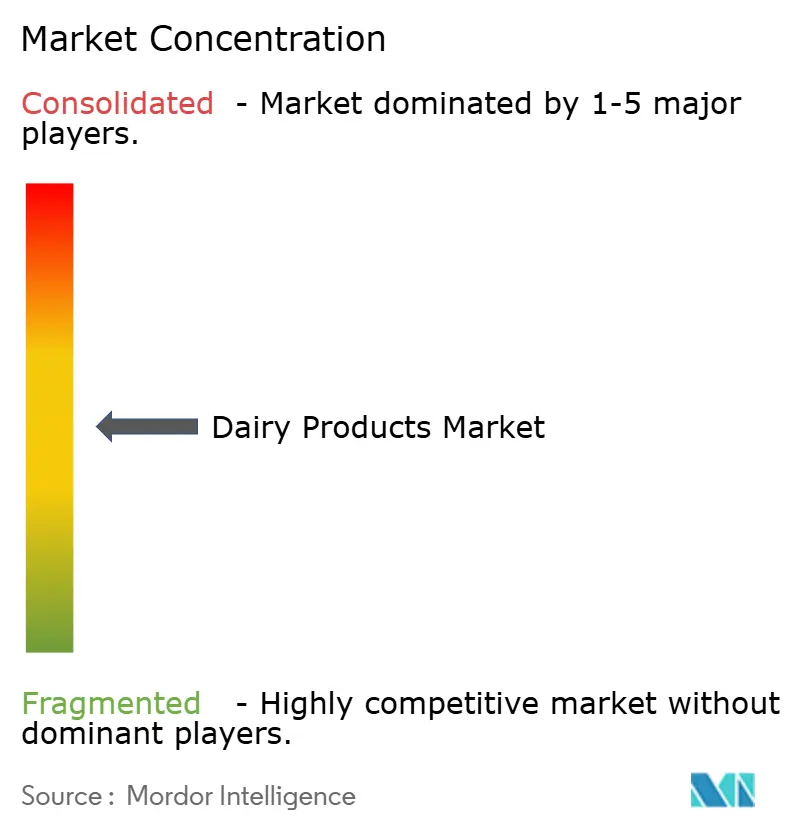
The industry combines diversified branded groups, farmer-owned processors, and multi-category dairy operators in a broad supplier field. Danone SA reported 4.5% like-for-like growth in group-wide sales in 2025, with a portfolio including dairy, plant-based products, waters, and specialized nutrition. Nestlé SA sells milk products and ice cream, while Dairy Farmers of America moves member milk and manufactures dairy products. Fonterra Co-operative Group is a New Zealand farmer-owned cooperative, while Groupe Lactalis operates across dairy categories including milk, cheese, and yogurt. These different ownership and portfolio models create competition through consumer brands, processing capability, and specialized business supply relationships.
On March 31, 2026, Fonterra sold Mainland Group to Groupe Lactalis, transferring its global consumer businesses outside Greater China plus specified associated Foodservice and Ingredients operations. Fonterra retained the Anchor brand in Greater China and continued as a New Zealand farmer-owned business-to-business dairy supplier. Groupe Lactalis also integrated General Mills' US yogurt activities into its Midwest Yogurt division in 2025, adding 2 production sites and a business with USD 1.2 billion in revenue. Acquirers can gain established brands and production assets together, while a seller can concentrate retained dairy activities around business customers.
In March 2026, New Caledonia's competition authority authorized Lactalis parent B.S.A.'s purchase of that Mainland business, subject to 3-year commitments renewable once. For Mainland cream and consumer-milk imports, B.S.A. must avoid the importer or distributor that mainly imports Lactalis dairy products. It must also avoid concentrating most sales of those products with one importer or distributor and cannot condition purchases or discounts on buying other Lactalis or Mainland products. In October 2025, Dairy Farmers of America reported that its Jasper Products plant in Joplin reached 1 billion beverages in cartons and bottles within one year, across dairy-based and non-dairy beverages. Lactalis's acquisition-led expansion contrasts with Fonterra's business supply focus, but the New Caledonia commitments restrict the acquired business's import channels and bundling.
Dairy Products Industry Leaders
-
Danone SA
-
Nestlé SA
-
Dairy Farmers of America
-
Fonterra Co-operative Group
-
Groupe Lactalis
- *Disclaimer: Major Players sorted in no particular order
Dairy Products Market Companies Covered in this Report
- Almarai Company
- Arla Foods Amba
- China Mengniu Dairy Co.
- Dairy Farmers of America
- Danone SA
- Fonterra Co-operative Group
- Groupe Lactalis
- Gujarat Cooperative Milk Marketing Federation Ltd.
- Tillamook County Creamery Association
- Nestlé SA
- Saputo Inc.
- The Magnum Ice Cream Company N.V.
- Royal FrieslandCampina N.V.
- Vinamilk
- Agropur Cooperative
- Meiji Co., Ltd.
- Bel SA
- Unternehmensgruppe Theo Müller
- DMK Group
- Grupo Lala, S.A.B. de C.V.
Recent Industry Developments in Dairy Products Market
- Sep 2026: Schreiber Foods announced an investment of more than USD 267 million in a new process-cheese facility in Carthage, Missouri, expected to open in 2028 and expand its US production capacity.
- Aug 2026: Gay Lea Foods announced an expansion of its Toronto dairy facility to add cottage-cheese and other high-protein dairy capacity, with completion planned for 2028.
- Jun 2026: Arla Foods Amba and DMK Group completed their merger, combining the dairy cooperatives under the Arla name with a reported milk pool of approximately 20 billion kilograms.
Scope and Methodology
Segmentation Overview
By Product Type
| Butter | Salted Butter | |
| Unsalted Butter | ||
| Cheese | Natural Cheese | Cheddar |
| Cottage | ||
| Feta | ||
| Parmesan | ||
| Others | ||
| Processed Cheese | ||
| Cream | Fresh Cream | |
| Cooking Cream | ||
| Whipping Cream | ||
| Others | ||
| Dairy Desserts | Ice Cream | |
| Cheesecakes | ||
| Frozen Desserts | ||
| Others | ||
| Milk | Condensed milk | |
| Flavored Milk | ||
| Fresh Milk | ||
| UHT Milk (Ultra-High Temperature Milk) | ||
| Powdered Milk | ||
| Others | ||
| Yogurt | Drinkable | |
| Spoonable | ||
| Sour Milk Drinks | ||
| Others | ||
By Distribution Channel
| On-trade | |
| Off-trade | Convenience Stores |
| Specialist Retailers | |
| Supermarkets/Hypermarkets | |
| Online Retail | |
| Others |
By Geography
| North America | United States |
| Canada | |
| Mexico | |
| Rest of North America | |
| Europe | Germany |
| United Kingdom | |
| Italy | |
| France | |
| Spain | |
| Netherlands | |
| Poland | |
| Belgium | |
| Sweden | |
| Rest of Europe | |
| Asia-Pacific | China |
| India | |
| Japan | |
| Australia | |
| Indonesia | |
| South Korea | |
| Thailand | |
| Singapore | |
| Rest of Asia-Pacific | |
| South America | Brazil |
| Argentina | |
| Colombia | |
| Chile | |
| Peru | |
| Rest of South America | |
| Middle East and Africa | South Africa |
| Saudi Arabia | |
| United Arab Emirates | |
| Nigeria | |
| Egypt | |
| Morocco | |
| Turkey | |
| Rest of Middle East and Africa |
| By Product Type | Butter | Salted Butter | |
| Unsalted Butter | |||
| Cheese | Natural Cheese | Cheddar | |
| Cottage | |||
| Feta | |||
| Parmesan | |||
| Others | |||
| Processed Cheese | |||
| Cream | Fresh Cream | ||
| Cooking Cream | |||
| Whipping Cream | |||
| Others | |||
| Dairy Desserts | Ice Cream | ||
| Cheesecakes | |||
| Frozen Desserts | |||
| Others | |||
| Milk | Condensed milk | ||
| Flavored Milk | |||
| Fresh Milk | |||
| UHT Milk (Ultra-High Temperature Milk) | |||
| Powdered Milk | |||
| Others | |||
| Yogurt | Drinkable | ||
| Spoonable | |||
| Sour Milk Drinks | |||
| Others | |||
| By Distribution Channel | On-trade | ||
| Off-trade | Convenience Stores | ||
| Specialist Retailers | |||
| Supermarkets/Hypermarkets | |||
| Online Retail | |||
| Others | |||
| By Geography | North America | United States | |
| Canada | |||
| Mexico | |||
| Rest of North America | |||
| Europe | Germany | ||
| United Kingdom | |||
| Italy | |||
| France | |||
| Spain | |||
| Netherlands | |||
| Poland | |||
| Belgium | |||
| Sweden | |||
| Rest of Europe | |||
| Asia-Pacific | China | ||
| India | |||
| Japan | |||
| Australia | |||
| Indonesia | |||
| South Korea | |||
| Thailand | |||
| Singapore | |||
| Rest of Asia-Pacific | |||
| South America | Brazil | ||
| Argentina | |||
| Colombia | |||
| Chile | |||
| Peru | |||
| Rest of South America | |||
| Middle East and Africa | South Africa | ||
| Saudi Arabia | |||
| United Arab Emirates | |||
| Nigeria | |||
| Egypt | |||
| Morocco | |||
| Turkey | |||
| Rest of Middle East and Africa | |||
Market Definition
- Butter - Butter is a yellow-to-white solid emulsion of fat globules, water, and inorganic salts produced by churning the cream from cows’ milk
- Dairy - Dairy product include milk and any of the foods made from milk, including butter, cheese, ice cream, yogurt, and condensed and dried milk.
- Frozen Desserts - Frozen dairy dessert means and includes products containing milk or cream and other ingredients which are frozen or semi-frozen prior to consumption, such as ice milk or sherbet, including frozen dairy desserts for special dietary purposes, and sorbet
- Sour Milk Drinks - Sour milk is thick, curdled milk, with a sour taste, obtained from the fermentation of milk. Sour milk drinks such as kefir, laban, buttermilk have been considered in the study
| Keyword | Definition |
|---|---|
| Cultured Butter | Cultured butter is prepared by having the raw butter go through chemical processing and has been added with certain emulsifiers and foreign ingredients. |
| Uncultured Butter | This type of butter is one which has not been processed in any way |
| Natural Cheese | The type of cheese in its most natural form. It is made from natural and simple products and ingredients, including fresh and natural salts, natural colors, enzymes, and high-quality milk. |
| Processed Cheese | Processed cheese undergoes the same processes as natural cheese; however, it requires more steps and many different forms of ingredients. Making processed cheese involves melting natural cheese, emulsifying it, and adding preservatives and other artificial ingredients or colorings. |
| Single Cream | Single cream contains around 18% fat. It’s a single layer of cream that appears over boiled milk. |
| Double Cream | Double cream contains 48% fat, more than double the amount of fat of single cream. It’s heavier and thicker than single cream |
| Whipping Cream | This has a much higher fat percentage than single cream (36%). Used to top cakes, pies, and puddings and as a thickener for sauces, soups, and fillings. |
| Frozen Desserts | Desserts that are meant to be eaten in frozen condition. E.g., sherbets, sorbets, frozen yogurts |
| UHT Milk (Ultra-high temperature milk) | Milk heated at a very high temperature. Ultra-high-temperature processing (UHT) of milk involves heating for 1–8 sec at 135–154°C. which kills the spore-forming pathogenic microorganism, resulting in a product with a shelf-life of several months. |
| Non-dairy butter/Plant-based butter | Butter made from plant-derived oil such as coconut, palm, etc. |
| Non-dairy Yogurt | Yogurt made from typically made from nuts, like almonds, cashews, coconuts, and even other foods like soybeans, plantains, oats, and peas |
| On-trade | It refers to restaurants, QSRs, and bars. |
| Off-trade | It refers to supermarkets, hypermarkets, on-line channels, etc. |
| Neufchatel cheese | One of the oldest kinds of cheese in France. It is a soft, slightly crumbly, mold-ripened, bloomy-rind cheese made in the Neufchâtel-en-Bray region of Normandy. |
| Flexitarian | It refers to a consumer preferring a semi-vegetarian diet, that is centered on plant foods with limited or occasional inclusion of meat. |
| Lactose Intolerance | Lactose intolerance is a reaction in digestive system to lactose, the sugar in milk. It causes uncomfortable symptoms in response to the consumption of dairy products. |
| Cream Cheese | Cream cheese is a soft and creamy fresh cheese with a tangy taste made from milk and cream. |
| Sorbets | Sorbet is a frozen dessert made using ice combined with fruit juice, fruit purée, or other ingredients, such as wine, liqueur, or honey. |
| Sherbet | Sherbet is a sweetened frozen dessert made with fruit and some sort of dairy product such as milk or cream. |
| Shelf stable | Foods that can be safely stored at room temperature, or "on the shelf," for at least one year and do not have to be cooked or refrigerated to eat safely. |
| DSD | Direct Store Delivery is the process in supply chain management wherein the product is delivered from manufacturing plant directly to the retailer. |
| OU Kosher | Orthodox Union Kosher is a kosher certification agency based in New York City. |
| Gelato | Gelato is a frozen creamy dessert made with milk, heavy cream and sugar. |
| Grass-fed Cows | Grass-fed cows are allowed to graze in pastures, where they eat a variety of grasses and clover. |
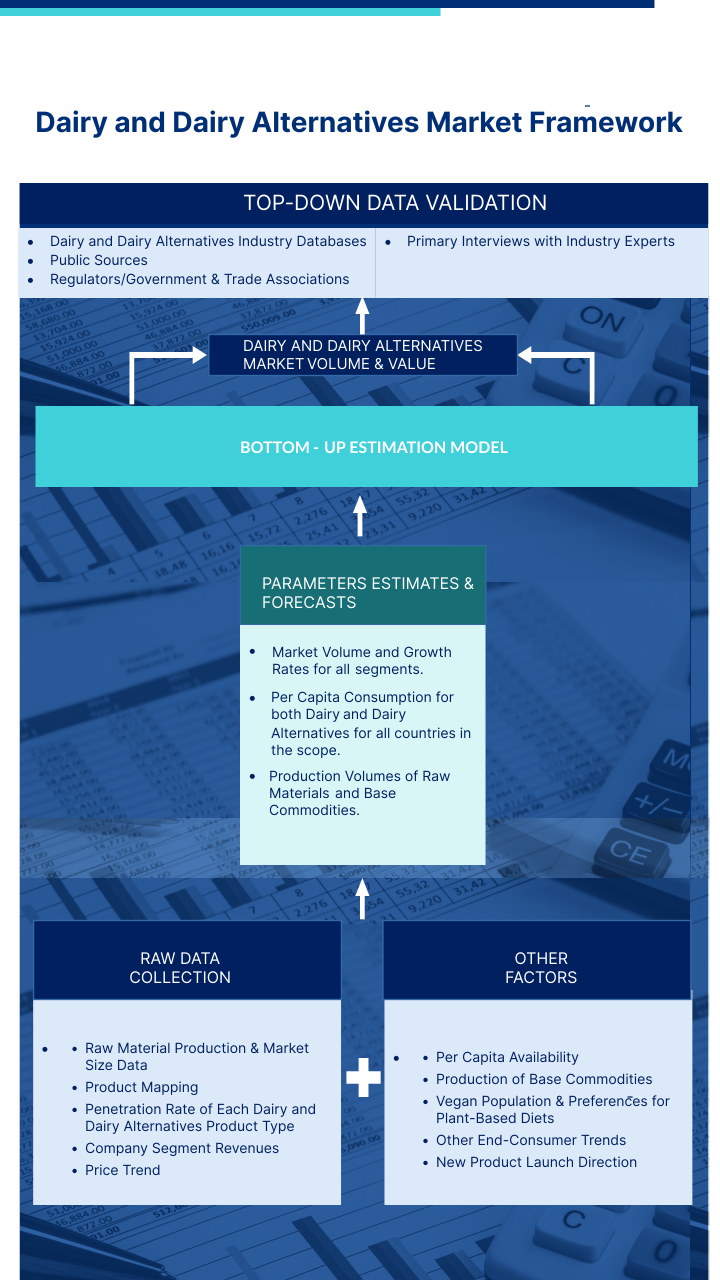
Research Methodology
Mordor Intelligence follows a four-step methodology in all our reports.
- Step-1: Identify Key Variables: In order to build a robust forecasting methodology, the variables and factors identified in Step 1 are tested against available historical market numbers. Through an iterative process, the variables required for market forecast are set, and the model is built on the basis of these variables.
- Step-2: Build a Market Model: Market-size estimations for the forecast years are in nominal terms. Inflation is not a part of the pricing, and the average selling price (ASP) is kept constant throughout the forecast period for each country.
- Step-3: Validate and Finalize: In this important step, all market numbers, variables, and analyst calls are validated through an extensive network of primary research experts from the market studied. The respondents are selected across levels and functions to generate a holistic picture of the market studied.
- Step-4: Research Outputs: Syndicated Reports, Custom Consulting Assignments, Databases & Subscription Platforms