
Hydraulic Cab Tilt System Market Size and Share
Market Overview
| Study Period | 2019 - 2030 |
|---|---|
| Market Size (2025) | USD 1.82 Billion |
| Market Size (2030) | USD 2.26 Billion |
| Growth Rate (2025 - 2030) | 4.43 % |
| Fastest Growing Market | Asia Pacific |
| Largest Market | Asia Pacific |
| Market Concentration | Medium |
Major Players *Disclaimer: Major Players sorted in no particular order Image © Mordor Intelligence. Reuse requires attribution under CC BY 4.0. | |
Hydraulic Cab Tilt System Market Analysis by Mordor Intelligence
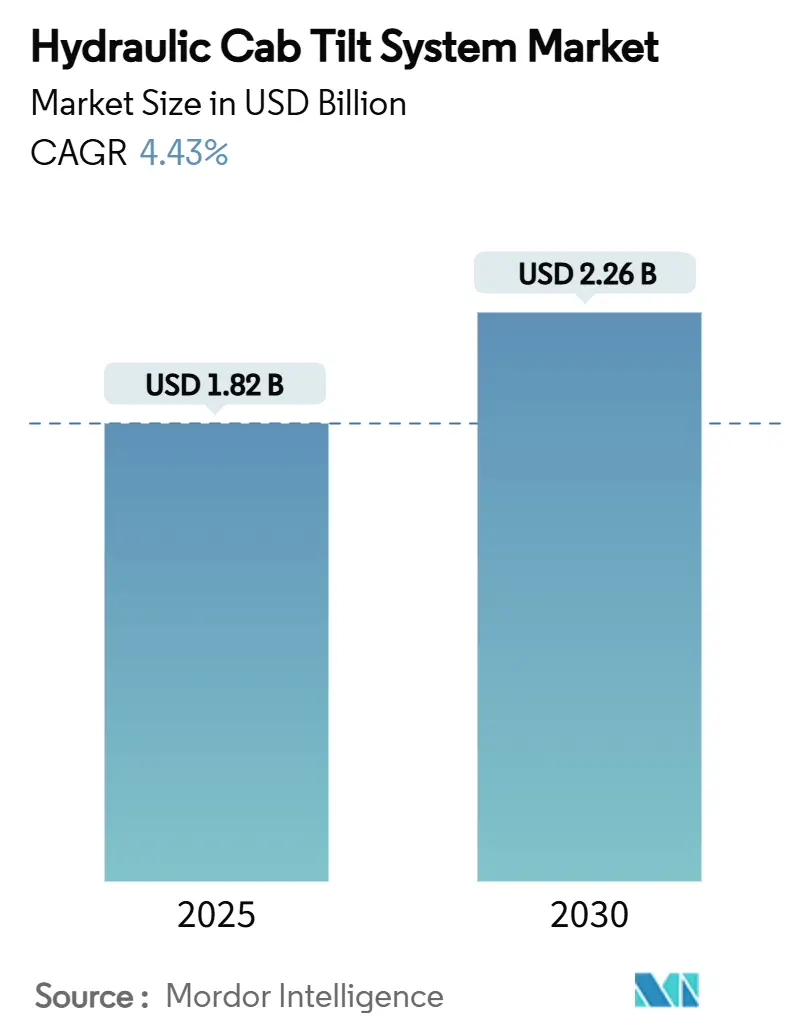
The hydraulic cab tilt system market size is valued at USD 1.82 billion in 2025 and is projected to touch USD 2.26 billion by 2030, registering a 4.43% CAGR over the forecast period. A resilient demand outlook across construction, mining, and agricultural equipment, combined with tightening global safety mandates, sustains the growth momentum of hydraulic cab tilt system market solutions. Expanding infrastructure programs in high-growth economies, rising mechanization rates in developing regions, and OEM investments in ergonomic cab redesign underpin steady volume gains. Parallel moves toward smart electro-hydraulic controls and predictive maintenance services open new revenue streams, even as margin pressures from volatile steel costs and fluid-leak OPEX remain tangible headwinds. Competitive rivalry is moderate; legacy firms leverage broad service networks and incremental digital upgrades to retain share while niche suppliers target compact equipment platforms.
Key Report Takeaways
- By equipment type, excavators held 40.25% share in 2024; skid steer loaders show the highest growth trajectory at 5.33% CAGR between 2025-2030.
- By end-user industry, construction led with 56.19% share in 2024; waste management is forecast to advance at a 6.14% CAGR through 2030.
- By component, hydraulic cylinders commanded 43.62% revenue in 2024; control electronics and sensors expand most rapidly at 5.89% CAGR over the same horizon.
- By actuation technology, manual systems retained 75.33% share in 2024, whereas electro-hydraulic configurations are projected to climb at 7.12% CAGR to 2030.
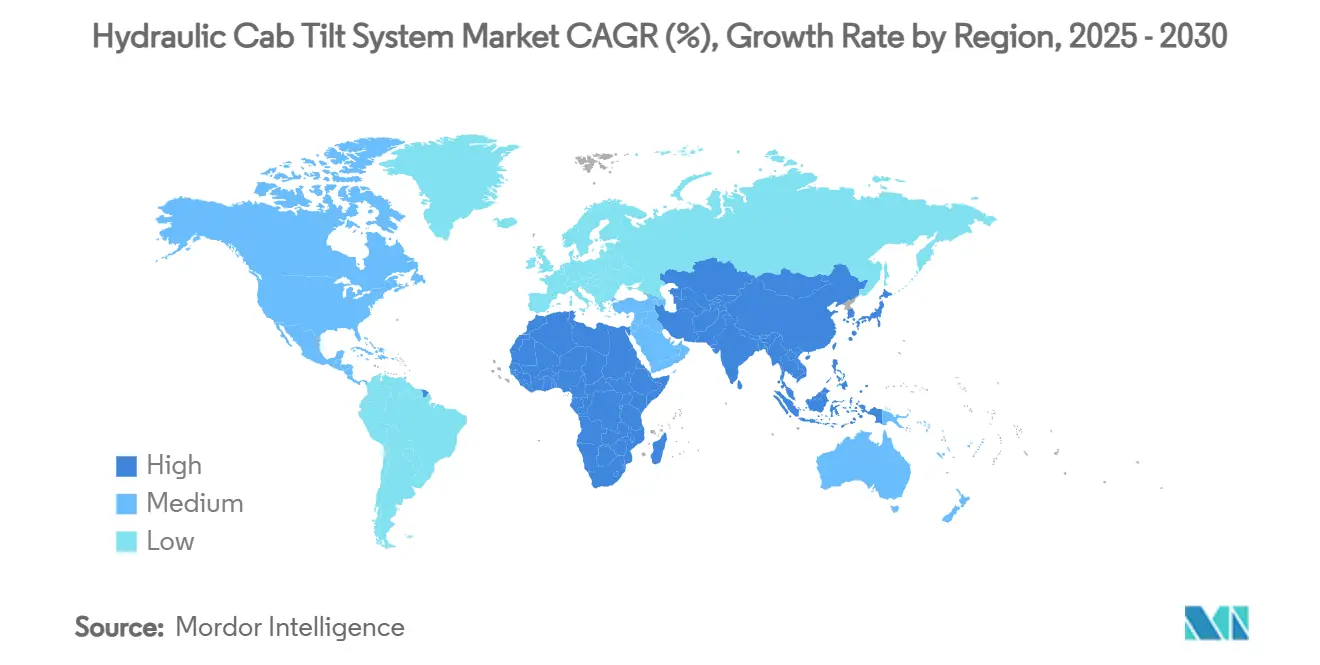
- By geography, Asia-Pacific accounted for 38.51% hydraulic cab tilt system market share in 2024, while also posting the fastest regional expansion at 6.44% CAGR to 2030.
Note: Market size and forecast figures in this report are generated using Mordor Intelligence’s proprietary estimation framework, updated with the latest available data and insights as of January 2026.
Market Trends and Insights
Drivers Impact Analysis of Hydraulic Cab Tilt System Market*
| Driver | (~) % Impact on CAGR Forecast | Geographic Relevance | Impact Timeline |
|---|---|---|---|
| Surging Demand for Infrastructure-Driven Heavy Equipment | +1.2% | Global, led by Asia-Pacific | Medium term (2-4 years) |
| Tightening Maintenance-Safety Regulations on Off-Road Machinery | +0.8% | North America, Europe, expanding in Asia-Pacific | Long term (≥ 4 years) |
| Accelerating Mining Rebound across Africa and Asia-Pacific | +0.7% | Africa, Asia-Pacific | Medium term (2-4 years) |
| Ergonomics-First Cabin Redesign Programs among OEMs | +0.5% | Global, spearheaded by North America and Europe | Long term (≥ 4 years) |
| Smart Electro-Hydraulic Controls Enabling Predictive Maintenance | +0.4% | Initially developed markets, global diffusion | Long term (≥ 4 years) |
| Modular Cab-Tilt Kits for Gigafactory Assembly Lines | +0.2% | North America, Europe, China | Short term (≤ 2 years) |
| Source: Mordor Intelligence | |||
Surging Demand for Infrastructure-Driven Heavy Equipment
Worldwide infrastructure spending pipelines continue to stimulate orders for excavators, loaders, and compact track machines equipped with hydraulic cab tilt systems, creating a direct lift to the hydraulic cab tilt system market. In the United States, the USD 1.2 trillion Infrastructure Investment and Jobs Act funds road, bridge, and energy projects that translate into higher equipment utilization. Comparable momentum is visible across Southeast Asian megaprojects and Belt & Road corridors where equipment exports from China grew 34% year-on-year in 2023. Each multi-disciplinary job site typically deploys several machine classes, multiplying unit demand for safe cab-tilting assemblies. Supply-chain-friendly modular kits further accelerate retrofit volumes among mid-tier fleets. The cumulative effect is a virtuous cycle of fleet expansion, component replacement, and aftermarket services that collectively raise the hydraulic cab tilt system market baseline.
Tightening Maintenance-Safety Regulations on Off-Road Machinery
Occupational safety agencies now mandate comprehensive cabin-protection ecosystems, raising the technical baseline for hydraulic cab tilt solutions. OSHA’s 29 CFR 1926.1001 rules dictate rollover protective structures and easy cab access for machinery manufactured after 2019 [1]. Parallel ISO 3471:2008 harmonization across Canada, Australia, and the EU embeds similar expectations. Because 80% of hydraulic failures trace to contamination, regulators highlight fast and safe cabin access as a pre-requisite for preventative maintenance. OEM engineering roadmaps now integrate robust tilt cylinders, tamper-proof latching, and lock-out sensors to achieve compliance. The outcome is a secular uplift in specification complexity and price realization for the hydraulic cab tilt system market.
Accelerating Mining Rebound Across Africa and Asia-Pacific
Metals-intensive energy transition targets keep commodity demand strong, stimulating equipment orders for open-cast and underground mines. Zimbabwe’s mining output quadrupled between 2017-2023, pulling in advanced excavators fitted with heavy-duty cab tilt gear for improved serviceability [2]. In Indonesia, nickel and copper projects similarly prioritize machines with enhanced safety and uptime features. Harsh operating environments heighten the value of sealed cylinders and biodegradable fluids that curb contamination. Mining contractors increasingly specify predictive-maintenance-ready electro-hydraulic kits that cut unplanned downtime. These trends anchor an outsized contribution of the segment to the hydraulic cab tilt system market long-range demand curve.
Ergonomics-First Cabin Redesign Programs Among OEMs
Labor shortages sharpen OEM focus on operator comfort, visibility, and intuitive controls. Modern tractors integrate electronic hydraulic joysticks that enable variable-rate planting, automated brake blending, and streamlined maintenance through tiltable cabs. Construction equipment launches for 2025 feature 360° camera pods and proximity sensors that must be service-accessible, necessitating wider cab tilt angles and smart lock valves. Enhanced ergonomics reduce operator fatigue and foster talent retention, driving fleets to refresh older machines. Hydraulic cab tilt system market participants benefit as tilt kits turn into must-have bundles rather than optional extras.
Restraints Impact Analysis of Hydraulic Cab Tilt System Market*
| Restraint | (~) % Impact on CAGR Forecast | Geographic Relevance | Impact Timeline |
|---|---|---|---|
| High OPEX Due to Hydraulic Fluid Leakage and Seal Failures | -0.9% | Global, harsh duty sites | Short term (≤ 2 years) |
| Volatile Steel and Cylinder Component Prices | -0.6% | Global manufacturing hubs | Medium term (2-4 years) |
| Emergence of Electric Actuator Alternatives Post-2028 | -0.4% | Developed markets first | Long term (≥ 4 years) |
| Urban Bans on Mineral-oil Discharge at Jobsites | -0.3% | Cities in Europe and North America | Medium term (2-4 years) |
| Source: Mordor Intelligence | |||
High OPEX Due to Hydraulic Fluid Leakage and Seal Failures
Even a single drop-per-second leak equals 420 gallons wasted annually, inflating fluid budgets and environmental liabilities. Lost oil also speeds component wear, because 80% of failures originate from contamination ingress. Downtime costs escalate when seals fail unexpectedly, pushing fleets toward rigorous preventive checks that raise labor spend. In cost-sensitive markets, operators delay adopting higher-spec tilt systems, trimming short-term volumes in the hydraulic cab tilt system market. Vendors respond with upgraded rod-wipers, compact secondary containment bladders, and bio-oil-compatible elastomers to ease leakage risks.
Volatile Steel and Cylinder Component Prices
Hydraulic cylinders comprise high-grade alloy tubes, tie-rods, and chromed rods that track global steel prices. Supply chain dislocations since 2021 saw lead times for precision-honed tubing spike, squeezing OEM margins. To protect budgets, some contractors postpone equipment renewals, affecting order visibility for hydraulic cab tilt system market suppliers. Countermeasures include dual-sourcing, localized machining hubs, and additive-manufactured clevis mounts that cut material waste.
*Our forecasts treat driver/restraint impacts as directional, not additive. The impact forecasts reflect baseline growth, mix effects, and variable interactions.
Hydraulic Cab Tilt System Market Segment Analysis
By Equipment Type:
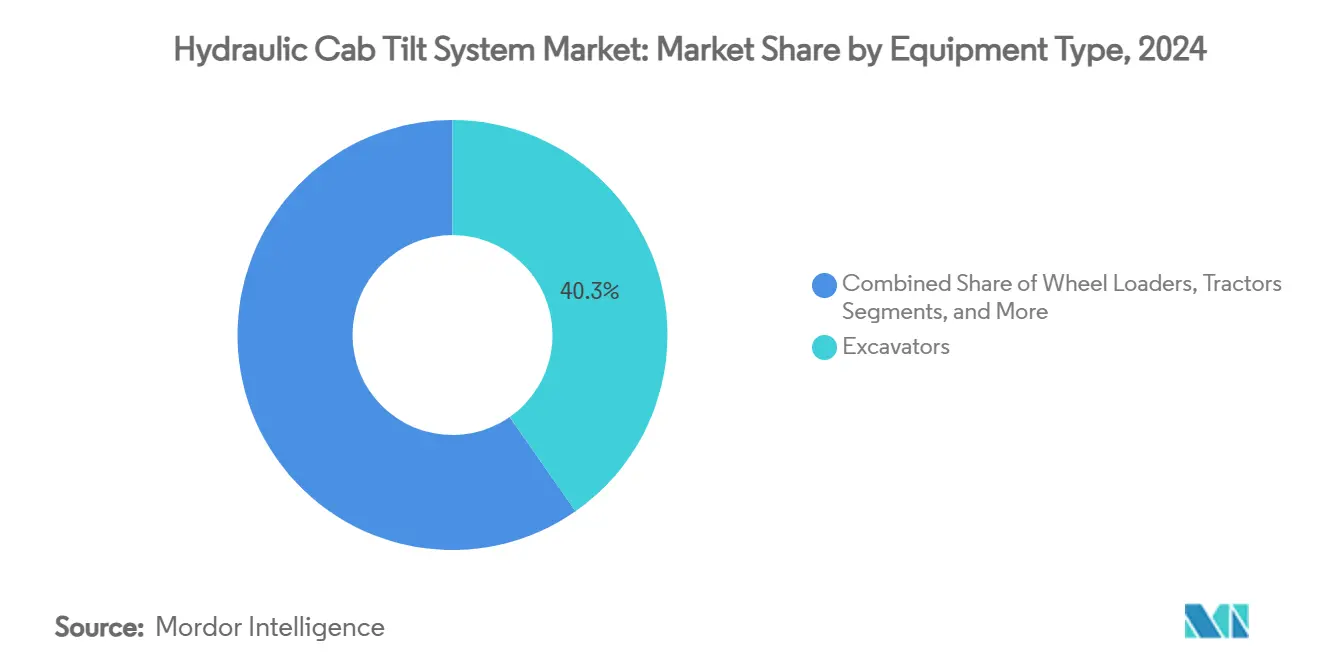
Diversified Demand Anchors Excavator DominanceExcavators captured 40.25% of hydraulic cab tilt system market size in 2024 on the back of their indispensability in earthworks and quarrying. Komatsu’s PC4000E-11 tethered electric model integrates dual hydraulic cylinders with position feedback to maintain safe service access during high-voltage operations [3]. Wheel loaders, backhoes, and tractors sustain steady replacement cycles, yet the nimble skid steer loader cohort is projected to clock a 5.33% CAGR. Urban renewal projects and landscaping contracts favor compact machines that maneuver in tight footprints, lifting tilt-system unit shipments. Manufacturers tailor plug-and-play cylinder-linkage kits with optional electro-hydraulic valves, enabling platform reuse across equipment classes. This modularity lowers engineering cost and accelerates time-to-market for next-generation solutions within the hydraulic cab tilt system market.
Upstart models unveiled at Bauma 2025 showcased variable displacement pumps linked to load-sensing electro-proportional valves, improving energy efficiency by up to 18% while safeguarding tilt stability. Retrofit opportunities also swell as fleets update legacy machines; tilt cylinder replacement intervals average 7-10 years in heavy-duty use, guaranteeing aftermarket revenue. Ongoing diversification pressures incumbents to balance high-volume excavator programs with bespoke kits for emerging micro-equipment niches.

By End-User Industry:
Construction Scale Meets Waste Management AgilityConstruction commanded 56.19% of hydraulic cab tilt system market size in 2024, reflecting project pipelines that span roads, tunnels, and renewable-energy installations. Job site safety guidelines compel contractors to specify cab tilt assemblies that enable rapid engine and hydraulic access without risking falls. In parallel, waste management fleets illustrate the fastest 6.14% CAGR trajectory through 2030 as municipalities upgrade refuse trucks and material handlers to comply with circular-economy targets. HED’s refuse-specific valve blocks synchronize multiple cylinder actions, ensuring stable cab angles during compactor servicing.
Mining customers maintain a counter-cyclical buffer; commodity-price swings modulate capital expenditure, but the harsh duty cycles drive predictable replacement of high-pressure seals. Agriculture expands steadily in mechanizing regions; precision farming boosts demand for smart electro-hydraulics that tie into tractor ISOBUS networks. Diversified end-use reduces cyclicality risk for suppliers while encouraging application-specific innovation, sustaining long-run growth for the hydraulic cab tilt system market.
By Component:
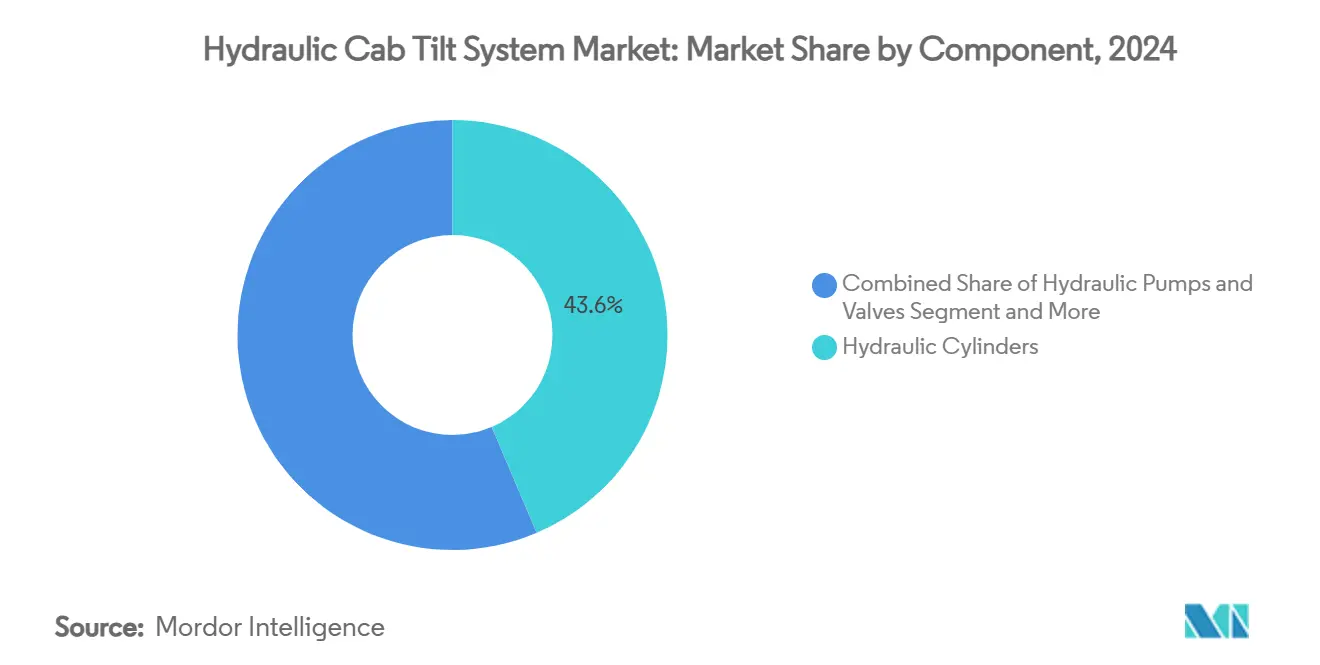
Cylinders Rule as Electronics Capture Delta GrowthHydraulic cylinders accounted for 43.62% revenue in 2024, underscoring their role as the core energy-conversion element. Enerpac’s RC-Trio design adds a trio-bearing collar that extends service life by 30%, catering to high-side-load tilt applications. Pumps and directional valves underpin power generation and flow control, yet they yield spotlight to electronics and sensors rising at 5.89% CAGR. Fourth-generation Parker DFplus proportional valves embed an NFC chip that streams cycle counts and temperature logs to maintenance apps, turning hardware into a data node.
Integrated power-pack modules combining reservoir, pump, motor, and manifold gain traction in compact loaders where space is at a premium. Suppliers co-develop firmware that harmonizes cylinder velocity with cab weight distribution, preventing overshoot. This mechanic-electronic convergence unlocks predictive diagnostics and remote firmware upgrades, elevating the aggregated value captured by the hydraulic cab tilt system market.
By Actuation Technology:
Manual Systems Endure as Electro-Hydraulic Adoption AcceleratesManual lever-controlled circuits remained the installed-base workhorse with 75.33% share in 2024, prized for simplicity, low cost, and field-service familiarity. Nonetheless, electro-hydraulic packages are forecast to deliver a 7.12% CAGR by 2030 as OEMs embed software-defined functionality. Volvo Construction Equipment’s hydraulic hybrid digging system recovers boom-down energy and reallocates it, cutting fuel use by 20% while retaining full cab tilt capability. Load-sensing pumps, pressure-compensated valves, and joystick-integrated proportional controllers work in concert to provide fine positioning suited to Tier 4-final and Stage V engines.
As telematics adoption widens, electro-hydraulic controllers push over-the-air updates that recalibrate tilt speeds based on wear analytics. Cost hurdles persist for price-sensitive regions, so tiered product lines coexist: entry-level mechanical kits in emerging markets and premium smart variants in regulated geographies. This stratified offering framework expands the total accessible hydraulic cab tilt system market while cushioning suppliers against macro shocks.
Geography Analysis
APAC Hydraulic Cab Tilt System Market
Asia-Pacific captured 38.51% hydraulic cab tilt system market share in 2024 and growing at 6.44% CAGR, underpinned by large-scale public works, rapid industrialization, and regional OEM manufacturing depth. China’s export-oriented excavator plants report monthly shipments cresting 100,000 units, many fitted with tilt-ready cabs to meet international safety codes. India’s National Infrastructure Pipeline channels steady orders into domestic fabricators, aided by government incentives that reward locally produced hydraulic cylinders.
North America Hydraulic Cab Tilt System Market
North America maintains second position, buoyed by Infrastructure Investment and Jobs Act roll-outs, stringent OSHA safety directives, and high telematics penetration that accelerate electro-hydraulic uptake. Contractors in the Midwest and Sunbelt favor preventive maintenance contracts that bundle tilt system health monitoring. Urban retrofit projects further boost demand for compact skid steers equipped with sealed-system cab tilt modules, elevating hydraulic cab tilt system market size for the region.
Europe, Africa and South America Hydraulic Cab Tilt System Market
Europe prioritizes sustainability; mineral-oil discharge restrictions push fleets toward synthetic esters and sealed cylinders, nudging average selling prices upward. OEMs in Germany and Sweden spearhead R&D on energy-recycling tilt valves aligned with Green Deal objectives. Meanwhile, Africa benefits from mining green-metal rushes; mechanized pits in Zimbabwe, Zambia and the DRC specify high-capacity cab tilts rated to 250 tonne excavators. South America trails, yet Brazilian agribusiness mechanization offers pockets of vitality, particularly for tractor-mounted tilt cabins designed for soybean and sugarcane estates. Collectively, regional heterogeneity diversifies revenue sources and cushions the global hydraulic cab tilt system market against localized slowdowns.
Competitive Landscape
Global competition is moderate, with the major players accounting for a significant share of revenue, leaving room for regional specialists. Caterpillar leverages vertically integrated cylinder production and a 190-country dealer web to safeguard parts availability. It's 2025 tiltrotator rollout slices job-site cycle times by 15%, demonstrating continuous innovation. Komatsu aligns electrified drivetrains with redesigned hydraulic loops to cut total cost of ownership on its latest compact loaders, courting European carbon-reduction mandates.
Parker Hannifin differentiates via high-bandwidth valve electronics and cloud analytics partnerships- its Camgian tie-up embeds AI dashboards that flag anomalous tilt torque within 30 seconds of detection. Volvo CE pushes hybrid-energy recovery to lower fuel bills while achieving Stage V compliance, enhancing its brand in environmentally regulated markets. Mid-tier firms such as Hydro Electronic Devices and Enerpac focus on niche verticals—refuse trucks and high-tonnage jacking equipment, where bespoke valve logic or trio-bearing cylinders secure defensible niches.
M&A chatter centers on sensor specialists and bio-fluid formulators that can round out full-stack offerings. Meanwhile, start-ups commercializing electric linear actuators court OEM pilots in the micro-loader segment. Service models evolve: subscription-based diagnostics platforms bundle cloud dashboards with on-site fluid sampling, expanding annuity streams for established hydraulic cab tilt system market incumbents. With technology convergence accelerating, sustained R&D and partnerships will likely determine share shifts through 2030.
Hydraulic Cab Tilt System Industry Leaders
-
Power-Packer (Enerpac Tool Group)
-
Parker Hannifin Corporation
-
Komatsu Ltd.
-
Caterpillar Inc.
-
Volvo Construction Equipment
- *Disclaimer: Major Players sorted in no particular order

Hydraulic Cab Tilt System Market Companies Covered in this Report
- Power-Packer (Enerpac Tool Group)
- Komatsu Ltd.
- Caterpillar Inc.
- Volvo Construction Equipment
- JCB Group
- Toyota Industries Corporation
- Hyster-Yale Materials Handling Inc.
- Mitsubishi Logisnext Co., Ltd.
- Doosan Bobcat
- KION Group AG
- Parker Hannifin Corporation
- Danfoss Power Solutions
- KYB Corporation
- Hydac International
- Wipro Infrastructure Engineering
Recent Industry Developments in Hydraulic Cab Tilt System Market
- April 2025: Caterpillar unveiled a new tiltrotator line allowing 360° rotation and 40° tilt, enabling tracked excavators to swap between digging, grading and compacting without repositioning.
- February 2025: Komatsu introduced 4-tonne skid steer and 5-tonne compact track loaders featuring Stage V engines and variable-displacement hydraulic pumps aimed at European contractors.
Global Hydraulic Cab Tilt System Market Report Scope
| Excavators |
| Wheel Loaders |
| Tractors |
| Skid Steer Loaders |
| Backhoe Loaders |
| Construction |
| Mining |
| Agriculture |
| Waste Management |
| Other Industries |
| Hydraulic Cylinders |
| Hydraulic Pumps and Valves |
| Power-Pack Modules |
| Control Electronics and Sensors |
| Conventional Manual-Hydraulic |
| Electro-Hydraulic |
| North America | United States |
| Canada | |
| Rest of North America | |
| South America | Brazil |
| Argentina | |
| Rest of South America | |
| Europe | Germany |
| United Kingdom | |
| France | |
| Italy | |
| Spain | |
| Russia | |
| Rest of Europe | |
| Asia-Pacific | China |
| India | |
| Japan | |
| South Korea | |
| Rest of Asia-Pacific | |
| Middle East and Africa | Saudi Arabia |
| United Arab Emirates | |
| South Africa | |
| Rest of Middle East and Africa |
| By Equipment Type | Excavators | |
| Wheel Loaders | ||
| Tractors | ||
| Skid Steer Loaders | ||
| Backhoe Loaders | ||
| By End-User Industry | Construction | |
| Mining | ||
| Agriculture | ||
| Waste Management | ||
| Other Industries | ||
| By Component | Hydraulic Cylinders | |
| Hydraulic Pumps and Valves | ||
| Power-Pack Modules | ||
| Control Electronics and Sensors | ||
| By Actuation Technology | Conventional Manual-Hydraulic | |
| Electro-Hydraulic | ||
| By Geography | North America | United States |
| Canada | ||
| Rest of North America | ||
| South America | Brazil | |
| Argentina | ||
| Rest of South America | ||
| Europe | Germany | |
| United Kingdom | ||
| France | ||
| Italy | ||
| Spain | ||
| Russia | ||
| Rest of Europe | ||
| Asia-Pacific | China | |
| India | ||
| Japan | ||
| South Korea | ||
| Rest of Asia-Pacific | ||
| Middle East and Africa | Saudi Arabia | |
| United Arab Emirates | ||
| South Africa | ||
| Rest of Middle East and Africa | ||
Key Questions Answered in the Report
What is the current hydraulic cab tilt system market size and growth outlook?
The hydraulic cab tilt system market size stands at USD 1.82 billion in 2025 and is projected to reach USD 2.26 billion by 2030, reflecting a 4.43% CAGR.
Which region dominates demand for hydraulic cab tilt systems?
Asia-Pacific leads with a 38.51% share in 2024 and is also the fastest-growing region at 6.44% CAGR thanks to infrastructure expansion and OEM manufacturing depth.
Which equipment type generates the most revenue for suppliers?
Excavators hold the largest slice at 40.25% because they are ubiquitous across construction and mining activities requiring cab tilt accessibility.
Why are electro-hydraulic systems gaining popularity?
Electro-hydraulic packages add sensor feedback, load-sensing efficiency and predictive maintenance capabilities that cut downtime and fuel consumption, driving a 7.12% CAGR adoption rate.