
Market Overview
| Study Period | 2019 - 2031 |
|---|---|
| Forecast Data Period | 2026 - 2031 |
| Base Year Market Size (2025) | USD 1.45 Billion |
| Market Size (2026) | USD 1.56 Billion |
| Market Size (2031) | USD 2.28 Billion |
| Growth Rate (2026 - 2031) | 7.82 % |
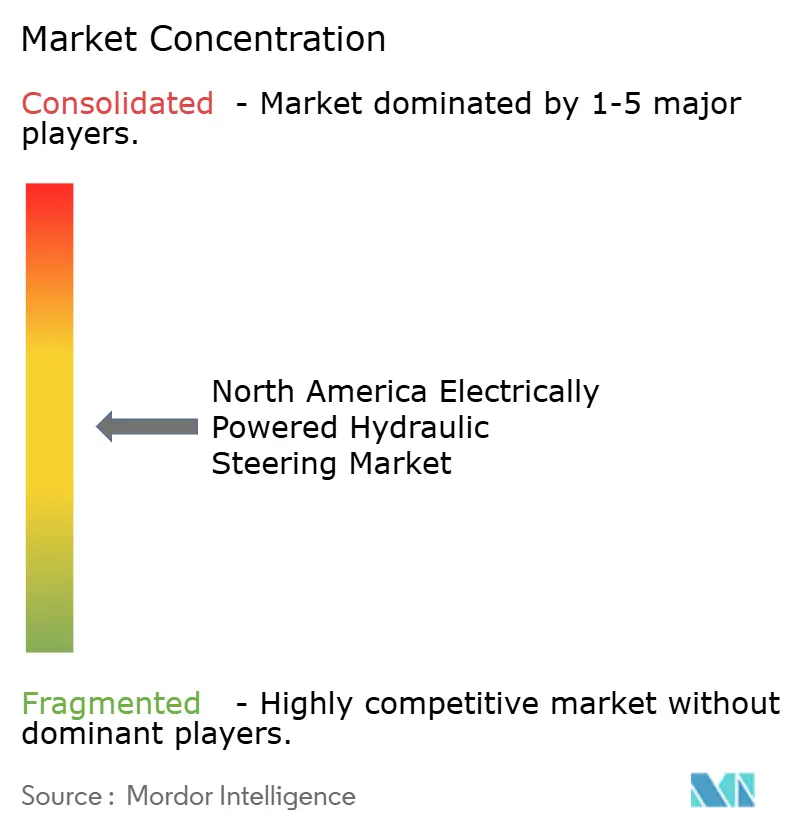
| Market Concentration | Medium |
Major Players *Disclaimer: Major Players sorted in no particular order Image © Mordor Intelligence. Reuse requires attribution under CC BY 4.0. | |
North America Electrically Powered Hydraulic Steering Market Analysis by Mordor Intelligence
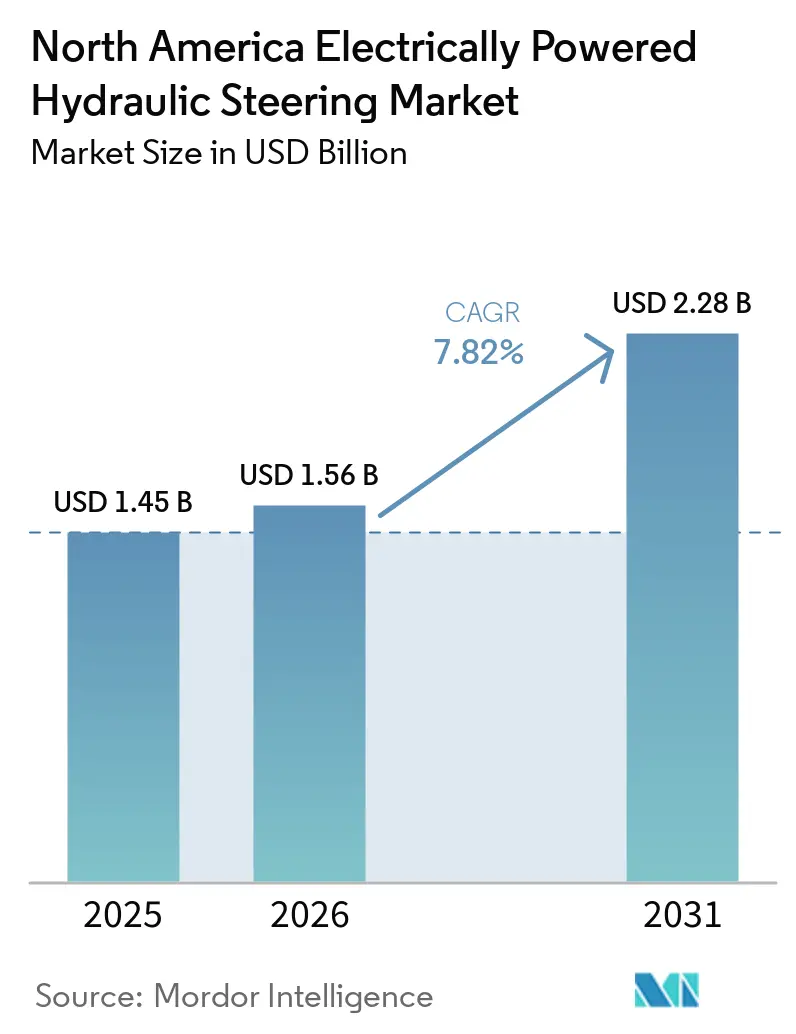
The North America electro-hydraulic power steering market size was valued at USD 1.45 billion in 2025 and is projected to expand from USD 1.56 billion in 2026 to USD 2.28 billion by 2031, registering a CAGR of 7.82% between 2026 and 2031. The North America electro-hydraulic power steering market remains tied to applications that need strong hydraulic assistance and an electrically driven pump. This design is relevant where vehicle loads, towing duties, and operating temperatures place pressure on smaller steering systems. It also gives vehicle makers a way to provide steering assistance when the engine is not running. The North America electro-hydraulic power steering market, therefore, has a clearer role in commercial vehicles, larger pickups, and electrified platforms than in compact passenger cars. Supplier decisions increasingly depend on software control, safety validation, and the ability to serve regional manufacturing programs.
Key Report Takeaways
- By type, column type held 43.53% of the North America electro-hydraulic power steering market share in 2025, while dual pinion type is expected to record the highest projected CAGR at 9.33% through 2031.
- By component type, steering motors accounted for 31.38% of revenue in 2025, while sensors and ECU clusters are projected to record the highest projected CAGR at 10.09% through 2031.
- By vehicle type, commercial vehicles held 58.72% of revenue in 2025 and are set to record the highest projected CAGR at 9.08% through 2031.
- By propulsion type, ICE vehicles held 62.76% of revenue in 2025, while battery electric vehicles are anticipated to register the highest projected CAGR at 13.24% through 2031.
- By sales channel, OEM channels held 89.09% of revenue in 2025, while the aftermarket is poised to record the highest projected CAGR at 8.83% through 2031.
- By geography, the United States held 83.01% of revenue in 2025, while Mexico is expected to record the highest projected CAGR at 7.98% through 2031.
Note: Market size and forecast figures in this report are generated using Mordor Intelligence’s proprietary estimation framework, updated with the latest available data and insights as of January 2026.
Market Trends and Insights
Drivers Impact Analysis of North America Electrically Powered Hydraulic Steering Market*
| Driver | (~)% Impact on CAGR Forecast | Geographic Relevance | Impact Timeline |
|---|---|---|---|
| Commercial-Vehicle Electrification | +2.4% | California, Texas, Michigan, Ontario | Medium term (2–4 years) |
| Growing SUV, Pickup, and Light-Truck Content | +1.8% | Michigan, Tennessee, Texas, Alabama, Ontario | Short term (≤ 2 years) |
| ADAS-Compatible Steering Assistance | +1.4% | Michigan, Ohio, California | Medium term (2–4 years) |
| High-Voltage Steering Demand in Heavy Electric Platforms | +1.2% | California, Texas, Ontario | Medium term (2–4 years) |
| Power-On-Demand Fuel Savings | +0.9% | Broad North America | Short term (≤ 2 years) |
| Software-Controlled Variable-Flow Pump Efficiency | +0.7% | Michigan, Indiana | Long term (≥ 4 years) |
| Source: Mordor Intelligence | |||
Commercial-Vehicle Electrification
Electric commercial vehicles need a steering system that operates without an engine-driven pump. Electro-hydraulic steering meets that need through an electric motor and pump arrangement that can work independently of engine speed. The North America electro-hydraulic power steering market benefits when fleets add battery-electric trucks and buses to their operating plans. The International Energy Agency reported that regional electric truck sales rose significantly in 2025, which supports the direction of demand for independently powered vehicle systems[1] International Energy Agency, “Trends in Other EV Modes,” Global EV Outlook 2026, iea.org. Fleet operators also need components that can withstand repeated use, high axle loads, and long duty cycles. This favors established suppliers that can support vehicle makers during development, testing, and service planning.
Growing SUV, Pickup, and Light-Truck Content
Large pickups and sport utility vehicles remain important outlets for electro-hydraulic steering because they are often used for towing, payload, and off-road work. These operating conditions can require more steering assistance than smaller vehicles need. General Motors reported strong full-size pickup sales in 2025, showing the continued importance of this vehicle category in the region[2]General Motors, “GM Leads U.S. Industry, 2025 Sales Up 6%,” General Motors Investor Relations, investor.gm.com. The North America electro-hydraulic power steering market gains support when vehicle programs retain hardware suited to demanding use. Hybrid versions of larger vehicles also need steering support when the combustion engine is temporarily off. Vehicle makers can therefore keep electro-hydraulic designs in selected programs even as they use electric steering in other light vehicles.
ADAS-Compatible Steering Assistance
Driver assistance functions require steering equipment that can receive and respond to electronic commands. Modern electro-hydraulic systems combine a motor, controller, sensors, and hydraulic assist in a single operating system. This setup can support lane guidance, automated steering corrections, and safety functions when it meets vehicle-specific validation requirements. The North America electro-hydraulic power steering market is shaped by the growing importance of calibrated software and dependable sensor inputs. Commercial vehicle programs can place particular value on steering systems that maintain controlled assistance under heavy loads. The result is a larger role for engineering support and software validation within supplier relationships.
High-Voltage Steering Demand in Heavy Electric Platforms
Heavy electric trucks and buses use electrical architectures that differ from conventional commercial vehicles. Steering units for these platforms need motors, inverters, and controls that work with higher-voltage systems. This changes how suppliers design, test, and manufacture electro-hydraulic equipment. The North America electro-hydraulic power steering market can benefit where high-voltage vehicle programs move from development into regular production. Suppliers also need thermal management and electrical protection that match the operating conditions of heavy vehicles. Local engineering and validation capacity becomes more important as vehicle makers seek timely support for North American programs.
Restraints Impact Analysis of North America Electrically Powered Hydraulic Steering Market*
| Restraint | (~)% Impact on CAGR Forecast | Geographic Relevance | Impact Timeline |
|---|---|---|---|
| EPS Substitution | -1.5% | Michigan, Ohio, Ontario, San Luis Potosí | Short term (≤ 2 years) |
| High Validation and Safety-Redundancy Costs | -0.8% | Michigan, Querétaro | Long term (≥ 4 years) |
| High-Voltage Thermal Integration Constraints | -0.5% | California, Texas | Medium term (2–4 years) |
| Hydraulic Leakage and Serviceability Exposure | -0.4% | Broad North America | Short term (≤ 2 years) |
| Source: Mordor Intelligence | |||
EPS Substitution and Platform Migration
Electric power steering is often simpler to package in passenger cars and lighter crossover vehicles. It removes the hydraulic circuit and can reduce the number of mechanical parts in programs with modest steering-force requirements. This limits the addressable base for the North America electro-hydraulic power steering market in smaller vehicle categories. Suppliers must focus their resources on vehicle programs where hydraulic assistance remains useful, rather than treating all light vehicles as similar opportunities. The separation is most visible between passenger cars and larger pickups, commercial trucks, or specialized equipment. Portfolio decisions must account for this difference because system requirements are set at the vehicle-program level.
High Validation and Safety-Redundancy Costs
Steering is a safety-critical vehicle system, so new designs require extensive testing and customer-specific approval. Redundant systems for highly automated trucks add more work because the backup function and switching logic must also be examined. These requirements raise development costs and lengthen the time needed to enter a new program. The North America electro-hydraulic power steering market consequently favors suppliers with established testing facilities and long customer relationships. Cost pressure can be strongest in medium-duty and fleet applications where vehicle buyers closely examine total ownership costs. It also makes it harder for smaller companies to compete for high-value programs without a specialized partner.
*Our forecasts treat driver/restraint impacts as directional, not additive. The impact forecasts reflect baseline growth, mix effects, and variable interactions.
North America Electrically Powered Hydraulic Steering Market Segment Analysis
By Type:
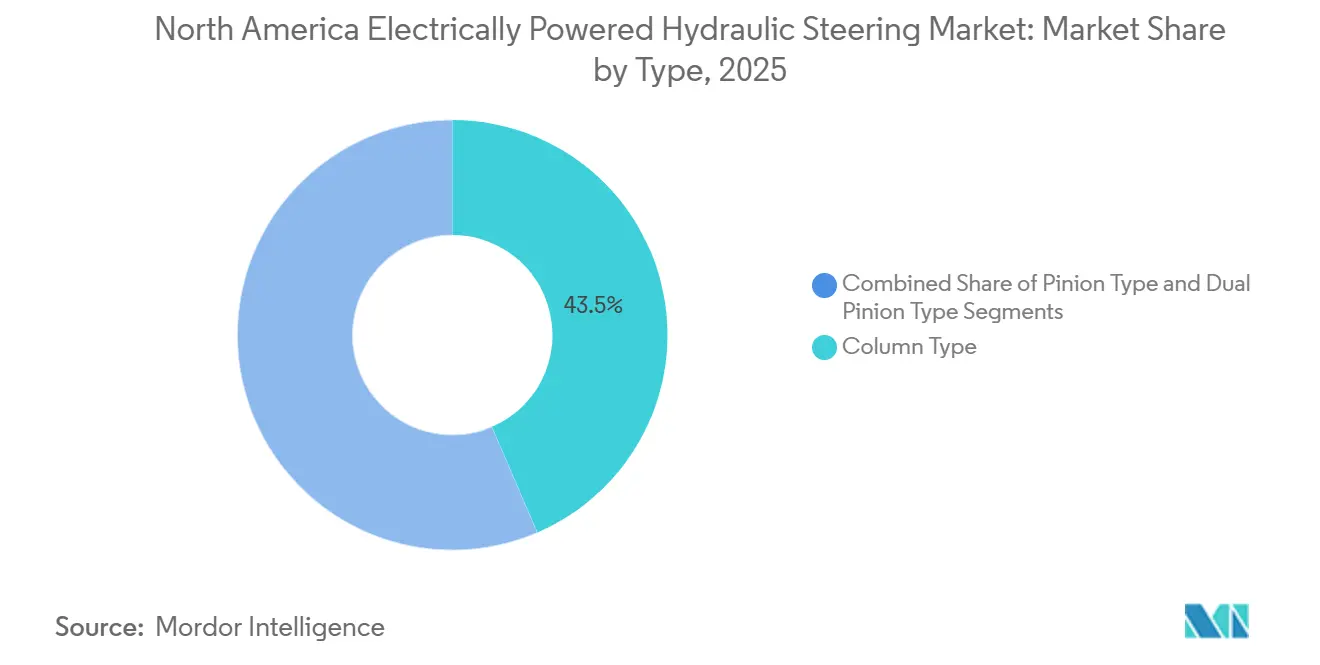
Established Column Systems Support Current DemandColumn type accounted for 43.53% of the North America electro-hydraulic power steering market share in 2025. This reflects its use across light commercial vehicles, medium-duty trucks, and pickup trucks that require compact packaging and dependable steering assistance. The design reduces hydraulic routing length and fits vehicle architectures with limited space. Column and pinion arrangements can coexist across different platform families, with the choice typically reflecting duty requirements. Service access and part commonality can also influence the final configuration.
The dual pinion type is projected to record a 9.33% CAGR through 2031, making it the fastest-growing type in the North America electro-hydraulic power steering market. The layout combines a conventional driver input path with a separate actuator for electronically commanded corrections, supporting driver assistance functions while retaining hydraulic assistance. This is relevant to commercial platforms where safety functions and controlled steering response are increasingly specified together. Demand is likely to concentrate in applications with clear operational requirements, where vehicle makers adopt the added complexity to address a defined safety or control need.



By Component Type:
Motors Lead Current Value While Electronics Gain ImportanceSteering motors accounted for 31.38% of component revenue in 2025. Motors are central to electro-hydraulic operation as they provide the power that drives the pump when steering assistance is required. This role makes efficiency, durability, and heat management important product considerations. Hydraulic pumps and reservoirs manage fluid delivery and support consistent steering response. The pump, motor, and hydraulic circuit must function as a coordinated assembly, as a change in 1 component can affect energy use, noise, and response across the system. Suppliers need to manage component interfaces carefully, creating value for companies that can provide both hardware knowledge and application support.
The sensors and ECU cluster are expected to expand at a 10.09% CAGR through 2031, the fastest rate among the component categories. Sensors supply information on steering angle, torque, force, and system condition to the vehicle controller, while the ECU uses that information to manage pump output and monitor system performance. This shift increases the importance of calibration, software development, and electronic reliability in the North America electro-hydraulic power steering market. Suppliers need clear procedures for software updates, diagnostics, and fault handling, increasing the importance of long-term technical support after vehicle launch.
By Vehicle Type:
Commercial Vehicles Remain the Main Demand BaseCommercial vehicles accounted for 58.72% of revenue in 2025, the largest share among all vehicle categories. Heavy trucks and buses require significant steering assistance due to high axle loads and extended operating periods. Electro-hydraulic equipment provides this assistance while allowing pump operation to be independent of engine speed. Medium-duty trucks contribute additional demand through distribution, municipal, and service applications. Construction and agricultural equipment also rely on hydraulic steering under demanding working conditions. Fleet utilization tends to be intensive, so operators prioritize equipment that performs reliably over long service intervals. The segment is driven by practical operating requirements rather than passenger car styling trends.
Commercial vehicles are also projected to record the fastest CAGR of 9.08% through 2031. The segment combines conventional demand with emerging requirements from electrified trucks and vehicles equipped with advanced driver assistance functions. Vehicle manufacturers need steering systems capable of supporting payload, towing, and frequent stop-and-turn driving. Supplier success will depend on support for both original equipment programs and aftermarket service requirements, including parts availability, diagnostics, and trained repair channels. Companies that plan for both stages can maintain stronger relationships with vehicle operators, particularly where downtime carries a direct business cost.
By Propulsion Type:
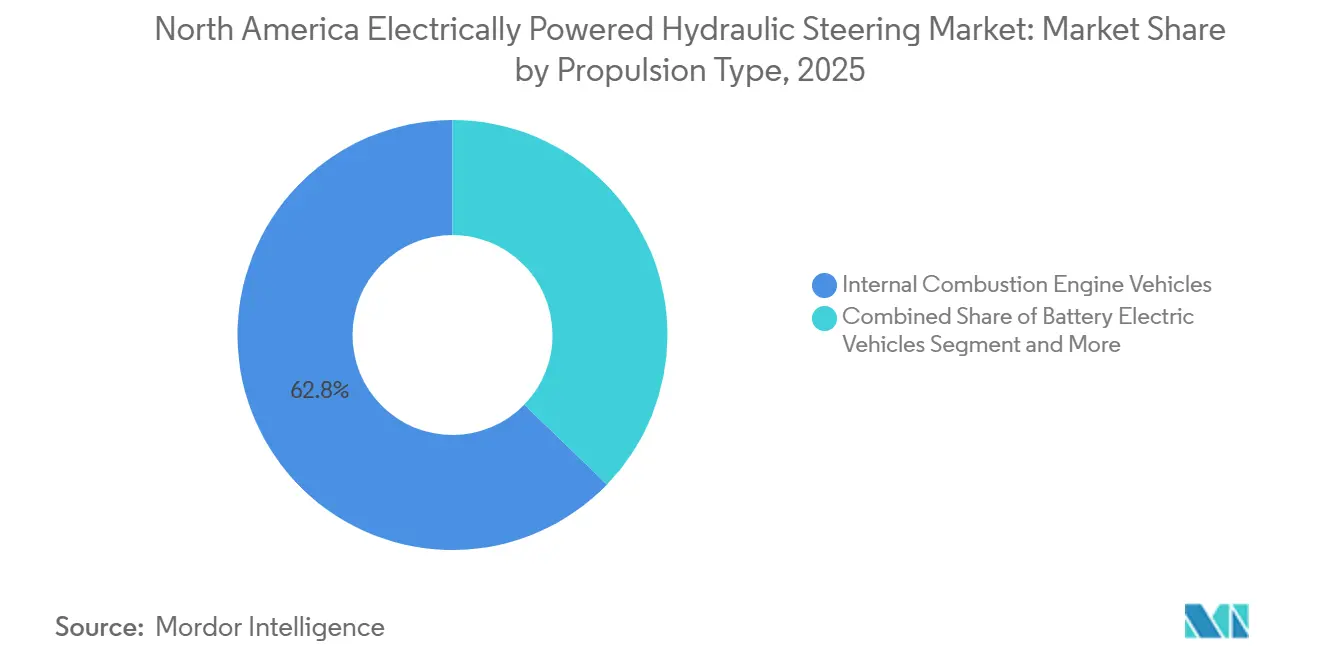
ICE Retains Scale While Battery-Electric Vehicles Grow FasterICE vehicles accounted for 62.76% of revenue in 2025, reflecting the continued use of engine-powered commercial vehicles across the region. These vehicles remain relevant due to long fleet replacement cycles and operators' reliance on established fueling and service infrastructure. Electro-hydraulic steering suits engine-powered vehicles by decoupling steering assistance from direct engine-driven pumping, with hybrid and plug-in hybrid vehicles also benefiting during periods when the engine is not running. Independently powered steering supports a gradual fleet technology transition, requiring suppliers to manage application-specific engineering across mixed powertrain production.
Battery electric vehicles are forecast to grow at a CAGR of 13.24% through 2031, the highest rate among propulsion categories. These vehicles require steering systems independent of engine-driven accessories, making electro-hydraulic designs with independently powered pumps and controllers well-suited to this need. Fuel-cell vehicles share similar requirements. High-voltage applications demand careful attention to insulation, cooling, and diagnostics, while suppliers must coordinate controls with the broader vehicle electrical architecture. Early program experience can support later production opportunities, provided suppliers demonstrate that new electrical requirements can be met without compromising steering performance.
By Sales Channel:
OEM Programs Dominate While Replacement Demand BuildsOEMs accounted for 89.09% of revenue in 2025, reflecting the importance of factory-installed steering systems in new vehicles. Vehicle manufacturers approve steering assemblies through program-specific engineering, testing, and warranty processes, creating a strong link between original equipment suppliers and vehicle production schedules. Commercial vehicle programs can require tailored calibration and hardware configurations for different axle loads and operating conditions, making it difficult for independent providers to replace the factory channel during the early life of a vehicle. Program awards can influence component volumes across several vehicle generations, requiring suppliers to maintain dependable production planning and quality systems. Suppliers must also respond when vehicle manufacturers change specifications or introduce new variants, making launch performance as important as the original product proposal.
The aftermarket is projected to expand at an 8.83% CAGR through 2031, the fastest rate among the sales channels. Demand emerges as vehicles age and require replacement pumps, motors, sensors, controllers, or related hardware. Fleet operators may evaluate new replacement parts against remanufactured systems when managing repair budgets. Service providers need access to parts that match the original steering configuration and vehicle safety requirements. Parts availability is especially important for operators that cannot keep vehicles out of service for extended periods, and the channel may also benefit from specialized distributors with experience in commercial vehicle parts.
Geography Analysis
United States Electrically Powered Hydraulic Steering Market
The United States held 83.01% of regional revenue in 2025, making it the dominant country market in North America. This scale reflects vehicle assembly activity, large commercial fleets, and strong demand for pickups and sport utility vehicles. Manufacturing activity across Michigan, Ohio, Kentucky, Tennessee, Texas, and California supports direct relationships between vehicle makers and steering suppliers. This concentration shapes the North America electro-hydraulic power steering market, as suppliers require local engineering, production, and service capability. Regional differences mean suppliers cannot rely on a single vehicle or powertrain pattern across the country, favoring companies with an established regional footprint and experienced customer teams.
Canada Electrically Powered Hydraulic Steering Market
Canada provides a smaller but connected base for passenger vehicles, light commercial programs, and cross-border component supply. Ontario vehicle production links Canadian facilities with the same regional supplier networks that serve United States plants. Electric truck activity in Canada gives vehicle makers an additional reason to consider independently powered steering units. Canadian demand remains closely tied to common vehicle platforms, regional production schedules, and shared engineering requirements. This connection gives suppliers an incentive to coordinate product support across both sides of the border, allowing companies to apply technical knowledge developed in one country to programs in another.
Mexico Electrically Powered Hydraulic Steering Market
Mexico is projected to record a 7.98% CAGR through 2031, the fastest country-level growth rate within the regional analysis. Its position is supported by vehicle manufacturing, component production, and engineering activity that serve North American supply chains. Nexteer Automotive opened a technical center in Querétaro in 2025 to support engineering, testing, and validation work for regional vehicle programs[3]“Nexteer Opens Mexico Technical Center to Advance Engineering Support, Testing & Validation Capabilities,” Nexteer Automotive, nexteer.com. The country's role extends beyond local sales, as components may be supplied throughout North America, connecting its growth to regional integration as much as to domestic vehicle demand. By comparison, the Rest of North America remains limited, centered primarily on replacement demand for working vehicles and equipment.
Competitive Landscape
The North America electro-hydraulic power steering market has a moderately concentrated supplier structure. Nexteer Automotive, JTEKT Corporation, Robert Bosch GmbH, ZF Friedrichshafen AG, and NSK Ltd. are key participants in regional original equipment programs. Competition is based on vehicle-maker relationships, steering-system capability, manufacturing support, and validation experience. Suppliers must meet demanding reliability and safety requirements, as steering components are fundamental to vehicle operation. Established program experience is a material advantage, as these suppliers understand the documentation, testing, and launch support that customers expect.
Product strategy increasingly centers on integrated controls, driver assistance compatibility, and the ability to support heavy vehicle use. Suppliers with strong electronic control and calibration capabilities are better positioned to address requests for variable steering behavior and system monitoring. Regional technical centers bring testing resources closer to vehicle assembly and design teams, reducing delays when components require calibration or validation changes. Investment in local capability serves as a practical competitive tool, helping suppliers resolve issues before they become production delays.
The North America electro-hydraulic power steering market reflects a clear split between passenger-car steering and larger vehicle applications. Established suppliers are likely to prioritize commercial trucks, larger pickups, electrified working vehicles, and advanced steering applications. The aftermarket provides an additional path for companies with repair, remanufacturing, and distribution expertise. Full-system providers retain an advantage where hardware, controls, and validation must be coordinated. Competitive positions will continue to depend on consistent delivery and technical credibility, with major gains depending on program wins and sustained execution.
North America Electrically Powered Hydraulic Steering Industry Leaders
Nexteer Automotive
JTEKT Corporation
Robert Bosch GmbH
ZF Friedrichshafen AG
NSK Ltd.
- *Disclaimer: Major Players sorted in no particular order
North America Electrically Powered Hydraulic Steering Market Companies Covered in this Report
- JTEKT Corporation
- Nexteer Automotive
- Robert Bosch GmbH
- ZF Friedrichshafen AG
- NSK Ltd.
- Hitachi Astemo, Ltd.
- thyssenkrupp Presta AG
- Mando Corporation
- Continental AG
- Hyundai Mobis Co., Ltd.
- Danfoss A/S
- Knorr-Bremse AG
- Concentric AB
- Magna International Inc.
- DENSO Corporation
- Schaeffler AG
- Mitsubishi Electric Corporation
- China Automotive Systems, Inc.
Read Analysis of North America Electrically Powered Hydraulic Steering Companies

Recent Industry Developments in North America Electrically Powered Hydraulic Steering Market
- November 2025: ZF Friedrichshafen AG and Kodiak AI agreed to deploy 100 redundant ReAX adaptive steering systems for Level 4 autonomous trucks, maintaining control if primary steering fails.
- October 2025: Nexteer Automotive opened its Mexico Technical Center in El Marqués, Querétaro, adding engineering, validation, and testing support near North American vehicle programs and manufacturing operations.


North America Electrically Powered Hydraulic Steering Market Report Scope
The North America Electrically-Powered Hydraulic Steering market is segmented by type, component type, vehicle type, propulsion type, sales channel, and country.
By Type, the market is segmented into Column Type, Pinion Type, and Dual Pinion Type. By Component Type, the market is segmented into Steering Motor, Sensors, Hydraulic Pump and Reservoir, Electronic Control Unit, Hydraulic Lines, Valves, and Seals, and Steering Gear, Rack, and Pinion. By Vehicle Type, the market is segmented into Passenger Vehicles (Passenger Cars, Sport Utility Vehicles, and Pickup Trucks) and Commercial Vehicles (Light Commercial Vehicles, Medium-Duty Trucks, Heavy-Duty Trucks, Buses and Coaches, Construction Equipment, and Agricultural Equipment). By Propulsion Type, the market is segmented into Internal Combustion Engine Vehicles, Hybrid Electric Vehicles, Plug-in Hybrid Electric Vehicles, Battery Electric Vehicles, and Fuel-Cell Electric Vehicles. By Sales Channel, the market is segmented into Original Equipment Manufacturer (OEM) and Aftermarket (Replacement Parts and Remanufactured Parts). By Country, the market is segmented into United States, Canada, Mexico, and Rest of North America.
Market forecasts are provided in terms of Value (USD) and Volume (Units).
By Type
| Column Type |
| Pinion Type |
| Dual Pinion Type |
By Component Type
| Steering Motor |
| Sensors |
| Hydraulic Pump and Reservoir |
| Electronic Control Unit |
| Hydraulic Lines, Valves, and Actuators |
| Steering Gear, Rack, and Column Interfaces |
By Vehicle Type
| Passenger Vehicles | Passenger Cars |
| Sport Utility Vehicles | |
| Pickup Trucks | |
| Commercial Vehicles | Light Commercial Vehicles |
| Medium-Duty Trucks | |
| Heavy-Duty Trucks | |
| Buses and Coaches | |
| Construction Equipment | |
| Agricultural Machinery |
By Propulsion Type
| Internal Combustion Engine Vehicles |
| Hybrid Electric Vehicles |
| Plug-in Hybrid Electric Vehicles |
| Battery Electric Vehicles |
| Fuel-Cell Electric Vehicles |
By Sales Channel
| Original Equipment Manufacturer | |
| Aftermarket | Replacement Parts |
| Remanufactured Systems |
By Country
| United States |
| Canada |
| Mexico |
| Rest of North America |
| By Type | Column Type | |
| Pinion Type | ||
| Dual Pinion Type | ||
| By Component Type | Steering Motor | |
| Sensors | ||
| Hydraulic Pump and Reservoir | ||
| Electronic Control Unit | ||
| Hydraulic Lines, Valves, and Actuators | ||
| Steering Gear, Rack, and Column Interfaces | ||
| By Vehicle Type | Passenger Vehicles | Passenger Cars |
| Sport Utility Vehicles | ||
| Pickup Trucks | ||
| Commercial Vehicles | Light Commercial Vehicles | |
| Medium-Duty Trucks | ||
| Heavy-Duty Trucks | ||
| Buses and Coaches | ||
| Construction Equipment | ||
| Agricultural Machinery | ||
| By Propulsion Type | Internal Combustion Engine Vehicles | |
| Hybrid Electric Vehicles | ||
| Plug-in Hybrid Electric Vehicles | ||
| Battery Electric Vehicles | ||
| Fuel-Cell Electric Vehicles | ||
| By Sales Channel | Original Equipment Manufacturer | |
| Aftermarket | Replacement Parts | |
| Remanufactured Systems | ||
| By Country | United States | |
| Canada | ||
| Mexico | ||
| Rest of North America | ||


Key Questions Answered in the Report
What is driving demand for electro-hydraulic power steering in North America?
Demand is supported by commercial vehicles, larger pickups, electrified trucks, and vehicle programs that need independently powered hydraulic assistance.
Which vehicle category leads demand for electro-hydraulic power steering?
Commercial vehicles led with 58.72% of revenue in 2025 and are projected to grow at a 9.08% CAGR through 2031.
Why are battery-electric trucks relevant to electro-hydraulic steering?
They do not use an engine-driven pump, so they need an independently powered steering solution. Battery electric vehicles are forecast to grow at a 13.24% CAGR through 2031.
Which sales channel is most important for steering-system suppliers?
OEM accounted for 89.09% of revenue in 2025 because factory-installed steering systems require vehicle-specific approval and calibration.
Page last updated on:





