
Hydraulic Motors Market Size and Share
Market Overview
| Study Period | 2019 - 2031 |
|---|---|
| Market Size (2026) | USD 14.32 Billion |
| Market Size (2031) | USD 18.72 Billion |
| Growth Rate (2026 - 2031) | 5.50 % |
| Fastest Growing Market | Asia Pacific |
| Largest Market | Asia Pacific |
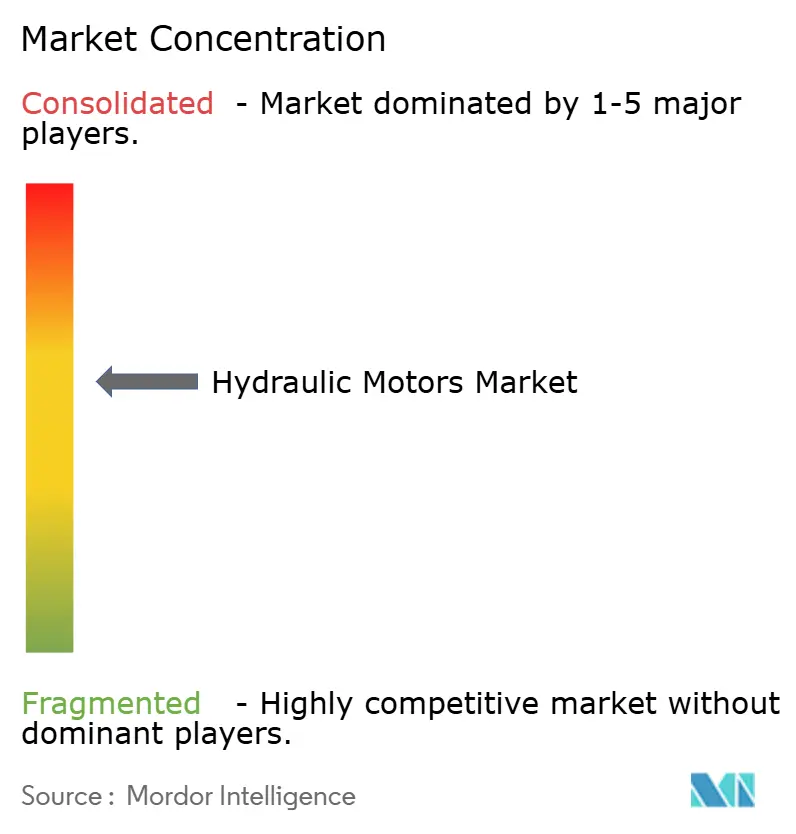
| Market Concentration | Medium |
Major Players *Disclaimer: Major Players sorted in no particular order Image © Mordor Intelligence. Reuse requires attribution under CC BY 4.0. | |
Hydraulic Motors Market Analysis by Mordor Intelligence
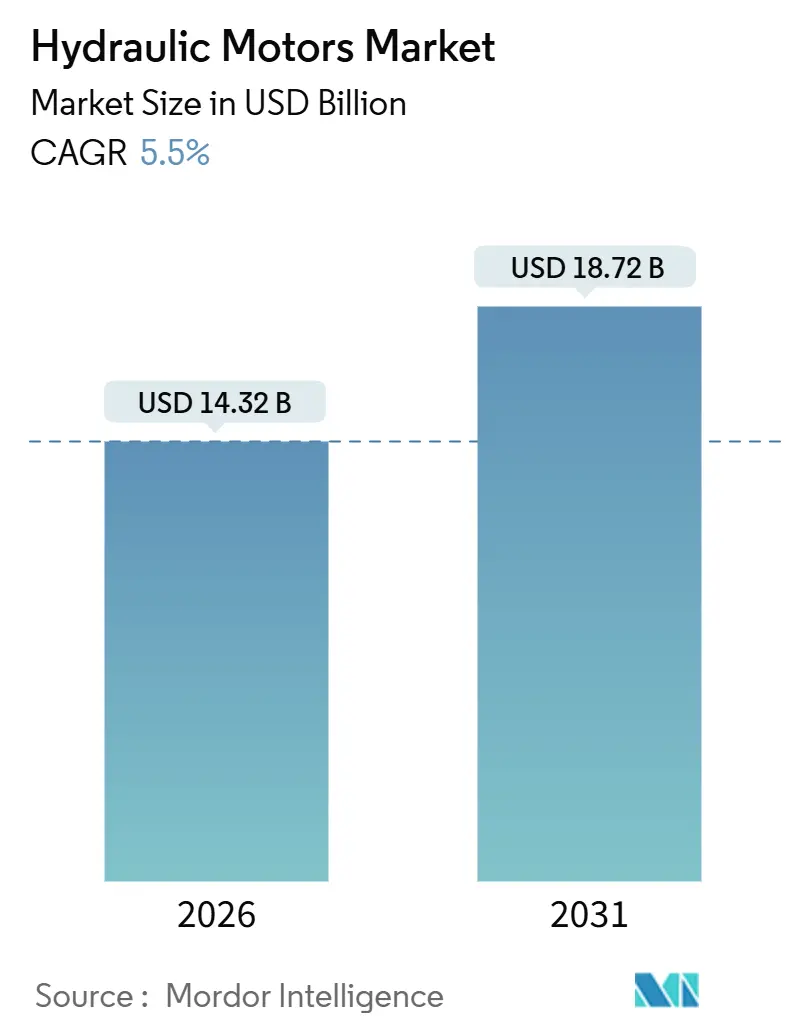
The hydraulic motors market size stands at USD 14.32 billion in 2026 and is projected to reach USD 18.72 billion by 2031, reflecting a 5.50% CAGR during the forecast period. Persistent demand for compact, high-torque power transmission in construction machinery and precision agriculture keeps the hydraulic motors market firmly on a mid-single-digit growth path despite encroaching electrification. Piston designs with variable-displacement control continue to win share because load-sensing accuracy yields measurable fuel savings for off-road equipment fleets. Asia-Pacific infrastructure megaprojects underpin volume gains, while IoT-enabled condition monitoring and bio-based fluid compatibility reshape the value proposition from pure hardware to uptime-driven services. Raw-material cost spikes and tighter leakage regulations temper margins, yet hybrid electro-hydraulic drivetrains point to a long runway of incremental efficiency improvements that sustain OEM investment in advanced motor architectures.
Key Report Takeaways
- By type, piston motors led the hydraulic motors market with 39.15% of the market share in 2025; the segment is forecast to expand at a 6.52% CAGR through 2031, outpacing gear and vane alternatives.
- By speed, low-speed motors held 57.01% of the hydraulic motors market share in 2025, while high-speed variants are projected to register the highest 8.02% CAGR through 2031.
- By displacement, fixed-displacement motors captured 64.25% of the hydraulic motors market size in 2025; variable-displacement motors are poised for a 7.85% CAGR during the forecast period.
- By application, off-road machinery accounted for 52.36% of the hydraulic motors market in 2025 and is expected to grow at a 6.13% CAGR through 2031.
- By geography, the Asia-Pacific region dominated the hydraulic motors market with 45.15% market share in 2025 and is advancing at a 7.21% CAGR through 2031.
Note: Market size and forecast figures in this report are generated using Mordor Intelligence’s proprietary estimation framework, updated with the latest available data and insights as of January 2026.
Global Hydraulic Motors Market Trends and Insights
Drivers Impact Analysis*
| Driver | (~) % Impact on CAGR Forecast | Geographic Relevance | Impact Timeline |
|---|---|---|---|
| Surge in Construction and Mining Equipment | +1.8% | Asia-Pacific core, spill-over to the Middle East and Africa | Medium term (2-4 years) |
| Rise in Offshore Energy Projects | +1.2% | Europe, Asia-Pacific, United States Gulf | Medium term (2-4 years) |
| Electro-Hydraulic Hybrid Drivetrains | +1.1% | Asia-Pacific, North America | Medium term (2-4 years) |
| Growth of Precision Agriculture Machinery | +0.9% | North America, Europe, and early adoption in Brazil and Argentina | Long term (≥ 4 years) |
| IoT-Enabled Condition Monitoring | +0.7% | Global, led by North America and Western Europe | Short term (≤ 2 years) |
| Adoption of Bio-Based Fluids | +0.5% | Europe, North America | Long term (≥ 4 years) |
| Source: Mordor Intelligence | |||
Surge in Construction and Mining Equipment Demand in Emerging Markets
In China, India, Indonesia, and Vietnam, robust infrastructure pipelines are driving the full-throttle operation of crawler excavators, tunnel-boring machines, and mining draglines. This surge cements the hydraulic motors market as a pivotal supply node. China has seen a significant increase in construction machine production, driven by subway extensions and high-speed rail corridors. India has earmarked USD 1.4 trillion through 2025 for highways, ports, and coal mine expansions, each project relying on closed-center load-sensing circuits built around piston motors [1]“National Infrastructure Pipeline,” Government of India, india.gov.in. In Southeast Asia, megaprojects like Nusantara and the North-South Expressway are turning to radial-piston units. These units, capable of delivering high torque at low speeds, are essential for drilling through challenging geology. Meanwhile, Saudi Arabia’s NEOM and other Gulf projects are rapidly increasing imports of Japanese and European excavators. This surge is not just about the machines; it's birthing a thriving aftermarket for motor refurbishment. In Australia and Chile, mining operators are innovating by retrofitting variable-displacement motors. This move not only shortens their replacement cycles but also slashes diesel consumption during uphill hauls.
Rise in Offshore Energy Projects Demanding High-Torque Hydraulic Solutions
Offshore wind installations added 8 GW in 2024, with floating platforms favoring hydraulic slewing motors rated at 1,200 kNm because electric drives cannot match torque density within tight nacelle envelopes [2]“Global Offshore Wind Report 2025,” International Energy Agency, iea.org. Cadeler's Wind Orca and similar vessels depend on these motors for the precise positioning of large nacelles. In Brazil's pre-salt fields, subsea ROVs utilize pressure-compensated radial-piston designs to maintain torque at significant depths. Offshore cranes in the North Sea use high-speed vane motors in their winches to minimize load swing during personnel transfers. Even as new-build activities continue, the demand for massive hydraulic deck machinery persists, especially for jacket decommissioning in the United Kingdom Continental Shelf.
Electro-Hydraulic Hybrid Drivetrains Driving Demand for High-Efficiency Motors
Komatsu's HB215LC-3 excavator integrates a lithium-ion battery with variable-displacement pumps, significantly reducing fuel consumption while maintaining its full breakout force. Hybrid systems harness swing-brake energy, positioning piston motors at the heart of energy-recovery loops. Major industry players are intensifying R&D efforts, focusing on quicker swashplate actuation to maximize energy capture. Notably, Danfoss secured multiple patents for control algorithms in 2024. While Asian OEMs spearhead commercial rollouts, North American manufacturers are accelerating prototype developments, aiming for future market launches. This innovative architecture not only extends the relevance of hydraulic propulsion amidst the industry's electrification trend but also bolsters the long-term growth trajectory of the hydraulic motors market.
Growth of Precision Agriculture Machinery Requiring Hydraulic Power
In 2024, 68% of large-scale crop farms in the United States featured precision technologies that count on hydraulic steering actuators and variable-rate planters[3]“Precision Agriculture Adoption,” U.S. Government Accountability Office, gao.gov. John Deere's ExactEmerge, utilizing closed-loop hydraulic drives, achieves exceptional seed spacing precision at high speeds, a capability beyond the reach of mechanical systems. In the EU, subsidies are incentivizing vineyards to adopt hydraulic-powered robotic pruners, significantly reducing labor costs. Brazil, with its substantial sugarcane harvest, is transitioning to variable-displacement axial-piston motors, enhancing juice extraction efficiency. In Argentina, no-till equipment, experiencing steady growth, employs hydraulic down-force controls to maintain consistent seed depth, even on uneven terrain.
Restraints Impact Analysis*
| Restraint | (~) % Impact on CAGR Forecast | Geographic Relevance | Impact Timeline |
|---|---|---|---|
| Raw Material Price Volatility | -0.6% | Global | Short term (≤ 2 years) |
| Compact Electric Drive Competition | -0.5% | North America, Europe, Japan | Long term (≥ 4 years) |
| Stringent Hydraulic Leakage Regulations | -0.4% | Europe, North America | Medium term (2-4 years) |
| Reshoring Driven Component Shortages | -0.3% | North America, Europe | Short term (≤ 2 years) |
| Source: Mordor Intelligence | |||
Raw-Material Price Volatility Affecting Motor Costs
Steel indices in the United States rose sharply, while copper prices also increased, driving up costs for motor casings and windings. Neodymium oxide, a critical component in hybrid systems, has become more expensive, prompting manufacturers to explore ferrite substitutes that result in reduced torque density. In a strategic move, Eaton acquired Jiangsu Jinfan Hydraulics, securing captive casting and highlighting the importance of vertical integration as a protective measure. Meanwhile, smaller Tier-2 suppliers are transferring these rising costs downstream, exerting pressure on distributor margins. This market volatility is impacting short-term profitability in the hydraulic motors sector.
Competition from Compact Electric Drives in Low-Torque Ranges
Brushless servos in robotic assembly cells and CNC indexers offer zero-leak operation and faster response than small hydraulic drives. Electric cylinders now claim payloads up to 50 kN, encroaching on mid-tier gear-motor applications in factory automation. European automation giants bundle electric actuators with digital twins, appealing to Industry 4.0 integrators. Yet, high-torque construction and mining tasks remain solidly hydraulic, shielding the core hydraulic motors market from wholesale displacement.
*Our forecasts treat driver/restraint impacts as directional, not additive. The impact forecasts reflect baseline growth, mix effects, and variable interactions.
Segment Analysis
By Type: Piston Motors Extend Leadership on Variable-Displacement Versatility
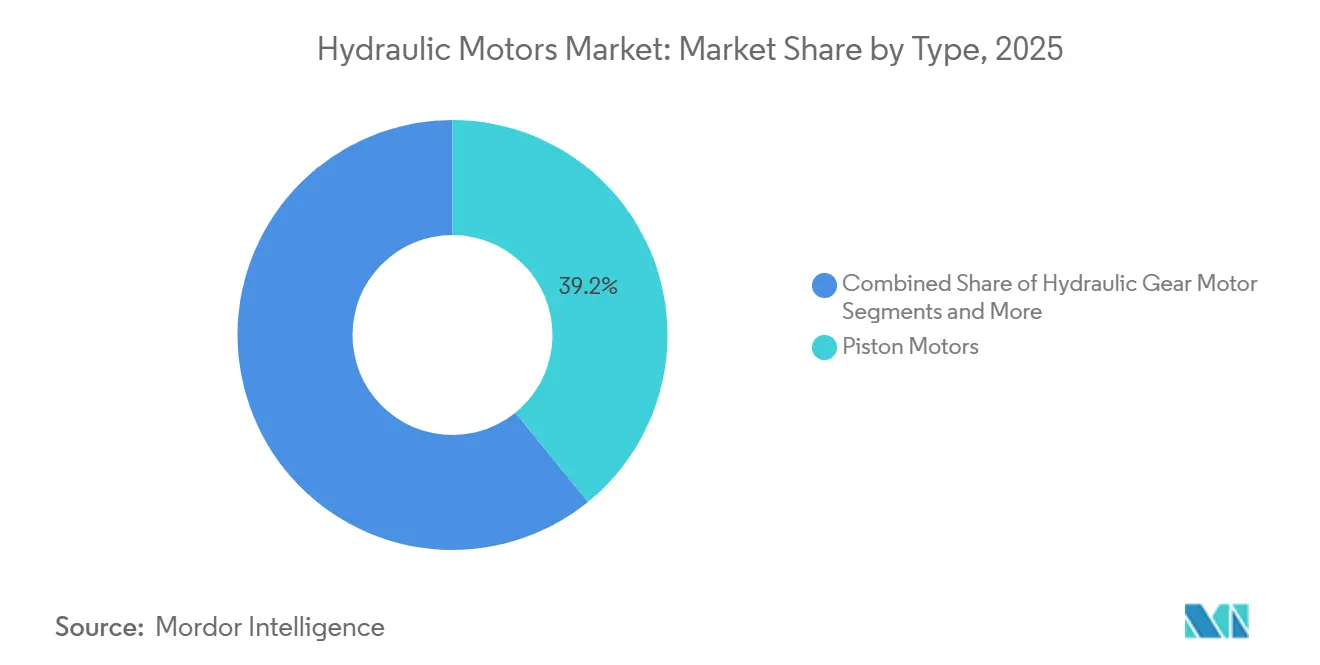
Piston motors captured 39.15% of the hydraulic motors market share in 2025, and the same segment is also set to expand at a 6.52% CAGR through 2031. Flexible swashplate control allows axial-piston designs to modulate flow precisely, trimming fuel burn in excavator swing drives. Radial-piston variants excel at ultra-low speeds below 10 RPM, making them a key component in mining winches and offshore cranes.
Gear motors remain cost-effective for municipal fleets, while epicyclic gearsets make compact track loaders more agile. Vane units hold niches in plastics and mixing lines, where balanced rotors cut vibration. The rise of hybrid drivetrains reinforces piston-motor demand, keeping this category ahead in the hydraulic motors market through 2031.



By Speed: High-RPM Units Gain Traction in Offshore and Compact Equipment
Low-speed motors retained 57.01% of the hydraulic motors market share in 2025, as construction and mining equipment crave torque at modest rpm. Nonetheless, high-speed designs are growing fastest at 8.02% through 2031, supplying offshore wind vessels with compact slewing drives that keep nacelle mass down.
Wheel loaders like Volvo’s L350H use gear motors in cooling circuits, freeing chassis space for emissions hardware. Agricultural harvesters mix low-speed threshing drums with high-speed cooling fans, straddling both design camps. As floating wind and mobile machinery continue to prioritize power-to-weight, high-speed motors should carve out a larger share of the hydraulic motors market over the forecast period.
By Displacement: Variable Designs Accelerate on Load-Sensing Economics
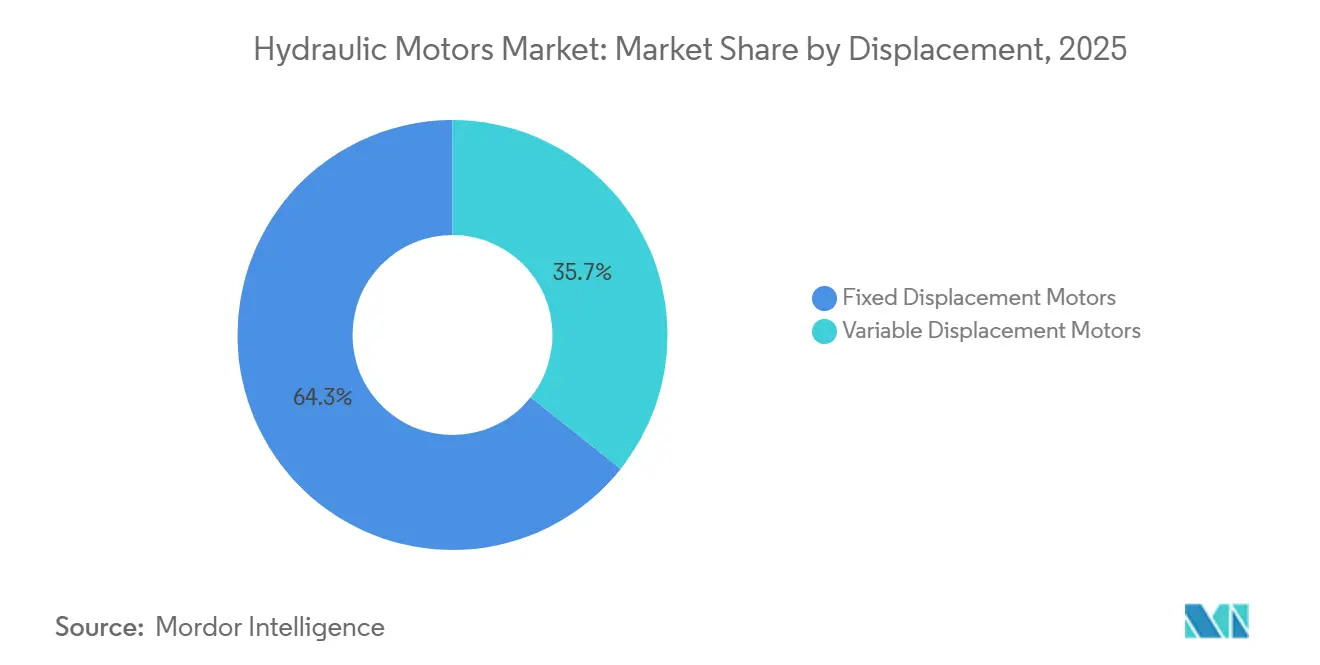
Fixed-displacement motors still hold 64.25% of the hydraulic motor market share in 2025 and dominate refuse trucks and forestry harvesters due to their simplicity. Variable-displacement motors, however, are advancing 7.85% annually, saving up to 18% input power by matching output to load.
Caterpillar’s 336 excavator throttles engine speed during light digging without cycle-time penalties, showcasing swashplate agility [4]“336 Excavator Technical Specifications,” Caterpillar Inc., caterpillar.com. Mining haul trucks recover kinetic energy on descents, thereby significantly extending brake life. By 2031, variable designs are poised to challenge and potentially diminish the dominance of fixed motors in the hydraulic motors market, driven by mounting regulatory pressures on fuel economy.
By Application: Off-Road Machinery Anchors Demand and Growth
Off-road machinery accounted for 52.36% of the hydraulic motors market share in 2025, the largest share. Construction machinery alone consumed a notable share of global volume, riding a production surge in China and India. Precision agriculture implements rely on variable-displacement motors to manage seed and chemical inputs, driving a 6.13% CAGR for the segment through 2031.
Industrial machinery demand spans plastics molding, CNC machining, and marine propulsion. Offshore vessels use hydraulic motors for dynamic positioning and crane operations at depths up to 3,000 meters. While industrial applications grow steadily, faster replacement cycles in construction and agriculture will keep off-road machinery at the forefront of the hydraulic motors market growth.
Geography Analysis
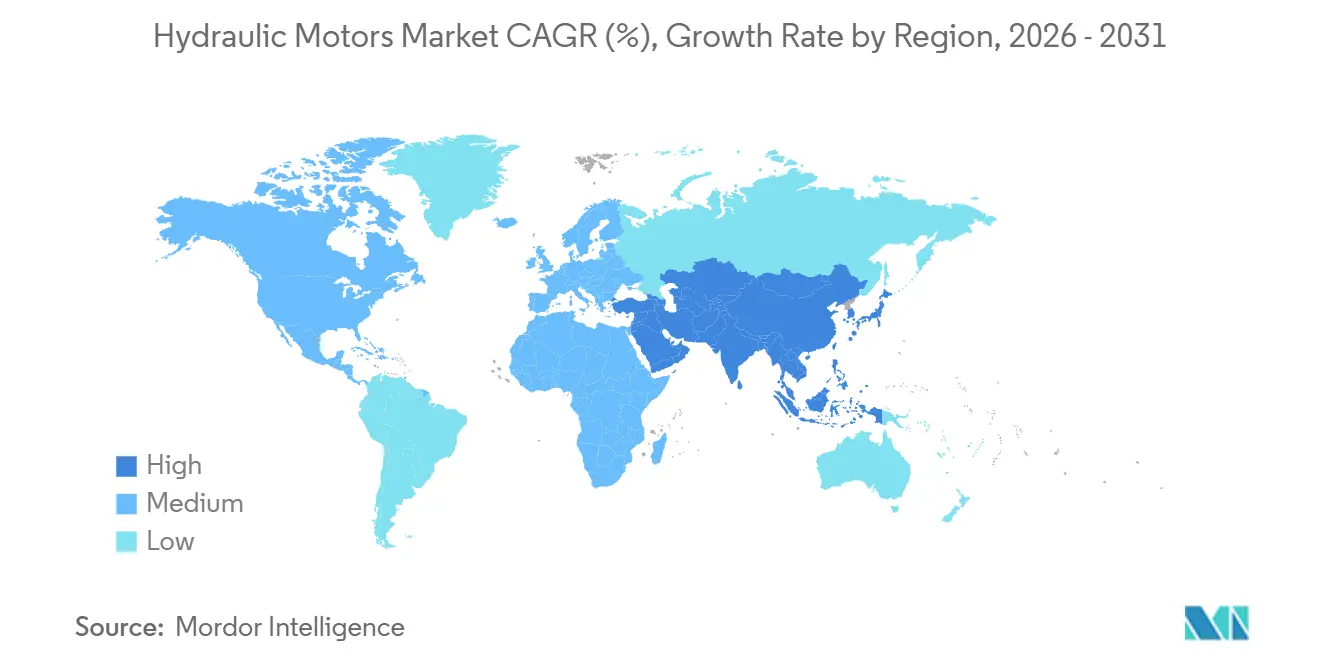
Asia-Pacific generated 45.15% of the hydraulic motors market share in 2025 and is projected to record a 7.21% CAGR through 2031. China's significant machinery production and India's large-scale infrastructure investments are driving strong demand for excavators and loaders. Japanese exporters are benefiting as Southeast Asian countries upgrade their fleets with hybrid excavators, while South Korean shipyards are increasingly specifying high-torque motors for deck equipment. Emerging megaprojects in Indonesia and Vietnam are further boosting the regional hydraulic motors market.
North America holds a notable share of the market, supported by widespread adoption of precision agriculture in the United States row crops and retrofitting activities in Canadian oil sands. Planned offshore wind capacity is also driving demand for high-speed vane motors in installation vessels. Europe captures a significant portion of revenue, driven by advancements in Germany's automation sector and wind energy projects in the North Sea. Subsidies for agricultural technology are encouraging the adoption of robotic pruners in vineyards, further supporting the uptake of hydraulic technology.
South America accounts for a smaller share, with Brazil's sugarcane harvest driving upgrades to axial-piston motors for improved cutter speed modulation, and Argentina experiencing growth in no-till farming equipment. The Middle East and Africa are witnessing steady growth, supported by large-scale infrastructure projects in Saudi Arabia and the United Arab Emirates, which are boosting excavator imports. Globally, infrastructure and agriculture remain the key drivers of growth in the hydraulic motors market.

Regulatory Landscape
Hydraulic motor specifications are increasingly paired with vehicle, machinery, and fluid-system compliance requirements, particularly around leakage, materials, and subsystem durability. In the European Union, Commission Delegated Regulation (EU) 2026/1188 (March 2026) updates Annex II to Regulation (EU) 2018/858, bringing in technical requirements linked to Euro 7 type-approval and related subsystem expectations, which tightens the documentation and validation demands for hydraulic-actuated components used on regulated vehicle platforms.
Standards bodies are also continuing to update core hydraulic-system interfaces and consumables that influence motor sealing, hose compatibility, and fluid selection. ISO published ISO 4925:2026 in June 2026 for non-petroleum-based hydraulic brake fluids, ISO 18752:2025 in June 2025 for performance requirements of hydraulic hoses and assemblies, and confirmed ISO 4928:2006 (elastomeric cups and seals for hydraulic braking systems) in December 2025. In the United States, the EPA released proposed amendments in July 2026 for Model Year 2027 and later heavy-duty highway engines, covering useful-life and warranty periods and nonconformance penalties under the heavy-duty regulatory framework. This reinforces OEM and supplier focus on durability validation and compliance traceability for vehicle-integrated hydraulic subsystems.
Value Chain Analysis
The hydraulic motors value chain covers metal inputs (steel and alloy castings), precision-machined rotating groups (gears, vanes, pistons, swashplates), sealing and hose assemblies, and electronics for sensing and control where electro-hydraulic architectures are used. Tier suppliers assemble motors and integrated modules, then sell through OEM channels for off-road machinery and through commercial-vehicle upfitters, distributors, and service networks for aftermarket demand. The market context also highlights vertical integration as a response to raw-material volatility, including Eaton securing casting capacity through its Jiangsu Jinfan Hydraulics acquisition, while major suppliers differentiate with telemetry and uptime services such as Bosch Rexroth CytroConnect.
Downstream, product architecture is shifting toward integrated electro-hydraulic units and redundancy-ready subsystems, which affects how components are sourced and packaged. In July 2026, BWI Group launched its integrated Dynamic Brake Control (iDBC) 1-Box system in Europe, which consolidates conventional actuation functions into a single electro-hydraulic module and increases requirements for tightly matched pump and motor elements, sealing, and embedded control. Similar consolidation efforts in commercial-vehicle systems, including the June 2026 Bosch, Brakes India, and Wheels India joint venture agreement to develop and manufacture advanced commercial-vehicle air systems (operations targeted by end-2026) and Knorr-Bremse announcements around redundant braking and EPS series orders, reinforce OEM emphasis on system suppliers that can deliver validated subassemblies at scale. This shifts bargaining power toward integrated-platform providers and their qualified component ecosystems.
Competitive Landscape
In the hydraulic motors market, the top suppliers—Bosch Rexroth, Eaton, Parker Hannifin, Danfoss, and Kawasaki—accounted for a significant share of revenue in 2025, indicating moderate concentration. Tier-1 suppliers are setting themselves apart with digital services. For instance, Bosch Rexroth’s CytroConnect and ABB’s Ability leverage cloud-streamed telemetry to minimize downtime. In a strategic move, Eaton heavily invested in eMobility R&D, while Parker Hannifin bolstered its portfolio by acquiring Meggitt’s electro-hydraulic actuation business.
Bio-fluid compatibility opens niches for Hydro Leduc and Sunfab, who offer ester-ready motors for forestry and marine applications. Danfoss leads patent filings in swashplate control speed, enhancing efficiency gains. Chinese challengers such as LHY Powertrain deliver piston motors at significantly lower prices, leveraging domestic economies of scale to penetrate price-sensitive customers in Asia-Pacific.
Vertical integration accelerates: Eaton’s Jiangsu Jinfan buy secures casting capacity against steel volatility. Regulatory moves, notably Per- and Polyfluoroalkyl Substances (PFAS) bans and Volatile Organic Compounds (VOCs) caps, raise R&D barriers, tilting the field toward capital-rich incumbents. Consequently, premium segments gravitate toward IoT-ready, hybrid-compatible products, while cost-conscious buyers in South America and Africa still choose fixed-displacement gear motors, preserving a two-tier competitive landscape in the hydraulic motors market.
Hydraulic Motors Industry Leaders
Bosch Rexforth AG
Parker Hannifin Corp.
Eaton Corporation plc
Danfoss Power Solutions
Kawasaki Heavy Industries, Ltd.
- *Disclaimer: Major Players sorted in no particular order

Market Opportunities and Future Outlook
System-level consolidation and service-led differentiation create whitespace for suppliers that can provide motors as part of integrated, monitored subsystems instead of standalone hardware. The market already shows traction for IoT-enabled condition monitoring and hybrid electro-hydraulic drivetrains in mobile equipment, where uptime and fuel savings influence procurement decisions. For suppliers, this translates into opportunities in sensorized motor packages, controller-ready variable-displacement designs, and retrofit kits that fit fleet refurbishment cycles in construction and mining, especially in Asia-Pacific where infrastructure megaprojects support high-utilization equipment.
M&A and capability expansion in adjacent hydraulic ecosystems point to where suppliers are directing investment to capture more of the system bill of materials. In July 2026, Danfoss announced a definitive agreement to acquire Alfagomma, expanding hoses and fittings within its Fluid Conveyance activities and strengthening control over critical interfaces that affect leakage, pressure losses, and total system efficiency in motor-driven circuits. In May 2026, Snap-on completed its acquisition of Hi-Force, adding high-pressure hydraulic tools and heavy lifting systems that support broader service and maintenance workflows for hydraulic equipment in industrial and field settings. Coupled with tightening standards activity, including ISO 4925:2026 for non-petroleum-based hydraulic brake fluids, these moves reinforce opportunities for motor suppliers to certify compatibility across fluids, hoses, seals, and connected diagnostics, while supporting faster validation and bundled supply for OEM and aftermarket channels.
Recent Industry Developments
- April 2026: Parker Hannifin introduced the GVM210 Gen 2 motor series for on-road and off-road applications, including adaptations for electrohydraulic pump (EHP) solutions. The launch positions hydraulic motor platforms for electrified and electronically controlled architectures, supporting OEM efforts to package compact, controllable power units for mobile machinery.
- September 2025: Bosch Rexroth announced the MPR Performance radial piston motor series for mobile machinery, featuring up to 9% higher start-up efficiency and a 470 bar rated pressure. This strengthens the premium piston-motor proposition for high-torque duty cycles such as construction, mining, and specialized off-road equipment, where efficiency and durability translate into lower operating cost.
- May 2024: Poclain introduced the MI330 torque motor, positioned for heavy-duty applications including tunnel boring and wind farm equipment. By increasing power and displacement capability in a single motor platform, the product supports OEMs seeking compact, high-torque drives for large rotating functions under tight space and weight constraints.


Research Methodology Framework and Report Scope
Market Definition and Coverage
This market covers revenue generated from hydraulic motors that convert hydraulic fluid pressure and flow into rotary motion, sold into off-road equipment and industrial machines, and counted at the component level across major regions.
Scope exclusions: Electric drive motors, pneumatic motors, pumps, valves, hoses, and full hydraulic power units are excluded from this market sizing.
Segmentation Overview
- By Type
- Hydraulic Gear Motor
- Gear Motor
- Epicyclic Gear Motor
- Vane Motor
- Piston Motor
- Radial Piston Motor
- Axial Piston Motor
- Hydraulic Gear Motor
- By Speed
- Low-Speed Motors
- High-Speed Motors
- By Displacement
- Fixed Displacement Motors
- Variable Displacement Motors
- By Application
- Off-road Machinery
- Construction Machinery
- Agricultural Machinery
- Mining Machinery
- Industrial Machinery
- Manufacturing
- Marine
- Off-road Machinery
- By Geography
- North America
- United States
- Canada
- Rest of North America
- South America
- Brazil
- Argentina
- Rest of South America
- Europe
- Germany
- United Kingdom
- France
- Italy
- Spain
- Rest of Europe
- Asia-Pacific
- China
- India
- Japan
- South Korea
- Rest of Asia-Pacific
- Middle East and Africa
- United Arab Emirates
- Saudi Arabia
- Turkey
- South Africa
- Rest of Middle East and Africa
- North America
Data Sources, Market Sizing, and Validation
Desk Research
Desk research was used to set the outer limits of demand and to keep the model tied to real activity in industries that consume hydraulic motors. We reviewed public production and trade signals for machinery and equipment, then mapped them to motor demand through application mix and replacement cycles.
Common inputs came from sources such as US Census Bureau manufacturing and shipments tables, UN Comtrade trade flows, OECD industrial production indicators, and the International Trade Administration country briefs, along with standards and terminology references from bodies such as ISO. We also used company annual reports, investor presentations, press releases, and reputable industry magazines to cross-check product positioning and price direction. In parallel, we supported financial and patent checks using approved paid database subscriptions for company intelligence and patent screening. These examples are not exhaustive, and we also referenced other public and paid sources for data collection, validation, and research clarification.
Primary Interviews and Surveys
Primary work was used to pressure-test the desk assumptions, especially around application splits, pricing ranges by motor type, and how quickly newer designs are being adopted in off-road and industrial use. We spoke with manufacturers, channel partners, and large end users across APAC, EMEA, and the Americas so regional operating differences and replacement behavior could be reflected in the final model.
Distribution of primary research fieldwork respondents
| Company type | Respondent position | Region |
|---|---|---|
| Top tier: 31% | CXOs: 14% | APAC: 44% |
| Mid tier: 47% | Functional/Unit leaders: 30% | EMEA: 30% |
| Smaller Players: 22% | Managers: 56% | Americas: 26% |
Market-Sizing & Forecasting
The core sizing starts from a top-down demand pool that is rebuilt using equipment production, fleet activity, and trade movement across key hydraulic motor consuming sectors such as construction machinery, agriculture equipment, mining equipment, marine equipment, and factory automation. Once that demand pool is shaped, it is translated into hydraulic motor value using application-level motor fit rates and typical price bands.
To keep the totals realistic, the result is corroborated with selective bottom-up approximations. We roll up sampled supplier revenues and sanity-check with channel feedback on unit volumes and average selling prices for gear, vane, and piston motors. Inputs that strongly influence the model include equipment production and utilization trends, replacement and rebuild cycles, the mix shift between fixed and variable displacement motors, the split of low-speed versus high-speed requirements, and observed price movement tied to materials and machining intensity. When bottom-up details are missing for smaller country pockets, gaps are handled by using proxy indicators like machinery output, import dependence, and the closest comparable market mix, followed by a second pass with interview feedback.
Forecasting is done using scenario analysis supported by short time-series smoothing for the most stable indicators, and then adjusted with expert views on capex cycles in off-road equipment and industrial manufacturing. This approach helps avoid overreacting to a single year swing and keeps the curve aligned with how hydraulic components typically move through cycles.
Data Validation & Update Cycle
Outputs are checked through triangulation across independent signals such as machinery output, trade values, and supplier commentary, then reviewed for variance by region, motor type, and application. If a region shows an abnormal jump that is not supported by the indicators, the assumptions are reopened and a follow-up call is triggered with one or more industry participants.
Before sign-off, a second analyst review is completed to confirm that units, currency timing, and price assumptions are consistent across the model. The report is refreshed annually, and interim updates are made when material events occur, such as sharp changes in equipment demand, supply constraints, or major policy shifts. Right before delivery, a final pass is performed so clients receive the latest updated view.
Mordor Intelligence's Hydraulic Motors Market Size Compared With Other Published Estimates
Published market values for hydraulic motors can look far apart because sources do not always count the same product bucket or the same selling point in the value chain, and the base year used can also shift the number. Differences also show up when one estimate leans on shipment values and another leans on production or installed base signals.
Hydraulic pumps and hydraulic valves sit outside Mordor Intelligence's scope for this estimate, which is one reason the 2026 value can look higher or lower than figures that bundle multiple hydraulic components. We also see gaps when other publications anchor to 2024, apply a single global average price without separating gear, vane, and piston motors, or use one exchange-rate assumption for all regions even when local pricing moves differently.
Benchmark comparison
| Source | Market Size | Gaps in Research Methodology |
|---|---|---|
| Mordor Intelligence | USD 14.32 B (2026) | |
| Global Consultancy A | USD 7.18 B (2024) | Uses a 2024 base and may reflect a narrower definition of hydraulic motors tied to reported sales in selected channels, which can undercount off-road and industrial demand that is served through broader OEM and distributor routes. |
| Industry Statistics B | USD 6.99 B (2024) | Treats motors as a component slice within a wider hydraulics dataset, so the motor category can be measured differently by value chain stage, and may not separate motor subtypes and application fit rates in the same way. |
Looking across the three figures, the spread mainly comes from what is counted as part of the hydraulic motors total, the base year selected, and whether pricing and application mix are modeled with enough detail. By keeping the inputs tied to observable equipment activity and then checking them with supplier and channel feedback, the estimate stays traceable to clear steps that can be repeated and updated as the market changes.


Key Questions Answered in the Report
What is the current size and growth outlook for the hydraulic motors market?
The hydraulic motors market size is USD 14.32 billion in 2026 and is forecast to reach USD 18.72 billion by 2031, advancing at a 5.5% CAGR.
Which motor type leads global revenue?
Piston motors dominate with 39.15% of 2025 revenue thanks to variable-displacement capability and are set to grow at a 6.52% CAGR.
How fast are high-speed hydraulic motors growing?
High-speed variants, favored in offshore wind and compact machinery, are expected to expand at an 8.02% CAGR through 2031.
Why is Asia-Pacific the largest regional market?
Massive infrastructure programs in China and India, plus strong shipbuilding activity in Japan and South Korea, give Asia-Pacific 45.15% of 2025 revenue and the fastest 7.21% CAGR.
Page last updated on:


 Your data is secure and never sold or shared.


