
Market Overview
| Study Period | 2020 - 2032 |
|---|---|
| Forecast Data Period | 2027 - 2032 |
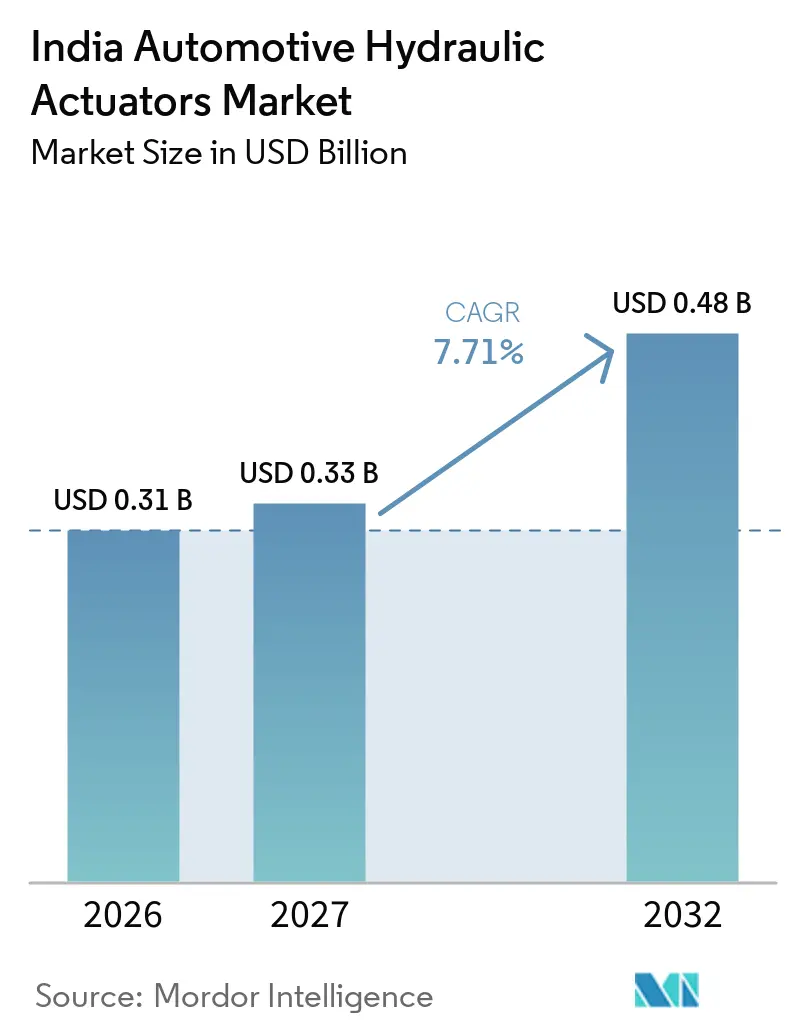
| Base Year Market Size (2026) | USD 0.31 Billion |
| Market Size (2027) | USD 0.33 Billion |
| Market Size (2032) | USD 0.48 Billion |
| Growth Rate (2027 - 2032) | 7.71 % |
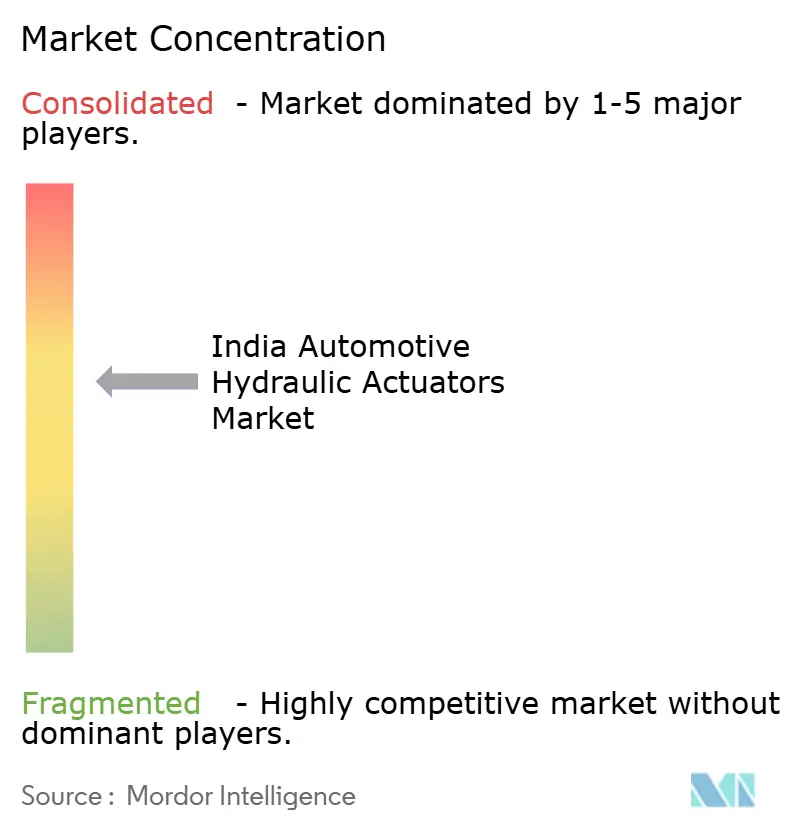
| Market Concentration | Medium |
Major Players *Disclaimer: Major Players sorted in no particular order Image © Mordor Intelligence. Reuse requires attribution under CC BY 4.0. | |
India Automotive Hydraulic Actuators Market Analysis by Mordor Intelligence
The Indian Automotive Hydraulic Actuators Market size was valued at USD 0.31 billion in 2026, is expected to reach USD 0.33 billion in 2027, and is forecast to reach USD 0.48 billion by 2032, at a 7.71% CAGR over 2027-2032. Demand is tied to vehicle systems that still use hydraulic force for braking, steering, clutch operation, suspension functions, and equipment controls across passenger, commercial, agricultural, construction, and other vehicle platforms. Safety rules are increasing the use of brake-control hardware. At the same time, commercial vehicles, tractors, and older vehicles create demand across OEM and replacement channels with different component designs, service intervals, and customer needs. The Indian automotive hydraulic actuators market also has room to grow through localized safety-component production, export-oriented manufacturing, and supplier investments that bring machining, sealing, assembly, and control-system capability closer to vehicle-production centers. Electric vehicles change the mix of demand rather than removing it, because electro-hydraulic braking remains relevant where regenerative and friction braking must work together, while commercial and off-highway platforms retain robust hydraulic functions that are difficult to replace quickly. Competition is centered on global and India-based Tier-1 suppliers in OEM programs, where validation, production capacity, engineering support, and supply reliability matter, while replacement demand remains more fragmented and dependent on fitment quality, traceability, service access, and the operating age of the vehicle parc across the full forecast period for every major vehicle and equipment category.
Key Report Takeaways
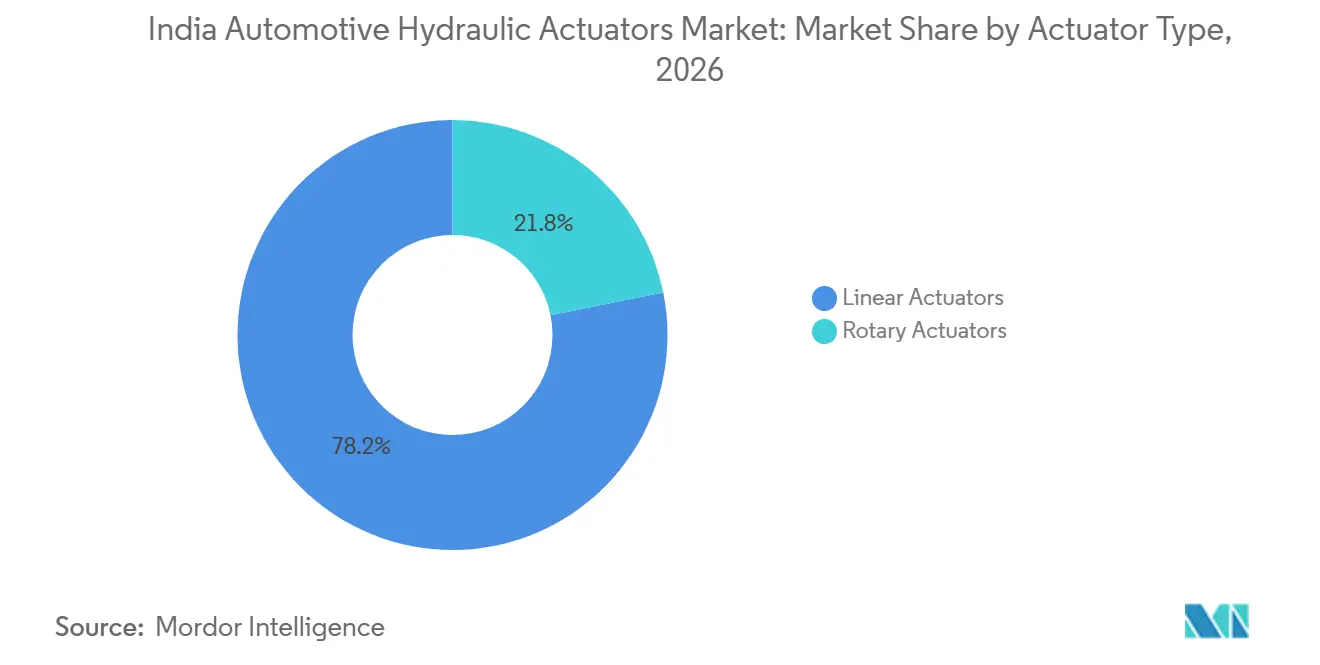
- By actuator type, linear actuators accounted for 78.17% of the Indian automotive hydraulic actuator market share in 2026, while rotary actuators are forecast to grow at an 8.36% CAGR through 2032.
- By application, brake actuators accounted for 54.57% of the Indian automotive hydraulic actuators market size in 2026, while steering actuators are projected to grow at an 8.75% CAGR through 2032.
- By vehicle type, passenger cars captured 67.17% of the Indian automotive hydraulic actuators market share in 2026, while light commercial vehicles are expected to expand at a 9.45% CAGR through 2032.
- By propulsion, ICE vehicles held 71.24% of the Indian automotive hydraulic actuator market share in 2026, while battery electric vehicles are forecast to grow at a 9.11% CAGR through 2032.
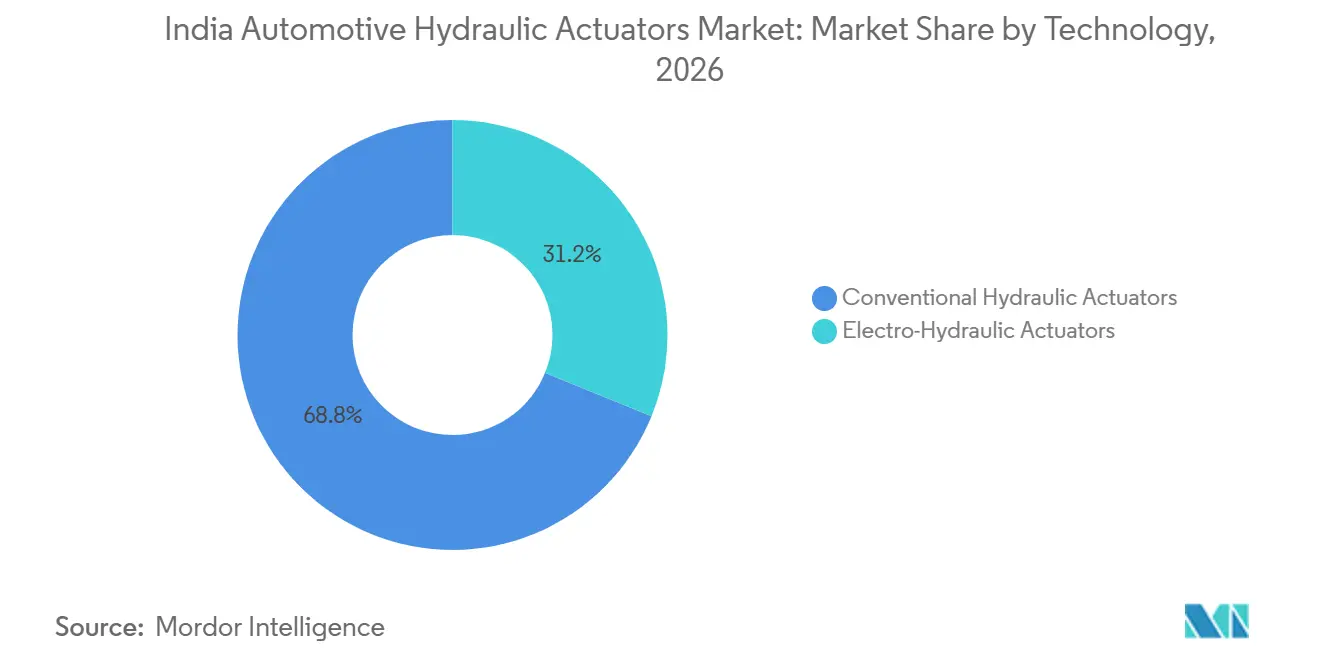
- By technology, conventional hydraulic actuators led with 68.83% of the Indian automotive hydraulic actuator market share in 2026, while electro-hydraulic actuators are projected to grow at a 9.04% CAGR through 2032.
- By sales channel, OEM sales accounted for 78.85% of the Indian automotive hydraulic actuator market share in 2026, while the aftermarket is projected to grow at an 8.96% CAGR through 2032.
- By geography, North India accounted for 63.28% of the Indian automotive hydraulic actuator market share in 2026, while West India is forecast to expand at a 9.07% CAGR through 2032.
Note: Market numbers in this report are based on Mordor Intelligence's proprietary estimation framework, which combines nine months of actuals with Q4 projections for base year 2026.
India Automotive Hydraulic Actuators Market Trends and Insights
Drivers Impact Analysis*
| Driver | (~) % Impact on CAGR Forecast | Geographic Relevance | Impact Timeline |
|---|---|---|---|
| Mandatory Brake-Safety Content and Hydraulic Actuation | +2.1% | National; early gains in North India and South India OEM clusters | Short term (≤ 2 years) |
| Commercial Vehicle and Tractor Production Growth | +1.3% | North India (Haryana, UP) and West India (Maharashtra, Gujarat) lead | Short to Medium term (1–3 years) |
| Replacement Demand from India's Aging Vehicle Parc | +1.0% | National; stronger in North India and West India due to dense urban fleet | Medium term (2–4 years) |
| Localization and Export-Oriented Component Manufacturing | +0.8% | Tamil Nadu, Maharashtra, Haryana; spillover to Gujarat and Telangana | Medium to Long term (3–5 years) |
| Hydraulic-to-Electro-Hydraulic Transition in Legacy Commercial-Vehicle Platforms | +0.6% | North India and South India; early deployment in premium bus and truck segments | Medium term (2–4 years) |
| Fleet Uptime Economics and Preventive Actuator Replacement | +0.5% | National, with logistics corridors in North India and West India leading | Long term (≥ 4 years) |
| Source: Mordor Intelligence | |||
Mandatory Brake-Safety Content and Hydraulic Actuation
The Indian automotive hydraulic actuators market benefits directly from wider safety requirements for braking systems, because these rules require hardware that regulates hydraulic pressure rather than a stand-alone electronic control unit. In June 2025, the Ministry of Road Transport and Highways issued draft rules requiring ABS on all two-wheelers manufactured from January 1, 2026. The requirement extends beyond vehicles with engine capacities above 125cc, affecting a significant share of two-wheeler demand and increasing the installed content of brake-control hardware in a high-volume vehicle category. The Central Motor Vehicles Sixth Amendment Rules, 2025, mandate ABS compliant with IS 11852:2019 and Advanced Emergency Braking Systems compliant with AIS-162 for new M2, M3, N2, and N3 vehicle models from January 2027 [1]. These requirements support electro-hydraulic pressure modulation, wheel-speed sensor integration, and the related components that form the braking-control stack. The rule changes also support future replacement demand, as fleets need compliant braking components throughout their operating life, including for vehicles that continue to face intensive commercial use.
Commercial Vehicle and Tractor Production Growth
Commercial vehicles and tractors create a stable demand base because they use more hydraulic actuators per unit than passenger cars and operate in applications where braking, clutch, and implement controls are subject to regular loads. Commercial vehicle retail sales crossed 1 million units for the first time in FY 2025-26 and grew 11.7%, according to the Federation of Automobile Dealers Associations [2]. These platforms require hydraulic systems for braking, clutch operation, implements, power take-off functions, and trailer-related controls, rather than only basic vehicle functions. The Indian automotive hydraulic actuators market, therefore, gains more from growth in heavy-duty and agricultural platforms than from an equivalent rise in passenger-car production, because the actuator requirement per unit is higher.
Replacement Demand from India's Aging Vehicle Parc
Replacement demand drives sales in the Indian automotive hydraulic actuators market beyond new vehicle production and sustains demand throughout normal vehicle replacement cycles. Brake and clutch actuators experience wear due to repeated use, varied road conditions, high-load freight routes, and the higher operating intensity typical of commercial fleets. Older vehicles continue to use conventional hydraulic systems, extending the relevance of compatible replacement components well beyond the original vehicle sale. Organized repair networks and branded replacement programs can serve this demand by providing consistent fitment and component quality, while offering fleet operators greater confidence than unverified replacement parts.
Localization, Electro-Hydraulic Transition, and Fleet Uptime
Localization supports the Indian automotive hydraulic actuators market by positioning safety-critical subassemblies, precision machining, sealing capabilities, and component assembly closer to OEM production sites. The policy direction under the PLI-Auto scheme supports the local production of braking, suspension, transmission, and steering components, which collectively represent a meaningful share of OEM component demand. Suppliers are also transitioning legacy commercial vehicles toward electro-hydraulic hardware, which enables additional control functions without eliminating the hydraulic circuits used in established vehicle designs. Sensor-integrated actuators can support preventive maintenance by providing fleet operators with position and pressure feedback before faults result in unplanned downtime. This combination enables organized manufacturers to improve uptime support, serve export-oriented programs, and reduce the quality gap with unorganized replacement suppliers.
Restraints Impact Analysis*
| Restraint | (~) % Impact on CAGR Forecast | Geographic Relevance | Impact Timeline |
|---|---|---|---|
| Electrification and Migration to Electric Actuation | -1.2% | National; stronger drag in South India and West India EV production hubs | Long term (≥ 4 years) |
| Raw-Material Volatility and OEM Price Pressure | -0.8% | National; sourcing effects concentrated in Maharashtra and Tamil Nadu | Short to Medium term (1–3 years) |
| Fragmented Aftermarket Traceability and Inconsistent Fitment Quality | -0.4% | National; urban North India and West India clusters most exposed | Medium term (2–4 years) |
| Fluid Leakage Risks and Environmental Concerns | -0.3% | National; compliance influence expected from major automotive states | Long term (≥ 4 years) |
| Source: Mordor Intelligence | |||
Electrification and Migration to Electric Actuation
Electrification reduces the use of certain conventional hydraulic components, particularly in passenger car steering systems. Electric power steering lowers energy losses and supports additional electronic vehicle functions. It is increasingly adopted in new passenger car programs, especially where manufacturers prioritize efficiency and electronically controlled steering behavior. As steering becomes the first major function to transition toward a fully electric configuration, hydraulic steering faces a higher risk of displacement than braking or off-highway actuation. However, the Indian automotive hydraulic actuators market continues to benefit from battery-electric vehicles, which use electro-hydraulic braking systems that integrate regenerative and friction braking without compromising pedal response. Hydraulic braking systems in commercial vehicles, along with hydraulic systems used in agricultural, construction, and mining equipment, will remain relevant during the forecast period, as these applications require robust force-control capabilities.
Raw-Material Volatility, Traceability, and Fluid Risks
Steel, aluminum, seals, and hydraulic fluids remain key cost inputs in actuator manufacturing, and fluctuations in their prices can affect supplier margins and sourcing decisions. Rising input costs can put pressure on suppliers when OEM contracts do not allow them to fully pass on higher material costs, particularly for components supplied at previously agreed-upon program prices. Fragmented replacement channels can also result in inconsistent fitment, limited traceability, and variable component quality, reducing confidence in non-branded replacement products. Fluid leakage and associated environmental concerns further encourage OEMs and suppliers to enhance sealing performance, durability, validation processes, and quality control across the value chain.
*Our forecasts treat driver/restraint impacts as directional, not additive. The impact forecasts reflect baseline growth, mix effects, and variable interactions.
Segment Analysis
By Actuator Type: Linear Actuators Sustain Dominance While Rotary Actuators Gain Pace
Linear actuators accounted for 78.17% of the Indian automotive hydraulic actuator market share in 2026, making them the leading actuator type. Their lead reflects their use in brake calipers, master cylinders, clutch master cylinders, and slave cylinders across passenger cars, commercial vehicles, tractors, and other equipment. Linear force transmission remains a cost-effective, established means of providing the controlled movement required by these systems. The commercial vehicle fleet is especially important because each platform employs multiple braking and clutch actuators throughout high-use operating cycles. Agricultural machinery adds further demand through braking, implement, and control functions, where reliability under load remains important.
This installed base is self-renewing because brake and clutch assemblies require replacement during the vehicle operating life, particularly in high-mileage fleet use, freight operations, and demanding agricultural work. Rotary actuators are forecast to grow at an 8.36% CAGR from 2027 to 2032. Their demand is linked to steering assist and hydraulic motor applications in agricultural and off-highway vehicles, where robust motion control, operating loads, and field conditions remain important. Research on electro-hydrostatic systems identifies natural-frequency optimization as important for improving the response of sensor-integrated linear actuators. Such designs can add monitoring capabilities to maintenance programs without requiring vehicle makers to replace the entire hydraulic architecture with electric actuation, which remains especially relevant in applications that require established, serviceable mechanical systems.
By Application: Brake Actuation Leads, While Steering Actuation Accelerates
Brake actuators accounted for 54.57% of the Indian automotive hydraulic actuators market size in 2026, making braking the largest application. The segment serves hydraulic, electro-hydraulic, disc, and drum brake systems across two-wheelers, passenger cars, light commercial vehicles, buses, and heavy trucks. Its scale follows the core safety role of braking and the continued use of hydraulic pressure throughout the braking chain. New ABS and advanced braking-system rules add pressure-control and modulation hardware to applicable new vehicle programs. The adoption of disc brakes in passenger cars and light commercial vehicles also supports demand for compatible actuator components and related hydraulic hardware.
Brake systems offer a wide replacement base because their components are subject to wear, regular inspection, periodic service, and safety-related replacement over the vehicle's life. Steering actuators are forecast to grow at an 8.75% CAGR from 2027 to 2032, the fastest rate among application types. Electro-hydraulic power steering is extending into light commercial vehicles where load capability, durability, packaging, and cost remain important design considerations. Electric assist can be added while hydraulic hardware continues to perform part of the steering function in these applications, allowing suppliers to update systems without an immediate full change in architecture. Suspension actuators in premium SUVs and clutch and transmission actuators in automated-manual-transmission buses add higher-value demand beyond the large brake actuator base, supporting a broader application mix.
By Vehicle Type: Passenger Cars Drive Volume While LCVs Deliver the Fastest Growth
Passenger cars captured 67.17% of the Indian automotive hydraulic actuators market share in 2026 and remain the largest vehicle category by demand. Their position follows the scale of passenger-vehicle production and the broad use of braking components across mass-market models. Passenger vehicles remain important for volume even as newer programs adopt electric power steering and more electronic controls. Hydraulic and electro-hydraulic braking systems remain relevant because passenger vehicles still require accurate, durable, and controlled braking pressure.
Light commercial vehicles are forecast to grow at a 9.45% CAGR from 2027 to 2032, the fastest rate among vehicle types. Logistics and e-commerce fleets support demand for newer LCV platforms with braking, steering, clutch, and suspension requirements that remain important over intensive operating cycles. These vehicles operate frequently and cover high mileage, which supports demand for both first-fit installation and later replacement of hydraulic assemblies. Tractor sales also sustain demand for hydraulic implements, braking, and control actuators in agricultural applications, adding an important off-highway source of volume that is less linked to passenger vehicle technology choices.
By Propulsion: ICE Dominance Remains While BEV Electro-Hydraulic Demand Matures
Internal Combustion Engine Vehicles held 71.24% of the Indian automotive hydraulic actuator market share in 2026 and will remain the primary volume driver over the forecast period. India’s fleet composition keeps ICE platforms central to demand across passenger, commercial, agricultural, and other vehicle applications. These vehicles use hydraulic systems in braking, clutch operation, steering, and several related core functions. The large installed base supports both new-vehicle sales and ongoing replacement of wear-intensive components. Conventional hydraulic architectures remain especially relevant in commercial vehicles, tractors, and lower-specification passenger vehicles, where established designs are still widely used.
Battery electric vehicles are projected to grow at a 9.11% CAGR from 2027 to 2032, the fastest rate among propulsion types. BEV platforms retain electro-hydraulic braking circuits that combine regenerative and friction braking while maintaining consistent pedal response and required stopping control. Research on electro-hydrostatic actuation identifies natural-frequency and motor-torque limits in demanding dynamic applications. These constraints support continued use of hybrid hydraulic architectures where robust force control, established service practices, and predictable component behavior are needed. Hybrid electric vehicles and plug-in hybrids also retain hydraulic braking and clutch-related systems, even as electric steering expands on higher-end models, thereby preserving demand across several propulsion pathways.
By Technology: Conventional Systems Remain Anchored While Electro-Hydraulic Systems Gain Ground
Conventional hydraulic actuators held 68.83% of the Indian automotive hydraulic actuator market share in 2026 and remain the leading technology category. Their position is supported by the large installed base of vehicles designed around established hydraulic architectures. Conventional systems retain a cost advantage in high-volume supply where OEM programs have already been validated, and service procedures are familiar. Their use remains strong in older fleets and in applications that need durable, direct, and well-understood actuation. Existing service networks also understand these systems, which reinforces replacement demand across both organized and unorganized repair channels.
Electro-hydraulic actuators are forecast to grow at a 9.04% CAGR from 2027 to 2032. ABS, ESC, and advanced braking requirements increase the use of electronically controlled pressure generation, modulation, and related control hardware across applicable vehicle categories. Sensor-integrated hydraulic actuators are a related design path that combines pressure or position feedback with a hydraulic mechanism and permits more informed component monitoring. These products support predictive maintenance programs in logistics, mining, and construction fleets without requiring a complete move away from hydraulic operation or a full redesign of every established vehicle platform.
By Sales Channel: OEM Concentration Persists While Aftermarket Growth Is Secured
The OEM channel accounted for 78.85% of the Indian automotive hydraulic actuator market share in 2026 and remains the primary route for first-fit actuator supply. New vehicle production drives this channel because actuator specifications are set early in vehicle-program development and validated against safety and operating requirements. Switching suppliers after design approval can be difficult, particularly for safety-related braking components and integrated assemblies. OEM supply, therefore, favors manufacturers that can meet validation, quality, manufacturing scale, and delivery requirements through long production cycles. Commercial vehicles, tractors, and passenger cars each create demand for different hydraulic actuator configurations and related service support.
The aftermarket is projected to grow at an 8.96% CAGR from 2027 to 2032. Replacement of braking, steering, clutch, and related components in India’s large vehicle base supports this outlook across many vehicle ages, vehicle types, and operating conditions. Fleet operators have an incentive to use consistent components because unplanned downtime affects delivery schedules, vehicle utilization, maintenance planning, and the reliability of assets used in commercial service. The channel remains fragmented, but branded programs can gain share where dependable fitment, traceability, component quality, and access to trained service support matter.
Geography Analysis
North India accounted for 63.28% of the Indian automotive hydraulic actuators market share in 2026, giving the region a clear lead in demand. The Haryana, Delhi, Uttar Pradesh, and Punjab corridor combines OEM assembly, Tier-1 suppliers, commercial fleet activity, and tractor demand across a closely linked manufacturing and distribution base. Haryana and Uttar Pradesh host vehicle manufacturing facilities that support passenger and commercial vehicle production, thereby meeting steady first-fit requirements. Punjab and Haryana are also important tractor regions, supporting demand for hydraulic implements and brake actuators tied to agricultural equipment.
West India is forecast to grow at a 9.07% CAGR from 2027 to 2032, making it the fastest-growing regional market. Maharashtra has component supplier clusters around Pune and Chhatrapati Sambhajinagar, where companies can support OEM programs with local manufacturing and engineering capacity. The Ministry of Heavy Industries reported that Maharashtra had 66 PLI-Auto manufacturing units as of March 2026, the highest number among Indian states. Gujarat is expanding its electric vehicle manufacturing base, increasing demand for related components, including electro-hydraulic braking hardware. Together, the region’s manufacturing base supports localized supply chains, export-oriented component production, and new-vehicle programs across both conventional and electrified platforms.
South India is the second-largest regional cluster, supported by the Chennai-Sriperumbudur OEM corridor, Bengaluru’s supplier base, and established vehicle and component production activity. Tamil Nadu had 38 PLI-Auto manufacturing units as of March 2026, according to the Ministry of Heavy Industries. East India, Central India, and Northeast India remain smaller. Still, these areas are developing, supported by commercial vehicle assembly, mining and construction fleets, agricultural mechanization, and an opportunity for organized replacement distribution as volumes expand.
Competitive Landscape
The Indian automotive hydraulic actuators market is moderately concentrated in OEM supply and more fragmented in the replacement channel. Global specialists such as Knorr-Bremse, Bosch, and ZF serve premium braking, control, and commercial-vehicle requirements that depend on validated systems, deep engineering capability, and close coordination with OEM vehicle programs. India-based suppliers, including Brakes India Private Limited, Endurance Technologies, and Gabriel India, have established positions in braking, suspension, and related systems for local vehicle programs by leveraging their domestic manufacturing base and customer relationships.
OEM programs favor suppliers that can meet validated quality, manufacturing scale, delivery requirements, and long product-cycle support for safety-critical components, rather than suppliers competing only on a unit-price basis. The fragmented aftermarket creates a separate opportunity for companies that can offer dependable fitment, traceable replacement parts, and service support for older vehicle fleets operating beyond their original warranty periods.
Nexteer Automotive introduced its Direct Drive Hand Wheel Actuator in October 2025 for steer-by-wire applications across 12V and 48V architectures. The launch reflects how steering suppliers are expanding their software and electronic control capabilities as electric steering advances. Meanwhile, braking suppliers are increasing capacity to capture regulation-driven growth, while organized suppliers are developing sensor-integrated actuators, electric commercial vehicle systems, and locally validated replacement solutions for aging fleets.
India Automotive Hydraulic Actuators Industry Leaders
-
Robert Bosch GmbH
-
Brakes India Private Limited
-
Aumovio SE
-
ZF Friedrichshafen AG
-
HL Mando Corp.
- *Disclaimer: Major Players sorted in no particular order
Recent Industry Developments
- May 2026: Bosch Limited, Brakes India Private Limited, and Wheels India Limited announced a 50:50 joint venture to develop electronically controlled air-compression, air-processing, air-suspension, and air-parking-brake modules for commercial vehicles. This initiative combines global control-system capabilities with Indian manufacturing expertise and customer access, representing a key competitive strategy as safety content in commercial vehicles expands and OEMs seek local supply capabilities for increasingly integrated technical products.
- February 2026: Knorr-Bremse announced an investment of up to EUR 200 million (USD 223.91 million) in a modular campus in Chennai. The campus will integrate commercial vehicle braking production, engineering, and other functions. The site is scheduled to begin operations by the end of 2027 and will support domestic and broader customer requirements for commercial vehicle and rail system components.
India Automotive Hydraulic Actuators Market Report Scope
The scope of the report includes Actuator Type (Linear Actuators and Rotary Actuators), Application (Brake Actuators and More), Vehicle Type (Passenger Cars and More), Propulsion (Internal Combustion Engine Vehicles and More), Technology, Sales Channel, and Geography. The Market Sizes and Forecasts are Provided in Terms of Value (USD) and Volume (Units).
By Actuator Type
| Linear Actuators |
| Rotary Actuators |
By Application
| Brake Actuators | Hydraulic Brake Actuators |
| Electro-Hydraulic Brake Actuators | |
| Disc Brake Actuators | |
| Drum Brake Actuators | |
| Steering Actuators | Hydraulic Power Steering Actuators |
| Rack-and-Pinion Actuators | |
| Recirculating-Ball Actuators | |
| Suspension Actuators | Active Suspension Actuators |
| Semi-Active Suspension Actuators | |
| Clutch and Transmission Actuators | Hydraulic Clutch Actuators |
| Shift Actuators | |
| Torque-Converter Actuators | |
| Throttle and Fuel-Injection Actuators | |
| Hydraulic Closure and Body Actuators |
By Vehicle Type
| Passenger Cars |
| Light Commercial Vehicles |
| Heavy Commercial Vehicles |
| Off-Highway Vehicles |
By Propulsion
| Internal Combustion Engine Vehicles |
| Hybrid Electric Vehicles |
| Battery Electric Vehicles |
| Plug-In Hybrid Electric Vehicles |
| Fuel Cell Electric Vehicles |
By Technology
| Conventional Hydraulic Actuators |
| Electro-Hydraulic Actuators |
By Sales Channel
| Original Equipment Manufacturer |
| Aftermarket |
By Geography
| North India | Delhi |
| Haryana | |
| Punjab | |
| Uttar Pradesh | |
| South India | Tamil Nadu |
| Karnataka | |
| Telangana | |
| Andhra Pradesh | |
| West India | Maharashtra |
| Gujarat | |
| Rajasthan | |
| East India | West Bengal |
| Odisha | |
| Jharkhand | |
| Central India | Madhya Pradesh |
| Chhattisgarh | |
| Northeast India |
| By Actuator Type | Linear Actuators | |
| Rotary Actuators | ||
| By Application | Brake Actuators | Hydraulic Brake Actuators |
| Electro-Hydraulic Brake Actuators | ||
| Disc Brake Actuators | ||
| Drum Brake Actuators | ||
| Steering Actuators | Hydraulic Power Steering Actuators | |
| Rack-and-Pinion Actuators | ||
| Recirculating-Ball Actuators | ||
| Suspension Actuators | Active Suspension Actuators | |
| Semi-Active Suspension Actuators | ||
| Clutch and Transmission Actuators | Hydraulic Clutch Actuators | |
| Shift Actuators | ||
| Torque-Converter Actuators | ||
| Throttle and Fuel-Injection Actuators | ||
| Hydraulic Closure and Body Actuators | ||
| By Vehicle Type | Passenger Cars | |
| Light Commercial Vehicles | ||
| Heavy Commercial Vehicles | ||
| Off-Highway Vehicles | ||
| By Propulsion | Internal Combustion Engine Vehicles | |
| Hybrid Electric Vehicles | ||
| Battery Electric Vehicles | ||
| Plug-In Hybrid Electric Vehicles | ||
| Fuel Cell Electric Vehicles | ||
| By Technology | Conventional Hydraulic Actuators | |
| Electro-Hydraulic Actuators | ||
| By Sales Channel | Original Equipment Manufacturer | |
| Aftermarket | ||
| By Geography | North India | Delhi |
| Haryana | ||
| Punjab | ||
| Uttar Pradesh | ||
| South India | Tamil Nadu | |
| Karnataka | ||
| Telangana | ||
| Andhra Pradesh | ||
| West India | Maharashtra | |
| Gujarat | ||
| Rajasthan | ||
| East India | West Bengal | |
| Odisha | ||
| Jharkhand | ||
| Central India | Madhya Pradesh | |
| Chhattisgarh | ||
| Northeast India | ||
Key Questions Answered in the Report
What is the projected market value of automotive hydraulic actuators in India by 2032?
The Indian automotive hydraulic actuators market is projected to reach USD 0.48 billion by 2032, growing at a CAGR of 7.71% from 2027 to 2032. Growth is driven by brake safety content, commercial vehicles, tractors, replacement demand, localized manufacturing, and hydraulic functions in established vehicle fleets.
Which actuator application has the greatest demand in India?
Brake actuators lead demand with a 54.57% share in 2026, driven by their widespread use across vehicle types, hydraulic braking systems, and ABS-related pressure-control hardware, as well as recurring replacement needs.
Why are electro-hydraulic actuators gaining traction in India?
Electro-hydraulic actuators are projected to register a 9.04% CAGR through 2032, driven by ABS, ESC, and advanced braking systems. Sensor-integrated designs also support maintenance in fleet, mining, construction, and other high-utilization applications.
Which vehicle type is expected to record the fastest growth in the hydraulic actuators market?
Light commercial vehicles are forecast to grow at a 9.45% CAGR through 2032, driven by logistics and e-commerce fleet expansion, high mileage, uptime needs, and regular maintenance.
How do electric vehicles affect the demand for hydraulic actuators?
Electric vehicles are reducing the use of hydraulic steering in some passenger cars. However, battery-electric vehicles use electro-hydraulic braking to combine regenerative and friction braking, whereas commercial, agricultural, construction, and mining platforms require durable hydraulic systems for demanding operations.
Which region offers the strongest growth outlook?
West India is projected to grow at a CAGR of 9.07% through 2032, supported by Maharashtra’s component clusters, Gujarat’s expanding EV production base, PLI-Auto units, and localized OEM programs.