
Hybrid Seeds Market Size and Share
Market Overview
| Study Period | 2020 - 2030 |
|---|---|
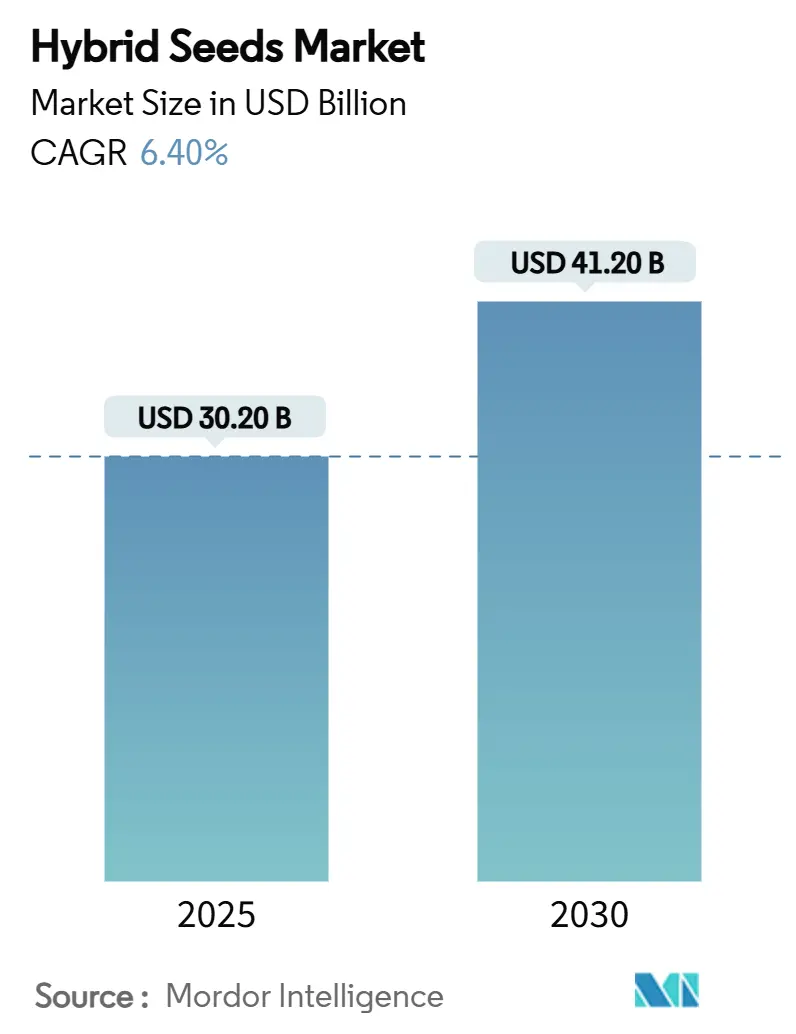
| Market Size (2025) | USD 30.20 Billion |
| Market Size (2030) | USD 41.20 Billion |
| Growth Rate (2025 - 2030) | 6.40 % |
| Fastest Growing Market | Asia Pacific |
| Largest Market | North America |
| Market Concentration | Medium |
Major Players *Disclaimer: Major Players sorted in no particular order Image © Mordor Intelligence. Reuse requires attribution under CC BY 4.0. | |
Hybrid Seeds Market Analysis by Mordor Intelligence
The hybrid seeds market size is estimated at USD 30.20 billion in 2025, and is anticipated to reach USD 41.20 billion by 2030, at a CAGR of 6.4% during the forecast period. Growth reflects the push for higher on-farm yields at a time of food-security pressure, climate variability, and shrinking arable land per capita. Commercial roll-outs of speed-breeding and synthetic-biology pipelines now cut the cultivar development window to 3-5 years, allowing companies to refresh portfolios faster and capture trait premiums[1]Source: Pablo Guo, “Speed Breeding in Growth Chambers and Glasshouses for Crop Breeding and Model Plant Research,” Biology, mdpi.com. North America continues to anchor revenue through entrenched corn and soybean adoption, yet Asia-Pacific generates the steepest volume gains as public programs fund mechanization, irrigation, and credit access. Cereals retain volume leadership, but vegetables are on a faster upward curve because cold-chain networks make a year-round supply of fresh produce viable. Technology convergence, AI-assisted genomic selection, high-throughput phenotyping, and the Clustered Regularly Interspaced Short Palindromic Repeats (CRISPR) editing intensify competition while regulatory fragmentation and seed-sovereignty activism temper uptake in some low-income regions.
Key Report Takeaways
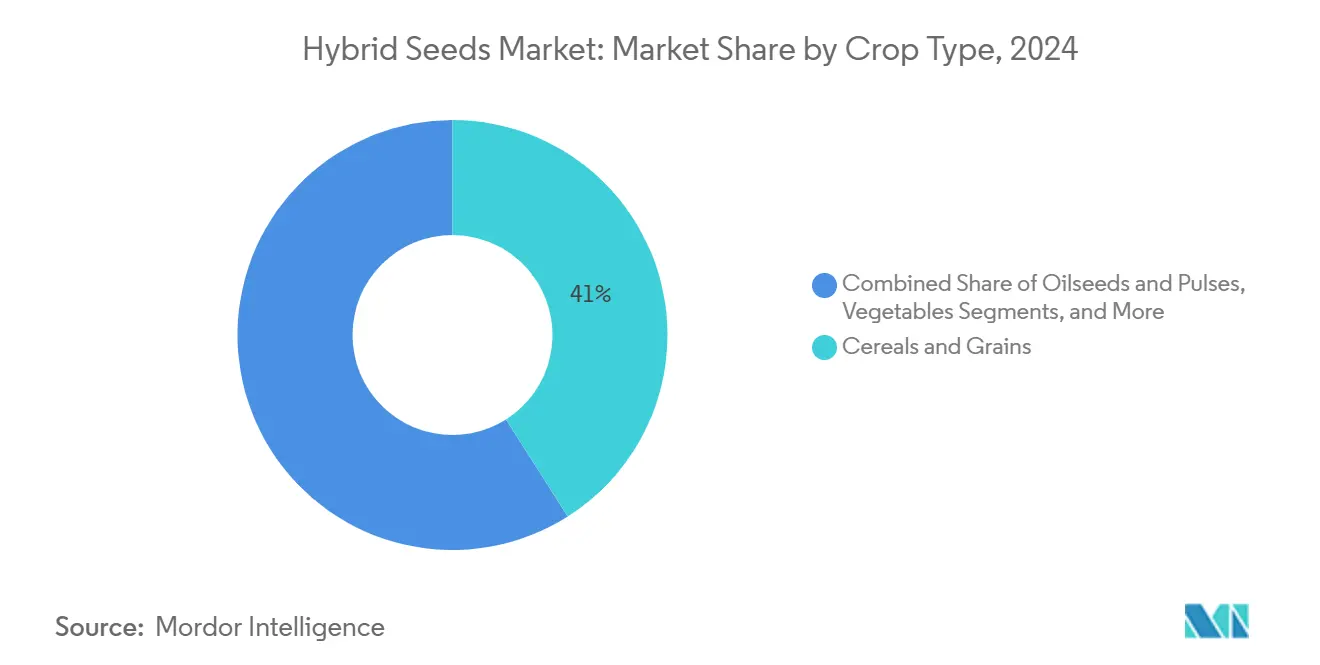
- By crop type, cereals and grains held 41% of the hybrid seeds market share in 2024, and the vegetables are advancing at a 9.5% CAGR through 2030.
- By trait, herbicide-tolerant hybrids accounted for 35% of the hybrid seeds market size in 2024, while stacked traits post the quickest growth at 12.2% CAGR to 2030.
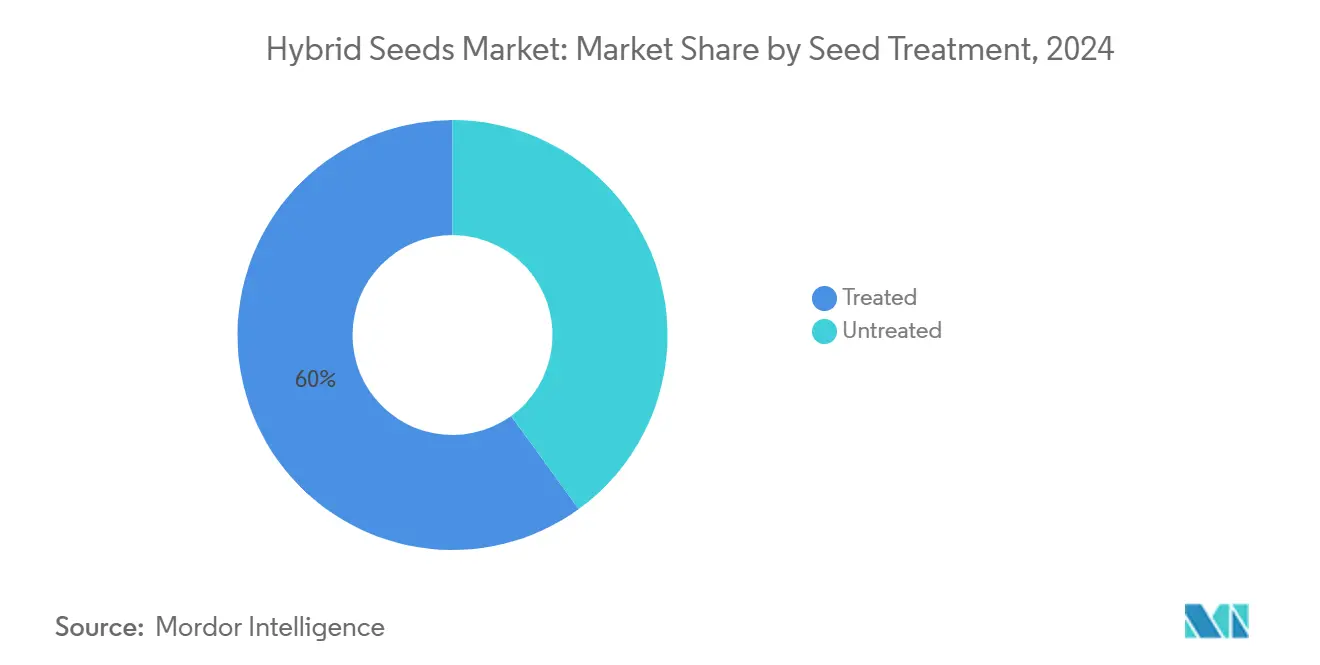
- By seed treatment, treated seed commanded a 60% share of the hybrid seeds market share in 2024 and is expanding at an 8.7% CAGR over the forecast period.
- By sales channel, the offline/dealer and retail outlets held 70% of 2024 revenue, and the online platforms posted a 15.2% CAGR between 2025 and 2030.
- By geography, North America led with 34% revenue share in 2024, and the Asia-Pacific is forecast to grow at 9.5% CAGR between 2025 and 2030.
- Bayer AG, Corteva Agriscience, Syngenta Group, BASF SE, and KWS Saat SE jointly commanded more than half of 2024 revenue within a top-five cohort that held 68.3% share.
Global Hybrid Seeds Market Trends and Insights
Drivers Impact Analysis*
| Driver | (~) % Impact on CAGR Forecast | Geographic Relevance | Impact Timeline |
|---|---|---|---|
| Yield plateaus in major staple crops prompting hybrid adoption | +1.2% | Global, with highest impact in Asia-Pacific, and Africa | Medium term (2-4 years) |
| Climate-resilient hybrid development accelerates under new public-private R&D consortia | +0.8% | Global, particularly Sub-Saharan Africa, and South Asia | Long term (≥ 4 years) |
| Rapid penetration of herbicide-tolerant and insect-resistant stacked traits | +1.5% | North America, South America, and expanding to Asia-Pacific | Short term (≤ 2 years) |
| Corporate carbon-credit programs rewarding hybrid seed use | +0.4% | North America and Europe primarily | Medium term (2-4 years) |
| Digitally enabled smallholder financing platforms bundling hybrid seed packets | +0.6% | Asia-Pacific, Africa, and South America | Short term (≤ 2 years) |
| Synthetic-biology-based speed-breeding cutting cultivar launch cycles | +0.9% | Global, led by North America, and Europe | Long term (≥ 4 years) |
| Source: Mordor Intelligence | |||
Yield Plateaus in Staple Crops Prompting Hybrid Adoption
Yield ceilings in wheat, rice, and maize have narrowed profit margins, nudging growers toward hybrids that deliver 10-15% productivity lifts over conventional lines. Accelerated R&D now supplies 3-9 breeding cycles per year instead of 1-2, enabling quicker release of yield-boosting genetics. Governments projecting a 70% jump in food demand by 2050 increasingly view hybrids as an essential, not optional, lever. Large farm operators in the United States Corn Belt pushed corn hybrid penetration beyond 95%, making wheat the next frontier for transformational yield gains. Similar plateaus in Asian rice bowls sharpen public investment in hybrid rice programs, underscoring the global relevance of the driver.
Climate-Resilient Hybrid Development Accelerates Under New Public-Private R&D Consortia
Public-private consortia now funnel resources into drought-tolerant and heat-resistant hybrids that can protect farm incomes under erratic weather. The adoption of hybrid seeds in Kenya's Sustainable Agriculture Land-Management project increased maize production by improved farming practices, while generating carbon credits valued at USD 184,447, demonstrating its commercial viability.[2]Source: World Bank, “Kenya: Project Boosts Maize Production and Climate Change Benefits,” worldbank.org. AI-guided genomic selection pinpoints stress-tolerance loci faster, compressing trait-deployment timelines. Rising insurance premiums tied to climate risk further motivate growers to adopt resilient hybrids that stabilize yields.
Digitally Enabled Smallholder Financing Platforms Bundling Hybrid Seed Packets
Technology-enabled financial services are revolutionizing hybrid seed distribution by integrating credit, insurance, and input supply into comprehensive packages tailored for smallholder farmers. These platforms address traditional barriers to hybrid adoption, including upfront costs, credit access, and risk management, by spreading payments across growing seasons and linking repayment to harvest outcomes. Farmerline's USD 1.5 million debt facility expansion in Ghana exemplifies this approach, combining digital farm management tools with access to drought-resistant seeds and organic fertilizers. The bundling strategy reduces transaction costs for both farmers and seed companies while improving adoption rates through risk mitigation and flexible payment terms. Mobile payment integration enables real-time transaction processing and reduces cash-handling risks, particularly important in regions with limited banking infrastructure.
Corporate Carbon-Credit Programs Rewarding Hybrid Seed Use
Food brands race to hit net-zero pledges and now pay growers for practices reduced tillage, cover crops, optimized nitrogen that hybrids facilitate through vigorous root systems, and nutrient-use efficiency. Anew Climate’s program offers upfront payments to participants using hybrid seed protocols that sequester more carbon. The income stream reframes hybrid seed expense as an investment with dual agronomic and environmental returns.
Restraints Impact Analysis*
| Restraint | (~) % Impact on CAGR Forecast | Geographic Relevance | Impact Timeline |
|---|---|---|---|
| Rising regulatory scrutiny on gene-edited traits | -0.7% | Europe, parts of Asia-Pacific, and selective African markets | Medium term (2-4 years) |
| Farmer distrust due to seed-sovereignty activism | -0.5% | Sub-Saharan Africa, South Asia, and South America | Long term (≥ 4 years) |
| Escalating royalty costs squeezing grower margins | -0.8% | Global, most acute in North America, and Europe | Short term (≤ 2 years) |
| Fragmented last-mile distribution in developing nations | -0.6% | Sub-Saharan Africa, South Asia, and remote South America | Medium term (2-4 years) |
| Source: Mordor Intelligence | |||
Rising Regulatory Scrutiny on Gene-Edited Traits
The European Union applies GMO-style reviews to the Clustered Regularly Interspaced Short Palindromic Repeats (CRISPR) edits, while the United States grants quicker clearances, forcing companies to run parallel pipelines and raising compliance costs [3]Source: European Molecular Biology Laboratory, “New technique enables breeding of genetically identical hybrid plants,” Phys.org, phys.org. India's recent approval of genome-edited rice varieties demonstrates regulatory evolution, but inconsistent timelines and requirements across jurisdictions create planning uncertainties for seed companies. This regulatory patchwork particularly impacts stacked trait development, where multiple gene edits require separate approvals in different markets, multiplying compliance costs and extending time-to-market. Companies are responding by establishing regional breeding programs and regulatory affairs teams, but these investments reduce overall R&D efficiency and slow innovation diffusion.
Farmer Distrust Due to Seed-Sovereignty Activism
Grassroots movements advocating for farmer seed rights are creating resistance to hybrid adoption, particularly in developing markets where traditional seed-saving practices remain culturally and economically important. The Open Source Seed Initiative and similar organizations promote "freed seeds" that cannot be patented, directly challenging the intellectual property foundations of hybrid seed business models. In Kenya, civil society organizations warn that intellectual property enforcement could criminalize traditional seed exchange practices, creating farmer distrust of hybrid varieties and corporate seed suppliers.
*Our forecasts treat driver/restraint impacts as directional, not additive. The impact forecasts reflect baseline growth, mix effects, and variable interactions.
Segment Analysis
By Crop Type: Cereals Remain Dominant as Vegetables Accelerate
Cereals and grains captured 41% of the 2024 hybrid seeds market share, a share built on large-scale corn, rice, and wheat programs that justify premium seed costs through volume efficiencies. The hybrid seeds market size for cereals continues to climb at steady mid-single-digit rates as yield plateaus create urgency for genetic gains. Vegetables register a 9.5% CAGR through 2030, outpacing all other crop groups because urban diets favor fresh produce and cold-chain upgrades cut post-harvest losses. Oilseeds and pulses grow with biodiesel mandates and plant-protein demand, while fruits and nuts stay niche but profitable. Forage and turf hybrids ride urban green-space budgets and livestock herd expansion, but remain the smallest slice. The cross-pollination of cover-crop traits into rye illustrates cereals’ evolving role in regenerative systems.
Vegetable breeders deploy speed breeding to load disease-resistance and shelf-life genes faster, crucial for high perishability. Premium tomato packets retail at USD 20 for 10 seeds, showing consumer readiness to pay for enhanced nutrition. Cereals still underpin caloric intake and thus command the largest market share, yet incremental gains make their growth curve shallower than vegetables. Breeders consequently pivot R&D budgets toward higher-margin horticulture while maintaining core cereal programs to secure staple supplies.



By Trait: Stacked Solutions Eclipse Single-Trait Lines
Herbicide-tolerant hybrids owned 35% of 2024 sales as growers rely on no-till systems. The hybrid seeds market size for stacked traits posts a 12.2% CAGR, reflecting farmer preference for one-bag convenience and lower stewardship hassle. Insect-resistant products maintain relevance where pest pressure is acute, and the conventional improved lines serve regions with tight regulatory or price constraints. Corn and soybean fields show the sharpest switch to stacked packages that combine glyphosate tolerance with Bt proteins, simplifying weed and worm control in one pass.
The stacked-trait boom rides on regulatory clarity in the Americas that allows trait pyramids and on seed firms’ ability to bundle IP into single offerings. The Clustered Regularly Interspaced Short Palindromic Repeats (CRISPR) multiplexing now stitches drought tolerance, nitrogen-use efficiency, and nutritional traits into one genome, raising the performance bar and the royalty stack. Markets with slower trait approvals still rely on first-generation herbicide tolerance, slowing the global average but not the direction of travel.
By Seed Treatment: Treated Seed Mirrors Precision-Ag Drive
Treated seed captured 60% of the 2024 volume share in the hybrid seeds market as growers opt for early-season protection and uniform stands. Advanced coatings add biological inoculants, micronutrients, and growth stimulants to traditional fungicides and insecticides, lifting the treated segment’s CAGR to 8.7%. The market share for untreated seed declines as precision farming spreads, though organic acres and low-input systems still demand untreated options.
Regulators also prefer on-seed treatments to in-field sprays, seeing lower drift risk. Precision planters now meter treated kernels with minimal wear, reinforcing agronomic and logistical incentives. Untreated demand persists where certification rules prohibit chemicals, yet technology cost curves and environmental pressure point the market toward comprehensive treatment stacks.
By Sales Channel: Online Disrupts Traditional Distribution
Offline/dealer and retail outlets maintained a 70% market share in 2024, reflecting the established infrastructure and agronomic support services that traditional distribution networks provide to farmers. However, online sales are emerging as the fastest-growing channel at 15.2% CAGR for 2025-2030, enabled by digital platforms that bypass traditional intermediaries and create direct relationships between seed companies and growers. This channel evolution reflects broader agricultural digitization trends where farmers increasingly access products and services through online platforms that offer convenience, competitive pricing, and customized solutions.
Digital financing platforms are accelerating online adoption by bundling seed purchases with credit, insurance, and agronomic services that address multiple farmers' needs through integrated solutions. This approach is particularly effective in developing markets where traditional credit access is limited and farmers require comprehensive support packages rather than standalone seed purchases. The offline channel's resilience stems from established relationships and value-added services like soil testing, crop scouting, and application services that complement seed sales. This competitive dynamic is driving innovation in both channels, as companies seek to optimize distribution efficiency while maintaining farmer relationships and support services.
Geography Analysis
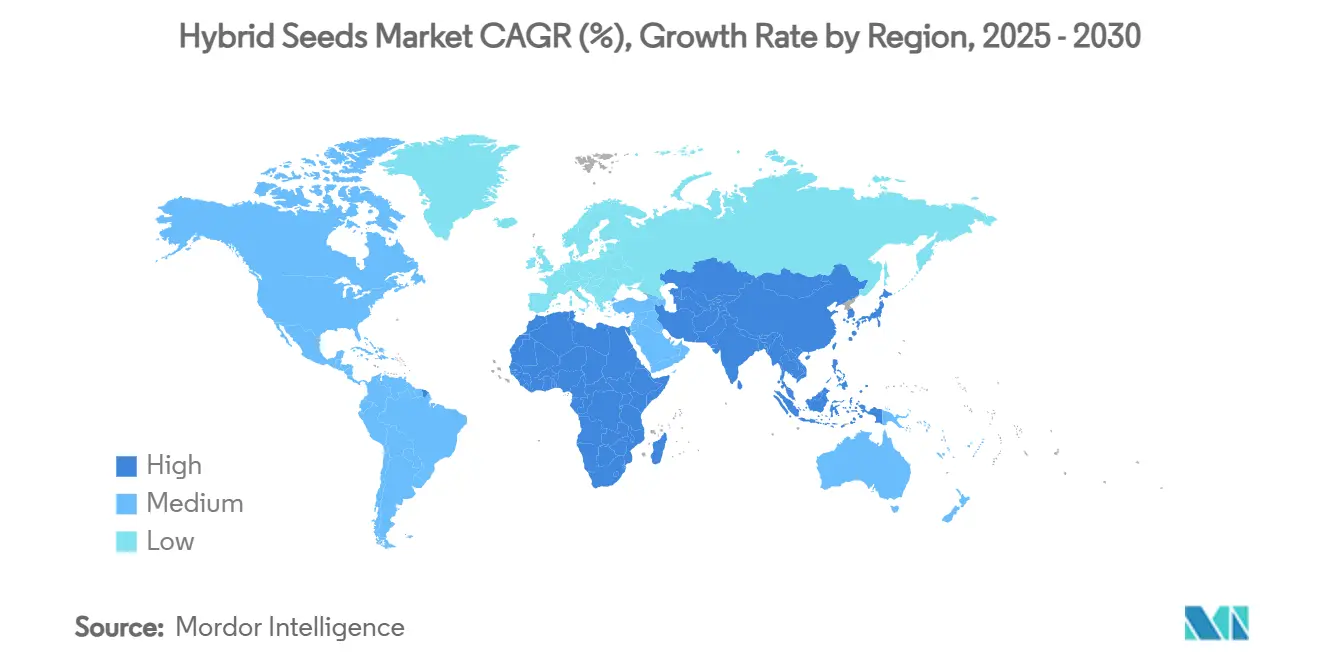
North America generated 34% of 2024 revenue, with hybrid corn and soybean near saturation in the U.S. and steady canola and wheat programs in Canada. A mature regulatory framework, robust IP enforcement, and integrated supply chains keep R&D capital flowing into climate-tolerant traits and AI-guided breeding. Regional CAGR moderates to 6.2% as acreage expansion is limited, but yield gains and trait premiums support value growth. Mexico’s climb in hybrid corn adoption for food security adds incremental uplift.
Asia-Pacific posts the fastest trajectory at 9.5% CAGR as China scales hybrid rice and maize while India channels subsidized credit toward cotton, vegetables, and maize. Government mechanization drives, irrigation upgrades, and rural digitization widen market access. Domestic champions such as Yuan Longping High-Tech deliver locally adapted hybrids, while multinationals co-invest in regional R&D hubs. Australia and Japan push high-value hybrid barley and vegetable seeds, though their acreage is small.
Europe moves at a 5.5% CAGR amid stringent trait rules that slow biotech adoption. Still, hybrid sugar beet, maize, and vegetable lines find traction, and breeding firms like KWS capitalize on regional know-how and distribution. Eastern EU members upgrade seed use under Common Agricultural Policy funding, while Russia’s wheat hybrid push adds volume despite geopolitical risk. South America expands at 7.4% CAGR on the back of Brazil’s soybean and corn hybridization and Argentina’s tech-savvy farms, with Chile and Colombia contributing via specialty crops and public modernization grants.

Competitive Landscape
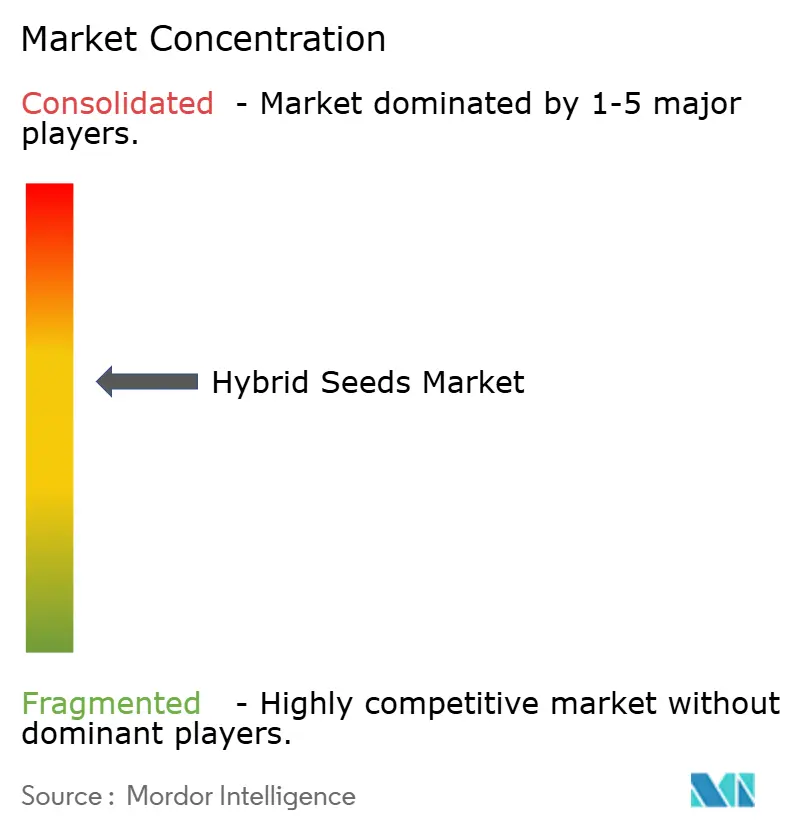
Market concentration is moderate, with the top five players accounting for 68.3% of the revenue share. This gives incumbents a significant advantage in terms of scale for high-throughput breeding, global regulatory teams, and multi-trait portfolios. Bayer AG holds a significant share, leveraging AI-driven genomic selection and partnerships such as its RAGT hybrid wheat venture to cut breeding cycles. Corteva Agriscience sits at a significant share and scales Pioneer A-Series soybeans with Enlist E3 traits to combine weed control and yield boosts. Syngenta Group holds a prominent share, reflecting deep pipelines in corn, rice, and vegetables and investments in seed-specific digital tools.
Smaller regional firms carve niches in crops or geographies overlooked by majors, often licensing traits while focusing on local germplasm. Start-ups applying synthetic biology to stack nutrition and stress traits attract venture backing, signaling new challengers. Patent races intensify around CRISPR editing and speed-breeding hardware, erecting fresh barriers to late entrants.
The competitive field tilts toward platform offerings, seed, traits, carbon credits, and agronomy software bundled into one subscription. Firms able to integrate these components and manage data ownership stand to lock in customers and margin. Partnerships with fintechs and ag-marketplace apps extend reach into smallholder segments, further blurring lines between input suppliers and service providers.
Hybrid Seeds Industry Leaders
Corteva Agriscience
Syngenta Group
BASF SE
KWS Saat SE
Bayer AG
- *Disclaimer: Major Players sorted in no particular order

Recent Industry Developments
- October 2025: Origin Agritech Ltd. has obtained a crop seed production and operation license from the Beijing Municipal Bureau of Agriculture and Rural Affairs. This license permits the company to produce, process, package, wholesale, and retail corn seeds. It marks an important advancement in enhancing Origin's production capacity and operational capabilities.
- July 2025: Beck's Hybrids acquired a Nebraska seed production facility, expanding its corn and soybean hybrid manufacturing capacity to meet growing demand in the central United States. Beck's and Syngenta have maintained a long-term partnership, collaborating for decades on line development, genetic trait introduction, basic seed production, and germplasm licensing.
- May 2025: East-West Seed has unveiled its new 36-hectare facility, the Hortanova Research Center, located in San Juan, Batangas, Philippines. This state-of-the-art center is designed to focus on the research and development of advanced hybrid crops, aiming to enhance agricultural productivity and meet the evolving needs of farmers and consumers.


Global Hybrid Seeds Market Report Scope
| Cereals and Grains |
| Oilseeds and Pulses |
| Vegetables |
| Fruits and Nuts |
| Forage and Turf |
| Herbicide-tolerant |
| Insect-resistant |
| Stacked traits |
| Conventional improved |
| Treated |
| Untreated |
| Online |
| Offline/Dealer and Retail Outlets |
| North America | United States |
| Canada | |
| Rest of North America | |
| South America | Brazil |
| Argentina | |
| Rest of South America | |
| Europe | Germany |
| France | |
| United Kingdom | |
| Italy | |
| Spain | |
| Russia | |
| Rest of Europe | |
| Asia-Pacific | China |
| India | |
| Japan | |
| Australia | |
| South Korea | |
| Rest of Asia-Pacific | |
| Middle East | Saudi Arabia |
| United Arab Emirates | |
| Turkey | |
| Rest of Middle East | |
| Africa | South Africa |
| Egypt | |
| Kenya | |
| Rest of Africa |
| By Crop Type | Cereals and Grains | |
| Oilseeds and Pulses | ||
| Vegetables | ||
| Fruits and Nuts | ||
| Forage and Turf | ||
| By Trait | Herbicide-tolerant | |
| Insect-resistant | ||
| Stacked traits | ||
| Conventional improved | ||
| By Seed Treatment | Treated | |
| Untreated | ||
| By Sales Channel | Online | |
| Offline/Dealer and Retail Outlets | ||
| By Geography | North America | United States |
| Canada | ||
| Rest of North America | ||
| South America | Brazil | |
| Argentina | ||
| Rest of South America | ||
| Europe | Germany | |
| France | ||
| United Kingdom | ||
| Italy | ||
| Spain | ||
| Russia | ||
| Rest of Europe | ||
| Asia-Pacific | China | |
| India | ||
| Japan | ||
| Australia | ||
| South Korea | ||
| Rest of Asia-Pacific | ||
| Middle East | Saudi Arabia | |
| United Arab Emirates | ||
| Turkey | ||
| Rest of Middle East | ||
| Africa | South Africa | |
| Egypt | ||
| Kenya | ||
| Rest of Africa | ||


Key Questions Answered in the Report
What is the current hybrid seeds market size and projected CAGR through 2030?
The hybrid seeds market size reached USD 30.2 billion in 2025 and is forecast to grow at a 6.4% CAGR, hitting USD 41.2 billion by 2030.
Which crop segment is expanding fastest in the hybrid seeds market?
Vegetables lead growth with a 9.5% CAGR through 2030 as cold-chain upgrades and urban diets lift demand.
Why are stacked traits gaining more market share than single-trait hybrids?
Stacked traits bundle herbicide tolerance and insect resistance into one seed, cutting input complexity and improving farm economics, which drives a 12.2% CAGR for the segment.
What regions show the strongest growth potential for hybrid seeds?
Asia-Pacific posts the fastest regional expansion at 9.5% CAGR due to government modernization programs in China and India that widen hybrid seed access.
How does seed treatment influence hybrid seed performance?
Treated seeds, which currently hold 60% share, improve germination and early-season protection through coatings that include fungicides, insecticides, and biological inoculants, supporting an 8.7% CAGR for the segment.
Page last updated on:


 Your data is secure and never sold or shared.


