
Philippines Hybrid Rice Seed Market Size and Share
Market Overview
| Study Period | 2021 - 2031 |
|---|---|
| Forecast Data Period | 2026 - 2031 |
| Base Year Market Size (2025) | USD 115 Million |
| Market Size (2026) | USD 126.53 Million |
| Market Size (2031) | USD 203.86 Million |
| Growth Rate (2026 - 2031) | 10.03 % |
| Market Concentration | High |
Major Players *Disclaimer: Major Players sorted in no particular order Image © Mordor Intelligence. Reuse requires attribution under CC BY 4.0. | |
Philippines Hybrid Rice Seed Market Analysis by Mordor Intelligence
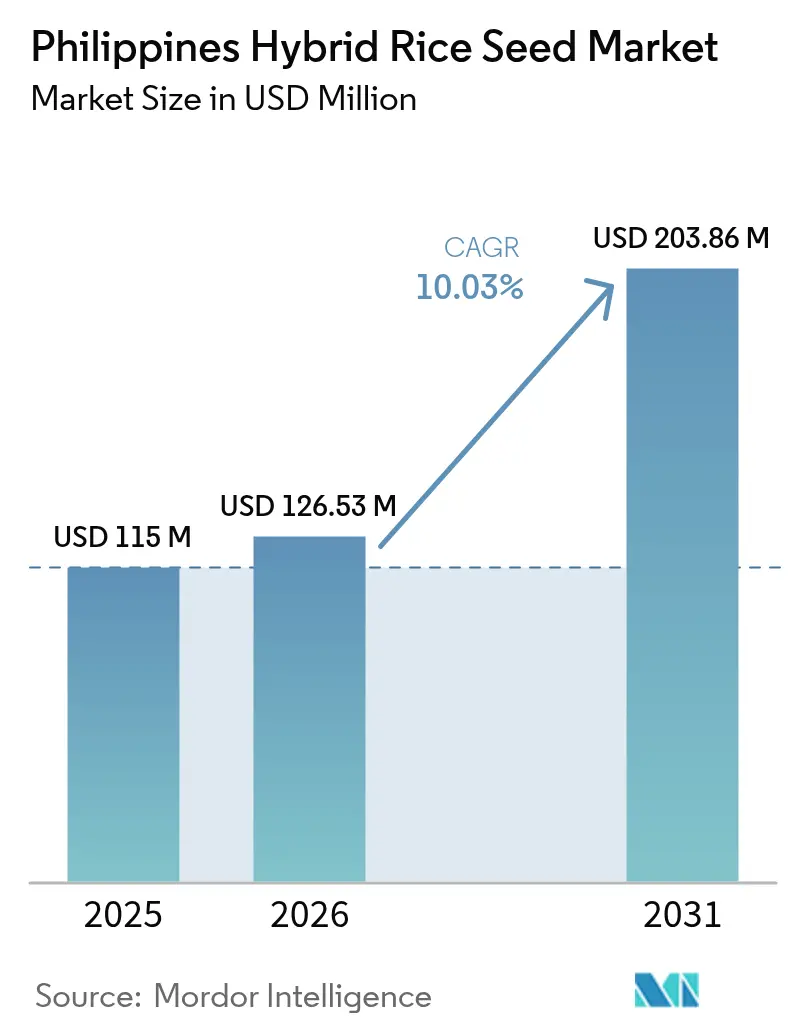
The Philippines' hybrid rice seed market size is expected to grow from USD 115 million in 2025 to USD 126.53 million in 2026 and is forecast to reach USD 203.86 million by 2031 at 10.03% CAGR over 2026-2031. Expansion is driven by stepped-up government funding through the Rice Competitiveness Enhancement Fund, rising hybrid yields of 7-15 metric tons per hectare versus 3-6 metric tons for inbred rice, and private-sector investment in locally tailored germplasm that lowers dependence on imports [1]. The rapid acreage shift toward hybrids, 614,619 hectares in 2024, with a target of 1.9 million hectares by 2028, signals strong demand visibility for seed producers. Policy alignment through Administrative Order 9, which prioritizes domestic seed multiplication, secures supply resilience [2]. At the same time, demonstration farms in Central Luzon, Western Visayas, and Mindanao continue to showcase clear profitability gains that offset higher seed costs. Competitive intensity remains moderate because variety registration, multi-location trials, and distribution scale create formidable entry barriers that favor incumbents.
Key Report Takeaways
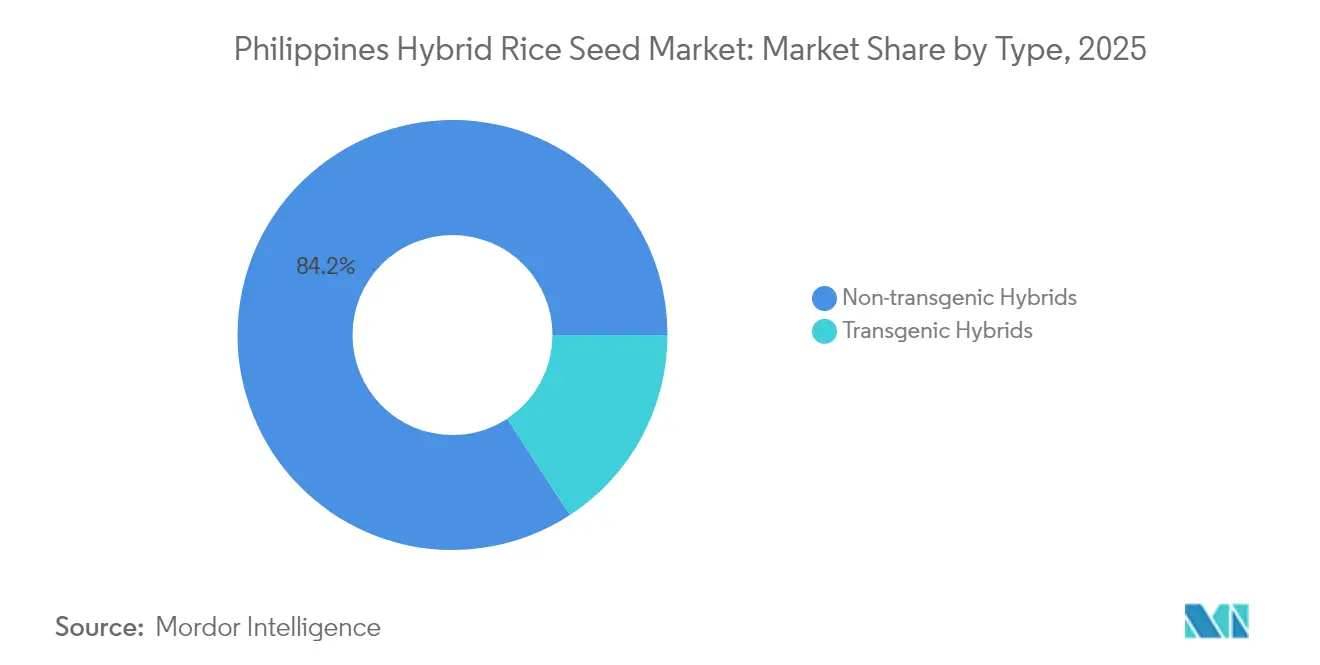
- By type, non-transgenic hybrids commanded 84.20% of the Philippines' hybrid rice seed market share in 2025, whereas transgenic is projected to surge at a 21.92% CAGR through 2031.
Note: Market size and forecast figures in this report are generated using Mordor Intelligence’s proprietary estimation framework, updated with the latest available data and insights as of 2026.
Market Trends and Insights
Drivers Impact Analysis of Philippines Hybrid Rice Seed Market*
| Driver | (~) % Impact on CAGR Forecast | Geographic Relevance | Impact Timeline |
|---|---|---|---|
| Rapid rise in hybrid-seed acreage under DA subsidy programs | +2.8% | Nationwide with Central Luzon, Western Visayas, and Mindanao clusters | Medium term (2-4 years) |
| Higher yield potential versus inbred varieties | +2.1% | Irrigated lowlands countrywide | Short term (≤ 2 years) |
| Strong government push for rice self-sufficiency | +1.9% | Nationwide with priority provinces | Long term (≥ 4 years) |
| Growing private-sector R&D | +1.4% | Research hubs in Luzon | Medium term (2-4 years) |
| Shift to locally produced seeds | +1.2% | Central Luzon seed production zones | Long term (≥ 4 years) |
| Climate-resilient hybrids positioned for drought-prone Western Visayas | +0.8% | Western Visayas and similar agro-climates | Long term (≥ 4 years) |
| Source: Mordor Intelligence | |||
Rapid Rise in Hybrid-Seed Acreage Under DA Subsidy Programs
The Department of Agriculture aims to plant hybrid varieties across 1.9 million hectares by 2028, up from 614,619 hectares in 2024. Budgeted outlays through the Rice Competitiveness Enhancement Fund rose to PHP 30 billion (USD 536 million) in 2025, supplying free hybrid seed, fertilizer, and training that reduce adoption cost hurdles. Western Visayas alone secured PHP 1.06 billion (approximately USD 19 million) for seed and fertilizer subsidies, covering 68,234 hectares. Central Luzon earmarked 70% of its seed budget for hybrids and distributed 285,000 bags annually. These systemic incentives shorten payback periods and institutionalize hybrids across farmer networks.
Higher Yield Potential Versus Inbred Varieties
Hybrid rice varieties consistently deliver 7-15 metric tons per hectare compared to 3-6 metric tons for conventional inbred varieties, creating compelling economic returns that offset higher seed costs through increased production value. Field results demonstrate that hybrids consistently record 7-15 metric tons per hectare, double the output of inbred rice. Farmers such as George Pasion harvested 14.3 metric tons per hectare with SL-8H, while Genaro Tamon achieved 15.78 metric tons using US 88 Premium Long Grain. Gross income gains reach PHP 160,000 (USD 2,857) per hectare, delivering four-fold returns despite steeper seed prices. When drought stress hit, IRRI’s resilient hybrids still yielded 1.2 metric tons more than inbred controls, highlighting income stability [3]. Peer-to-peer endorsements further accelerate acceptance among smallholders.
Strong Government Push for Rice Self-Sufficiency
The Rice Competitiveness Enhancement Fund channels PHP 30 billion (USD 536 million) annually to seed, mechanization, credit, and extension support. Palay output targets sit at 20.4 million metric tons in 2025, up nearly 11% from 2024. Memorandums of understanding with SL Agritech and other seed suppliers integrate hybrid promotion into national food-security plans. This policy framework creates sustained market demand for hybrid seeds by institutionalizing their adoption through government procurement and distribution channels, while reducing farmer financial barriers through subsidized access programs. Administrative Order 9 stresses domestic seed production, providing predictable demand for Philippine-grown hybrid seed.
Growing Private-Sector R&D
SL Agritech leverages local germplasm and disease screening to extend its SL-8H family, while Bayer’s Arize AZ 8433 DT introduces herbicide tolerance and insect resistance for Filipino paddies. IRRI technology licenses grant private firms access to low glycemic index traits, opening premium health segments. Syngenta’s NK hybrids pair seed sales with bundled agronomy services that improve stand establishment and crop protection. Rising R&D budgets diversify trait pipelines and spur differentiated product launches. This R&D intensification creates competitive advantages for companies that successfully develop varieties adapted to specific Philippine agroecologies while addressing emerging challenges such as climate variability and evolving pest pressures.
Restraints Impact Analysis of Philippines Hybrid Rice Seed Market*
| Restraint | (~) % Impact on CAGR Forecast | Geographic Relevance | Impact Timeline |
|---|---|---|---|
| High seed cost | -1.8% | Nationwide smallholder base | Short term (≤ 2 years) |
| Limited farmer technical know-how on hybrid agronomy | -1.2% | Low-service rural areas | Medium term (2-4 years) |
| Slow irrigation build-out in rain-fed regions | -0.9% | Eastern Visayas and upland Mindanao | Long term (≥ 4 years) |
| Emerging consumer pushback on GM traits | -0.6% | Urban markets | Medium term (2-4 years) |
| Source: Mordor Intelligence | |||
High Seed Cost
The substantial cost differential between hybrid rice seeds at ₱366 per kilogram (USD 6.31) and conventional inbred varieties at ₱29 per kilogram (USD 0.50) creates a significant adoption barrier for smallholder farmers operating on tight margins in 2024. The need for annual seed purchases compounds the cost challenge, as hybrid varieties do not breed true, preventing farmers from saving seeds for subsequent seasons as they traditionally do with inbred varieties. Government subsidy programs through RCEF partially address this constraint by providing free hybrid seeds to qualified farmers, but coverage remains limited to priority areas and registered beneficiaries, leaving many potential adopters without financial support.The economic viability equation becomes more complex when considering that hybrid rice requires higher fertilizer inputs and more precise management practices, further increasing production costs beyond the initial seed investment.
Limited Farmer Technical Know-How on Hybrid Agronomy
Hybrid success depends on precise seeding rates, synchronized fertilizer timing, and pest scouting, which are unfamiliar to many smallholders. Fewer than 1,400 trained technicians serve a grower base that exceeds 2 million, creating service gaps. Poorly managed hybrid fields often yield only marginally above inbred controls, eroding confidence and slowing word-of-mouth diffusion. Extension service limitations in remote areas compound the technical knowledge constraint, as farmers in isolated regions have limited access to agronomic support and demonstration sites where they can observe proper hybrid rice management practices.
*Our forecasts treat driver/restraint impacts as directional, not additive. The impact forecasts reflect baseline growth, mix effects, and variable interactions.
Philippines Hybrid Rice Seed Market Segment Analysis
By Type:
Conventional dominance, gene-edited momentumThe non-transgenic segment captured 84.20% of the Philippines' hybrid rice seed market in 2025, underpinned by regulatory clarity, farmer familiarity, and RCEF (Rice Competitiveness Enhancement Fund) procurement preferences that favor conventionally bred hybrids. These hybrids, led by SL-8H and US 88, anchor seed distributors’ revenue streams and ensure wide geographic coverage across irrigated plains where management practices are well understood.
Growth in transgenic and gene-edited hybrids, projected at a 21.92% CAGR through 2031, centers on stacked traits that mitigate herbicide drift and stem borer pressure. Although commercialization timelines face uncertainty after the Golden Rice injunction, ongoing biosafety reviews of Bt eggplant and CRISPR-derived iron-fortified lines suggest eventual regulatory pathways. The regulatory landscape significantly influences segment dynamics, with the Court of Appeals' April 2024 ruling halting Golden Rice commercialization creating uncertainty around transgenic varieties while simultaneously highlighting their potential value for addressing nutritional deficiencies

Geography Analysis
The Philippines' hybrid rice seed market exhibits strong geographic concentration in irrigated lowland areas of Central Luzon, Western Visayas, and Mindanao, where established infrastructure and government support programs create optimal conditions for hybrid adoption and performance validation. Central Luzon leads hybrid rice cultivation with 614,619 hectares planted as of 2024, benefiting from the region's advanced irrigation systems and proximity to research institutions that facilitate technology transfer and farmer training.
Western Visayas represents a high-growth region with PHP 1.06 billion (USD 19 million) allocated for hybrid rice expansion across 68,234 hectares, targeting the area's vulnerability to drought conditions through climate-resilient varieties developed specifically for the region's agroecological challenges. The region's 1.17 proportion rice sufficiency level provides a strong foundation for hybrid adoption, while its contribution of approximately one-eighth to national rice output amplifies the impact of productivity improvements achieved through hybrid technology.
Eastern Visayas demonstrates both challenges and opportunities, with only 5.9% of rice farms currently planted with hybrid seeds due to higher costs and limited technical support, yet demonstration farms show potential yields of 9 metric tons per hectare compared to traditional varieties. The region's target of achieving one million metric tons annual rice production requires substantial hybrid adoption increases, creating significant market expansion opportunities for seed companies that can address cost and knowledge constraints through innovative distribution and support models.
Regulatory Landscape
Hybrid rice seed production, importation, and marketing in the Philippines operate under the seed quality and certification framework implemented by the Department of Agriculture (DA) through the Bureau of Plant Industry (BPI), anchored by Republic Act 7308 (Seed Industry Development Act of 1992). Under this framework, eligibility for government-supported distribution programs depends on requirements such as the use of NSIC-registered varieties and compliance with BPI-enforced standards for F1 hybrid seed and parental lines, which influences which products scale through public channels.
Program rules and procurement guidance are tightening around domestic supply assurance. Administrative Order 9 (Series of 2024) formalized guidelines on local hybrid rice seed production, reinforcing the policy push toward domestic multiplication. Separately, a mandated sourcing shift for hybrid rice seed distributors is being implemented, moving toward an 80% locally produced and 20% imported mix by 2026, which makes local production capability and accredited multiplication networks a practical market-access requirement for major suppliers.
Competitive Landscape
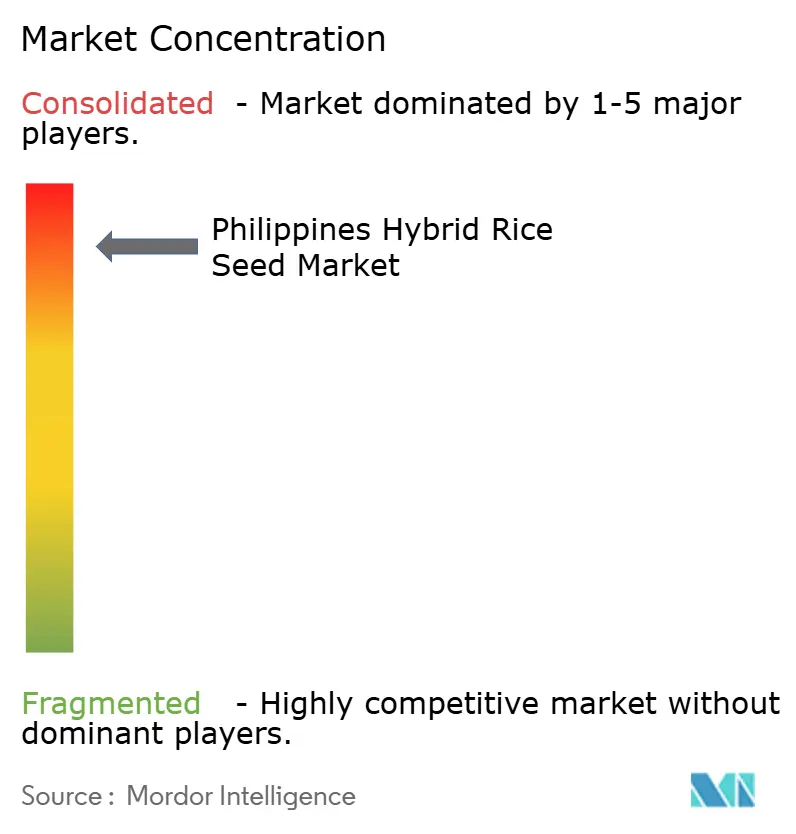
The Philippine hybrid rice seed market remains highly concentrated, with players including SL Agritech Corporation, SeedWorks International, Private Limited, Bayer AG, Syngenta Group, and Corteva Agriscience. Strategic differentiation patterns reveal distinct approaches to market positioning, with SL Agritech leveraging its local market knowledge and government relationships to maintain dominance in conventional hybrids, while international players focus on advanced trait integration and premium positioning strategies.
Bayer's introduction of dual-trait hybrids incorporating herbicide tolerance and insect resistance represents a technology-driven competitive strategy that targets progressive farmers willing to pay premiums for enhanced crop protection benefits. Competitive intensity remains tempered by variety registration bottlenecks that can run three seasons, limiting rapid share swings. Nonetheless, any regulatory breakthrough on transgenic lines could rebalance power by favoring global patent holders.
Strategic differentiation patterns reveal distinct approaches to market positioning, with SL Agritech leveraging its local market knowledge and government relationships to maintain dominance in conventional hybrids, while international players focus on advanced trait integration and premium positioning strategies. Bayer's introduction of dual-trait hybrids incorporating herbicide tolerance and insect resistance represents a technology-driven competitive strategy that targets progressive farmers willing to pay premiums for enhanced crop protection benefits.
Philippines Hybrid Rice Seed Industry Leaders
-
SL Agritech Corporation
-
SeedWorks International Private Limited
-
Bayer AG
-
Syngenta Group
-
Corteva Agriscience
- *Disclaimer: Major Players sorted in no particular order
Philippines Hybrid Rice Seed Market Companies Covered in this Report
- SL Agritech Corporation
- SeedWorks International Private Limited
- Bayer AG
- Syngenta Group
- Corteva Agriscience
- UPL Limited
- Yuan Longping High-Tech Agriculture Co Ltd
- Vietnam National Seed Corporation (Vinaseed)
- Bioseed
- Allied Botanical Corporation
Market Opportunities and Future Outlook
Public programs continue to support near-term hybrid seed volume through seed distribution, model farms, and clustered production approaches. Late-2025 budget releases for the 2026 dry season seed program (PHP 1.665 billion) back procurement and distribution activity. Province-level actions also broaden reach, including DA-11 distributing PHP 16.4 million worth of hybrid rice seeds in April 2026 to 2,250 farmers in Davao del Norte across 3,364 hectares, and DA-MIMAROPA expanding a 100-hectare hybrid rice model farm in Gloria, Oriental Mindoro by July 2026 with free seed provision and defined yield targets.
Opportunities also appear in product and trait refresh as new releases and institutional pipelines move into deployment. In June 2026, IRRI highlighted the introduction of new hybrid rice varieties (Mestiso 120, Mestiso 149, and Mestiso 164), widening the menu available for localization and distribution programs. Digital and logistics enablement remains a related area for differentiation, with platforms such as the Rice Seed Information System (RSIS) and Binhi e-Padala being deployed to track seed production and improve delivery execution, favoring companies that can connect traceability, forecasting, and last-mile distribution with hybrid management support.
Recent Industry Developments in Philippines Hybrid Rice Seed Market
- July 2026: The Department of Agriculture, led by Secretary Francisco Tiu Laurel Jr., pushed for greater flexibility for the agency to choose between hybrid and inbred seeds under RCEF distribution. This policy move ties seed-type procurement to on-the-ground conditions (such as weather stress), which can change annual demand allocation for hybrid seed suppliers participating in government channels.
- June 2026: IRRI reported the introduction of three new hybrid rice varieties for the Philippines, Mestiso 120, Mestiso 149, and Mestiso 164. The additions broaden the commercial pipeline and strengthen variety-based differentiation for suppliers competing for inclusion in demonstrations and program-driven deployments.
- July 2024: Charoen Pokphand Group pledged USD 1.5 billion to develop a 10,000-hectare mega-farm in Luzon with integrated production and logistics, incorporating advanced hybrid rice. The project points to a large-scale commercial user adopting hybrid technology and can increase demand for consistent, high-performing seed supply linked to downstream supply-chain integration.
Philippines Hybrid Rice Seed Market Report Scope and Research Methodology
Market Definition and Coverage
This market is defined as the value of hybrid rice seed sold for planting in the Philippines, counted at the point of seed sale (commercial seed that is purchased for cultivation) in USD.
Scope exclusions: It excludes non-hybrid rice seed types such as open pollinated varieties and farm-saved seed reuse, and it also excludes downstream paddy rice sales.
Segments Covered in This Report
- By Type
- Transgenic Hybrids
- Non-transgenic Hybrids
Data Sources, Market Sizing, and Validation
Desk Research
Desk work started with mapping the rice area and cropping context that ultimately shapes seed demand in the Philippines. Public data points were taken from sources such as the Philippine Statistics Authority (rice area and production), the Department of Agriculture and its attached agencies (seed programs and adoption targets), and the International Rice Research Institute for agronomy and yield references.
To keep pricing and trade related assumptions grounded, we also reviewed customs and trade statistics, plus technical publications in peer-reviewed agronomy journals that discuss hybrid performance and planting practices. Company annual reports, investor decks, and agriculture press were used to understand product availability and channel structure. Where needed, paid subscriptions for company financials and a patent database were used to cross-check corporate activity signals around hybrid seed development. The desk sources listed here are illustrative, and additional public references were reviewed for data collection, validation, and clarification.
Primary Interviews and Surveys
Primary checks were done through expert interviews and structured surveys with seed producers and distributors, agronomists, and large farm operators, then cross-verified against procurement patterns observed in trading hubs. Since this is a country market, the fieldwork coverage focused on key rice producing areas across Luzon, Visayas, and Mindanao, so adoption assumptions and pricing behavior could be tested under different growing conditions.
Distribution of primary research fieldwork respondents
| Company type | Respondent position |
|---|---|
| Top tier: 39% | CXOs: 12% |
| Mid tier: 42% | Functional/Unit leaders: 37% |
| Smaller Players: 19% | Managers: 51% |
Market-Sizing & Forecasting
For sizing, we used a top-down approach where national rice cultivation indicators are used to reconstruct the demand pool for hybrid seed, then those totals are shaped by adoption and pricing inputs. The core logic starts from rice planted area and cropping intensity, and it is filtered through the hybrid seed penetration rate and the typical seeding rate per hectare, which converts demand into volume.
Once the volume is built, value is derived using average selling prices that reflect pack sizes, seasonality around planting windows, and the observed premium for hybrid seed versus conventional planting material. Key model inputs included rice area trends, hybrid adoption under government support programs, the share of irrigated versus rainfed rice areas (which can affect hybrid suitability), seeding rates used in farmer practice, and seed price movement in local channels. The initial outputs were corroborated with selective bottom-up approximations, such as sampled channel price checks and supplier level volume sanity checks, and gaps were handled by using conservative adoption bounds that were validated in interviews.
Forecasts were generated using scenario analysis supported by expert views, with adoption curves and price progression varied based on policy continuity, seed availability, and farmer economics. When multiple inputs moved together, the scenario ranges helped keep the final forecast practical and traceable to a small set of clear drivers.
Data Validation & Update Cycle
Validation was done through triangulation across the area-based demand model, pricing checks from channels, and independent signals such as program level targets and seed supply commentary from stakeholders. When outputs looked out of line, the underlying assumptions were revisited, and follow-up calls were triggered to recheck adoption and pricing in the affected areas.
Before sign-off, the model and narrative go through multi-step analyst reviews that focus on variance checks across years, sudden jumps in penetration, and currency timing issues in USD conversion. The report is refreshed annually, and interim updates are made when material events occur, such as major policy shifts or large changes in seed availability. Right before delivery, a final review pass is completed so the output reflects the most current view.
Mordor Intelligence's Philippines Hybrid Rice Seed Market Size Compared With Other Published Estimates
Published market values can vary even when they describe the same topic, because the scope boundary and the data building blocks are often not the same. Differences in what is counted as seed revenue, which year is treated as the base, and how adoption is assumed across seasons usually create the largest spread.
The benchmark table shows a noticeable gap across estimates, and in Mordor Intelligence's model the count is limited to hybrid rice seed sold in the Philippines, with value built from planted area, seeding rate, adoption, and average selling price checks, rather than blending in adjacent rice seed categories or broader agriculture seed totals. Some published numbers also appear to lean on a single point estimate for pricing or a more generalized adoption curve, which can inflate the value in years where hybrid uptake is uneven across provinces.
Benchmark comparison
| Source | Market Size | Gaps in Research Methodology |
|---|---|---|
| Mordor Intelligence | USD 115.00 M (2025) | |
| Global Consultancy A | USD 87.40 M (2026) | Uses a later base year and appears to apply a narrower interpretation around certified hybrid seed purchases, which can reduce implied adoption when converted back to total planted area demand. |
| Industry Portal B | USD 84.68 M (2023) | Leans on a historical value point and a long-horizon CAGR, and it may mix trade and price trend views without clearly aligning them to hybrid planting penetration and seeding rate mechanics. |
Taken together, the spread is mainly explained by base year choice, what gets counted as hybrid seed revenue, and how adoption and pricing are converted into a value figure. Our approach stays transparent because each step can be traced back to a small set of measurable inputs, and then it is checked with channel feedback before finalizing the totals.
Key Questions Answered in the Report
How much can hybrids boost rice yield per hectare in Philippine conditions?
Demonstration farms show hybrids routinely deliver 7-15 metric tons per hectare compared with 3-6 tons from inbred varieties, doubling output and improving farm income.
Which region currently plants the largest area of hybrid rice?
Central Luzon leads the country with 614,619 hectares under hybrid cultivation thanks to established irrigation and Department of Agriculture subsidy programs.
What is the main financial support channel for Filipino growers who want to adopt hybrid seed?
The Rice Competitiveness Enhancement Fund provides free seed, fertilizer, mechanization aid, and extension services, reducing the high upfront seed cost that can reach ?7,320 (USD 131) per hectare.
Who dominates commercial seed supply today?
SL Agritech Corporation controls 68% of domestic sales through its SL-8H variety, followed by SeedWorks International, Bayer, Syngenta, and Corteva.
Why are some consumers cautious about genetically modified rice?
On April 2024 Court of Appeals ruling halted Golden Rice commercialization, fueling urban skepticism about genetically modified crops and extending regulatory approval timelines.
Are drone technologies being used to improve hybrid rice farming?
Yes, a 2025 partnership between IRRI and XAG is deploying drones for precision seeding, fertilization, and pest control as part of the Drones4Rice initiative.