
Netherlands Telecom MNO Market Size and Share
Market Overview
| Study Period | 2020 - 2031 |
|---|---|
| Forecast Data Period | 2026 - 2031 |
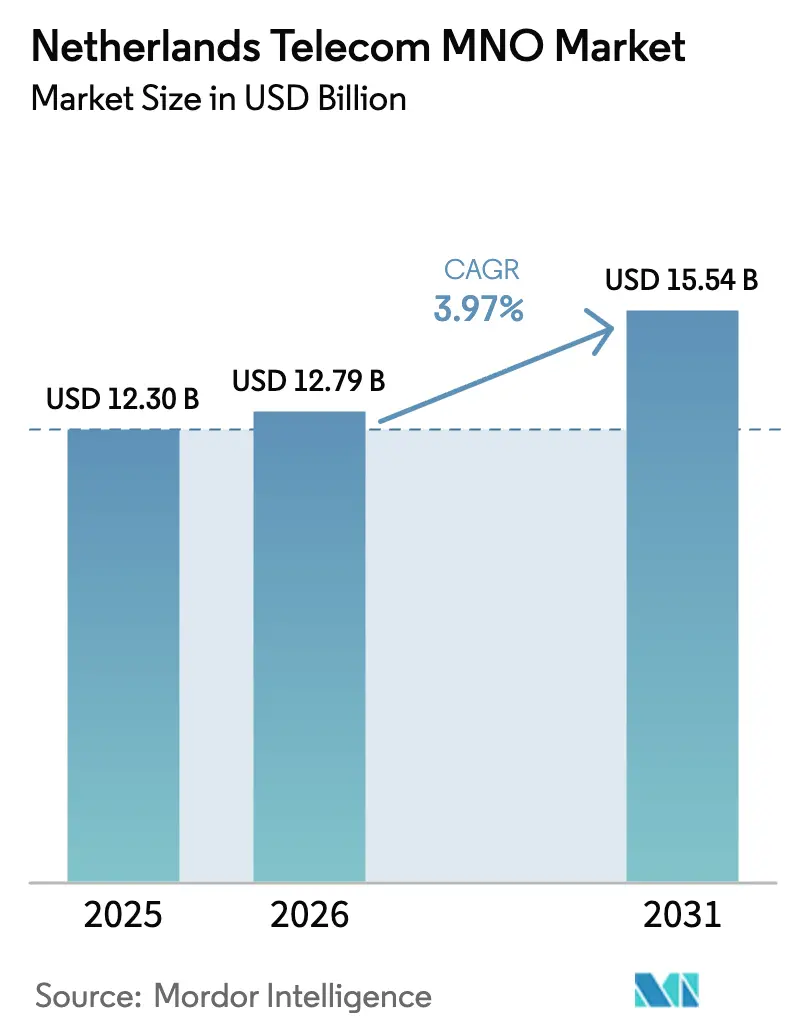
| Base Year Market Size (2025) | USD 12.30 Billion |
| Market Size (2026) | USD 12.79 Billion |
| Market Size (2031) | USD 15.54 Billion |
| Growth Rate (2026 - 2031) | 3.97 % |
| Market Concentration | High |
Major Players *Disclaimer: Major Players sorted in no particular order Image © Mordor Intelligence. Reuse requires attribution under CC BY 4.0. | |
Netherlands Telecom MNO Market Analysis by Mordor Intelligence
The Netherlands Telecom MNO Market size is expected to grow from USD 12.30 billion in 2025 to USD 12.79 billion in 2026 and is forecast to reach USD 15.54 billion by 2031 at 3.97% CAGR over 2026-2031.
The steady trajectory reflects a mature infrastructure backbone, rising enterprise digitization, and continuous 5G monetization. Operators completed nationwide 3.5 GHz activation in 2024, pushing average 5G download speeds beyond 330 Mbps and sustaining unlimited data plan adoption. Fiber-to-the-home now covers 90% of households, yet the 38.8% take-up ratio highlights an untapped customer activation pool. Enterprise appetite for private 5G networks is accelerating, with manufacturers, logistics providers, and public-sector agencies piloting network-slicing use cases that convert connectivity into premium-priced solutions. Regulatory safeguards from ACM, including mandated network sharing and wholesale price reviews, prevent price inflation and preserve consumer surplus estimated at EUR 250 million per year. Rising energy tariffs, up 80–90% on high-voltage lines during 2024, are compressing operator margins and prompting fresh investment in low-power RAN equipment and renewable power purchase agreements.
Key Report Takeaways
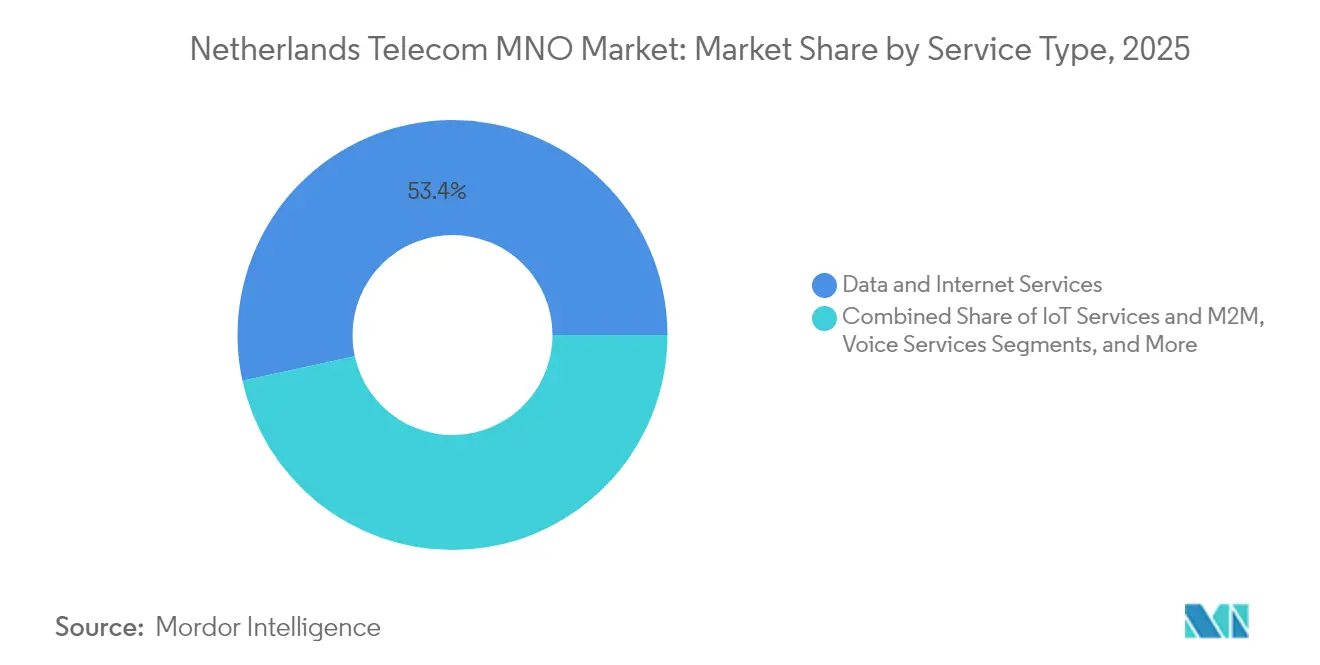
- By service type, data and internet activities led with 53.42% of Netherlands telecom MNO market share in 2025; IoT and M2M are poised to record the fastest 4.18% CAGR through 2031.
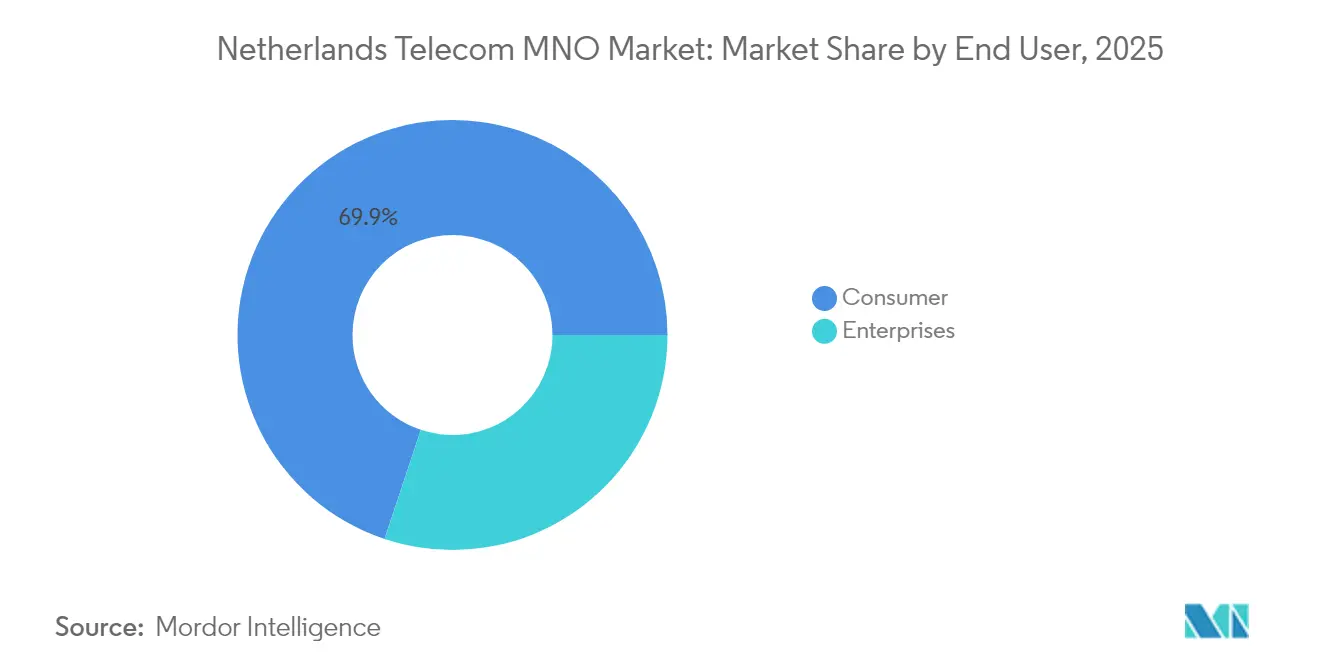
- By end user, consumer connections held 69.88% revenue share of the Netherlands telecom MNO market in 2025, while enterprise services are projected to advance at a 4.22% CAGR over 2026-2031.
Note: Market size and forecast figures in this report are generated using Mordor Intelligence’s proprietary estimation framework, updated with the latest available data and insights as of 2026.
Netherlands Telecom MNO Market Trends and Insights
Drivers Impact Analysis*
| Driver | (~) % Impact on CAGR Forecast | Geographic Relevance | Impact Timeline |
|---|---|---|---|
| Explosive Growth in Mobile & Fixed Data Traffic | +1.2% | Global | Medium term (2-4 years) |
| Nationwide Fibre-to-the-Home Build-outs | +0.8% | National, with early gains in major cities | Long term (≥ 4 years) |
| 5G Spectrum Licensing Completed | +0.6% | National | Short term (≤ 2 years) |
| Quad-play Bundling Boosts ARPU | +0.4% | National | Medium term (2-4 years) |
| Rapid Adoption of Private 5G Networks | +0.3% | Enterprise-focused regions | Long term (≥ 4 years) |
| Energy-efficiency Regulations Accelerate Modernisation | +0.2% | National | Long term (≥ 4 years) |
| Source: Mordor Intelligence | |||
Explosive Growth in Mobile & Fixed Data Traffic
Monthly data volumes per SIM continue to set new records, forcing operators to densify radio sites and to migrate signaling workloads onto LTE-M and LoRa networks for low-power devices. KPN reports a steep jump in network signaling that now requires purpose-built IoT cores. [1]KPN, “Annual Report 2024,” kpn.com Odido, having modernised 80% of its transmission grid since 3.5 GHz activation, delivers average 5G speeds of 331.9 Mbps, the fastest recorded in the country. Unlimited plans now dominate post-paid bundles, eliminating usage-based pricing and steering differentiation toward speed tiers, content perks, and premium latency guarantees. Fixed-wireless access is projected to capture 35% of new broadband adds by 2030, with Odido’s Klik&Klaar already covering roughly three-quarters of the population. [2]Telecoms.com, “FWA Outlook Netherlands,” telecoms.com
Nationwide Fibre-to-the-Home Build-outs
Operators added 1.5 million new FTTH passes during 2024, taking national coverage to 7 million premises. KPN alone has reached 4.68 million homes passed but intentionally slowed its roll-out in late-2024 to raise activation rather than coverage metrics. Around 526,000 addresses now sit in fibre overbuild areas, most notably Zeeland, Friesland, and South Holland, prompting discussions on network duplication and potential asset swaps. Delta Fiber’s agreement to sell 200,000 fibre lines to Glaspoort, pending regulatory clearance, signals a shift toward footprint rationalisation and wholesale consolidation. Operators increasingly track homes connected, not merely homes passed, to secure faster payback on capital outlays.
5G Spectrum Licensing Completed
The July 2024 auction yielded 100 MHz blocks in the 3.5 GHz band for each incumbent at a combined EUR 58.4 million cost. All three MNOs entered 2025 with networks ready for 5G Standalone, a prerequisite for ultra-reliable low-latency communications and network slicing. [3]5G Observatory, “Netherlands Spectrum Auction Review,” 5gobservatory.eu KPN had prepared 5,319 sites for instant spectrum activation, enabling industrial clients to tap end-to-end quality-of-service guarantees. Despite European SA adoption averaging only 2%, the Netherlands is positioned as an early mover relative to regional peers, helping local industry pilot factory automation, AGV fleets, and computer-vision use cases.
Quad-play Bundling Boosts ARPU
Converged fixed-mobile packages have turned into the primary lever for ARPU uplift and churn reduction. KPN extended its portfolio with “Internet at Work,” an enterprise remote work bundle that combines fibre, LTE back-up, and managed security services. International benchmarks show limited FMC traction in most of Europe, yet Dutch players benefit from deep fibre and cable footprints, easing single-bill integration. Successful bundles rely on seamless device provisioning and common support teams, rather than on simple discount stacking. Device-as-a-Service offers, coupled with handset insurance and trade-in schemes, are gaining adoption, creating new revenue legs without diluting connectivity margins.
Restraints Impact Analysis*
| Restraint | (~) % Impact on CAGR Forecast | Geographic Relevance | Impact Timeline |
|---|---|---|---|
| Mobile Penetration >120% Limits Subscriber Growth | -0.8% | National | Long term (≥ 4 years) |
| MVNO Price Pressure Compresses ARPU | -0.6% | National | Medium term (2-4 years) |
| Rising Electricity Costs Inflate Network OPEX | -0.4% | National | Short term (≤ 2 years) |
| Municipal Resistance to New Tower Sites | -0.2% | Urban areas, specific municipalities | Medium term (2-4 years) |
| Source: Mordor Intelligence | |||
Mobile Penetration > 120% Limits Subscriber Growth
With more SIMs than people, organic net-add potential is scarce, forcing operators to prioritise value extraction over volume. KPN shifted strategy toward ARPU expansion through premium speed tiers and post-paid migration. The EUR 200 million Youfone purchase lifted KPN’s mobile share from 31% to 34%, proving acquisition rather than new connections is the viable path to scale. In this saturated setting, network quality and service breadth become primary competitive weapons. Odido’s speed leadership and KPN’s top global quality ranking, awarded by umlaut, exemplify how operators seek to differentiate. IoT and M2M lines remain the one bright spot for connection growth, with KPN running 12 million M2M SIMs across 195 countries.
MVNO Price Pressure Compresses ARPU
Dozens of MVNO brands continue to undercut incumbent tariffs and lure price-sensitive subscribers. European surveys indicate 27% of users plan to switch providers within two years, mostly to save money. Speed caps once viewed as MVNO weaknesses no longer deter churn, as studies show limited real-world impact on user satisfaction. Youfone take-over reflects the need to own budget brands to defend the overall customer pyramid. ACM obliges host networks to offer fair wholesale rates, ensuring the MVNO sector keeps pressure on retail pricing.
*Our forecasts treat driver/restraint impacts as directional, not additive. The impact forecasts reflect baseline growth, mix effects, and variable interactions.
Segment Analysis
By Service Type: Data Services Drive Revenue Growth
Data and internet lines generated 53.42% of Netherlands telecom MNO market revenue in 2025, underscoring a decisive pivot away from voice-centric business models. Operators rely on tiered speed plans, uncapped volumes, and zero-rating for popular video platforms to push higher-priced bundles. The Netherlands telecom MNO market size for IoT and M2M is projected to expand at a 4.18% CAGR through 2031, outpacing every other service category as industrial sensors and connected vehicles proliferate. Voice minutes continue to slide, yet VoLTE adoption sustains margin by consolidating legacy switch costs. OTT video and pay-TV add-on sales give carriers incremental streams that help offset messaging erosion, which saw national SMS traffic slide from 3.3 billion in 2019 to 2.3 billion in 2022. Enterprise wholesale backhaul keeps steady as hyperscale cloud providers lease dark fibre and wavelength capacity from carriers.
Commercial focus has shifted from homes passed to lines activated. Fibre roll-outs, together with mid-band 5G, allow operators to promote symmetrical gigabit offers that bundle cloud gaming, security, and IPTV. As core connectivity commoditises, service layers such as managed SD-WAN, IoT device orchestration, and edge analytics become critical to protect pricing. VodafoneZiggo leverages its hybrid fibre-coax plant to challenge pure fibre players, offering competitive gigabit speeds while advertising a national entertainment platform that aggregates streaming subscriptions in a single interface. Odido modernised its Business Support Systems in 2024, enabling a marketplace model that lets customers self-order connectivity, security, and collaboration tools.



By End User: Enterprise Growth Accelerates Digital Transformation
Households still delivered 69.88% of Netherlands telecom MNO market revenue in 2025, yet enterprise lines record the sharper growth curve. The Netherlands telecom MNO market size for enterprise services is forecast to rise at a 4.22% CAGR through 2031 as private 5G networks become an industrial standard. Manufacturing hubs, ports, and smart-city pilots adopt network slicing, edge computing, and cyber-hardened IoT, lifting average revenue per enterprise customer. KPN already markets a dedicated 5G private network suite to Dutch factories seeking deterministic latency below 10 milliseconds.
Consumer growth potential narrows because of near-full mobile penetration and stiff MVNO discounting, yet ARPU still edges up thanks to unlimited data plans and premium speed buckets. Fibre migration presents a parallel upgrade cycle, allowing incumbents to upsell from cable or xDSL to symmetrical gigabit lines. Enterprise digital transformation reinforces cross-sell between connectivity, cybersecurity, and managed cloud, illustrated by McKinsey forecasts that B2B telecom revenues worldwide will hit USD 116.7 billion by 2027, largely on private wireless and premium SLA contracts. Regulatory assignment of spectrum blocks for private networks also removes a key bottleneck for factory and logistics deployments.
Geography Analysis
The Netherlands enjoys near-universal 5G coverage, with operators claiming service for more than 98% of residents. Fibre-to-the-home reaches 90% of households, yet adoption lags in rural provinces where installation appointments and trenching backlogs slow activations. Major urban centers in the Randstad—Amsterdam, Rotterdam, The Hague, Utrecht—display the highest average download rates, propelled by dense small-cell grids and multiple fibre paths. Odido’s 331.9 Mbps average downlink speed in these zones leads national performance tables. KPN’s network scored top in independent quality audits, reflecting superior consistency metrics across urban and suburban cells.
Municipal cooperation drives regional variance. Northern provinces used public-private partnerships to streamline permit approval, achieving robust connection ratios despite lower population density. Southern regions exhibit overlapping fibre builds, giving users more choice but creating potential over-investment. Cross-border peering positions Amsterdam as a preferred hub for trans-European data transit, anchoring the Netherlands telecom MNO market as a digital gateway. Regulatory focus now targets critical infrastructure redundancy, mandating distributed data centers and backup fibre routes to mitigate single-point vulnerabilities. The policy emphasis on resilience aligns with growing reliance on cloud and IoT traffic that cannot tolerate extended outages.
Provinces with strict site-approval rules, notably parts of Utrecht and Gelderland, delay new macro towers, forcing operators toward small-cell deployments on street furniture. Energy tariff surges hit rural RAN economics harder, as remote sites often rely on less efficient power links. Operators therefore pilot solar-plus-battery arrays to cut daytime grid draw and hedge against future tariff volatility. Geographically balanced licence conditions encourage uniform quality, yet final user experience still correlates strongly with local fibre backhaul availability.
Competitive Landscape
Competition revolves around three full-service MNOs. KPN leads fixed connectivity with roughly 40% broadband share and capitalises on its 51%-owned TowerCo to monetise passive assets. VodafoneZiggo retains a solid cable base but lost 31,000 broadband customers in Q1 2025 despite offering free gigabit upgrades on legacy DOCSIS lines. Odido holds the speed crown on 5G and re-platformed BSS stacks to court enterprise clients via on-demand service purchasing. Strategic initiatives pivot from pure price warfare to network excellence and integrated solution bundles.
KPN’s EUR 200 million Youfone buy absorbed a prominent low-cost rival, signalling that incumbents prefer owning discount brands rather than ceding share. ACM nevertheless scrutinises wholesale access to ensure MVNO competitiveness remains intact. VodafoneZiggo has yet to follow peers into tower carve-outs, maintaining balance-sheet control over 4,000 sites but facing investor pressure for infrastructure monetisation. 5G standalone roll-out creates a new battleground: the first operator to offer commercial network slicing at scale could secure high-margin verticals such as ports and automated warehouses.
MNOs complement radio upgrades with renewable energy procurement. KPN’s PPA with Eneco secures 47 GWh of solar output from 2025, aiding its 2040 net-zero pledge. Odido and Ericsson jointly opened a Tech Hub that showcases live industrial 5G demos and underlines a shared commitment to carbon neutrality. Carrier collaboration extends into fibre. Delta Fiber’s pending line sale to Glaspoort hints at future swap deals that free cash and lessen network duplication. Competitive dynamics therefore evolve around asset optimisation, customer experience, and vertical solution depth, rather than headline discounting.
Netherlands Telecom MNO Industry Leaders
VodafoneZiggo Group B.V
Odido Netherlands
Koninklijke KPN N.V.
- *Disclaimer: Major Players sorted in no particular order


Recent Industry Developments
- March 2025: Odido recognised by Opensignal for the fastest 5G network in the Netherlands, clocking 331.9 Mbps average downloads.
- January 2025: KPN posted 3.4% year-on-year service revenue growth for FY 2024, announced a EUR 250 million buy-back, and raised dividends by 7%.
- December 2024: Odido and Ericsson inaugurated the Odido Tech Hub to demonstrate real-world 5G applications and outline a joint net-zero trajectory to 2040.
- September 2024: KPN launched “Internet at Work,” a remote-work bundle combining fibre, mobile back-up, and security features.


Netherlands Telecom MNO Market Report Scope
Telecom or telecommunication is the long-range transmission of information by electromagnetic means. The telecom market includes in-depth trend analysis based on connectivity like fixed networks, mobile networks, and telecom towers. Several factors, including an increasing demand for 5G, are likely to drive the adoption of telecom services in the Netherlands.
The Dutch telecom market is segmented by services (voice services (wired and wireless), data and messaging services, OTT, and payTV services). The market sizes and forecasts are provided in terms of value in USD for all the above segments.
| Voice Services |
| Data and Internet Services |
| Messaging Services |
| IoT and M2M Services |
| OTT and PayTV Services |
| Other Services (VAS, Roaming and International Services, Enterprise and Wholesale Services, etc.) |
| Enterprises |
| Consumer |
| Service Type | Voice Services |
| Data and Internet Services | |
| Messaging Services | |
| IoT and M2M Services | |
| OTT and PayTV Services | |
| Other Services (VAS, Roaming and International Services, Enterprise and Wholesale Services, etc.) | |
| End-User | Enterprises |
| Consumer |


Key Questions Answered in the Report
How large is the Netherlands telecom MNO market in 2026?
The Netherlands telecom MNO market size stood at USD 12.79 billion in 2026 and is projected to reach USD 15.54 billion by 2031.
What is the expected growth rate for Dutch mobile network operators?
Aggregate revenue is forecast to rise at a 3.97% CAGR over 2026-2031 as 5G and enterprise services expand.
Which service category holds the biggest revenue share?
Data and internet services command the largest share at 53.42% of total operator revenue in 2025.
Why are enterprise services growing faster than consumer lines?
Private 5G networks, IoT projects, and edge solutions are lifting enterprise demand, pushing a 4.22% CAGR compared with near-flat consumer growth.
How advanced is 5G deployment in the Netherlands?
Post-auction, all three operators activated 100 MHz of 3.5 GHz spectrum, delivering population coverage above 98% and enabling 5G Standalone capabilities.
What challenges threaten operator profitability?
Mobile penetration above 120%, intense MVNO pricing, and electricity costs up 80–90% in 2024 compress margins and slow free-cash-flow expansion.
Page last updated on:


 Your data is secure and never sold or shared.


